
High Resolution Digitally Trimmable Resistor Presented by Alek

High Resolution Digitally Trimmable Resistor Presented by: Alek Benson, Clark Reimers, Pierce Nablo, Oluwatosin Oyenekan

Overview ● ● ● Intro Initial Research Proposed Approaches Testing Technical Difficulties Conclusion
Intro - Project Description Project Statement: To design a high resolution digitally trimmable resistor. It should be capable of adjusting its resistance value by ± 1%, should be re-trimmable infinitely many times.

Intro - Requirements The requirements of this project are the following: ● ● Resistance value can be adjusted to ± 1% Designed in CMOS process Size should be comparable to current resistor solutions Temperature dependencies minimized

Intro - Assumptions/Limitations Assumptions ● ● Process variations exist Inherent gradient effects exist Operating environment is controlled Power consumption should be minimized Limitations ● ● Current switch technology Software capabilities Simulation errors CMOS process available to ISU
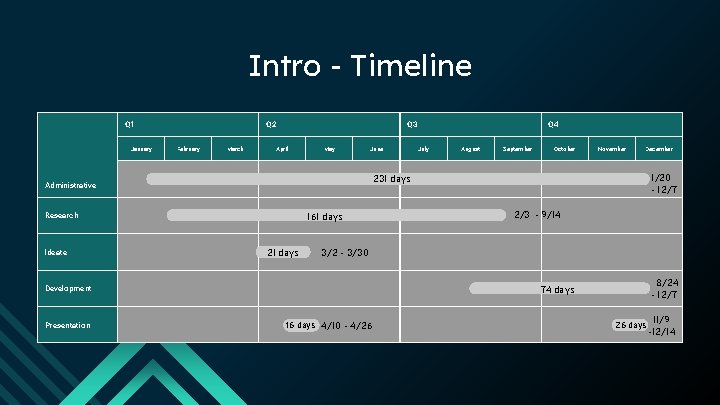
Intro - Timeline January Q 1 Week of the LOR January 13 th February Q 2 Week of the IPS February 20 th Week of the DOL March 27 th Week of the LORApril 3 rd March Q 3 Week of the IPS May 10 th Week of the DOLJune 17 th Lorem ipsum Administrative 161 days 21 days DOL September LOR October IPS November DOL December 1/20 - 12/7 2/3 - 9/14 3/2 - 3/30 8/24 - 12/7 74 days Lorem ipsum Development Documentation/ Lorem ipsum Presentation presentation IPSAugust 231 days Lorem ipsum Research Lorem ipsum Ideate LORJuly April Q 4 16 days 4/10 - 4/26 26 days 11/9 -12/14
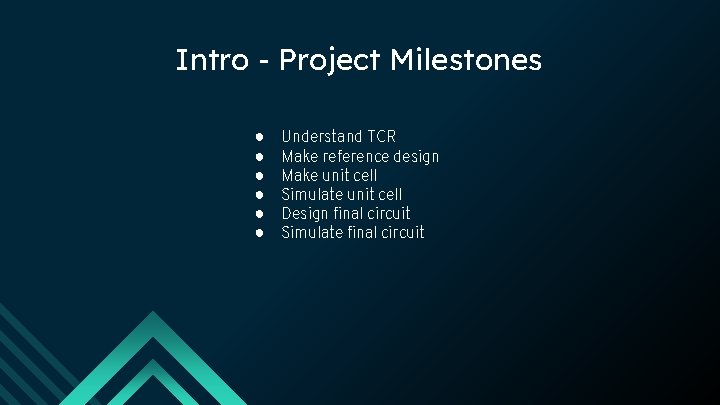
Intro - Project Milestones ● ● ● Understand TCR Make reference design Make unit cell Simulate unit cell Design final circuit Simulate final circuit

Overview ● ● ● Intro Initial Research Proposed Approaches Testing Technical Difficulties Conclusion
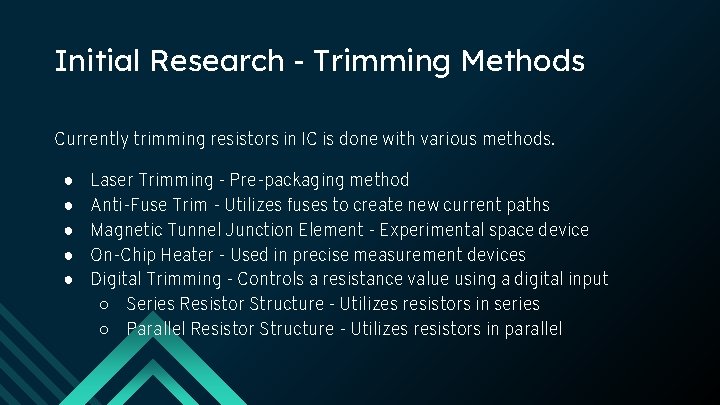
Initial Research - Trimming Methods Currently trimming resistors in IC is done with various methods. ● ● ● Laser Trimming - Pre-packaging method Anti-Fuse Trim - Utilizes fuses to create new current paths Magnetic Tunnel Junction Element - Experimental space device On-Chip Heater - Used in precise measurement devices Digital Trimming - Controls a resistance value using a digital input ○ Series Resistor Structure - Utilizes resistors in series ○ Parallel Resistor Structure - Utilizes resistors in parallel
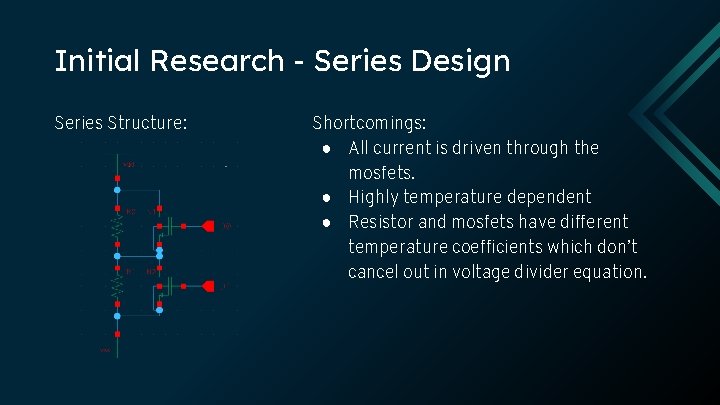
Initial Research - Series Design Series Structure: Shortcomings: ● All current is driven through the mosfets. ● Highly temperature dependent ● Resistor and mosfets have different temperature coefficients which don’t cancel out in voltage divider equation.
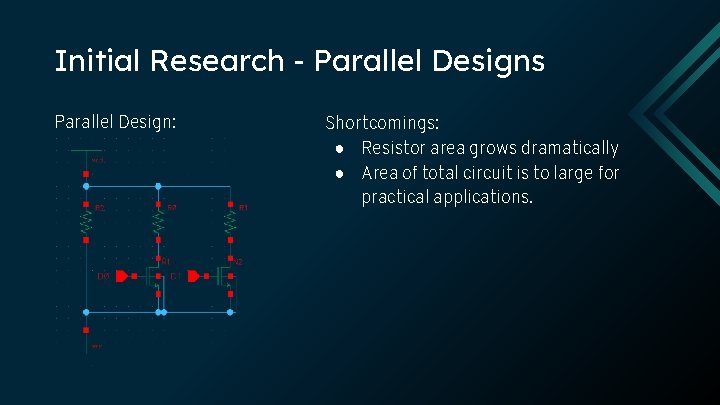
Initial Research - Parallel Designs Parallel Design: Shortcomings: ● Resistor area grows dramatically ● Area of total circuit is to large for practical applications.
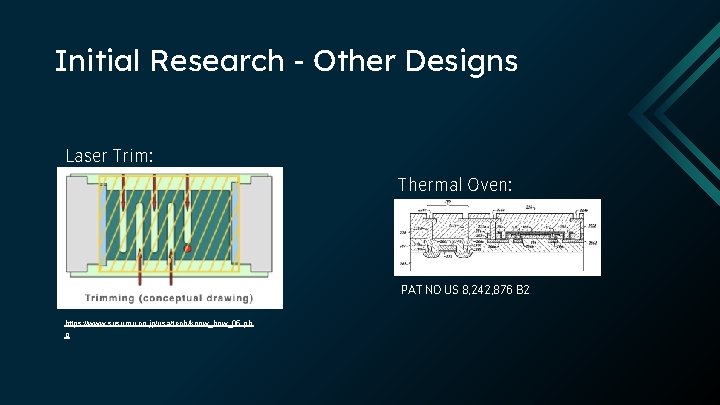
Initial Research - Other Designs Laser Trim: Thermal Oven: PAT NO US 8, 242, 876 B 2 https: //www. susumu. co. jp/usa/tech/know_how_05. ph p

Overview ● ● ● Intro Initial Research Proposed Approaches Testing Technical Difficulties Conclusion

Proposed Approaches - Ladder Design Ladder Structure: Theory: ● Combination of Series and parallel structure. Might hold promising results? ● Shortcomings of the designs individually won’t be as prominent?

Proposed Approaches - Matrix Designs Matrix Structure: Theory: ● Most adaptable and configurable ● Possibly is a larger area due to a lot of switches ● Resistors could be all one size
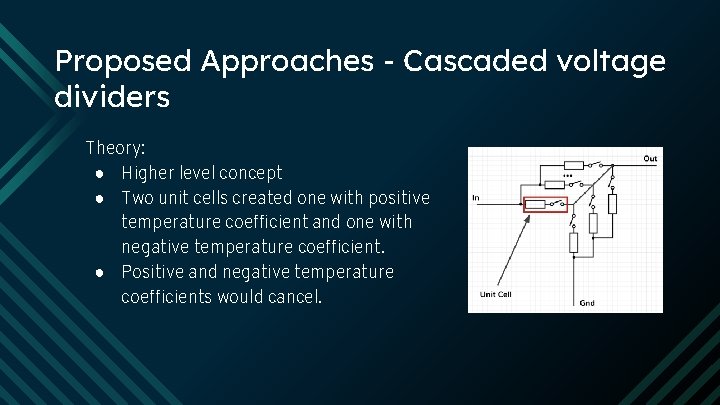
Proposed Approaches - Cascaded voltage dividers Theory: ● Higher level concept ● Two unit cells created one with positive temperature coefficient and one with negative temperature coefficient. ● Positive and negative temperature coefficients would cancel.
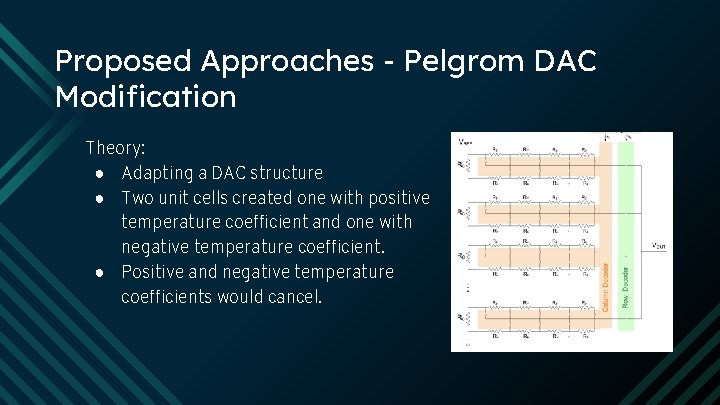
Proposed Approaches - Pelgrom DAC Modification Theory: ● Adapting a DAC structure ● Two unit cells created one with positive temperature coefficient and one with negative temperature coefficient. ● Positive and negative temperature coefficients would cancel.

Overview ● ● ● Intro Initial Research Proposed Approaches Testing Technical Difficulties Conclusion
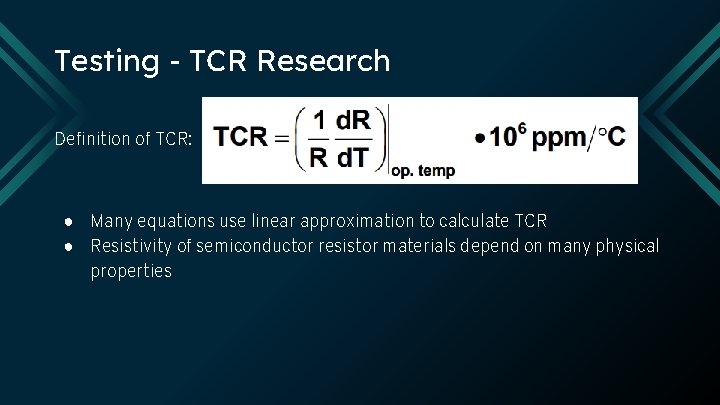
Testing - TCR Research Definition of TCR: ● Many equations use linear approximation to calculate TCR ● Resistivity of semiconductor resistor materials depend on many physical properties
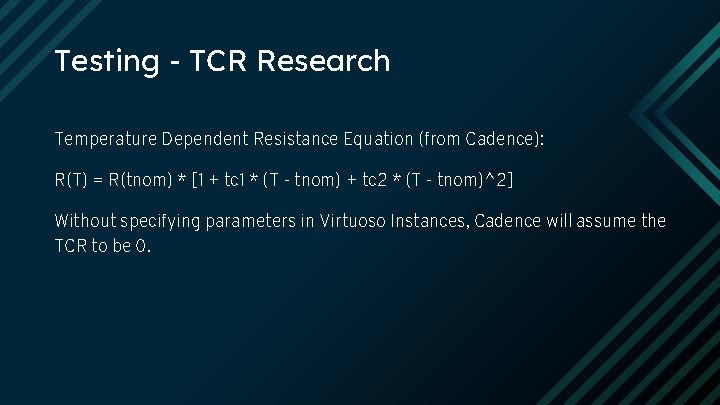
Testing - TCR Research Temperature Dependent Resistance Equation (from Cadence): R(T) = R(tnom) * [1 + tc 1 * (T - tnom) + tc 2 * (T - tnom)^2] Without specifying parameters in Virtuoso Instances, Cadence will assume the TCR to be 0.

Testing - TCR Research Tested TCR for different Energy barrier levels for a p+ polysilicon resistor: °Kelvin
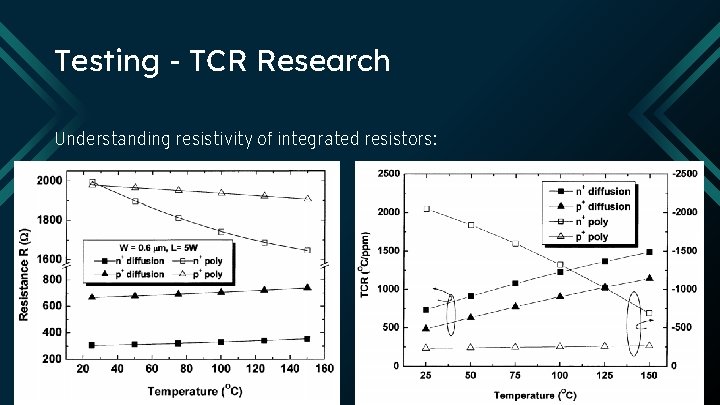
Testing - TCR Research Understanding resistivity of integrated resistors:
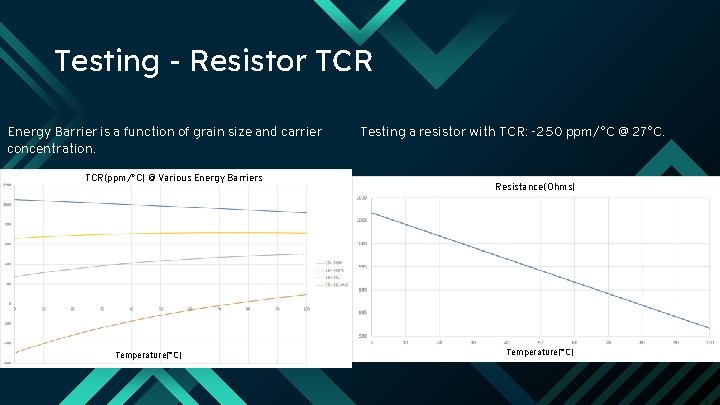
Testing - Resistor TCR Energy Barrier is a function of grain size and carrier concentration. TCR(ppm/°C) @ Various Energy Barriers Temperature(°C) Testing a resistor with TCR: -250 ppm/°C @ 27°C. Resistance(Ohms) Temperature(°C)
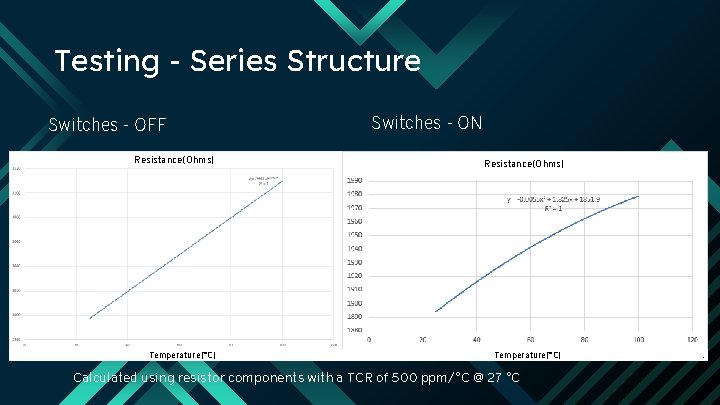
Testing - Series Structure Switches - OFF Resistance(Ohms) Temperature(°C) Switches - ON Resistance(Ohms) Temperature(°C) Calculated using resistor components with a TCR of 500 ppm/°C @ 27 °C .
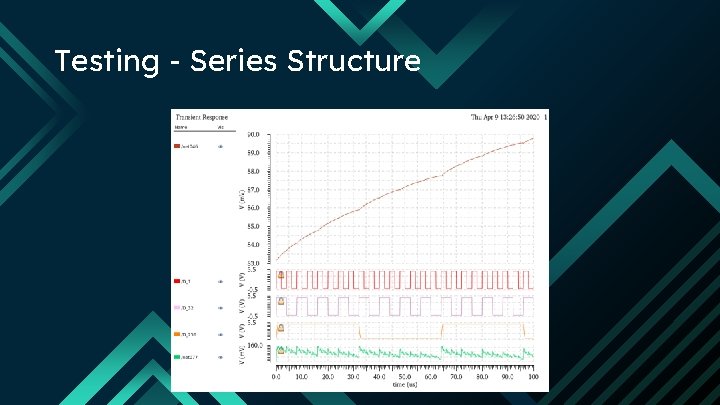
Testing - Series Structure

Testing - Ladder Design
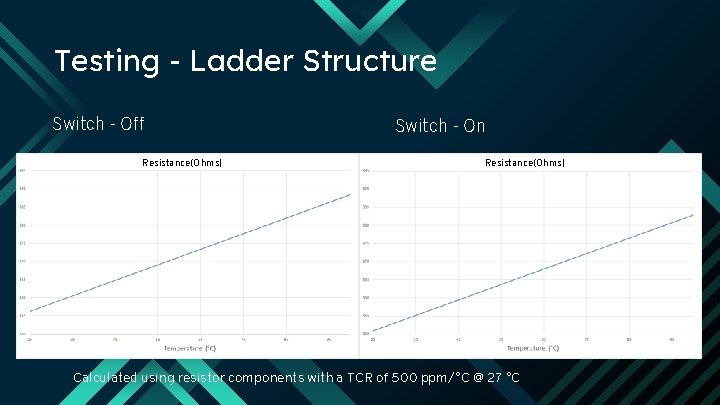
Testing - Ladder Structure Switch - Off Resistance(Ohms) Switch - On Resistance(Ohms) Calculated using resistor components with a TCR of 500 ppm/°C @ 27 °C

Overview ● ● ● Intro Initial Research Proposed Approaches Testing Technical Difficulties Conclusion

Technical Difficulties Technical issues we’ve encountered so far: ● ● ● Website accidentally got corrupted Lack of knowledge on going virtual Collaboration difficulties Connectivity difficulties Virtuoso issues Lack of OS knowledge (Linux)

Technical Difficulties continued

Technical Difficulties continued

Technical Difficulties continued Google Meet

Overview ● ● ● Intro Initial Research Proposed Approaches Testing Technical Difficulties Conclusion
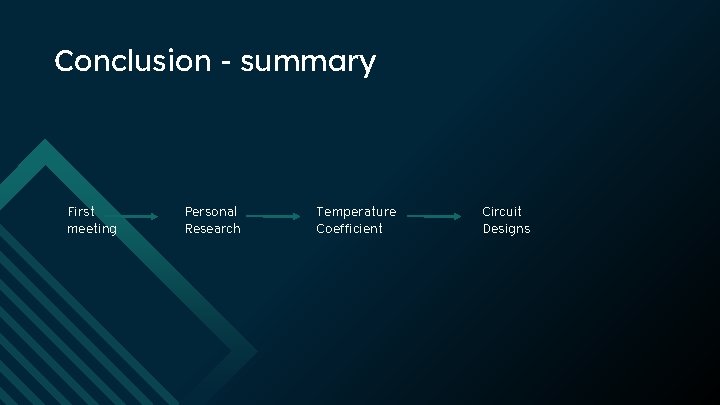
Conclusion - summary First meeting Personal Research Temperature Coefficient Circuit Designs
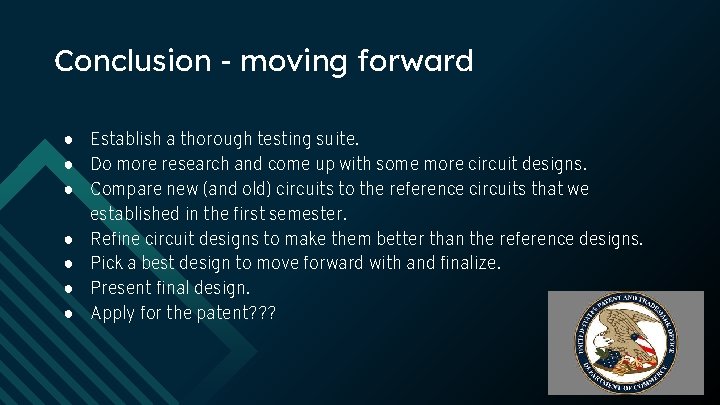
Conclusion - moving forward ● Establish a thorough testing suite. ● Do more research and come up with some more circuit designs. ● Compare new (and old) circuits to the reference circuits that we established in the first semester. ● Refine circuit designs to make them better than the reference designs. ● Pick a best design to move forward with and finalize. ● Present final design. ● Apply for the patent? ? ?

This concludes our presentation for the first semester of senior design. A big thanks to professor Geiger for all of his advising throughout the semester. Also, thanks to Pallavi-Sugantha for her assistance with some Virtuoso questions. Thanks for listening! CREDITS: This presentation template was created by Slidesgo, including icons by Flaticon, and infographics & images by Freepik. Please keep this slide for attribution.
- Slides: 36