
High Resolution Depth Profiling Using MEIS Andrew Rossall


- Slides: 18
High Resolution Depth Profiling Using MEIS Andrew Rossall and Jaap van den Berg International Institute for Accelerator Applications University of Huddersfield The 5 th Huddersfield Annual Accelerator Symposium 21 st April 2017
Outline • • • Experimental set-up for Medium Energy Ion Scattering (MEIS) Analysing the spectrum Simulating the spectrum Recent projects using MEIS: • As 3/H 2 plasma doping (PLAD) of silicon – in collaboration with Jon England – AMAT - Process of PLAD - Wet cleaning and annealing - Substitutional dose and surface resistivity • Metal-Insulator-Metal Capacitors (MIMcap) – in collaboration with Imec, Leuven - DRAM structures - Surface segregation - Interdiffusion of layers • Cu photocathode preparation for VELA – in collaboration with Tim Noakes, Daresbury - Effect of oxygen cleaning and annealing • 3 D Analysis of Au-Core Silica-Shell Nanoparticles – in collaboration with MFA, Hungary - Use MEIS to examine the effect of ion irradiation on nanoparticles • La. Sr. Mn. O 3 (LSMO) epitaxy on Sr. Ti. O 3 (STO) – in collaboration with Steve Tear et al. University of York
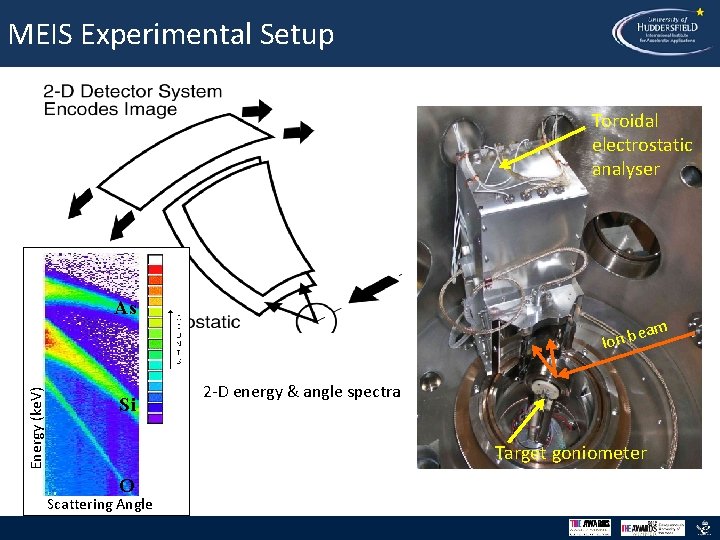
MEIS Experimental Setup Toroidal electrostatic analyser As eam Energy (ke. V) Ion b Si 2 -D energy & angle spectra Target goniometer O Scattering Angle
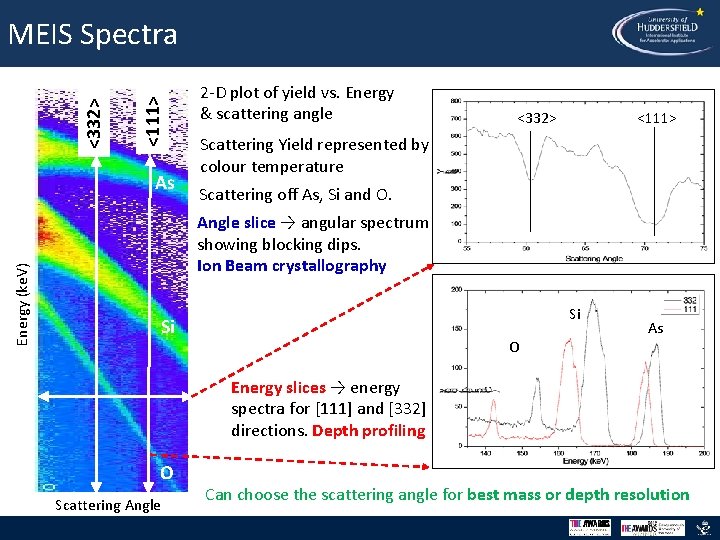
<111> <332> MEIS Spectra Energy (ke. V) As 2 -D plot of yield vs. Energy & scattering angle <332> <111> Scattering Yield represented by colour temperature Scattering off As, Si and O. Angle slice → angular spectrum showing blocking dips. Ion Beam crystallography Si Si O As Energy slices → energy spectra for [111] and [332] directions. Depth profiling O Scattering Angle Can choose the scattering angle for best mass or depth resolution
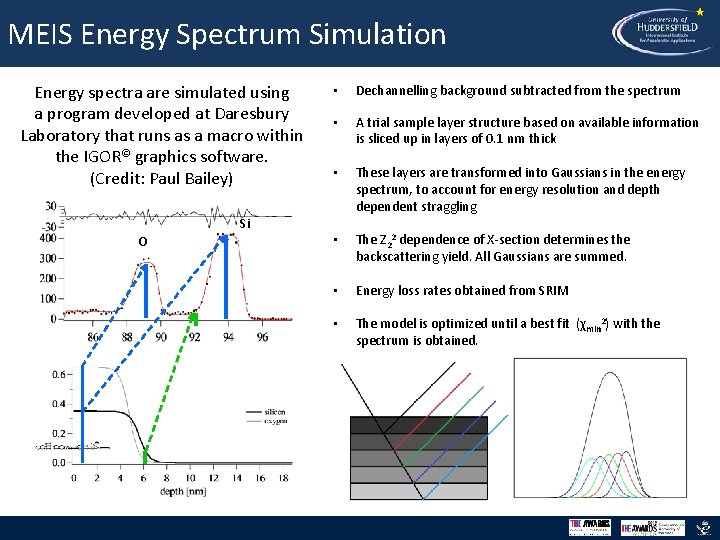
MEIS Energy Spectrum Simulation Energy spectra are simulated using a program developed at Daresbury Laboratory that runs as a macro within the IGOR© graphics software. (Credit: Paul Bailey) Si O • Dechannelling background subtracted from the spectrum • A trial sample layer structure based on available information is sliced up in layers of 0. 1 nm thick • These layers are transformed into Gaussians in the energy spectrum, to account for energy resolution and depth dependent straggling • The Z 22 dependence of X-section determines the backscattering yield. All Gaussians are summed. • Energy loss rates obtained from SRIM • The model is optimized until a best fit (χmin 2) with the spectrum is obtained.
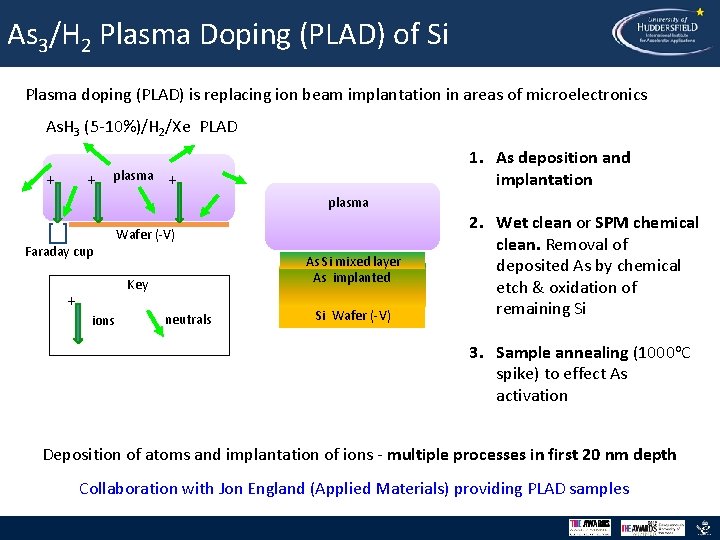
As 3/H 2 Plasma Doping (PLAD) of Si Plasma doping (PLAD) is replacing ion beam implantation in areas of microelectronics As. H 3 (5 -10%)/H 2/Xe PLAD + + plasma 1. As deposition and implantation + plasma Faraday cup Wafer (-V) As Si mixed layer As implanted Key + ions neutrals Si Wafer (-V) 2. Wet clean or SPM chemical clean. Removal of deposited As by chemical etch & oxidation of remaining Si 3. Sample annealing (1000 o. C spike) to effect As activation Deposition of atoms and implantation of ions - multiple processes in first 20 nm depth Collaboration with Jon England (Applied Materials) providing PLAD samples
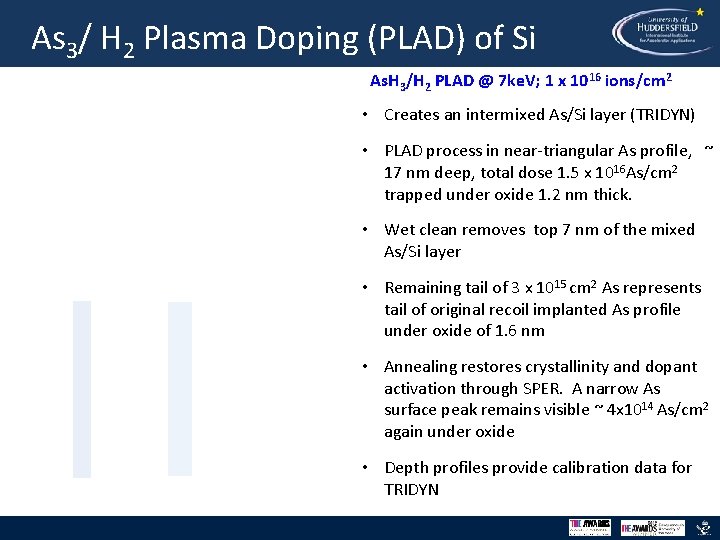
As 3/ H 2 Plasma Doping (PLAD) of Si As. H 3/H 2 PLAD @ 7 ke. V; 1 x 10¹⁶ ions/cm 2 • Creates an intermixed As/Si layer (TRIDYN) • PLAD process in near-triangular As profile, ~ 17 nm deep, total dose 1. 5 x 10¹⁶ As/cm 2 trapped under oxide 1. 2 nm thick. • Wet clean removes top 7 nm of the mixed As/Si layer • Remaining tail of 3 x 1015 cm 2 As represents tail of original recoil implanted As profile under oxide of 1. 6 nm • Annealing restores crystallinity and dopant activation through SPER. A narrow As surface peak remains visible ~ 4 x 10¹⁴ As/cm 2 again under oxide • Depth profiles provide calibration data for TRIDYN
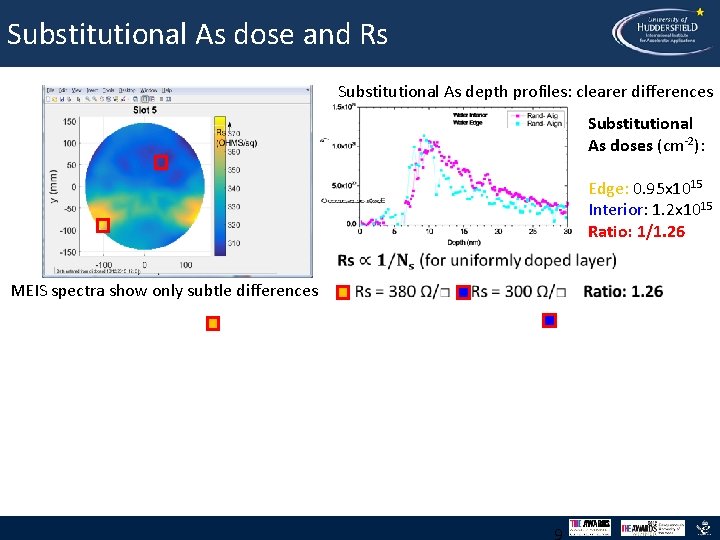
Substitutional As dose and Rs Substitutional As depth profiles: clearer differences Substitutional As doses (cm-2): Edge: 0. 95 x 1015 Interior: 1. 2 x 10¹⁵ Ratio: 1/1. 26 MEIS spectra show only subtle differences 9
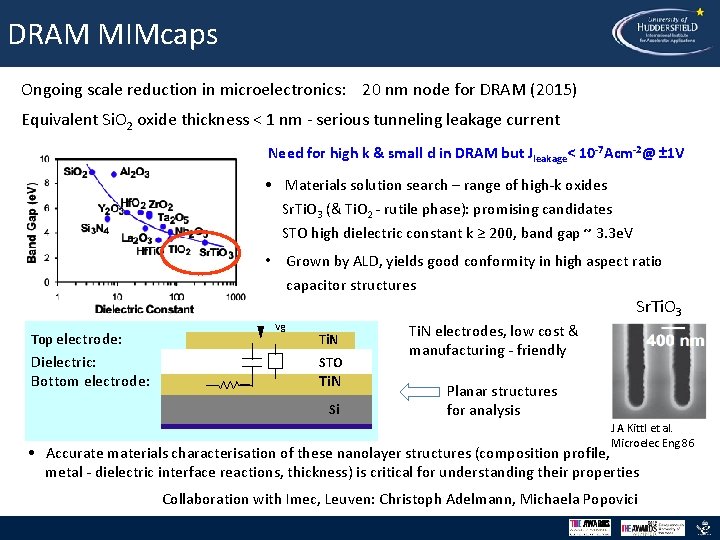
DRAM MIMcaps Ongoing scale reduction in microelectronics: 20 nm node for DRAM (2015) Equivalent Si. O 2 oxide thickness < 1 nm - serious tunneling leakage current Need for high k & small d in DRAM but Jleakage< 10 -7 Acm-2@ ± 1 V • Materials solution search – range of high-k oxides Sr. Ti. O 3 (& Ti. O 2 - rutile phase): promising candidates STO high dielectric constant k ≥ 200, band gap ~ 3. 3 e. V • Grown by ALD, yields good conformity in high aspect ratio capacitor structures Sr. Ti. O 3 Vg Top electrode: Dielectric: Bottom electrode: Ti. N STO Ti. N Si Si Ti. N electrodes, low cost & manufacturing - friendly Planar structures for analysis J A Kittl et al. Microelec Eng 86 • Accurate materials characterisation of these nanolayer structures (composition profile, metal - dielectric interface reactions, thickness) is critical for understanding their properties Collaboration with Imec, Leuven: Christoph Adelmann, Michaela Popovici
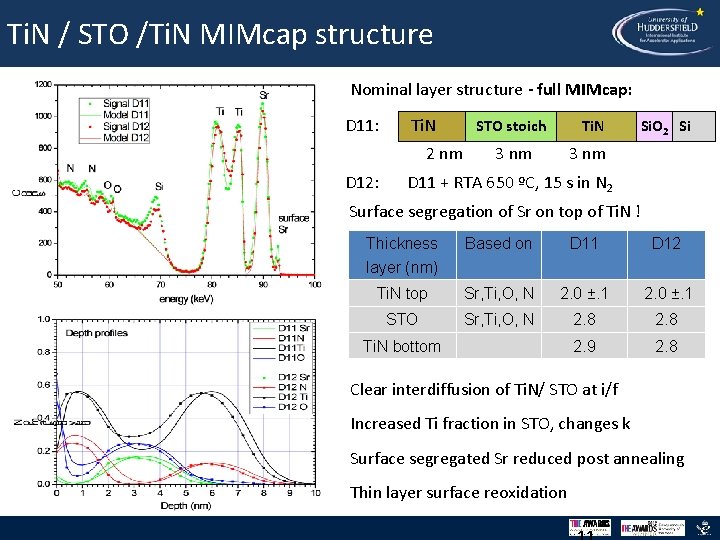
Ti. N / STO /Ti. N MIMcap structure Nominal layer structure - full MIMcap: D 11: Ti. N STO stoich Ti. N Si. O 2 Si 2 nm 3 nm D 12: D 11 + RTA 650 ºC, 15 s in N 2 Surface segregation of Sr on top of Ti. N ! Thickness layer (nm) Based on D 11 D 12 Ti. N top Sr, Ti, O, N 2. 0 ±. 1 STO Sr, Ti, O, N 2. 8 2. 9 2. 8 Ti. N bottom Clear interdiffusion of Ti. N/ STO at i/f Increased Ti fraction in STO, changes k Surface segregated Sr reduced post annealing Thin layer surface reoxidation
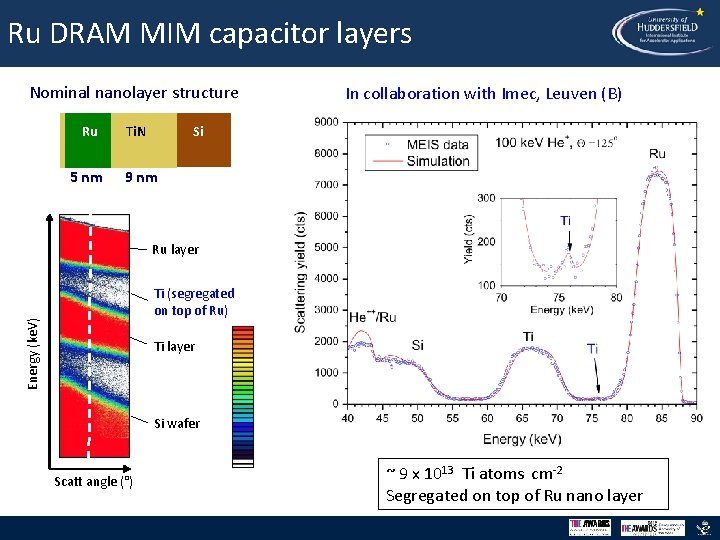
Ru DRAM MIM capacitor layers Nominal nanolayer structure Ru 5 nm Ti. N In collaboration with Imec, Leuven (B) Si 9 nm Ru layer Energy (ke. V) Ti (segregated on top of Ru) Ti layer Si wafer Scatt angle (°) ~ 9 x 10¹³ Ti atoms cm-2 Segregated on top of Ru nano layer
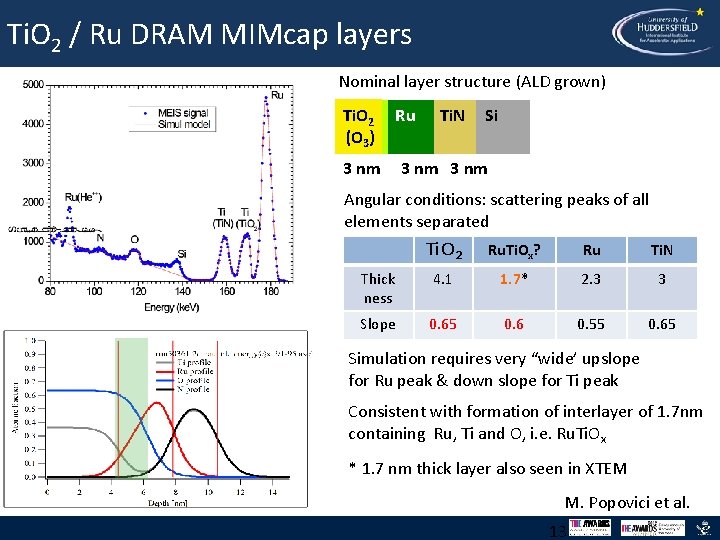
Ti. O 2 / Ru DRAM MIMcap layers Nominal layer structure (ALD grown) Ti. O 2 (O 3) Ru Ti. N Si 3 nm Angular conditions: scattering peaks of all elements separated Ti. O 2 Ru. Ti. Ox? Ru Ti. N Thick ness 4. 1 1. 7* 2. 3 3 Slope 0. 65 0. 6 0. 55 0. 65 Simulation requires very “wide’ upslope for Ru peak & down slope for Ti peak Consistent with formation of interlayer of 1. 7 nm containing Ru, Ti and O, i. e. Ru. Ti. Ox * 1. 7 nm thick layer also seen in XTEM M. Popovici et al. 13
VELA Cu Cathode Preparation Versatile Electron Linear Accelerator (VELA) In collaboration with Daresbury Laboratory (T. Noakes) Cu photocathode prepared by: • O 2 plasma cleaning • Removes hydrocarbons • Leaves a thin protective oxide layer • Heating to 250 °C (system bake) Schematic of plasma cleaner VELA Specifications • Beam energy: 4. 0 – 5. 5 Me. V • Bunch charge: 10 – 250 p. C • Bunch length (s t, rms): 80 – 3 ps • Normalised emittance: 0. 1 – 2. 0 mm • Beam size (s x, y, rms): 0. 1 – 3. 5 mm • Energy spread (s e, rms): 0. 1 – 5 % • Bunch repetition rate: 1 – 10 Hz Poor detailed understanding of the changes in composition and thickness of the oxide film in this preparation process
Preparation procedure 15
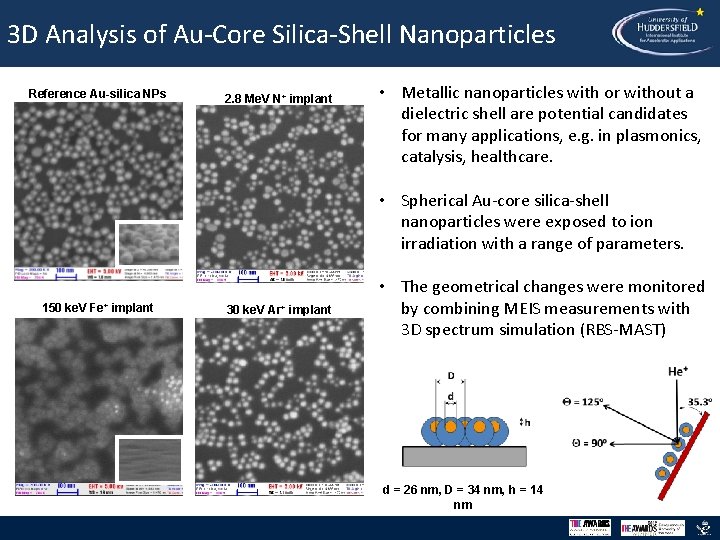
3 D Analysis of Au-Core Silica-Shell Nanoparticles Reference Au-silica NPs 2. 8 Me. V N+ implant • Metallic nanoparticles with or without a dielectric shell are potential candidates for many applications, e. g. in plasmonics, catalysis, healthcare. • Spherical Au-core silica-shell nanoparticles were exposed to ion irradiation with a range of parameters. 150 ke. V Fe+ implant 30 ke. V Ar+ implant • The geometrical changes were monitored by combining MEIS measurements with 3 D spectrum simulation (RBS-MAST) d = 26 nm, D = 34 nm, h = 14 nm
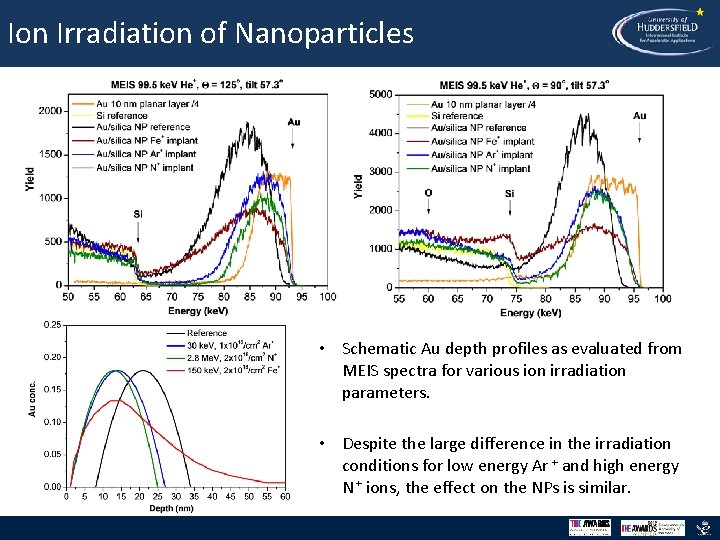
Ion Irradiation of Nanoparticles • Schematic Au depth profiles as evaluated from MEIS spectra for various ion irradiation parameters. • Despite the large difference in the irradiation conditions for low energy Ar + and high energy N + ions, the effect on the NPs is similar.
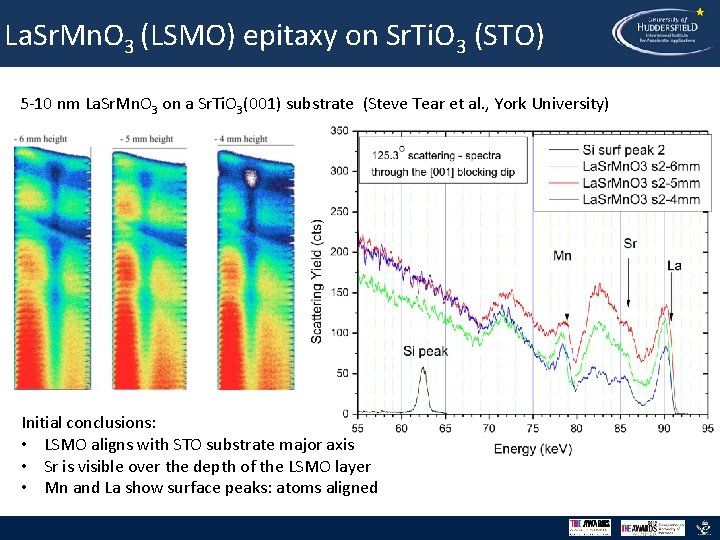
La. Sr. Mn. O 3 (LSMO) epitaxy on Sr. Ti. O 3 (STO) 5 -10 nm La. Sr. Mn. O 3 on a Sr. Ti. O 3(001) substrate (Steve Tear et al. , York University) Initial conclusions: • LSMO aligns with STO substrate major axis • Sr is visible over the depth of the LSMO layer • Mn and La show surface peaks: atoms aligned
Conclusions • MEIS enables the investigation of the surface structure and properties of crystalline materials as well as high resolution depth profiling of non-crystalline nanometre thin layers. • By analysing the energies and angles of He+ ions scattered off samples and comparing with computer simulation, a depth profile with sub nano-meter resolution is produced, enabling the analysis of layer structure, stoichiometry and interface abruptness. • Funded access to the Medium Energy Ion Scattering (MEIS) Facility is available to existing EPSRC grant holders, new applicants for EPSRC funding, EPSRC funded students and for pump-priming (10% of the available time) projects. • Please contact us for further information or to discuss a project: Prof. Jaap van den Berg - j. vandenberg@hud. ac. uk Dr. Andrew Rossall – a. rossall@hud. ac. uk