
High Resolution Array Detector Design of Infrasound Detection

- Slides: 28
High Resolution Array Detector Design of Infrasound Detection and Parameter Estimation Systems Hein Haak & Läslo Evers June-September 2003
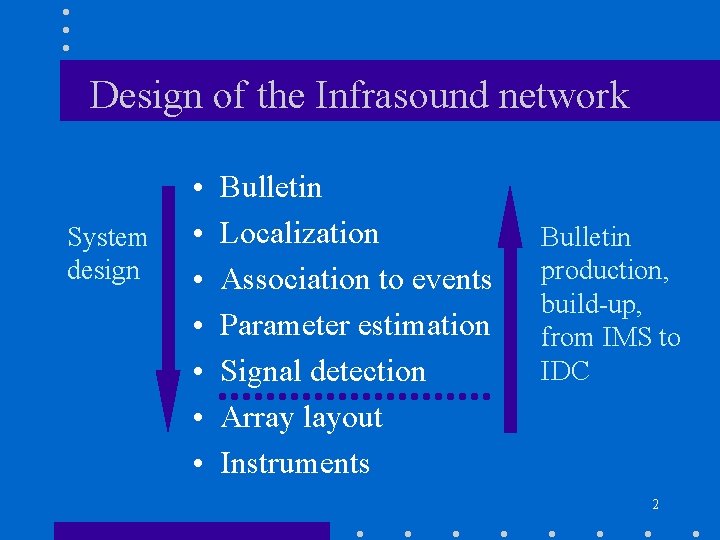
Design of the Infrasound network System design • • Bulletin Localization Association to events Parameter estimation Signal detection Array layout Instruments Bulletin production, build-up, from IMS to IDC 2
Detectors / Estimators • Several detectors available: • • F- detector PMCC, MCCM PWS phase-weighted stacks LTA/STA … * Generally the detailed descriptions of the detectors could be improved, clear determination of ROCs could be added, black boxes are undesirable, transparency is needed * What is the relation between detector and array design 3
Basic design considerations • Hardware is hard to adjust, software is more flexible • Frequency wave number analysis is the standard • High resolution methods (Capon) are less robust at low S/N • Coherency detectors are used: Fisher, correlation, semblance throughout the network of arrays • Small arrays, higher resolution, lower costs • Detection without some parameter extraction or estimation is meaningless 4
What is “Performance” • Low missed event and false alarm rates (detection part of the problem) • Event parameters with small error bars (estimation part of the problem) • Low investment and operation costs leading to small dimensions of the array (cost efficiency) 5
6
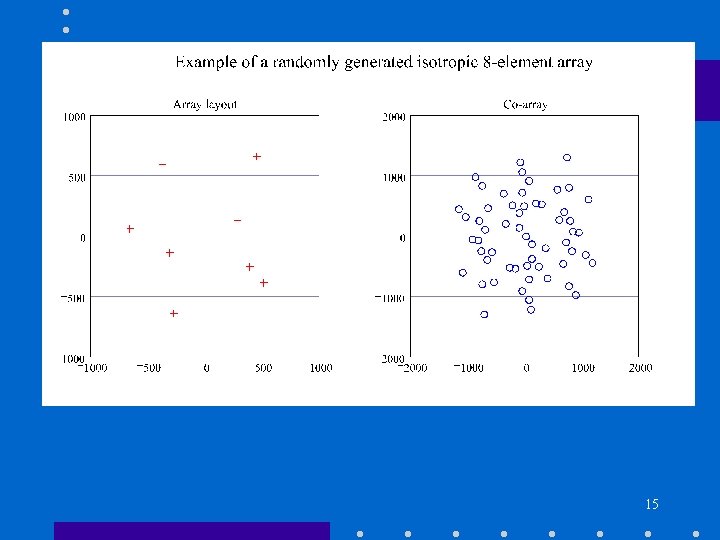
Practical array design (1) 1. Suppose an array of 8 elements is confined to a 100 grid, then the system has 2. 5 10 27 independent realizations • • • A year contains 31. 5 10 9 milliseconds Brute force array design is not realistic Even with only 50 independent positions there are 536, 878, 650 possible configurations 2. Alternative solutions are needed like genetic algorithms or Monte Carlo techniques 3. Only an approximate solution are possible 4. Symmetric approaches are generally not helpful 7
Practical array design (2) 1. If most of the array is fixed, for instance because of infrastructural circumstances additional elements can be placed strategically, to achieve a secondary optimum • With isotropic response • Angular resolution conform array diameter • Low side lobe amplitudes 8
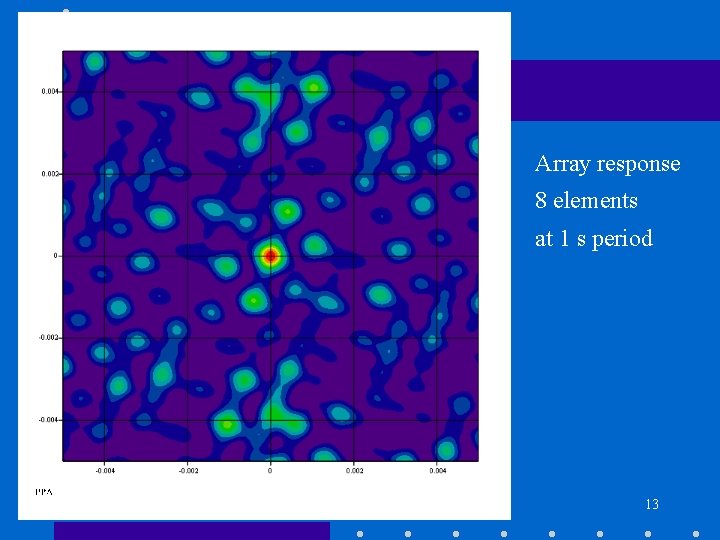
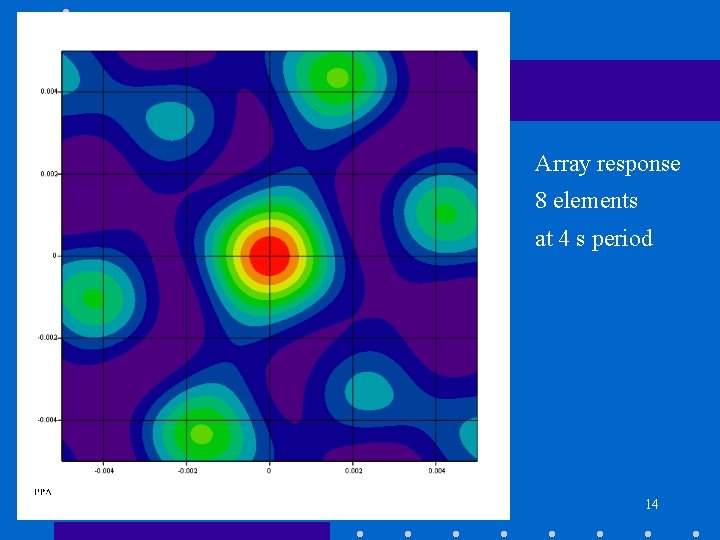
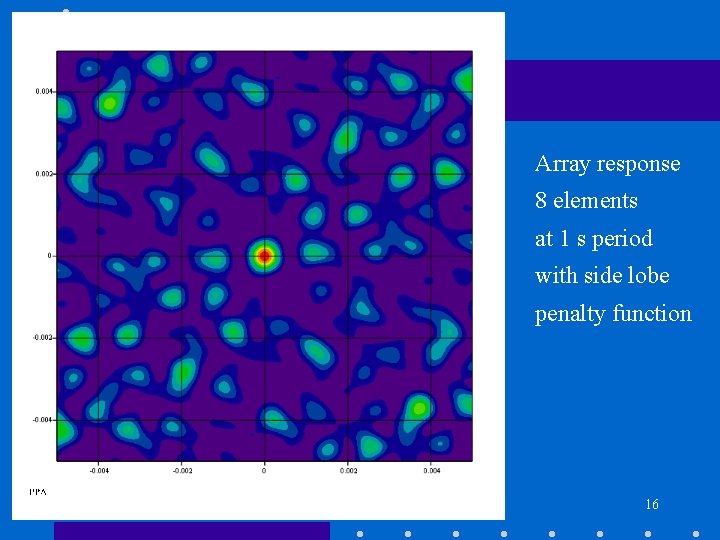
Side lobes reducers Side lobes can be reduced through: Hardware 1. Small diameter of the array 2. Many array elements 3. Optimal array design in detail Software 4. Broad frequency band in analysis 5. Use of Fisher statistics Conclusion: side lobes should not be a problem 9
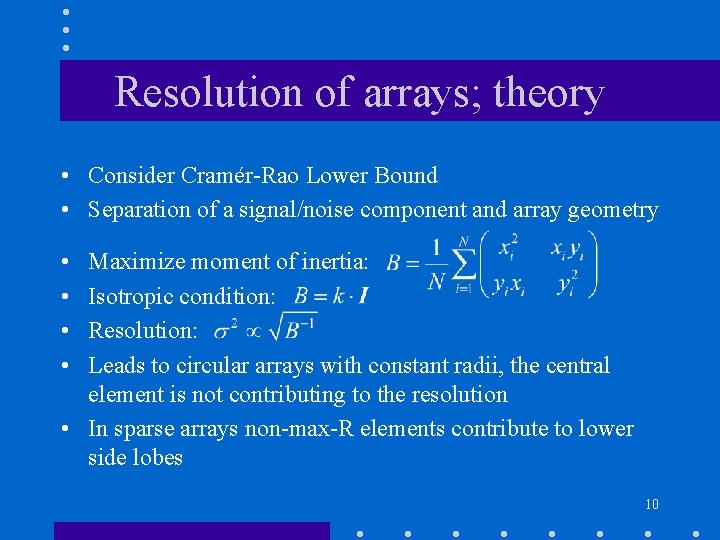
Resolution of arrays; theory • Consider Cramér-Rao Lower Bound • Separation of a signal/noise component and array geometry • • Maximize moment of inertia: Isotropic condition: Resolution: Leads to circular arrays with constant radii, the central element is not contributing to the resolution • In sparse arrays non-max-R elements contribute to lower side lobes 10
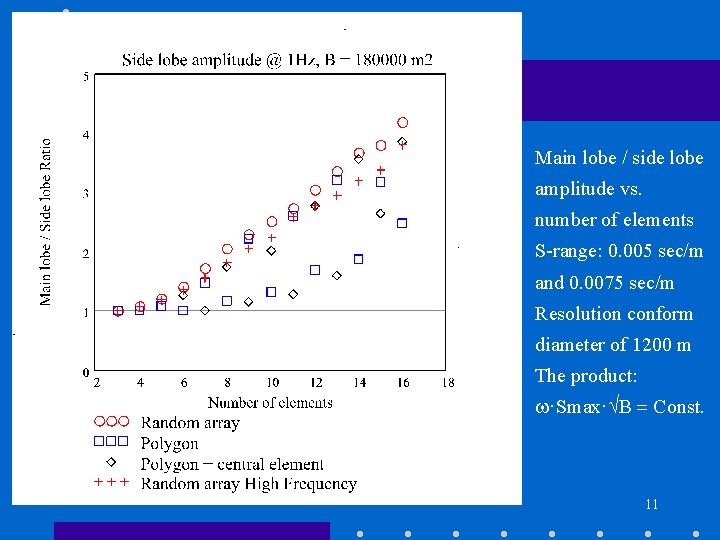
Main lobe / side lobe amplitude vs. number of elements S-range: 0. 005 sec/m and 0. 0075 sec/m Resolution conform diameter of 1200 m The product: w·Smax· B Const. 11
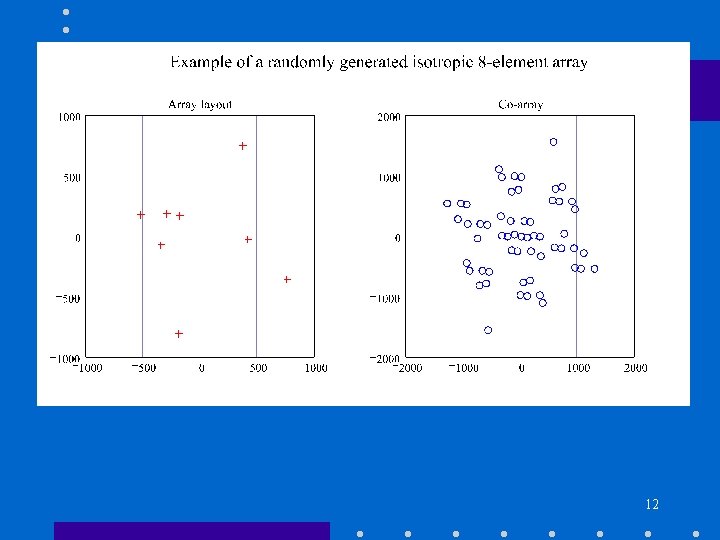
12
Array response 8 elements at 1 s period 13
Array response 8 elements at 4 s period 14
15
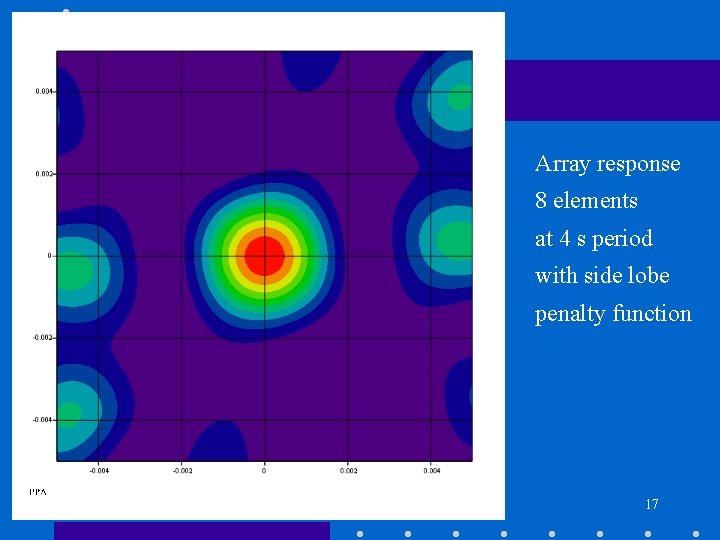
Array response 8 elements at 1 s period with side lobe penalty function 16
Array response 8 elements at 4 s period with side lobe penalty function 17
‘F’ • Calculation of the F-statistic from multiple time series Xct: 18
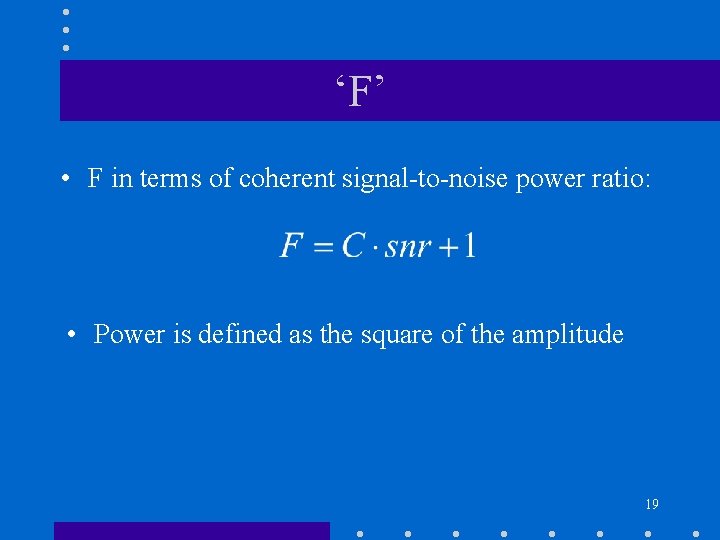
‘F’ • F in terms of coherent signal-to-noise power ratio: • Power is defined as the square of the amplitude 19
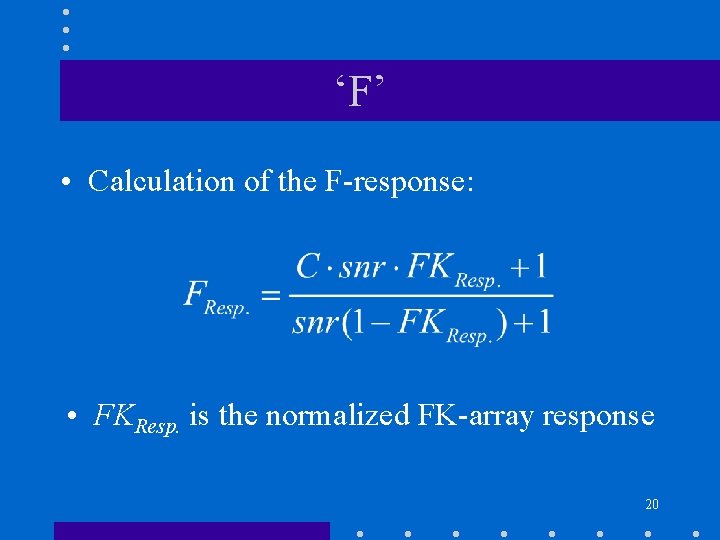
‘F’ • Calculation of the F-response: • FKResp. is the normalized FK-array response 20
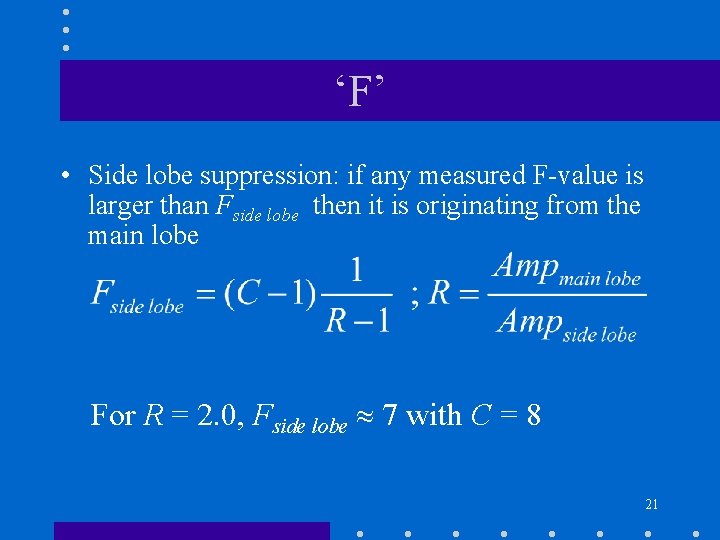
‘F’ • Side lobe suppression: if any measured F-value is larger than Fside lobe then it is originating from the main lobe For R = 2. 0, Fside lobe 7 with C = 8 21
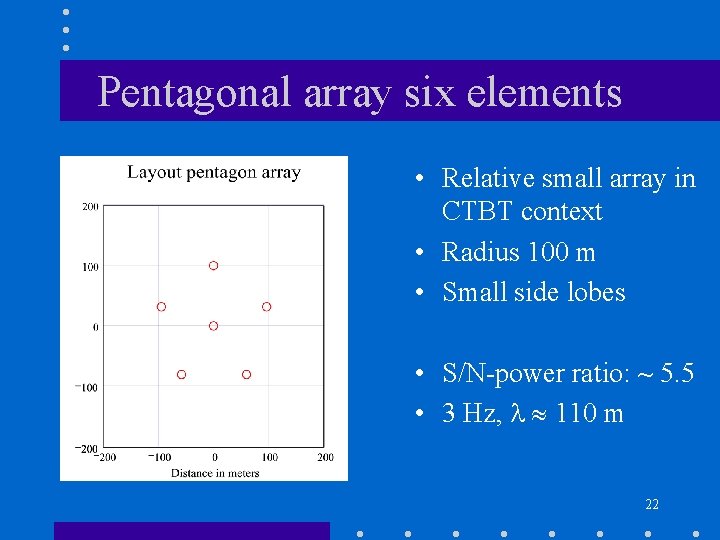
Pentagonal array six elements • Relative small array in CTBT context • Radius 100 m • Small side lobes • S/N-power ratio: ~ 5. 5 • 3 Hz, 110 m 22
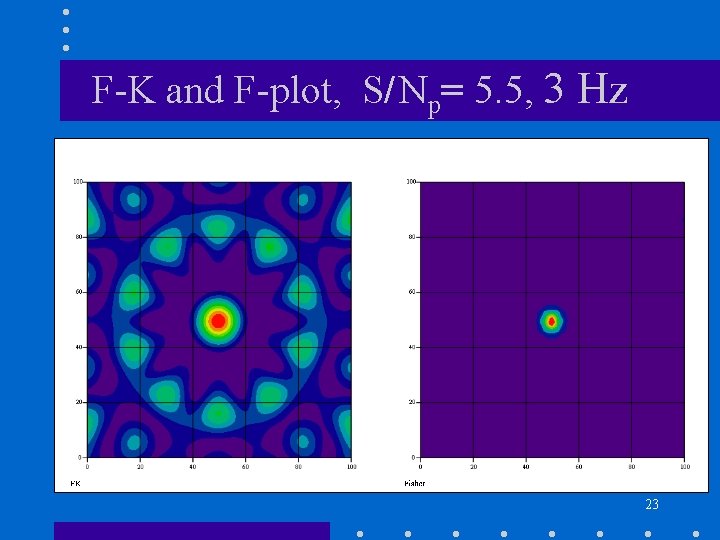
F-K and F-plot, S/ Np= 5. 5, 3 Hz 23
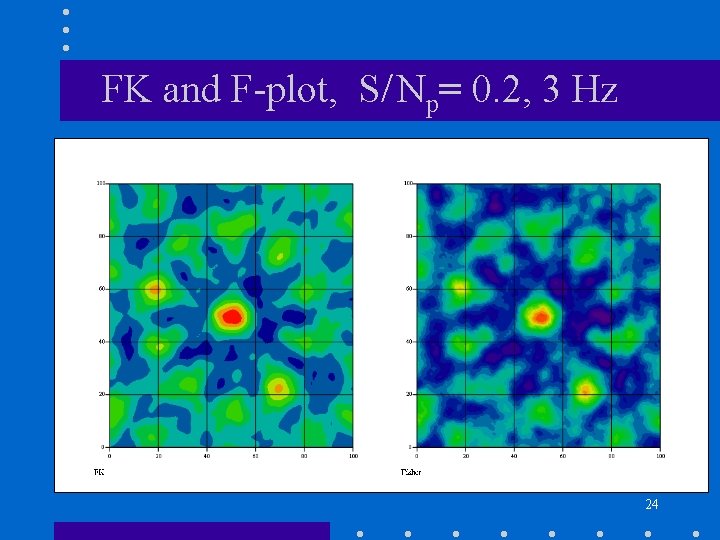
FK and F-plot, S/ Np= 0. 2, 3 Hz 24
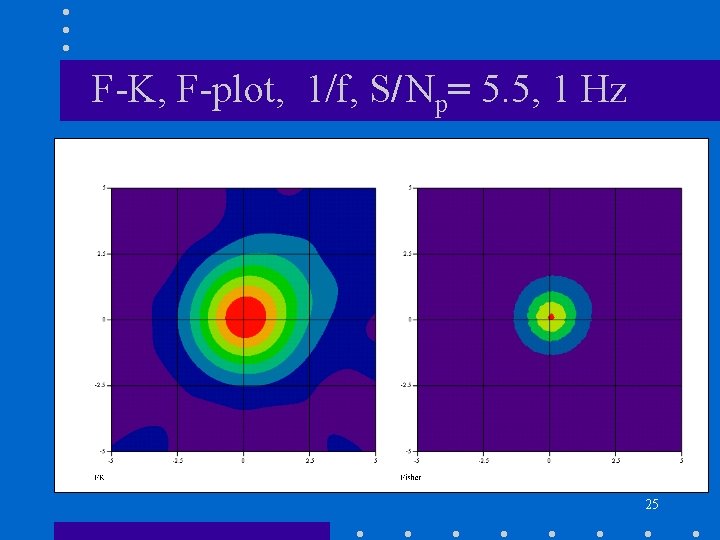
F-K, F-plot, 1/f, S/ Np= 5. 5, 1 Hz 25
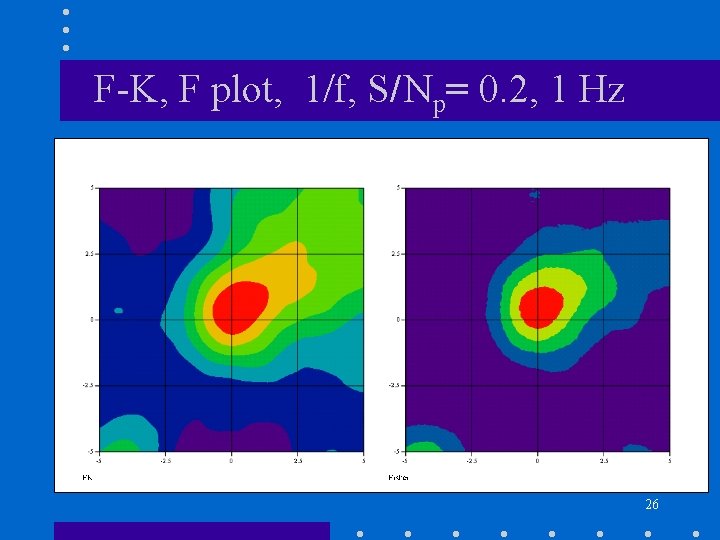
F-K, F plot, 1/f, S/ Np= 0. 2, 1 Hz 26
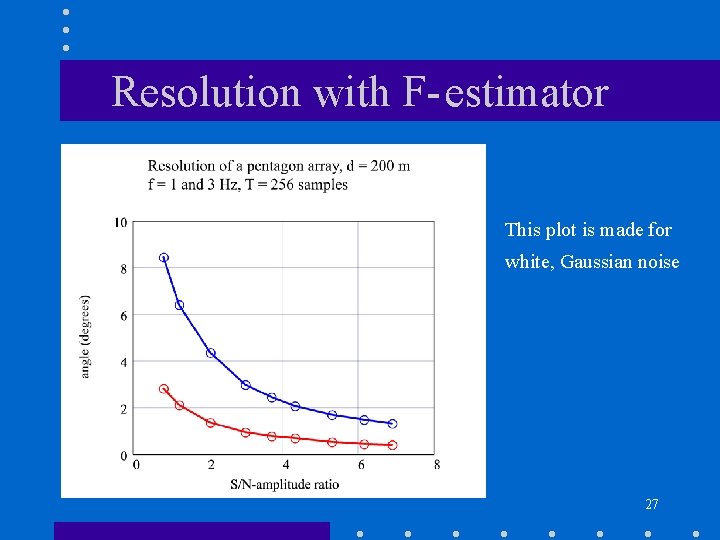
Resolution with F- estimator This plot is made for white, Gaussian noise 27
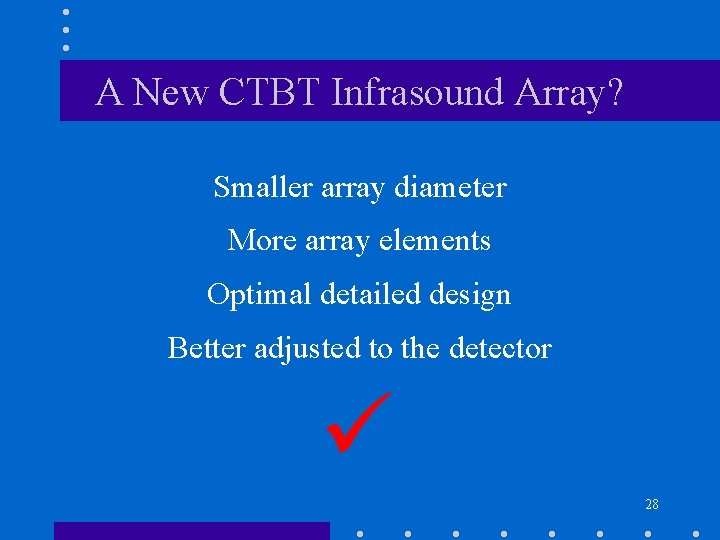
A New CTBT Infrasound Array? Smaller array diameter More array elements Optimal detailed design Better adjusted to the detector 28