
High resolution analysis DBT For the Hires group
High resolution analysis DBT For the Hires group Collab mtg, Nov ‘ 20 1 ADMX
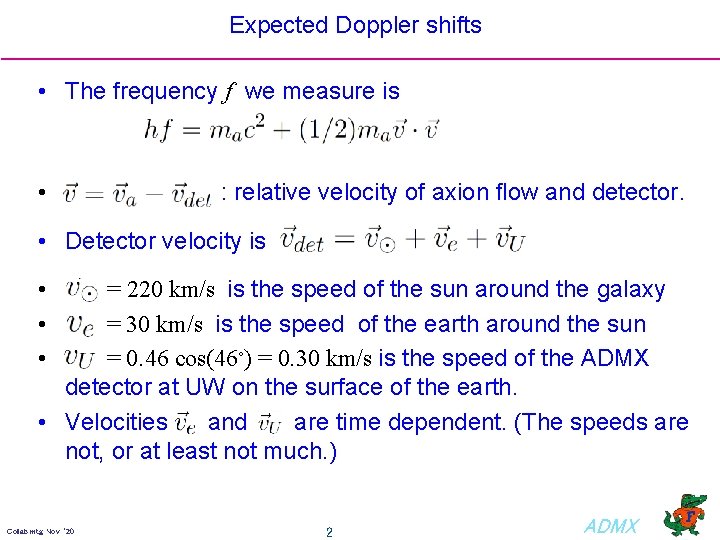
Expected Doppler shifts • The frequency f we measure is • : relative velocity of axion flow and detector. • Detector velocity is • • • = 220 km/s is the speed of the sun around the galaxy = 30 km/s is the speed of the earth around the sun = 0. 46 cos(46◦) = 0. 30 km/s is the speed of the ADMX detector at UW on the surface of the earth. • Velocities and are time dependent. (The speeds are not, or at least not much. ) Collab mtg, Nov ‘ 20 2 ADMX

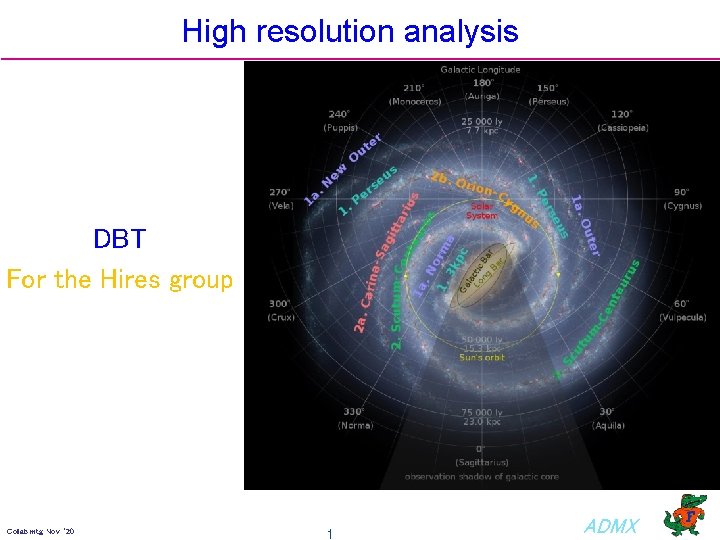
Galactic coordinates • Use global cylindrical coordinates rˆ, φˆ, zˆ for the galaxy. – rˆ axis goes from the center of the galaxy to ADMX. – φˆ along the velocity vector of the sun in the galaxy. – zˆ normal to the galaxy. • The sun is not in the plane and is heading away from it so there is a zˆ component to its velocity. The orbit is an ellipse so there is also a rˆ component to its velocity. I ignore both. Collab mtg, Nov ‘ 20 3 ADMX

Ecliptic plane • The ecliptic plane is inclined at 60◦ to the galactic plane. • 60◦ is the angle between the ecliptic normal nˆe and zˆ. • Simplest thing would be to have nˆe in the r-z or φ-z plane. • It appears that nˆe is mostly in the φ-z plane. I’ll take it as entirely in that plane Collab mtg, Nov ‘ 20 4 ADMX
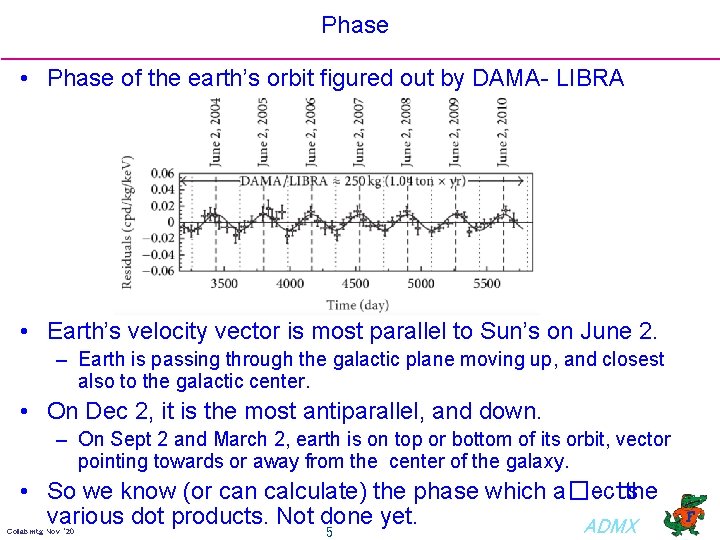
Phase • Phase of the earth’s orbit figured out by DAMA- LIBRA • Earth’s velocity vector is most parallel to Sun’s on June 2. – Earth is passing through the galactic plane moving up, and closest also to the galactic center. • On Dec 2, it is the most antiparallel, and down. – On Sept 2 and March 2, earth is on top or bottom of its orbit, vector pointing towards or away from the center of the galaxy. • So we know (or can calculate) the phase which a�ects the various dot products. Not done yet. ADMX 5 Collab mtg, Nov ‘ 20
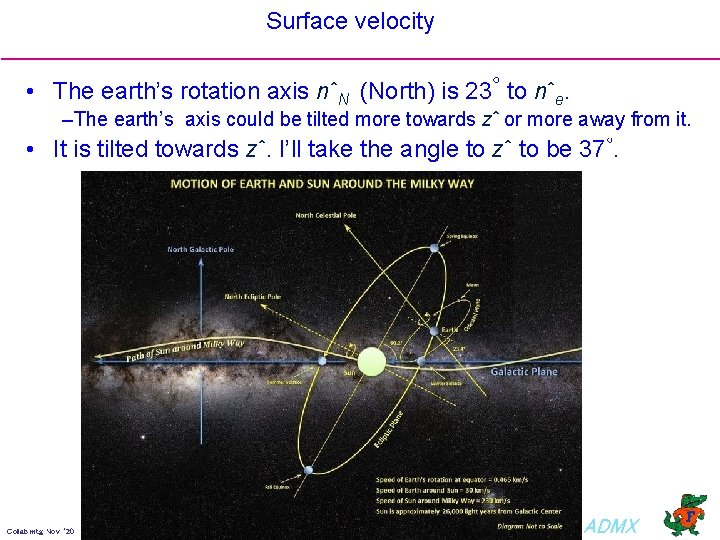
Surface velocity • The earth’s rotation axis nˆN (North) is 23◦ to nˆe. –The earth’s axis could be tilted more towards zˆ or more away from it. • It is tilted towards zˆ. I’ll take the angle to zˆ to be 37◦. Collab mtg, Nov ‘ 20 6 ADMX

Doppler shifts • I can calculate the Doppler shift from • • where I have discarded terms like The second term in braces is a constant, O(10− 6). The third term has velocities that are functions of the time. Then Collab mtg, Nov ‘ 20 7 ADMX
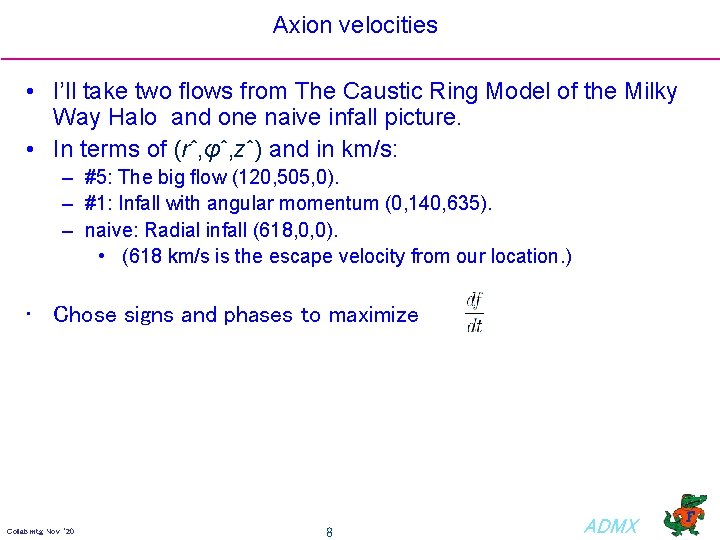
Axion velocities • I’ll take two flows from The Caustic Ring Model of the Milky Way Halo and one naive infall picture. • In terms of (rˆ, φˆ, zˆ) and in km/s: – #5: The big flow (120, 505, 0). – #1: Infall with angular momentum (0, 140, 635). – naive: Radial infall (618, 0, 0). • (618 km/s is the escape velocity from our location. ) • Chose signs and phases to maximize Collab mtg, Nov ‘ 20 8 ADMX
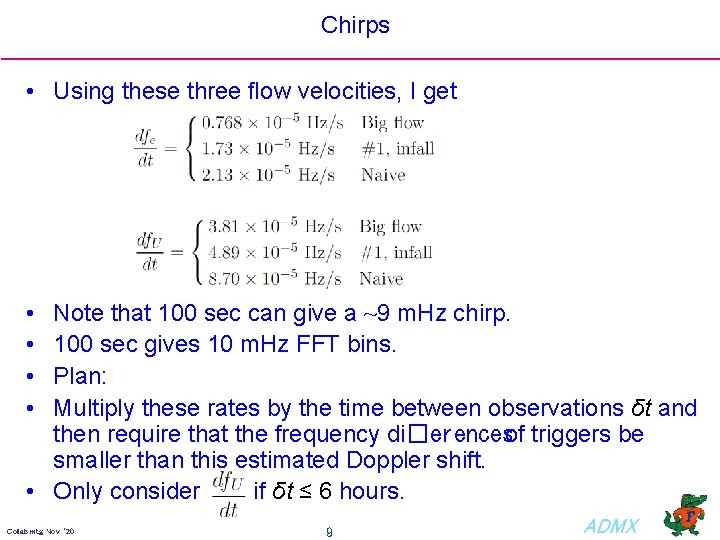
Chirps • Using these three flow velocities, I get • • Note that 100 sec can give a ~9 m. Hz chirp. 100 sec gives 10 m. Hz FFT bins. Plan: Multiply these rates by the time between observations δt and then require that the frequency di�erencesof triggers be smaller than this estimated Doppler shift. • Only consider if δt ≤ 6 hours. Collab mtg, Nov ‘ 20 9 ADMX
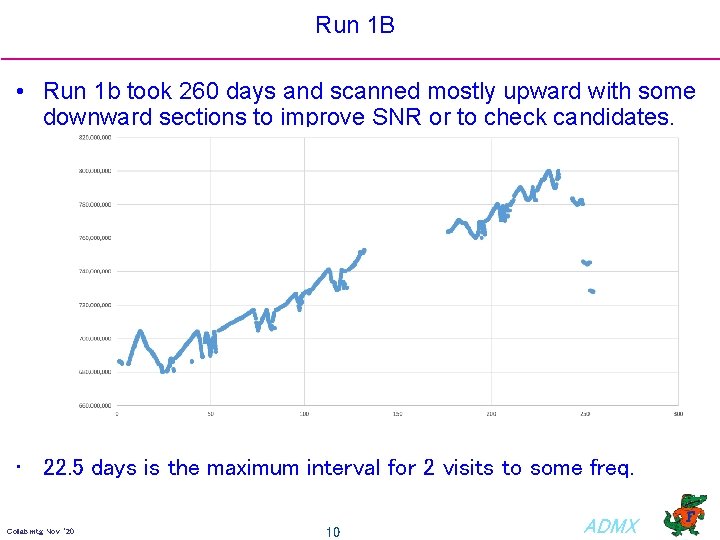
Run 1 B • Run 1 b took 260 days and scanned mostly upward with some downward sections to improve SNR or to check candidates. • 22. 5 days is the maximum interval for 2 visits to some freq. Collab mtg, Nov ‘ 20 10 ADMX
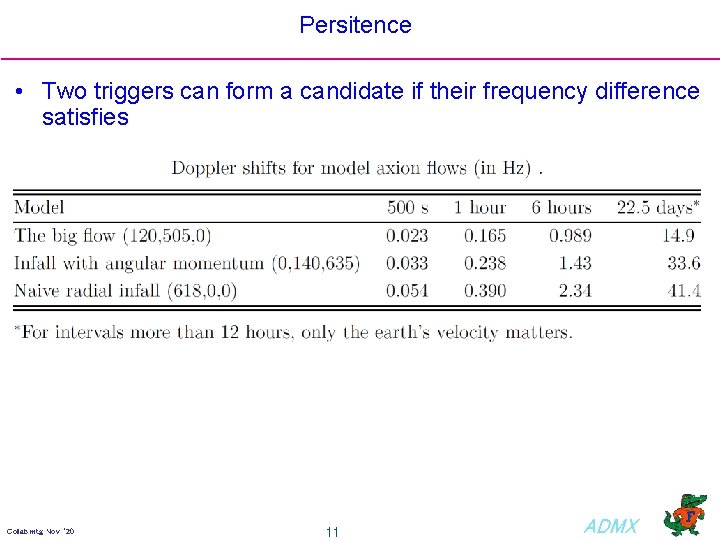
Persitence • Two triggers can form a candidate if their frequency difference satisfies Collab mtg, Nov ‘ 20 11 ADMX
THE END Collab mtg, Nov ‘ 20 12 ADMX
- Slides: 12