
High rates of nonreactive HIV serology after antiretroviral
- Slides: 12
High rates of non-reactive HIV serology after antiretroviral treatment initiated in acute HIV infection J. L. K. Fletcher, S. Pinyakorn, M. de Souza, S. Akapirat, R. Trichavaroj, T. Pankam, E. Kroon, D. Colby, P. Prueksakaew, D. Suttichom, J. H. Kim, P. Phanuphak, N. Phanuphak, J. Ananworanich, The SEARCH 010/RV 254 Study Group IAS 2015, Abstract WEAB 0102
Conflicts � None to declare
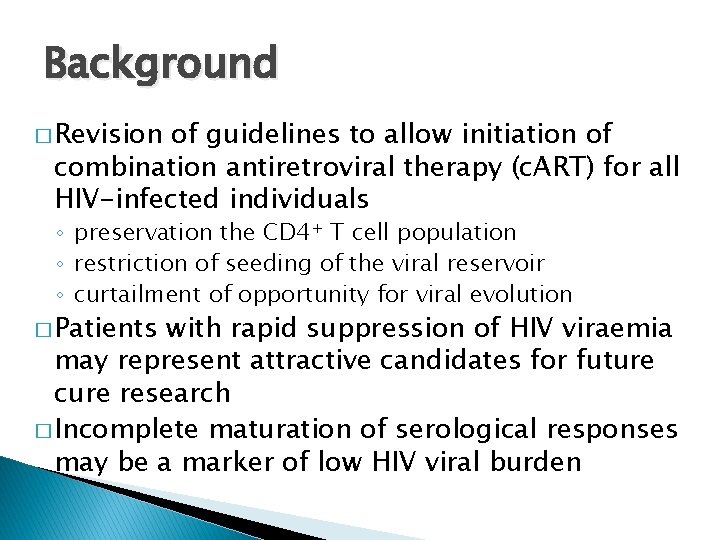
Background � Revision of guidelines to allow initiation of combination antiretroviral therapy (c. ART) for all HIV-infected individuals ◦ preservation the CD 4+ T cell population ◦ restriction of seeding of the viral reservoir ◦ curtailment of opportunity for viral evolution � Patients with rapid suppression of HIV viraemia may represent attractive candidates for future cure research � Incomplete maturation of serological responses may be a marker of low HIV viral burden
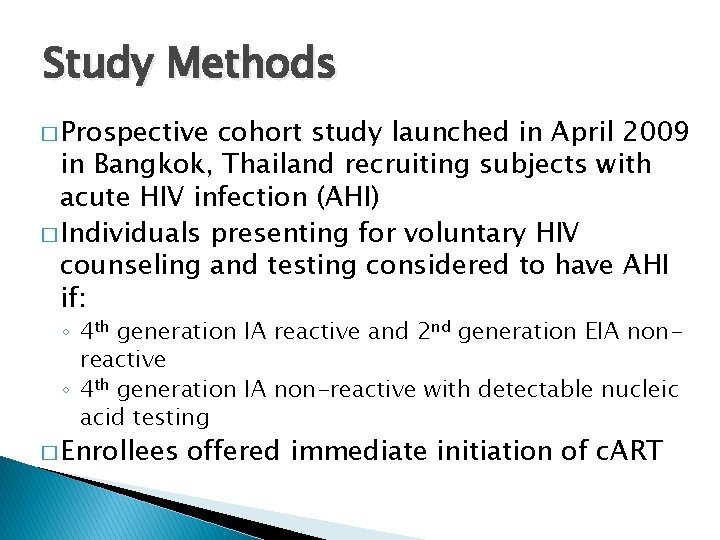
Study Methods � Prospective cohort study launched in April 2009 in Bangkok, Thailand recruiting subjects with acute HIV infection (AHI) � Individuals presenting for voluntary HIV counseling and testing considered to have AHI if: ◦ 4 th generation IA reactive and 2 nd generation EIA nonreactive ◦ 4 th generation IA non-reactive with detectable nucleic acid testing � Enrollees offered immediate initiation of c. ART
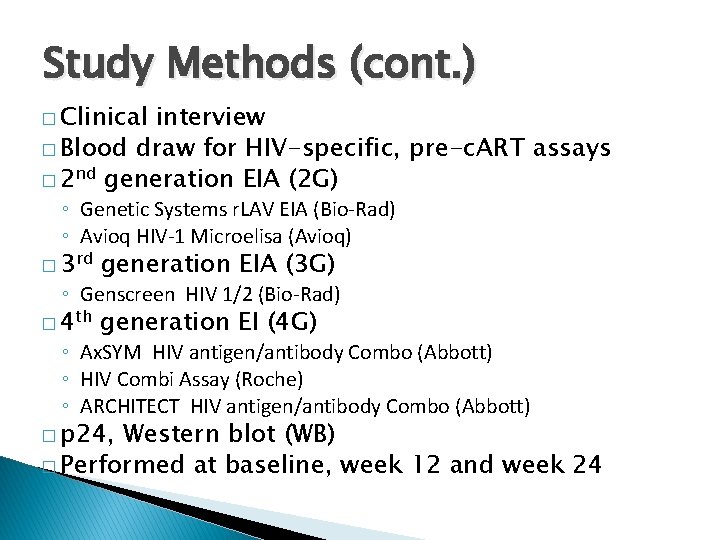
Study Methods (cont. ) � Clinical interview � Blood draw for HIV-specific, pre-c. ART assays � 2 nd generation EIA (2 G) ◦ Genetic Systems r. LAV EIA (Bio-Rad) ◦ Avioq HIV-1 Microelisa (Avioq) � 3 rd generation EIA (3 G) � 4 th generation EI (4 G) ◦ Genscreen HIV 1/2 (Bio-Rad) ◦ Ax. SYM HIV antigen/antibody Combo (Abbott) ◦ HIV Combi Assay (Roche) ◦ ARCHITECT HIV antigen/antibody Combo (Abbott) � p 24, Western blot (WB) � Performed at baseline, week 12 and week 24
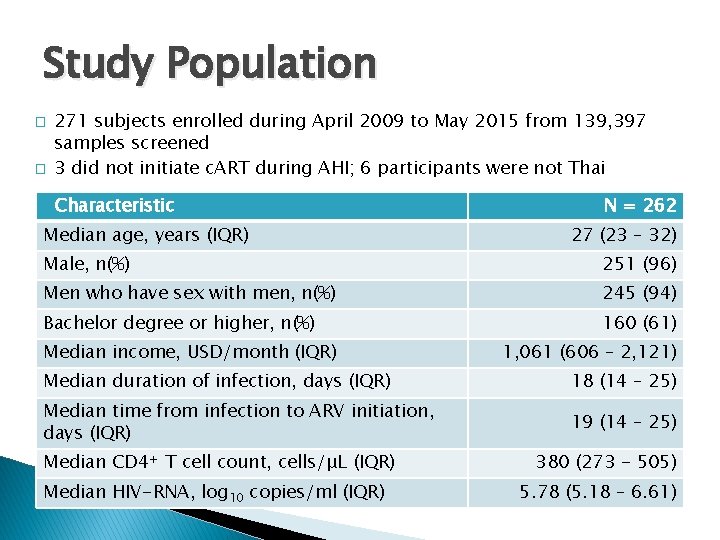
Study Population � � 271 subjects enrolled during April 2009 to May 2015 from 139, 397 samples screened 3 did not initiate c. ART during AHI; 6 participants were not Thai Characteristic Median age, years (IQR) N = 262 27 (23 – 32) Male, n(%) 251 (96) Men who have sex with men, n(%) 245 (94) Bachelor degree or higher, n(%) 160 (61) Median income, USD/month (IQR) 1, 061 (606 – 2, 121) Median duration of infection, days (IQR) 18 (14 – 25) Median time from infection to ARV initiation, days (IQR) 19 (14 – 25) Median CD 4+ T cell count, cells/μL (IQR) Median HIV-RNA, log 10 copies/ml (IQR) 380 (273 - 505) 5. 78 (5. 18 – 6. 61)
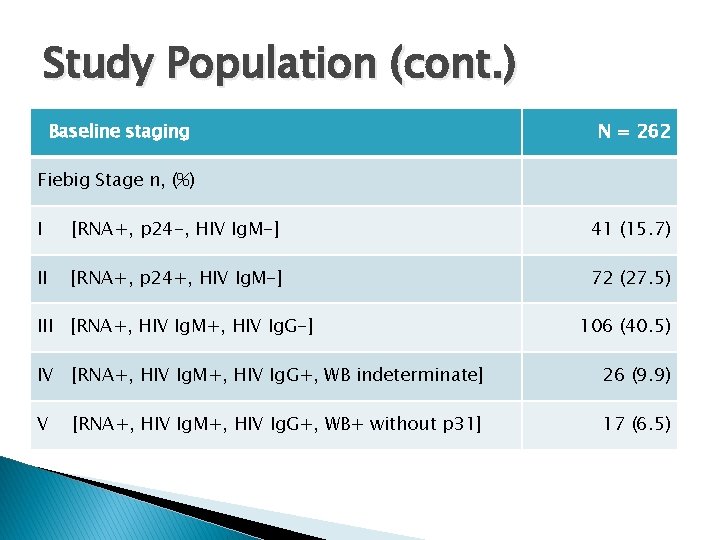
Study Population (cont. ) Baseline staging N = 262 Fiebig Stage n, (%) I [RNA+, p 24 -, HIV Ig. M-] 41 (15. 7) II [RNA+, p 24+, HIV Ig. M-] 72 (27. 5) III [RNA+, HIV Ig. M+, HIV Ig. G-] 106 (40. 5) IV [RNA+, HIV Ig. M+, HIV Ig. G+, WB indeterminate] 26 (9. 9) V 17 (6. 5) [RNA+, HIV Ig. M+, HIV Ig. G+, WB+ without p 31]
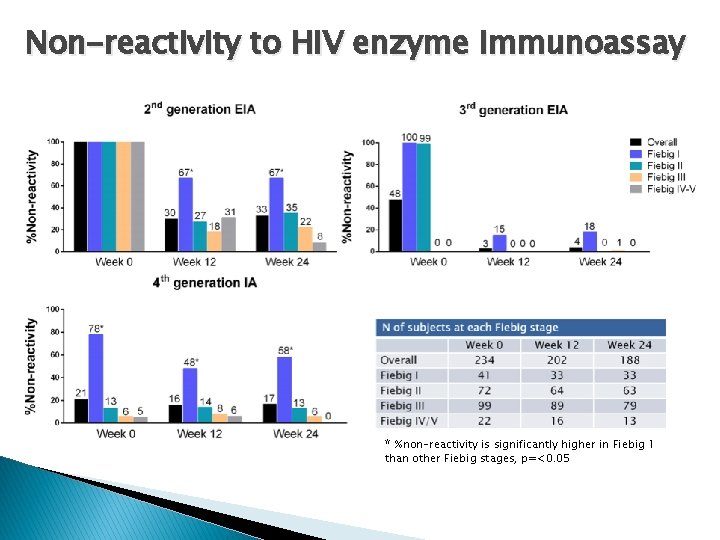
Non-reactivity to HIV enzyme immunoassay * %non-reactivity is significantly higher in Fiebig 1 than other Fiebig stages, p=<0. 05
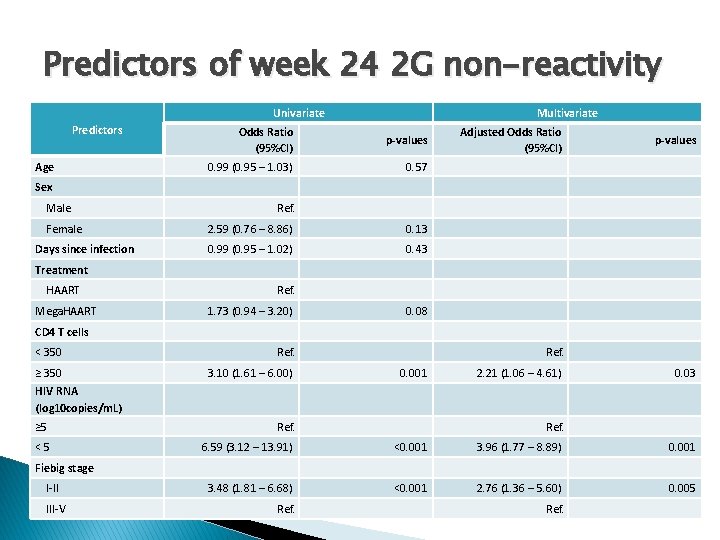
Predictors of week 24 2 G non-reactivity Univariate Predictors Age Multivariate Odds Ratio (95%CI) p-values 0. 99 (0. 95 – 1. 03) 0. 57 Adjusted Odds Ratio (95%CI) p-values Sex Male Female Days since infection Ref. 2. 59 (0. 76 – 8. 86) 0. 13 0. 99 (0. 95 – 1. 02) 0. 43 Treatment HAART Mega. HAART Ref. 1. 73 (0. 94 – 3. 20) 0. 08 CD 4 T cells < 350 Ref. ≥ 350 3. 10 (1. 61 – 6. 00) Ref. 0. 001 2. 21 (1. 06 – 4. 61) 0. 03 HIV RNA (log 10 copies/m. L) ≥ 5 <5 Ref. 6. 59 (3. 12 – 13. 91) <0. 001 3. 96 (1. 77 – 8. 89) 0. 001 3. 48 (1. 81 – 6. 68) <0. 001 2. 76 (1. 36 – 5. 60) 0. 005 Fiebig stage I-II III-V Ref.
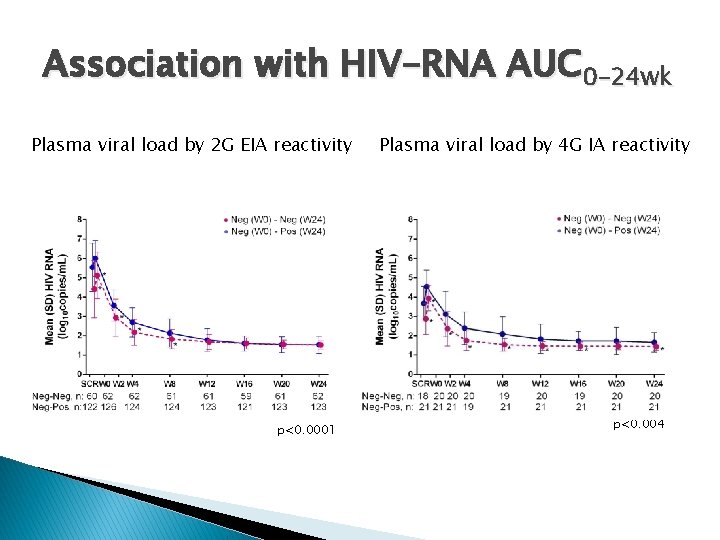
Association with HIV-RNA AUC 0 -24 wk Plasma viral load by 2 G EIA reactivity p<0. 0001 Plasma viral load by 4 G IA reactivity p<0. 004
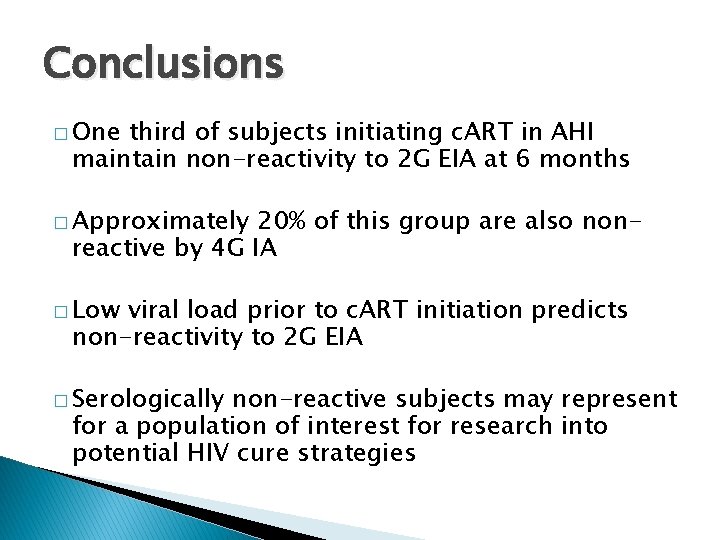
Conclusions � One third of subjects initiating c. ART in AHI maintain non-reactivity to 2 G EIA at 6 months � Approximately 20% of this group are also nonreactive by 4 G IA � Low viral load prior to c. ART initiation predicts non-reactivity to 2 G EIA � Serologically non-reactive subjects may represent for a population of interest for research into potential HIV cure strategies
Acknowledgements