
High Pt Jet Calibration M Kaneda S Tsuno

High Pt Jet Calibration M. Kaneda, S. Tsuno and S. Asai (Univ. Tokyo) Jet. Et. Miss. WG 14/Sep/2006 M. Kaneda Outline • Introduction • Track-base method • Multi-jets method 1
Introduction High Pt jets are important for SUSY search or other many physics, but it is nontrivial to calibrate the jets which have Pt > 400 Ge. V with L=1 fb-1. (ex. g-Jet method does not have enough statistics of such a high Pt jet ) I tried two methods: Track-base method using tracks in a jet cone Multi-jets method using multi jets with high Pt jet: : Pthighest > 2*Ptother 14/Sep/2006 M. Kaneda 2
Track-base Method 14/Sep/2006 M. Kaneda 3
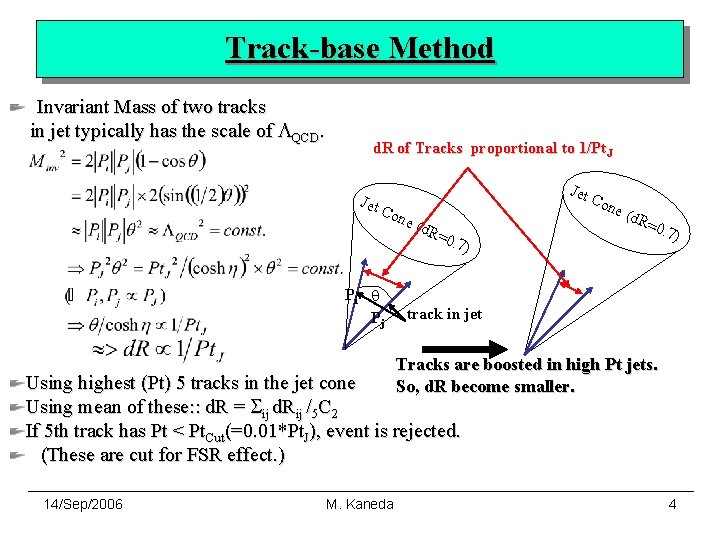
Track-base Method Invariant Mass of two tracks in jet typically has the scale of LQCD. d. R of Tracks proportional to 1/Pt. J Jet Con Jet Pi q Pj e (d Con R=0. 7) e (d R =0. 7) track in jet Tracks are boosted in high Pt jets. So, d. R become smaller. Using highest (Pt) 5 tracks in the jet cone Using mean of these: : d. R = Sij d. Rij /5 C 2 If 5 th track has Pt < Pt. Cut(=0. 01*Pt. J), event is rejected. (These are cut for FSR effect. ) 14/Sep/2006 M. Kaneda 4
Samples CSC samples (QCD di-jets with Pythia) csc 11. 005013. J 4_pythia_jetjet. digit csc 11. 005014. J 5_pythia_jetjet. digit csc 11. 005015. J 6_pythia_jetjet. digit csc 11. 005016. J 7_pythia_jetjet. digit Full simulation J 4, J 5 and J 7 were simulated with ATHNA 11. 0. 41 J 6 was simulated with ATHENA 11. 0. 42 All samples were reconstructed with ATHENA 11. 0. 42 14/Sep/2006 M. Kaneda 5
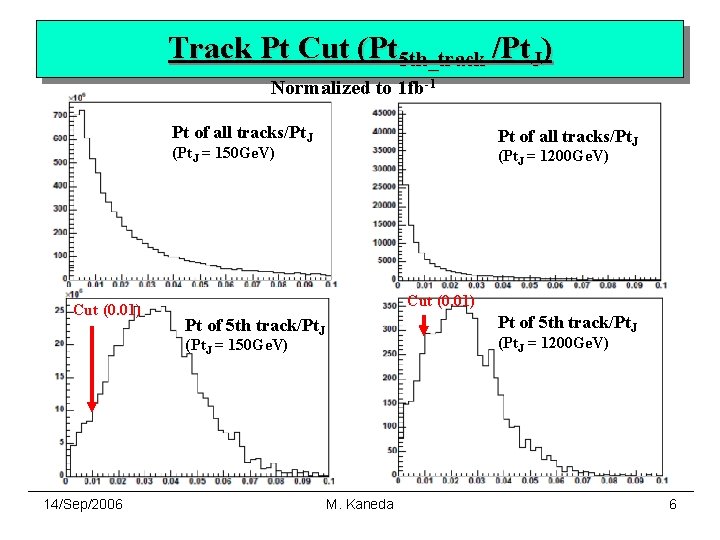
Track Pt Cut (Pt 5 th_track /Pt. J) Normalized to 1 fb-1 Pt of all tracks/Pt. J (Pt. J = 150 Ge. V) Cut (0. 01) (Pt. J = 1200 Ge. V) Cut (0. 01) Pt of 5 th track/Pt. J (Pt. J = 1200 Ge. V) (Pt. J = 150 Ge. V) 14/Sep/2006 M. Kaneda 6
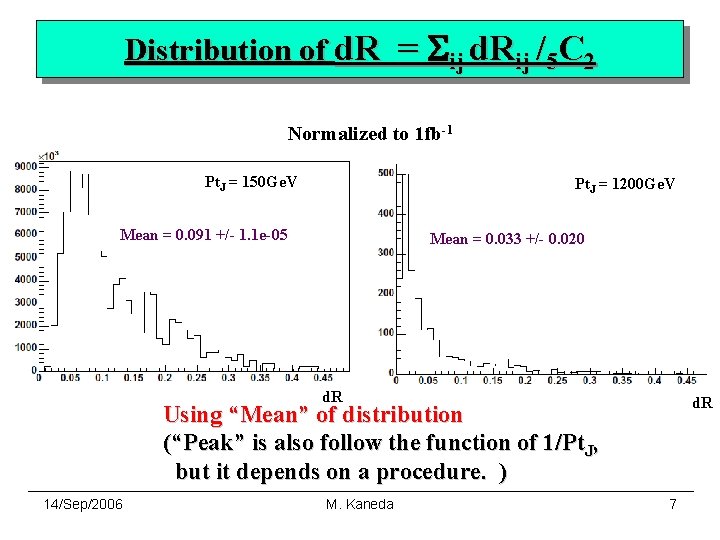
Distribution of d. R = Sij d. Rij /5 C 2 Normalized to 1 fb-1 Pt. J = 150 Ge. V Pt. J = 1200 Ge. V Mean = 0. 091 +/- 1. 1 e-05 Mean = 0. 033 +/- 0. 020 d. R Using “Mean” of distribution (“Peak” is also follow the function of 1/Pt. J, but it depends on a procedure. ) 14/Sep/2006 M. Kaneda 7
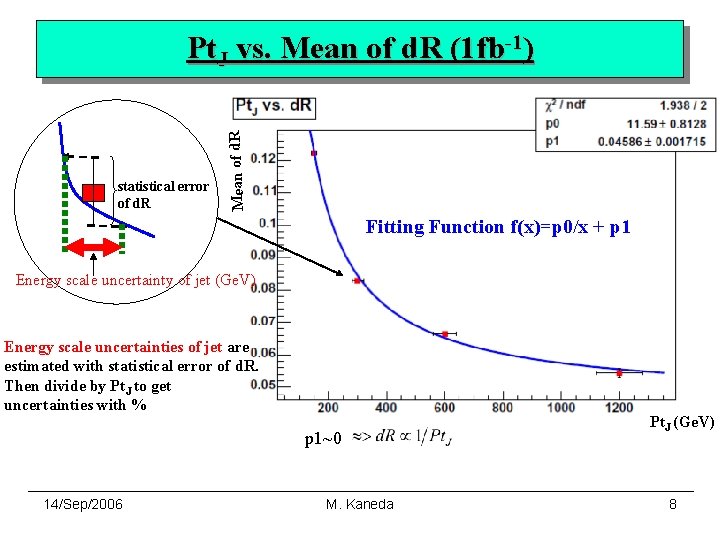
statistical error of d. R Mean of d. R Pt. J vs. Mean of d. R (1 fb-1) Fitting Function f(x)=p 0/x + p 1 Energy scale uncertainty of jet (Ge. V) Energy scale uncertainties of jet are estimated with statistical error of d. R. Then divide by Pt. J to get uncertainties with % p 1~0 14/Sep/2006 M. Kaneda Pt. J (Ge. V) 8
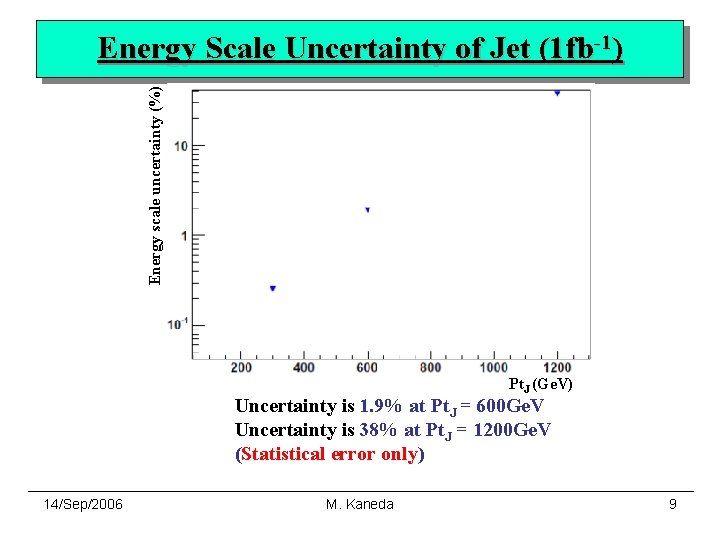
Energy scale uncertainty (%) Energy Scale Uncertainty of Jet (1 fb-1) Pt. J (Ge. V) Uncertainty is 1. 9% at Pt. J = 600 Ge. V Uncertainty is 38% at Pt. J = 1200 Ge. V (Statistical error only) 14/Sep/2006 M. Kaneda 9
Summary and To do (Track-base Method) Mean of d. R obeys function of 1/Pt. J well. This method works less than 1 Te. V. (At Pt. J=600 Ge. V, it shows accuracy of 2%. ) To do Some systematic errors from followings must be included in the results: tracks momentum QCD (FSR effect) low Pt jet accuracy 14/Sep/2006 M. Kaneda 10
Multi-jets Method 14/Sep/2006 M. Kaneda 11
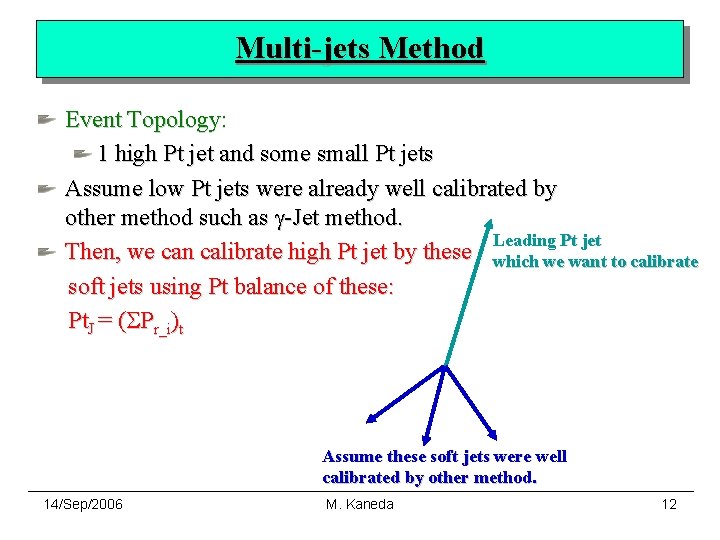
Multi-jets Method Event Topology: 1 high Pt jet and some small Pt jets Assume low Pt jets were already well calibrated by other method such as g-Jet method. Leading Pt jet Then, we can calibrate high Pt jet by these which we want to calibrate soft jets using Pt balance of these: Pt. J = (SPr_i)t Assume these soft jets were well calibrated by other method. 14/Sep/2006 M. Kaneda 12
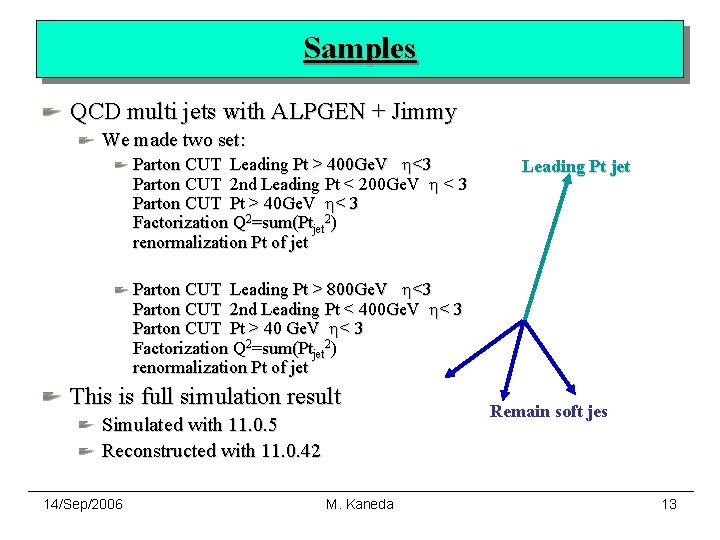
Samples QCD multi jets with ALPGEN + Jimmy We made two set: Parton CUT Leading Pt > 400 Ge. V h<3 Parton CUT 2 nd Leading Pt < 200 Ge. V h < 3 Parton CUT Pt > 40 Ge. V h< 3 Factorization Q 2=sum(Ptjet 2) renormalization Pt of jet Leading Pt jet Parton CUT Leading Pt > 800 Ge. V h<3 Parton CUT 2 nd Leading Pt < 400 Ge. V h< 3 Parton CUT Pt > 40 Ge. V h< 3 Factorization Q 2=sum(Ptjet 2) renormalization Pt of jet This is full simulation result Simulated with 11. 0. 5 Reconstructed with 11. 0. 42 14/Sep/2006 M. Kaneda Remain soft jes 13
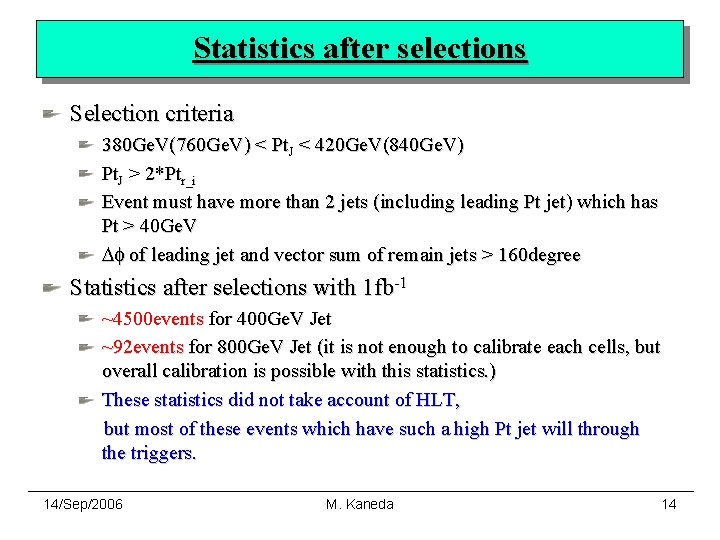
Statistics after selections Selection criteria 380 Ge. V(760 Ge. V) < Pt. J < 420 Ge. V(840 Ge. V) Pt. J > 2*Ptr_i Event must have more than 2 jets (including leading Pt jet) which has Pt > 40 Ge. V Df of leading jet and vector sum of remain jets > 160 degree Statistics after selections with 1 fb-1 ~4500 events for 400 Ge. V Jet ~92 events for 800 Ge. V Jet (it is not enough to calibrate each cells, but overall calibration is possible with this statistics. ) These statistics did not take account of HLT, but most of these events which have such a high Pt jet will through the triggers. 14/Sep/2006 M. Kaneda 14
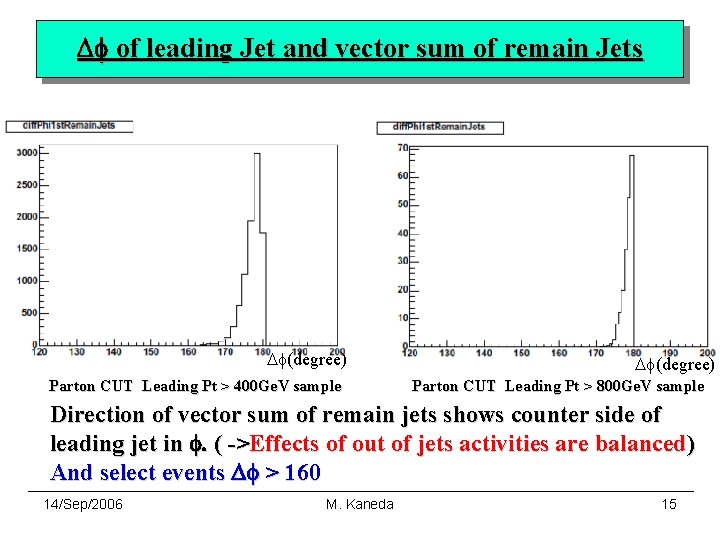
Df of leading Jet and vector sum of remain Jets Df(degree) Parton CUT Leading Pt > 400 Ge. V sample Df(degree) Parton CUT Leading Pt > 800 Ge. V sample Direction of vector sum of remain jets shows counter side of leading jet in f. ( ->Effects of out of jets activities are balanced) And select events Df > 160 14/Sep/2006 M. Kaneda 15

Pt. J vs. (SPr_i)t(Ge. V) Normalized to 1 fb-1 Pt. J(Ge. V) Parton CUT Leading Pt > 400 Ge. V sample Pt. J(Ge. V) Parton CUT Leading Pt > 800 Ge. V sample They were strongly correlated. =>Pt. J and (SPr_i)t balanced well. 14/Sep/2006 M. Kaneda 16
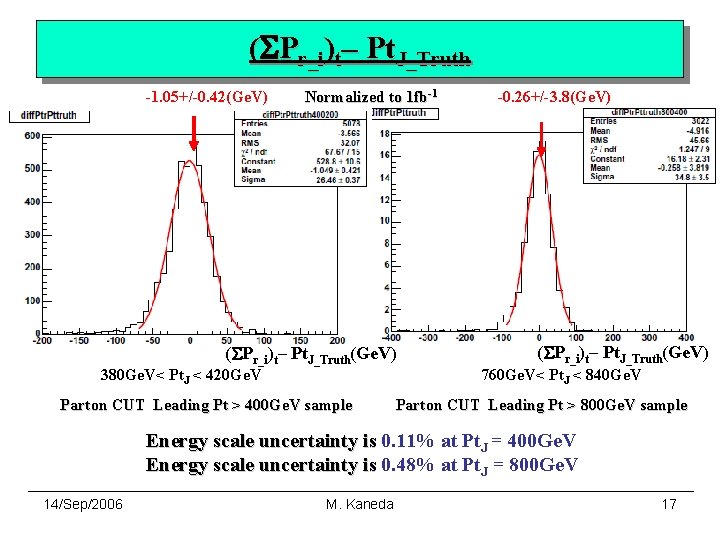
(SPr_i)t– Pt. J_Truth -1. 05+/-0. 42(Ge. V) Normalized to 1 fb-1 (SPr_i)t– Pt. J_Truth(Ge. V) 380 Ge. V< Pt. J < 420 Ge. V Parton CUT Leading Pt > 400 Ge. V sample -0. 26+/-3. 8(Ge. V) (SPr_i)t– Pt. J_Truth(Ge. V) 760 Ge. V< Pt. J < 840 Ge. V Parton CUT Leading Pt > 800 Ge. V sample Energy scale uncertainty is 0. 11% at Pt. J = 400 Ge. V Energy scale uncertainty is 0. 48% at Pt. J = 800 Ge. V 14/Sep/2006 M. Kaneda 17
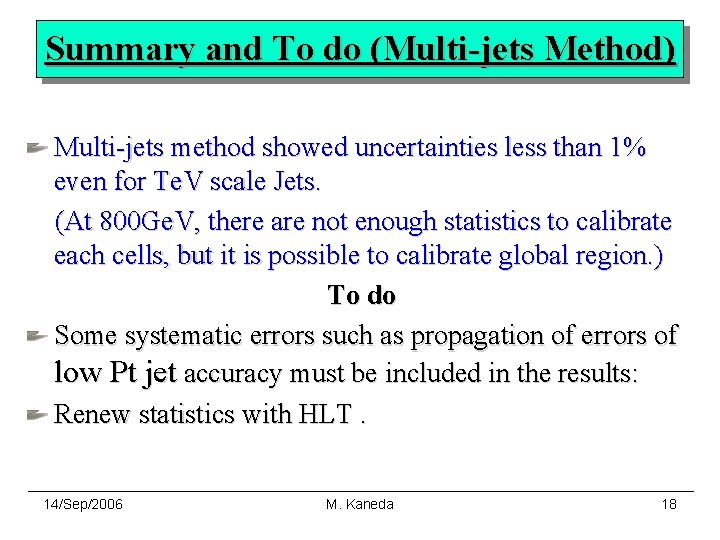
Summary and To do (Multi-jets Method) Multi-jets method showed uncertainties less than 1% even for Te. V scale Jets. (At 800 Ge. V, there are not enough statistics to calibrate each cells, but it is possible to calibrate global region. ) To do Some systematic errors such as propagation of errors of low Pt jet accuracy must be included in the results: Renew statistics with HLT. 14/Sep/2006 M. Kaneda 18
Back Up 14/Sep/2006 M. Kaneda 19
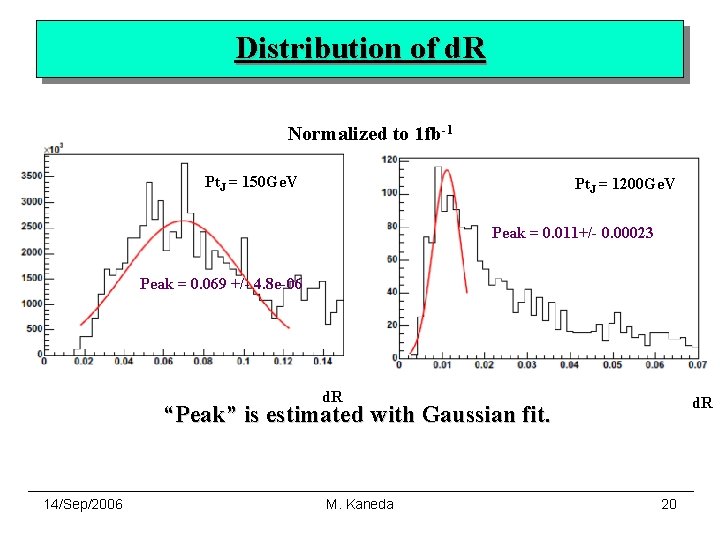
Distribution of d. R Normalized to 1 fb-1 Pt. J = 150 Ge. V Pt. J = 1200 Ge. V Peak = 0. 011+/- 0. 00023 Peak = 0. 069 +/- 4. 8 e-06 d. R “Peak” is estimated with Gaussian fit. 14/Sep/2006 M. Kaneda 20

Pt. J vs. d. R (1 fb-1) (using Peak) Fitting Function f(x)=p 0/x + p 1 Invariant Mass of two tracks in jet ~ LQCD 14/Sep/2006 M. Kaneda Pt. J (Ge. V) 21
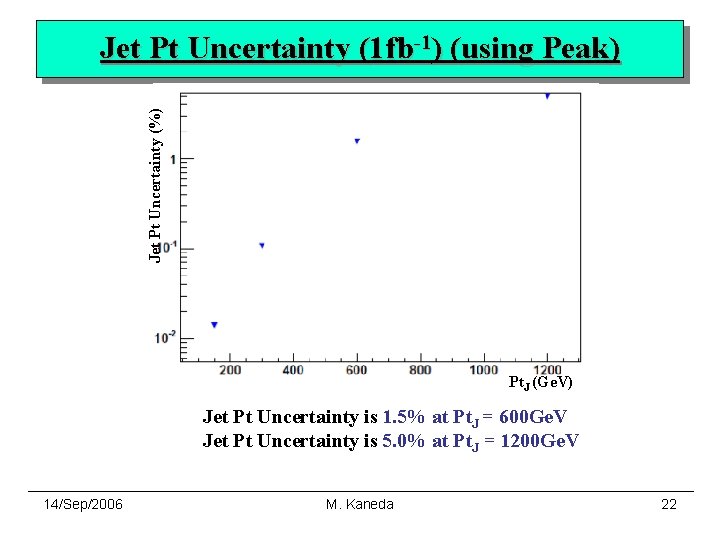
Jet Pt Uncertainty (%) Jet Pt Uncertainty (1 fb-1) (using Peak) Pt. J (Ge. V) Jet Pt Uncertainty is 1. 5% at Pt. J = 600 Ge. V Jet Pt Uncertainty is 5. 0% at Pt. J = 1200 Ge. V 14/Sep/2006 M. Kaneda 22
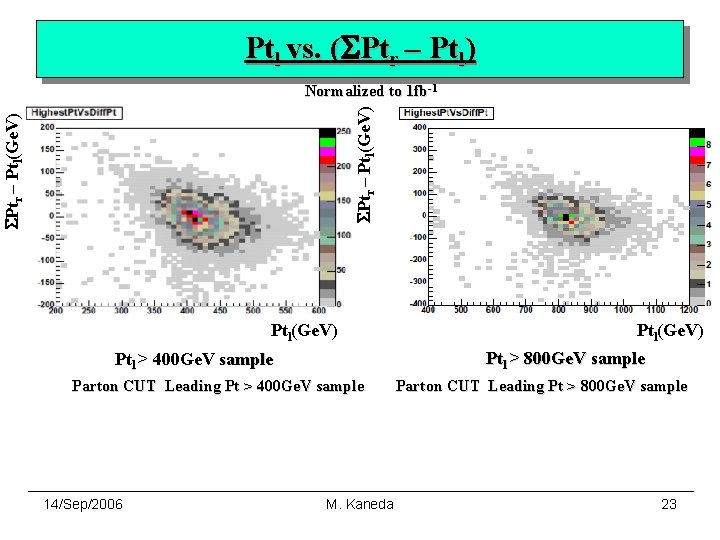
Ptl vs. (SPtr – Ptl) SPtr – Ptl(Ge. V) Normalized to 1 fb-1 Ptl(Ge. V) Ptl > 800 Ge. V sample Ptl > 400 Ge. V sample Parton CUT Leading Pt > 400 Ge. V sample 14/Sep/2006 Ptl(Ge. V) M. Kaneda Parton CUT Leading Pt > 800 Ge. V sample 23
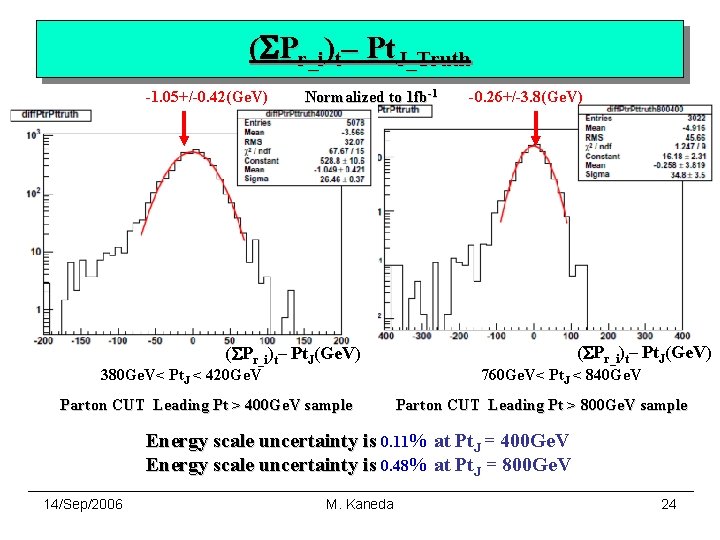
(SPr_i)t– Pt. J_Truth -1. 05+/-0. 42(Ge. V) Normalized to 1 fb-1 (SPr_i)t– Pt. J(Ge. V) 380 Ge. V< Pt. J < 420 Ge. V Parton CUT Leading Pt > 400 Ge. V sample -0. 26+/-3. 8(Ge. V) (SPr_i)t– Pt. J(Ge. V) 760 Ge. V< Pt. J < 840 Ge. V Parton CUT Leading Pt > 800 Ge. V sample Energy scale uncertainty is 0. 11% at Pt. J = 400 Ge. V Energy scale uncertainty is 0. 48% at Pt. J = 800 Ge. V 14/Sep/2006 M. Kaneda 24

(SPr_i)t– Pt. J -0. 87+/-0. 45(Ge. V) Normalized to 1 fb-1 (SPr_i)t– Pt. J(Ge. V) 380 Ge. V< Pt. J < 420 Ge. V Parton CUT Leading Pt > 400 Ge. V sample 0. 31+/-4. 39(Ge. V) (SPr_i)t– Pt. J(Ge. V) 760 Ge. V< Pt. J < 840 Ge. V Parton CUT Leading Pt > 800 Ge. V sample Energy scale uncertainty is 0. 11% at Pt. J = 400 Ge. V Energy scale uncertainty is 0. 55% at Pt. J = 800 Ge. V 14/Sep/2006 M. Kaneda 25
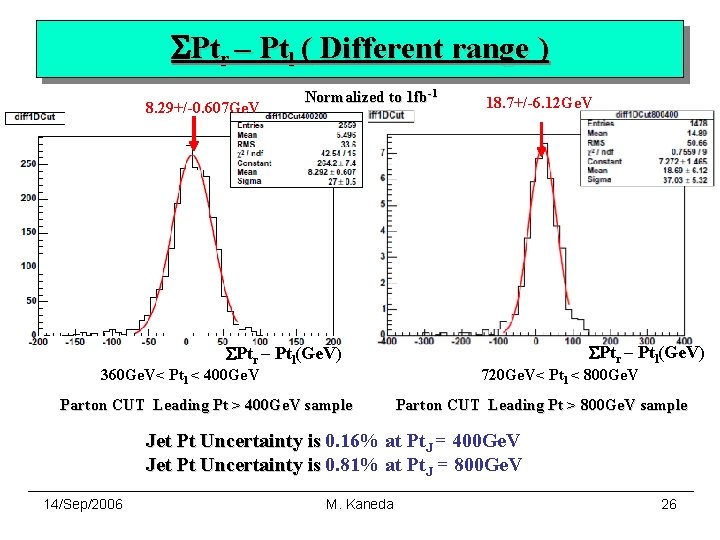
SPtr – Ptl ( Different range ) 8. 29+/-0. 607 Ge. V Normalized to 1 fb-1 SPtr – Ptl(Ge. V) 360 Ge. V< Ptl < 400 Ge. V Parton CUT Leading Pt > 400 Ge. V sample 18. 7+/-6. 12 Ge. V SPtr – Ptl(Ge. V) 720 Ge. V< Ptl < 800 Ge. V Parton CUT Leading Pt > 800 Ge. V sample Jet Pt Uncertainty is 0. 16% at Pt. J = 400 Ge. V Jet Pt Uncertainty is 0. 81% at Pt. J = 800 Ge. V 14/Sep/2006 M. Kaneda 26
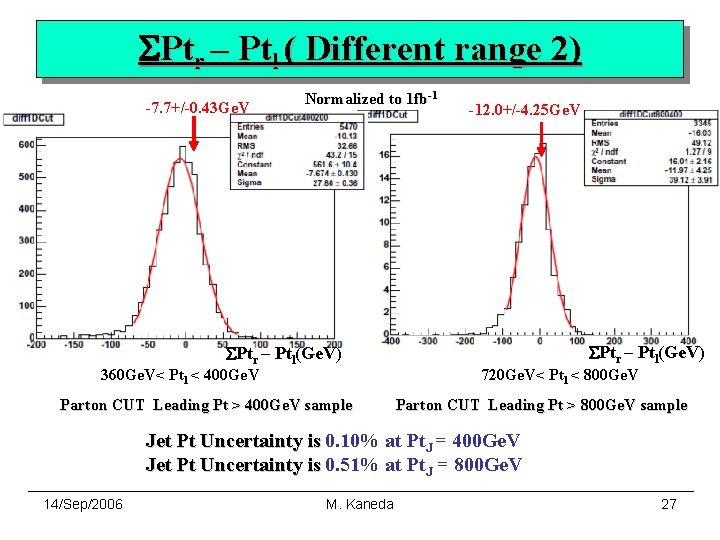
SPtr – Ptl ( Different range 2) -7. 7+/-0. 43 Ge. V Normalized to 1 fb-1 SPtr – Ptl(Ge. V) 360 Ge. V< Ptl < 400 Ge. V Parton CUT Leading Pt > 400 Ge. V sample -12. 0+/-4. 25 Ge. V SPtr – Ptl(Ge. V) 720 Ge. V< Ptl < 800 Ge. V Parton CUT Leading Pt > 800 Ge. V sample Jet Pt Uncertainty is 0. 10% at Pt. J = 400 Ge. V Jet Pt Uncertainty is 0. 51% at Pt. J = 800 Ge. V 14/Sep/2006 M. Kaneda 27
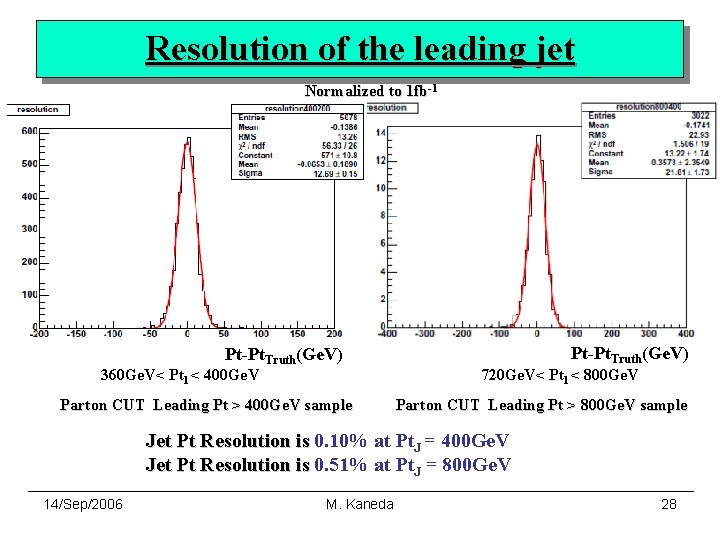
Resolution of the leading jet Normalized to 1 fb-1 Pt-Pt. Truth(Ge. V) 360 Ge. V< Ptl < 400 Ge. V Parton CUT Leading Pt > 400 Ge. V sample Pt-Pt. Truth(Ge. V) 720 Ge. V< Ptl < 800 Ge. V Parton CUT Leading Pt > 800 Ge. V sample Jet Pt Resolution is 0. 10% at Pt. J = 400 Ge. V Jet Pt Resolution is 0. 51% at Pt. J = 800 Ge. V 14/Sep/2006 M. Kaneda 28
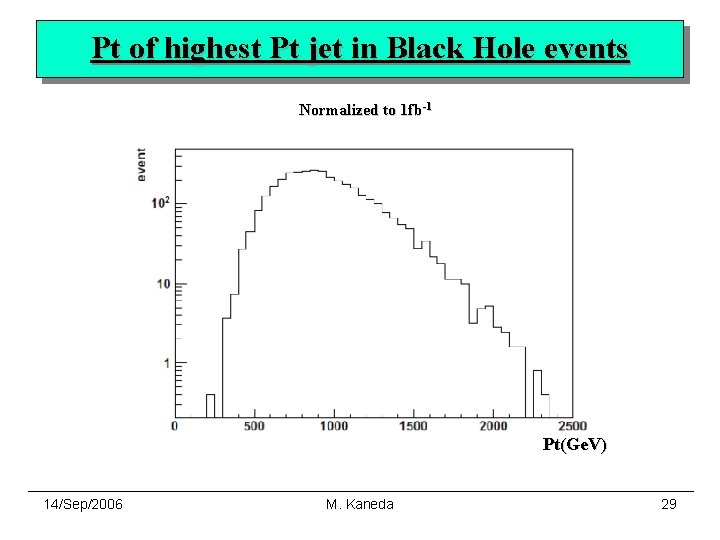
Pt of highest Pt jet in Black Hole events Normalized to 1 fb-1 Pt(Ge. V) 14/Sep/2006 M. Kaneda 29
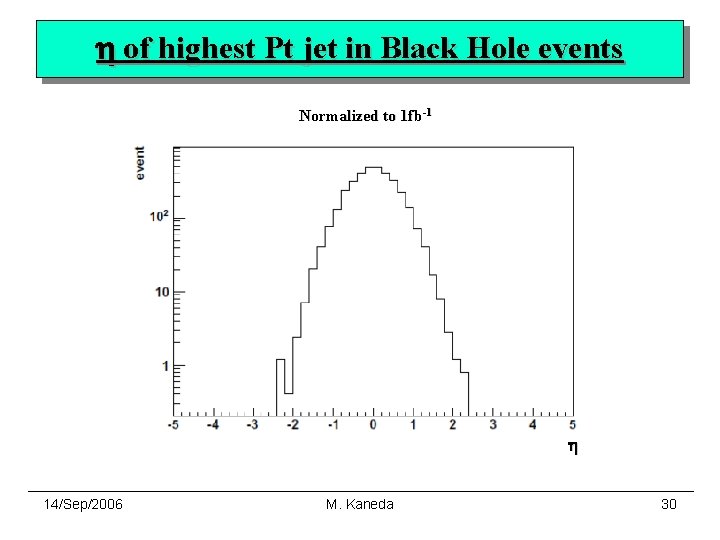
h of highest Pt jet in Black Hole events Normalized to 1 fb-1 h 14/Sep/2006 M. Kaneda 30
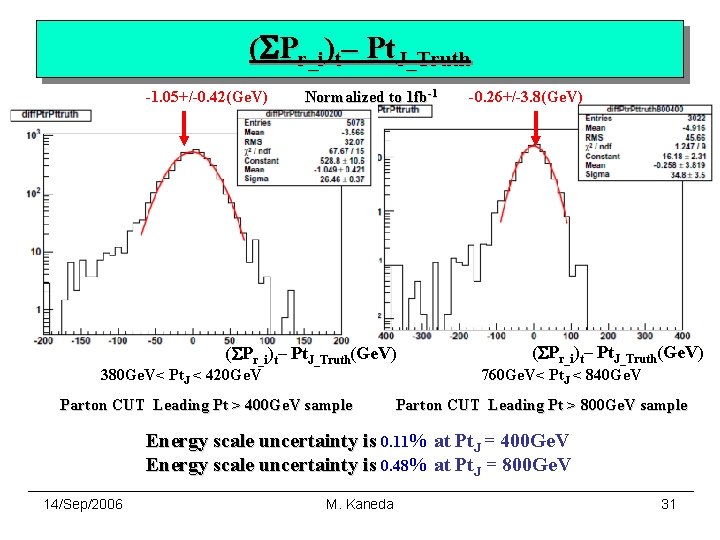
(SPr_i)t– Pt. J_Truth -1. 05+/-0. 42(Ge. V) Normalized to 1 fb-1 (SPr_i)t– Pt. J_Truth(Ge. V) 380 Ge. V< Pt. J < 420 Ge. V Parton CUT Leading Pt > 400 Ge. V sample -0. 26+/-3. 8(Ge. V) (SPr_i)t– Pt. J_Truth(Ge. V) 760 Ge. V< Pt. J < 840 Ge. V Parton CUT Leading Pt > 800 Ge. V sample Energy scale uncertainty is 0. 11% at Pt. J = 400 Ge. V Energy scale uncertainty is 0. 48% at Pt. J = 800 Ge. V 14/Sep/2006 M. Kaneda 31
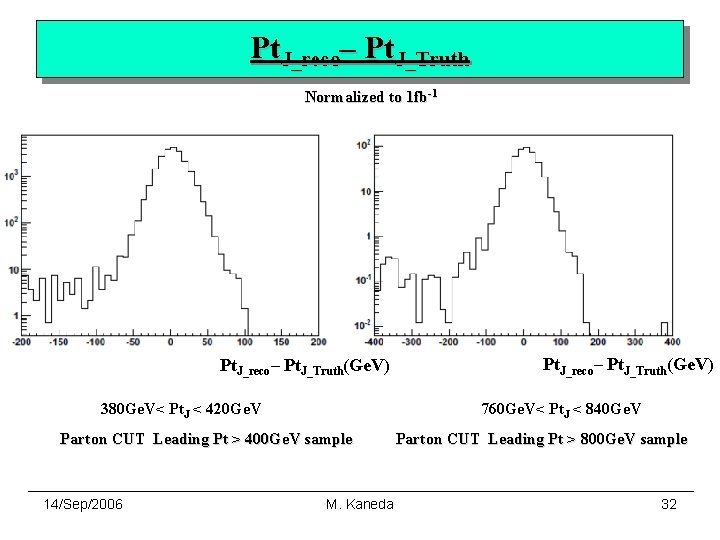
Pt. J_reco– Pt. J_Truth Normalized to 1 fb-1 Pt. J_reco– Pt. J_Truth(Ge. V) 380 Ge. V< Pt. J < 420 Ge. V 760 Ge. V< Pt. J < 840 Ge. V Parton CUT Leading Pt > 400 Ge. V sample 14/Sep/2006 Pt. J_reco– Pt. J_Truth(Ge. V) M. Kaneda Parton CUT Leading Pt > 800 Ge. V sample 32
- Slides: 32