
High Pressure Gas Filled RF Cavities Over view
- Slides: 10
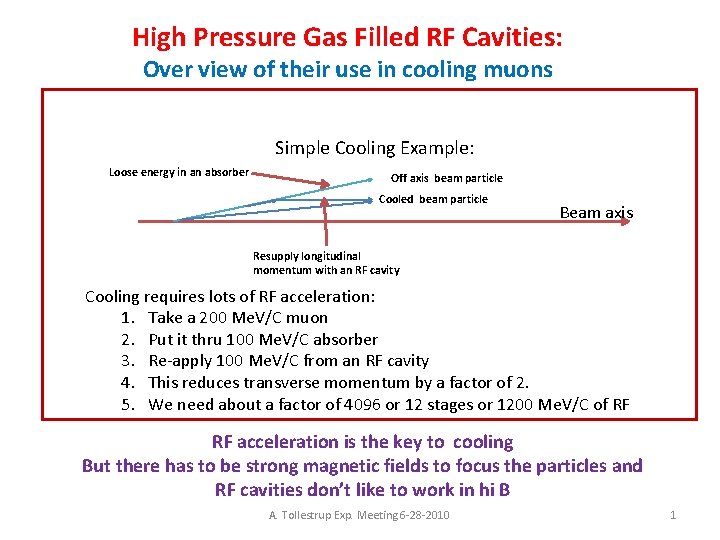
High Pressure Gas Filled RF Cavities: Over view of their use in cooling muons Simple Cooling Example: Loose energy in an absorber Off axis beam particle Cooled beam particle Beam axis Resupply longitudinal momentum with an RF cavity Cooling requires lots of RF acceleration: 1. Take a 200 Me. V/C muon 2. Put it thru 100 Me. V/C absorber 3. Re-apply 100 Me. V/C from an RF cavity 4. This reduces transverse momentum by a factor of 2. 5. We need about a factor of 4096 or 12 stages or 1200 Me. V/C of RF RF acceleration is the key to cooling But there has to be strong magnetic fields to focus the particles and RF cavities don’t like to work in hi B A. Tollestrup Exp. Meeting 6 -28 -2010 1
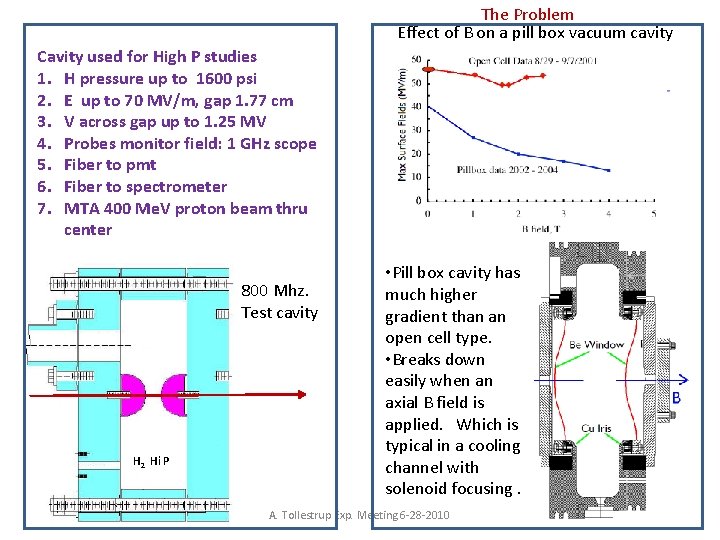
The Problem Effect of B on a pill box vacuum cavity Cavity used for High P studies 1. H pressure up to 1600 psi 2. E up to 70 MV/m, gap 1. 77 cm 3. V across gap up to 1. 25 MV 4. Probes monitor field: 1 GHz scope 5. Fiber to pmt 6. Fiber to spectrometer 7. MTA 400 Me. V proton beam thru center 800 Mhz. Test cavity H 2 Hi P • Pill box cavity has much higher gradient than an open cell type. • Breaks down easily when an axial B field is applied. Which is typical in a cooling channel with solenoid focusing. A. Tollestrup Exp. Meeting 6 -28 -2010 2
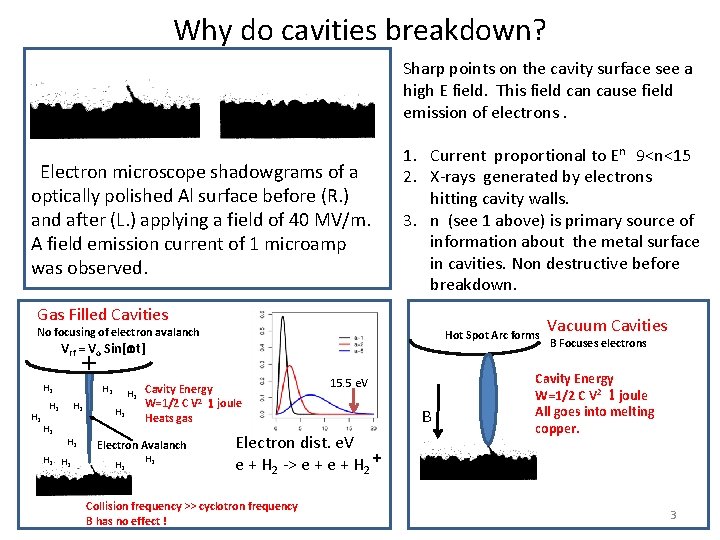
Why do cavities breakdown? Sharp points on the cavity surface see a high E field. This field can cause field emission of electrons. Electron microscope shadowgrams of a optically polished Al surface before (R. ) and after (L. ) applying a field of 40 MV/m. A field emission current of 1 microamp was observed. 1. Current proportional to En 9<n<15 2. X-rays generated by electrons hitting cavity walls. 3. n (see 1 above) is primary source of information about the metal surface in cavities. Non destructive before breakdown. Gas Filled Cavities No focusing of electron avalanch Hot Spot Arc forms Vrf = Vo Sin[wt] + H 2 H 2 H 2 Cavity Energy W=1/2 C V 2 1 joule H 2 Heats gas Electron Avalanch H 2 15. 5 e. V Electron dist. e. V e + H 2 -> e + H 2 + Collision frequency >> cyclotron frequency B has no effect ! B Vacuum Cavities B Focuses electrons Cavity Energy W=1/2 C V 2 1 joule All goes into melting copper. 3
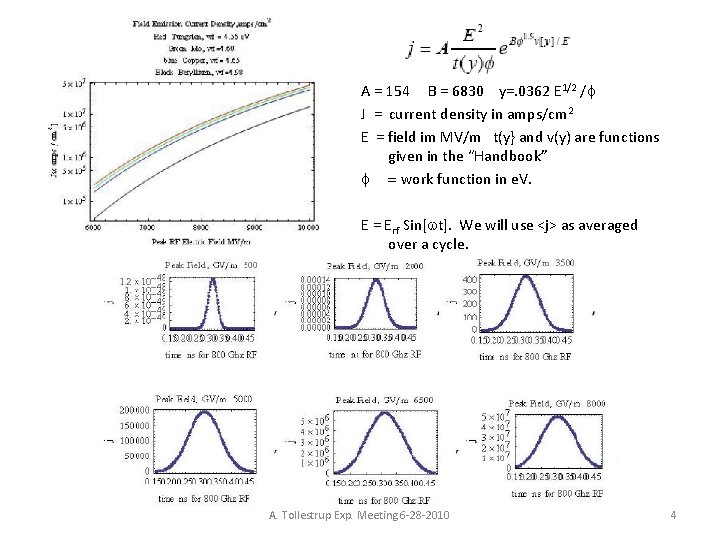
A = 154 B = 6830 y=. 0362 E 1/2 /f J = current density in amps/cm 2 E = field im MV/m t(y} and v(y) are functions given in the “Handbook” f = work function in e. V. E = Erf Sin[wt]. We will use <j> as averaged over a cycle. A. Tollestrup Exp. Meeting 6 -28 -2010 4
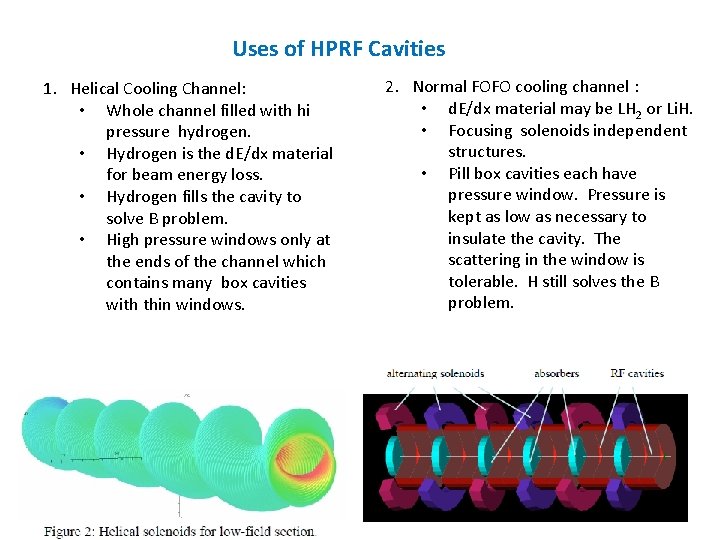
Uses of HPRF Cavities 1. Helical Cooling Channel: • Whole channel filled with hi pressure hydrogen. • Hydrogen is the d. E/dx material for beam energy loss. • Hydrogen fills the cavity to solve B problem. • High pressure windows only at the ends of the channel which contains many box cavities with thin windows. 2. Normal FOFO cooling channel : • d. E/dx material may be LH 2 or Li. H. • Focusing solenoids independent structures. • Pill box cavities each have pressure window. Pressure is kept as low as necessary to insulate the cavity. The scattering in the window is tolerable. H still solves the B problem. A. Tollestrup Exp. Meeting 6 -28 -2010 5
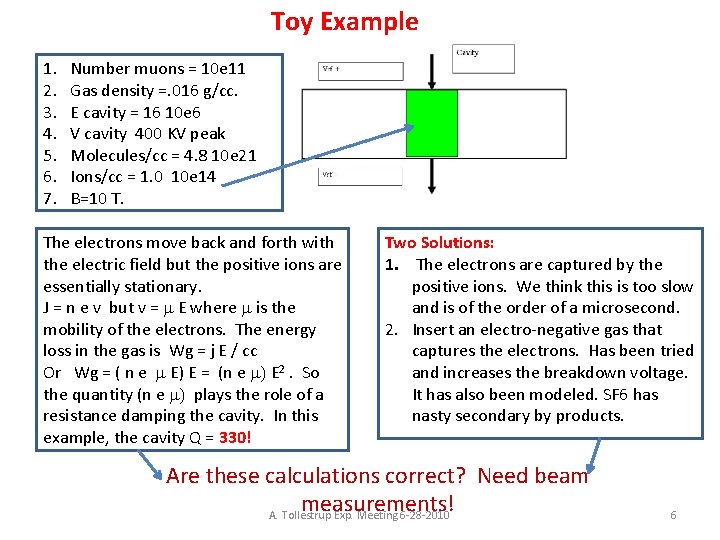
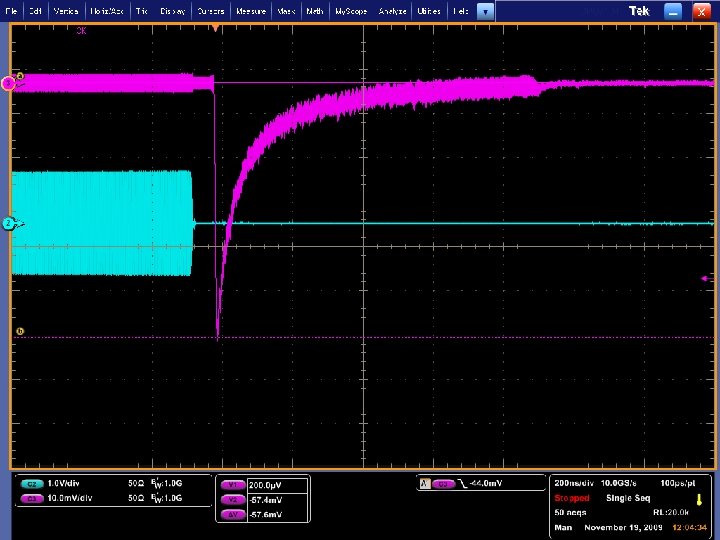
Toy Example 1. 2. 3. 4. 5. 6. 7. Number muons = 10 e 11 Gas density =. 016 g/cc. E cavity = 16 10 e 6 V cavity 400 KV peak Molecules/cc = 4. 8 10 e 21 Ions/cc = 1. 0 10 e 14 B=10 T. The electrons move back and forth with the electric field but the positive ions are essentially stationary. J = n e v but v = m E where m is the mobility of the electrons. The energy loss in the gas is Wg = j E / cc Or Wg = ( n e m E) E = (n e m) E 2. So the quantity (n e m) plays the role of a resistance damping the cavity. In this example, the cavity Q = 330! Two Solutions: 1. The electrons are captured by the positive ions. We think this is too slow and is of the order of a microsecond. 2. Insert an electro-negative gas that captures the electrons. Has been tried and increases the breakdown voltage. It has also been modeled. SF 6 has nasty secondary by products. Are these calculations correct? Need beam measurements! A. Tollestrup Exp. Meeting 6 -28 -2010 6
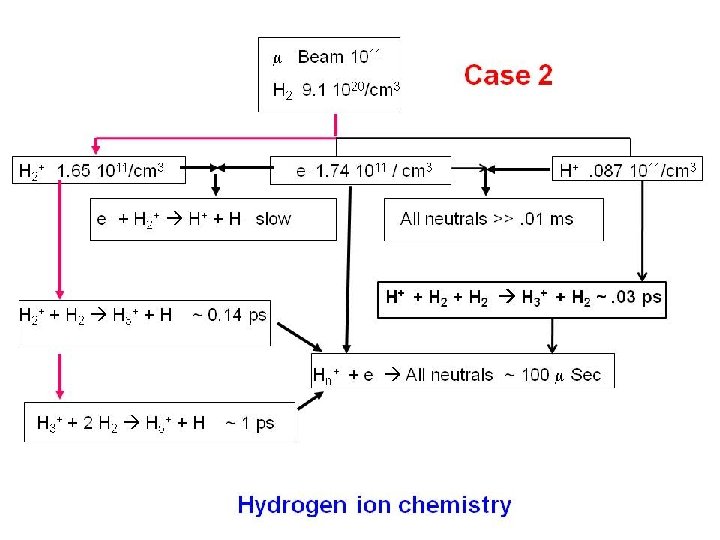
A. Tollestrup Exp. Meeting 6 -28 -2010 7
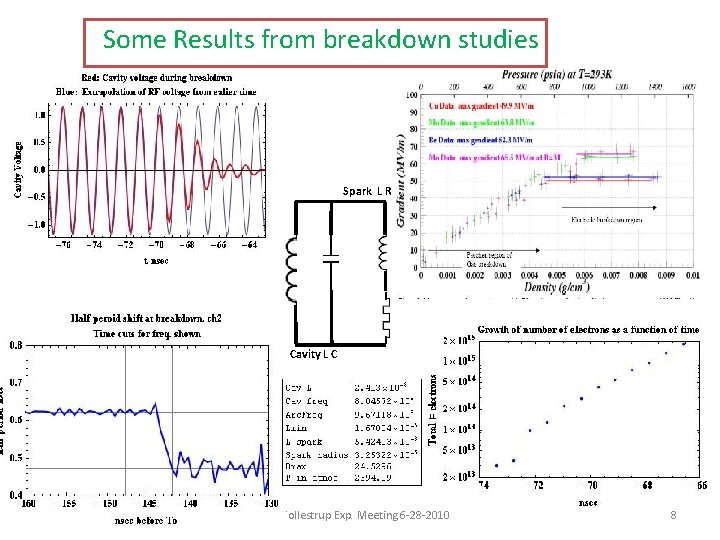
Some Results from breakdown studies Spark L R Cavity L C A. Tollestrup Exp. Meeting 6 -28 -2010 8
A. Tollestrup Exp. Meeting 6 -28 -2010 9
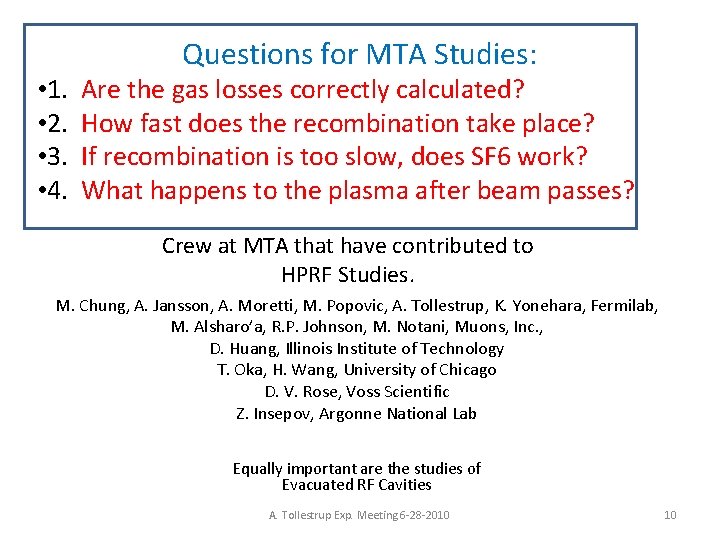
• 1. • 2. • 3. • 4. Questions for MTA Studies: Are the gas losses correctly calculated? How fast does the recombination take place? If recombination is too slow, does SF 6 work? What happens to the plasma after beam passes? Crew at MTA that have contributed to HPRF Studies. M. Chung, A. Jansson, A. Moretti, M. Popovic, A. Tollestrup, K. Yonehara, Fermilab, M. Alsharo’a, R. P. Johnson, M. Notani, Muons, Inc. , D. Huang, Illinois Institute of Technology T. Oka, H. Wang, University of Chicago D. V. Rose, Voss Scientific Z. Insepov, Argonne National Lab Equally important are the studies of Evacuated RF Cavities A. Tollestrup Exp. Meeting 6 -28 -2010 10