
High Precision Measurement of the Proton Charge Radius

- Slides: 27
High Precision Measurement of the Proton Charge Radius (C 12 -11 -106) A. Gasparian NC A&T State University, Greensboro, NC M. Khandaker (co-spokesperson), H. Gao (co-spokesperson), D. Dutta (cospokesperson) Outline § Motivation of the experiment § Proposed experiment windowless hydrogen gas flow target v beam background 2 v radiative corrections at very low Q v § Summary
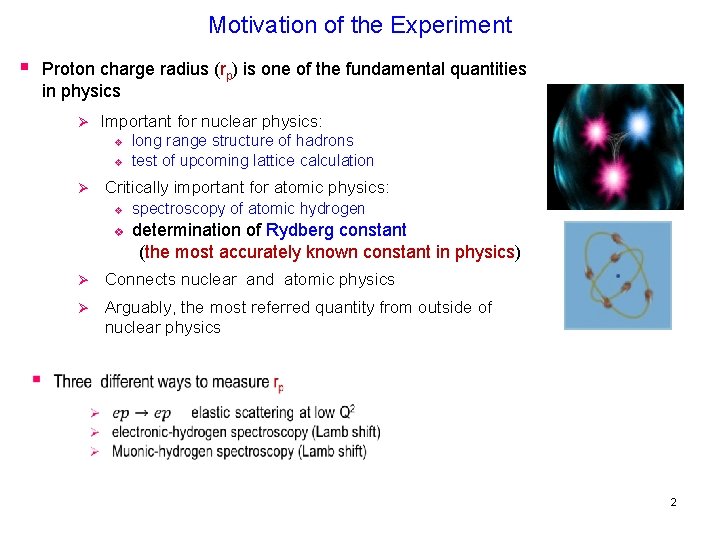
Motivation of the Experiment § Proton charge radius (rp) is one of the fundamental quantities in physics Ø Important for nuclear physics: v v Ø long range structure of hadrons test of upcoming lattice calculation Critically important for atomic physics: v v spectroscopy of atomic hydrogen determination of Rydberg constant (the most accurately known constant in physics) Ø Connects nuclear and atomic physics Ø Arguably, the most referred quantity from outside of nuclear physics 2
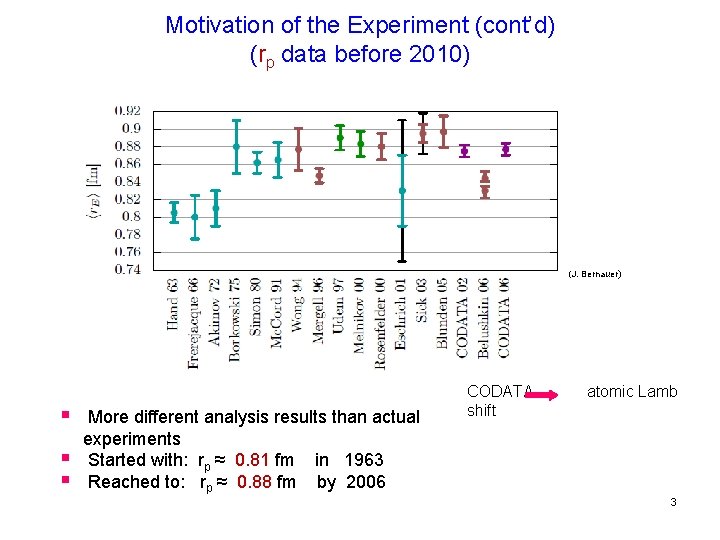
Motivation of the Experiment (cont’d) (rp data before 2010) (J. Bernauer) § § § More different analysis results than actual experiments Started with: rp ≈ 0. 81 fm in 1963 Reached to: rp ≈ 0. 88 fm by 2006 CODATA shift atomic Lamb 3
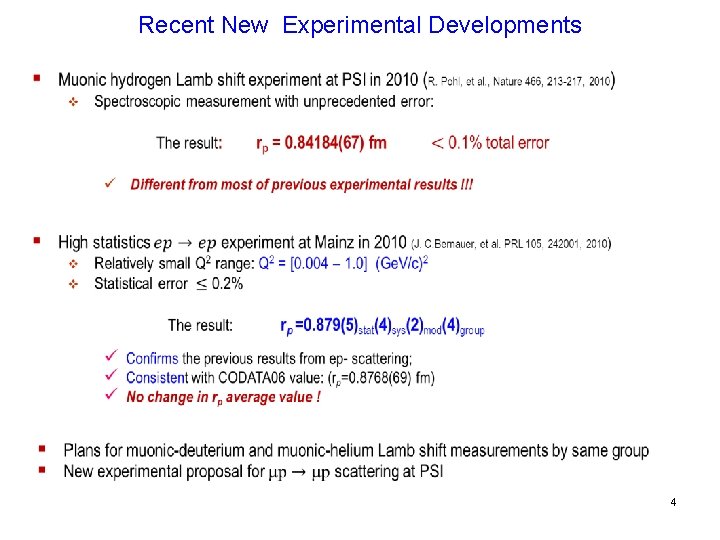
Recent New Experimental Developments 4
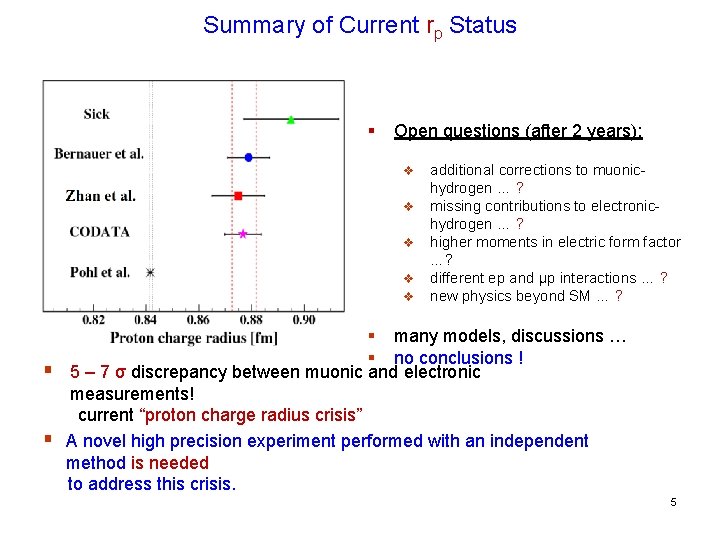
Summary of Current rp Status § Open questions (after 2 years): v v v additional corrections to muonichydrogen … ? missing contributions to electronichydrogen … ? higher moments in electric form factor …? different ep and μp interactions … ? new physics beyond SM … ? § many models, discussions … § no conclusions ! § 5 – 7 σ discrepancy between muonic and electronic measurements! current “proton charge radius crisis” § A novel high precision experiment performed with an independent method is needed to address this crisis. 5
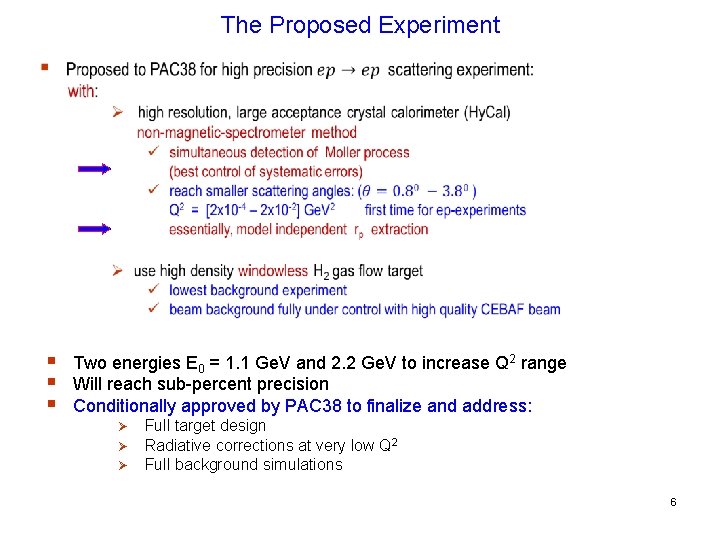
The Proposed Experiment § § § Two energies E 0 = 1. 1 Ge. V and 2. 2 Ge. V to increase Q 2 range Will reach sub-percent precision Conditionally approved by PAC 38 to finalize and address: Ø Ø Ø Full target design Radiative corrections at very low Q 2 Full background simulations 6
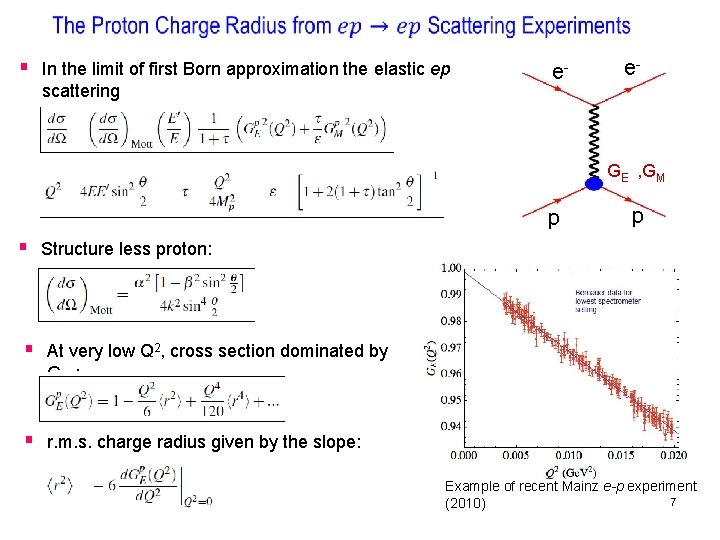
§ In the limit of first Born approximation the elastic ep scattering (one photon exchange): e- e- GE , GM p p § Structure less proton: § At very low Q 2, cross section dominated by GEp: § r. m. s. charge radius given by the slope: Example of recent Mainz e-p experiment 7 (2010)
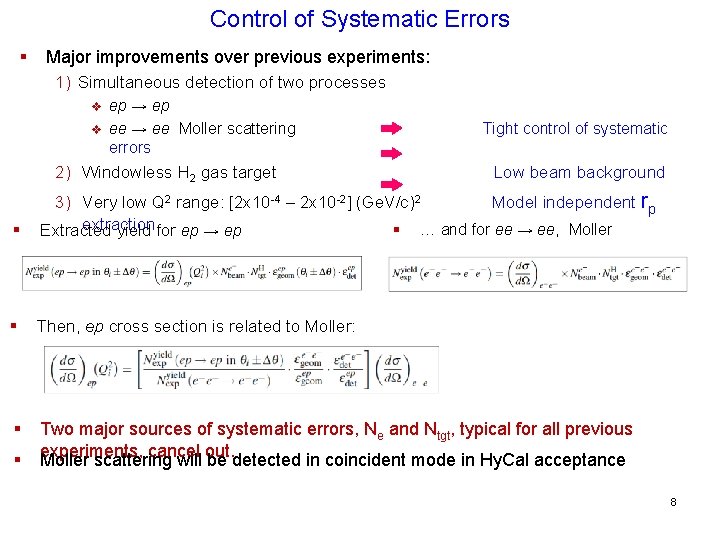
Control of Systematic Errors § Major improvements over previous experiments: 1) Simultaneous detection of two processes ep → ep v ee → ee Moller scattering errors v 2) Windowless H 2 gas target Tight control of systematic Low beam background § 3) Very low Q 2 range: [2 x 10 -4 – 2 x 10 -2] (Ge. V/c)2 Model independent rp extraction § … and for ee → ee, Moller Extracted yield for ep → ep § Then, ep cross section is related to Moller: § Two major sources of systematic errors, Ne and Ntgt, typical for all previous experiments, cancel out. Moller scattering will be detected in coincident mode in Hy. Cal acceptance § 8
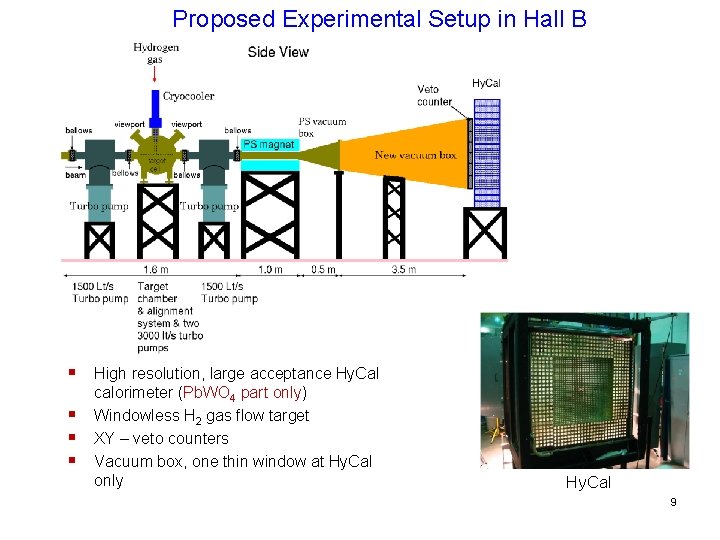
Proposed Experimental Setup in Hall B § High resolution, large acceptance Hy. Cal § § § calorimeter (Pb. WO 4 part only) Windowless H 2 gas flow target XY – veto counters Vacuum box, one thin window at Hy. Cal only Hy. Cal 9
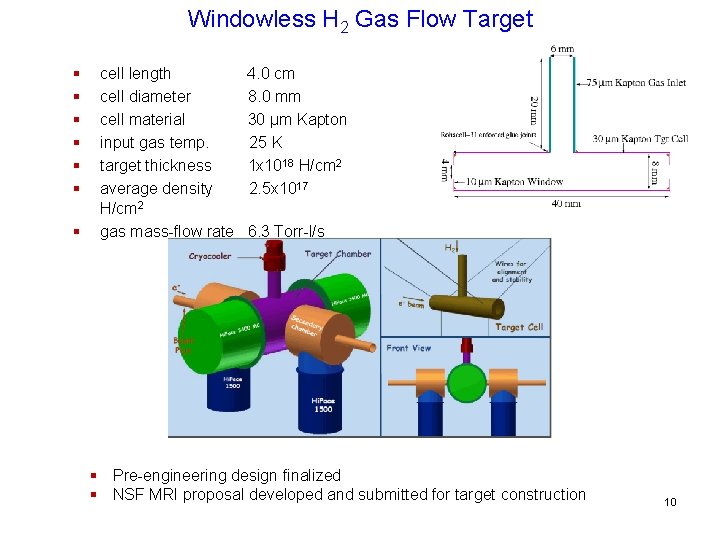
Windowless H 2 Gas Flow Target § § § § cell length cell diameter cell material input gas temp. target thickness average density H/cm 2 gas mass-flow rate 4. 0 cm 8. 0 mm 30 μm Kapton 25 K 1 x 10¹⁸ H/cm 2 2. 5 x 10¹⁷ 6. 3 Torr-l/s § Pre-engineering design finalized § NSF MRI proposal developed and submitted for target construction 10
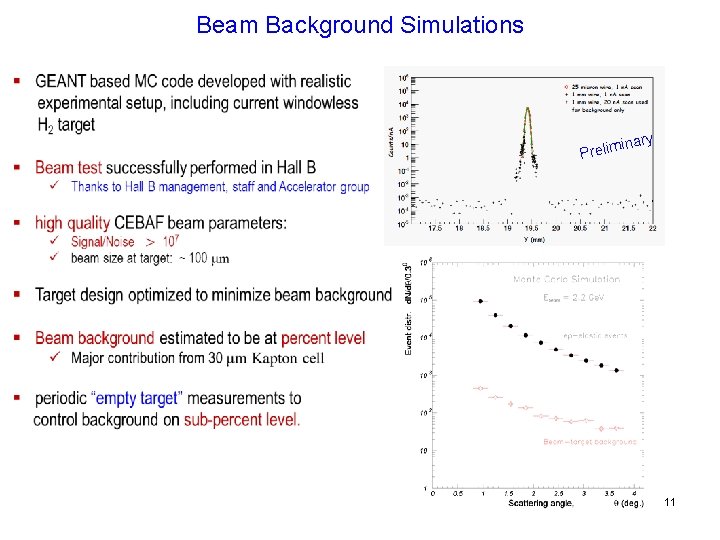
Beam Background Simulations ary in Prelim 11
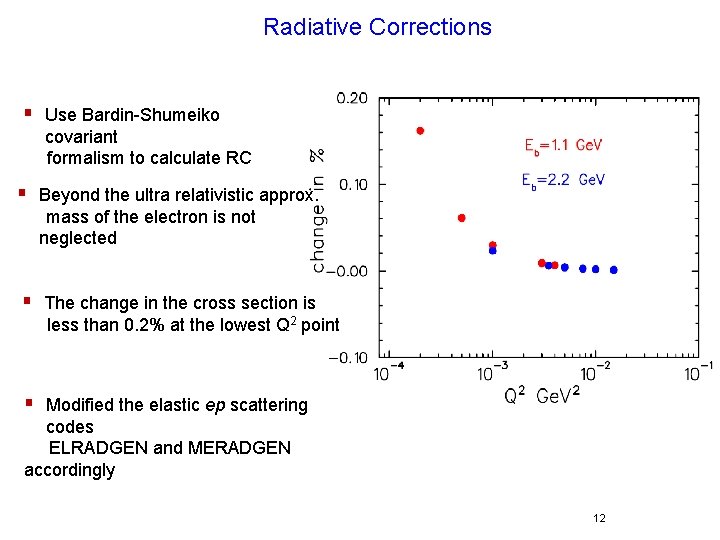
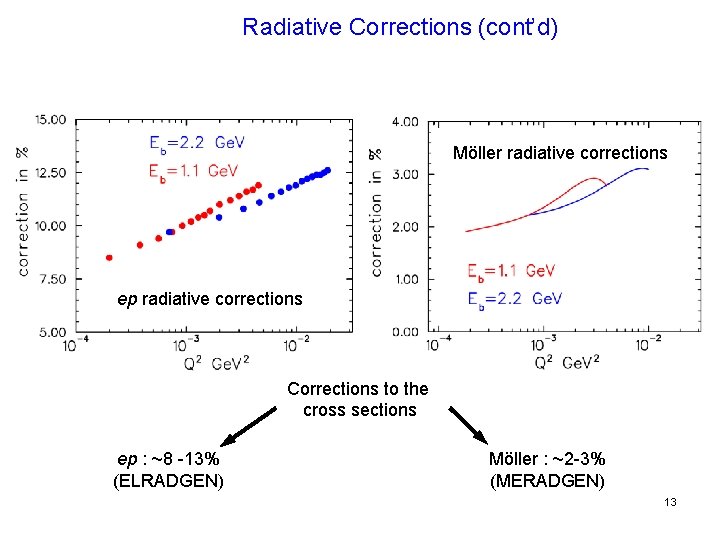
Radiative Corrections § Use Bardin-Shumeiko covariant formalism to calculate RC § Beyond the ultra relativistic approx. mass of the electron is not neglected § The change in the cross section is less than 0. 2% at the lowest Q 2 point § Modified the elastic ep scattering codes ELRADGEN and MERADGEN accordingly 12
Radiative Corrections (cont’d) Möller radiative corrections ep radiative corrections Corrections to the cross sections ep : ~8 -13% (ELRADGEN) Möller : ~2 -3% (MERADGEN) 13
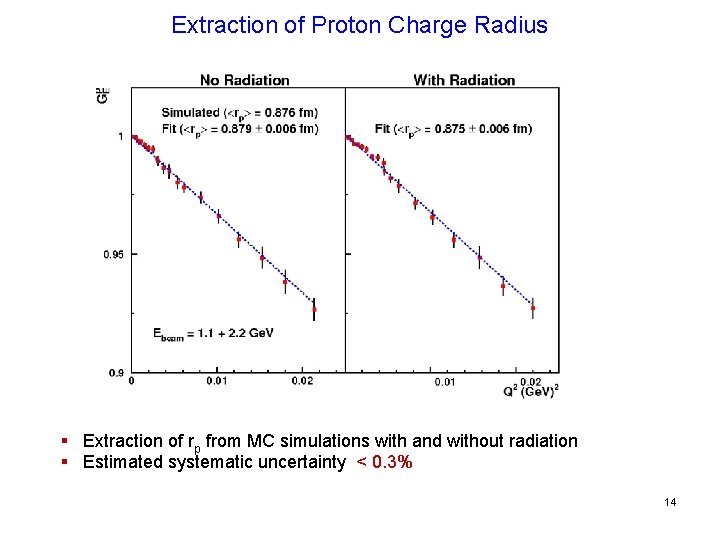
Extraction of Proton Charge Radius § Extraction of rp from MC simulations with and without radiation § Estimated systematic uncertainty < 0. 3% 14
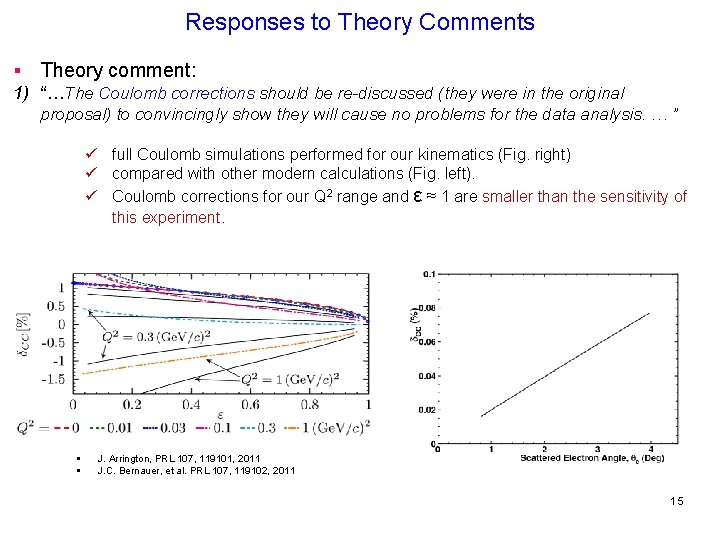
Responses to Theory Comments § Theory comment: 1) “…The Coulomb corrections should be re-discussed (they were in the original proposal) to convincingly show they will cause no problems for the data analysis. … ” ü full Coulomb simulations performed for our kinematics (Fig. right) ü compared with other modern calculations (Fig. left). ü Coulomb corrections for our Q 2 range and ε ≈ 1 are smaller than the sensitivity of this experiment. § § J. Arrington, PRL 107, 119101, 2011 J. C. Bernauer, et al. PRL 107, 119102, 2011 15
Responses to TAC Comments § TAC comments: 1) “…coordinate with JLab engineers during the design and construction of the target to ensure that it meets the lab’s stringent safety requirements …” ü We agree with this comment and already from the pre-engineering design phase of the target we have closely worked with Jlab engineers. We will continue this during the entire period of the full engineering design, construction and installation of the target. 2) “… A plan should be devised of how the focal plane will be maintained and calibrated after the Hall upgrade to 12 Ge. V operation …” 1) The photon tagger will be used for the 2) (a) gain equalizing to make an effective trigger and 3) (b) energy calibration of Hy. Cal. 4) For this, only a small part (upper ~20%) of the focal plane is needed. 2) We will continue discussions and work out all possible tagger related options with Hall B 3) management. 16
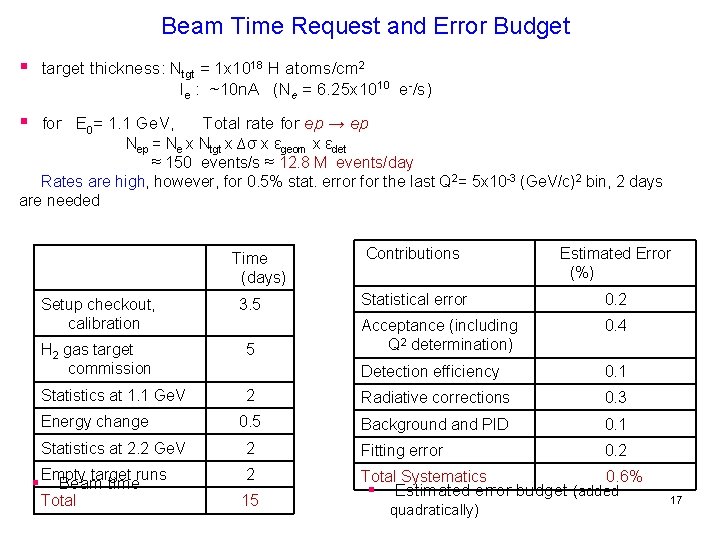
Beam Time Request and Error Budget § target thickness: Ntgt = 1 x 10¹⁸ H atoms/cm 2 Ie : ~10 n. A (Ne = 6. 25 x 1010 e-/s) § for E 0= 1. 1 Ge. V, Total rate for ep → ep Nep = Ne x Ntgt x ∆σ x εgeom x εdet ≈ 150 events/s ≈ 12. 8 M events/day Rates are high, however, for 0. 5% stat. error for the last Q 2= 5 x 10 -3 (Ge. V/c)2 bin, 2 days are needed Time (days) Contributions Estimated Error (%) Statistical error 0. 2 Acceptance (including Q 2 determination) 0. 4 Detection efficiency 0. 1 Setup checkout, calibration 3. 5 H 2 gas target commission 5 Statistics at 1. 1 Ge. V 2 Radiative corrections 0. 3 0. 5 Background and PID 0. 1 2 Fitting error 0. 2 2 Total Systematics 0. 6% Energy change Statistics at 2. 2 Ge. V target runs § Empty Beam time Total 15 § Estimated error budget (added quadratically) 17
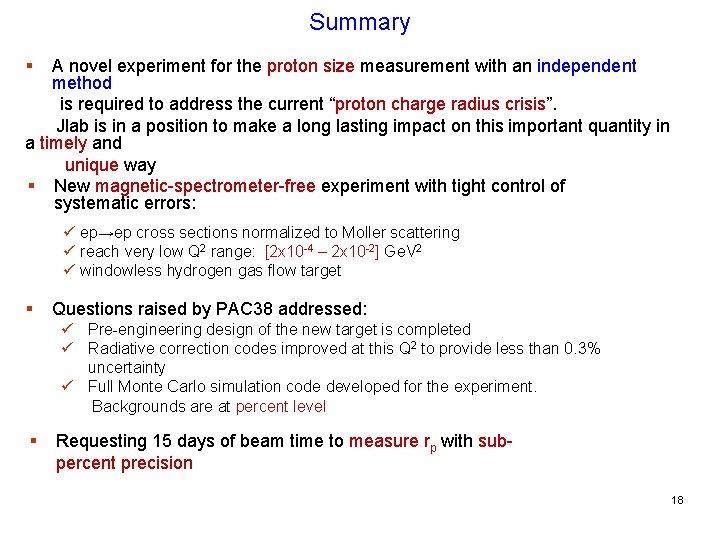
Summary § A novel experiment for the proton size measurement with an independent method is required to address the current “proton charge radius crisis”. Jlab is in a position to make a long lasting impact on this important quantity in a timely and unique way § New magnetic-spectrometer-free experiment with tight control of systematic errors: ü ep→ep cross sections normalized to Moller scattering ü reach very low Q 2 range: [2 x 10 -4 – 2 x 10 -2] Ge. V 2 ü windowless hydrogen gas flow target § Questions raised by PAC 38 addressed: ü Pre-engineering design of the new target is completed ü Radiative correction codes improved at this Q 2 to provide less than 0. 3% uncertainty ü Full Monte Carlo simulation code developed for the experiment. Backgrounds are at percent level § Requesting 15 days of beam time to measure rp with subpercent precision 18
The End
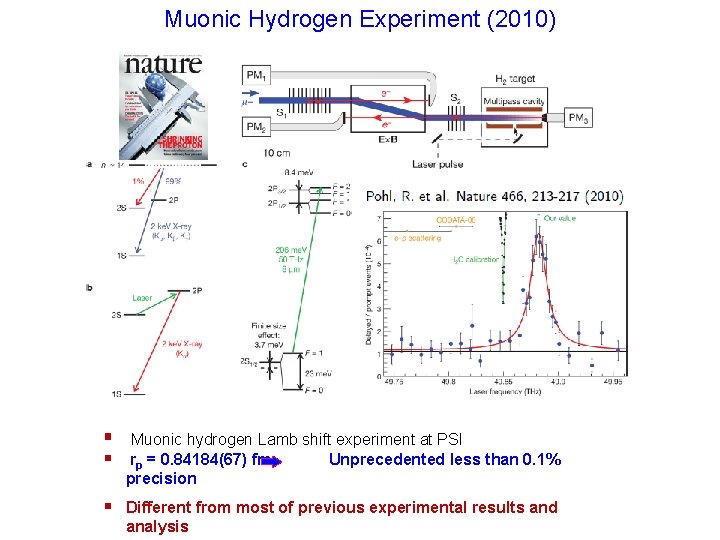
Muonic Hydrogen Experiment (2010) § § Muonic hydrogen Lamb shift experiment at PSI rp = 0. 84184(67) fm Unprecedented less than 0. 1% precision § Different from most of previous experimental results and analysis
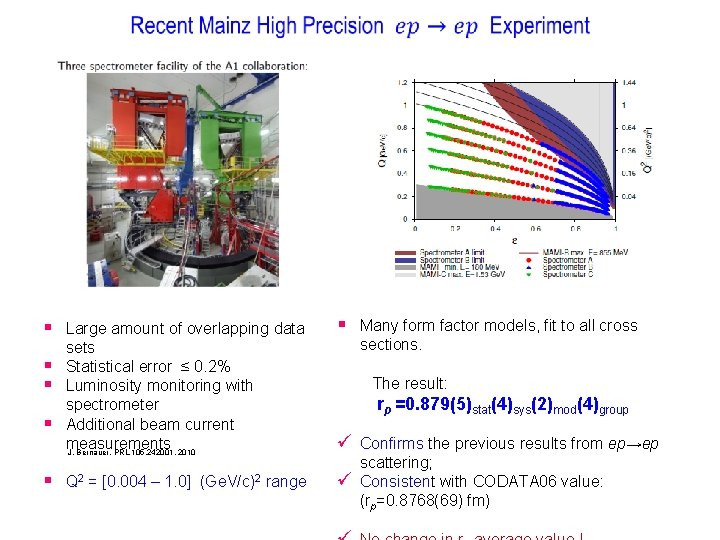
§ Large amount of overlapping data § § § sets Statistical error ≤ 0. 2% Luminosity monitoring with spectrometer Additional beam current measurements J. Bernauer, PRL 105, 242001, 2010 § Q 2 = [0. 004 – 1. 0] (Ge. V/c)2 range § Many form factor models, fit to all cross sections. The result: rp =0. 879(5)stat(4)sys(2)mod(4)group ü Confirms the previous results from ep→ep ü scattering; Consistent with CODATA 06 value: (rp=0. 8768(69) fm)
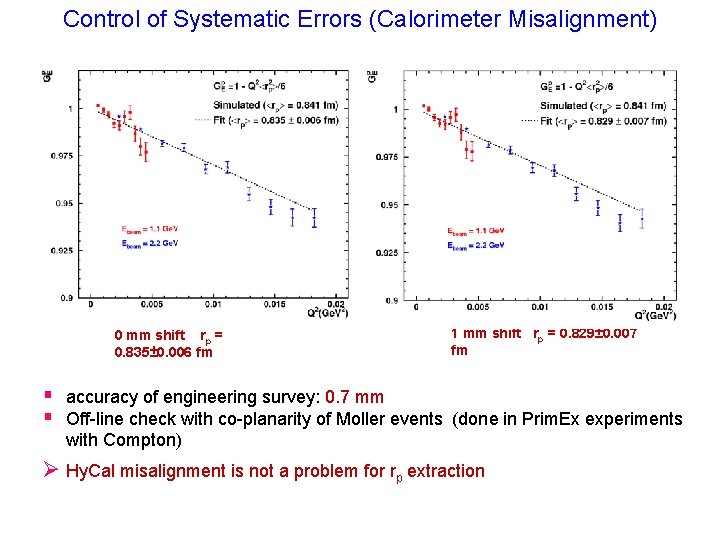
Control of Systematic Errors (Calorimeter Misalignment) 0 mm shift rp = 0. 835± 0. 006 fm 1 mm shift rp = 0. 829± 0. 007 fm § accuracy of engineering survey: 0. 7 mm § Off-line check with co-planarity of Moller events (done in Prim. Ex experiments with Compton) Ø Hy. Cal misalignment is not a problem for rp extraction
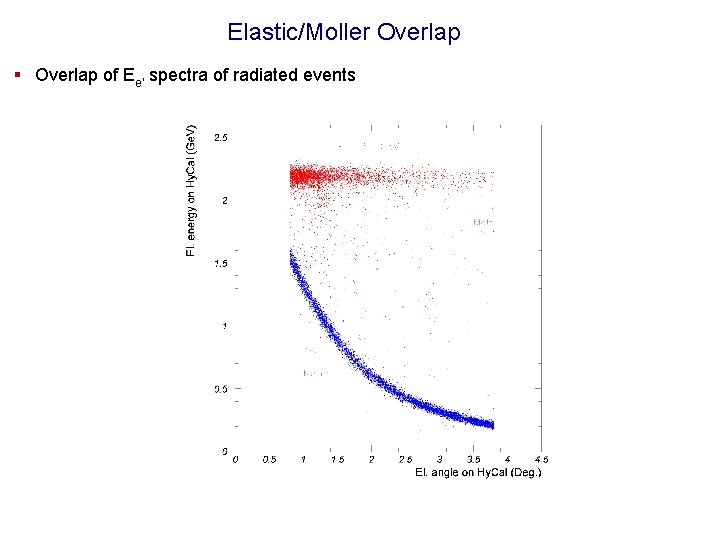
Elastic/Moller Overlap § Overlap of Ee' spectra of radiated events
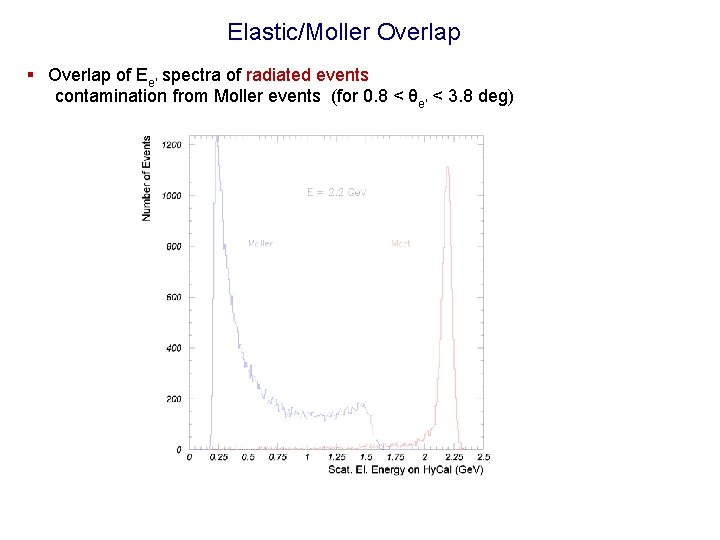
Elastic/Moller Overlap § Overlap of Ee' spectra of radiated events contamination from Moller events (for 0. 8 < θe' < 3. 8 deg)
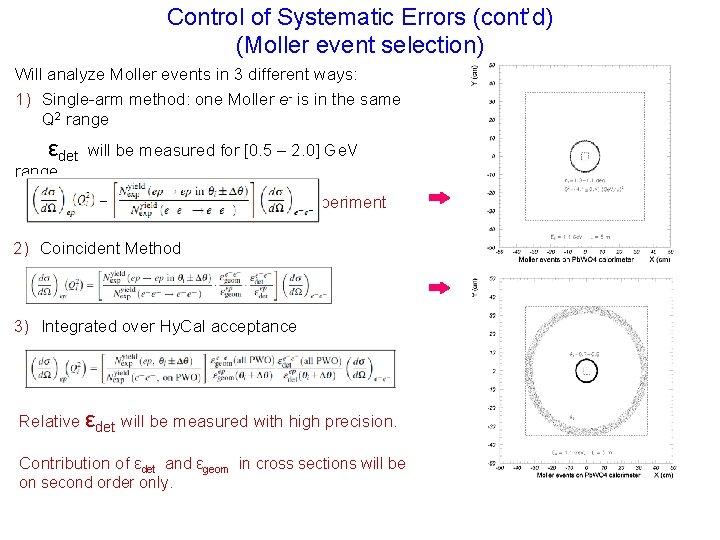
Control of Systematic Errors (cont’d) (Moller event selection) Will analyze Moller events in 3 different ways: 1) Single-arm method: one Moller e- is in the same Q 2 range εdet will be measured for [0. 5 – 2. 0] Ge. V range Relative εdet are needed for this experiment 2) Coincident Method 3) Integrated over Hy. Cal acceptance Relative εdet will be measured with high precision. Contribution of εdet and εgeom in cross sections will be on second order only.
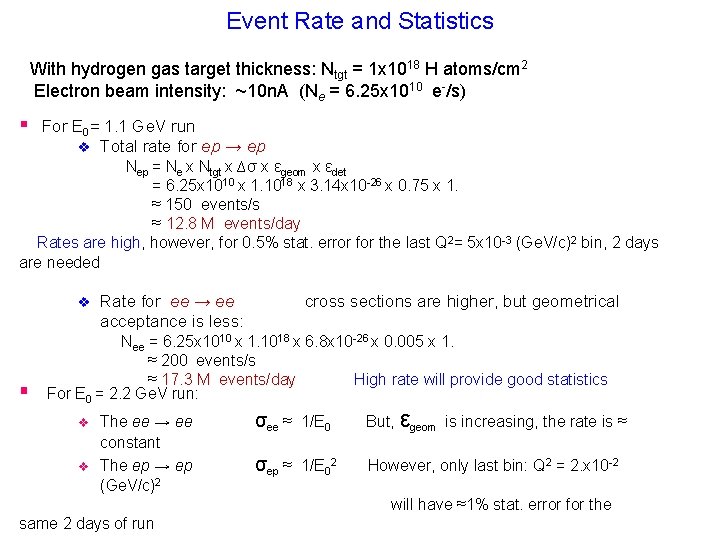
Event Rate and Statistics With hydrogen gas target thickness: Ntgt = 1 x 10¹⁸ H atoms/cm 2 Electron beam intensity: ~10 n. A (Ne = 6. 25 x 1010 e-/s) § For E 0= 1. 1 Ge. V run v Total rate for ep → ep Nep = Ne x Ntgt x ∆σ x εgeom x εdet = 6. 25 x 1010 x 1. 1018 x 3. 14 x 10 -26 x 0. 75 x 1. ≈ 150 events/s ≈ 12. 8 M events/day Rates are high, however, for 0. 5% stat. error for the last Q 2= 5 x 10 -3 (Ge. V/c)2 bin, 2 days are needed v § Rate for ee → ee acceptance is less: cross sections are higher, but geometrical Nee = 6. 25 x 1010 x 1. 1018 x 6. 8 x 10 -26 x 0. 005 x 1. ≈ 200 events/s ≈ 17. 3 M events/day High rate will provide good statistics For E 0 = 2. 2 Ge. V run: The ee → ee constant v The ep → ep (Ge. V/c)2 v σee ≈ 1/E 0 But, εgeom is increasing, the rate is ≈ σep ≈ 1/E 02 However, only last bin: Q 2 = 2. x 10 -2 will have ≈1% stat. error for the same 2 days of run
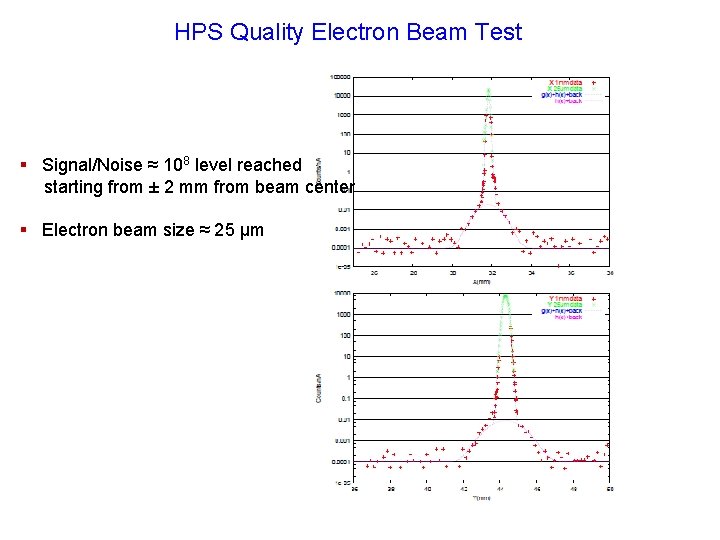
HPS Quality Electron Beam Test § Signal/Noise ≈ 108 level reached starting from ± 2 mm from beam center § Electron beam size ≈ 25 μm