
HIGH PLAINS BLVD STUDY FORMERLY KNOWN AS THE
HIGH PLAINS BLVD. STUDY (FORMERLY KNOWN AS THE I-25 PARALLEL ARTERIAL) Video Recording Outreach 7/21/2020
MISSION Provide regional connectivity throughout the Northern Colorado Transportation Network by planning north-south arterial alternatives to I-25 in conjunction with economic development and population growth BACKGROUND In 2003, Weld County began preparing for population and economic growth by conducting a study (I-25 Parallel Arterial Corridor Study) that observed an alternate arterial route to I-25. This route was recommended because of the opportunity for a continuous, connected roadway while accommodating future planned development. In 2018, development began to ramp-up, so Weld County, Larimer County, the Town’s of Mead, Berthoud, and Johnstown along with CDOT formed a Technical Advisory Committee (TAC) to reexamine the 2003 Study. A public meeting was held in September 2019 to discuss the alignment of High Plains Blvd and incorporate comments provided from that meeting into the preliminary design of High Plains Blvd.
SCOPE & GOALS Weld County, Larimer County, the Town of Berthoud, the Town of Johnstown, and the Town of Mead along with CDOT have been working together to advance the engineering level of design of High Plains Blvd to provide regional connectivity for anticipated population growth. GOAL II ENGINEERING CONSISTENCY ADOPTION The TAC has been preparing a preliminary design of the proposed arterial corridor with agreed upon engineering and access design criteria Local Agencies plan to adopt an Intergovernmental Agreement (IGA) for High Plains Blvd engineering design criteria and ACP Roadway design will progress to about a 30% level Local Agencies will host updated information on High Plains Blvd to their Websites Hydraulic design at floodplain crossings will progress to about a 20% level Development of an Access Control Plan (ACP) The preliminary design is expected to determine the ultimate footprint needed throughout the corridor for planning purposes
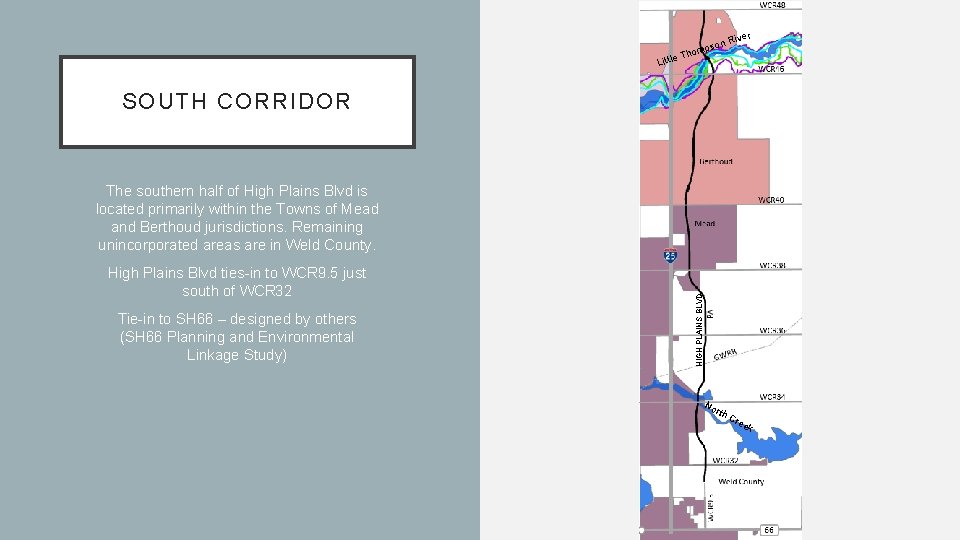
Little Th son omp r Rive SOUTH CORRIDOR High Plains Blvd ties-in to WCR 9. 5 just south of WCR 32 Tie-in to SH 66 – designed by others (SH 66 Planning and Environmental Linkage Study) HIGH PLAINS BLVD The southern half of High Plains Blvd is located primarily within the Towns of Mead and Berthoud jurisdictions. Remaining unincorporated areas are in Weld County. No rth C ree k
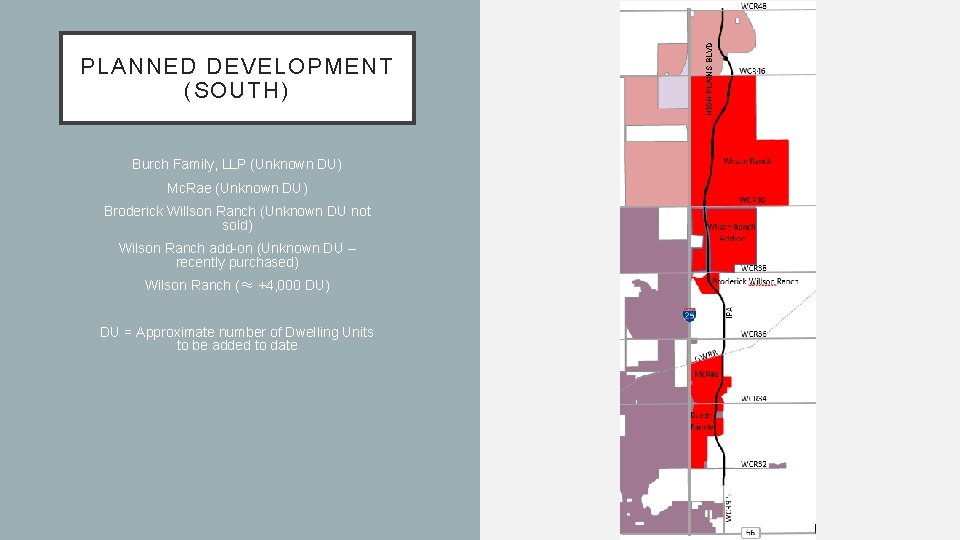
Burch Family, LLP (Unknown DU) Mc. Rae (Unknown DU) Broderick Willson Ranch (Unknown DU not sold) Wilson Ranch add-on (Unknown DU – recently purchased) Wilson Ranch (≈ +4, 000 DU) DU = Approximate number of Dwelling Units to be added to date HIGH PLAINS BLVD PLANNED DEVELOPMENT (SOUTH)
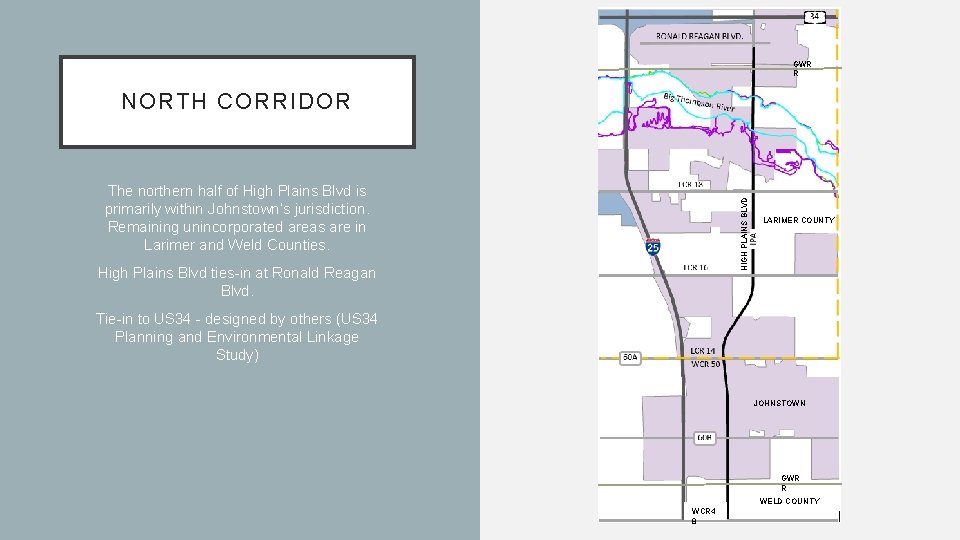
GWR R NORTH CORRIDOR HIGH PLAINS BLVD The northern half of High Plains Blvd is primarily within Johnstown’s jurisdiction. Remaining unincorporated areas are in Larimer and Weld Counties. High Plains Blvd ties-in at Ronald Reagan Blvd. LARIMER COUNTY Tie-in to US 34 - designed by others (US 34 Planning and Environmental Linkage Study) JOHNSTOWN GWR R WELD COUNTY WCR 4 8
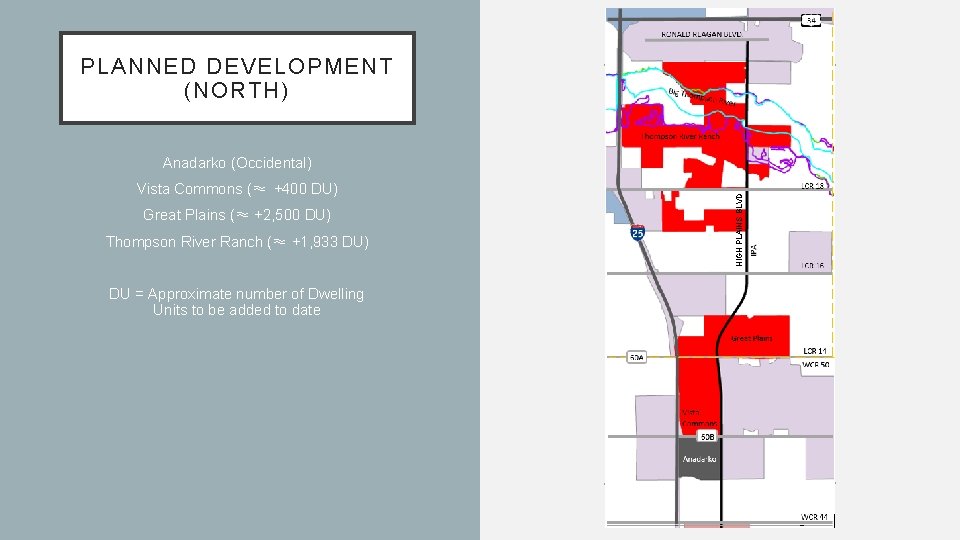
PLANNED DEVELOPMENT (NORTH) Vista Commons (≈ +400 DU) Great Plains (≈ +2, 500 DU) Thompson River Ranch (≈ +1, 933 DU) HIGH PLAINS BLVD Anadarko (Occidental) DU = Approximate number of Dwelling Units to be added to date WCR 4 8
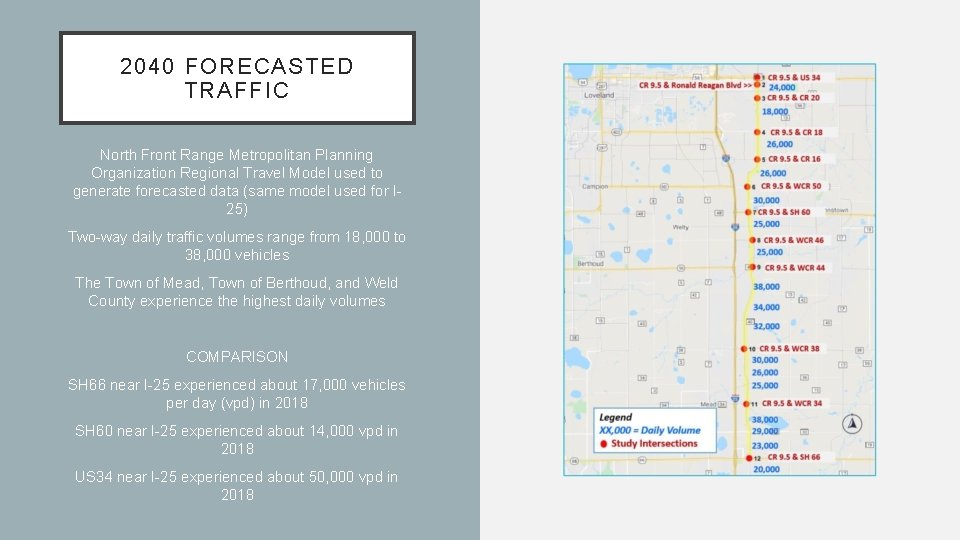
2040 FORECASTED TRAFFIC North Front Range Metropolitan Planning Organization Regional Travel Model used to generate forecasted data (same model used for I 25) Two-way daily traffic volumes range from 18, 000 to 38, 000 vehicles The Town of Mead, Town of Berthoud, and Weld County experience the highest daily volumes COMPARISON SH 66 near I-25 experienced about 17, 000 vehicles per day (vpd) in 2018 SH 60 near I-25 experienced about 14, 000 vpd in 2018 US 34 near I-25 experienced about 50, 000 vpd in 2018
ACCESS CONTROL PLAN (BACKGROUND) PURPOSE Allow a roadway design plan which designates preferred access locations and their designs for the purpose of bringing those portions of roadway included in the access control plan into conformance with their functional classification to the extent feasible EXISTING GUIDELINES TAC’s PLAN Each Local Public Agency along the High Plains Blvd corridor maintains their own standards for access spacing. Review existing access criteria and agree upon a standard criteria for this arterial corridor. Then present to the Public and incorporate their comments in a final Access Control Plan that will be signed into an IGA.
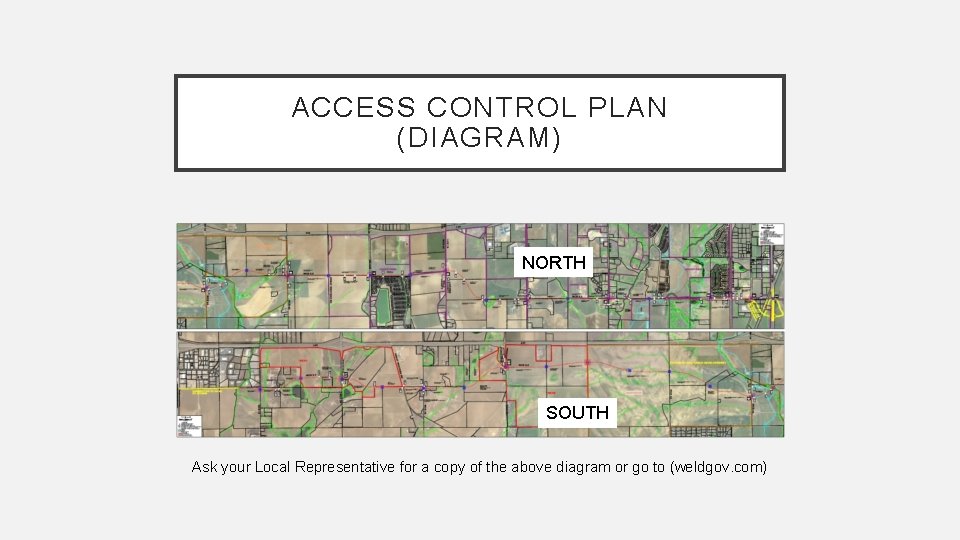
ACCESS CONTROL PLAN (DIAGRAM) NORTH SOUTH Ask your Local Representative for a copy of the above diagram or go to (weldgov. com)
NEXT STEPS F O R TAC Review the Public’s comments for the TAC to recommend be incorporated into the Access Control Plan Develop and sign an IGA to make the Access Control Plan and other Engineering Design Criteria official
CONSTRUCTION Developer Driven (the roadway corridor is dependent on new developments and agreements with the local jurisdiction) Interim and Ultimate Phases (in some locations the ultimate roadway footprint may not be constructed for a long time) Timeline varies (today to 20+ years) Expected to follow design and access criteria from adopted IGA Arterial will be locally owned and maintained
COMMENTS We want to hear your comments about the Access Control Plan. Steps to provide feedback and comments: One-on-one meetings August 12 and 13 – Sign up via Weld County’s Website (weldgov. com) Contact your Local Agency Official (see next slide)
CONTACTS WELD COUNTY – Elizabeth Relford (erelford@weldgov. com), Don Dunker (ddunker@weldgov. com) LARIMER COUNTY – Rusty Mc. Daniel (mcdanird@co. larimer. co. us) TOWN OF MEAD – Erika Rasmussen (erasmussen@townofmead. org) TOWN OF BERTHOUD – Chris Kirk (ckirk@berthoud. org), Walt Elish (welish@berthoud. org), Stephanie Brothers (sbrothers@berthoud. org) TOWN OF JOHNSTOWN – Kim Meyer (kmeyer@townofjohnstown. com), Matt Le. Cerf (mlecerf@townofjohnstown. com) LOVELAND (interested party) – Dave Klockeman (Dave. Klockeman@cityofloveland. org)
- Slides: 14