
High performance sensor interfaces Efficient system architectures and
![External signal aliasing +[+(Vext; 1 + Vref) + Voff] -[-(Vext; 2 + Vref) +](https://slidetodoc.com/presentation_image_h2/efddb3cd0544faceb96cbb1e8934d503/image-16.jpg "External signal aliasing +[+(Vext; 1 + Vref) + Voff] -[-(Vext; 2 + Vref) +")
- Slides: 55
High performance sensor interfaces: Efficient system architectures and calibration techniques Marc Pastre – 2011
Outline • Sensor interfaces – System architectures • Open-loop vs. Closed-loop • Continuous-time vs. Sampled – Frontends • Voltage-, current-, charge-mode • Case studies – Hall sensor – MEMS-based accelerometer • Digital calibration – Successive approximations – M/2+M Sub-binary DACs for successive approximations • Conclusion High performance sensor interfaces, Marc Pastre 2011 2
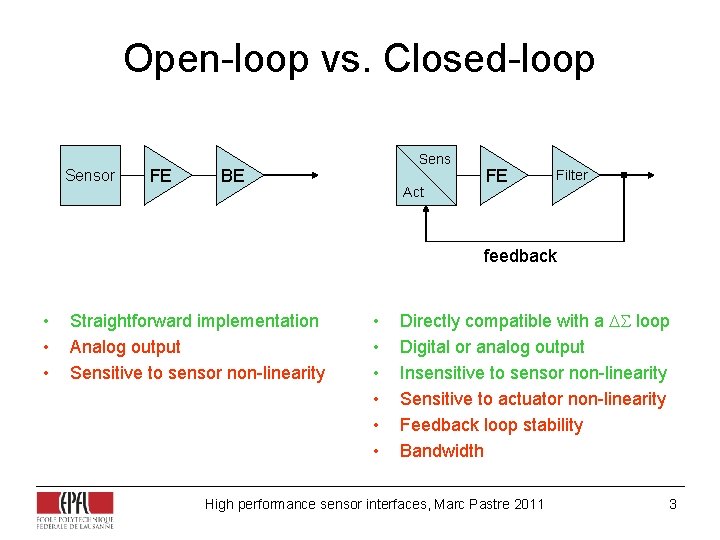
Open-loop vs. Closed-loop Sensor FE Sens BE Act FE Filter feedback • • • Straightforward implementation Analog output Sensitive to sensor non-linearity • • • Directly compatible with a S loop Digital or analog output Insensitive to sensor non-linearity Sensitive to actuator non-linearity Feedback loop stability Bandwidth High performance sensor interfaces, Marc Pastre 2011 3
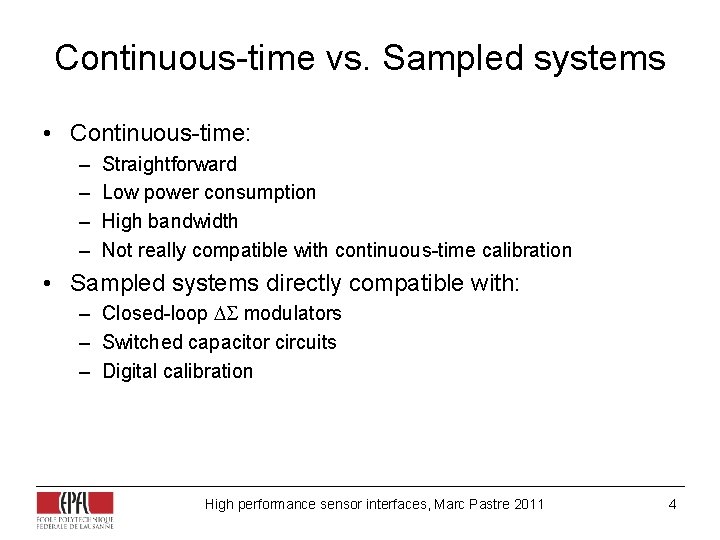
Continuous-time vs. Sampled systems • Continuous-time: – – Straightforward Low power consumption High bandwidth Not really compatible with continuous-time calibration • Sampled systems directly compatible with: – Closed-loop S modulators – Switched capacitor circuits – Digital calibration High performance sensor interfaces, Marc Pastre 2011 4
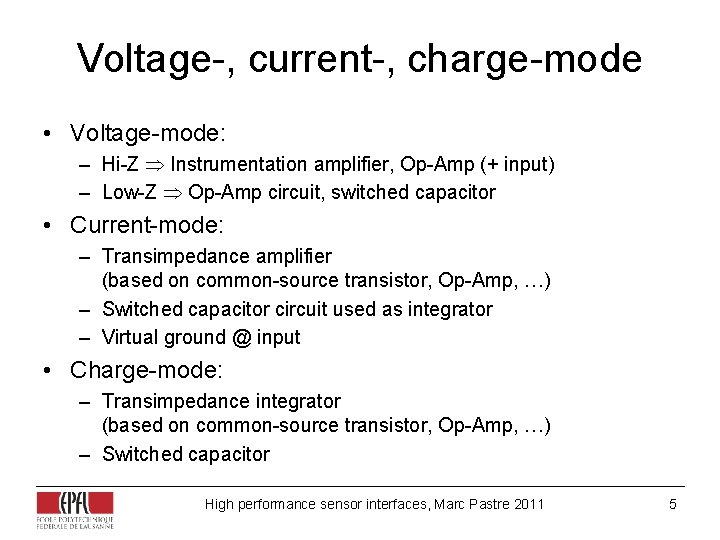
Voltage-, current-, charge-mode • Voltage-mode: – Hi-Z Instrumentation amplifier, Op-Amp (+ input) – Low-Z Op-Amp circuit, switched capacitor • Current-mode: – Transimpedance amplifier (based on common-source transistor, Op-Amp, …) – Switched capacitor circuit used as integrator – Virtual ground @ input • Charge-mode: – Transimpedance integrator (based on common-source transistor, Op-Amp, …) – Switched capacitor High performance sensor interfaces, Marc Pastre 2011 5
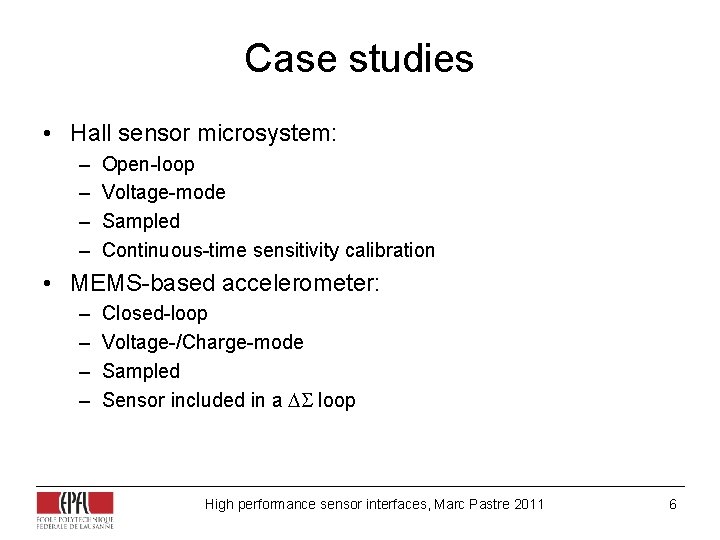
Case studies • Hall sensor microsystem: – – Open-loop Voltage-mode Sampled Continuous-time sensitivity calibration • MEMS-based accelerometer: – – Closed-loop Voltage-/Charge-mode Sampled Sensor included in a S loop High performance sensor interfaces, Marc Pastre 2011 6
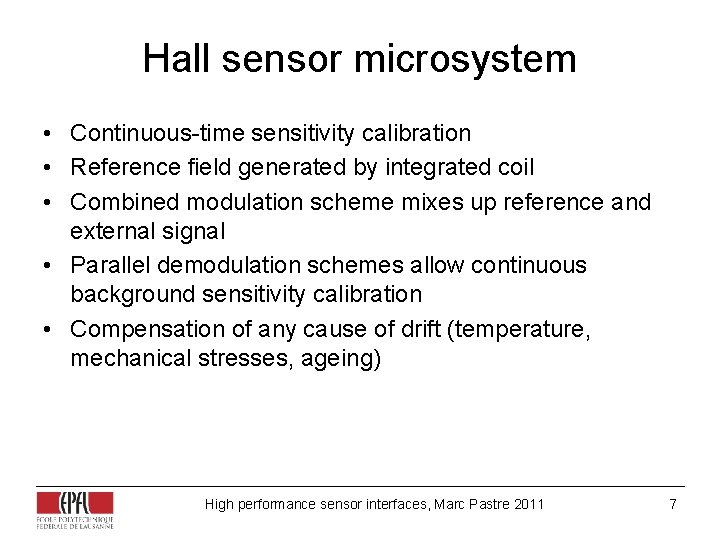
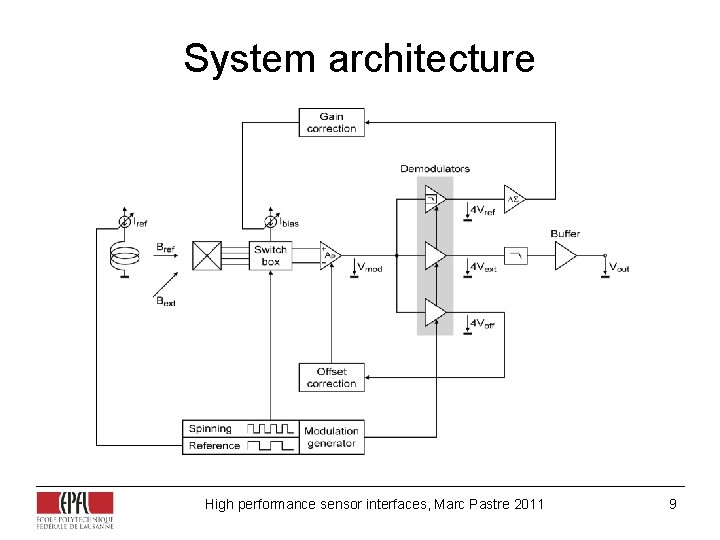
Hall sensor microsystem • Continuous-time sensitivity calibration • Reference field generated by integrated coil • Combined modulation scheme mixes up reference and external signal • Parallel demodulation schemes allow continuous background sensitivity calibration • Compensation of any cause of drift (temperature, mechanical stresses, ageing) High performance sensor interfaces, Marc Pastre 2011 7
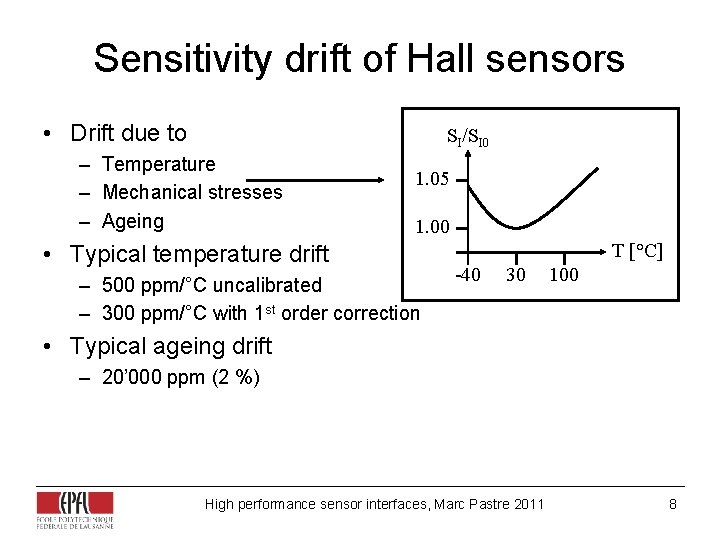
Sensitivity drift of Hall sensors • Drift due to SI/SI 0 – Temperature – Mechanical stresses – Ageing 1. 05 1. 00 • Typical temperature drift – 500 ppm/°C uncalibrated – 300 ppm/°C with 1 st order correction T [°C] -40 30 100 • Typical ageing drift – 20’ 000 ppm (2 %) High performance sensor interfaces, Marc Pastre 2011 8
System architecture High performance sensor interfaces, Marc Pastre 2011 9
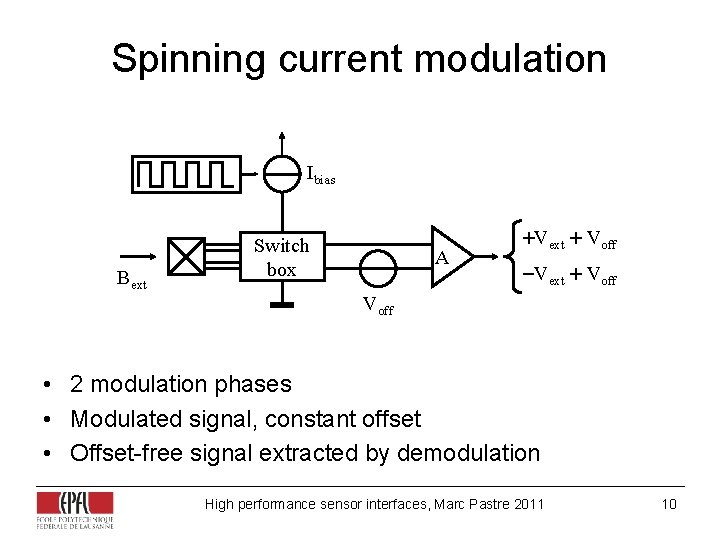
Spinning current modulation Ibias Bext Switch box A +Vext + Voff -Vext + Voff • 2 modulation phases • Modulated signal, constant offset • Offset-free signal extracted by demodulation High performance sensor interfaces, Marc Pastre 2011 10
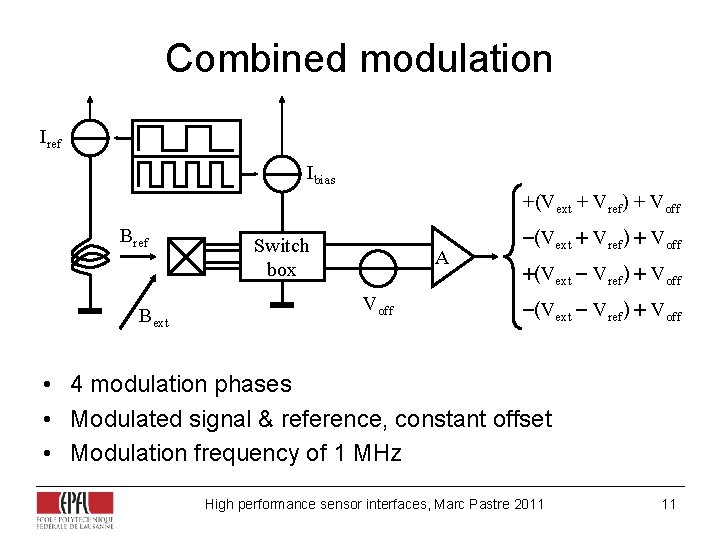
Combined modulation Iref Ibias +(Vext + Vref) + Voff Bref Bext Switch box A Voff -(Vext + Vref) + Voff +(Vext - Vref) + Voff -(Vext - Vref) + Voff • 4 modulation phases • Modulated signal & reference, constant offset • Modulation frequency of 1 MHz High performance sensor interfaces, Marc Pastre 2011 11
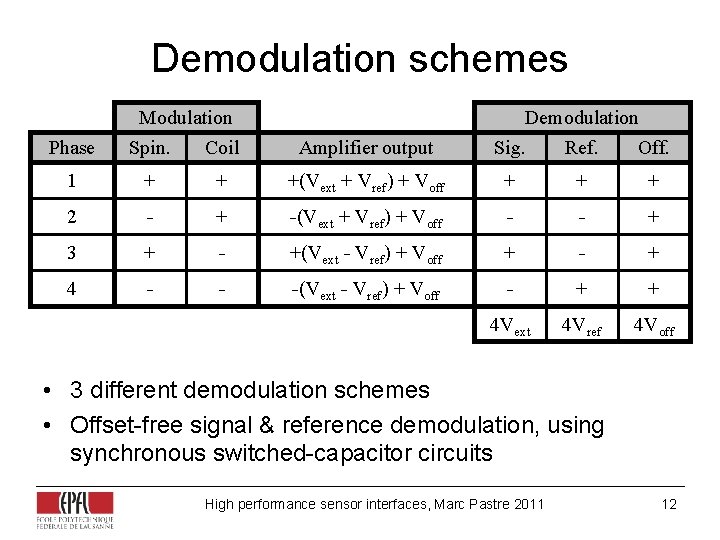
Demodulation schemes Modulation Demodulation Phase Spin. Coil Amplifier output Sig. Ref. Off. 1 + + +(Vext + Vref) + Voff + + + 2 - + -(Vext + Vref) + Voff - - + 3 + - +(Vext - Vref) + Voff + - + 4 - - -(Vext - Vref) + Voff - + + 4 Vext 4 Vref 4 Voff • 3 different demodulation schemes • Offset-free signal & reference demodulation, using synchronous switched-capacitor circuits High performance sensor interfaces, Marc Pastre 2011 12
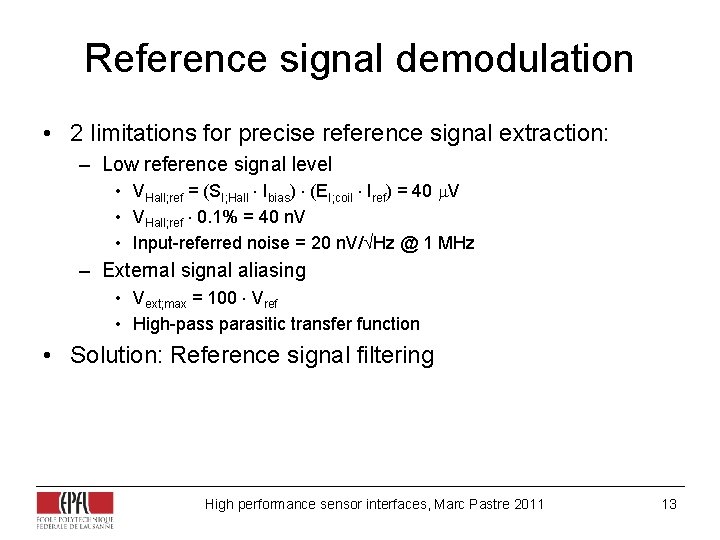
Reference signal demodulation • 2 limitations for precise reference signal extraction: – Low reference signal level • VHall; ref = (SI; Hall Ibias) (EI; coil Iref) = 40 V • VHall; ref 0. 1% = 40 n. V • Input-referred noise = 20 n. V/ Hz @ 1 MHz – External signal aliasing • Vext; max = 100 Vref • High-pass parasitic transfer function • Solution: Reference signal filtering High performance sensor interfaces, Marc Pastre 2011 13
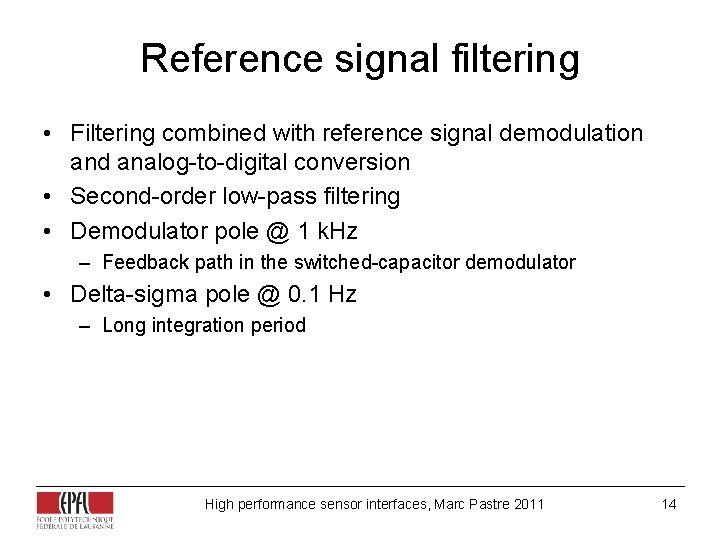
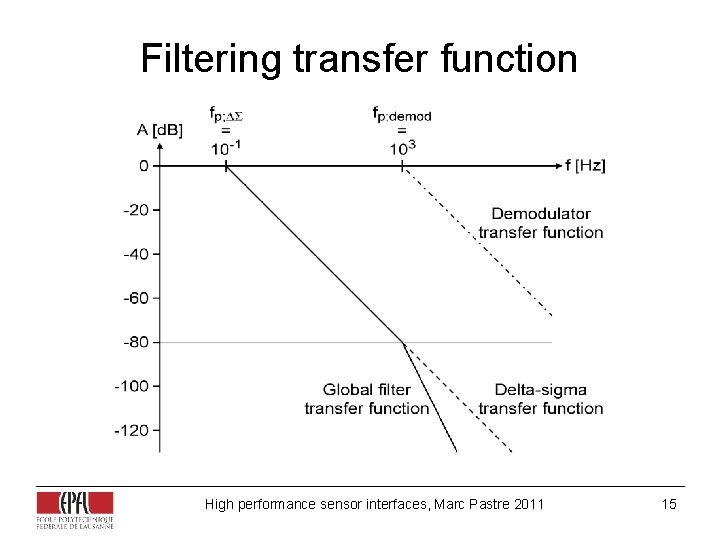
Reference signal filtering • Filtering combined with reference signal demodulation and analog-to-digital conversion • Second-order low-pass filtering • Demodulator pole @ 1 k. Hz – Feedback path in the switched-capacitor demodulator • Delta-sigma pole @ 0. 1 Hz – Long integration period High performance sensor interfaces, Marc Pastre 2011 14
Filtering transfer function High performance sensor interfaces, Marc Pastre 2011 15
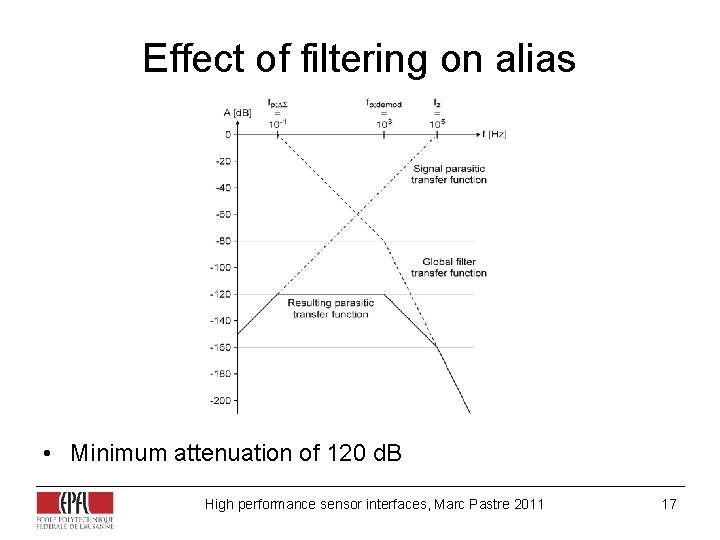
External signal aliasing +[+(Vext; 1 + Vref) + Voff] -[-(Vext; 2 + Vref) + Voff] -[+(Vext; 3 - Vref) + Voff] +[-(Vext; 4 - Vref) + Voff] = 4 Vref + [(Vext; 1 + Vext; 2) - (Vext; 3 + Vext; 4)] Parasitic term • Variation of the external signal between the reference demodulation phases alias • Derivative effect high-pass transfer function • Zero @ 100 k. Hz High performance sensor interfaces, Marc Pastre 2011 16
Effect of filtering on alias • Minimum attenuation of 120 d. B High performance sensor interfaces, Marc Pastre 2011 17
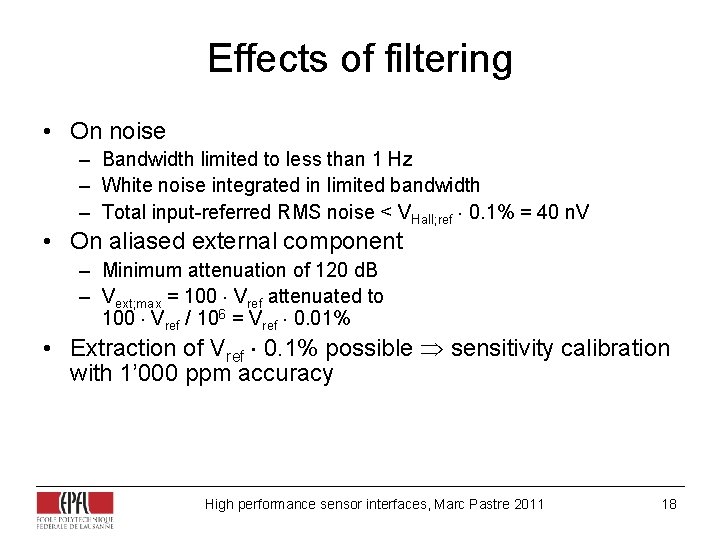
Effects of filtering • On noise – Bandwidth limited to less than 1 Hz – White noise integrated in limited bandwidth – Total input-referred RMS noise < VHall; ref 0. 1% = 40 n. V • On aliased external component – Minimum attenuation of 120 d. B – Vext; max = 100 Vref attenuated to 100 Vref / 106 = Vref 0. 01% • Extraction of Vref 0. 1% possible sensitivity calibration with 1’ 000 ppm accuracy High performance sensor interfaces, Marc Pastre 2011 18
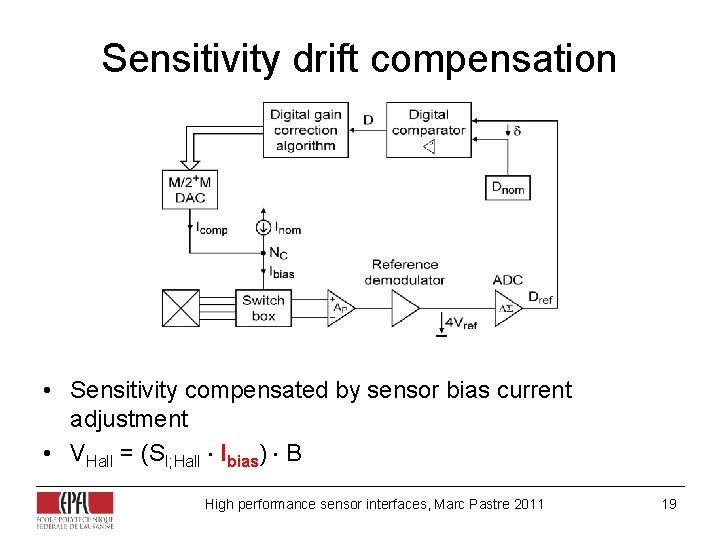
Sensitivity drift compensation • Sensitivity compensated by sensor bias current adjustment • VHall = (SI; Hall Ibias) B High performance sensor interfaces, Marc Pastre 2011 19
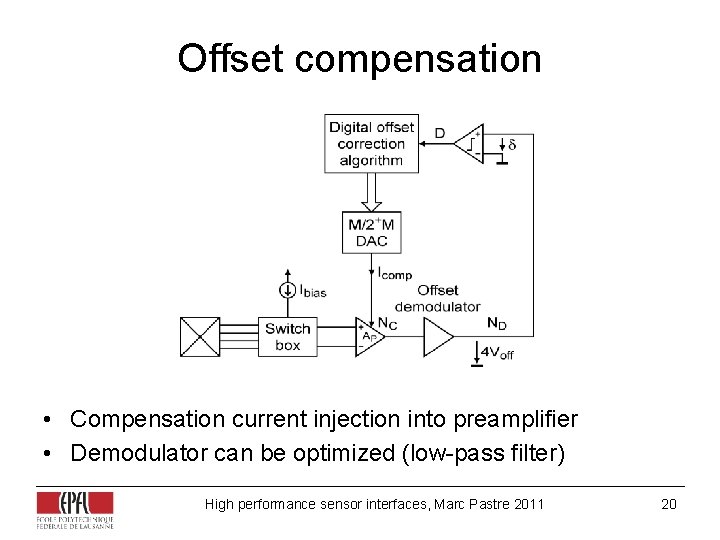
Offset compensation • Compensation current injection into preamplifier • Demodulator can be optimized (low-pass filter) High performance sensor interfaces, Marc Pastre 2011 20
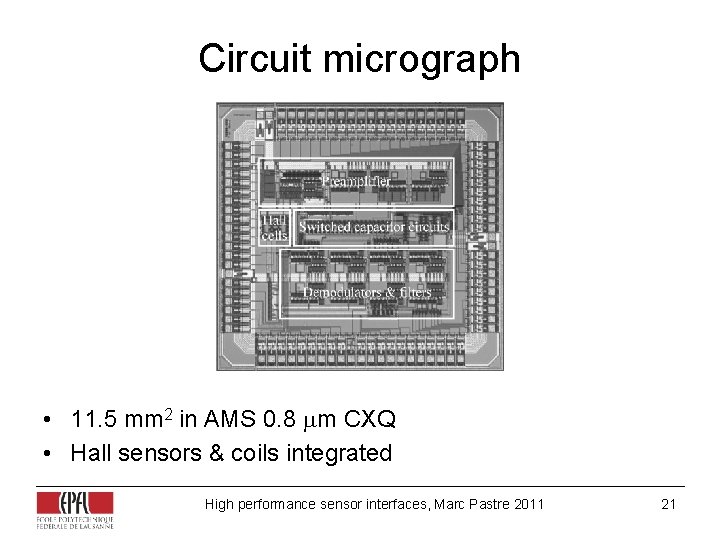
Circuit micrograph • 11. 5 mm 2 in AMS 0. 8 m CXQ • Hall sensors & coils integrated High performance sensor interfaces, Marc Pastre 2011 21
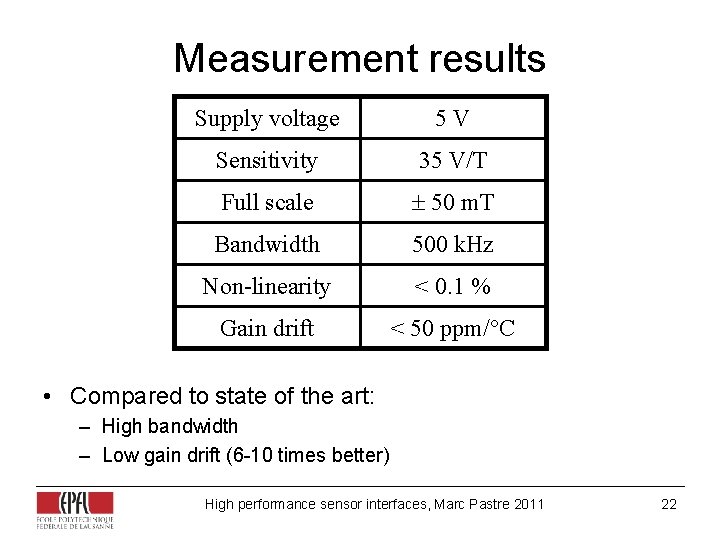
Measurement results Supply voltage 5 V Sensitivity 35 V/T Full scale 50 m. T Bandwidth 500 k. Hz Non-linearity < 0. 1 % Gain drift < 50 ppm/ C • Compared to state of the art: – High bandwidth – Low gain drift (6 -10 times better) High performance sensor interfaces, Marc Pastre 2011 22
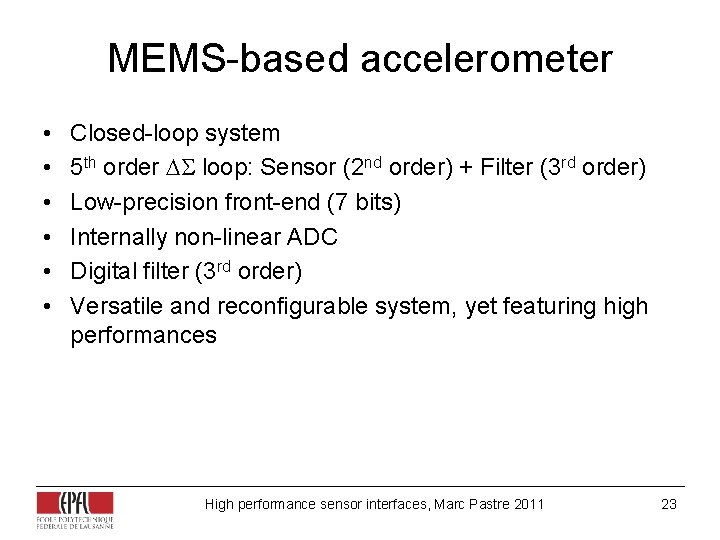
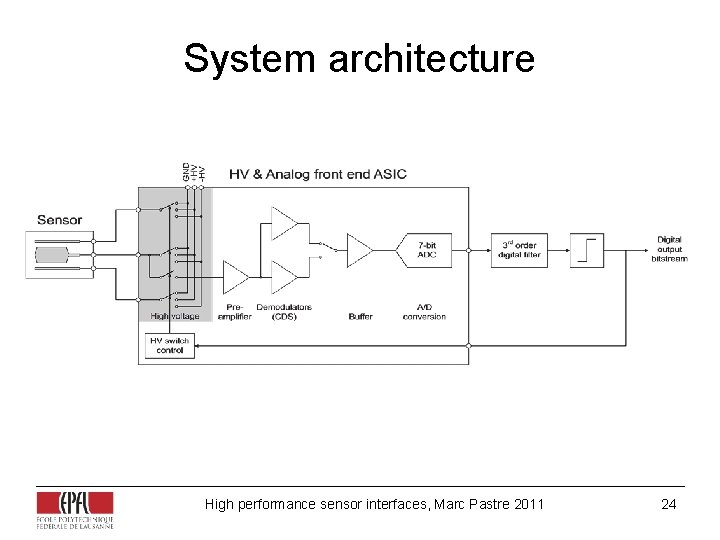
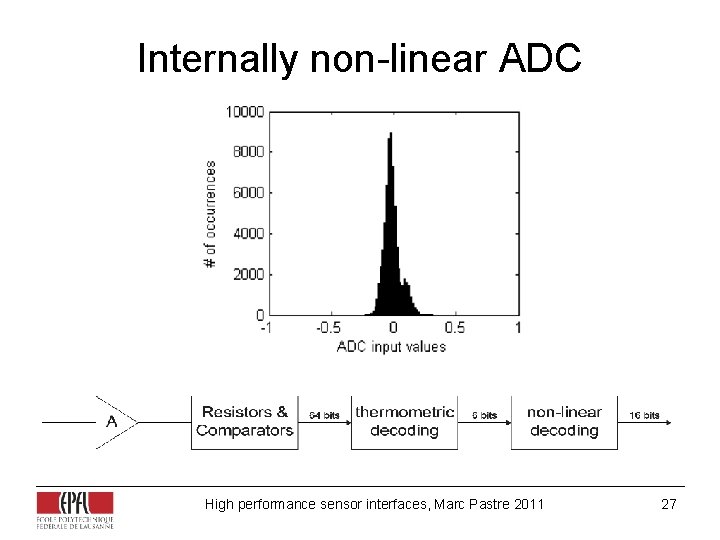
MEMS-based accelerometer • • • Closed-loop system 5 th order S loop: Sensor (2 nd order) + Filter (3 rd order) Low-precision front-end (7 bits) Internally non-linear ADC Digital filter (3 rd order) Versatile and reconfigurable system, yet featuring high performances High performance sensor interfaces, Marc Pastre 2011 23
System architecture High performance sensor interfaces, Marc Pastre 2011 24
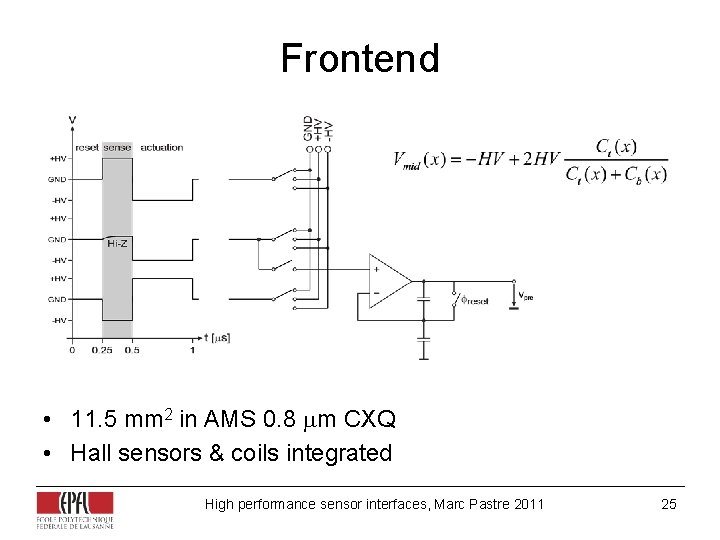
Frontend • 11. 5 mm 2 in AMS 0. 8 m CXQ • Hall sensors & coils integrated High performance sensor interfaces, Marc Pastre 2011 25
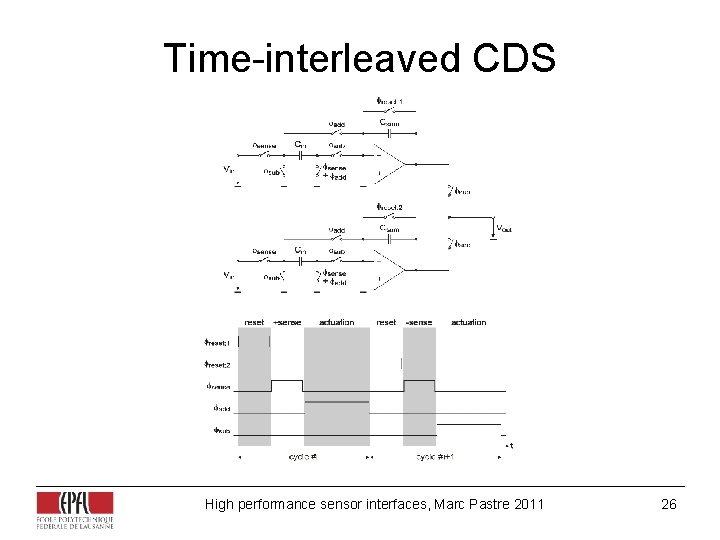
Time-interleaved CDS High performance sensor interfaces, Marc Pastre 2011 26
Internally non-linear ADC High performance sensor interfaces, Marc Pastre 2011 27
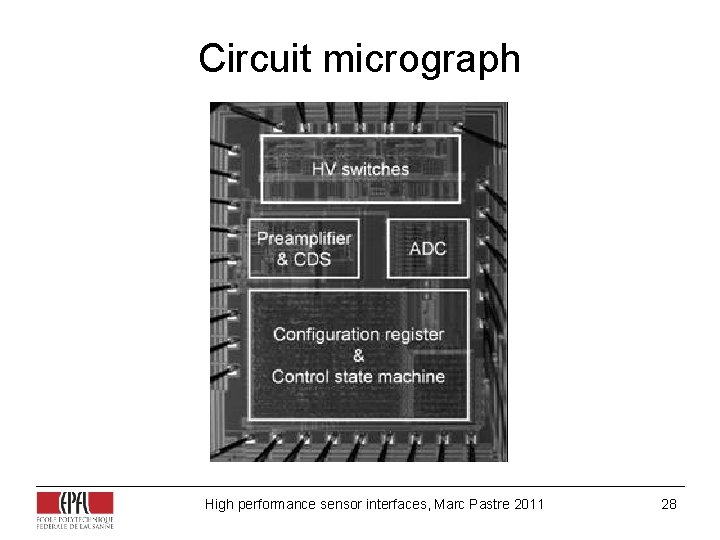
Circuit micrograph High performance sensor interfaces, Marc Pastre 2011 28
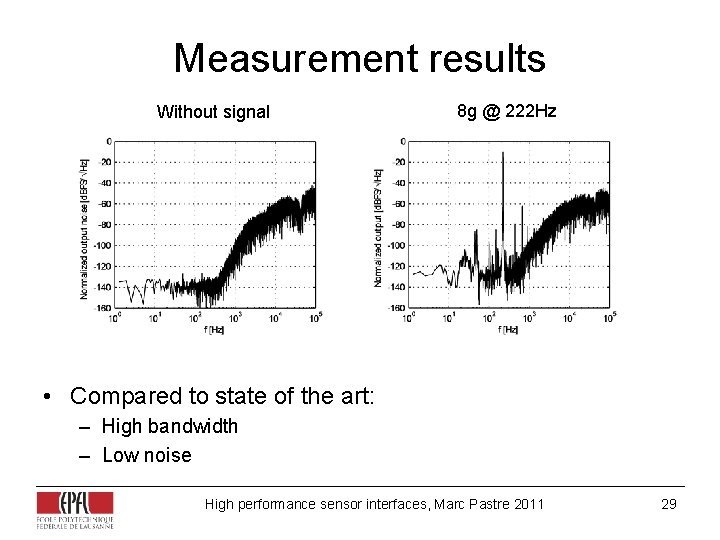
Measurement results Without signal 8 g @ 222 Hz • Compared to state of the art: – High bandwidth – Low noise High performance sensor interfaces, Marc Pastre 2011 29
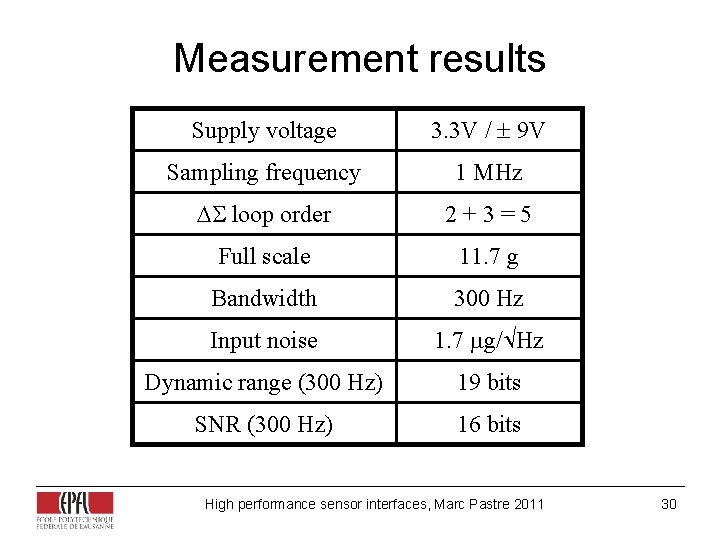
Measurement results Supply voltage 3. 3 V / 9 V Sampling frequency 1 MHz S loop order 2+3=5 Full scale 11. 7 g Bandwidth 300 Hz Input noise 1. 7 g/ Hz Dynamic range (300 Hz) 19 bits SNR (300 Hz) 16 bits High performance sensor interfaces, Marc Pastre 2011 30
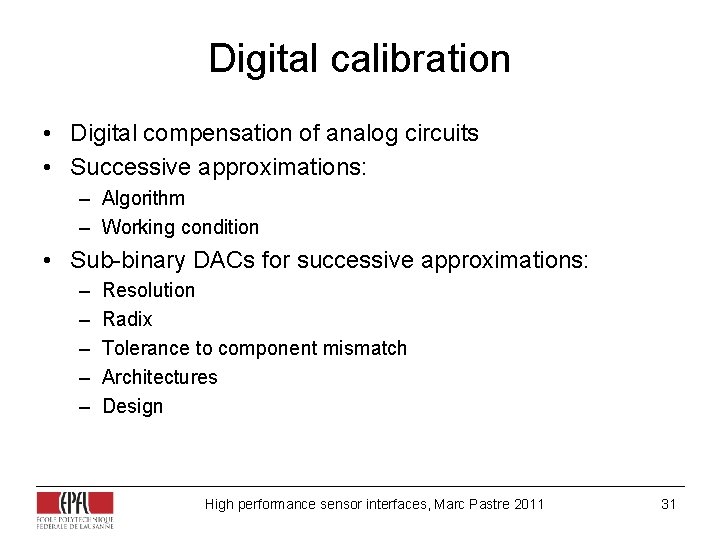
Digital calibration • Digital compensation of analog circuits • Successive approximations: – Algorithm – Working condition • Sub-binary DACs for successive approximations: – – – Resolution Radix Tolerance to component mismatch Architectures Design High performance sensor interfaces, Marc Pastre 2011 31
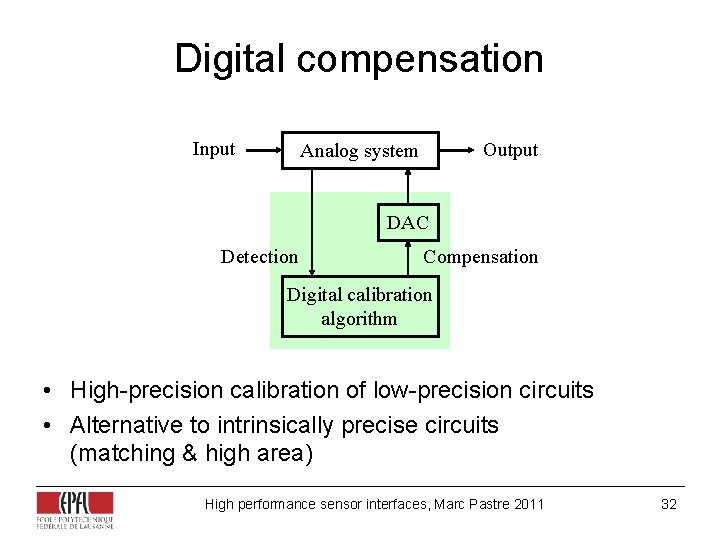
Digital compensation Input Output Analog system DAC Detection Compensation Digital calibration algorithm • High-precision calibration of low-precision circuits • Alternative to intrinsically precise circuits (matching & high area) High performance sensor interfaces, Marc Pastre 2011 32
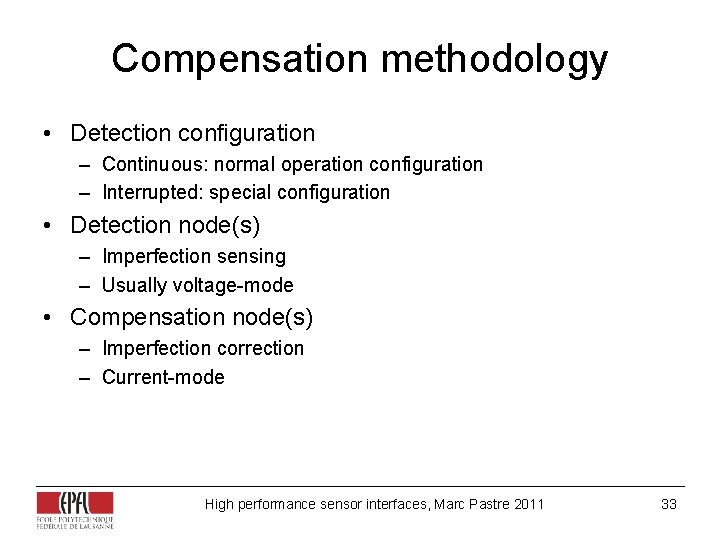
Compensation methodology • Detection configuration – Continuous: normal operation configuration – Interrupted: special configuration • Detection node(s) – Imperfection sensing – Usually voltage-mode • Compensation node(s) – Imperfection correction – Current-mode High performance sensor interfaces, Marc Pastre 2011 33
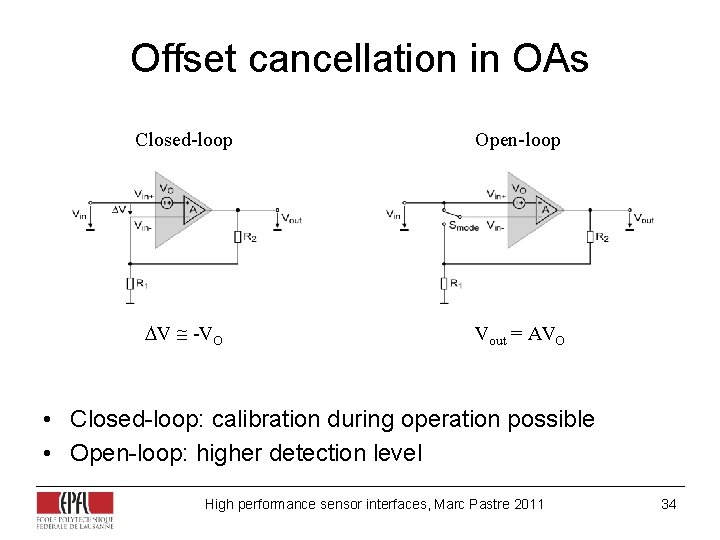
Offset cancellation in OAs Closed-loop Open-loop V -VO Vout = AVO • Closed-loop: calibration during operation possible • Open-loop: higher detection level High performance sensor interfaces, Marc Pastre 2011 34
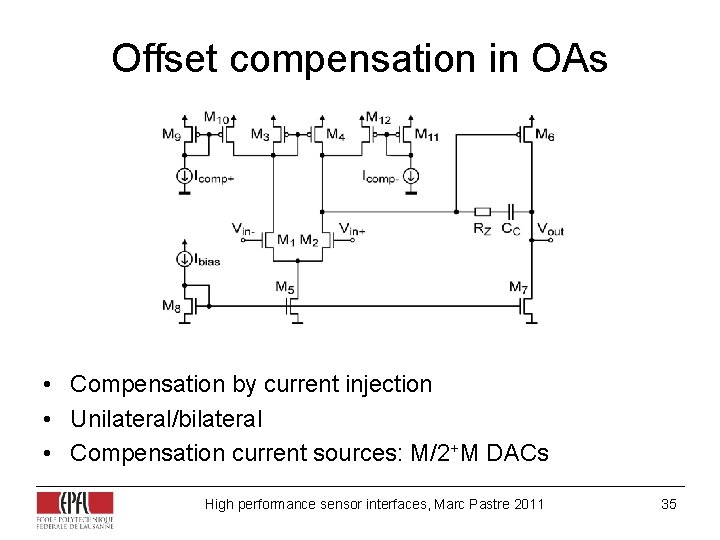
Offset compensation in OAs • Compensation by current injection • Unilateral/bilateral • Compensation current sources: M/2+M DACs High performance sensor interfaces, Marc Pastre 2011 35
Choice of compensation node(s) • Compensation current corrects imperfection only • Current injected by a small current mirror, taking into account: – Channel length modulation – Saturation voltage • Connection of the current mirror does not affect the compensation node characteristics: – Impedance – Parasitic capacitance – System parameters linked to parasitics High performance sensor interfaces, Marc Pastre 2011 36
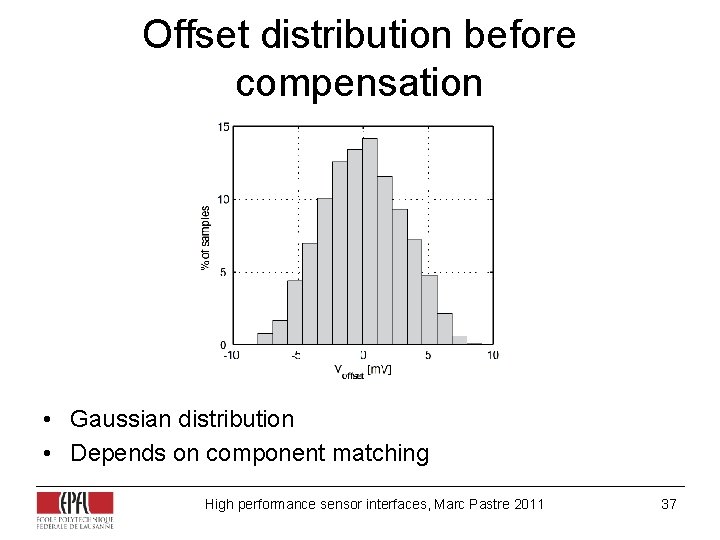
Offset distribution before compensation • Gaussian distribution • Depends on component matching High performance sensor interfaces, Marc Pastre 2011 37
Offset reduction • Offset can be reduced by: – Matching Increase area – Digital calibration • Digital calibration circuits can be made very small • In deep sub-micron technologies: – Design analog circuits with reasonable performance – Enhance critical parameters by digital calibration • Mixed-signal solution is optimal in terms of global circuit area High performance sensor interfaces, Marc Pastre 2011 38
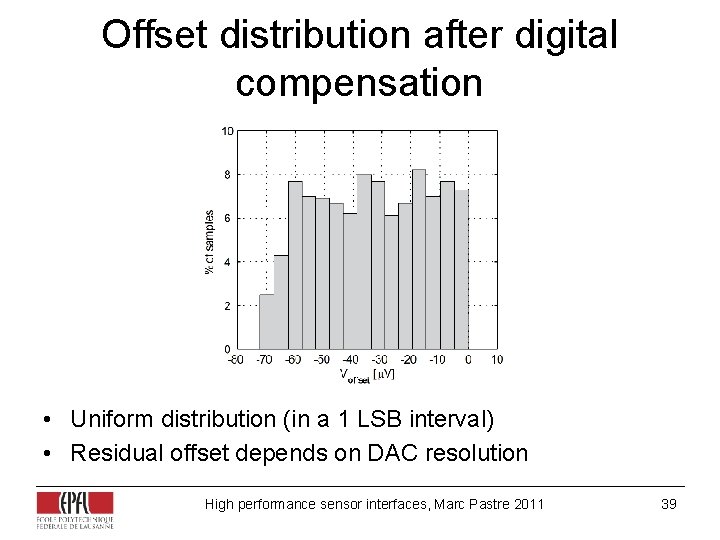
Offset distribution after digital compensation • Uniform distribution (in a 1 LSB interval) • Residual offset depends on DAC resolution High performance sensor interfaces, Marc Pastre 2011 39
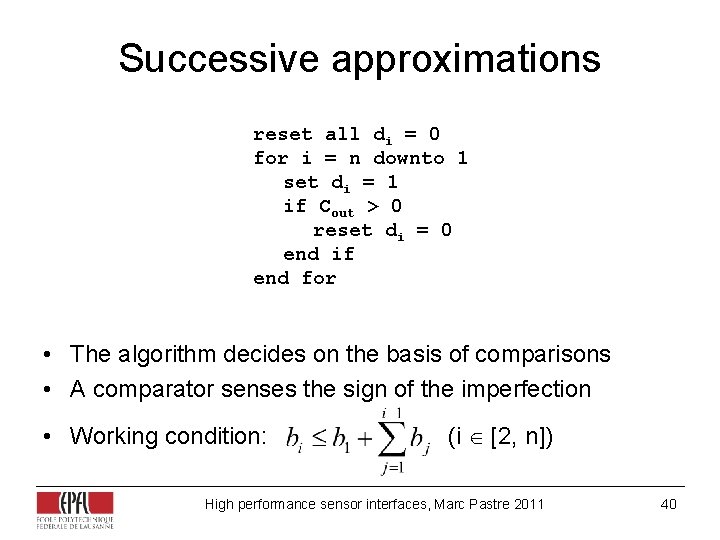
Successive approximations reset all di = 0 for i = n downto 1 set di = 1 if Cout > 0 reset di = 0 end if end for • The algorithm decides on the basis of comparisons • A comparator senses the sign of the imperfection • Working condition: (i [2, n]) High performance sensor interfaces, Marc Pastre 2011 40
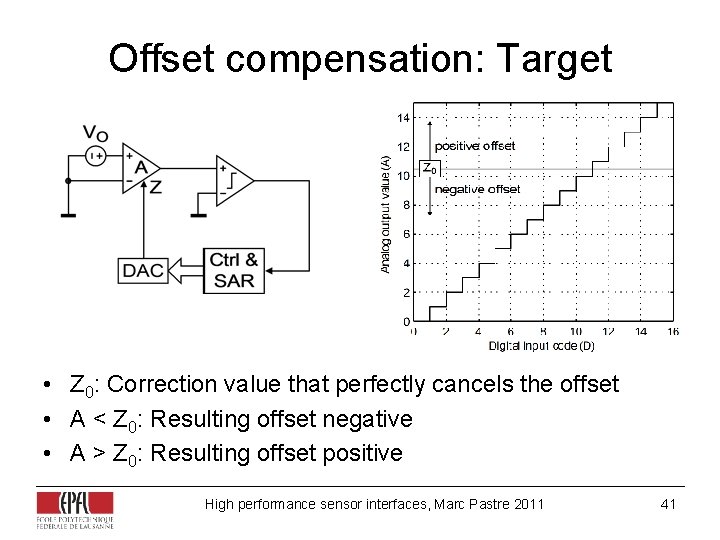
Offset compensation: Target • Z 0: Correction value that perfectly cancels the offset • A < Z 0: Resulting offset negative • A > Z 0: Resulting offset positive High performance sensor interfaces, Marc Pastre 2011 41
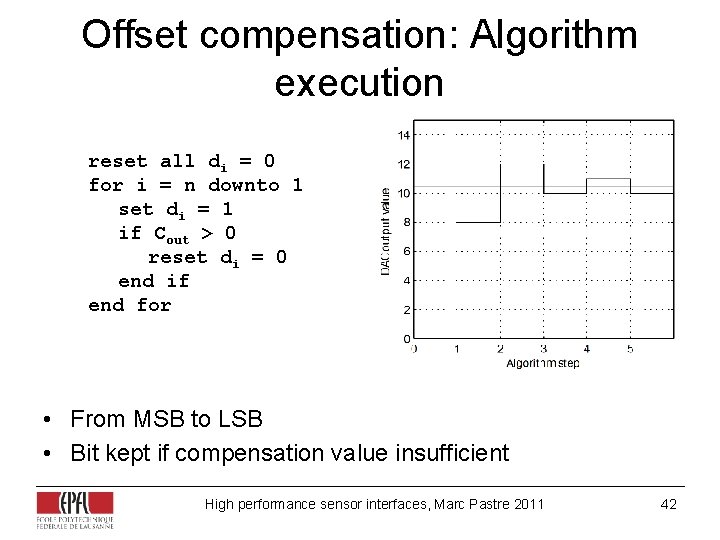
Offset compensation: Algorithm execution reset all di = 0 for i = n downto 1 set di = 1 if Cout > 0 reset di = 0 end if end for • From MSB to LSB • Bit kept if compensation value insufficient High performance sensor interfaces, Marc Pastre 2011 42
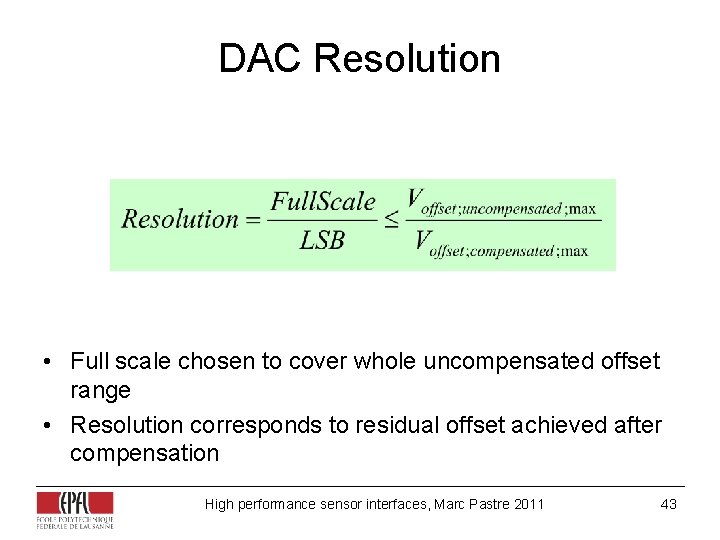
DAC Resolution • Full scale chosen to cover whole uncompensated offset range • Resolution corresponds to residual offset achieved after compensation High performance sensor interfaces, Marc Pastre 2011 43
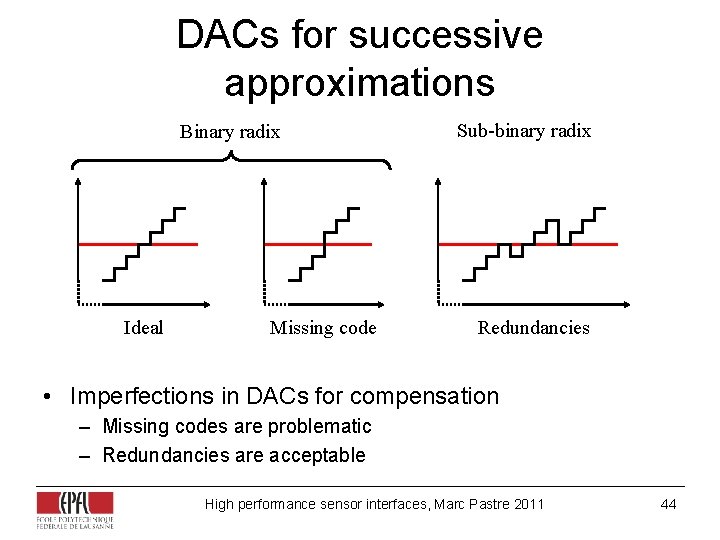
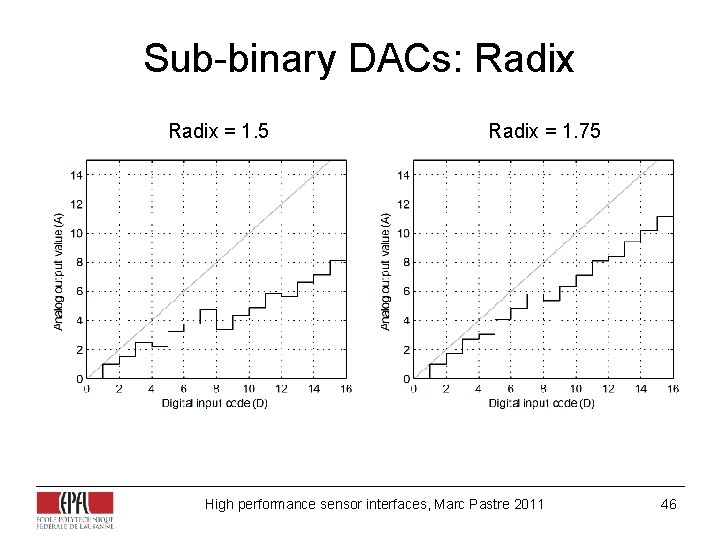
DACs for successive approximations Binary radix Ideal Missing code Sub-binary radix Redundancies • Imperfections in DACs for compensation – Missing codes are problematic – Redundancies are acceptable High performance sensor interfaces, Marc Pastre 2011 44
Sub-binary radix DACs • Code redundancies are voluntarily introduced to: – Account for variations of component values – Avoid missing codes • Arbitrarily high resolutions can be achieved without exponential increase of area • For successive approximations: – Precision is not important – Resolution is the objective • Sub-binary DACs are ideal in conjunction with successive approximations – Very low area High performance sensor interfaces, Marc Pastre 2011 45
Sub-binary DACs: Radix = 1. 5 Radix = 1. 75 High performance sensor interfaces, Marc Pastre 2011 46
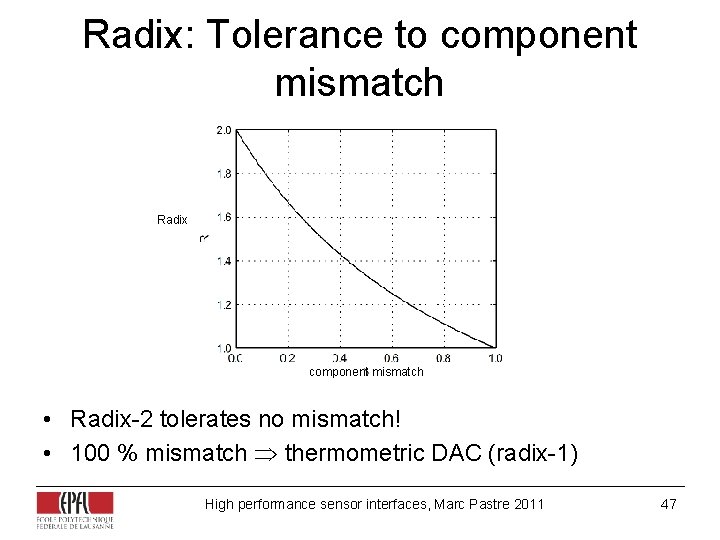
Radix: Tolerance to component mismatch Radix component mismatch • Radix-2 tolerates no mismatch! • 100 % mismatch thermometric DAC (radix-1) High performance sensor interfaces, Marc Pastre 2011 47
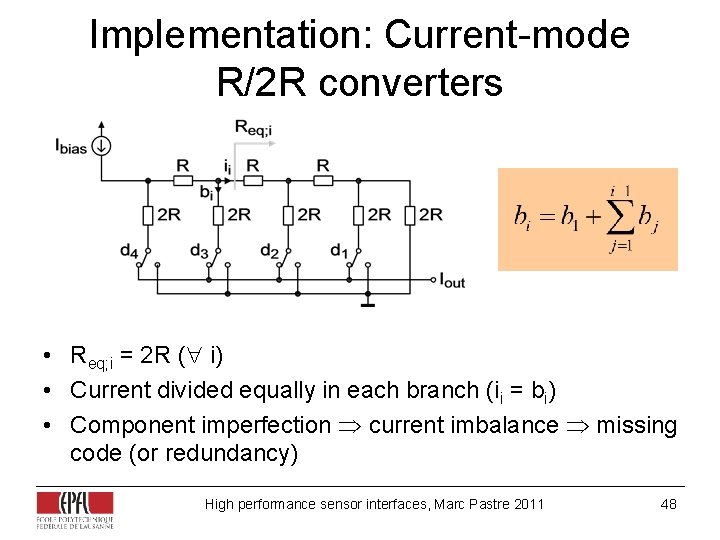
Implementation: Current-mode R/2 R converters • Req; i = 2 R ( i) • Current divided equally in each branch (ii = bi) • Component imperfection current imbalance missing code (or redundancy) High performance sensor interfaces, Marc Pastre 2011 48
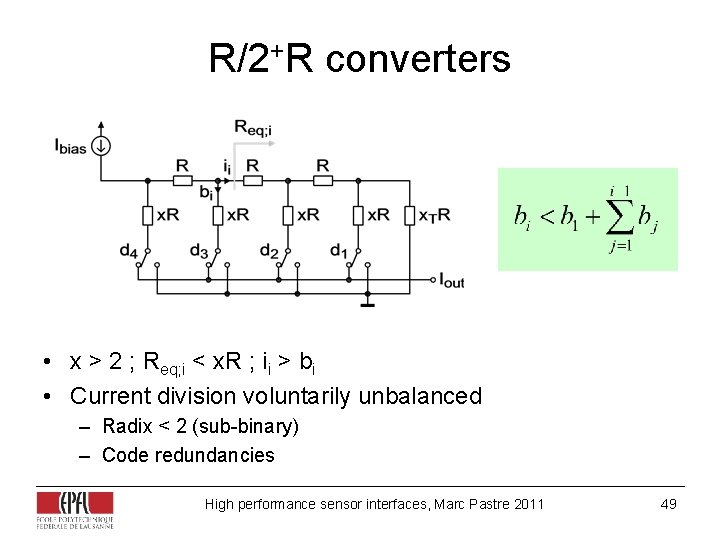
R/2+R converters • x > 2 ; Req; i < x. R ; ii > bi • Current division voluntarily unbalanced – Radix < 2 (sub-binary) – Code redundancies High performance sensor interfaces, Marc Pastre 2011 49
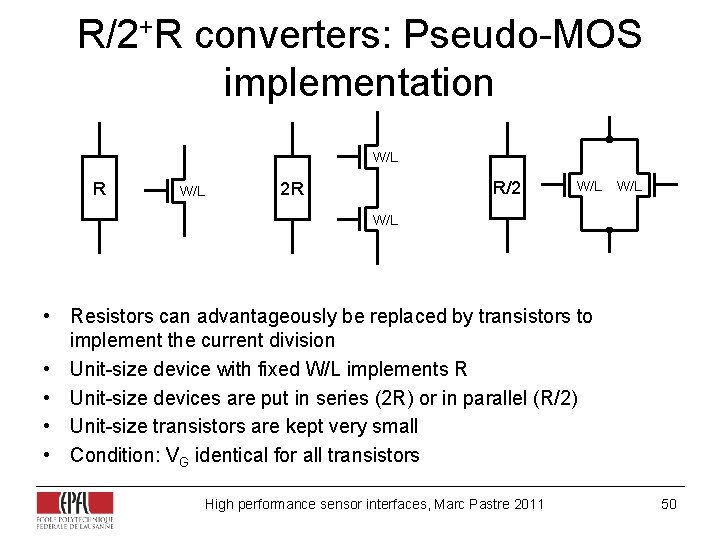
R/2+R converters: Pseudo-MOS implementation W/L R/2 2 R W/L W/L • Resistors can advantageously be replaced by transistors to implement the current division • Unit-size device with fixed W/L implements R • Unit-size devices are put in series (2 R) or in parallel (R/2) • Unit-size transistors are kept very small • Condition: VG identical for all transistors High performance sensor interfaces, Marc Pastre 2011 50
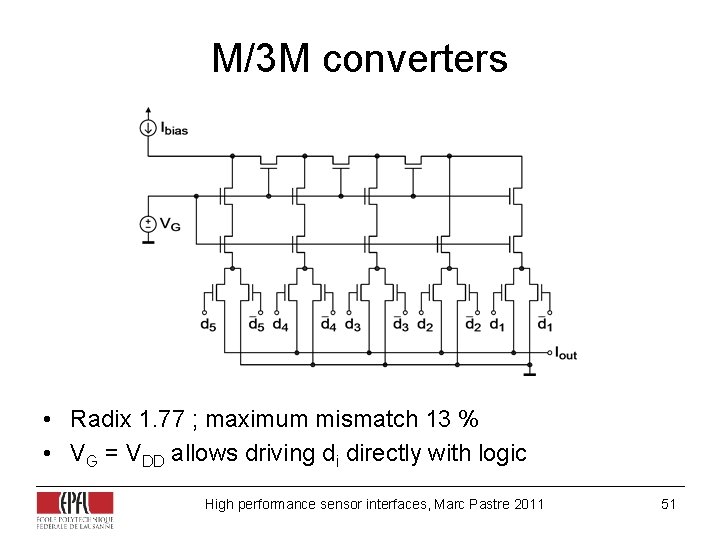
M/3 M converters • Radix 1. 77 ; maximum mismatch 13 % • VG = VDD allows driving di directly with logic High performance sensor interfaces, Marc Pastre 2011 51
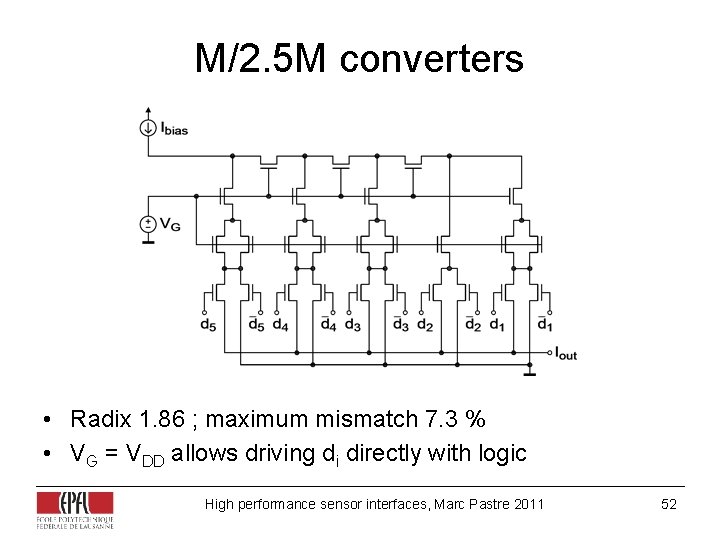
M/2. 5 M converters • Radix 1. 86 ; maximum mismatch 7. 3 % • VG = VDD allows driving di directly with logic High performance sensor interfaces, Marc Pastre 2011 52
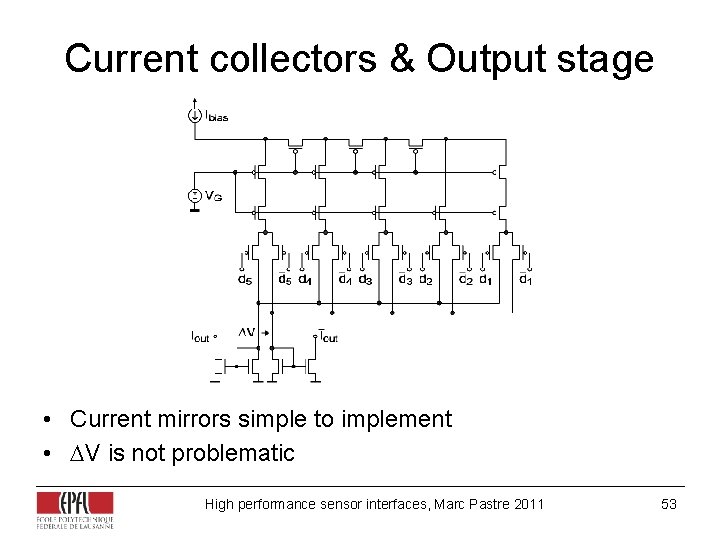
Current collectors & Output stage • Current mirrors simple to implement • V is not problematic High performance sensor interfaces, Marc Pastre 2011 53
Conclusion • Closed-loop systems are less sensitive to imperfections • Calibration can be included transparently in sampled systems • It is advantageous to include sensors in S loops • Switched capacitor circuits enable flexible and reconfigurable systems • Calibration is necessary in deep sub-micron technologies to reach high performances • Improve analog performance with digital calibration: – Design analog circuits with reasonable performance – Enhance critical parameters by digital calibration – Mixed-signal solution optimal in terms of global circuit area High performance sensor interfaces, Marc Pastre 2011 54
References • • • M. Pastre, M. Kayal, H. Blanchard, “A Hall Sensor Analog Front End for Current Measurement with Continuous Gain Calibration”, IEEE Sensors Journal, Special Edition on Intelligent Sensors, Vol. 7, Number 5, pp. 860 -867, May 2007 M. Pastre, M. Kayal, H. Schmid, A. Huber, P. Zwahlen, A. -M. Nguyen, Y. Dong, “A 300 Hz 19 b DR capacitive accelerometer based on a versatile front end in a 5 th order ΔΣ loop”, IEEE European Solid-State Circuits Conference (ESSCIRC), pp. 288 -291, September 2009 M. Pastre, M. Kayal, “Methodology for the Digital Calibration of Analog Circuits and Systems – with Case Studies”, Springer, The International Series in Engineering and Computer Science, Vol. 870, ISBN 1 -4020 -4252 -3, 2006 M. Pastre, M. Kayal, “Methodology for the Digital Calibration of Analog Circuits and Systems Using Sub-binary Radix DACs”, IEEE Mixed Design of Integrated Circuits and Systems Conference (MIXDES), June 2009 M. Pastre, M. Kayal, “High-precision DAC based on a self calibrated sub-binary radix converter”, IEEE International Symposium on Circuits and Systems (ISCAS), Vol. 1, pp. 341 344, May 2004 C. C. Enz, G. C. Temes, “Circuit Techniques for Reducing the Effects of Op-Amp Imperfections: Autozeroing, Correlated Double Sampling, and Chopper Stabilization”, Proceedings of the IEEE, Vol. 84, pp. 1584 -1614, November 1996 High performance sensor interfaces, Marc Pastre 2011 55