
High Performance Parallel Computing with Clouds and Cloud


- Slides: 21
High Performance Parallel Computing with Clouds and Cloud Technologies Cloud. Comp 09 Munich, Germany 1 1 1, 2 Jaliya Ekanayake, Geoffrey Fox {jekanaya, gcf}@indiana. edu School of Informatics and Computing 2 Pervasive Technology Institute Indiana University Bloomington SALSA
Acknowledgements to: • Joe Rinkovsky and Jenett Tillotson at IU UITS • SALSA Team - Pervasive Technology Institution, Indiana University – Scott Beason – Xiaohong Qiu – Thilina Gunarathne SALSA
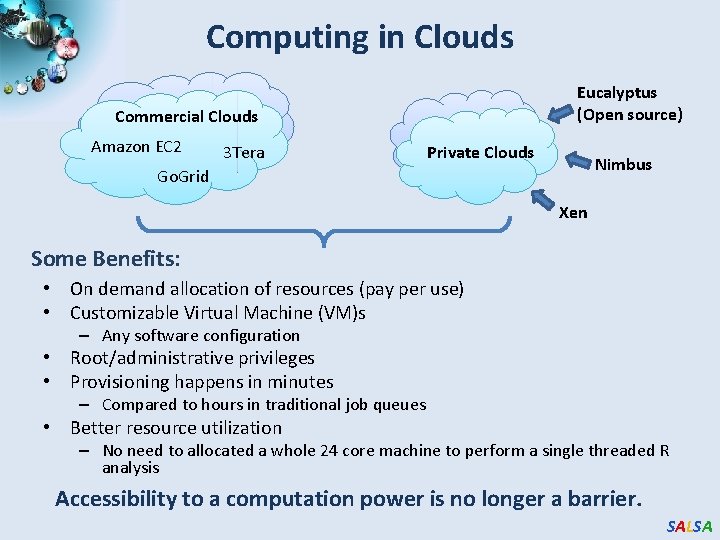
Computing in Clouds Eucalyptus (Open source) Commercial Clouds Amazon EC 2 3 Tera Private Clouds Nimbus Go. Grid Xen Some Benefits: • On demand allocation of resources (pay per use) • Customizable Virtual Machine (VM)s – Any software configuration • Root/administrative privileges • Provisioning happens in minutes – Compared to hours in traditional job queues • Better resource utilization – No need to allocated a whole 24 core machine to perform a single threaded R analysis Accessibility to a computation power is no longer a barrier. SALSA
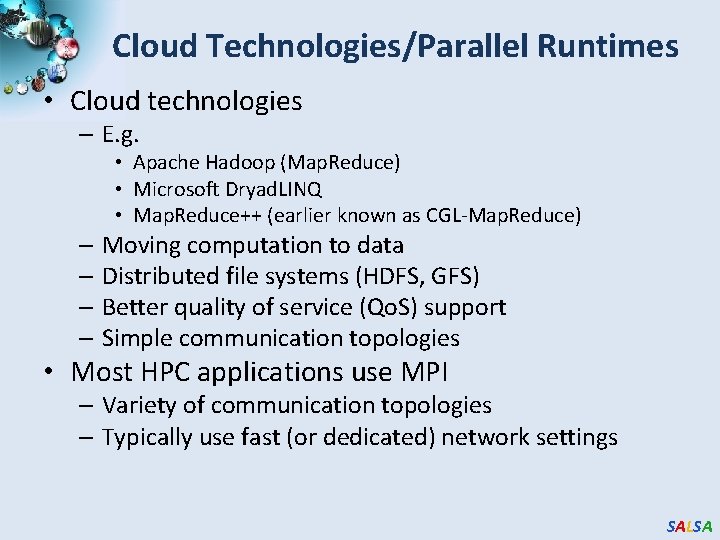
Cloud Technologies/Parallel Runtimes • Cloud technologies – E. g. • Apache Hadoop (Map. Reduce) • Microsoft Dryad. LINQ • Map. Reduce++ (earlier known as CGL-Map. Reduce) – Moving computation to data – Distributed file systems (HDFS, GFS) – Better quality of service (Qo. S) support – Simple communication topologies • Most HPC applications use MPI – Variety of communication topologies – Typically use fast (or dedicated) network settings SALSA
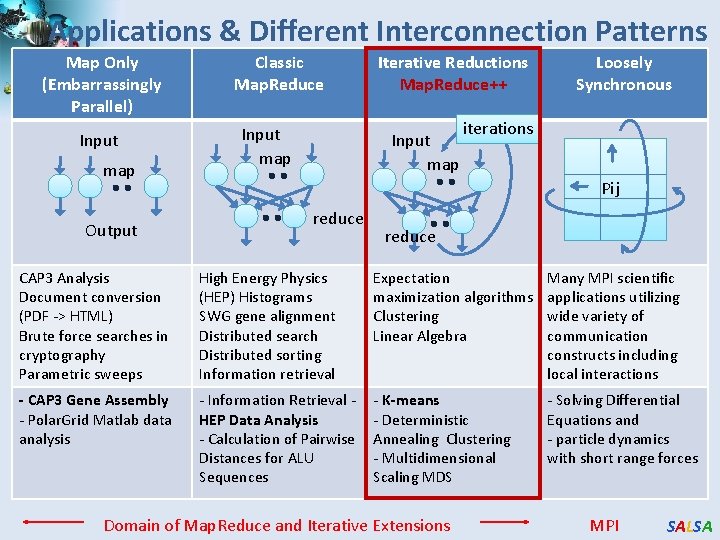
Applications & Different Interconnection Patterns Map Only (Embarrassingly Parallel) Input map Output Classic Map. Reduce Input map Iterative Reductions Map. Reduce++ Input map Loosely Synchronous iterations Pij reduce CAP 3 Analysis Document conversion (PDF -> HTML) Brute force searches in cryptography Parametric sweeps High Energy Physics (HEP) Histograms SWG gene alignment Distributed search Distributed sorting Information retrieval Expectation maximization algorithms Clustering Linear Algebra Many MPI scientific applications utilizing wide variety of communication constructs including local interactions - CAP 3 Gene Assembly - Polar. Grid Matlab data analysis - Information Retrieval HEP Data Analysis - Calculation of Pairwise Distances for ALU Sequences - K-means - Deterministic Annealing Clustering - Multidimensional Scaling MDS - Solving Differential Equations and - particle dynamics with short range forces Domain of Map. Reduce and Iterative Extensions MPI SALSA
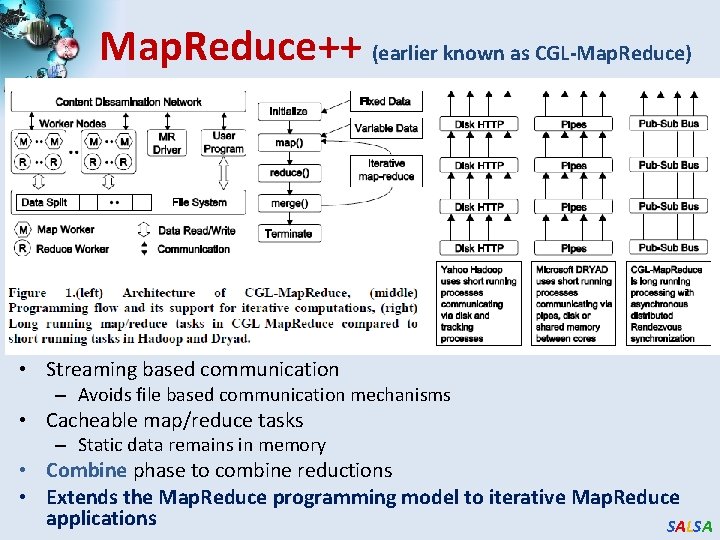
Map. Reduce++ (earlier known as CGL-Map. Reduce) • In memory Map. Reduce • Streaming based communication – Avoids file based communication mechanisms • Cacheable map/reduce tasks – Static data remains in memory • Combine phase to combine reductions • Extends the Map. Reduce programming model to iterative Map. Reduce applications SALSA
What I will present next 1. Our experience in applying cloud technologies to: – EST (Expressed Sequence Tag) sequence assembly program -CAP 3. – HEP Processing large columns of physics data using ROOT – K-means Clustering – Matrix Multiplication 2. Performance analysis of MPI applications using a private cloud environment SALSA
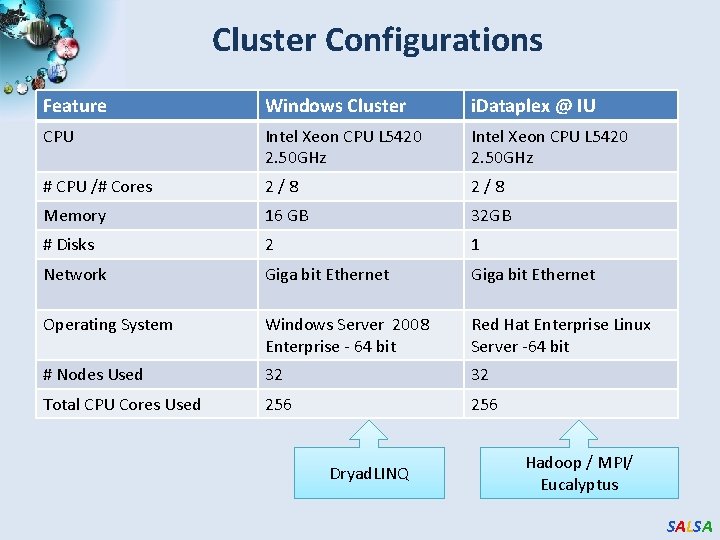
Cluster Configurations Feature Windows Cluster i. Dataplex @ IU CPU Intel Xeon CPU L 5420 2. 50 GHz # CPU /# Cores 2/8 Memory 16 GB 32 GB # Disks 2 1 Network Giga bit Ethernet Operating System Windows Server 2008 Enterprise - 64 bit Red Hat Enterprise Linux Server -64 bit # Nodes Used 32 32 Total CPU Cores Used 256 Dryad. LINQ Hadoop / MPI/ Eucalyptus SALSA
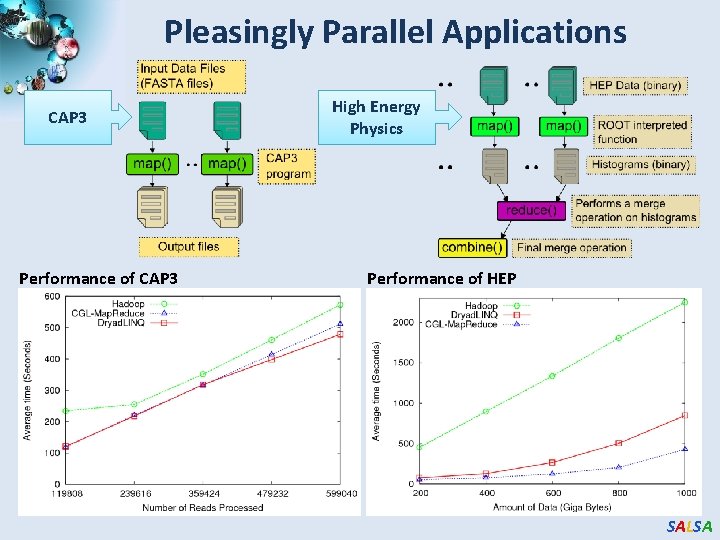
Pleasingly Parallel Applications CAP 3 Performance of CAP 3 High Energy Physics Performance of HEP SALSA
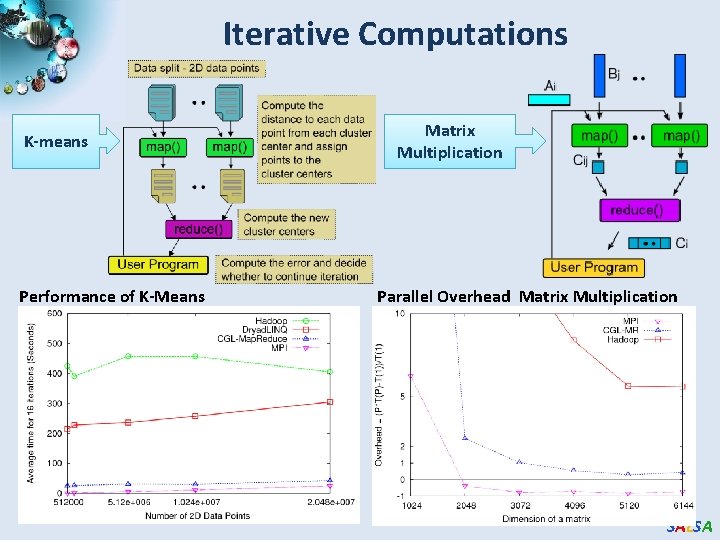
Iterative Computations K-means Performance of K-Means Matrix Multiplication Parallel Overhead Matrix Multiplication SALSA
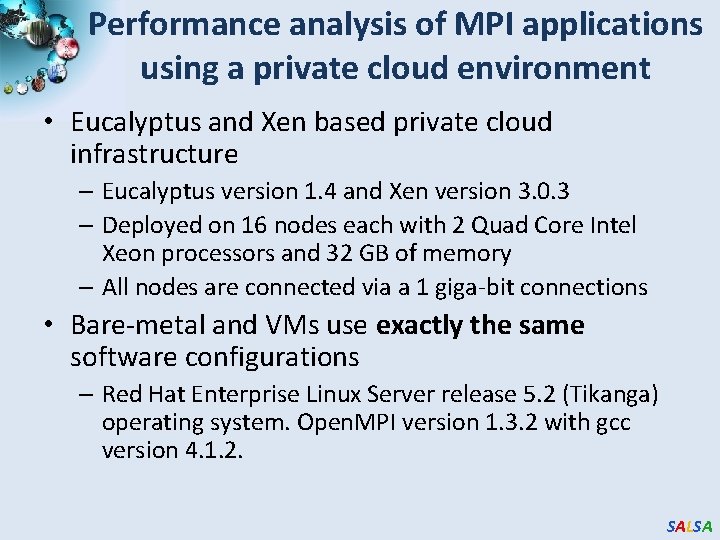
Performance analysis of MPI applications using a private cloud environment • Eucalyptus and Xen based private cloud infrastructure – Eucalyptus version 1. 4 and Xen version 3. 0. 3 – Deployed on 16 nodes each with 2 Quad Core Intel Xeon processors and 32 GB of memory – All nodes are connected via a 1 giga-bit connections • Bare-metal and VMs use exactly the same software configurations – Red Hat Enterprise Linux Server release 5. 2 (Tikanga) operating system. Open. MPI version 1. 3. 2 with gcc version 4. 1. 2. SALSA
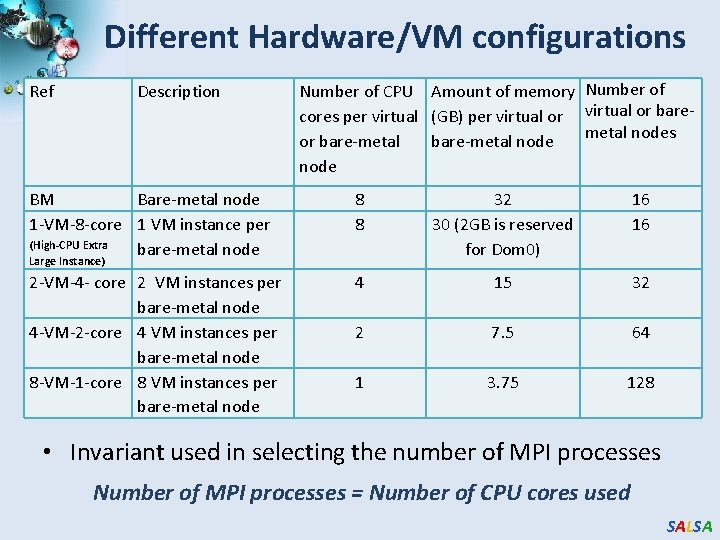
Different Hardware/VM configurations Ref Description Number of CPU Amount of memory Number of cores per virtual (GB) per virtual or baremetal nodes or bare-metal node BM Bare-metal node 1 -VM-8 -core 1 VM instance per (High-CPU Extra bare-metal node 8 8 32 30 (2 GB is reserved for Dom 0) 16 16 2 -VM-4 - core 2 VM instances per bare-metal node 4 -VM-2 -core 4 VM instances per bare-metal node 8 -VM-1 -core 8 VM instances per bare-metal node 4 15 32 2 7. 5 64 1 3. 75 128 Large Instance) • Invariant used in selecting the number of MPI processes Number of MPI processes = Number of CPU cores used SALSA
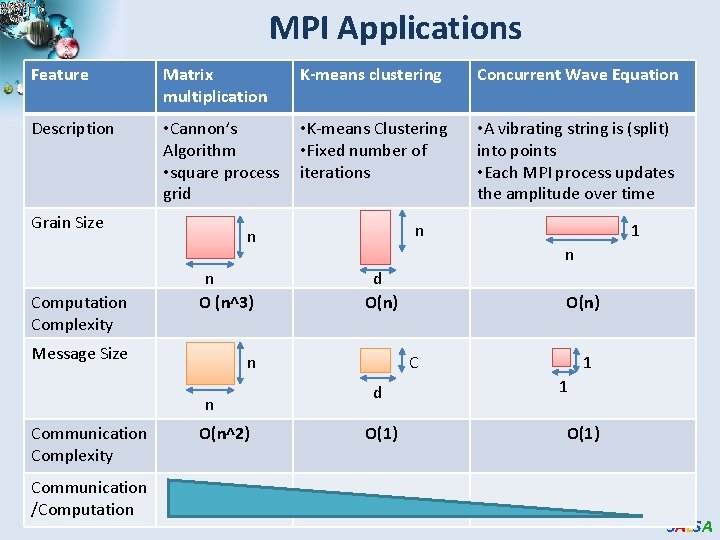
MPI Applications Feature Matrix multiplication K-means clustering Concurrent Wave Equation Description • Cannon’s Algorithm • square process grid • K-means Clustering • Fixed number of iterations • A vibrating string is (split) into points • Each MPI process updates the amplitude over time Grain Size Computation Complexity n O (n^3) Message Size Communication /Computation O(n^2) 1 n d O(n) n n Communication Complexity n n O(n) C d O(1) 1 1 O(1) SALSA
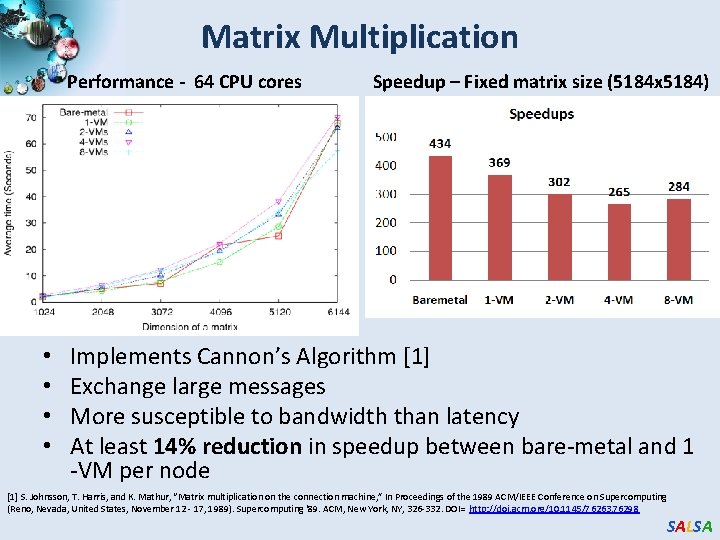
Matrix Multiplication Performance - 64 CPU cores • • Speedup – Fixed matrix size (5184 x 5184) Implements Cannon’s Algorithm [1] Exchange large messages More susceptible to bandwidth than latency At least 14% reduction in speedup between bare-metal and 1 -VM per node [1] S. Johnsson, T. Harris, and K. Mathur, “Matrix multiplication on the connection machine, ” In Proceedings of the 1989 ACM/IEEE Conference on Supercomputing (Reno, Nevada, United States, November 12 - 17, 1989). Supercomputing '89. ACM, New York, NY, 326 -332. DOI= http: //doi. acm. org/10. 1145/76263. 76298 SALSA
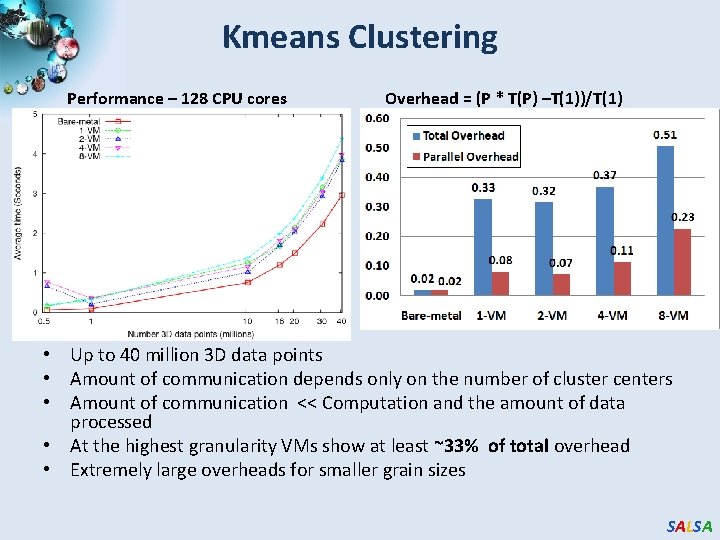
Kmeans Clustering Performance – 128 CPU cores Overhead = (P * T(P) –T(1))/T(1) • Up to 40 million 3 D data points • Amount of communication depends only on the number of cluster centers • Amount of communication << Computation and the amount of data processed • At the highest granularity VMs show at least ~33% of total overhead • Extremely large overheads for smaller grain sizes SALSA
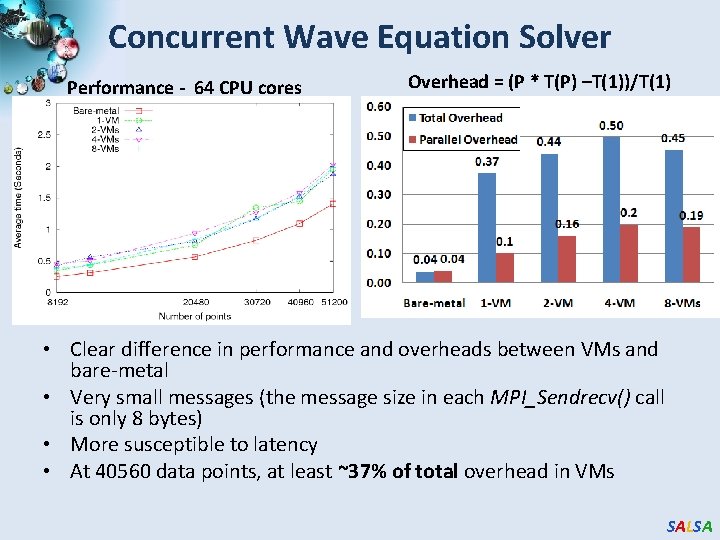
Concurrent Wave Equation Solver Performance - 64 CPU cores Overhead = (P * T(P) –T(1))/T(1) • Clear difference in performance and overheads between VMs and bare-metal • Very small messages (the message size in each MPI_Sendrecv() call is only 8 bytes) • More susceptible to latency • At 40560 data points, at least ~37% of total overhead in VMs SALSA
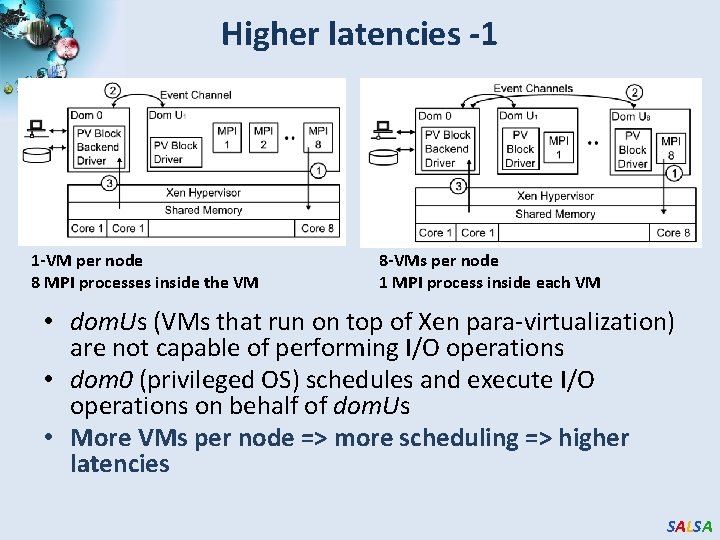
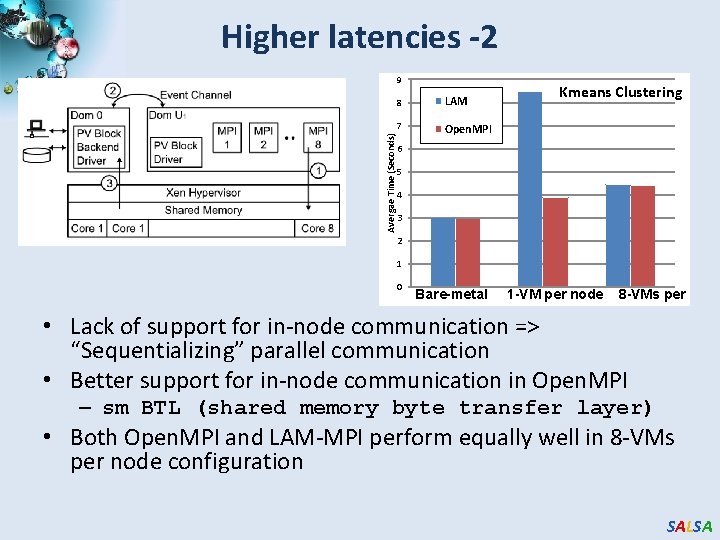
Higher latencies -1 1 -VM per node 8 MPI processes inside the VM 8 -VMs per node 1 MPI process inside each VM • dom. Us (VMs that run on top of Xen para-virtualization) are not capable of performing I/O operations • dom 0 (privileged OS) schedules and execute I/O operations on behalf of dom. Us • More VMs per node => more scheduling => higher latencies SALSA
Higher latencies -2 Avergae Time (Seconds) 9 8 LAM 7 Open. MPI Kmeans Clustering 6 5 4 3 2 1 0 Bare-metal 1 -VM per node 8 -VMs per node • Lack of support for in-node communication => “Sequentializing” parallel communication • Better support for in-node communication in Open. MPI – sm BTL (shared memory byte transfer layer) • Both Open. MPI and LAM-MPI perform equally well in 8 -VMs per node configuration SALSA
Conclusions and Future Works • Cloud technologies works for most pleasingly parallel applications • Runtimes such as Map. Reduce++ extends Map. Reduce to iterative Map. Reduce domain • MPI applications experience moderate to high performance degradation (10% ~ 40%) in private cloud – Dr. Edward walker noticed (40% ~ 1000%) performance degradations in commercial clouds [1] • Applications sensitive to latencies experience higher overheads • Bandwidth does not seem to be an issue in private clouds • More VMs per node => Higher overheads • In-node communication support is crucial • Applications such as Map. Reduce may perform well on VMs ? [1] Walker, E. : benchmarking Amazon EC 2 for high-performance scientific computing, http: //www. usenix. org/publications/login/2008 -10/openpdfs/walker. pdf SALSA
Questions? SALSA
Thank You! SALSA