
High Performance Liquid Chromatography HPLC 3 nd lecture
- Slides: 30
High Performance Liquid Chromatography (HPLC) 3 nd lecture
Principle l l A liquid mobile phase is pumped under pressure through a stainless steel column containing particles of stationary phase with a diameter of 3 -l 0; 1 m. The analyte is loaded onto the head of the column via a loop valve and separation of a mixture occurs according l to the relative lengths of time spent by its components in the stationary phase. lt should be noted that all components in a mixture spend more or less the same time in the mobile phase in order to exit the column. Monitoring of the column effluent can be carried out with a variety of detectors.
Applications l l The combination of high pressure liquid chromatography (HPLC) with monitoring by UV/visible detection provides an accurate, precise and robust method for quantitative analysis of pharmaceutical products and is the industry standard method for this purpose. Monitoring of the stability of pure drug substances and in drugs in formulations with quantitation of any degradation products. Measurement of drugs and their metabolites in biological fluids. Determination of partition coefficients and p. Ka values of drugs and of drug protein binding.
Strength l l l Easily controlled and precise sample introduction ensures quantitative precision. HPLC is the chromatographic technique which has seen the most intensive development in recent years leading to improved. columns. detectors and software control. The variety of columns and detectors means that the selectivity of the method can be readily adjusted, Compared to GC there is less risk of sample degradation because heating is not required in the chromatographic process. Readily automated.
Limitations l l l There is still a requirement for reliable and inexpensive detectors which can monitor compounds that lack a chromophore. Drugs have to be extracted from their formulations prior to analysis. Large amounts of organic solvent waste is generated, which is expensive to dispose of.
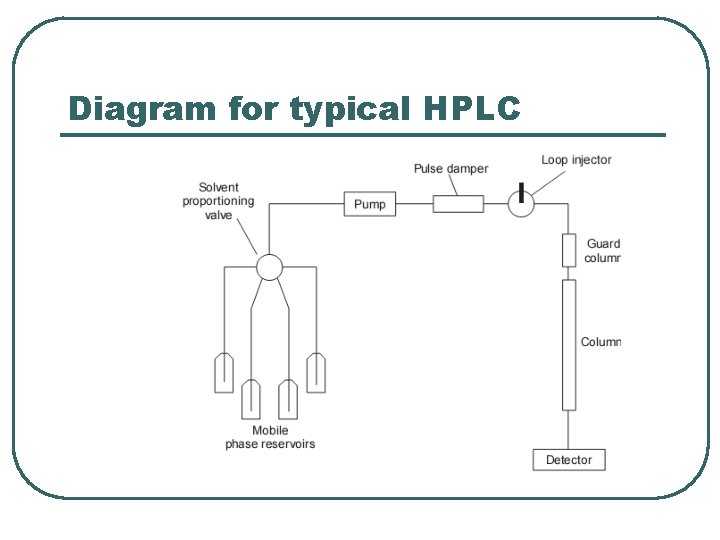
Diagram for typical HPLC
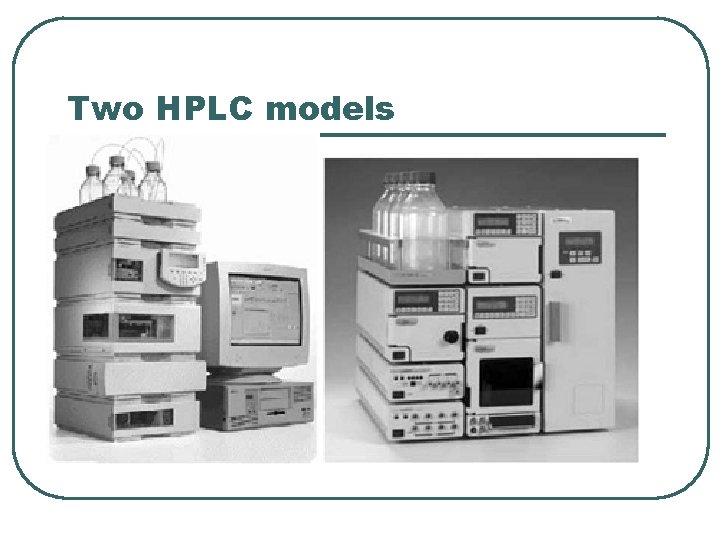
Two HPLC models
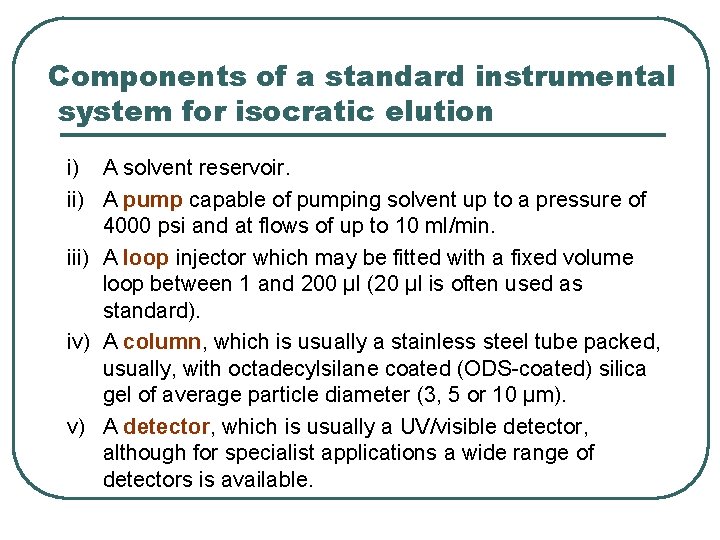
Components of a standard instrumental system for isocratic elution i) A solvent reservoir. ii) A pump capable of pumping solvent up to a pressure of 4000 psi and at flows of up to 10 ml/min. iii) A loop injector which may be fitted with a fixed volume loop between 1 and 200 µl (20 µl is often used as standard). iv) A column, which is usually a stainless steel tube packed, usually, with octadecylsilane coated (ODS-coated) silica gel of average particle diameter (3, 5 or 10 µm). v) A detector, which is usually a UV/visible detector, although for specialist applications a wide range of detectors is available.
continued vi) A data capture system, which may be a computing integrator or a PC with software suitable for processing chromatographic data. vii) The column is connected to the injector and detector with tubing of narrow internal diameter ca 0. 2 mm in order to minimise ‘dead volume', i. e. empty space in the system where chromatography is not occurring and broadening can occur by longitudinal diffusion. viii) More advanced instruments may have automatic sample injection and a column oven and are capable of mixing two or more solvents in varying proportions with time to produce a mobile phase gradient.
Pump and Injector Pump The role of the pump is to force the mobile phase through the liquid chromatograph Typical pumps can reach pressures in the range of 6000 -9000 psi (400 -to 600 bar). Injector The injector serves to introduce the liquid sample into the flow stream of the mobile phase. Typical sample volumes are 5 -to 20 -microliters (μL). The injector must be able to withstand the high pressures of the liquid system. An auto sampler is the automatic version for when the user has many samples to analyze or when manual injection is not practical.
Column l l l Considered the “heart of the chromatograph” the column’s stationary phase separates the sample components of interest using various physical and chemical parameters. The small particles inside the column are what cause the high back pressure at normal flow rates. The pump must push hard to move the mobile phase through the column and this resistance causes a high pressure within the chromatograph.
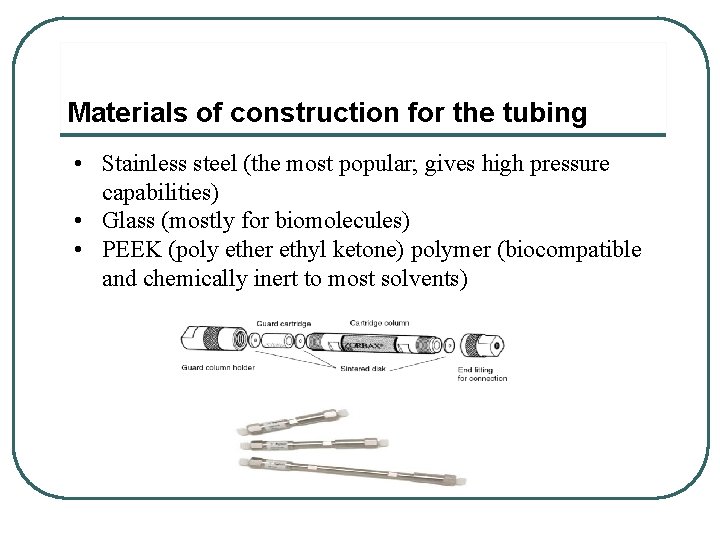
Materials of construction for the tubing • Stainless steel (the most popular; gives high pressure capabilities) • Glass (mostly for biomolecules) • PEEK (poly ether ethyl ketone) polymer (biocompatible and chemically inert to most solvents)
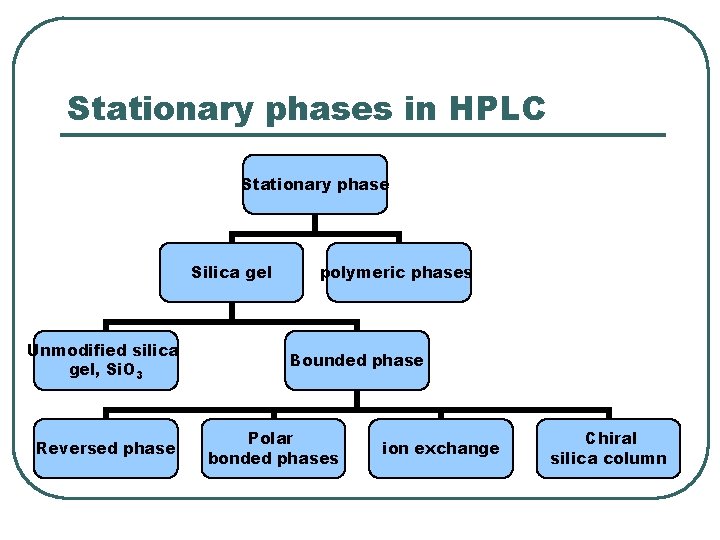
Stationary phases in HPLC Stationary phase Silica gel Unmodified silica gel, Si. O 3 Reversed phase polymeric phases Bounded phase Polar bonded phases ion exchange Chiral silica column
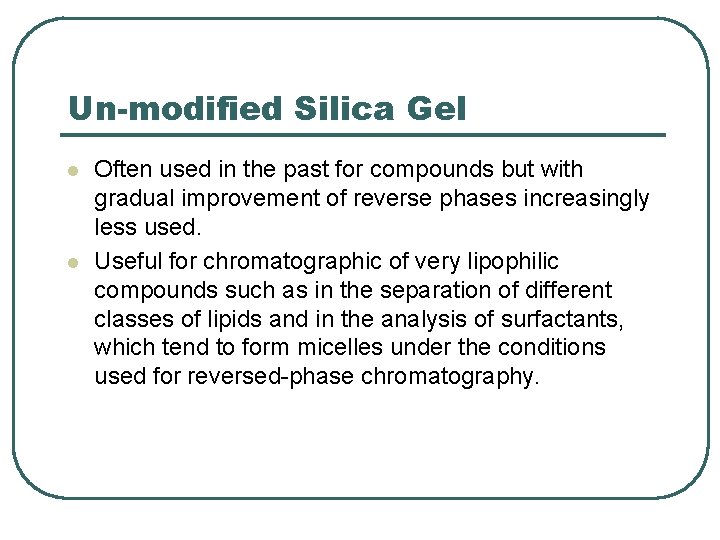
Un-modified Silica Gel l l Often used in the past for compounds but with gradual improvement of reverse phases increasingly less used. Useful for chromatographic of very lipophilic compounds such as in the separation of different classes of lipids and in the analysis of surfactants, which tend to form micelles under the conditions used for reversed-phase chromatography.
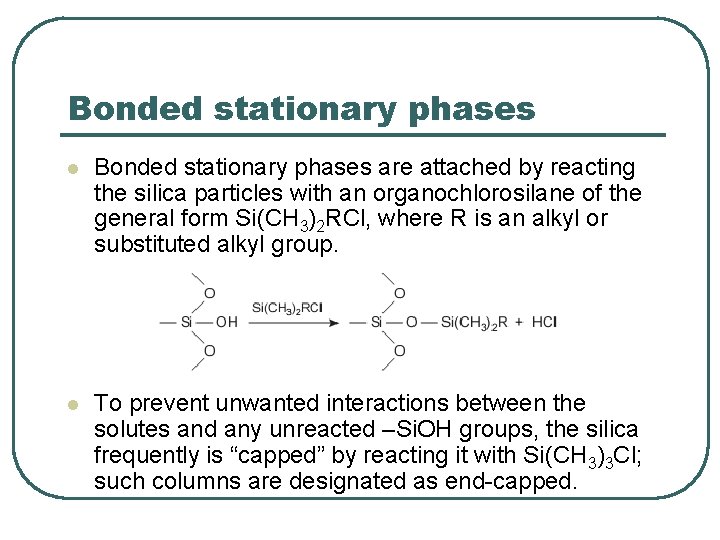
Bonded stationary phases l Bonded stationary phases are attached by reacting the silica particles with an organochlorosilane of the general form Si(CH 3)2 RCl, where R is an alkyl or substituted alkyl group. l To prevent unwanted interactions between the solutes and any unreacted –Si. OH groups, the silica frequently is “capped” by reacting it with Si(CH 3)3 Cl; such columns are designated as end-capped.
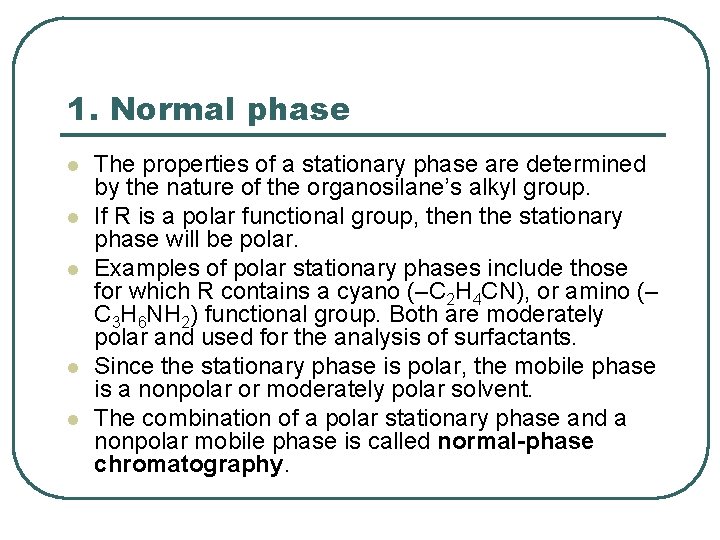
1. Normal phase l l l The properties of a stationary phase are determined by the nature of the organosilane’s alkyl group. If R is a polar functional group, then the stationary phase will be polar. Examples of polar stationary phases include those for which R contains a cyano (–C 2 H 4 CN), or amino (– C 3 H 6 NH 2) functional group. Both are moderately polar and used for the analysis of surfactants. Since the stationary phase is polar, the mobile phase is a nonpolar or moderately polar solvent. The combination of a polar stationary phase and a nonpolar mobile phase is called normal-phase chromatography.
2. Reverse phase l l In reverse-phase chromatography, which is the more commonly encountered form of HPLC, the stationary phase is nonpolar and the mobile phase is polar. The most common nonpolar stationary phases use an organochlorosilane for which the R group is an noctyl (C 8) or n-octyldecyl (C 18) hydrocarbon chain. Most reverse-phase separations are carried out using a buffered aqueous solution as a polar mobile phase. Because the silica substrate is subject to hydrolysis in basic solutions, the p. H of the mobile phase must be less than 7. 5.
continued l l l It is the most commonly used phase applicable for most problems in the analysis of pharmaceutical formulations. Currently, ODS silica gel or related phases such as octyl silica gel are used for > 80% of all pharmaceutical analyses. ODS silica gel can even be applied to the analysis of peptides, where wide-pore packings are used to improve access of these bulky molecules to the internal surface of the packings.
End-capping process l l l Early phases gave problems with strongly basic compounds because of the incomplete endcaping of the silanol (Si-OH) groups. Amine absorb strongly onto silanol groups not covered by the stationary phase. Fully endcapped phases and phases with low metal content are now available, which enable the analysis of strongly basic compounds that formerly tended to produce tailing peak.
3. Ion exchanger silica Cationic exchanger l Usually base on the ion pairing of the analyte with sulfonic acid groups on the surface of the stationary phase. l Useful for the analysis of very polar compounds such as aminoglycosides and other charged sugar molecules and polar bases such as catecholamines. Anioic exchanger l Usually base on the ion pairing of the analyte with quaternary ammonium groups on the surface of the stationary phase. l Useful fir the separation of polar compounds with anionic groups such as nucleotides and anionic drug metabolites such as sulphate or glucuronides
Polymeric stationary phases l In recent years polymeric phases have become available for certain specialist applications; the surface chemistries of these phases are similar to those of the silica gel-based phases. l Advantages of the polymeric phases are stability to extremes of p. H (1 -13) and the lack of secondary interactions of analytes with uncapped silanol groups. l Disadvantages include expense and a tendency to swell when in contact with lipophilic mobile phases. which can destroy them. Such phases are best used with predominantly aqueous-based mobile phases.
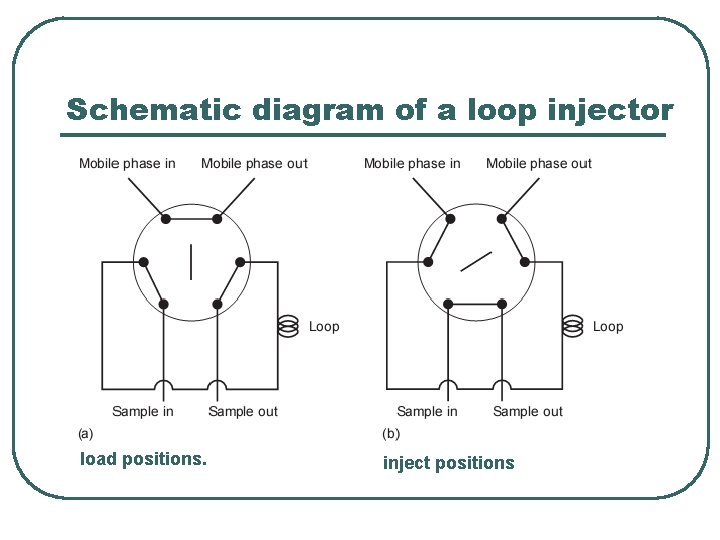
Sample introduction l l The typical operating pressure of an HPLC is sufficiently high that it is impossible to inject the sample in the same manner as in gas chromatography. Instead, the sample is introduced using a loop injector. Sampling loops are inter-changeable, and available with volumes ranging from 0. 5 µL to 2 m. L. In the load position the sampling loop is isolated from the mobile phase and is open to the atmosphere. A syringe with a capacity several times that of the sampling loop is used to place the sample in the loop. Any extra sample beyond that needed to fill the sample loop exits through the waste line. After loading the sample, the injector is turned to the inject position. In this position the mobile phase is directed through the sampling loop, and the sample is swept onto the column.
Schematic diagram of a loop injector load positions. inject positions
Detectors in HPLC
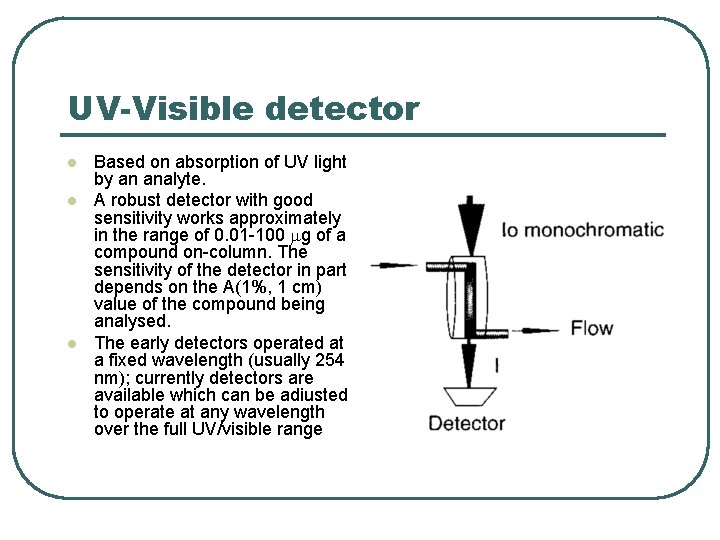
UV-Visible detector l l l Based on absorption of UV light by an analyte. A robust detector with good sensitivity works approximately in the range of 0. 01 -100 g of a compound on-column. The sensitivity of the detector in part depends on the A(1%, 1 cm) value of the compound being analysed. The early detectors operated at a fixed wavelength (usually 254 nm); currently detectors are available which can be adiusted to operate at any wavelength over the full UV/visible range
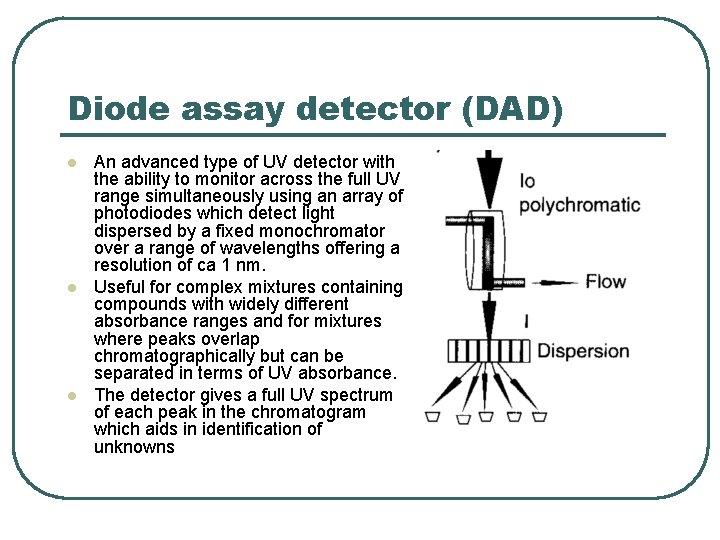
Diode assay detector (DAD) l l l An advanced type of UV detector with the ability to monitor across the full UV range simultaneously using an array of photodiodes which detect light dispersed by a fixed monochromator over a range of wavelengths offering a resolution of ca 1 nm. Useful for complex mixtures containing compounds with widely different absorbance ranges and for mixtures where peaks overlap chromatographically but can be separated in terms of UV absorbance. The detector gives a full UV spectrum of each peak in the chromatogram which aids in identification of unknowns
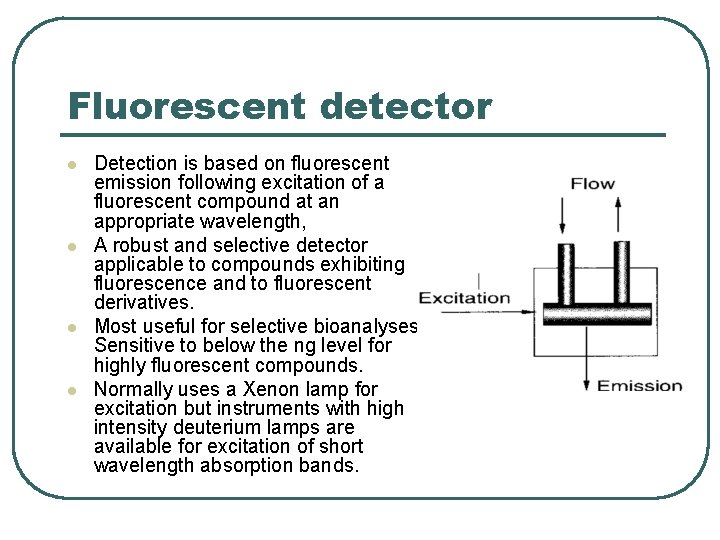
Fluorescent detector l l Detection is based on fluorescent emission following excitation of a fluorescent compound at an appropriate wavelength, A robust and selective detector applicable to compounds exhibiting fluorescence and to fluorescent derivatives. Most useful for selective bioanalyses. Sensitive to below the ng level for highly fluorescent compounds. Normally uses a Xenon lamp for excitation but instruments with high intensity deuterium lamps are available for excitation of short wavelength absorption bands.
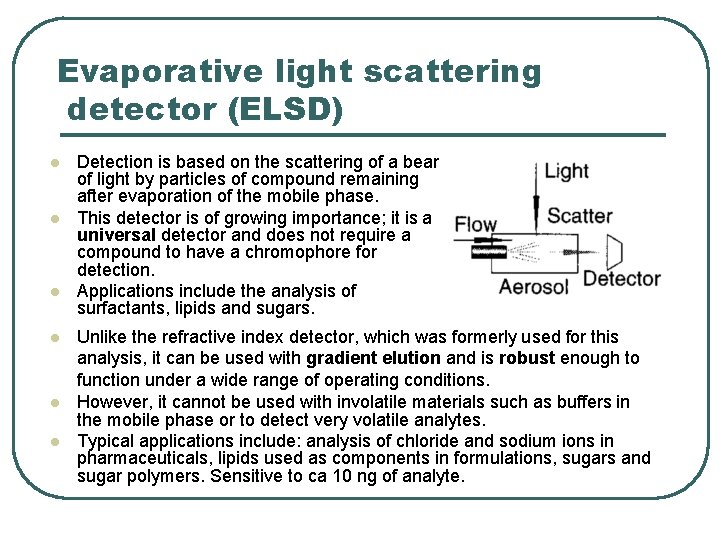
Evaporative light scattering detector (ELSD) l l l Detection is based on the scattering of a beam of light by particles of compound remaining after evaporation of the mobile phase. This detector is of growing importance; it is a universal detector and does not require a compound to have a chromophore for detection. Applications include the analysis of surfactants, lipids and sugars. Unlike the refractive index detector, which was formerly used for this analysis, it can be used with gradient elution and is robust enough to function under a wide range of operating conditions. However, it cannot be used with involatile materials such as buffers in the mobile phase or to detect very volatile analytes. Typical applications include: analysis of chloride and sodium ions in pharmaceuticals, lipids used as components in formulations, sugars and sugar polymers. Sensitive to ca 10 ng of analyte.
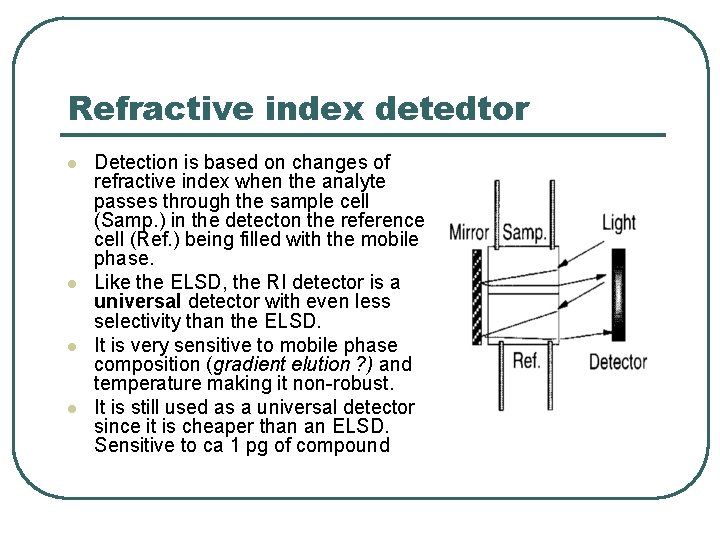
Refractive index detedtor l l Detection is based on changes of refractive index when the analyte passes through the sample cell (Samp. ) in the detecton the reference cell (Ref. ) being filled with the mobile phase. Like the ELSD, the RI detector is a universal detector with even less selectivity than the ELSD. It is very sensitive to mobile phase composition (gradient elution ? ) and temperature making it non-robust. It is still used as a universal detector since it is cheaper than an ELSD. Sensitive to ca 1 pg of compound
Example of HPLC separation: Elution of corticosteroids from an ODS column Compounds: • Prednisolone • Betamethasone • and their esters Column: ODS column (25 cm x 4. 6 mm) Mobile phase: methanol/water (75: 25) Detection: UV detection at 240 nm.