
High Performance from Global Virtual Teams Martha Maznevski
High Performance from Global Virtual Teams Martha Maznevski Copyright 2001 © IMD, Lausanne, Switzerland Not to be used or reproduced without permission Maznevski – Virtual Teams –
My Background § Anthropology / Linguistics § Education (Development, Learning) § Organizational Behavior • Business context • Social psychology, sociology, anthropology, political science, etc. • Dependent variable is effectiveness (organizational and personal) Copyright 2001 © IMD, Lausanne, Switzerland Not to be used or reproduced without permission Maznevski – Virtual Teams – 2
Research Stream § Global team effectiveness • Multicultural, multifunctional, often multiorganizational • Highly complex tasks, tight deadlines • Map-Bridge-Integrate model • “But most of the time we work virtually…” § Global virtual team effectiveness • Presented here § Global virtual network effectiveness • Current work, introduced here Copyright 2001 © IMD, Lausanne, Switzerland Not to be used or reproduced without permission Maznevski – Virtual Teams – 3
Introduction § Virtual team • Group of people working together on a shared task • Members are in different locations • Members communicate using technology significantly more often than face-to-face § Great potential! • Get the best people, no matter where they are • Members bring perspectives from their own locations • Test ideas in multiple contexts before making final decisions Copyright 2001 © IMD, Lausanne, Switzerland Not to be used or reproduced without permission Maznevski – Virtual Teams – 4
Research Overview § Main empirical study • Multi-method, in-depth study of 3 teams in one organization over almost 2 years; one success, one failure, one mixed. § Other studies • Less formal in-depth research with several teams over several years • Interviews and observation in many teams, many organizations to test and validate research ideas Copyright 2001 © IMD, Lausanne, Switzerland Not to be used or reproduced without permission Maznevski – Virtual Teams – 5
Technology Is Not the Most Important Part! Teams that focus on the issues of being “virtual” sometimes do well, but often don’t. Teams that focus on being a team and getting their job done well generally figure out the technology anyway. Copyright 2001 © IMD, Lausanne, Switzerland Not to be used or reproduced without permission Maznevski – Virtual Teams – 6
Three Simple Rules 1. Choose the right technology. 2. Manage by the task. 3. Sequence technologies in a rhythm. Copyright 2001 © IMD, Lausanne, Switzerland Not to be used or reproduced without permission Maznevski – Virtual Teams – 7
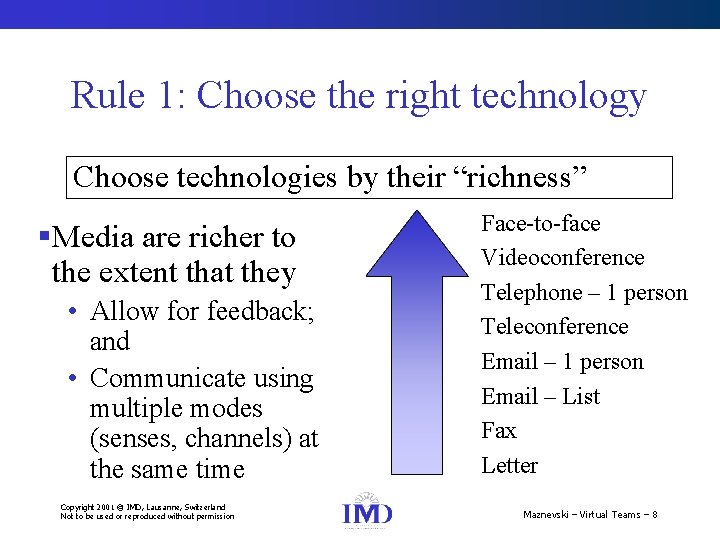
Rule 1: Choose the right technology Choose technologies by their “richness” §Media are richer to the extent that they • Allow for feedback; and • Communicate using multiple modes (senses, channels) at the same time Copyright 2001 © IMD, Lausanne, Switzerland Not to be used or reproduced without permission Face-to-face Videoconference Telephone – 1 person Teleconference Email – 1 person Email – List Fax Letter Maznevski – Virtual Teams – 8
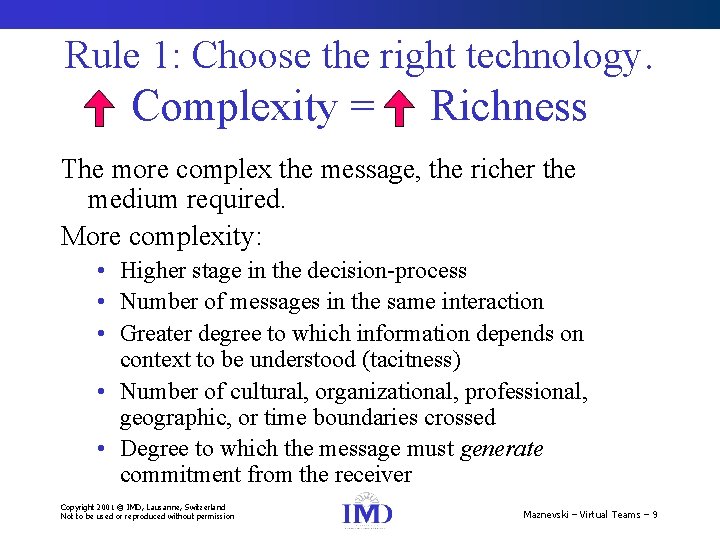
Rule 1: Choose the right technology. Complexity = Richness The more complex the message, the richer the medium required. More complexity: • Higher stage in the decision-process • Number of messages in the same interaction • Greater degree to which information depends on context to be understood (tacitness) • Number of cultural, organizational, professional, geographic, or time boundaries crossed • Degree to which the message must generate commitment from the receiver Copyright 2001 © IMD, Lausanne, Switzerland Not to be used or reproduced without permission Maznevski – Virtual Teams – 9
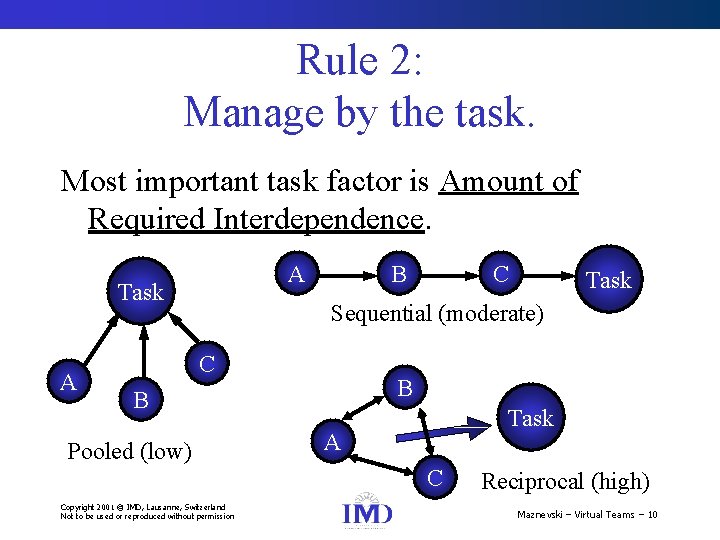
Rule 2: Manage by the task. Most important task factor is Amount of Required Interdependence. A Task A B C Task Sequential (moderate) C B B Pooled (low) Task A C Copyright 2001 © IMD, Lausanne, Switzerland Not to be used or reproduced without permission Reciprocal (high) Maznevski – Virtual Teams – 10
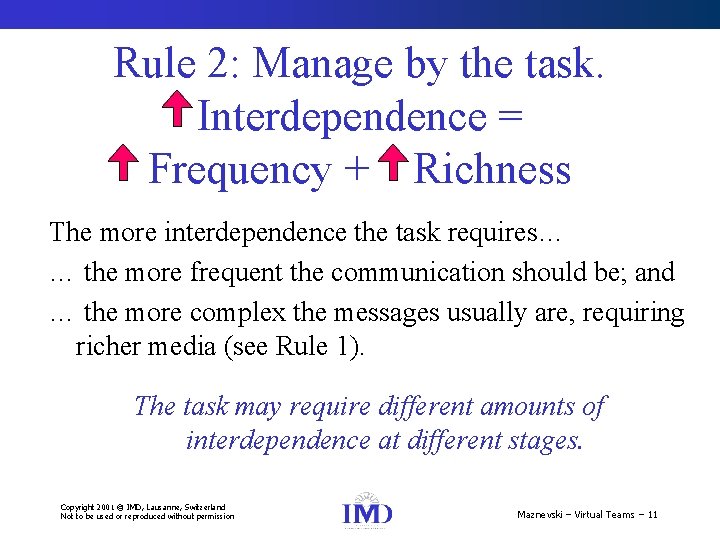
Rule 2: Manage by the task. Interdependence = Frequency + Richness The more interdependence the task requires… … the more frequent the communication should be; and … the more complex the messages usually are, requiring richer media (see Rule 1). The task may require different amounts of interdependence at different stages. Copyright 2001 © IMD, Lausanne, Switzerland Not to be used or reproduced without permission Maznevski – Virtual Teams – 11
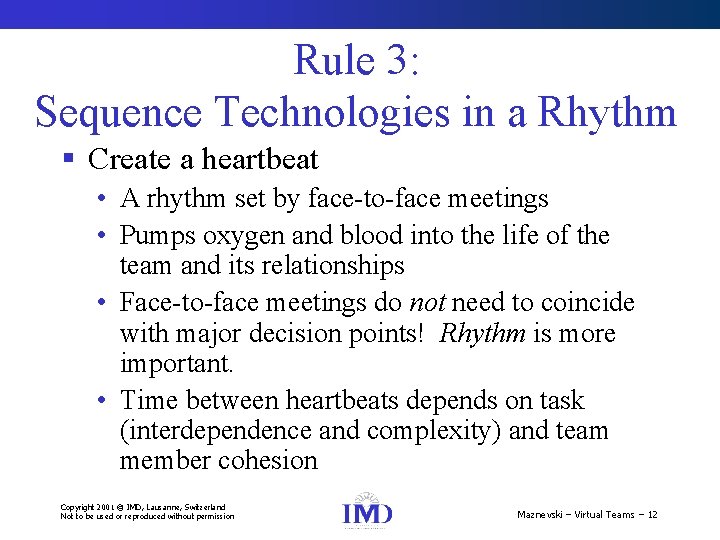
Rule 3: Sequence Technologies in a Rhythm § Create a heartbeat • A rhythm set by face-to-face meetings • Pumps oxygen and blood into the life of the team and its relationships • Face-to-face meetings do not need to coincide with major decision points! Rhythm is more important. • Time between heartbeats depends on task (interdependence and complexity) and team member cohesion Copyright 2001 © IMD, Lausanne, Switzerland Not to be used or reproduced without permission Maznevski – Virtual Teams – 12
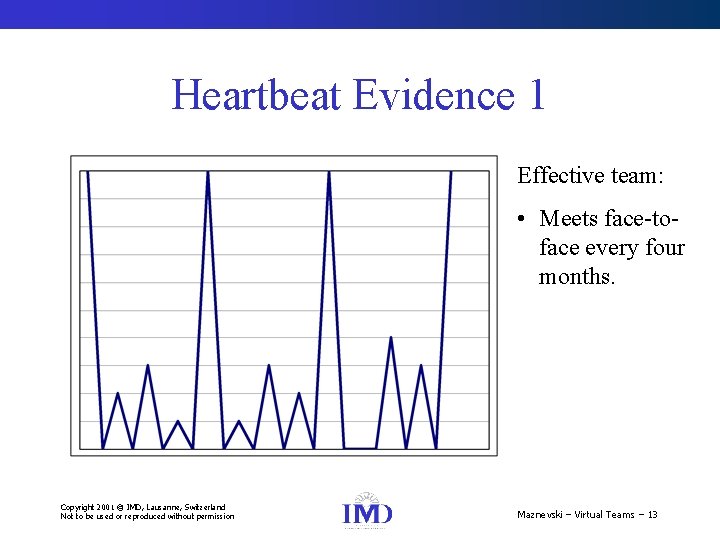
Heartbeat Evidence 1 Effective team: • Meets face-toface every four months. Copyright 2001 © IMD, Lausanne, Switzerland Not to be used or reproduced without permission Maznevski – Virtual Teams – 13
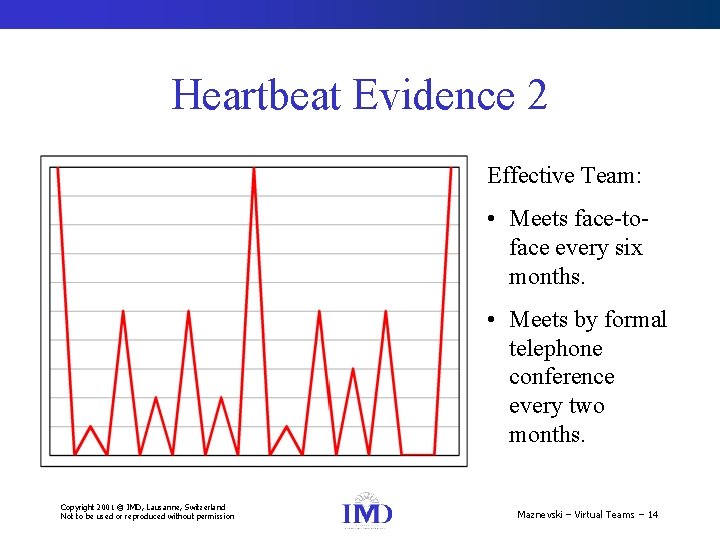
Heartbeat Evidence 2 Effective Team: • Meets face-toface every six months. • Meets by formal telephone conference every two months. Copyright 2001 © IMD, Lausanne, Switzerland Not to be used or reproduced without permission Maznevski – Virtual Teams – 14
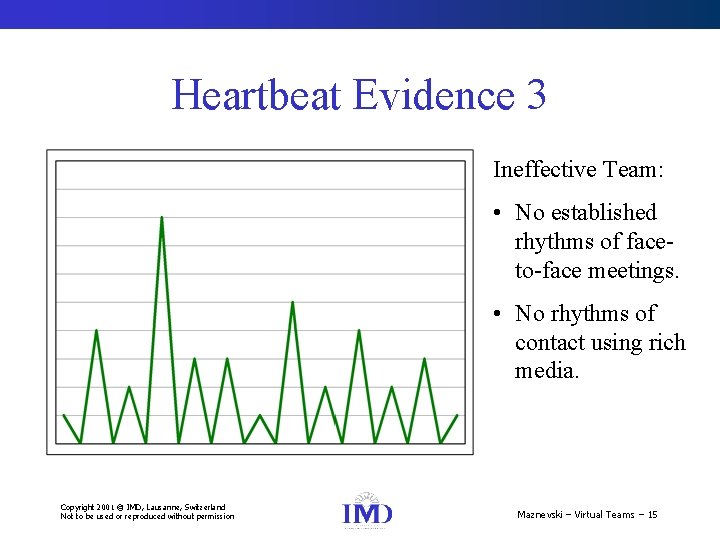
Heartbeat Evidence 3 Ineffective Team: • No established rhythms of faceto-face meetings. • No rhythms of contact using rich media. Copyright 2001 © IMD, Lausanne, Switzerland Not to be used or reproduced without permission Maznevski – Virtual Teams – 15
Some Finer Points More effective teams and relationships… … also select technology based on receiver preference … often use 2 or more technologies simultaneously (e. g. , phone and email or shared database) … explicitly talk about using different technologies … if the relationship is strong, address and resolve conflicts over the phone rather than face-to-face (exception to the Rule 1) Copyright 2001 © IMD, Lausanne, Switzerland Not to be used or reproduced without permission Maznevski – Virtual Teams – 16
Supporting Global Virtual Teams § Support your employees who are on virtual teams § Make available as many communication technologies as possible; give people access to good training § Remember this is dynamic: what you set up today is probably not how people will work next year Copyright 2001 © IMD, Lausanne, Switzerland Not to be used or reproduced without permission Maznevski – Virtual Teams – 17
Current Research § Notion of “team” is too constraining… • Connotations of stable, bounded, unidimensional • Real work flows are dynamic, open, multidimensional • Capture this in networks § Working much more with nature of knowledge and knowledge flows, as well as collaboration and influence processes Copyright 2001 © IMD, Lausanne, Switzerland Not to be used or reproduced without permission Maznevski – Virtual Teams – 18
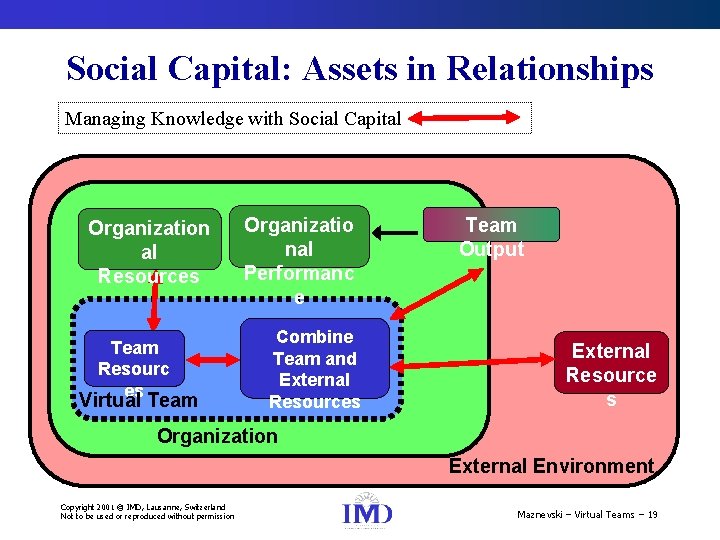
Social Capital: Assets in Relationships Managing Knowledge with Social Capital Organization al Resources Team Resourc es Virtual Team Organizatio nal Performanc e Combine Team and External Resources Team Output External Resource s Organization External Environment Copyright 2001 © IMD, Lausanne, Switzerland Not to be used or reproduced without permission Maznevski – Virtual Teams – 19
Empirical Study § 35 global account management teams in a large professional services firm, 10 -100 people per “team” § Team networks for task advice, “people” advice: • Within the team • Between the team and the rest of the organization • Between the team and the client § Technology use § Two points in time § Multiple interviews, observations, etc. Copyright 2001 © IMD, Lausanne, Switzerland Not to be used or reproduced without permission Maznevski – Virtual Teams – 20
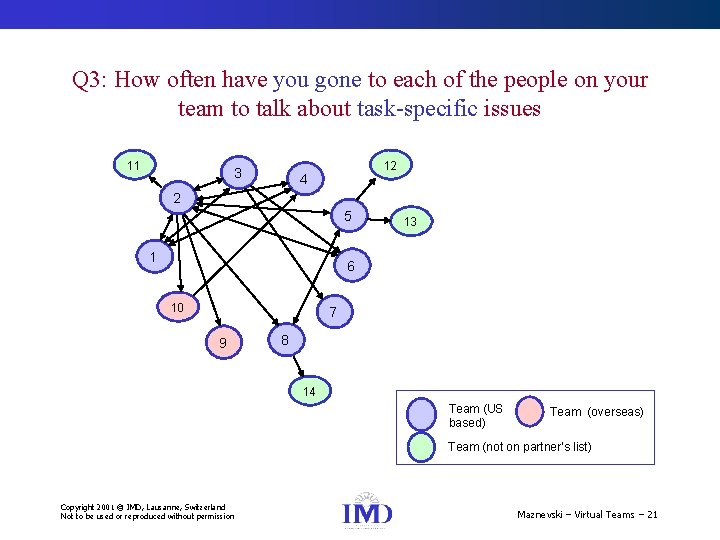
Q 3: How often have you gone to each of the people on your team to talk about task-specific issues 11 3 12 4 2 5 1 13 6 10 7 9 8 14 Team (US based) Team (overseas) Team (not on partner’s list) Copyright 2001 © IMD, Lausanne, Switzerland Not to be used or reproduced without permission Maznevski – Virtual Teams – 21
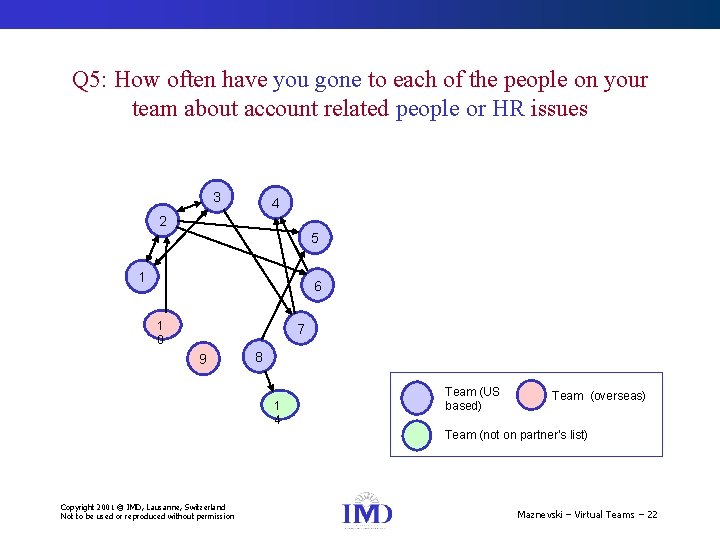
Q 5: How often have you gone to each of the people on your team about account related people or HR issues 3 4 2 5 1 6 1 0 7 9 8 1 4 Team (US based) Team (overseas) Team (not on partner’s list) Copyright 2001 © IMD, Lausanne, Switzerland Not to be used or reproduced without permission Maznevski – Virtual Teams – 22
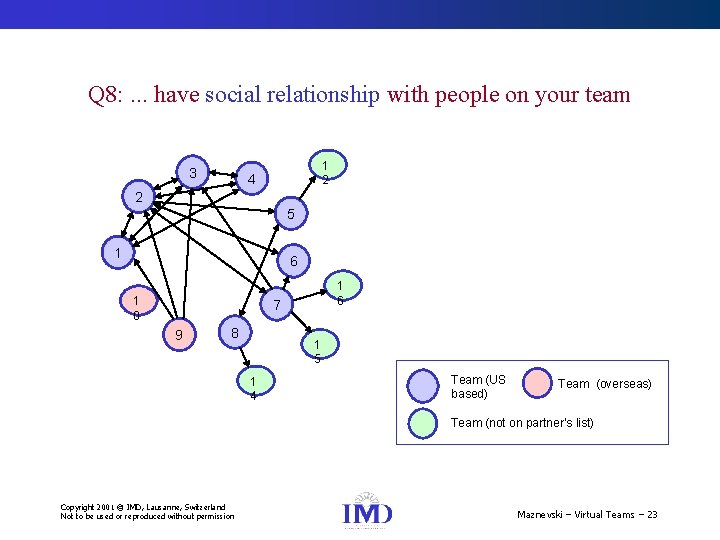
Q 8: . . . have social relationship with people on your team 3 1 2 4 2 5 1 6 1 0 1 6 7 9 8 1 5 1 4 Team (US based) Team (overseas) Team (not on partner’s list) Copyright 2001 © IMD, Lausanne, Switzerland Not to be used or reproduced without permission Maznevski – Virtual Teams – 23
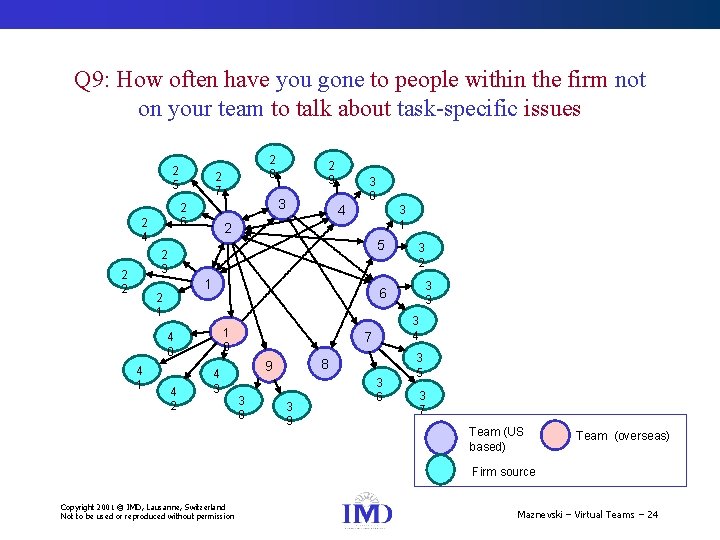
Q 9: How often have you gone to people within the firm not on your team to talk about task-specific issues 2 5 2 7 2 6 2 4 2 8 2 9 3 4 3 0 3 1 2 5 2 3 2 2 1 4 2 3 3 6 1 0 4 1 3 2 4 3 3 4 7 8 9 3 8 3 9 3 6 3 5 3 7 Team (US based) Team (overseas) Firm source Copyright 2001 © IMD, Lausanne, Switzerland Not to be used or reproduced without permission Maznevski – Virtual Teams – 24
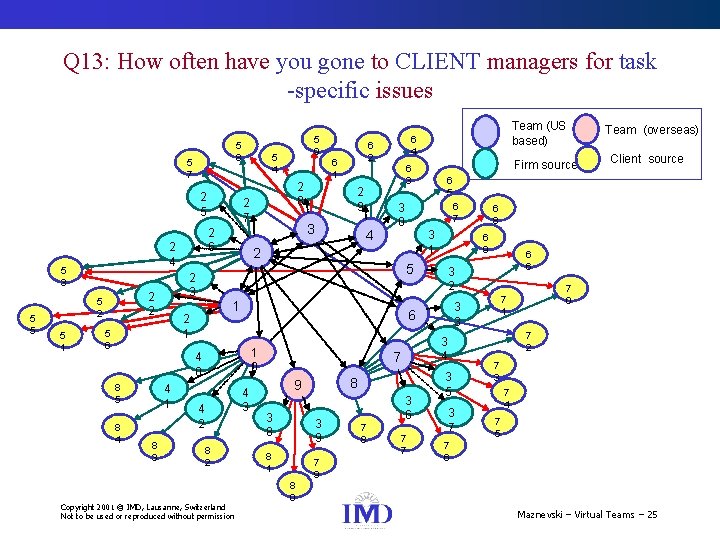
Q 13: How often have you gone to CLIENT managers for task -specific issues 5 8 5 7 2 5 5 3 5 5 5 1 8 4 4 1 8 3 2 9 3 4 3 0 3 1 4 3 4 2 8 2 Copyright 2001 © IMD, Lausanne, Switzerland Not to be used or reproduced without permission 8 9 3 8 3 9 8 1 8 0 7 9 3 6 7 8 7 7 6 6 3 2 7 0 7 1 3 3 7 2 3 4 7 6 8 6 9 6 1 0 Client source 6 5 6 7 1 Team (overseas) Firm source 6 3 2 4 0 8 5 6 2 6 1 Team (US based) 6 4 5 2 1 5 6 2 8 2 7 2 3 2 2 5 4 2 6 2 4 5 9 3 5 3 7 7 3 7 4 7 5 7 6 Maznevski – Virtual Teams – 25
- Slides: 25