
High Performance Computing Concepts Methods Means Open MP
![Open. MP Environment Variables Environment Variable: OMP_SCHEDULE Usage : bash/sh/ksh: csh/tcsh OMP_SCHEDULE “schedule, [chunk]”](https://slidetodoc.com/presentation_image/6398d7fa831dbb27d4e422be114c84fd/image-14.jpg "Open. MP Environment Variables Environment Variable: OMP_SCHEDULE Usage : bash/sh/ksh: csh/tcsh OMP_SCHEDULE “schedule, [chunk]”")
![DEMO : Hello World [cdekate@celeritas open. MP]$ icc -o helloc -openmp hello. c(6) :](https://slidetodoc.com/presentation_image/6398d7fa831dbb27d4e422be114c84fd/image-16.jpg "DEMO : Hello World [cdekate@celeritas open. MP]$ icc -o helloc -openmp hello. c(6) :")
![Understanding variables in Open. MP #pragma omp parallel for (i=0; i<n; i++) z[i] =](https://slidetodoc.com/presentation_image/6398d7fa831dbb27d4e422be114c84fd/image-28.jpg "Understanding variables in Open. MP #pragma omp parallel for (i=0; i<n; i++) z[i] =")
- Slides: 46
High Performance Computing: Concepts, Methods & Means Open. MP Programming Prof. Thomas Sterling Department of Computer Science Louisiana State University February 8 th, 2007
Topics • Introduction • • Overview of Open. MP Basic Constructs Shared Data Parallel Flow Control Synchronization Performance Synopsis of Commands Summary – Material for Test 2
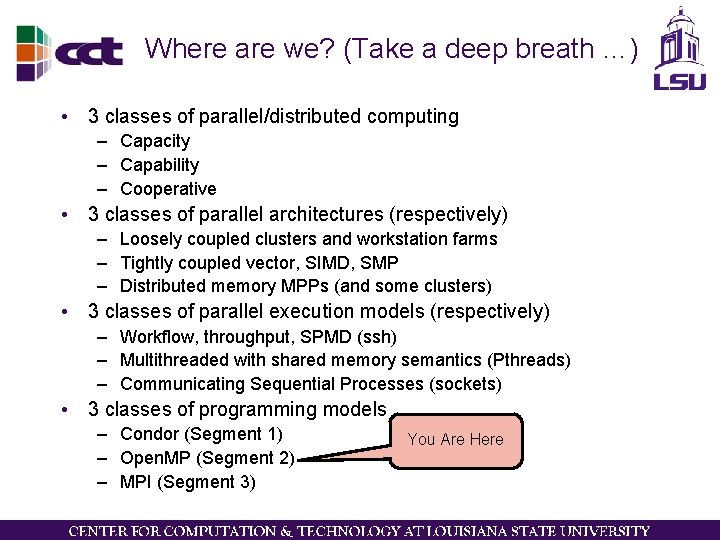
Where are we? (Take a deep breath …) • 3 classes of parallel/distributed computing – Capacity – Capability – Cooperative • 3 classes of parallel architectures (respectively) – Loosely coupled clusters and workstation farms – Tightly coupled vector, SIMD, SMP – Distributed memory MPPs (and some clusters) • 3 classes of parallel execution models (respectively) – Workflow, throughput, SPMD (ssh) – Multithreaded with shared memory semantics (Pthreads) – Communicating Sequential Processes (sockets) • 3 classes of programming models – Condor (Segment 1) – Open. MP (Segment 2) – MPI (Segment 3) You Are Here
Topics • Introduction • Overview of Open. MP • • Basic Constructs Shared Data Parallel Flow Control Synchronization Performance Synopsis of Commands Summary – Material for Test 4
Intro (1) • Open. MP is : – an API (Application Programming Interface) – NOT a programming language – A set of compiler directives that help the application developer to parallelize their workload. – A collection of the directives, environment variables and the library routines 5
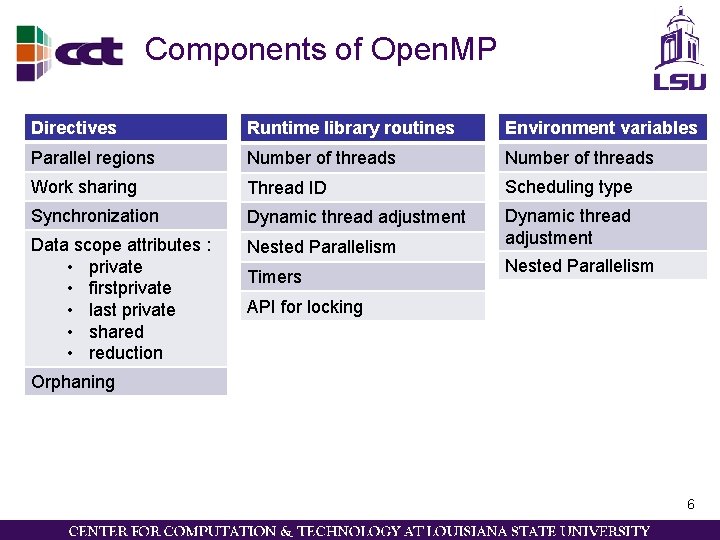
Components of Open. MP Directives Runtime library routines Environment variables Parallel regions Number of threads Work sharing Thread ID Scheduling type Synchronization Dynamic thread adjustment Data scope attributes : • private • firstprivate • last private • shared • reduction Nested Parallelism Dynamic thread adjustment Timers Nested Parallelism API for locking Orphaning 6
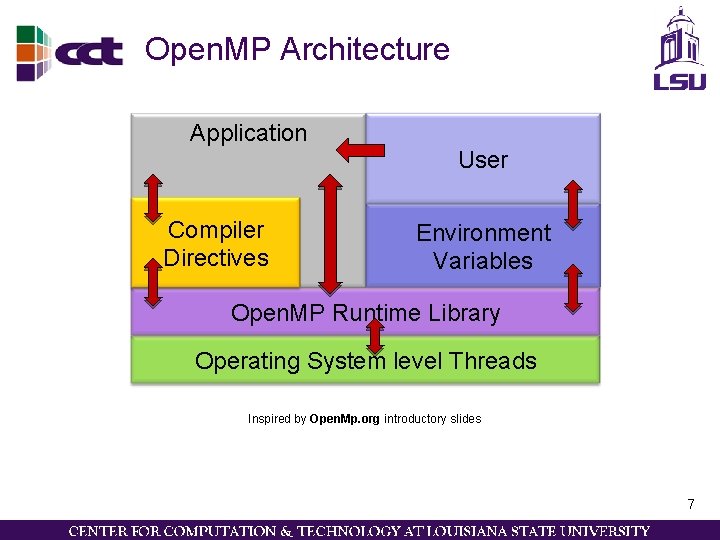
Open. MP Architecture Application User Compiler Directives Environment Variables Open. MP Runtime Library Operating System level Threads Inspired by Open. Mp. org introductory slides 7
Topics • Introduction • Overview of Open. MP • Basic Constructs • • • Shared Data Parallel Flow Control Synchronization Performance Synopsis of Commands Summary – Material for Test 8
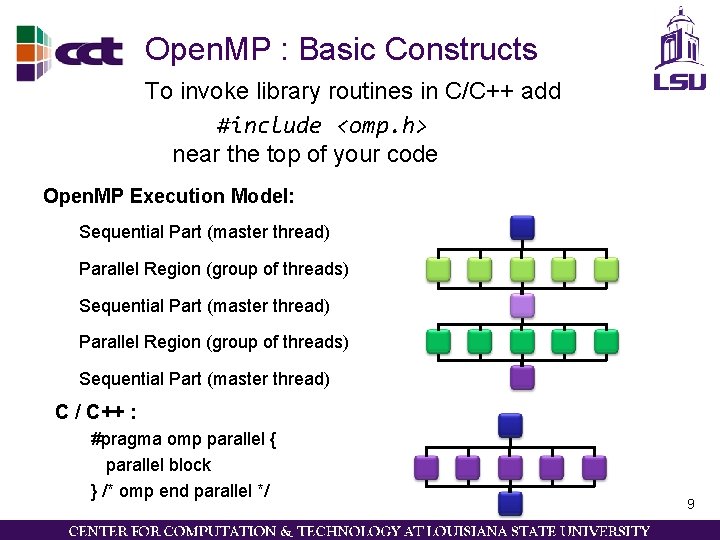
Open. MP : Basic Constructs To invoke library routines in C/C++ add #include <omp. h> near the top of your code Open. MP Execution Model: Sequential Part (master thread) Parallel Region (group of threads) Sequential Part (master thread) C / C++ : #pragma omp parallel { parallel block } /* omp end parallel */ 9
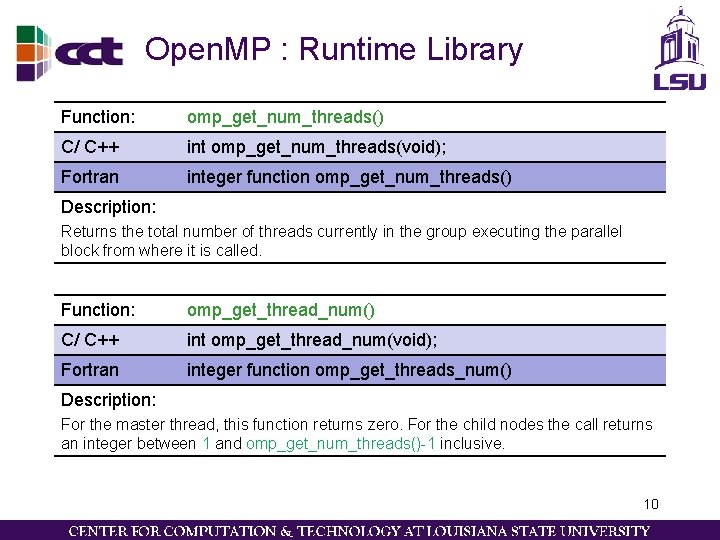
Open. MP : Runtime Library Function: omp_get_num_threads() C/ C++ int omp_get_num_threads(void); Fortran integer function omp_get_num_threads() Description: Returns the total number of threads currently in the group executing the parallel block from where it is called. Function: omp_get_thread_num() C/ C++ int omp_get_thread_num(void); Fortran integer function omp_get_threads_num() Description: For the master thread, this function returns zero. For the child nodes the call returns an integer between 1 and omp_get_num_threads()-1 inclusive. 10
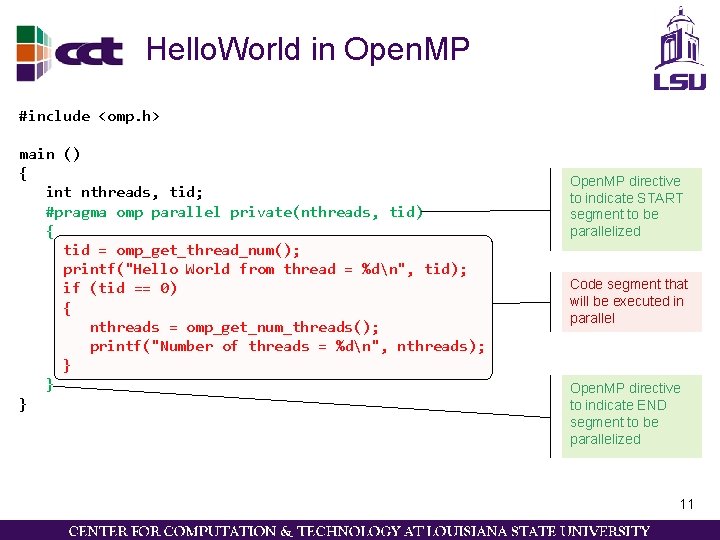
Hello. World in Open. MP #include <omp. h> main () { int nthreads, tid; #pragma omp parallel private(nthreads, tid) { tid = omp_get_thread_num(); printf("Hello World from thread = %dn", tid); if (tid == 0) { nthreads = omp_get_num_threads(); printf("Number of threads = %dn", nthreads); } } } Open. MP directive to indicate START segment to be parallelized Code segment that will be executed in parallel Open. MP directive to indicate END segment to be parallelized 11
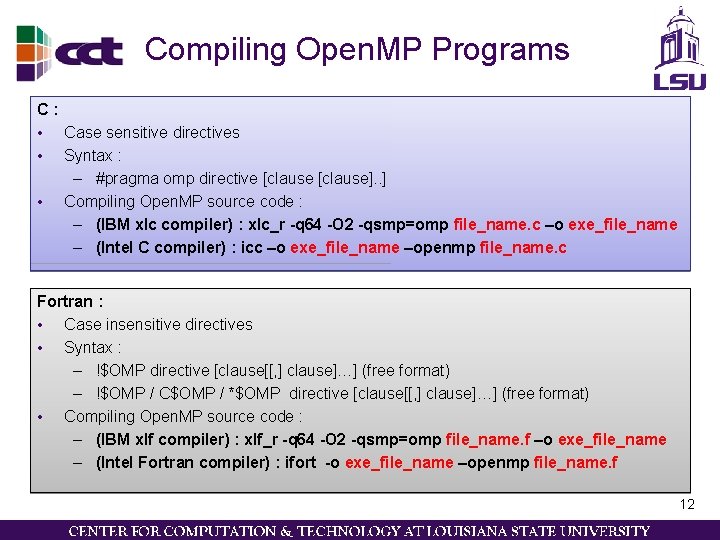
Compiling Open. MP Programs C: • Case sensitive directives • Syntax : – #pragma omp directive [clause]. . ] • Compiling Open. MP source code : – (IBM xlc compiler) : xlc_r -q 64 -O 2 -qsmp=omp file_name. c –o exe_file_name – (Intel C compiler) : icc –o exe_file_name –openmp file_name. c Fortran : • Case insensitive directives • Syntax : – !$OMP directive [clause[[, ] clause]…] (free format) – !$OMP / C$OMP / *$OMP directive [clause[[, ] clause]…] (free format) • Compiling Open. MP source code : – (IBM xlf compiler) : xlf_r -q 64 -O 2 -qsmp=omp file_name. f –o exe_file_name – (Intel Fortran compiler) : ifort -o exe_file_name –openmp file_name. f 12
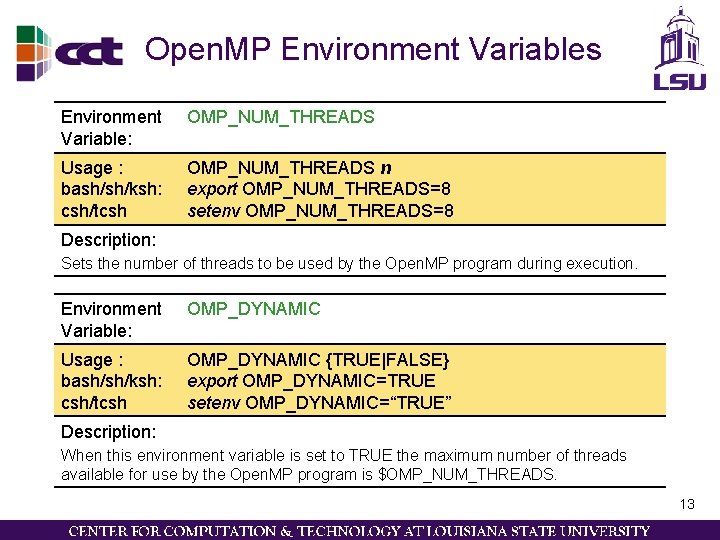
Open. MP Environment Variables Environment Variable: OMP_NUM_THREADS Usage : bash/sh/ksh: csh/tcsh OMP_NUM_THREADS n export OMP_NUM_THREADS=8 setenv OMP_NUM_THREADS=8 Description: Sets the number of threads to be used by the Open. MP program during execution. Environment Variable: OMP_DYNAMIC Usage : bash/sh/ksh: csh/tcsh OMP_DYNAMIC {TRUE|FALSE} export OMP_DYNAMIC=TRUE setenv OMP_DYNAMIC=“TRUE” Description: When this environment variable is set to TRUE the maximum number of threads available for use by the Open. MP program is $OMP_NUM_THREADS. 13
Open. MP Environment Variables Environment Variable: OMP_SCHEDULE Usage : bash/sh/ksh: csh/tcsh OMP_SCHEDULE “schedule, [chunk]” export OMP_SCHEDULE static, N/P setenv OMP_SCHEDULE=“GUIDED, 4” Description: Only applies to for and parallel for directives. This environment variable sets the schedule type and chunk size for all such loops. The chunk size can be provided as an integer number, the default being 1. Environment Variable: OMP_NESTED Usage : bash/sh/ksh: csh/tcsh OMP_NESTED {TRUE|FALSE} export OMP_NESTED FALSE setenv OMP_NESTED=“FALSE” Description: Setting this environment variable to TRUE enables multi-threaded execution of inner parallel regions in nested parallel regions. 14
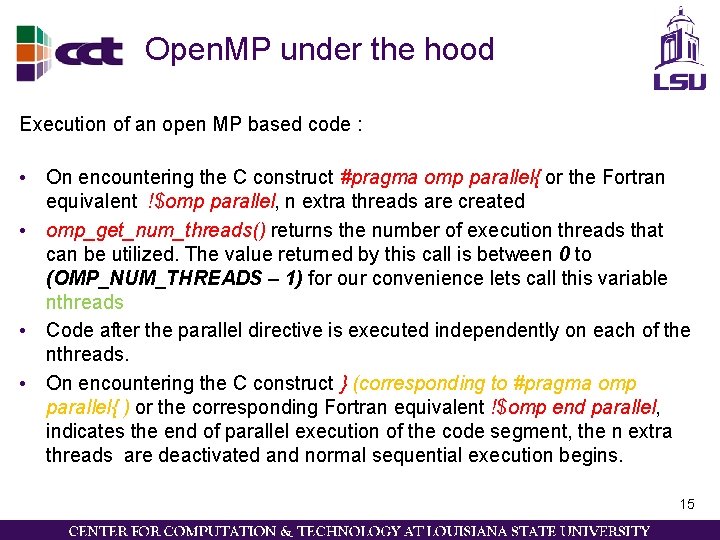
Open. MP under the hood Execution of an open MP based code : • On encountering the C construct #pragma omp parallel{ or the Fortran equivalent !$omp parallel, n extra threads are created • omp_get_num_threads() returns the number of execution threads that can be utilized. The value returned by this call is between 0 to (OMP_NUM_THREADS – 1) for our convenience lets call this variable nthreads • Code after the parallel directive is executed independently on each of the nthreads. • On encountering the C construct } (corresponding to #pragma omp parallel{ ) or the corresponding Fortran equivalent !$omp end parallel, indicates the end of parallel execution of the code segment, the n extra threads are deactivated and normal sequential execution begins. 15
DEMO : Hello World [cdekate@celeritas open. MP]$ icc -o helloc -openmp hello. c(6) : (col. 4) remark: Open. MP DEFINED REGION WAS PARALLELIZED. [cdekate@celeritas open. MP]$ export OMP_NUM_THREADS=8 [cdekate@celeritas open. MP]$. /helloc Hello World from thread = 0 Number of threads = 8 Hello World from thread = 1 Hello World from thread = 2 Hello World from thread = 3 Hello World from thread = 4 Hello World from thread = 5 Hello World from thread = 6 Hello World from thread = 7 [cdekate@celeritas open. MP]$ 16
Topics • Introduction • Overview of Open. MP • Basic Constructs • Shared Data • • • Parallel Flow Control Synchronization Performance Synopsis of Commands Summary – Material for Test 17
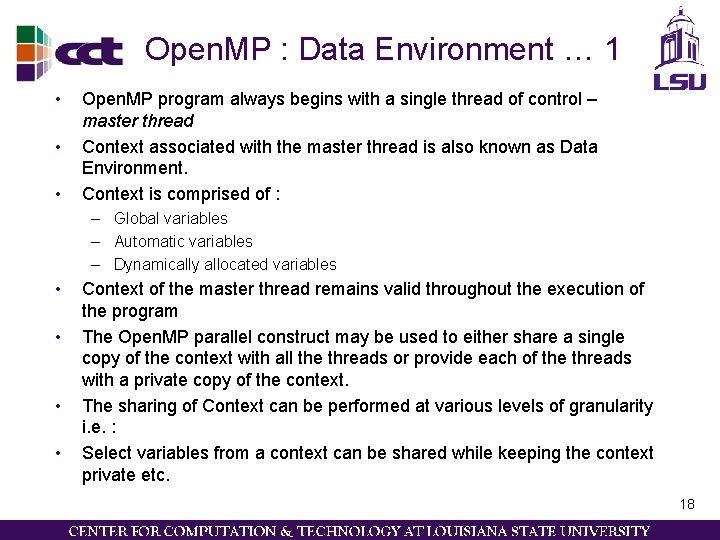
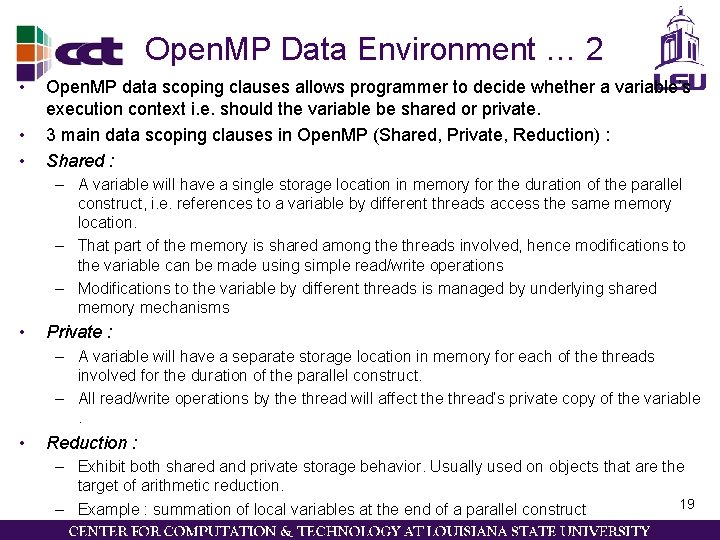
Open. MP : Data Environment … 1 • • • Open. MP program always begins with a single thread of control – master thread Context associated with the master thread is also known as Data Environment. Context is comprised of : – Global variables – Automatic variables – Dynamically allocated variables • • Context of the master thread remains valid throughout the execution of the program The Open. MP parallel construct may be used to either share a single copy of the context with all the threads or provide each of the threads with a private copy of the context. The sharing of Context can be performed at various levels of granularity i. e. : Select variables from a context can be shared while keeping the context private etc. 18
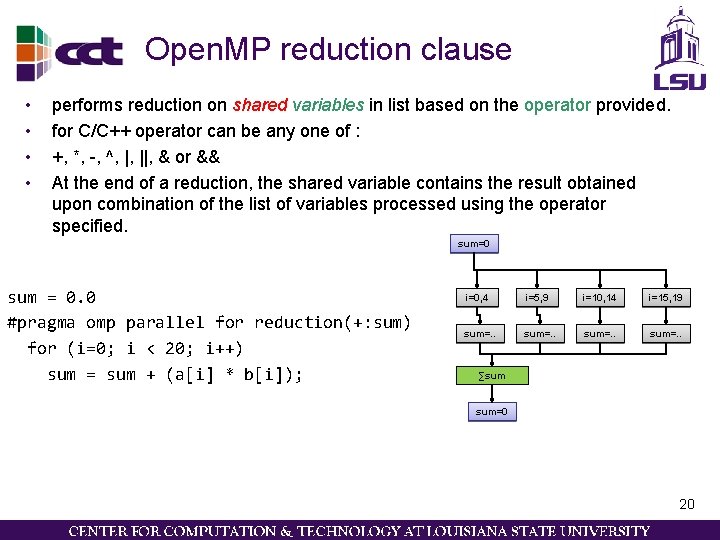
Open. MP Data Environment … 2 • • • Open. MP data scoping clauses allows programmer to decide whether a variable’s execution context i. e. should the variable be shared or private. 3 main data scoping clauses in Open. MP (Shared, Private, Reduction) : Shared : – A variable will have a single storage location in memory for the duration of the parallel construct, i. e. references to a variable by different threads access the same memory location. – That part of the memory is shared among the threads involved, hence modifications to the variable can be made using simple read/write operations – Modifications to the variable by different threads is managed by underlying shared memory mechanisms • Private : – A variable will have a separate storage location in memory for each of the threads involved for the duration of the parallel construct. – All read/write operations by the thread will affect the thread’s private copy of the variable. • Reduction : – Exhibit both shared and private storage behavior. Usually used on objects that are the target of arithmetic reduction. 19 – Example : summation of local variables at the end of a parallel construct
Open. MP reduction clause • • performs reduction on shared variables in list based on the operator provided. for C/C++ operator can be any one of : +, *, -, ^, |, ||, & or && At the end of a reduction, the shared variable contains the result obtained upon combination of the list of variables processed using the operator specified. sum=0 sum = 0. 0 #pragma omp parallel for reduction(+: sum) for (i=0; i < 20; i++) sum = sum + (a[i] * b[i]); i=0, 4 i=5, 9 i=10, 14 i=15, 19 sum=. . ∑sum sum=0 20
DEMO 1 • Calculating Pi using Integrals • Demonstrating private and shared
Topics • • Introduction Overview of Open. MP Basic Constructs Shared Data • Parallel Flow Control • • Synchronization Performance Synopsis of Commands Summary – Material for Test 22
Open. MP Work-Sharing Directives • Work sharing construct divide the execution of the enclosed block of code among the group of threads. • They do not launch new threads. • No implied barrier on entry • Implicit barrier at the end of work-sharing construct • Commonly used Work Sharing constructs : – for directive (C/C++ ; equivalent DO construct available in Fortran but will not be covered here) : shares iterations of a loop across a group of threads – sections directive : breaks work into separate sections between the group of threads; such that each thread independently executes a section of the work. – single directive: serializes a section of code • We will cover for and sections directive of these in greater detail 23
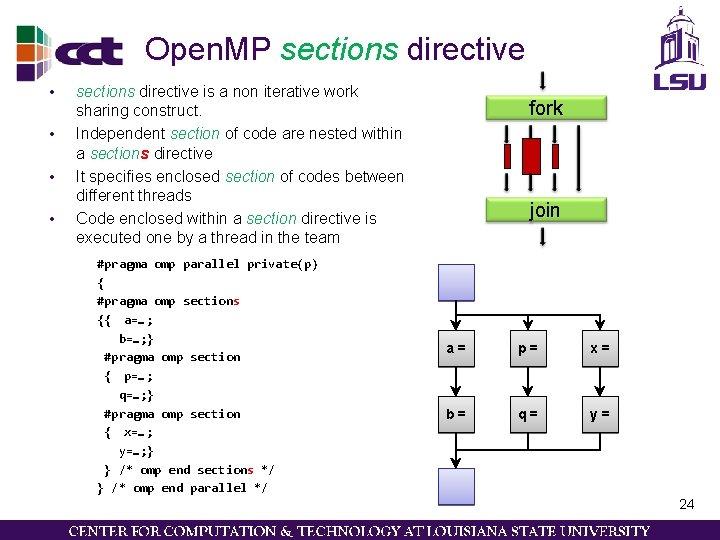
Open. MP sections directive • • sections directive is a non iterative work sharing construct. Independent section of code are nested within a sections directive It specifies enclosed section of codes between different threads Code enclosed within a section directive is executed one by a thread in the team #pragma omp parallel private(p) { #pragma omp sections {{ a=…; b=…; } #pragma omp section { p=…; q=…; } #pragma omp section { x=…; y=…; } } /* omp end sections */ } /* omp end parallel */ fork join a= p= x= b= q= y= 24
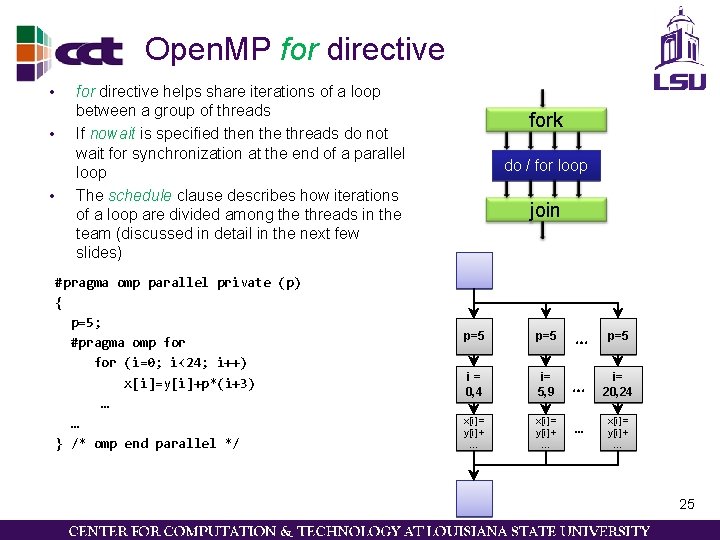
Open. MP for directive • • • for directive helps share iterations of a loop between a group of threads If nowait is specified then the threads do not wait for synchronization at the end of a parallel loop The schedule clause describes how iterations of a loop are divided among the threads in the team (discussed in detail in the next few slides) #pragma omp parallel private (p) { p=5; #pragma omp for (i=0; i<24; i++) x[i]=y[i]+p*(i+3) … … } /* omp end parallel */ fork do / for loop join p=5 … p=5 i= 0, 4 i= 5, 9 … i= 20, 24 x[i]= y[i]+ … … x[i]= y[i]+ … 25
Open. MP schedule clause • The schedule clause defines how the iterations of a loop are divided among a group of threads • static : iterations are divided into pieces of size chunk and are statically assigned to each of the threads in a round robin fashion • dynamic : iterations divided into pieces of size chunk and dynamically assigned to a group of threads. After a thread finishes processing a chunk, it is dynamically assigned the next set of iterations. • guided : For a chunk of size 1, the size of each chunk is proportional to the number of unassigned iterations divided by the number of threads, decreasing to 1. For a chunk with value k, the same algorithm is used to for determining the chunk size with the constraint that no chunk should have less than k chunks except the last chunk. • Default schedule is implementation specific while the default chunk size is usually 1 26
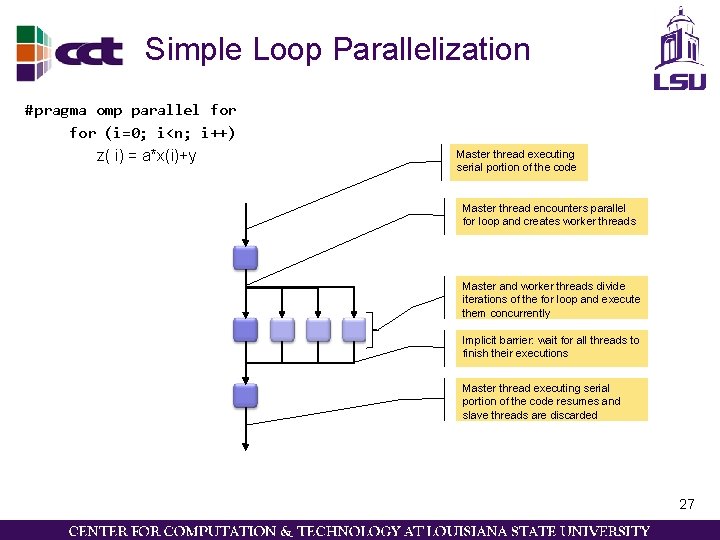
Simple Loop Parallelization #pragma omp parallel for (i=0; i<n; i++) z( i) = a*x(i)+y Master thread executing serial portion of the code Master thread encounters parallel for loop and creates worker threads Master and worker threads divide iterations of the for loop and execute them concurrently Implicit barrier: wait for all threads to finish their executions Master thread executing serial portion of the code resumes and slave threads are discarded 27
Understanding variables in Open. MP #pragma omp parallel for (i=0; i<n; i++) z[i] = a*x[i]+y • • • z[ ] a x[ ] y Shared variable z is modified by multiple threads Each iteration reads the scalar variables a and y and the array element x[i] a, y, x can be read concurrently as their values remain unchanged. Each iteration writes to a distinct element of z[i] over the index range. Hence write operations can be carried out concurrently with each iteration writing to a distinct array index and memory location The parallel for directive in Open. MP ensure that the for loop index value (i in this case) is private to each thread. n i i i 28
DEMO 2 • Demonstrating loop-level parallelism
Topics • • • Introduction Overview of Open. MP Basic Constructs Shared Data Parallel Flow Control • Synchronization • Performance • Synopsis of Commands • Summary – Material for Test 30
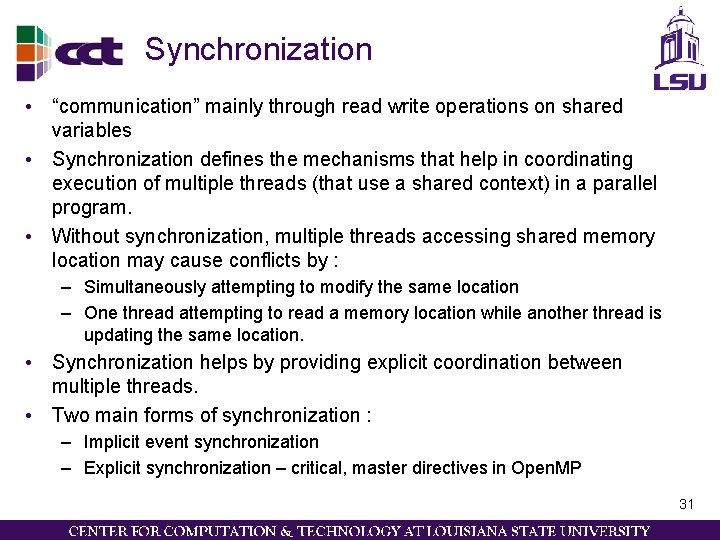
Synchronization • “communication” mainly through read write operations on shared variables • Synchronization defines the mechanisms that help in coordinating execution of multiple threads (that use a shared context) in a parallel program. • Without synchronization, multiple threads accessing shared memory location may cause conflicts by : – Simultaneously attempting to modify the same location – One thread attempting to read a memory location while another thread is updating the same location. • Synchronization helps by providing explicit coordination between multiple threads. • Two main forms of synchronization : – Implicit event synchronization – Explicit synchronization – critical, master directives in Open. MP 31
Basic Types of Synchronization • Explicit Synchronization via mutual exclusion – Controls access to the shared variable by providing a thread exclusive access to the memory location for the duration of its construct. – Requiring multiple threads to acquiring access to a shared variable before modifying the memory location helps ensure integrity of the shared variable. – Critical directive of Open. MP provides mutual exclusion • Event Synchronization – Signals occurrence of an event across multiple threads. – Barrier directives in Open. MP provide the simplest form of event synchronization – The barrier directive defines a point in a parallel program where each thread waits for all other threads to arrive. This helps to ensure that all threads have executed the same code in parallel upto the barrier. – Once all threads arrive at the point, the threads can continue execution past the barrier. • Additional synchronization mechanisms available in Open. MP 32
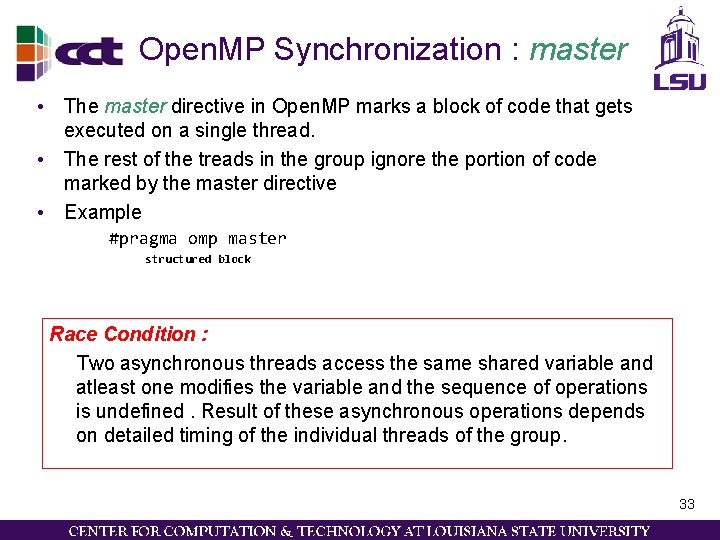
Open. MP Synchronization : master • The master directive in Open. MP marks a block of code that gets executed on a single thread. • The rest of the treads in the group ignore the portion of code marked by the master directive • Example #pragma omp master structured block Race Condition : Two asynchronous threads access the same shared variable and atleast one modifies the variable and the sequence of operations is undefined. Result of these asynchronous operations depends on detailed timing of the individual threads of the group. 33
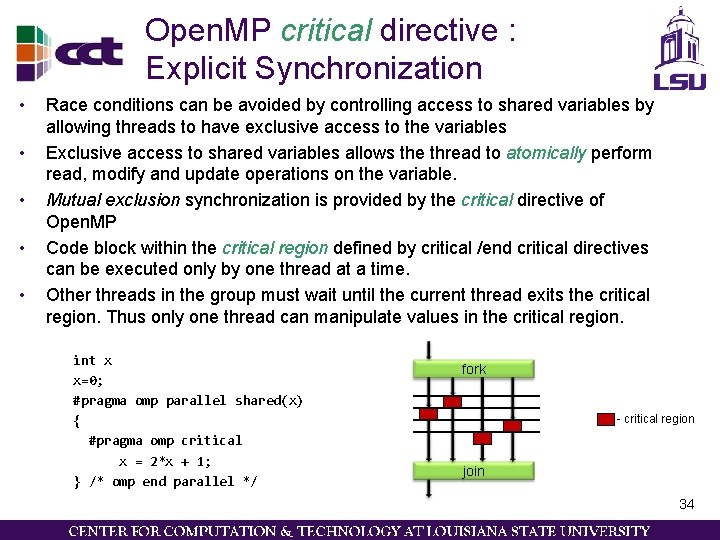
Open. MP critical directive : Explicit Synchronization • • • Race conditions can be avoided by controlling access to shared variables by allowing threads to have exclusive access to the variables Exclusive access to shared variables allows the thread to atomically perform read, modify and update operations on the variable. Mutual exclusion synchronization is provided by the critical directive of Open. MP Code block within the critical region defined by critical /end critical directives can be executed only by one thread at a time. Other threads in the group must wait until the current thread exits the critical region. Thus only one thread can manipulate values in the critical region. int x x=0; #pragma omp parallel shared(x) { #pragma omp critical x = 2*x + 1; } /* omp end parallel */ fork - critical region join 34
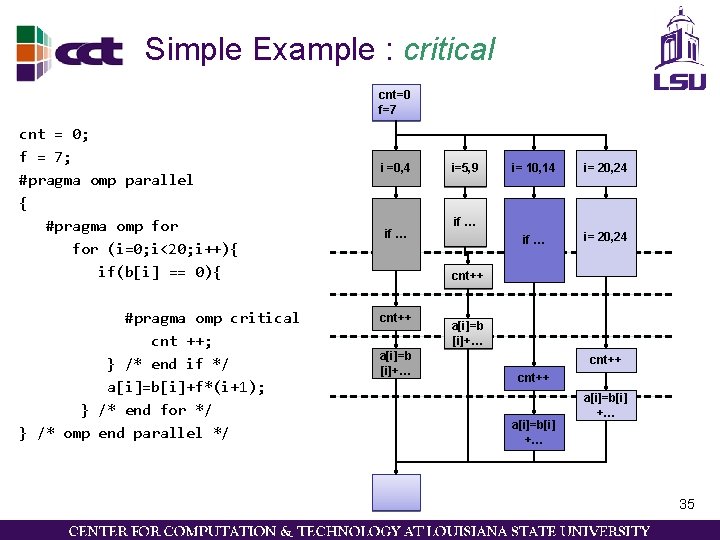
Simple Example : critical cnt=0 f=7 cnt = 0; f = 7; #pragma omp parallel { #pragma omp for (i=0; i<20; i++){ if(b[i] == 0){ #pragma omp critical cnt ++; } /* end if */ a[i]=b[i]+f*(i+1); } /* end for */ } /* omp end parallel */ i =0, 4 if … i=5, 9 i= 10, 14 i= 20, 24 if … cnt++ a[i]=b [i]+… cnt++ a[i]=b[i] +… 35
Demo 4 • Critical section in calculation of value of 22/7
Topics • • • Introduction Overview of Open. MP Basic Constructs Shared Data Parallel Flow Control Synchronization • Performance • Synopsis of Commands • Summary – Material for Test 37
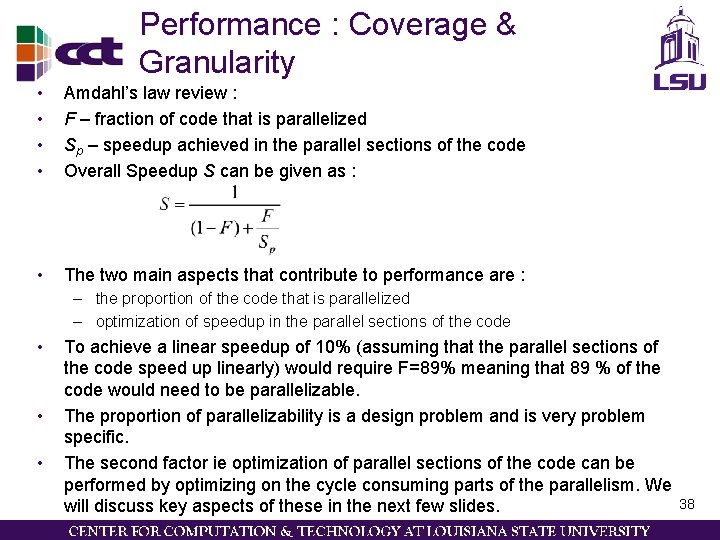
Performance : Coverage & Granularity • • Amdahl’s law review : F – fraction of code that is parallelized Sp – speedup achieved in the parallel sections of the code Overall Speedup S can be given as : • The two main aspects that contribute to performance are : – the proportion of the code that is parallelized – optimization of speedup in the parallel sections of the code • • • To achieve a linear speedup of 10% (assuming that the parallel sections of the code speed up linearly) would require F=89% meaning that 89 % of the code would need to be parallelizable. The proportion of parallelizability is a design problem and is very problem specific. The second factor ie optimization of parallel sections of the code can be performed by optimizing on the cycle consuming parts of the parallelism. We will discuss key aspects of these in the next few slides. 38
Performance Open. MP : Key Factors • Load Balancing : • mapping workloads with thread scheduling • Caches : – Write-through – Write-back • Locality : – Temporal Locality – Spatial Locality • How Locality affects scheduling algorithm selection • Synchronization : – Effect of critical sections on performance 39
Performance : Load Balancing • • • Performance of a parallel loop is inversely proportional to the processing time taken by the processors involved. That is if a processor takes longer to complete a particular portion of the parallel loop the performance is negatively affected. Open. MP allows programmer to control the scheduling and workload size at loop level by providing mechanisms like static, dynamic, guided self scheduling. Static scheduling is best when the data (eg a matrix ) can be evenly divided across available processors. Load balancing can become problematic when data cannot be divided uniformly across the processors. Some processors will be assigned larger chunks of work and hence would take longer to finish (negatively impacting the performance) For workloads that cannot be divided evenly Dynamic scheduling can provide even workload processing times. One limitation of dynamic scheduling is that of the overhead involved in the form of synchronization, and work request procedures of the Open. MP runtime system. For workloads such as a sparse matrix where the amount of work varies in an unpredictable, data-dependent manner Guided self scheduling can provide the best load balancing. 40
Performance : Caches & Locality • Caches (Review) : – for a C statement : • a[i] = b[i]+c[i] – the system accesses the memory locations referenced by b[i] and c[i] to the processor, the result of the computation is subsequently stored in the memory location referenced by a[i] • Write-through caches: When a user writes some data, the data is immediately written back to the memory, thus maintaining the cache-memory consistency. In write through caches data in caches always reflect the data in the memory. One of the main issues in write through caches is the increase in system overhead required due to moving of large data between cache and memory. • Write-back caches : When a user writes some data, the data is stored in the cache and is not synchronized with the memory. Instead when the cache content is different than the memory content, a bit entry is made in the cache. While cleaning up caches the system checks for the entry in cache and if the bit is set the system writes the changes to the memory. 41
Performance : Caches & Locality • Temporal Locality is a property that if a program accesses a memory location, there is a much higher than random probability that the same location would be accessed again. • Spatial Locality is a property that if a program accesses a memory location, there is a much higher than random probability that the nearby locations would be accessed soon. • Spatial locality is usually easier to achieve than temporal locality • A couple of key factors affect the relationship between locality and scheduling : – Size of dataset being processed by each processor – How much reuse is present in the code processing a chunk of iterations. 42
Topics • • Introduction Overview of Open. MP Basic Constructs Shared Data Parallel Flow Control Synchronization Performance • Synopsis of Commands • Summary – Material for Test 43
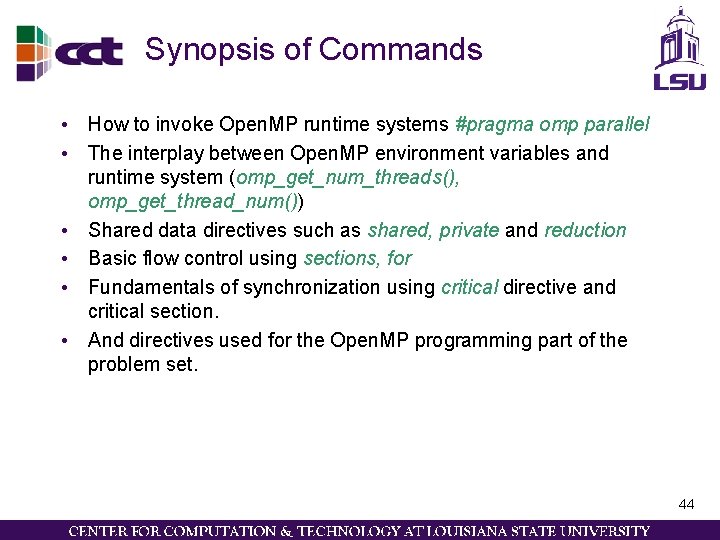
Synopsis of Commands • How to invoke Open. MP runtime systems #pragma omp parallel • The interplay between Open. MP environment variables and runtime system (omp_get_num_threads(), omp_get_thread_num()) • Shared data directives such as shared, private and reduction • Basic flow control using sections, for • Fundamentals of synchronization using critical directive and critical section. • And directives used for the Open. MP programming part of the problem set. 44
Topics • • Introduction Overview of Open. MP Basic Constructs Shared Data Parallel Flow Control Synchronization Performance Synopsis of Commands • Summary – Material for Test 45
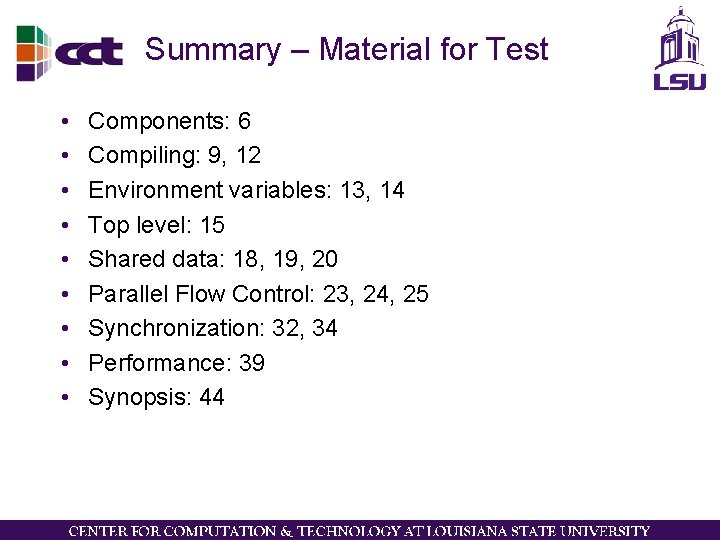
Summary – Material for Test • • • Components: 6 Compiling: 9, 12 Environment variables: 13, 14 Top level: 15 Shared data: 18, 19, 20 Parallel Flow Control: 23, 24, 25 Synchronization: 32, 34 Performance: 39 Synopsis: 44