
High Performance Architectures EPIC Part 2 EPIC a
- Slides: 39
High Performance Architectures EPIC Part 2
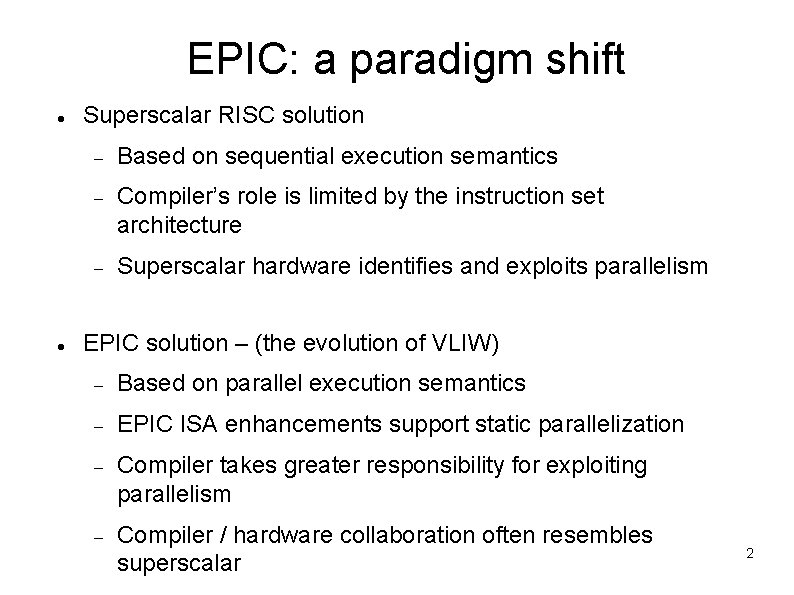
EPIC: a paradigm shift Superscalar RISC solution Based on sequential execution semantics Compiler’s role is limited by the instruction set architecture Superscalar hardware identifies and exploits parallelism EPIC solution – (the evolution of VLIW) Based on parallel execution semantics EPIC ISA enhancements support static parallelization Compiler takes greater responsibility for exploiting parallelism Compiler / hardware collaboration often resembles superscalar 2
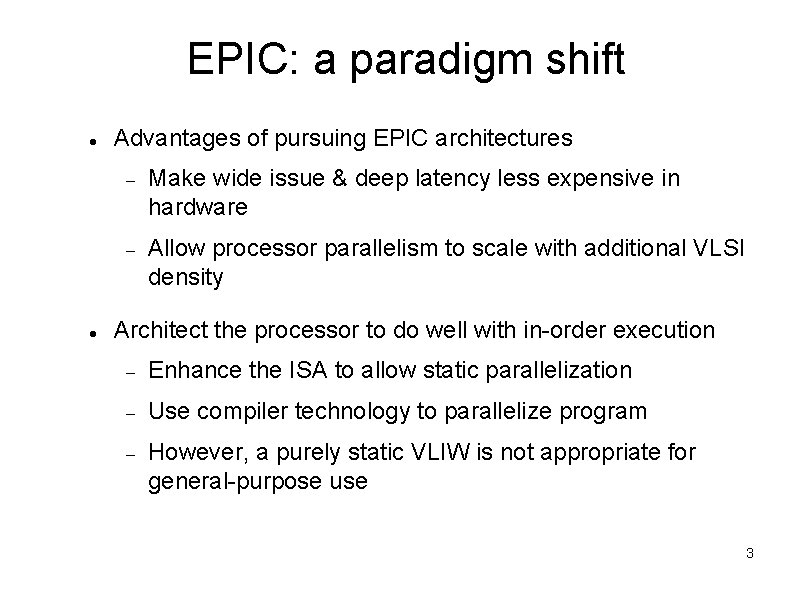
EPIC: a paradigm shift Advantages of pursuing EPIC architectures Make wide issue & deep latency less expensive in hardware Allow processor parallelism to scale with additional VLSI density Architect the processor to do well with in-order execution Enhance the ISA to allow static parallelization Use compiler technology to parallelize program However, a purely static VLIW is not appropriate for general-purpose use 3
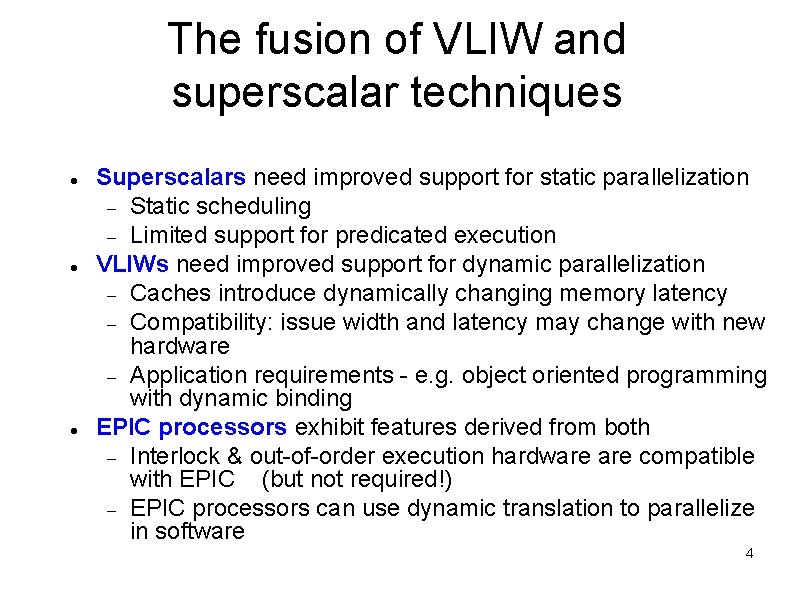
The fusion of VLIW and superscalar techniques Superscalars need improved support for static parallelization Static scheduling Limited support for predicated execution VLIWs need improved support for dynamic parallelization Caches introduce dynamically changing memory latency Compatibility: issue width and latency may change with new hardware Application requirements - e. g. object oriented programming with dynamic binding EPIC processors exhibit features derived from both Interlock & out-of-order execution hardware compatible with EPIC (but not required!) EPIC processors can use dynamic translation to parallelize in software 4
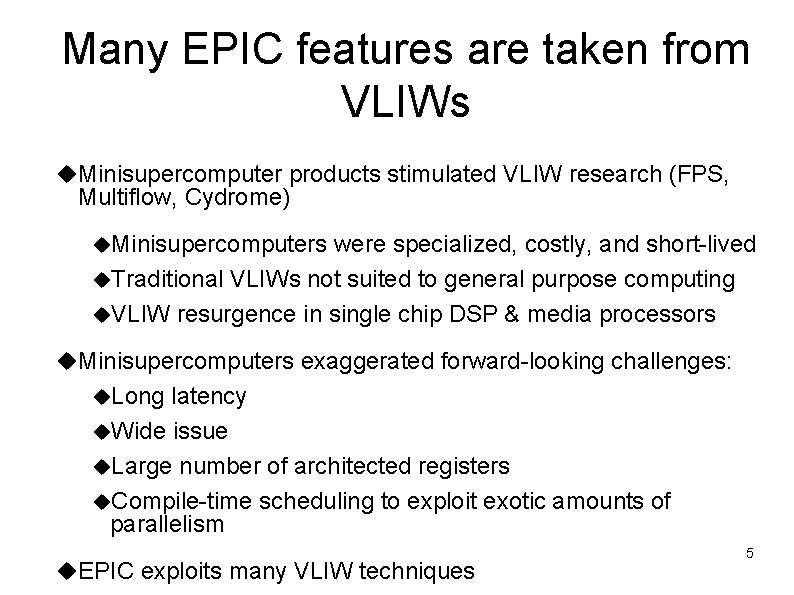
Many EPIC features are taken from VLIWs Minisupercomputer products stimulated VLIW research (FPS, Multiflow, Cydrome) Minisupercomputers were specialized, costly, and short-lived Traditional VLIWs not suited to general purpose computing VLIW resurgence in single chip DSP & media processors Minisupercomputers exaggerated forward-looking challenges: Long latency Wide issue Large number of architected registers Compile-time scheduling to exploit exotic amounts of parallelism EPIC exploits many VLIW techniques 5
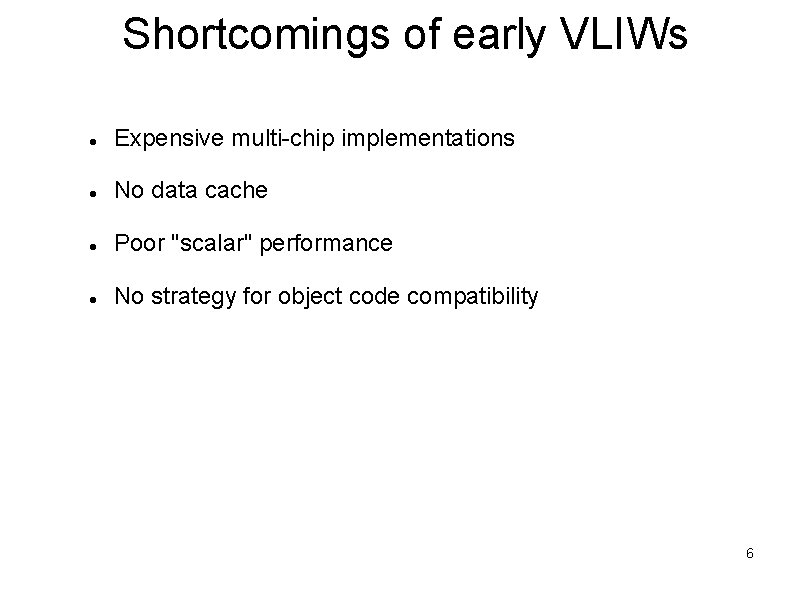
Shortcomings of early VLIWs Expensive multi-chip implementations No data cache Poor "scalar" performance No strategy for object code compatibility 6
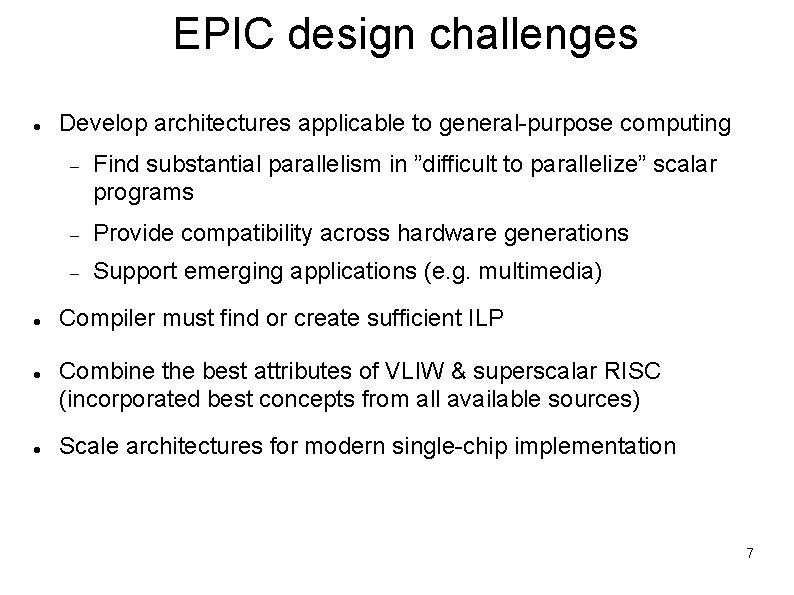
EPIC design challenges Develop architectures applicable to general-purpose computing Find substantial parallelism in ”difficult to parallelize” scalar programs Provide compatibility across hardware generations Support emerging applications (e. g. multimedia) Compiler must find or create sufficient ILP Combine the best attributes of VLIW & superscalar RISC (incorporated best concepts from all available sources) Scale architectures for modern single-chip implementation 7
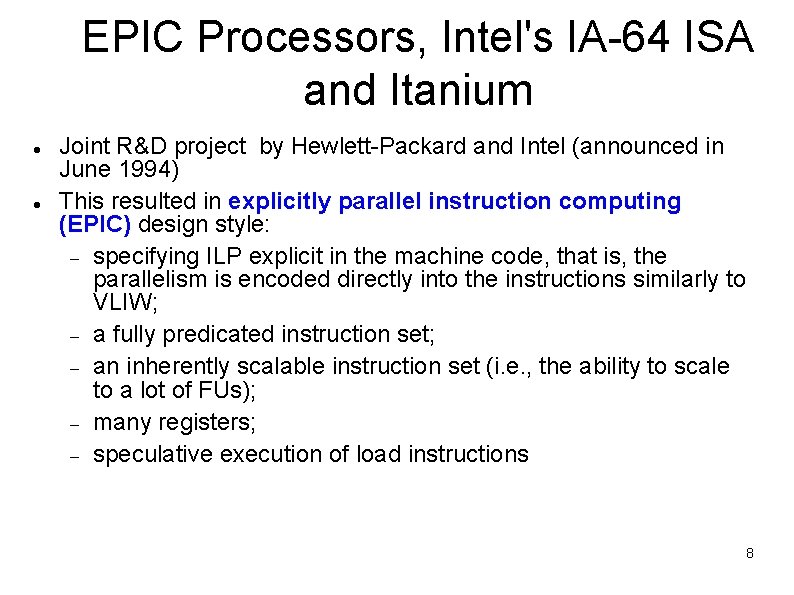
EPIC Processors, Intel's IA-64 ISA and Itanium Joint R&D project by Hewlett-Packard and Intel (announced in June 1994) This resulted in explicitly parallel instruction computing (EPIC) design style: specifying ILP explicit in the machine code, that is, the parallelism is encoded directly into the instructions similarly to VLIW; a fully predicated instruction set; an inherently scalable instruction set (i. e. , the ability to scale to a lot of FUs); many registers; speculative execution of load instructions 8
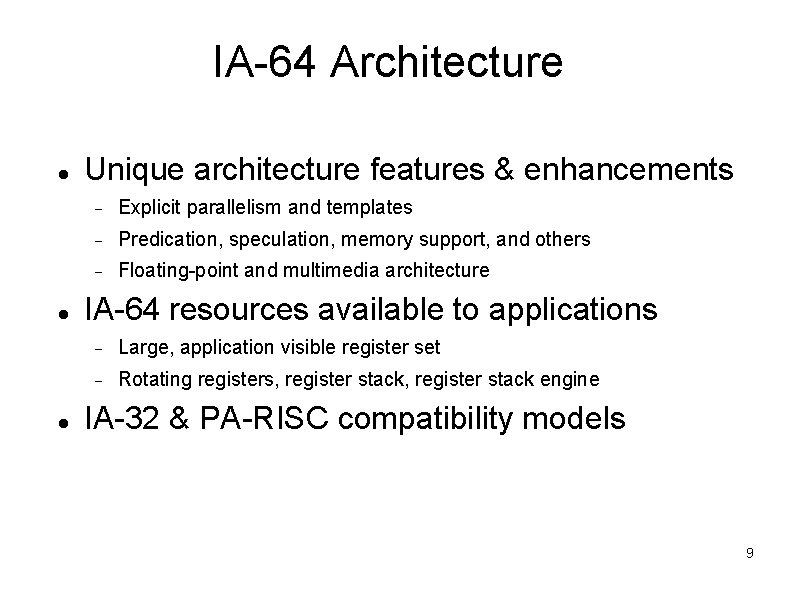
IA-64 Architecture Unique architecture features & enhancements Explicit parallelism and templates Predication, speculation, memory support, and others Floating-point and multimedia architecture IA-64 resources available to applications Large, application visible register set Rotating registers, register stack engine IA-32 & PA-RISC compatibility models 9
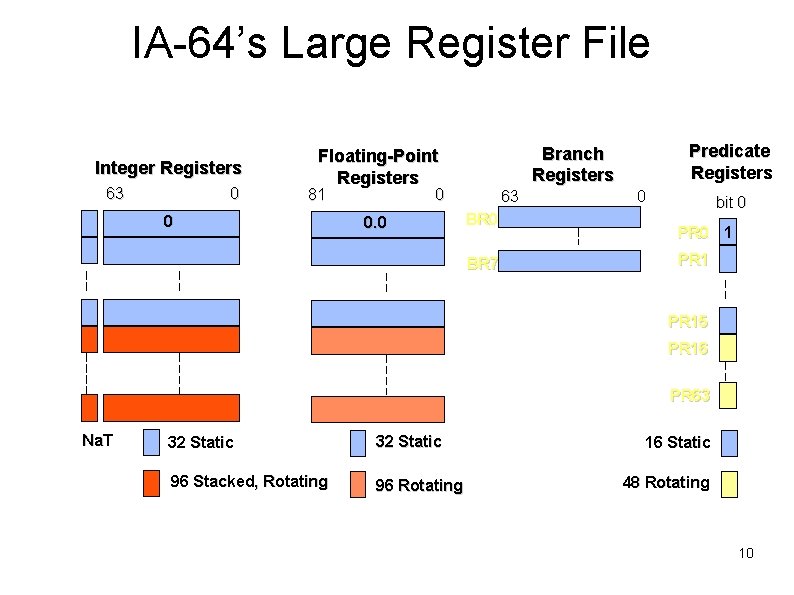
IA-64’s Large Register File Integer Registers 63 0 81 0 0 0. 0 Predicate Registers Branch Registers Floating-Point Registers 63 BR 0 BR 7 0 bit 0 PR 0 1 PR 15 PR 16 PR 63 Na. T 32 Static 96 Stacked, Rotating 96 Rotating 16 Static 48 Rotating 10
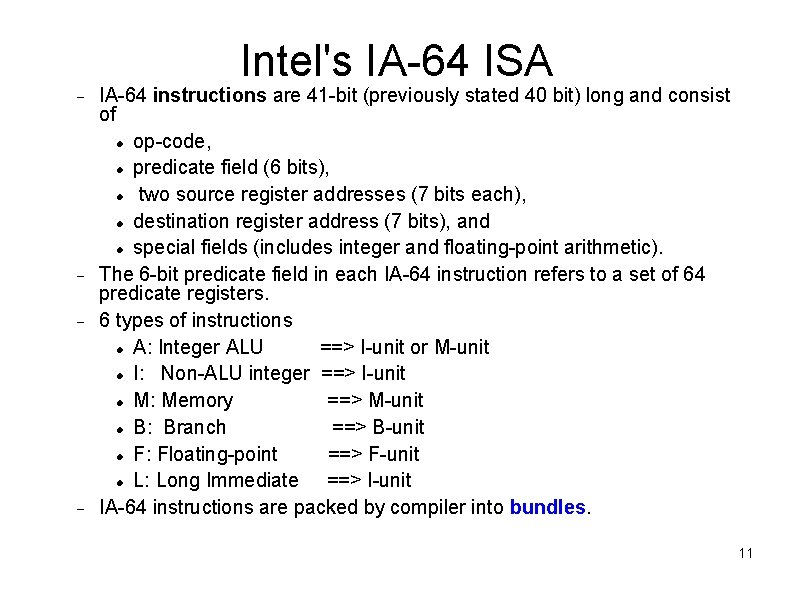
Intel's IA-64 ISA IA-64 instructions are 41 -bit (previously stated 40 bit) long and consist of op-code, predicate field (6 bits), two source register addresses (7 bits each), destination register address (7 bits), and special fields (includes integer and floating-point arithmetic). The 6 -bit predicate field in each IA-64 instruction refers to a set of 64 predicate registers. 6 types of instructions A: Integer ALU ==> I-unit or M-unit I: Non-ALU integer ==> I-unit M: Memory ==> M-unit B: Branch ==> B-unit F: Floating-point ==> F-unit L: Long Immediate ==> I-unit IA-64 instructions are packed by compiler into bundles. 11
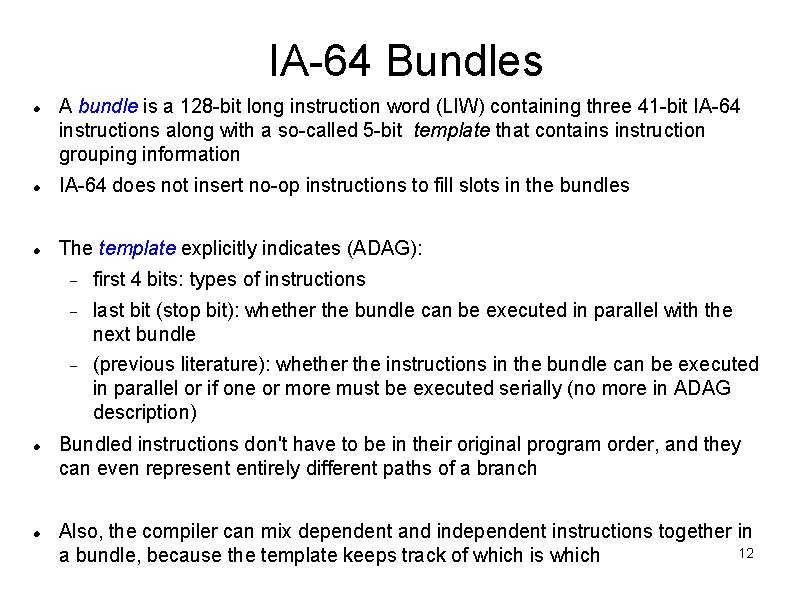
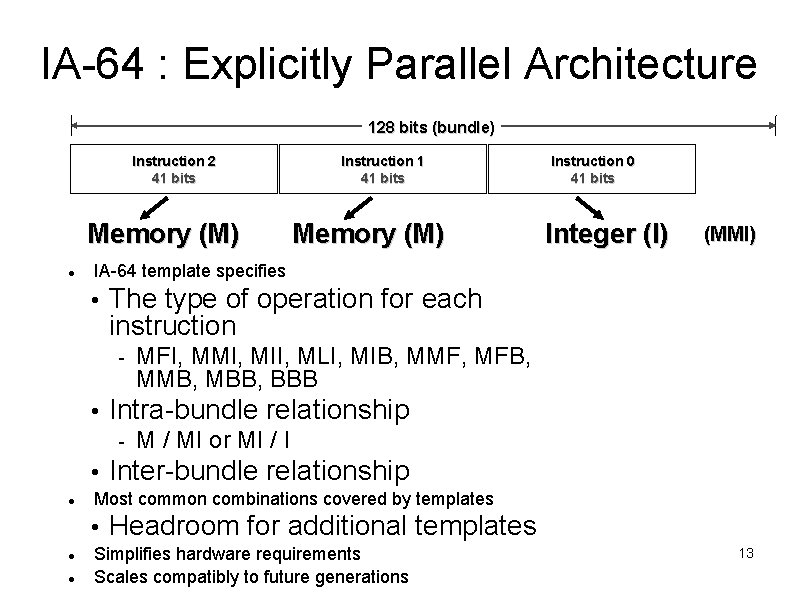
IA-64 Bundles A bundle is a 128 -bit long instruction word (LIW) containing three 41 -bit IA-64 instructions along with a so-called 5 -bit template that contains instruction grouping information IA-64 does not insert no-op instructions to fill slots in the bundles The template explicitly indicates (ADAG): first 4 bits: types of instructions last bit (stop bit): whether the bundle can be executed in parallel with the next bundle (previous literature): whether the instructions in the bundle can be executed in parallel or if one or more must be executed serially (no more in ADAG description) Bundled instructions don't have to be in their original program order, and they can even represent entirely different paths of a branch Also, the compiler can mix dependent and independent instructions together in 12 a bundle, because the template keeps track of which is which
IA-64 : Explicitly Parallel Architecture 128 bits (bundle) Instruction 2 41 bits Memory (M) Instruction 1 41 bits Memory (M) Instruction 0 41 bits Integer (I) (MMI) IA-64 template specifies • The type of operation for each instruction - MFI, MMI, MII, MLI, MIB, MMF, MFB, MMB, MBB, BBB • Intra-bundle relationship - M / MI or MI / I • Most common combinations covered by templates • Inter-bundle relationship Headroom for additional templates Simplifies hardware requirements Scales compatibly to future generations 13
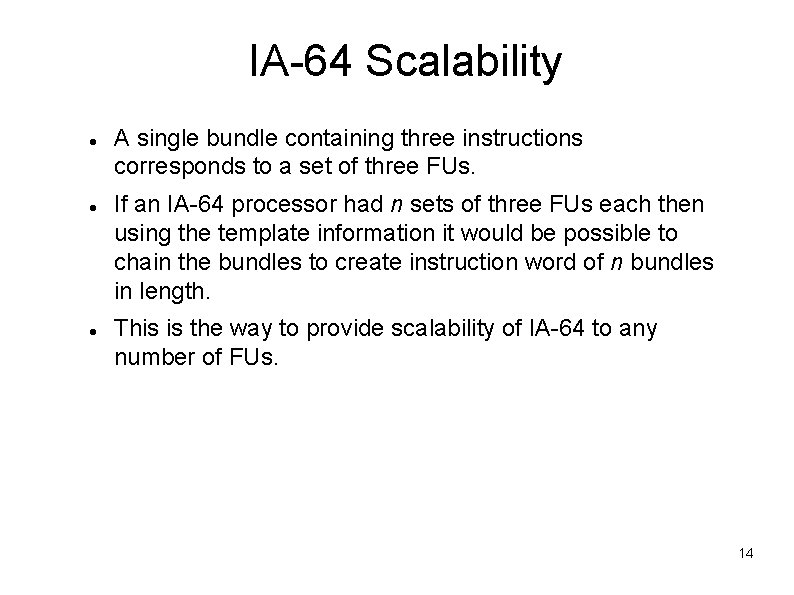
IA-64 Scalability A single bundle containing three instructions corresponds to a set of three FUs. If an IA-64 processor had n sets of three FUs each then using the template information it would be possible to chain the bundles to create instruction word of n bundles in length. This is the way to provide scalability of IA-64 to any number of FUs. 14
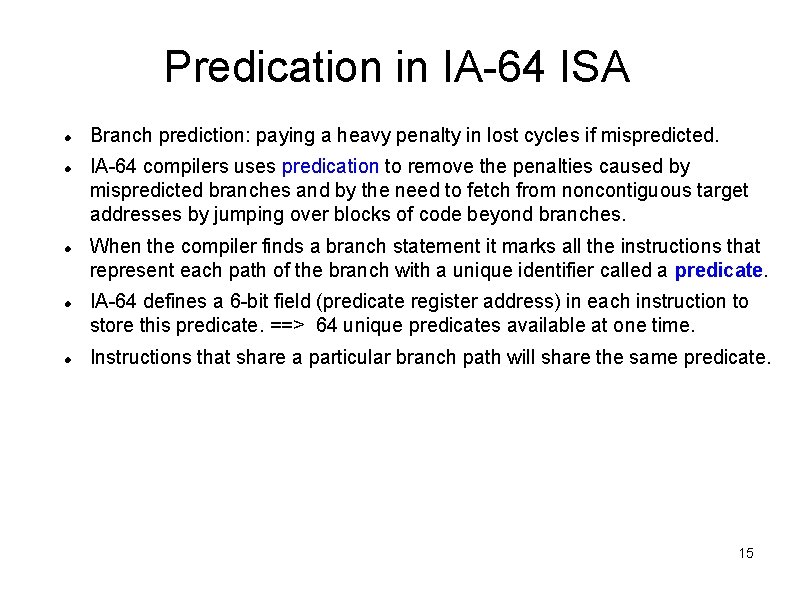
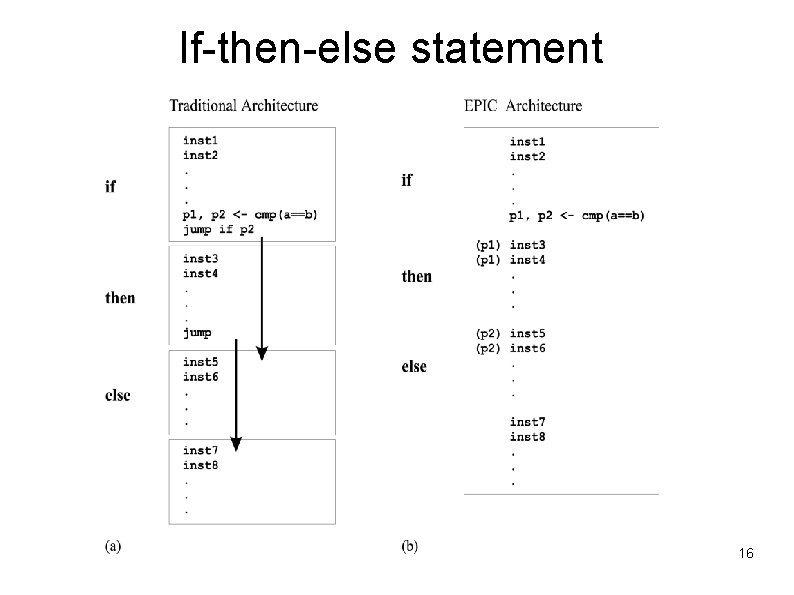
Predication in IA-64 ISA Branch prediction: paying a heavy penalty in lost cycles if mispredicted. IA-64 compilers uses predication to remove the penalties caused by mispredicted branches and by the need to fetch from noncontiguous target addresses by jumping over blocks of code beyond branches. When the compiler finds a branch statement it marks all the instructions that represent each path of the branch with a unique identifier called a predicate. IA-64 defines a 6 -bit field (predicate register address) in each instruction to store this predicate. ==> 64 unique predicates available at one time. Instructions that share a particular branch path will share the same predicate. 15
If-then-else statement 16
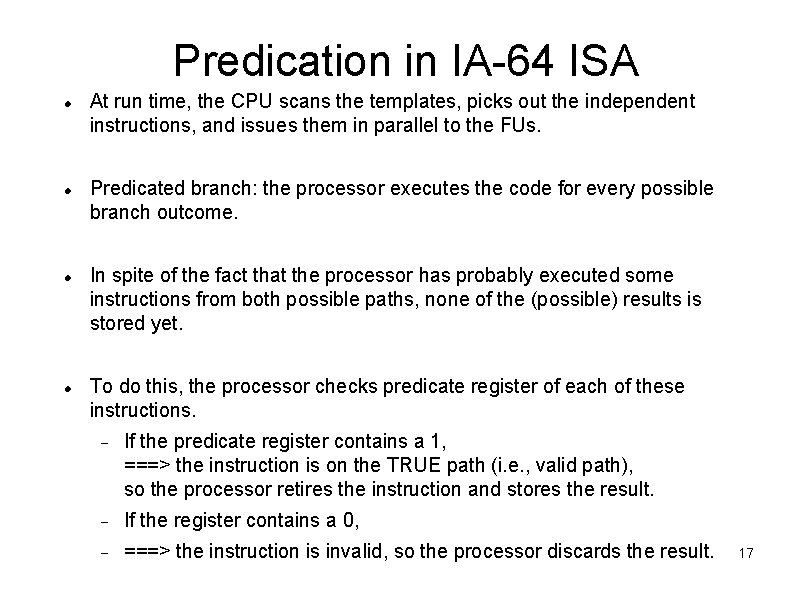
Predication in IA-64 ISA At run time, the CPU scans the templates, picks out the independent instructions, and issues them in parallel to the FUs. Predicated branch: the processor executes the code for every possible branch outcome. In spite of the fact that the processor has probably executed some instructions from both possible paths, none of the (possible) results is stored yet. To do this, the processor checks predicate register of each of these instructions. If the predicate register contains a 1, ===> the instruction is on the TRUE path (i. e. , valid path), so the processor retires the instruction and stores the result. If the register contains a 0, ===> the instruction is invalid, so the processor discards the result. 17
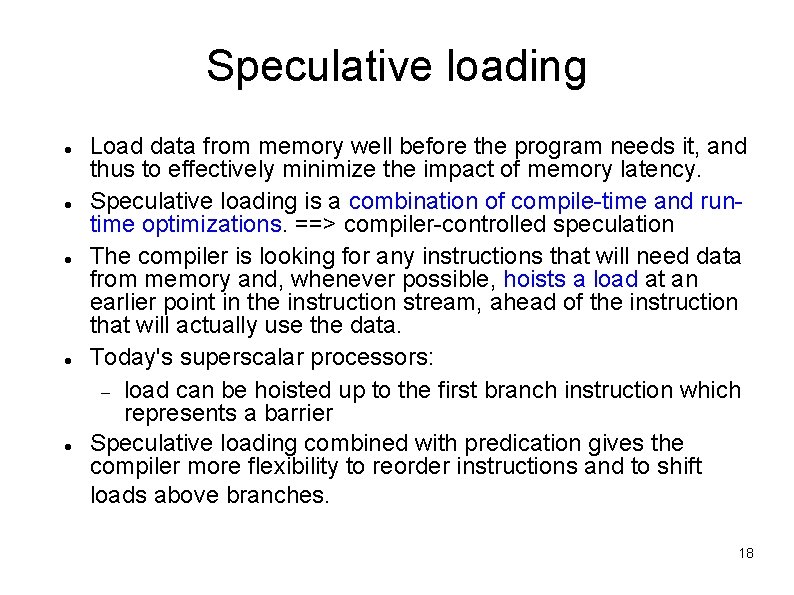
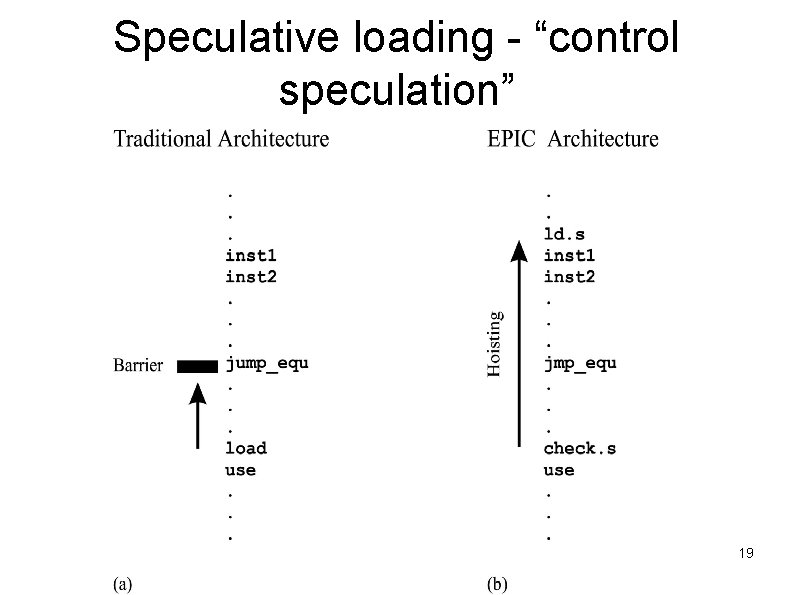
Speculative loading Load data from memory well before the program needs it, and thus to effectively minimize the impact of memory latency. Speculative loading is a combination of compile-time and runtime optimizations. ==> compiler-controlled speculation The compiler is looking for any instructions that will need data from memory and, whenever possible, hoists a load at an earlier point in the instruction stream, ahead of the instruction that will actually use the data. Today's superscalar processors: load can be hoisted up to the first branch instruction which represents a barrier Speculative loading combined with predication gives the compiler more flexibility to reorder instructions and to shift loads above branches. 18
Speculative loading - “control speculation” 19
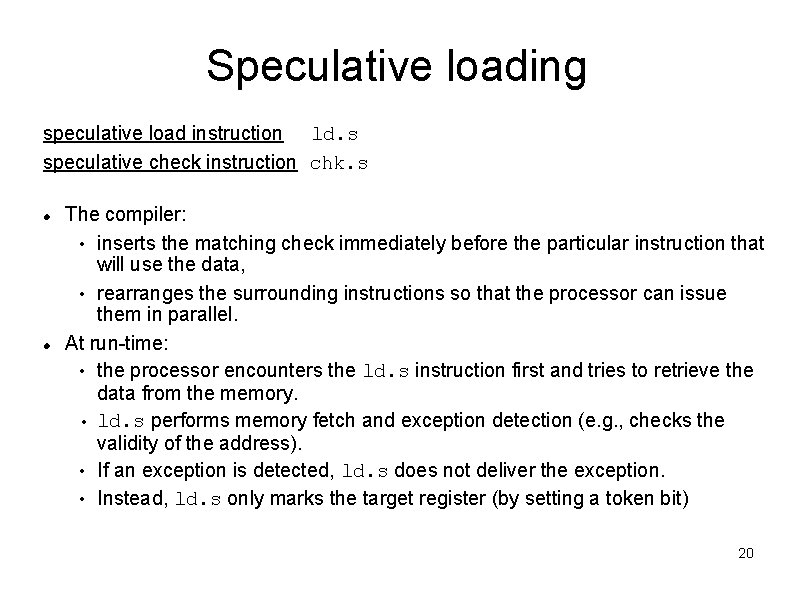
Speculative loading speculative load instruction ld. s speculative check instruction chk. s The compiler: • inserts the matching check immediately before the particular instruction that will use the data, • rearranges the surrounding instructions so that the processor can issue them in parallel. At run-time: • the processor encounters the ld. s instruction first and tries to retrieve the data from the memory. • ld. s performs memory fetch and exception detection (e. g. , checks the validity of the address). • If an exception is detected, ld. s does not deliver the exception. • Instead, ld. s only marks the target register (by setting a token bit) 20
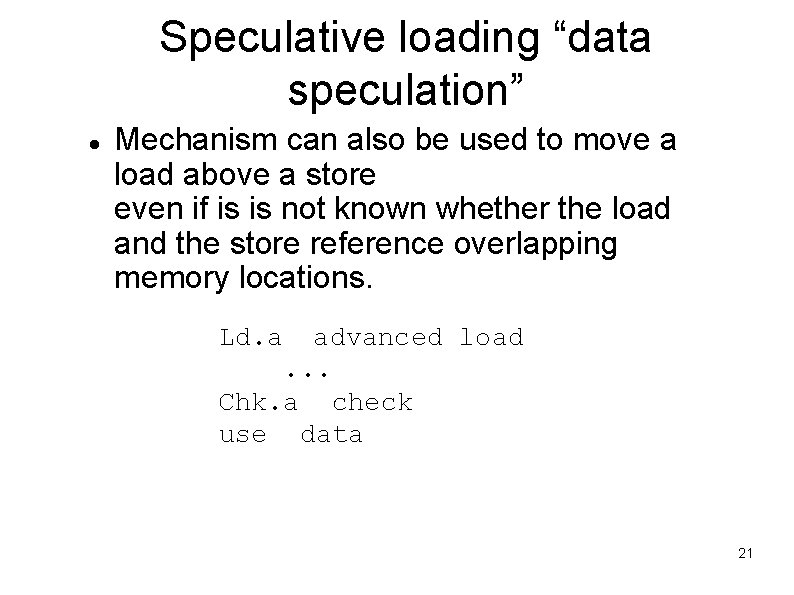
Speculative loading “data speculation” Mechanism can also be used to move a load above a store even if is is not known whether the load and the store reference overlapping memory locations. Ld. a advanced load. . . Chk. a check use data 21
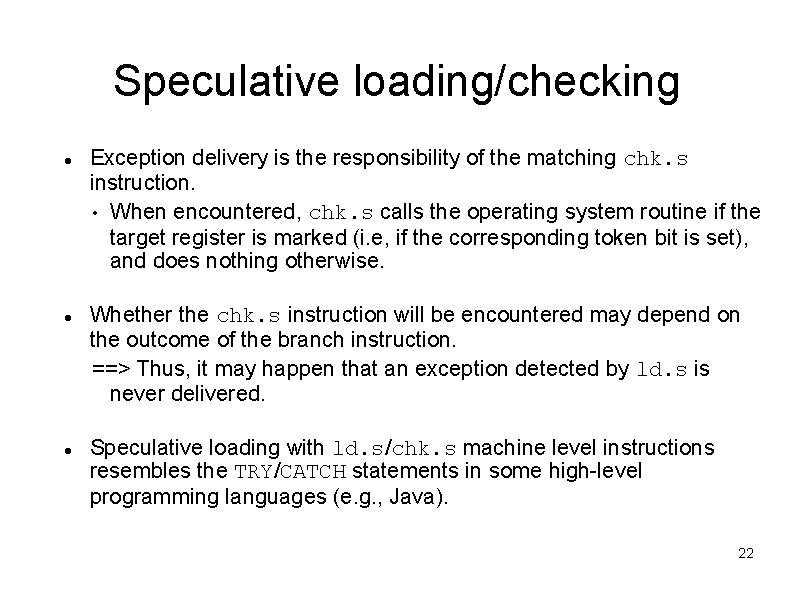
Speculative loading/checking Exception delivery is the responsibility of the matching chk. s instruction. • When encountered, chk. s calls the operating system routine if the target register is marked (i. e, if the corresponding token bit is set), and does nothing otherwise. Whether the chk. s instruction will be encountered may depend on the outcome of the branch instruction. ==> Thus, it may happen that an exception detected by ld. s is never delivered. Speculative loading with ld. s/chk. s machine level instructions resembles the TRY/CATCH statements in some high-level programming languages (e. g. , Java). 22
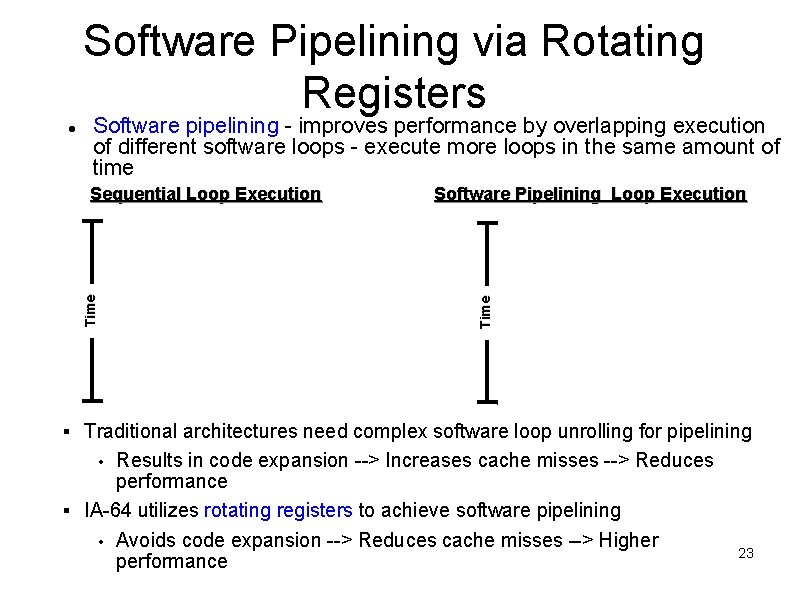
Software Pipelining via Rotating Registers Software pipelining - improves performance by overlapping execution of different software loops - execute more loops in the same amount of time Time Sequential Loop Execution Software Pipelining Loop Execution Time Traditional architectures need complex software loop unrolling for pipelining Results in code expansion --> Increases cache misses --> Reduces performance IA-64 utilizes rotating registers to achieve software pipelining • Avoids code expansion --> Reduces cache misses --> Higher performance • 23
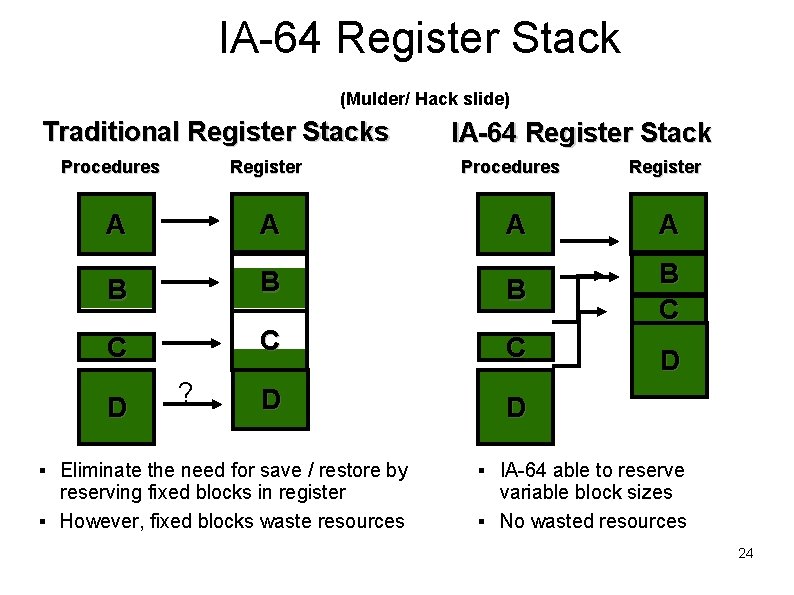
IA-64 Register Stack (Mulder/ Hack slide) Traditional Register Stacks Procedures Register IA-64 Register Stack Procedures A A B B B C C C D D D ? Eliminate the need for save / restore by reserving fixed blocks in register However, fixed blocks waste resources A Register A B C D D IA-64 able to reserve variable block sizes No wasted resources 24
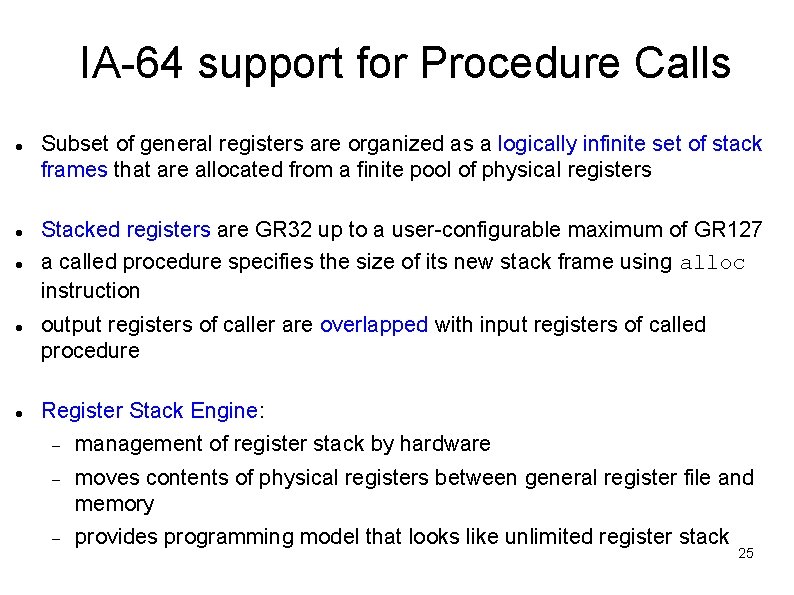
IA-64 support for Procedure Calls Subset of general registers are organized as a logically infinite set of stack frames that are allocated from a finite pool of physical registers Stacked registers are GR 32 up to a user-configurable maximum of GR 127 a called procedure specifies the size of its new stack frame using alloc instruction output registers of caller are overlapped with input registers of called procedure Register Stack Engine: management of register stack by hardware moves contents of physical registers between general register file and memory provides programming model that looks like unlimited register stack 25
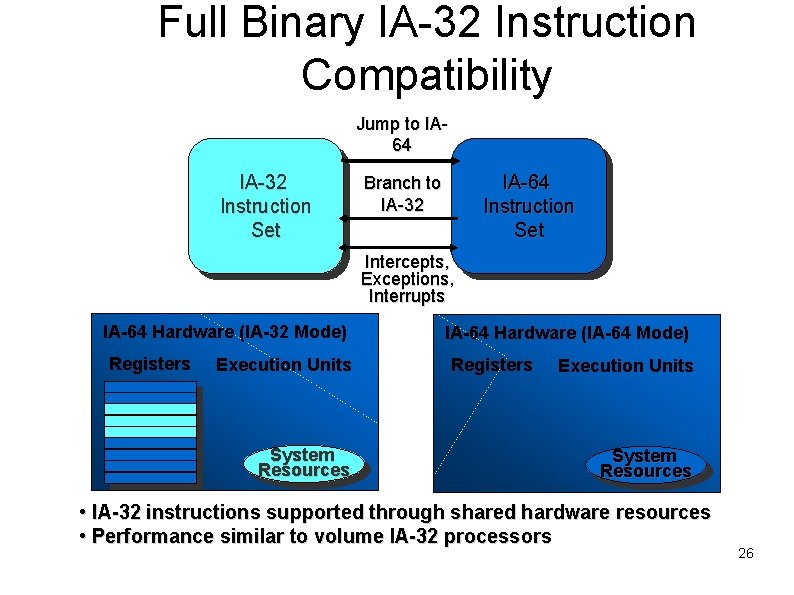
Full Binary IA-32 Instruction Compatibility Jump to IA 64 IA-32 Instruction Set IA-64 Instruction Set Branch to IA-32 Intercepts, Exceptions, Interrupts IA-64 Hardware (IA-32 Mode) Registers Execution Units System Resources IA-64 Hardware (IA-64 Mode) Registers Execution Units System Resources • IA-32 instructions supported through shared hardware resources • Performance similar to volume IA-32 processors 26
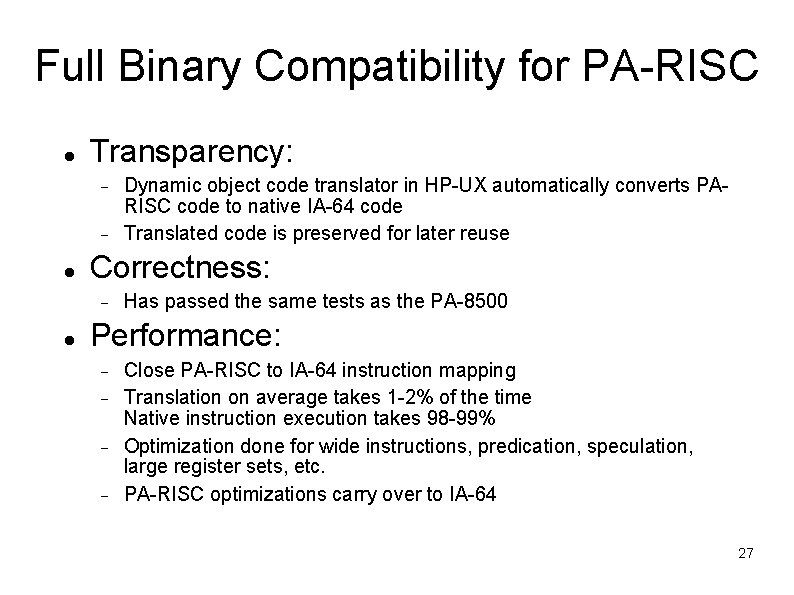
Full Binary Compatibility for PA-RISC Transparency: Correctness: Dynamic object code translator in HP-UX automatically converts PARISC code to native IA-64 code Translated code is preserved for later reuse Has passed the same tests as the PA-8500 Performance: Close PA-RISC to IA-64 instruction mapping Translation on average takes 1 -2% of the time Native instruction execution takes 98 -99% Optimization done for wide instructions, predication, speculation, large register sets, etc. PA-RISC optimizations carry over to IA-64 27
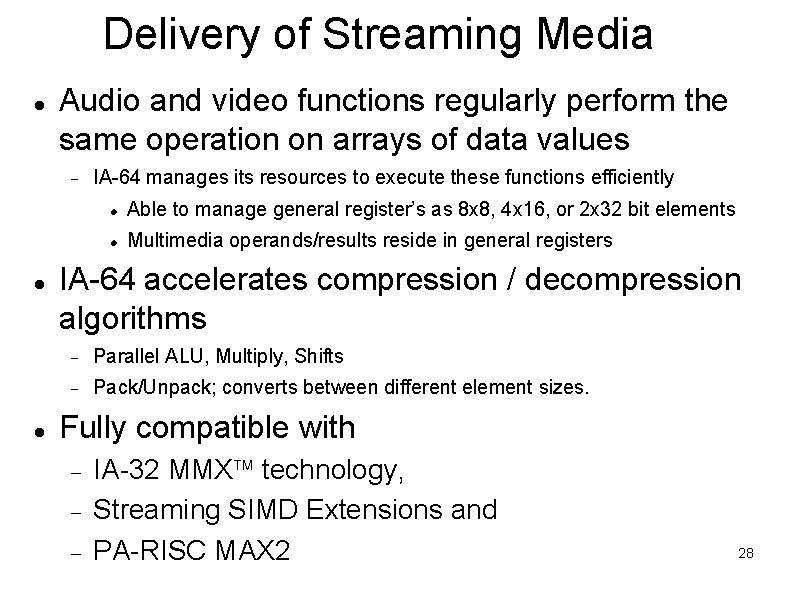
Delivery of Streaming Media Audio and video functions regularly perform the same operation on arrays of data values IA-64 manages its resources to execute these functions efficiently Able to manage general register’s as 8 x 8, 4 x 16, or 2 x 32 bit elements Multimedia operands/results reside in general registers IA-64 accelerates compression / decompression algorithms Parallel ALU, Multiply, Shifts Pack/Unpack; converts between different element sizes. Fully compatible with IA-32 MMX technology, Streaming SIMD Extensions and PA-RISC MAX 2 28
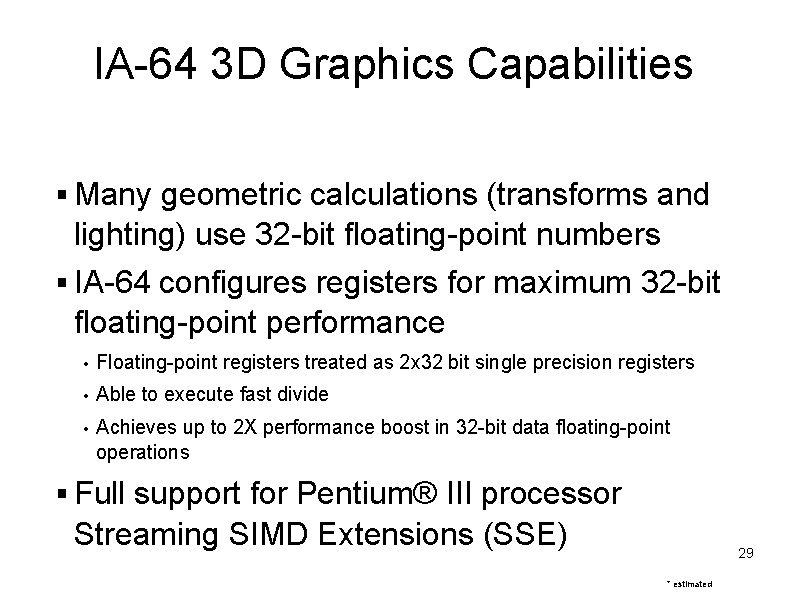
IA-64 3 D Graphics Capabilities Many geometric calculations (transforms and lighting) use 32 -bit floating-point numbers IA-64 configures registers for maximum 32 -bit floating-point performance • Floating-point registers treated as 2 x 32 bit single precision registers • Able to execute fast divide • Achieves up to 2 X performance boost in 32 -bit data floating-point operations Full support for Pentium® III processor Streaming SIMD Extensions (SSE) 29 * estimated
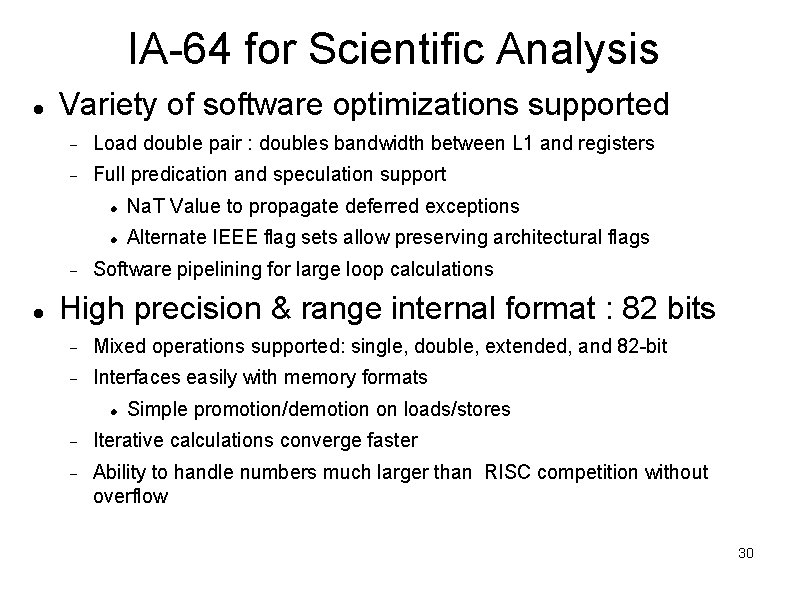
IA-64 for Scientific Analysis Variety of software optimizations supported Load double pair : doubles bandwidth between L 1 and registers Full predication and speculation support Na. T Value to propagate deferred exceptions Alternate IEEE flag sets allow preserving architectural flags Software pipelining for large loop calculations High precision & range internal format : 82 bits Mixed operations supported: single, double, extended, and 82 -bit Interfaces easily with memory formats Simple promotion/demotion on loads/stores Iterative calculations converge faster Ability to handle numbers much larger than RISC competition without overflow 30
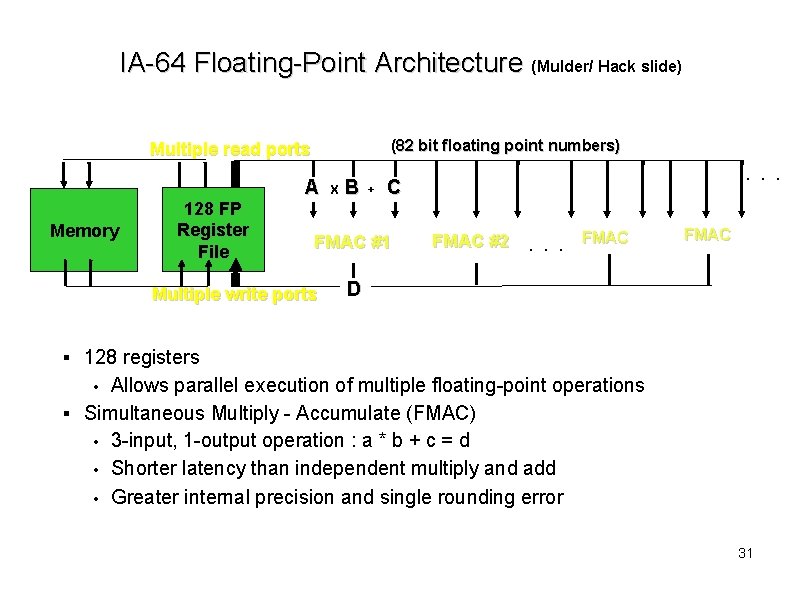
IA-64 Floating-Point Architecture (Mulder/ Hack slide) (82 bit floating point numbers) Multiple read ports Memory 128 FP Register File A X B + C FMAC #1 Multiple write ports . . . FMAC #2 . . . FMAC D 128 registers Allows parallel execution of multiple floating-point operations Simultaneous Multiply - Accumulate (FMAC) • 3 -input, 1 -output operation : a * b + c = d • Shorter latency than independent multiply and add • Greater internal precision and single rounding error • 31
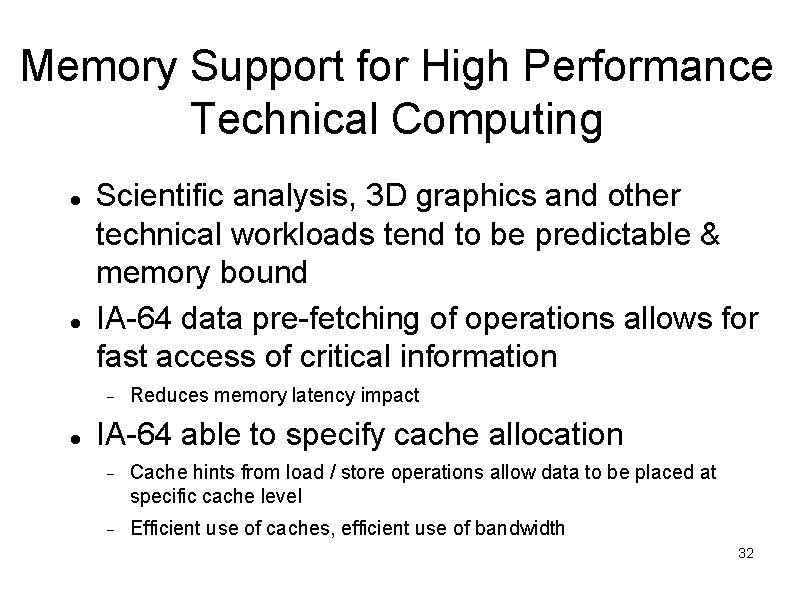
Memory Support for High Performance Technical Computing Scientific analysis, 3 D graphics and other technical workloads tend to be predictable & memory bound IA-64 data pre-fetching of operations allows for fast access of critical information Reduces memory latency impact IA-64 able to specify cache allocation Cache hints from load / store operations allow data to be placed at specific cache level Efficient use of caches, efficient use of bandwidth 32
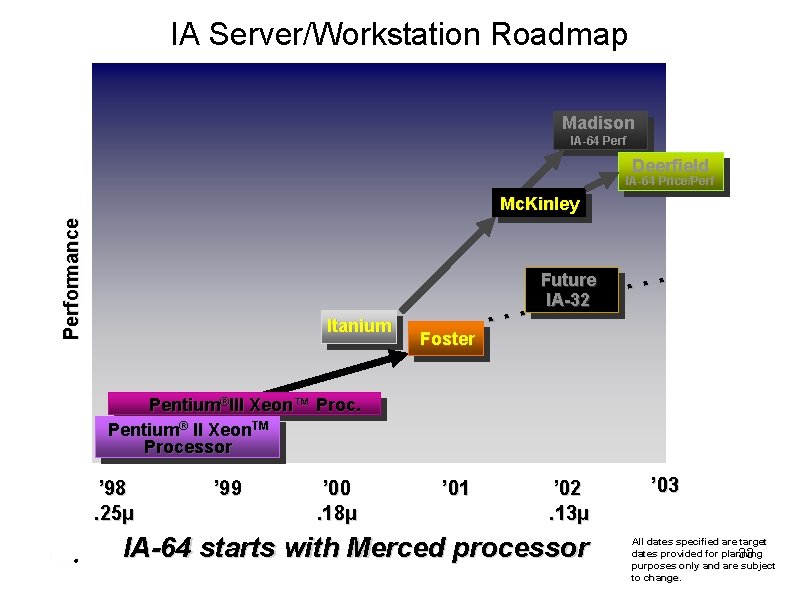
IA Server/Workstation Roadmap Madison IA-64 Perf Deerfield IA-64 Price/Performance Mc. Kinley Itanium Foster . . . Future IA-32 . . . Pentium®III Xeon™ Proc. Pentium® II Xeon. TM Processor ’ 98. 25µ ® ’ 99 ’ 00. 18µ ’ 01 ’ 02. 13µ IA-64 starts with Merced processor ’ 03 All dates specified are target dates provided for planning 33 purposes only and are subject to change.
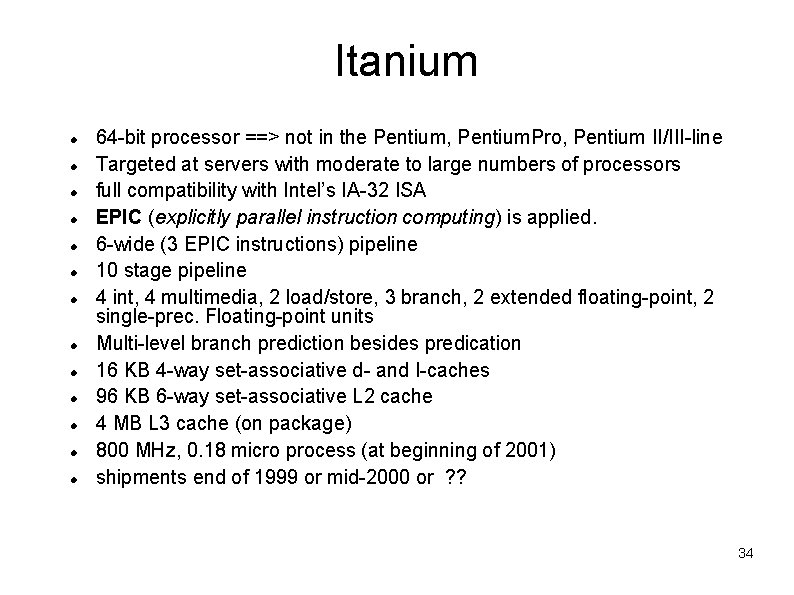
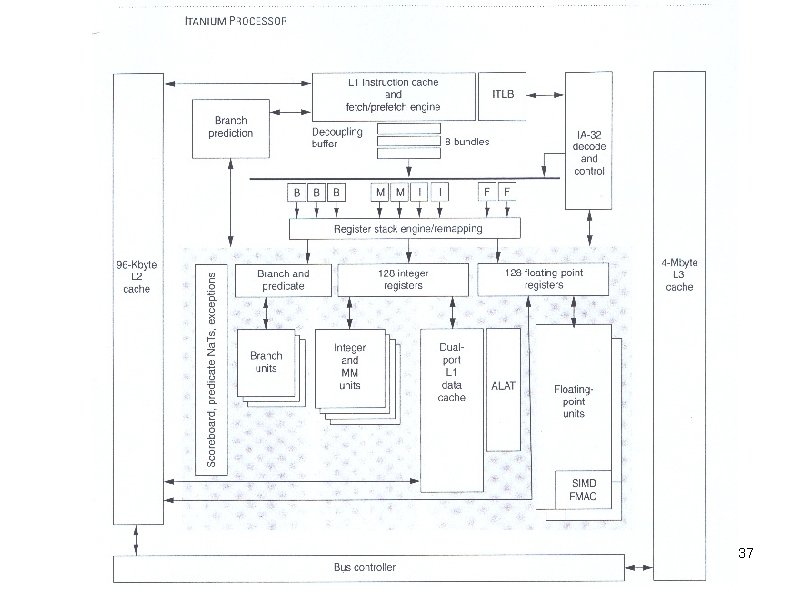
Itanium 64 -bit processor ==> not in the Pentium, Pentium. Pro, Pentium II/III-line Targeted at servers with moderate to large numbers of processors full compatibility with Intel’s IA-32 ISA EPIC (explicitly parallel instruction computing) is applied. 6 -wide (3 EPIC instructions) pipeline 10 stage pipeline 4 int, 4 multimedia, 2 load/store, 3 branch, 2 extended floating-point, 2 single-prec. Floating-point units Multi-level branch prediction besides predication 16 KB 4 -way set-associative d- and I-caches 96 KB 6 -way set-associative L 2 cache 4 MB L 3 cache (on package) 800 MHz, 0. 18 micro process (at beginning of 2001) shipments end of 1999 or mid-2000 or ? ? 34
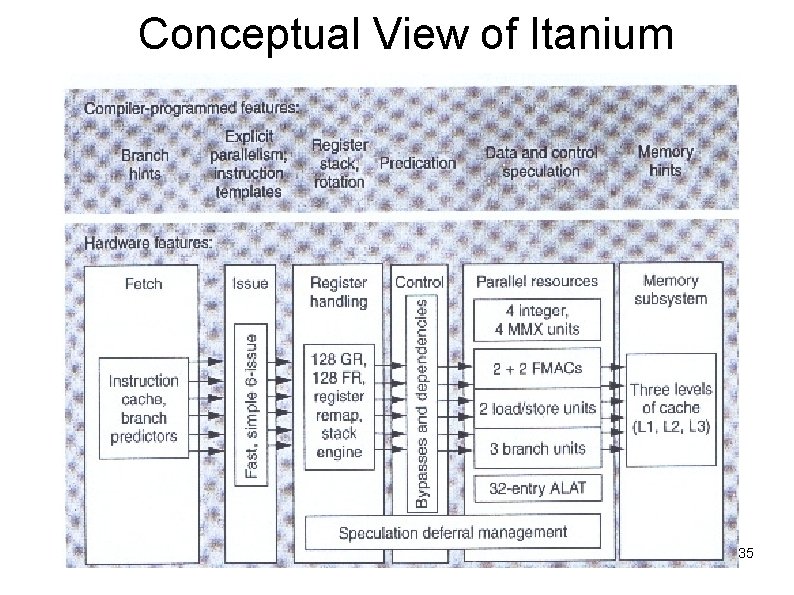
Conceptual View of Itanium 35
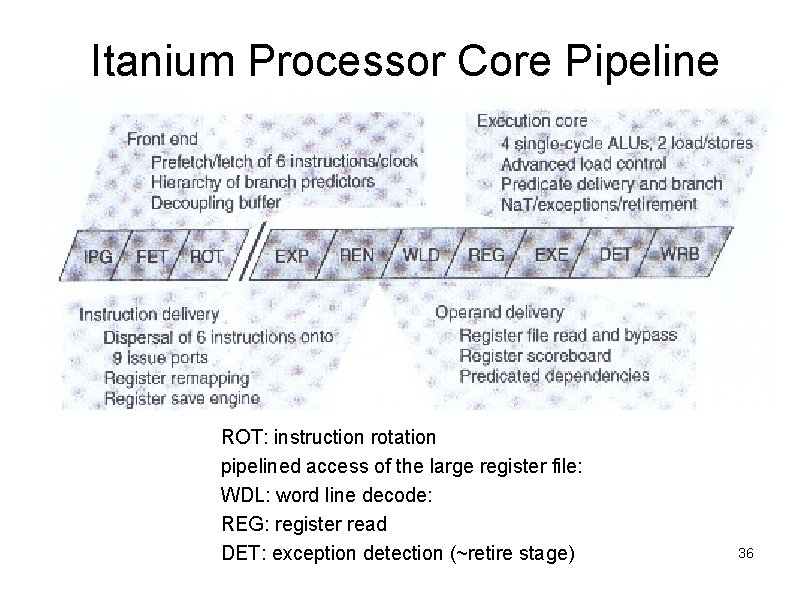
Itanium Processor Core Pipeline ROT: instruction rotation pipelined access of the large register file: WDL: word line decode: REG: register read DET: exception detection (~retire stage) 36
37
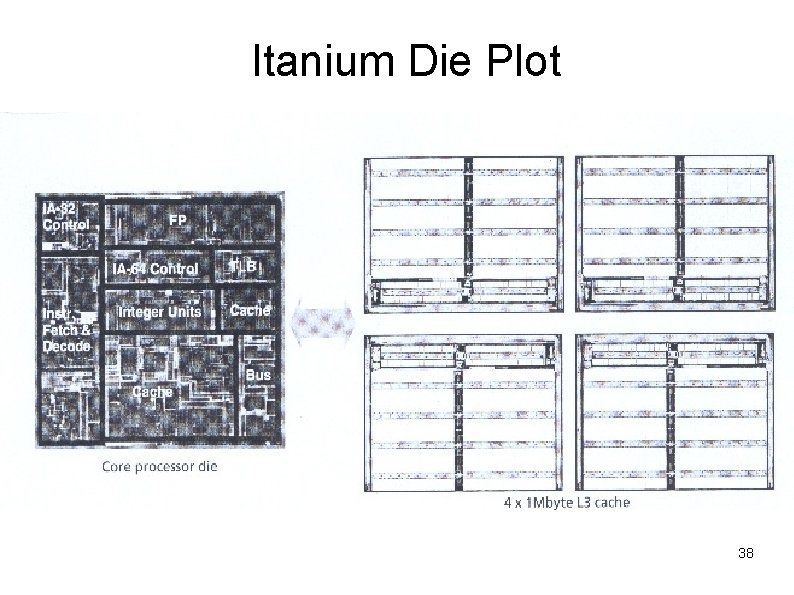
Itanium Die Plot 38
Itanium vs. Willamette (P 4) Itanium announced with 800 MHz P 4 announced with 1. 2 GHz P 4 may be faster in running IA-32 code than Itanium running IA-64 code Itanium probably won‘t compete with contemporary IA-32 processors but Intel will complete the Itanium design anyway Intel hopes for the Itanium successor Mc. Kinley 39 which will be out only one year later