
High moisture extrusion optimisation of texturisation through control
- Slides: 29
High moisture extrusion : optimisation of texturisation through control of rheological and textural parameters D. Bounie, E. Van Hecke USTL (Université des Sciences et Technologies de Lille) IAAL (Institut Agricole et Alimentaire) Bâtiment C 6 59655 Villeneuve d’Ascq Cedex - France Tel : +33 (0)3 20. 43. 49. 21, Fax : +33 (0)3 20. 43. 44. 86 E-Mail : Bounie@univ-lille 1. fr, vanhecke@univ-lille 1. fr Smart Extrusion Workshop, Sydney, 2 december 1997 iaal D. Bounie, E. Van Hecke : High moisture extrusion - Sydney, dec. 2 nd 97 (p 1)
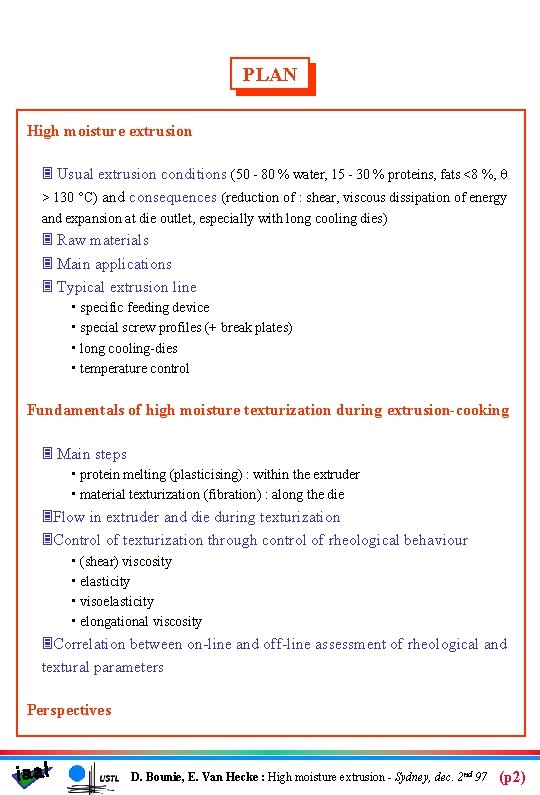
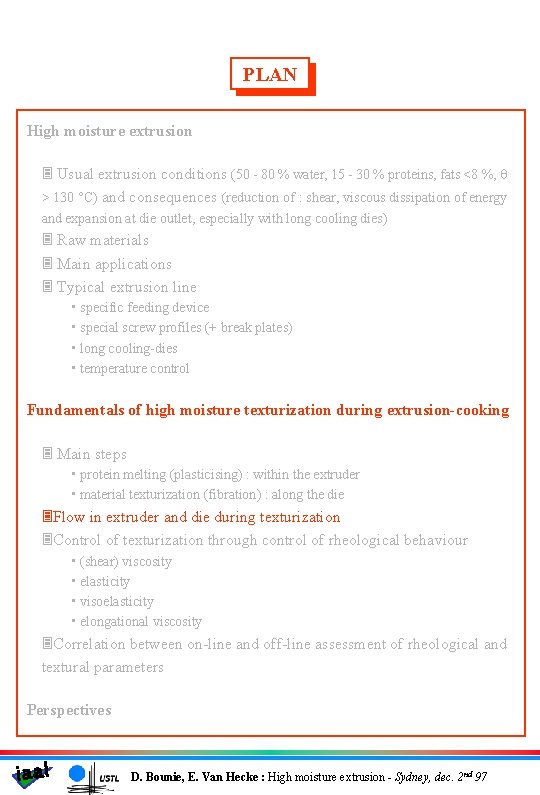
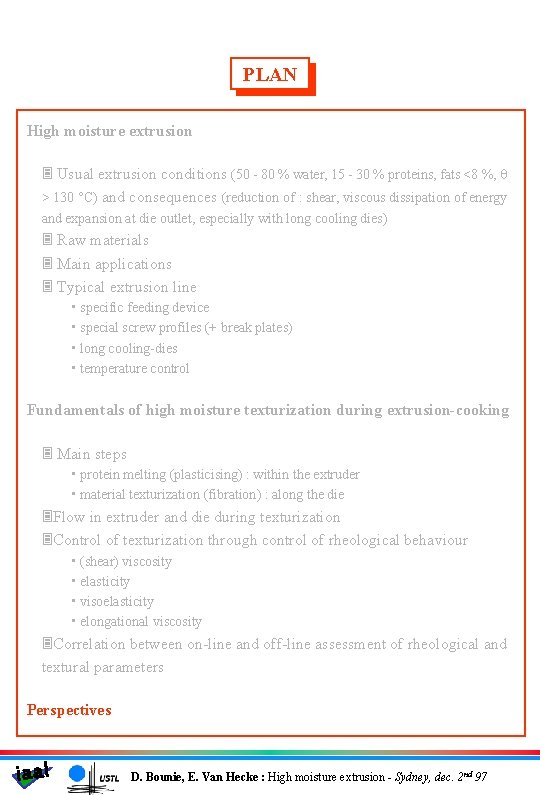
PLAN High moisture extrusion 3 Usual extrusion conditions (50 - 80 % water, 15 - 30 % proteins, fats <8 %, q > 130 °C) and consequences (reduction of : shear, viscous dissipation of energy and expansion at die outlet, especially with long cooling dies) 3 Raw materials 3 Main applications 3 Typical extrusion line • specific feeding device • special screw profiles (+ break plates) • long cooling-dies • temperature control Fundamentals of high moisture texturization during extrusion-cooking 3 Main steps • protein melting (plasticising) : within the extruder • material texturization (fibration) : along the die 3 Flow in extruder and die during texturization 3 Control of texturization through control of rheological behaviour • (shear) viscosity • elasticity • visoelasticity • elongational viscosity 3 Correlation between on-line and off-line assessment of rheological and textural parameters Perspectives iaal D. Bounie, E. Van Hecke : High moisture extrusion - Sydney, dec. 2 nd 97 (p 2)
PLAN High moisture extrusion 3 Usual extrusion conditions (50 - 80 % water, 15 - 30 % proteins, fats <8 %, q > 130 °C) and consequences (reduction of : shear, viscous dissipation of energy and expansion at die outlet, especially with long cooling dies) 3 Raw materials 3 Main applications 3 Typical extrusion line • specific feeding device • special screw profiles (+ break plates) • long cooling-dies • temperature control Fundamentals of high moisture texturization during extrusion-cooking 3 Main steps • protein melting (plasticising) : within the extruder • material texturization (fibration) : along the die 3 Flow in extruder and die during texturization 3 Control of texturization through control of rheological behaviour • (shear) viscosity • elasticity • visoelasticity • elongational viscosity 3 Correlation between on-line and off-line assessment of rheological and textural parameters Perspectives iaal D. Bounie, E. Van Hecke : High moisture extrusion - Sydney, dec. 2 nd 97
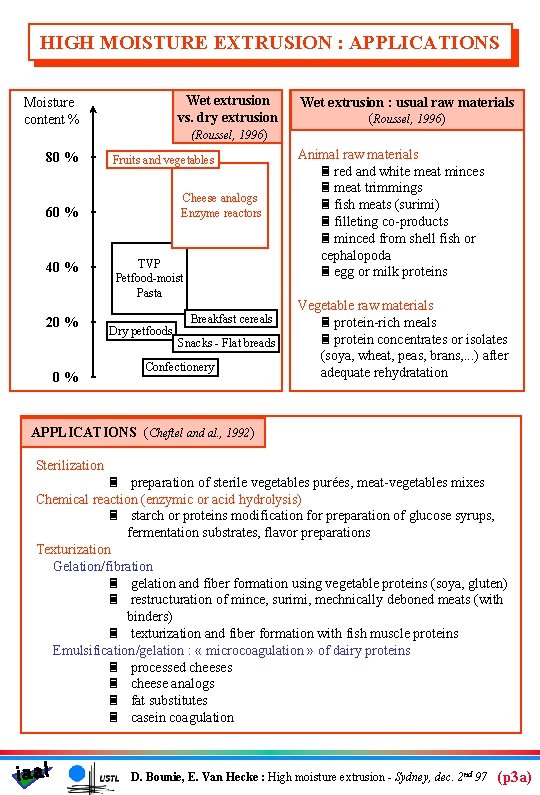
HIGH MOISTURE EXTRUSION : APPLICATIONS Wet extrusion vs. dry extrusion (Roussel, 1996) Moisture content % 80 % Fruits and vegetables Cheese analogs Enzyme reactors 60 % 40 % 20 % 0% TVP Petfood-moist Pasta Dry petfoods Breakfast cereals Snacks - Flat breads Confectionery Wet extrusion : usual raw materials (Roussel, 1996) Animal raw materials 3 red and white meat minces 3 meat trimmings 3 fish meats (surimi) 3 filleting co-products 3 minced from shell fish or cephalopoda 3 egg or milk proteins Vegetable raw materials 3 protein-rich meals 3 protein concentrates or isolates (soya, wheat, peas, brans, . . . ) after adequate rehydratation APPLICATIONS (Cheftel and al. , 1992) Sterilization 3 preparation of sterile vegetables purées, meat-vegetables mixes Chemical reaction (enzymic or acid hydrolysis) 3 starch or proteins modification for preparation of glucose syrups, fermentation substrates, flavor preparations Texturization Gelation/fibration 3 gelation and fiber formation using vegetable proteins (soya, gluten) 3 restructuration of mince, surimi, mechnically deboned meats (with binders) 3 texturization and fiber formation with fish muscle proteins Emulsification/gelation : « microcoagulation » of dairy proteins 3 processed cheeses 3 cheese analogs 3 fat substitutes 3 casein coagulation iaal D. Bounie, E. Van Hecke : High moisture extrusion - Sydney, dec. 2 nd 97 (p 3 a)
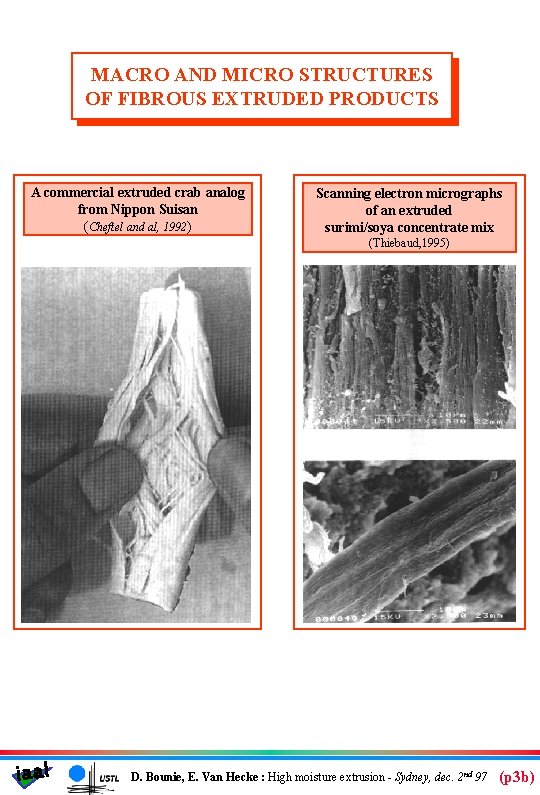
MACRO AND MICRO STRUCTURES OF FIBROUS EXTRUDED PRODUCTS A commercial extruded crab analog from Nippon Suisan (Cheftel and al, 1992) Scanning electron micrographs of an extruded surimi/soya concentrate mix (Thiebaud, 1995) iaal D. Bounie, E. Van Hecke : High moisture extrusion - Sydney, dec. 2 nd 97 (p 3 b)
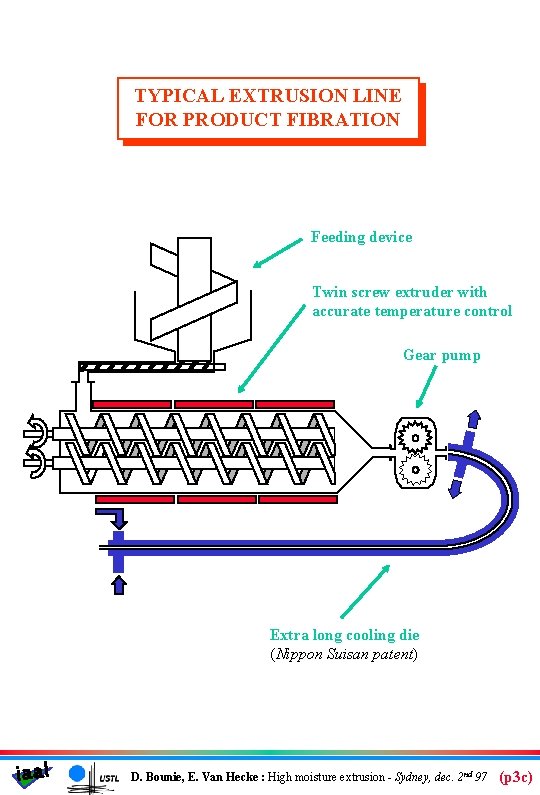
TYPICAL EXTRUSION LINE FOR PRODUCT FIBRATION Feeding device Twin screw extruder with accurate temperature control Gear pump Extra long cooling die (Nippon Suisan patent) iaal D. Bounie, E. Van Hecke : High moisture extrusion - Sydney, dec. 2 nd 97 (p 3 c)
PLAN High moisture extrusion 3 Usual extrusion conditions (50 - 80 % water, 15 - 30 % proteins, fats <8 %, q > 130 °C) and consequences (reduction of : shear, viscous dissipation of energy and expansion at die outlet, especially with long cooling dies) 3 Raw materials 3 Main applications 3 Typical extrusion line • specific feeding device • special screw profiles (+ break plates) • long cooling-dies • temperature control Fundamentals of high moisture texturization during extrusion-cooking 3 Main steps • protein melting (plasticising) : within the extruder • material texturization (fibration) : along the die 3 Flow in extruder and die during texturization 3 Control of texturization through control of rheological behaviour • (shear) viscosity • elasticity • visoelasticity • elongational viscosity 3 Correlation between on-line and off-line assessment of rheological and textural parameters Perspectives iaal D. Bounie, E. Van Hecke : High moisture extrusion - Sydney, dec. 2 nd 97
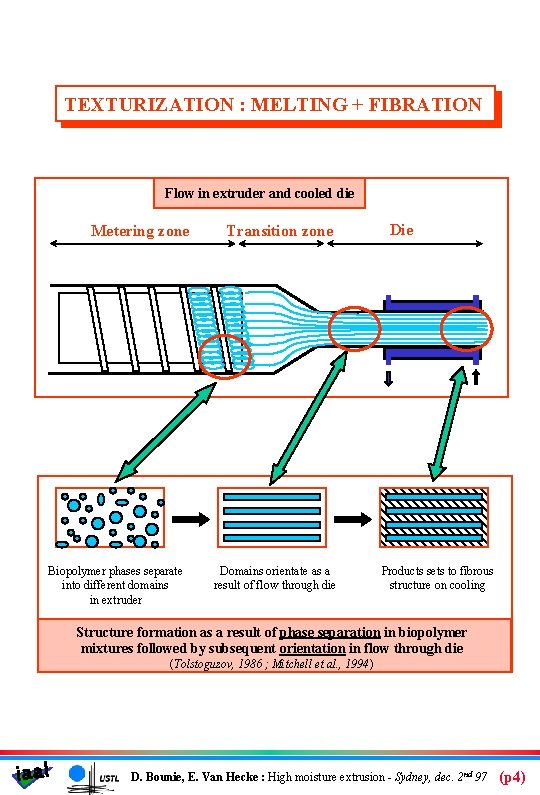
TEXTURIZATION : MELTING + FIBRATION Flow in extruder and cooled die Metering zone Biopolymer phases separate into different domains in extruder Transition zone Domains orientate as a result of flow through die Die Products sets to fibrous structure on cooling Structure formation as a result of phase separation in biopolymer mixtures followed by subsequent orientation in flow through die (Tolstoguzov, 1986 ; Mitchell et al. , 1994) iaal D. Bounie, E. Van Hecke : High moisture extrusion - Sydney, dec. 2 nd 97 (p 4)
PLAN High moisture extrusion 3 Usual extrusion conditions (50 - 80 % water, 15 - 30 % proteins, fats <8 %, q > 130 °C) and consequences (reduction of : shear, viscous dissipation of energy and expansion at die outlet, especially with long cooling dies) 3 Raw materials 3 Main applications 3 Typical extrusion line • specific feeding device • special screw profiles (+ break plates) • long cooling-dies • temperature control Fundamentals of high moisture texturization during extrusion-cooking 3 Main steps • protein melting (plasticising) : within the extruder • material texturization (fibration) : along the die 3 Flow in extruder and die during texturization 3 Control of texturization through control of rheological behaviour • (shear) viscosity • elasticity • visoelasticity • elongational viscosity 3 Correlation between on-line and off-line assessment of rheological and textural parameters Perspectives iaal D. Bounie, E. Van Hecke : High moisture extrusion - Sydney, dec. 2 nd 97
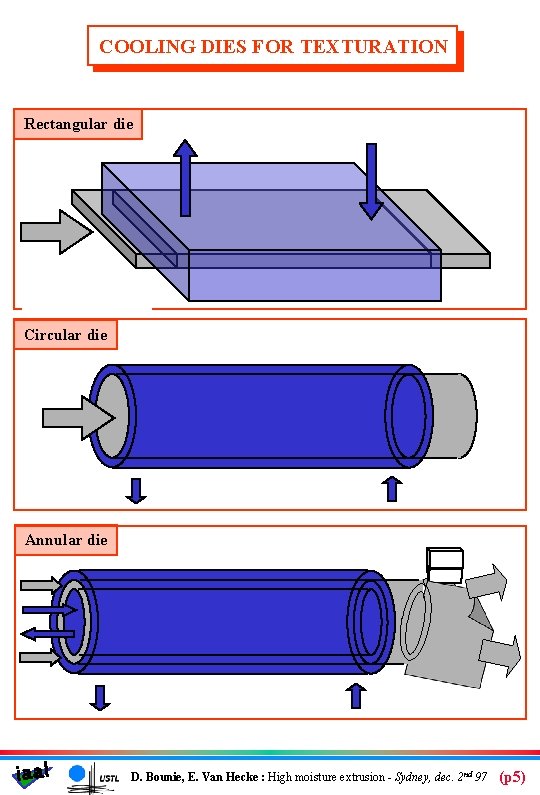
COOLING DIES FOR TEXTURATION Rectangular die Circular die Annular die iaal D. Bounie, E. Van Hecke : High moisture extrusion - Sydney, dec. 2 nd 97 (p 5)
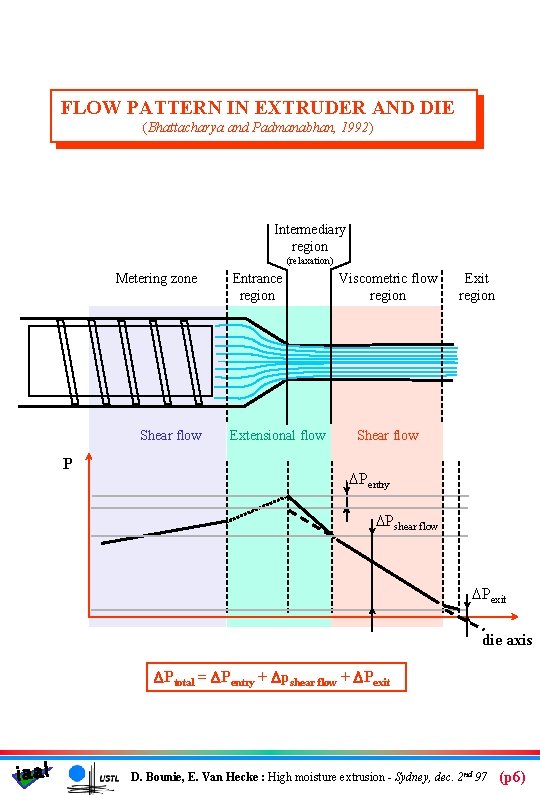
FLOW PATTERN IN EXTRUDER AND DIE (Bhattacharya and Padmanabhan, 1992) Intermediary region (relaxation) Metering zone Shear flow P Entrance region Extensional flow Viscometric flow region Exit region Shear flow DPentry DPshear flow DPexit die axis DPtotal = DPentry + Dpshear flow + DPexit iaal D. Bounie, E. Van Hecke : High moisture extrusion - Sydney, dec. 2 nd 97 (p 6)
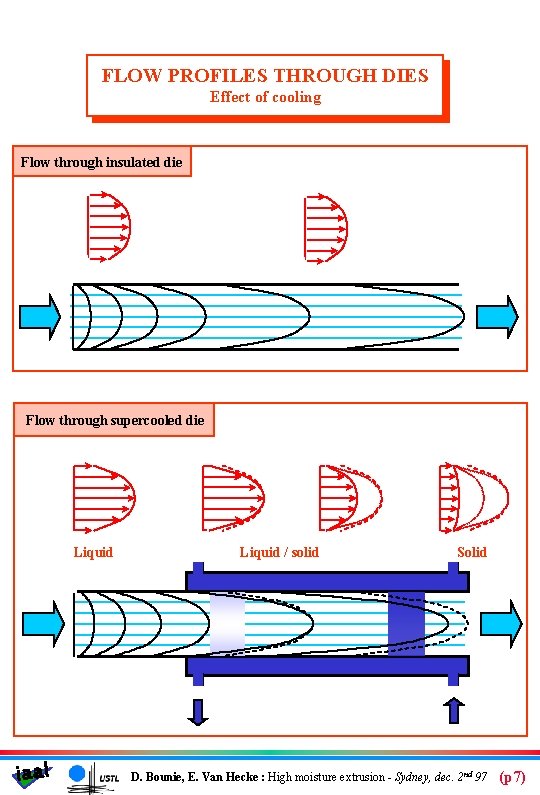
FLOW PROFILES THROUGH DIES Effect of cooling Flow through insulated die Flow through supercooled die Liquid iaal Liquid / solid Solid D. Bounie, E. Van Hecke : High moisture extrusion - Sydney, dec. 2 nd 97 (p 7)
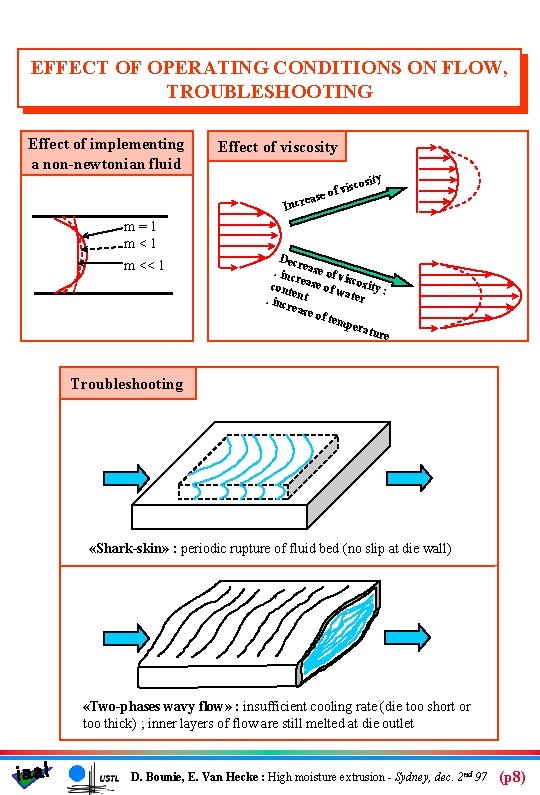
EFFECT OF OPERATING CONDITIONS ON FLOW, TROUBLESHOOTING Effect of implementing a non-newtonian fluid Effect of viscosity y cosit vis se of ea Incr m=1 m<1 m << 1 Decr e. inc ase of v i reas e of scosity : cont w e ater. inc nt reas e of temp erat ure Troubleshooting «Shark-skin» : periodic rupture of fluid bed (no slip at die wall) «Two-phases wavy flow» : insufficient cooling rate (die too short or too thick) ; inner layers of flow are still melted at die outlet iaal D. Bounie, E. Van Hecke : High moisture extrusion - Sydney, dec. 2 nd 97 (p 8)
PLAN High moisture extrusion 3 Usual extrusion conditions (50 - 80 % water, 15 - 30 % proteins, fats <8 %, q > 130 °C) and consequences (reduction of : shear, viscous dissipation of energy and expansion at die outlet, especially with long cooling dies) 3 Raw materials 3 Main applications 3 Typical extrusion line • specific feeding device • special screw profiles (+ break plates) • long cooling-dies • temperature control Fundamentals of high moisture texturization during extrusion-cooking 3 Main steps • protein melting (plasticising) : within the extruder • material texturization (fibration) : along the die 3 Flow in extruder and die during texturization 3 Control of texturization through control of rheological behaviour • (shear) viscosity • elasticity • visoelasticity • elongational viscosity 3 Correlation between on-line and off-line assessment of rheological and textural parameters Perspectives iaal D. Bounie, E. Van Hecke : High moisture extrusion - Sydney, dec. 2 nd 97
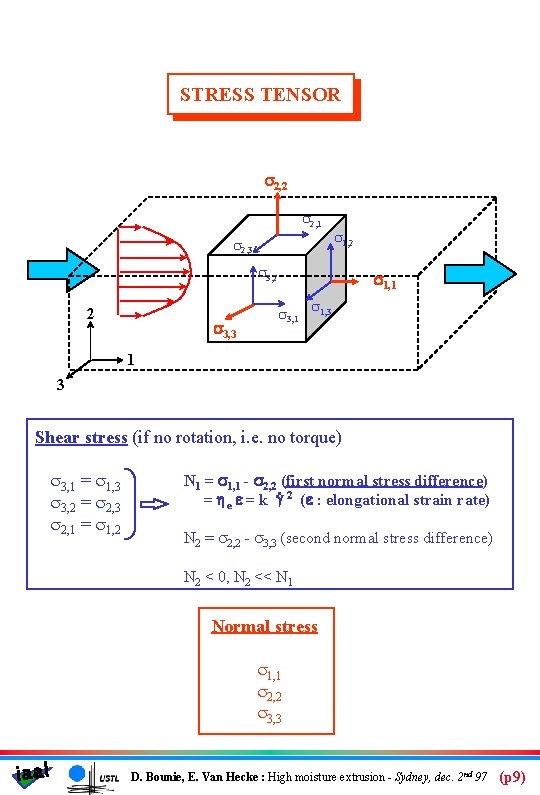
STRESS TENSOR s 2, 2 s 2, 1 s 2, 3 s 1, 2 s 3, 2 2 s 3, 3 s 1, 1 s 3, 1 s 1, 3 1 3 Shear stress (if no rotation, i. e. no torque) s 3, 1 = s 1, 3 s 3, 2 = s 2, 3 s 2, 1 = s 1, 2 N 1 = s 1, 1 - s 2, 2 (first normal stress difference). = he e = k g 2 (e : elongational strain rate) N 2 = s 2, 2 - s 3, 3 (second normal stress difference) N 2 < 0, N 2 << N 1 Normal stress s 1, 1 s 2, 2 s 3, 3 iaal D. Bounie, E. Van Hecke : High moisture extrusion - Sydney, dec. 2 nd 97 (p 9)
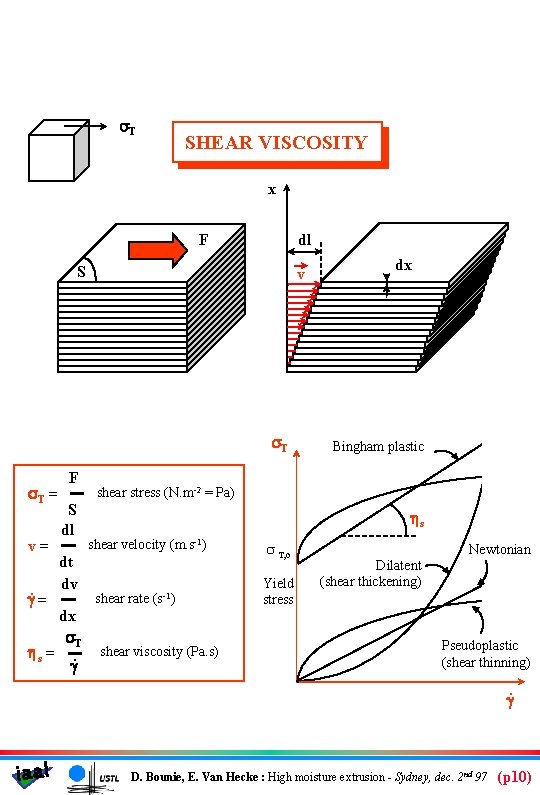
s. T SHEAR VISCOSITY x dl F S v s. T = v= . g= hs = F S dl dt dv dx s. T . g dx Bingham plastic shear stress (N. m-2 = Pa) hs shear velocity (m. s-1) shear rate (s-1) shear viscosity (Pa. s) s T, o Yield stress Newtonian Dilatent (shear thickening) Pseudoplastic (shear thinning) . g iaal D. Bounie, E. Van Hecke : High moisture extrusion - Sydney, dec. 2 nd 97 (p 10)
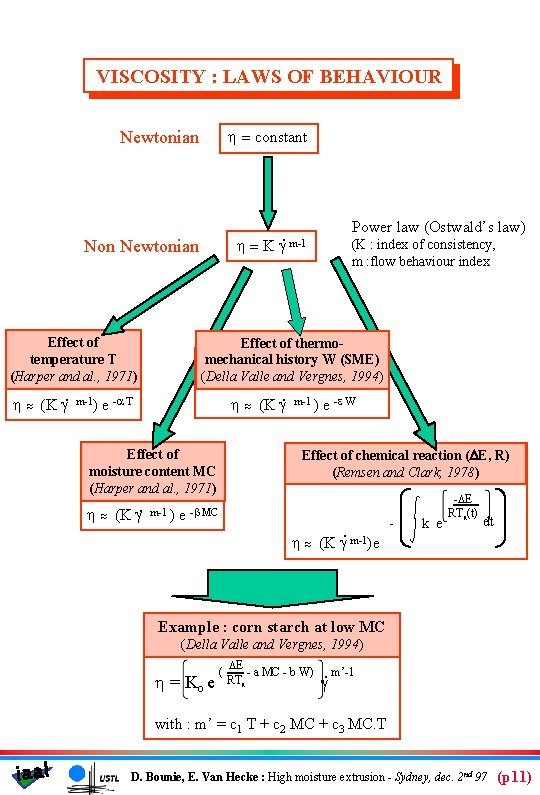
VISCOSITY : LAWS OF BEHAVIOUR Newtonian h = constant Non Newtonian . h = K g m-1 Effect of temperature T (Harper and al. , 1971) . h » (K g m-1) . h » (K g Effect of moisture content MC (Harper and al. , 1971) h» (K : index of consistency, m : flow behaviour index Effect of thermomechanical history W (SME) (Della Valle and Vergnes, 1994) e -a T . (K g Power law (Ostwald’s law) m-1 ) e -e W Effect of chemical reaction (DE, R) (Remsen and Clark, 1978) -b MC h» . (K g m-1)e - k e -DE RTa(t) dt Example : corn starch at low MC (Della Valle and Vergnes, 1994) h = Ko e ( DE - a MC - b W) RTa . m’-1 g with : m’ = c 1 T + c 2 MC + c 3 MC. T iaal D. Bounie, E. Van Hecke : High moisture extrusion - Sydney, dec. 2 nd 97 (p 11)
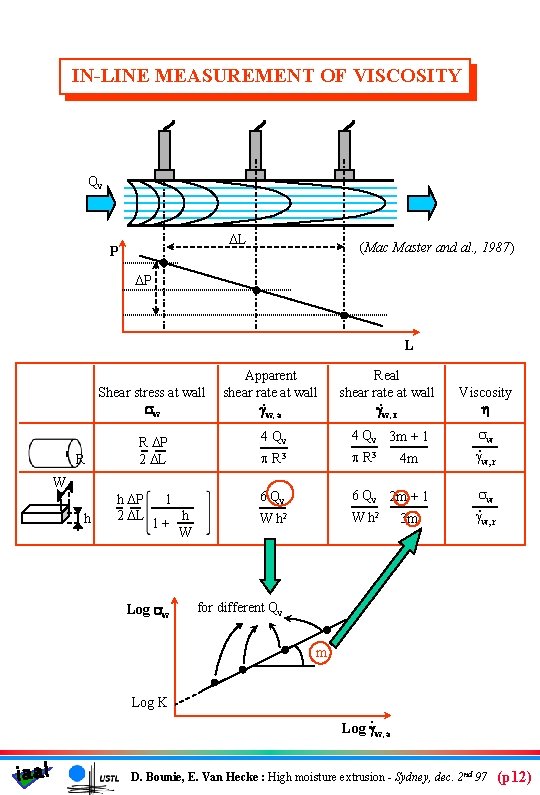
IN-LINE MEASUREMENT OF VISCOSITY Qv DL P (Mac Master and al. , 1987) DP L Shear stress at wall sw R W h R DP 2 DL h DP 2 DL Log sw Real shear rate at wall. gw, r Viscosity h 4 Qv 3 m + 1 p R 3 4 m sw. gw, r 6 Qv 2 m + 1 W h 2 3 m sw. gw, r p R 3 6 Qv 1 1+ Apparent shear rate at wall. gw, a h W W h 2 for different Qv m Log K. Log gw, a iaal D. Bounie, E. Van Hecke : High moisture extrusion - Sydney, dec. 2 nd 97 (p 12)
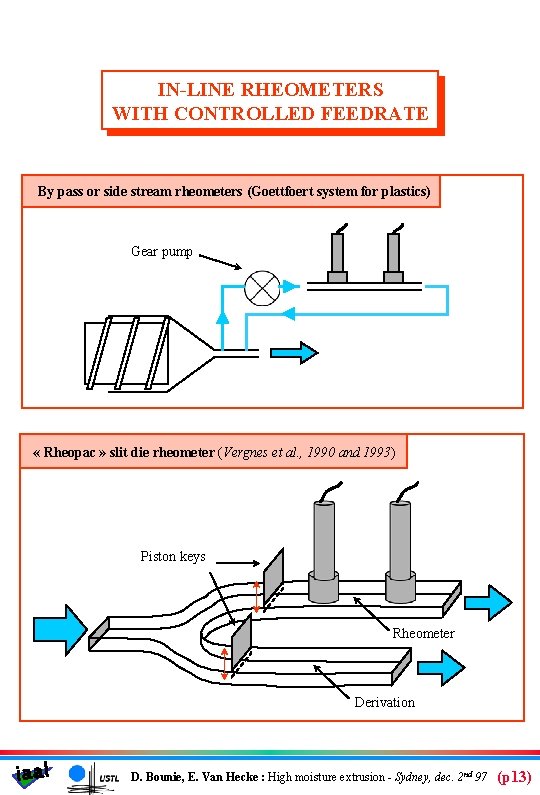
IN-LINE RHEOMETERS WITH CONTROLLED FEEDRATE By pass or side stream rheometers (Goettfoert system for plastics) Gear pump « Rheopac » slit die rheometer (Vergnes et al. , 1990 and 1993) Piston keys Rheometer Derivation iaal D. Bounie, E. Van Hecke : High moisture extrusion - Sydney, dec. 2 nd 97 (p 13)
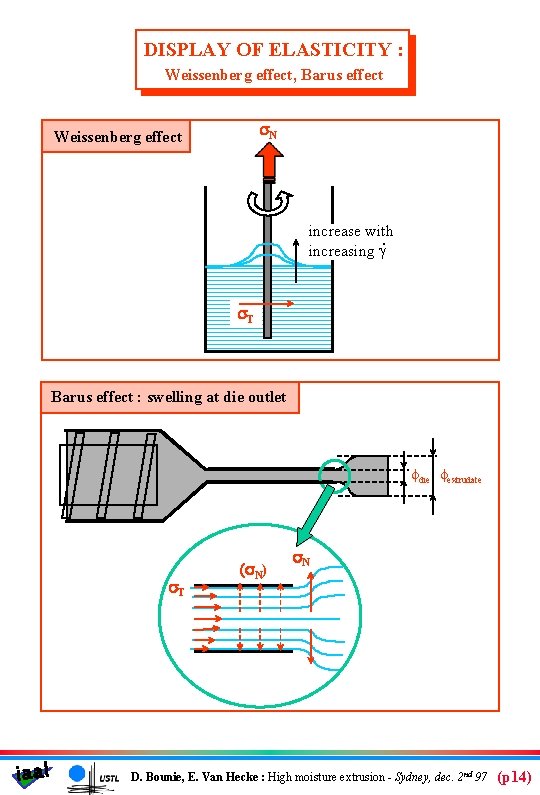
DISPLAY OF ELASTICITY : Weissenberg effect, Barus effect s. N Weissenberg effect increase with. increasing g s. T Barus effect : swelling at die outlet fdie fextrudate s. T iaal (s. N) s. N D. Bounie, E. Van Hecke : High moisture extrusion - Sydney, dec. 2 nd 97 (p 14)
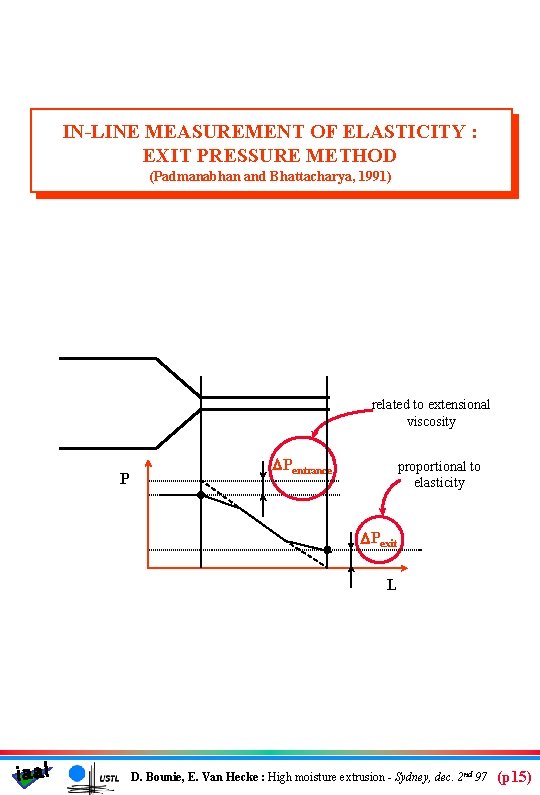
IN-LINE MEASUREMENT OF ELASTICITY : EXIT PRESSURE METHOD (Padmanabhan and Bhattacharya, 1991) related to extensional viscosity P DPentrance proportional to elasticity DPexit L iaal D. Bounie, E. Van Hecke : High moisture extrusion - Sydney, dec. 2 nd 97 (p 15)
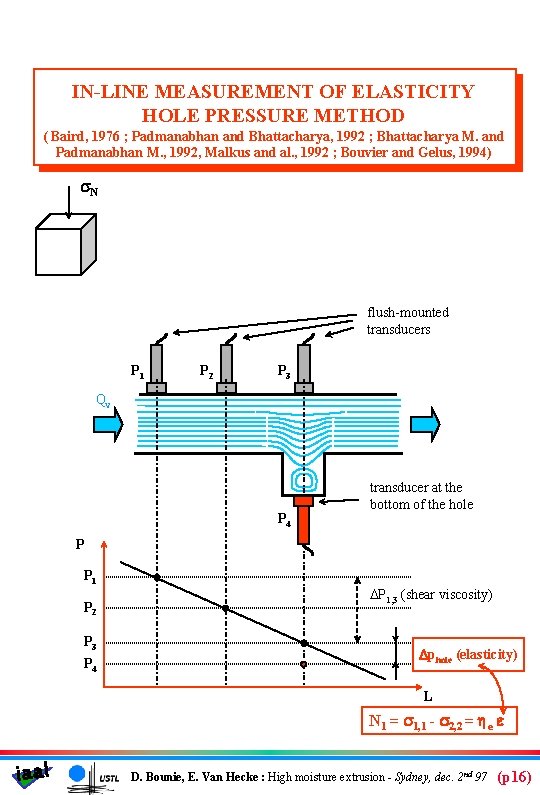
IN-LINE MEASUREMENT OF ELASTICITY HOLE PRESSURE METHOD ( Baird, 1976 ; Padmanabhan and Bhattacharya, 1992 ; Bhattacharya M. and Padmanabhan M. , 1992, Malkus and al. , 1992 ; Bouvier and Gelus, 1994) s. N flush-mounted transducers P 1 P 2 P 3 Qv P 4 transducer at the bottom of the hole P P 1 P 2 P 3 P 4 DP 1, 3 (shear viscosity) Dphole (elasticity) L N 1 = s 1, 1 - s 2, 2 = he e iaal D. Bounie, E. Van Hecke : High moisture extrusion - Sydney, dec. 2 nd 97 (p 16)
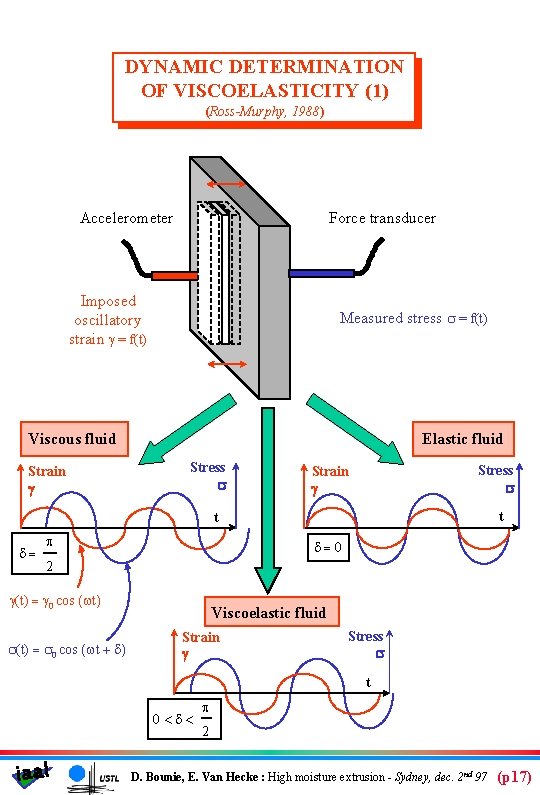
DYNAMIC DETERMINATION OF VISCOELASTICITY (1) (Ross-Murphy, 1988) Accelerometer Force transducer Imposed oscillatory strain g = f(t) Measured stress s = f(t) Viscous fluid Strain g Elastic fluid Stress s Strain g t t d= p d=0 2 g(t) = g 0 cos (wt) s(t) = s 0 cos (wt + d) Viscoelastic fluid Strain g Stress s t 0<d< iaal p 2 D. Bounie, E. Van Hecke : High moisture extrusion - Sydney, dec. 2 nd 97 (p 17)
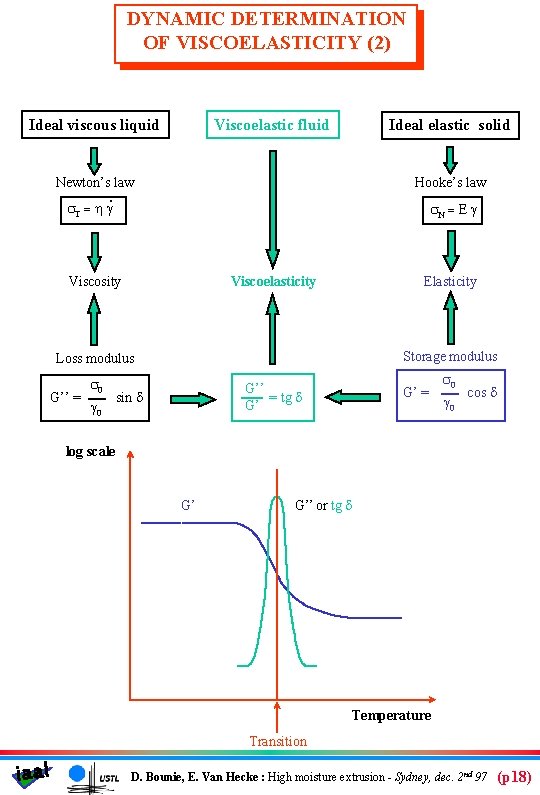
DYNAMIC DETERMINATION OF VISCOELASTICITY (2) Ideal viscous liquid Viscoelastic fluid Ideal elastic solid Newton’s law Hooke’s law . s. T = h g s. N = E g Viscosity Viscoelasticity Elasticity Storage modulus Loss modulus G’’ = s 0 g 0 G’’ = tg d G’ sin d G’ = s 0 g 0 cos d log scale G’ G’’ or tg d Temperature Transition iaal D. Bounie, E. Van Hecke : High moisture extrusion - Sydney, dec. 2 nd 97 (p 18)
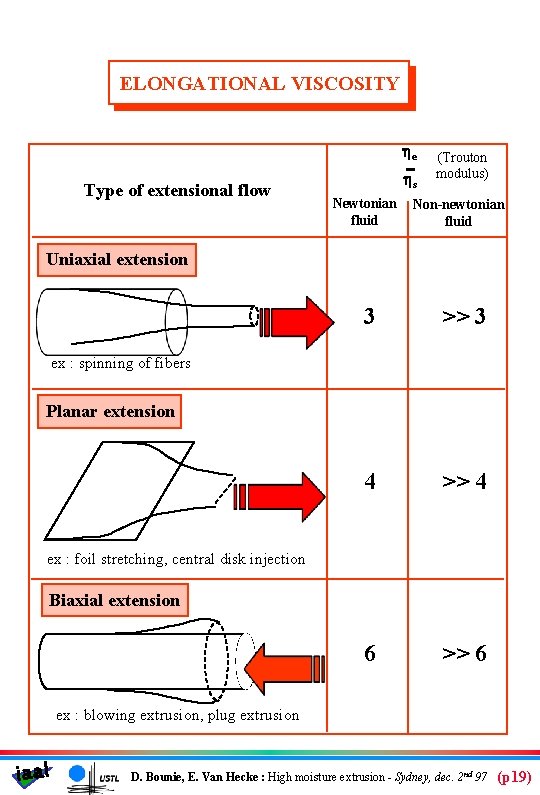
ELONGATIONAL VISCOSITY he Type of extensional flow hs Newtonian fluid (Trouton modulus) Non-newtonian fluid Uniaxial extension 3 >> 3 4 >> 4 6 >> 6 ex : spinning of fibers Planar extension ex : foil stretching, central disk injection Biaxial extension ex : blowing extrusion, plug extrusion iaal D. Bounie, E. Van Hecke : High moisture extrusion - Sydney, dec. 2 nd 97 (p 19)
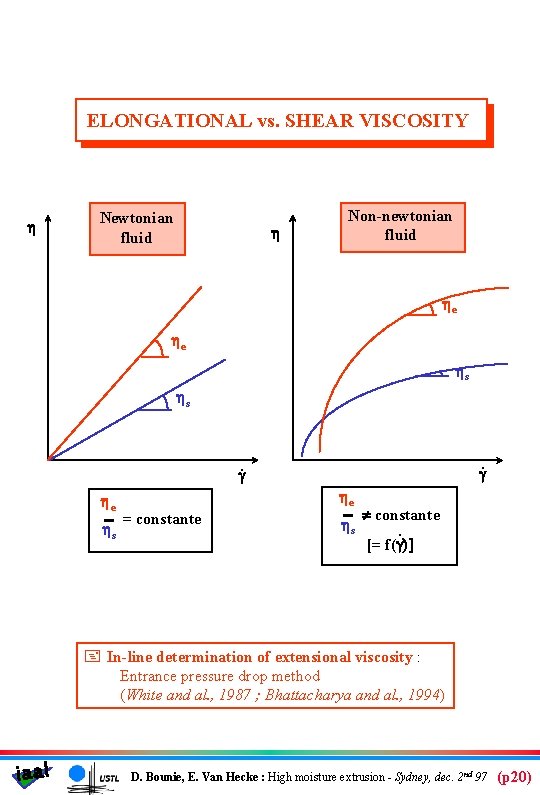
ELONGATIONAL vs. SHEAR VISCOSITY h Newtonian fluid h Non-newtonian fluid he he hs hs . . g g he hs he = constante hs ¹ constante. [= f(g)] + In-line determination of extensional viscosity : Entrance pressure drop method (White and al. , 1987 ; Bhattacharya and al. , 1994) iaal D. Bounie, E. Van Hecke : High moisture extrusion - Sydney, dec. 2 nd 97 (p 20)
PLAN High moisture extrusion 3 Usual extrusion conditions (50 - 80 % water, 15 - 30 % proteins, fats <8 %, q > 130 °C) and consequences (reduction of : shear, viscous dissipation of energy and expansion at die outlet, especially with long cooling dies) 3 Raw materials 3 Main applications 3 Typical extrusion line • specific feeding device • special screw profiles (+ break plates) • long cooling-dies • temperature control Fundamentals of high moisture texturization during extrusion-cooking 3 Main steps • protein melting (plasticising) : within the extruder • material texturization (fibration) : along the die 3 Flow in extruder and die during texturization 3 Control of texturization through control of rheological behaviour • (shear) viscosity • elasticity • visoelasticity • elongational viscosity 3 Correlation between on-line and off-line assessment of rheological and textural parameters Perspectives iaal D. Bounie, E. Van Hecke : High moisture extrusion - Sydney, dec. 2 nd 97
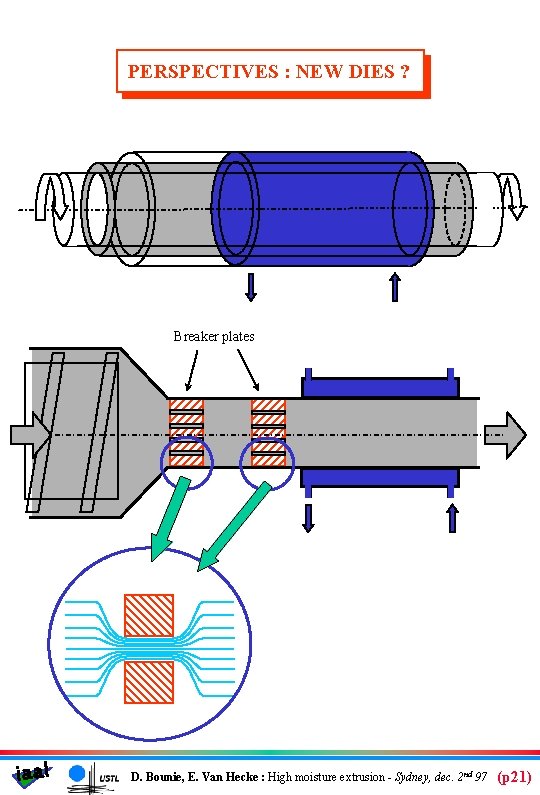
PERSPECTIVES : NEW DIES ? Breaker plates iaal D. Bounie, E. Van Hecke : High moisture extrusion - Sydney, dec. 2 nd 97 (p 21)
BIBLIOGRAPHY • Baird D. G. , 1976. Fluid elasticity measurements from hole pressure error data. J. Appl. Polym. Sci, 20, pp 31553173. • Bhattacharya M. and Padmanabhan M. , 1992. Extrusion processing : texture and rheology. In : Encyclopedia of Food and Science Technology, Hui Y. H. Ed. , Willey Interscience, New York, pp 800 -814. • Bhattacharya M. , Padmanabhan M. and Seethamraju K. , 1994. Uniaxial extensional viscosity during extrusion cooking from entrance pressure drop method. J. Food Sci. , 59(1), pp 221 -226, 230 • Bouvier J. M. and Gelus M. , 1994. Apport des mesures en ligne à l’analyse du procédé de cuisson-extrusion. In : La Cuisson-Extrusion, Colonna P. and Della Valle G. Eds. , Tec & Doc Lavoisier, Paris, pp 323 -355. • Cheftel J. C. , Kitagawa M. and Quéguiner C. , 1992. New protein texturization processes by extrusion cooking at high moisture levels. Food Rev. Int. , 8(2), pp 235 -275. • Cheftel J. C. , Kitagawa M. and Quéguiner C. , 1994. Nouveaux procédés de texturation protéique par cuissonextrusion à teneur élevée en eau. In : La Cuisson-Extrusion, Colonna P. and Della Valle G. Eds. , Tec & Doc Lavoisier, Paris, pp 45 -84. • Cheftel J. C. and Dumay E. , 1993. Microcoagulation of proteins for development of "creaminess". Food Rev. Int. , 9(4), pp 473 -502. • Della Valle G. and Vergnes B. , 1994. Propriétés thermophysiques et rhéologiques des substrats utilisés en cuisson-extrusion. In : La Cuisson-Extrusion, Colonna P. and Della Valle G. Eds. , Tec & Doc Lavoisier, Paris, pp 439 -467. • Harper J. M. , Rhodes T. P. and Wanninger L. A. , 1971. Viscosity model for cooked cereal doughs. A. I. Ch. E. Symposium Series, 676(108), pp 40 -43. • Malkus D. S. , Pritchard W. G. and Yao M. , 1992. The hole-pressure effect and viscosimetry. Rheol. Acta, 31, pp 521 -534. • Mc Master T. J. , Senouci A. and Smith A. C. , 1987. Measurements of rheological and ultrasonic properties of food and synthetic polymer melts. Rheol. Acta, 26, pp 308 -315. • Mitchell J. R. , Areas J. A. G. and Rasul S. , 1994. Modifications chimiques et texturation des protéines à faible teneur en eau. . In : La Cuisson-Extrusion, Colonna P. and Della Valle G. Eds. , Tec & Doc Lavoisier, Paris, pp 85104. • Padmanabhan M. and Bhattacharya M. , 1991. Flow behavior and exit pressures of corn meal under highshear-high-temperature extrusion conditions using a slit die. J. Rheol. , 35(3), pp 315 -343. • Padmanabhan M. and Bhattacharya M. , 1992. Rheological measurement of fluid elasticity during extrusioncooking. Trends in Food Science and Technology, 6, 149 -151. • Quéguiner C. , Dumay E. , Cavalier-Salou and Cheftel J. C. , 1991. Application of extrusion cooking to dairy products : preparation of fat analogues by microcoagulation of whey proteins. In : Applied Food Extrusion Science, Kokini J. and al. Eds. , Dekker, New York, pp 363 -376. • Quéguiner C. , Dumay E. , Cavalier-Salou and Cheftel J. C. , 1992. Microcoagulation of a whey protein isolate by extrusion cooking at acid p. H. J. Food Sci. , 57, pp 610 -616. • Remsen C. H. and Clark J. P. , 1978. A viscosity model for a cooking dough. J. Food Process Eng. , 2, pp 39 -64. • Ross-Murphy S. B. , 1988. Small deformation measurements. In : Food Structure : its Creation and Evaluation, Blanshard J. M. and Mitchell Eds. , Butterworth, London, pp 387 -400. • Roussel L. , 1996. Making meat products using extrusion technology. Extrusion Communiqué, nov-dec, pp 16 -18. • Thiebaud M. , 1995. Texturation par cuisson-extrusion de mélanges protéiques hydratés à base de surimi de poisson. Influence des paramètres opératoires et de la formulation sur les caractéristiques biochimiques et physicochimiques des extrudats. Ph. D. Thesis, University of Montpellier. • Tolstoguzov V. B. , 1986. Functional properties of protein-polysaccharides mixtures. In : Functional Properties of Food Macromolecules, Mitchell J. R. and Ledward D. A. Eds. , Elesevier Applied Science Pub. , London, pp 385415. • Vergnes B. , Della Valle G. and Tayeb J. , 1990. Rheopac : a new on-line rheometer with controlled feed rate to determine the viscosity of starchy products. In : Proceedings of ACo. Fo. P 2, 13 -14 nov. 1990, Bimbenet J. J. and Trystram G. Eds. , Paris. • Vergnes B. , Della Valle G. and Tayeb J. , 1993. Rheopac : a specificin-line rheometer for extruded starchy products. Design, validation and application to maize starch. Rheol. Acta, 32, pp 465 -476. • White S. A, Gotsis A. D. and Baird D. G. , 1987. Review of the entry flow problem : experimental and numerical. J. Non-Newtonian Fluid Mech. , 24, pp 121 -160. iaal D. Bounie, E. Van Hecke : High moisture extrusion - Sydney, dec. 2 nd 97 (p 22)