
High Lift Grouting Procedures and Expectations Presented by
High Lift Grouting Procedures and Expectations Presented by: Mc. Kay M. Parrish, SE
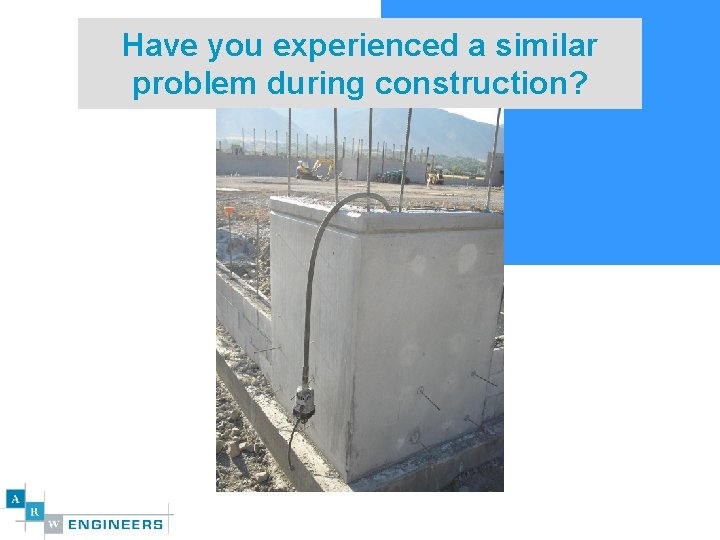
Have you experienced a similar problem during construction?
Typical Structural Notes Regarding High Lift Grouting:
Typical Structural Notes Regarding High Lift Grouting: • • GROUT POURS SHALL NOT EXCEED 5’-0” UNLESS HIGH LIFT GROUTING PROCEDURES ARE FOLLOWED. THE USE OF HIGH LIFT GROUTING PROCEDURES REQUIRE THE APPROVAL OF THE ARCHITECT AND ENGINEER AND SHALL NOT EXCEED THE MAXIMUM HEIGHTS GIVEN IN TABLE 3. 2. 1 OF TMS 402 -13/ACI 530 -13/ASCE 5 -13. GROUT DEMONSTRATION PANELS, AS PRESCRIBED BY THE ARCHITECT AND ENGINEER, SHALL BE REQUIRED WHERE REQUESTED GROUTING PROCEDURES DO NOT MEET THE LIMITS OF TABLE 3. 2. 1. ADDITIONALLY, ALL HIGH LIFT GROUTING SHALL REQUIRE SPECIAL INSPECTION PROCEDURES NEEDED TO VERIFY GROUT PLACEMENT DURING CONSTRUCTION. DURING THE SUBMITTAL FOR APPROVAL PROCESS, THE SUBMITTAL SHALL INCLUDE, BUT NOT BE LIMITED TO: STATEMENT OF PROCEDURE FOR MECHANICAL VIBRATION OF HIGH LIFT GROUT; NEW MIX DESIGNS FOR HIGH SLUMP, HIGH LIFT GROUT. FOR SELF-CONSOLIDATING GROUT, SUBMIT MIX DESIGNS, SLUMP FLOW RATES, VISUAL STABILITY INDEX (VSI), AND QUANTITIES OF ADMXTURES BEING USED.

Typical RFI from Contractor:

Typical Response in the Past:

Special Inspectors Responsibility:
Special Inspectors • If the Contractor and Design Team wait until the Special Inspector is involved before they create a High Lift Grouting plan, it could delay the construction process. – Masonry pour heights may be too high – Grout mix designs may not be correct – Destructive testing may be required to verify grout consolidation, grout strength, etc.
What works: • THE USE OF HIGH LIFT GROUTING PROCEDURES REQUIRE THE APPROVAL OF THE ARCHITECT AND ENGINEER AND SHALL NOT EXCEED THE MAXIMUM HEIGHTS GIVEN IN TABLE 3. 2. 1 OF TMS 40213/ACI 530 -13/ASCE 5 -13. GROUT DEMONSTRATION PANELS, AS PRESCRIBED BY THE ARCHITECT AND ENGINEER, SHALL BE REQUIRED WHERE REQUESTED GROUTING PROCEDURES DO NOT MEET THE LIMITS OF TABLE 3. 2. 1. ADDITIONALLY, ALL HIGH LIFT GROUTING SHALL REQUIRE SPECIAL INSPECTION PROCEDURES NEEDED TO VERIFY GROUT PLACEMENT DURING CONSTRUCTION. DURING THE SUBMITTAL FOR APPROVAL PROCESS, THE SUBMITTAL SHALL INCLUDE, BUT NOT BE LIMITED TO: STATEMENT OF PROCEDURE FOR MECHANICAL VIBRATION OF HIGH LIFT GROUT; NEW MIX DESIGNS FOR HIGH SLUMP. FOR SELFCONSOLIDATING GROUT, SUBMIT MIX DESIGNS, SLUMP FLOW RATES, VISUAL STABILITY INDEX (VSI), AND QUANTITIES OF ADMXTURES BEING USED.
High Lift Grouting Submittal
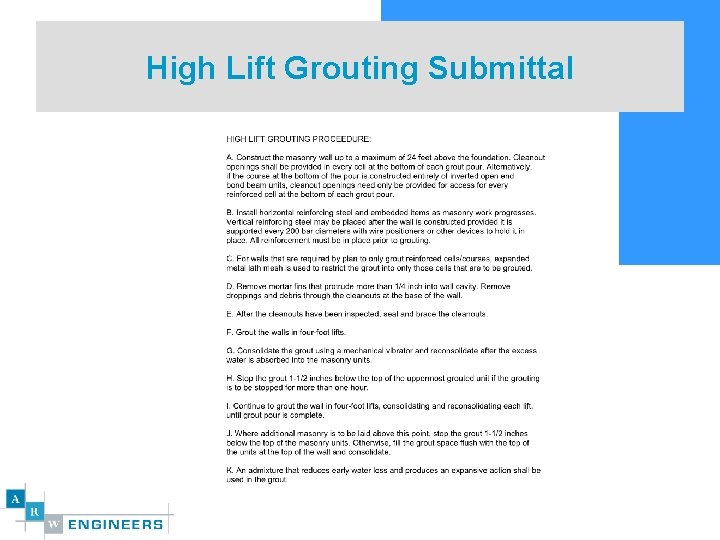
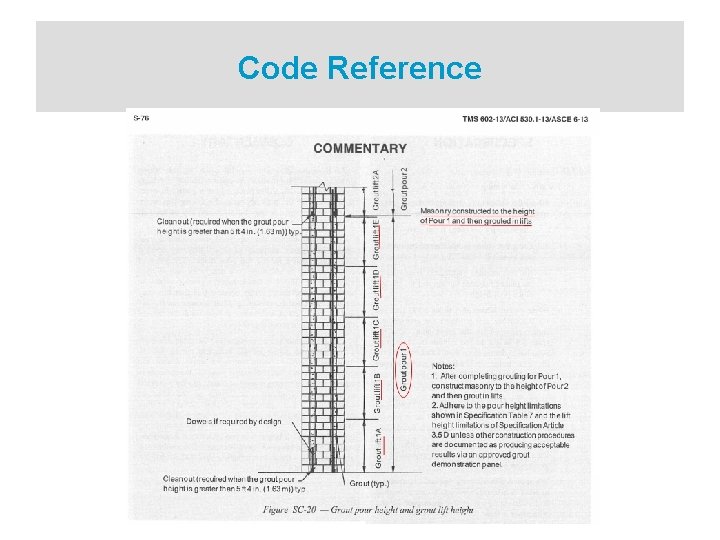
High Lift Grouting Submittal A. Construct the masonry wall up to a maximum of 24 feet above the foundation. Cleanout openings shall be provided in every cell at the bottom of each grout pour. Alternatively, if the course at the bottom of the pour is constructed entirely of inverted open end bond beam units, cleanout openings need only be provided for access for every reinforced cell at the bottom of each grout pour.

Code Reference

Code Reference

Code Reference

Code Reference

High Lift Grouting Submittal B. Install horizontal reinforcing steel and embedded items as masonry work progresses. Vertical reinforcing steel may be placed after the wall is constructed provided it is supported every 200 bar diameters with wire positioners or other devices to hold it in place. All reinforcement must be in place prior to grouting.

Code Reference

Poor Rebar Placement

Code Reference
High Lift Grouting Submittal C. For walls that are required by plan to only grout reinforced cells/courses, expanded metal lath mesh is used to restrict the grout into only those cells that are to be grouted. D. Remove mortar fins that protrude more than 1/4 inch into wall cavity. Remove droppings and debris through the cleanouts at the base of the wall.

High Lift Grouting Submittal E. After the cleanouts have been inspected, seal and brace the cleanouts. F. Grout the walls in four-foot lifts (Or at each bond beam if they occur less than 48” o. c. ). G. Consolidate the grout using a mechanical vibrator and reconsolidate after the excess water is absorbed into the masonry units.
Code Reference

Code Reference

Code Reference

High Lift Grouting Submittal
Self-Consolidating Grout • Self-Consolidating Grout (SCG) is not the same as grout with a high slump (i. e. 10”-11”). • Slump values for SCG are expressed as a slump flow because they exceed the 8”-11” slump range for non-self-consolidating grouts. • Red Flag during submittal reviews – Request High Lift Grouting with SCG to avoid consolidating and reconsolidating grout at each bond beam, but submit non-SCG mix design.

Self-Consolidating Grout

Non-Self-Consolidating Grout

Non-Self-Consolidating Grout

Self-Consolidating Grout • Three tests are conducted in the field to measure the plastic properties of SCG – Slump Flow (the measure of the fluidity of the grout) – T-20 (the time, in seconds, in which the slump low reaches a diameter of 20 inches) – Visual Stability Index (VSI) (an indication of the stability and/or resistance to segregation of the fluid SCG mixture or material)

Self-Consolidating Grout

Self-Consolidating Grout • Benefits: • Grout lifts are not limited by intermediate bond beams (for shear walls the maximum distance between bond beams is 48”). • Not required to consolidate and reconsolidate grout. • Allows for masonry to be constructed in lifts up to 24’-0”. This is possible with SCG because its fluidity and lower initial w/c ratio results in reduced fluid pressure problems.
Self-Consolidating Grout • Proportioning of SCG at the project site is not permitted. Do not add water at the project site except in accordance with the SCG manufacturers recommendations.

Questions?
- Slides: 34