
High Level Trigger Simone Gennai on Behalf of
High Level Trigger Simone Gennai on Behalf of the CMS and ATLAS collaboration Simone Gennai IFAE 12 Aprile 2007
Index n This talk is a mixture of old (but not complitely out) … ¨ …new … ¨ and “near-future” results ¨ Apologies for information not anylonger up to date n CMS and Atlas Trigger systems L 1 rates ¨ HLT reconstruction ¨ n n A concrete example: the Tau trigger Trigger optimization and HLT exercise (CMS) Special thanks to Francesca Sarri for pointing me to the relevant documentation Simone Gennai IFAE 12 Aprile 2007 2
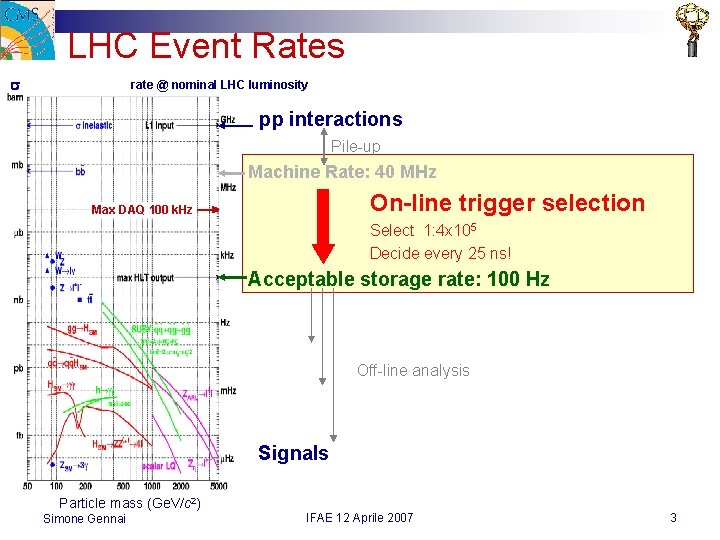
LHC Event Rates s rate @ nominal LHC luminosity pp interactions Pile-up Machine Rate: 40 MHz On-line trigger selection Max DAQ 100 k. Hz Select 1: 4 x 10⁵ Decide every 25 ns! Acceptable storage rate: 100 Hz Off-line analysis Signals Particle mass (Ge. V/c 2) Simone Gennai IFAE 12 Aprile 2007 3
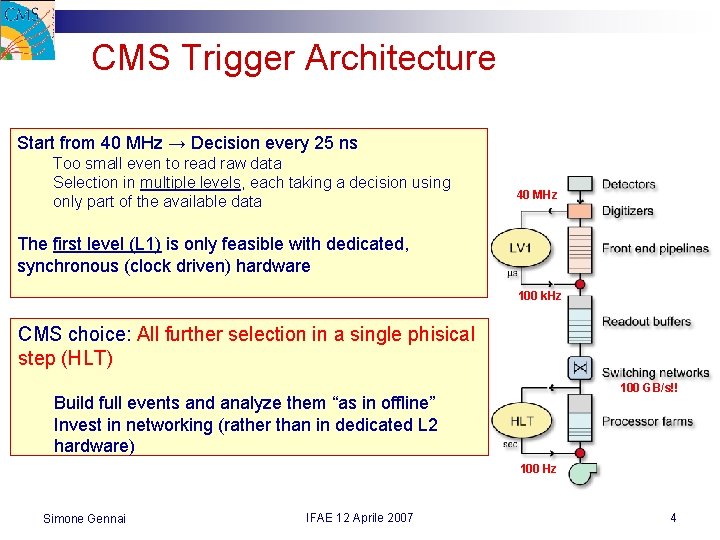
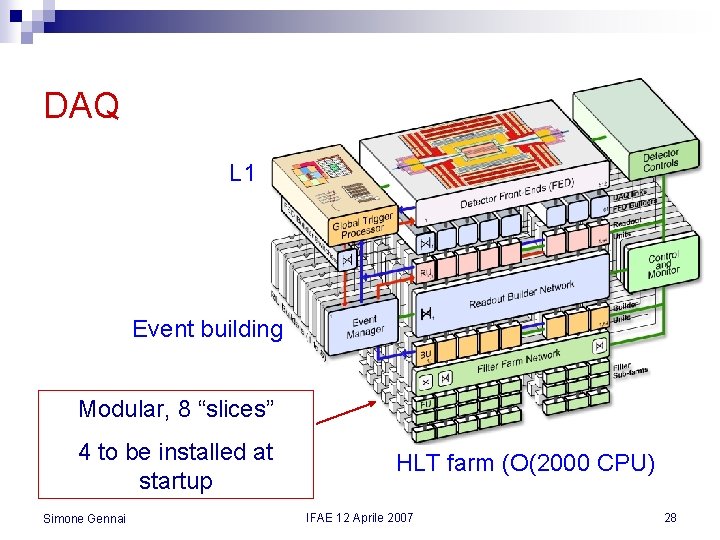
CMS Trigger Architecture Start from 40 MHz → Decision every 25 ns Too small even to read raw data Selection in multiple levels, each taking a decision using only part of the available data 40 MHz The first level (L 1) is only feasible with dedicated, synchronous (clock driven) hardware 100 k. Hz CMS choice: All further selection in a single phisical step (HLT) 100 GB/s!! Build full events and analyze them “as in offline” Invest in networking (rather than in dedicated L 2 hardware) 100 Hz Simone Gennai IFAE 12 Aprile 2007 4
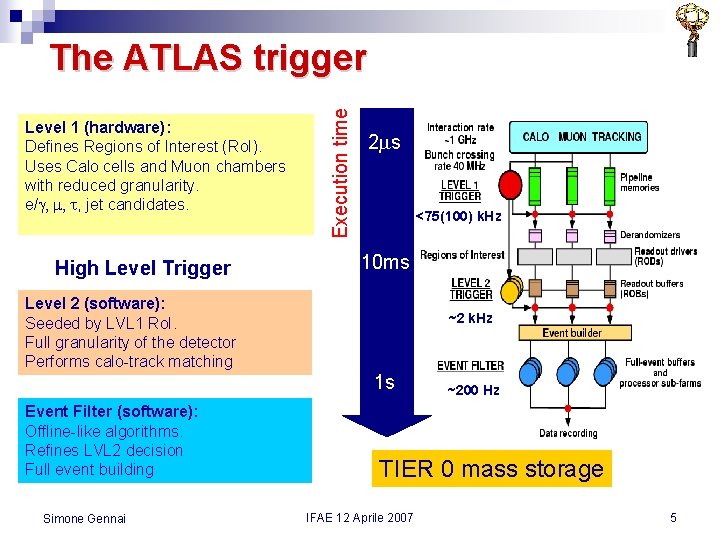
Level 1 (hardware): Defines Regions of Interest (Ro. I). Uses Calo cells and Muon chambers with reduced granularity. e/g, m, , jet candidates. High Level Trigger Execution time The ATLAS trigger 2 ms <75(100) k. Hz 10 ms Level 2 (software): Seeded by LVL 1 Ro. I. Full granularity of the detector Performs calo-track matching ~2 k. Hz 1 s Event Filter (software): Offline-like algorithms. Refines LVL 2 decision Full event building Simone Gennai ~200 Hz TIER 0 mass storage IFAE 12 Aprile 2007 5
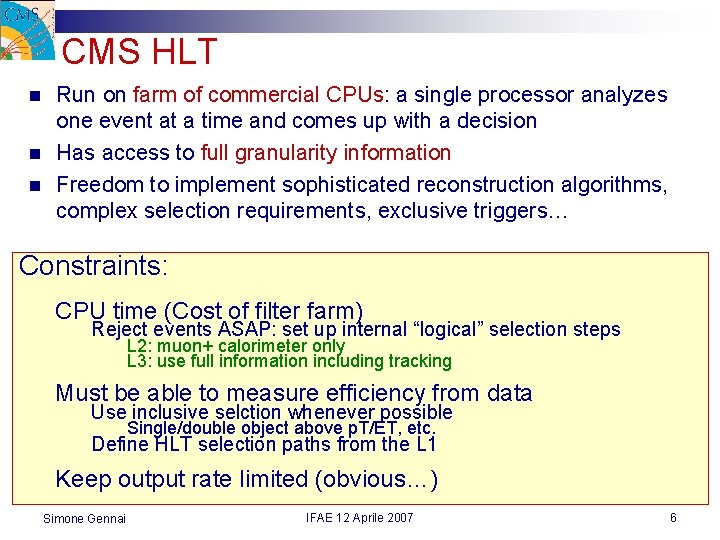
CMS HLT n n n Run on farm of commercial CPUs: a single processor analyzes one event at a time and comes up with a decision Has access to full granularity information Freedom to implement sophisticated reconstruction algorithms, complex selection requirements, exclusive triggers… Constraints: CPU time (Cost of filter farm) Reject events ASAP: set up internal “logical” selection steps L 2: muon+ calorimeter only L 3: use full information including tracking Must be able to measure efficiency from data Use inclusive selction whenever possible Single/double object above p. T/ET, etc. Define HLT selection paths from the L 1 Keep output rate limited (obvious…) Simone Gennai IFAE 12 Aprile 2007 6

Setting trigger tables n n HLT trigger paths start from corresponding L 1 paths Thresholds are set distributing bandwidth to the various paths in order to maximize efficiencies There can be significant overlaps ¨ Iterative process ¨ n Thresholds (and streams) will change with luminosity And according to the physics of interest at the time of operation ¨ Reference: 2 x 1033 cm-2 s-1 (and Pilot Run) ¨ Evolution of selection with luminosity is a delicate issue, up to now studied in detail only for jet (with prescales) ¨ It will be part of the CMS HLT Exercise ¨ Simone Gennai IFAE 12 Aprile 2007 7
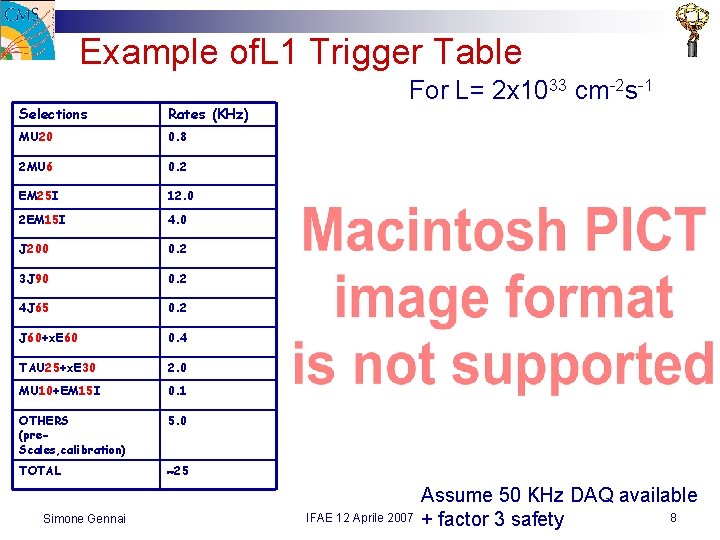
Example of. L 1 Trigger Table Selections Rates (KHz) MU 20 0. 8 2 MU 6 0. 2 EM 25 I 12. 0 2 EM 15 I 4. 0 J 200 0. 2 3 J 90 0. 2 4 J 65 0. 2 J 60+x. E 60 0. 4 TAU 25+x. E 30 2. 0 MU 10+EM 15 I 0. 1 OTHERS (pre. Scales, calibration) 5. 0 TOTAL 25 Simone Gennai For L= 2 x 1033 cm-2 s-1 IFAE 12 Aprile 2007 Assume 50 KHz DAQ available 8 + factor 3 safety
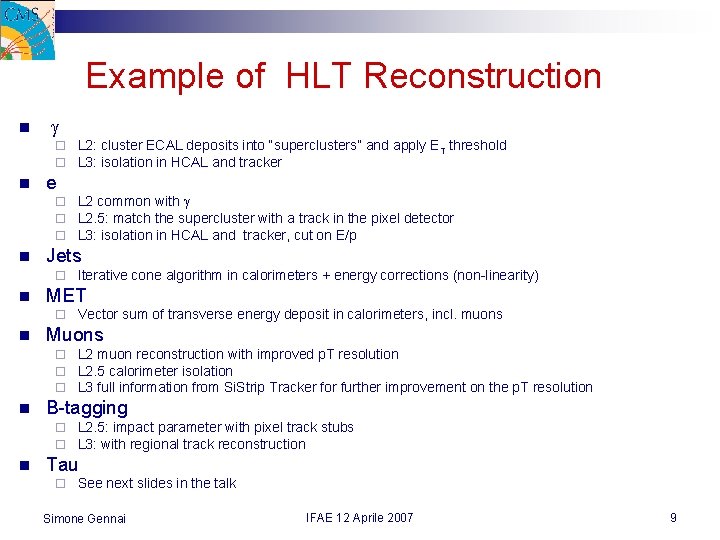
Example of HLT Reconstruction n g ¨ ¨ n e ¨ ¨ ¨ n L 2 muon reconstruction with improved p. T resolution L 2. 5 calorimeter isolation L 3 full information from Si. Strip Tracker for further improvement on the p. T resolution B-tagging ¨ ¨ n Vector sum of transverse energy deposit in calorimeters, incl. muons Muons ¨ ¨ ¨ n Iterative cone algorithm in calorimeters + energy corrections (non-linearity) MET ¨ n L 2 common with g L 2. 5: match the supercluster with a track in the pixel detector L 3: isolation in HCAL and tracker, cut on E/p Jets ¨ n L 2: cluster ECAL deposits into “superclusters” and apply ET threshold L 3: isolation in HCAL and tracker L 2. 5: impact parameter with pixel track stubs L 3: with regional track reconstruction Tau ¨ See next slides in the talk Simone Gennai IFAE 12 Aprile 2007 9
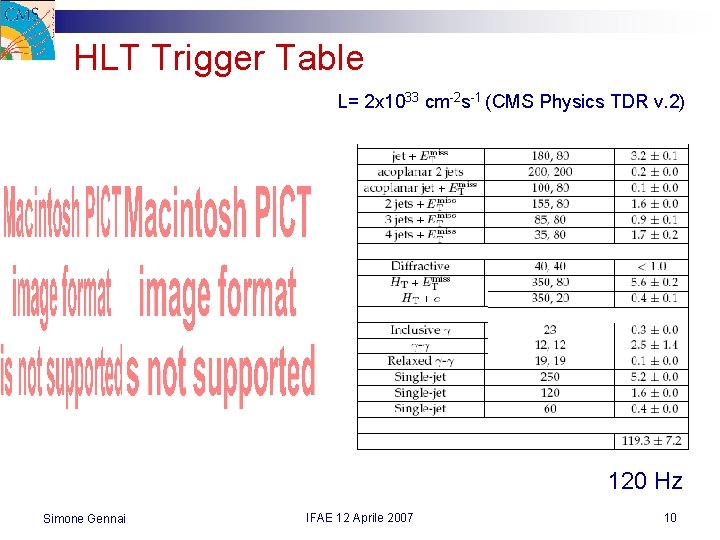
HLT Trigger Table L= 2 x 1033 cm-2 s-1 (CMS Physics TDR v. 2) 120 Hz Simone Gennai IFAE 12 Aprile 2007 10
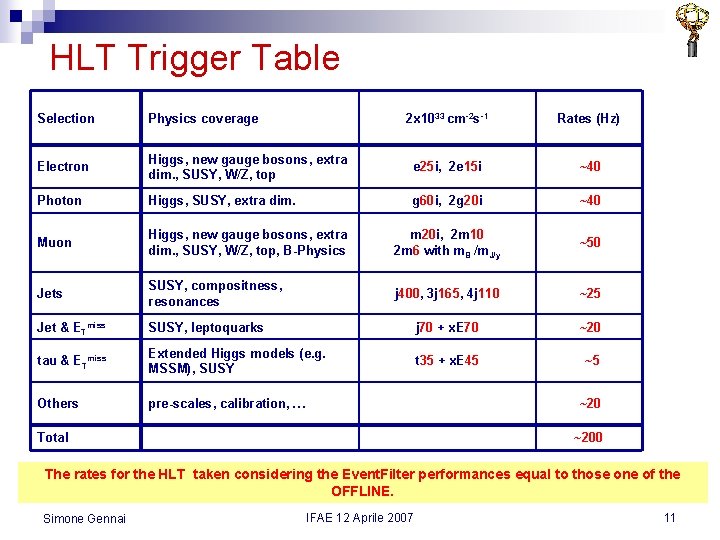
HLT Trigger Table Selection Physics coverage 2 x 1033 cm-2 s-1 Rates (Hz) Electron Higgs, new gauge bosons, extra dim. , SUSY, W/Z, top e 25 i, 2 e 15 i ~40 Photon Higgs, SUSY, extra dim. g 60 i, 2 g 20 i ~40 Muon Higgs, new gauge bosons, extra dim. , SUSY, W/Z, top, B-Physics m 20 i, 2 m 10 2 m 6 with m. B /m. J/y ~50 Jets SUSY, compositness, resonances j 400, 3 j 165, 4 j 110 ~25 Jet & ETmiss SUSY, leptoquarks j 70 + x. E 70 ~20 tau & ETmiss Extended Higgs models (e. g. MSSM), SUSY t 35 + x. E 45 ~5 Others pre-scales, calibration, … ~20 Total ~200 The rates for the HLT taken considering the Event. Filter performances equal to those one of the OFFLINE. Simone Gennai IFAE 12 Aprile 2007 11
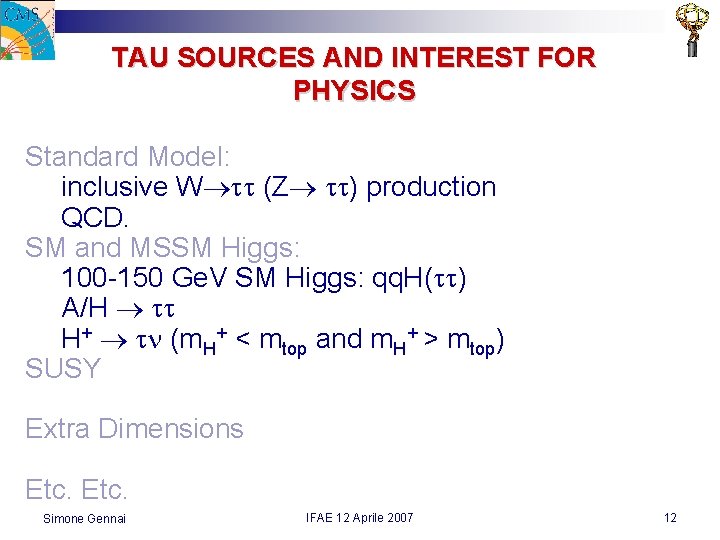
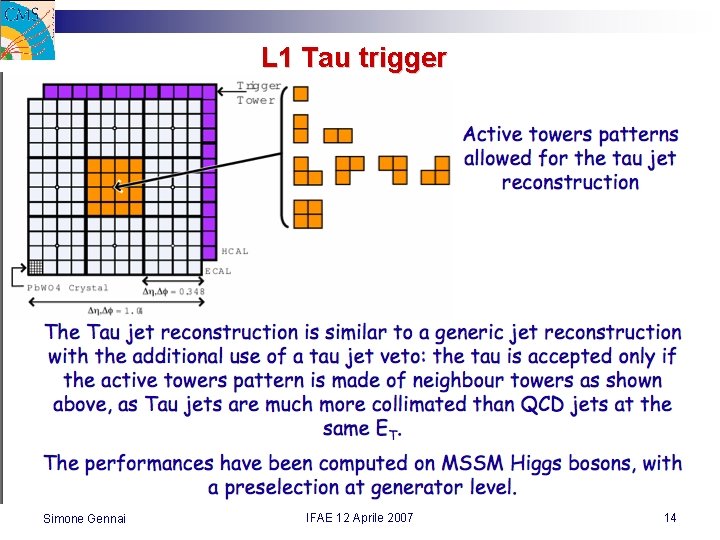
TAU SOURCES AND INTEREST FOR PHYSICS Standard Model: inclusive W (Z ) production QCD. SM and MSSM Higgs: 100 -150 Ge. V SM Higgs: qq. H( ) A/H H+ n (m. H+ < mtop and m. H+ > mtop) SUSY Extra Dimensions Etc. Simone Gennai IFAE 12 Aprile 2007 12
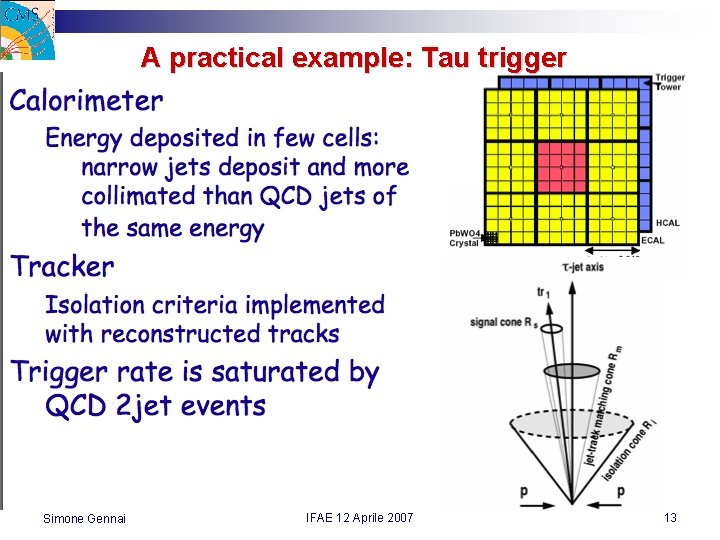
A practical example: Tau trigger Simone Gennai IFAE 12 Aprile 2007 13
L 1 Tau trigger Simone Gennai IFAE 12 Aprile 2007 14
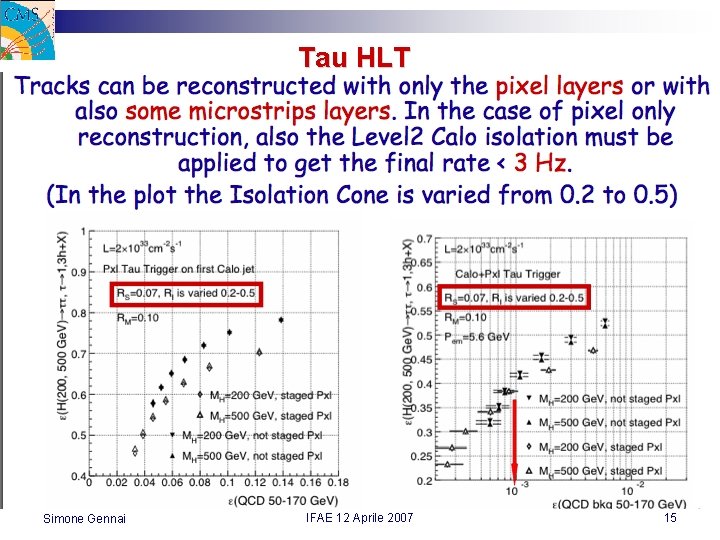
Tau HLT Simone Gennai IFAE 12 Aprile 2007 15
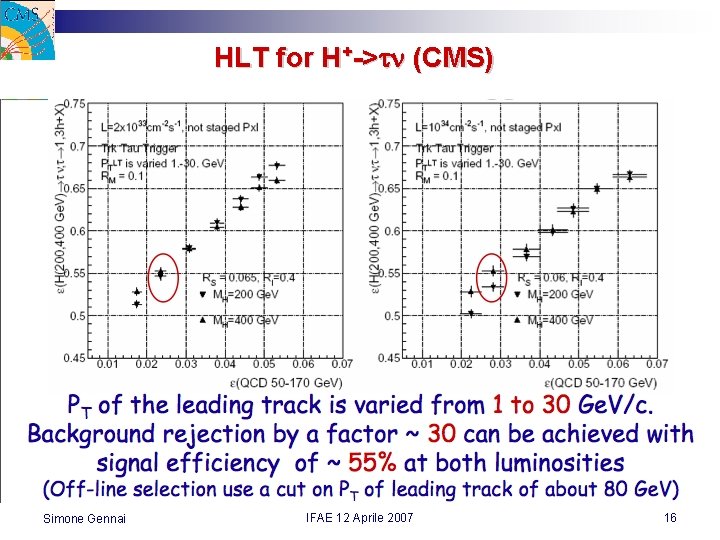
HLT for H+-> n (CMS) Simone Gennai IFAE 12 Aprile 2007 16
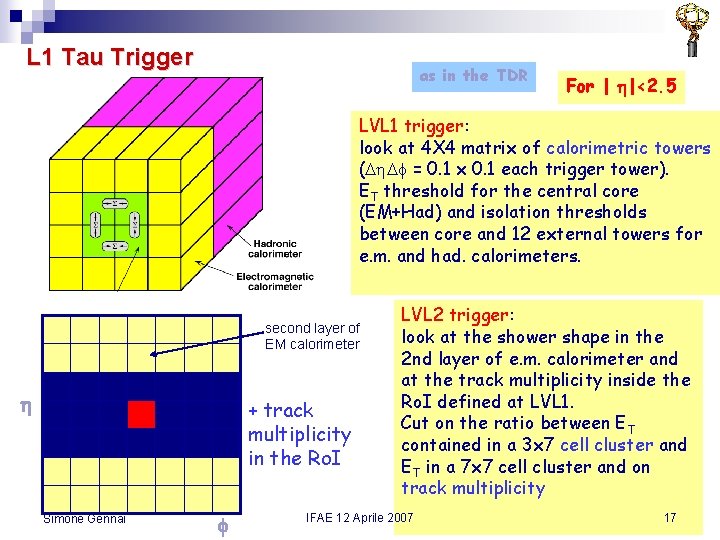
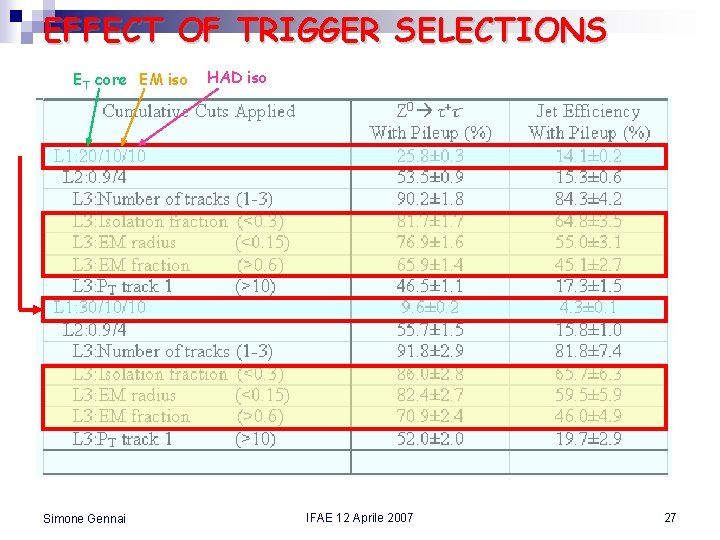
L 1 Tau Trigger as in the TDR For | |<2. 5 LVL 1 trigger: look at 4 X 4 matrix of calorimetric towers ( f = 0. 1 x 0. 1 each trigger tower). ET threshold for the central core (EM+Had) and isolation thresholds between core and 12 external towers for e. m. and had. calorimeters. second layer of EM calorimeter + track multiplicity in the Ro. I Simone Gennai f LVL 2 trigger: look at the shower shape in the 2 nd layer of e. m. calorimeter and at the track multiplicity inside the Ro. I defined at LVL 1. Cut on the ratio between ET contained in a 3 x 7 cell cluster and ET in a 7 x 7 cell cluster and on track multiplicity IFAE 12 Aprile 2007 17
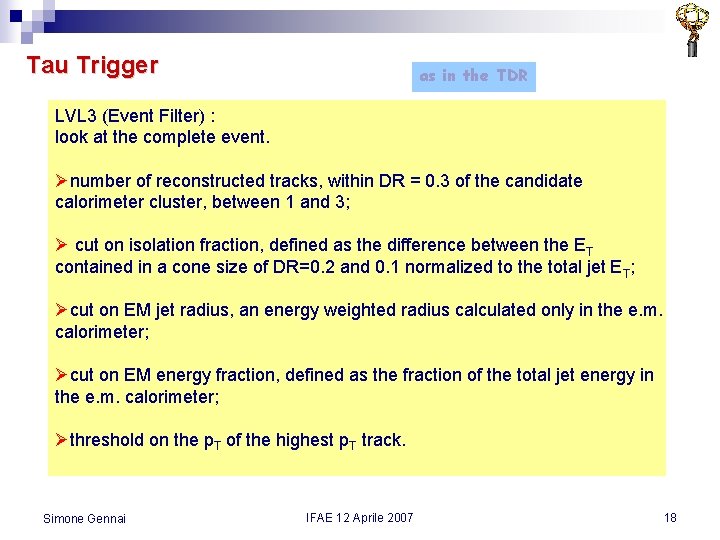
Tau Trigger as in the TDR LVL 3 (Event Filter) : look at the complete event. Ønumber of reconstructed tracks, within DR = 0. 3 of the candidate calorimeter cluster, between 1 and 3; Ø cut on isolation fraction, defined as the difference between the ET contained in a cone size of DR=0. 2 and 0. 1 normalized to the total jet ET; Øcut on EM jet radius, an energy weighted radius calculated only in the e. m. calorimeter; Øcut on EM energy fraction, defined as the fraction of the total jet energy in the e. m. calorimeter; Øthreshold on the p. T of the highest p. T track. Simone Gennai IFAE 12 Aprile 2007 18
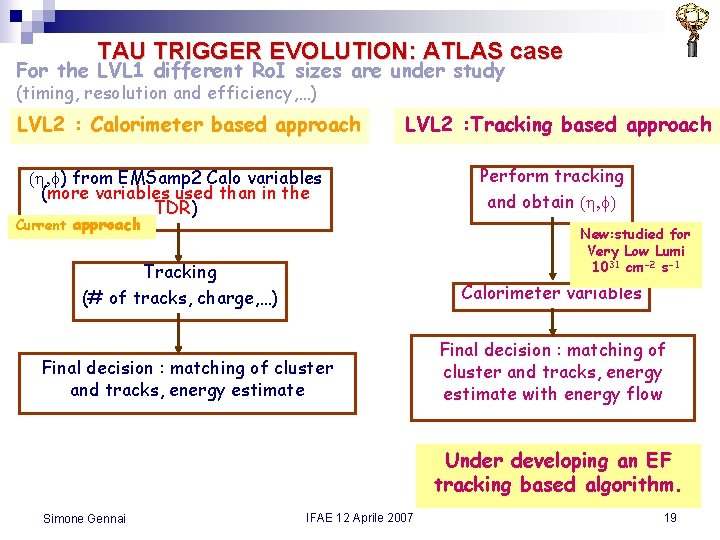
TAU TRIGGER EVOLUTION: ATLAS case For the LVL 1 different Ro. I sizes are under study (timing, resolution and efficiency, …) LVL 2 : Calorimeter based approach LVL 2 : Tracking based approach ( , f) from EMSamp 2 Calo variables (more variables used than in the TDR) Current approach Perform tracking and obtain ( , f) New: studied for Very Low Lumi 1031 cm-2 s-1 Tracking (# of tracks, charge, …) Calorimeter variables Final decision : matching of cluster and tracks, energy estimate with energy flow Under developing an EF tracking based algorithm. Simone Gennai IFAE 12 Aprile 2007 19
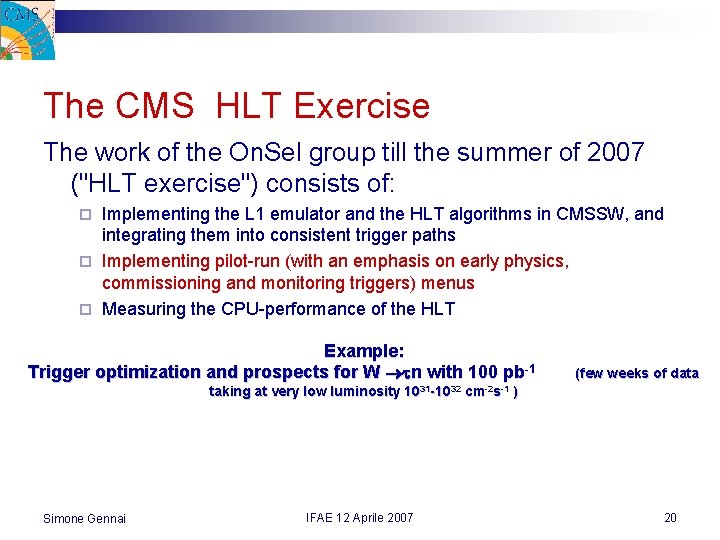
The CMS HLT Exercise The work of the On. Sel group till the summer of 2007 ("HLT exercise") consists of: Implementing the L 1 emulator and the HLT algorithms in CMSSW, and integrating them into consistent trigger paths ¨ Implementing pilot-run (with an emphasis on early physics, commissioning and monitoring triggers) menus ¨ Measuring the CPU-performance of the HLT ¨ Example: Trigger optimization and prospects for W n with 100 pb-1 taking at very low luminosity Simone Gennai 1031 -1032 IFAE 12 Aprile 2007 cm-2 s-1 (few weeks of data ) 20
Timing issue n n Up to the Physics TDR, the trigger performances were evaluated only in terms of Signal efficiency and background rejection As the Pilot run is approaching we have to optimize the timing performance. ¨ 40 msec/Event is the “budget” we can spent at HLT n n Reduce as soon as possible the bkg Apply faster code than the one used in offline Regional reconstruction and data unpacking becomes an Issue Some trigger paths have been partially re-designed in order to speed up the reconstruction and selection Simone Gennai IFAE 12 Aprile 2007 21
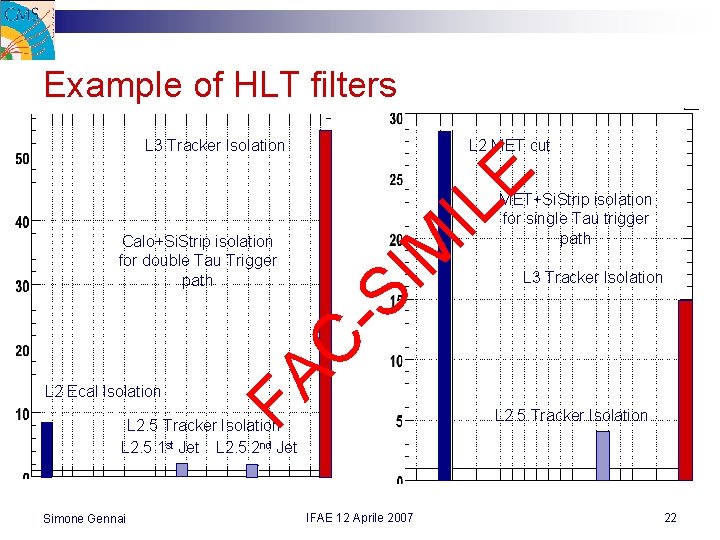
Example of HLT filters L 2 MET cut IL E L 3 Tracker Isolation L 2 Ecal Isolation FA C -S IM Calo+Si. Strip isolation for double Tau Trigger path MET+Si. Strip isolation for single Tau trigger path L 2. 5 Tracker Isolation L 2. 5 1 st Jet L 2. 5 2 nd Jet Simone Gennai IFAE 12 Aprile 2007 L 2. 5 Tracker Isolation 22
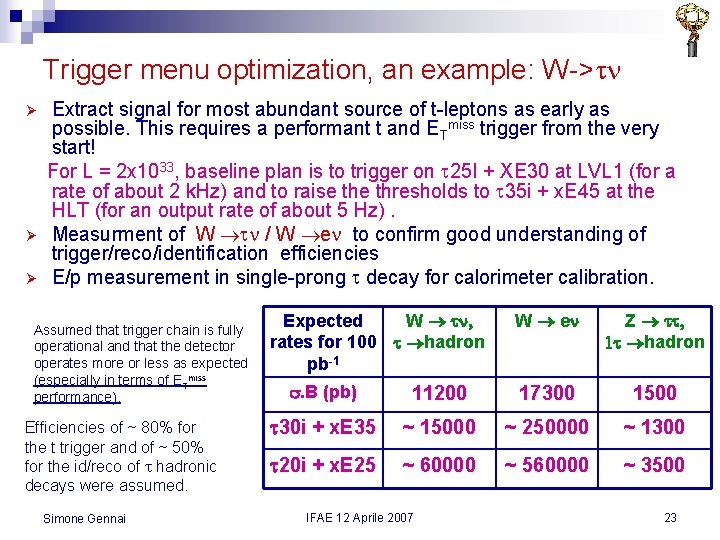
Trigger menu optimization, an example: W-> n Ø Ø Ø Extract signal for most abundant source of t-leptons as early as possible. This requires a performant t and ETmiss trigger from the very start! For L = 2 x 1033, baseline plan is to trigger on 25 I + XE 30 at LVL 1 (for a rate of about 2 k. Hz) and to raise thresholds to 35 i + x. E 45 at the HLT (for an output rate of about 5 Hz). Measurment of W n / W en to confirm good understanding of trigger/reco/identification efficiencies E/p measurement in single-prong decay for calorimeter calibration. Assumed that trigger chain is fully operational and that the detector operates more or less as expected (especially in terms of ETmiss performance). Efficiencies of ~ 80% for the t trigger and of ~ 50% for the id/reco of hadronic decays were assumed. Simone Gennai Expected W n, W en rates for 100 hadron pb-1 Z , 1 hadron s. B (pb) 11200 17300 1500 30 i + x. E 35 ~ 15000 ~ 250000 ~ 1300 20 i + x. E 25 ~ 60000 ~ 560000 ~ 3500 IFAE 12 Aprile 2007 23
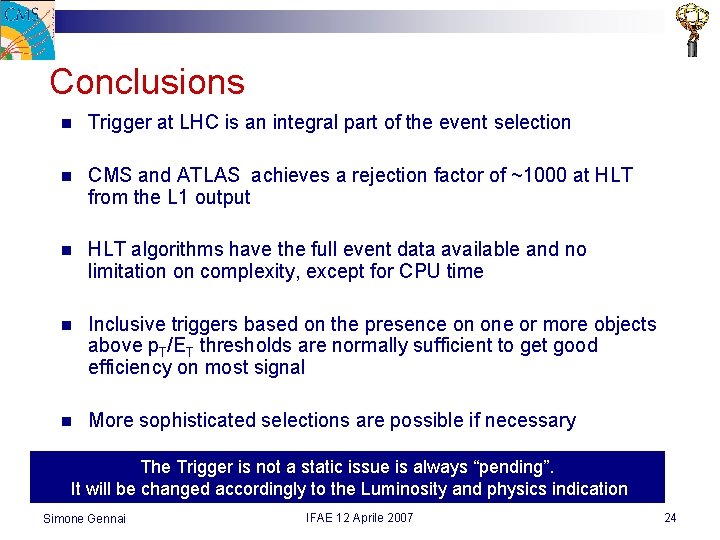
Conclusions n Trigger at LHC is an integral part of the event selection n CMS and ATLAS achieves a rejection factor of ~1000 at HLT from the L 1 output n HLT algorithms have the full event data available and no limitation on complexity, except for CPU time n Inclusive triggers based on the presence on one or more objects above p. T/ET thresholds are normally sufficient to get good efficiency on most signal n More sophisticated selections are possible if necessary The Trigger is not a static issue is always “pending”. It will be changed accordingly to the Luminosity and physics indication Simone Gennai IFAE 12 Aprile 2007 24
References n CMS DAQ/HLT TDR, 2002, CERN-LHCC-2002 -026 ¨ n CMS Physics TDR Volume 1 (2006), CERN-LHCC-2006001 ¨ n Detector performance, reconstruction CMS Physics TDR Volume 2 (2006), CERN-LHCC-2006021, ¨ n Full study of HLT rates, timing, benchmark signal efficiencies Update of HLT rates and trigger tables (Appendix E) ATL-COM-DAQ-2003 -030 Simone Gennai IFAE 12 Aprile 2007 25
BACKUP SLIDES Simone Gennai IFAE 12 Aprile 2007 26
EFFECT OF TRIGGER SELECTIONS ET core EM iso Simone Gennai HAD iso IFAE 12 Aprile 2007 27
DAQ L 1 Event building Modular, 8 “slices” 4 to be installed at startup Simone Gennai HLT farm (O(2000 CPU) IFAE 12 Aprile 2007 28
LAr | | < 3 : Electromagnetic di EM Sistema calorimetrico ATLAS Tile Calorimeters Liquid Argon Calorimeters Pb/LAr 24 -26 X 0 3 sezioni longitudinali 1. 2 = 0. 025 – 1% equal. Central Hadronic | | < 1. 7 : η=1. 475 η=1. 8 Fe(82%)/scintillatore(18%) 3 sezioni longitudinali 7. 2 η=3. 2 = 0. 1 End Cap Hadronic 1. 7 < < 3. 2 : Cu/LAr – 4 sezioni longitudinali Hadronic Liquid Argon End. Cap Calorimeters Forward Liquid Argon Calorimeters < 0. 2 Forward calorimeter 3 < < 4. 9 : EM Cu/LAr – HAD W/LAr 3 sezioni longitudinali Simone Gennai IFAE 12 Aprile 2007 29
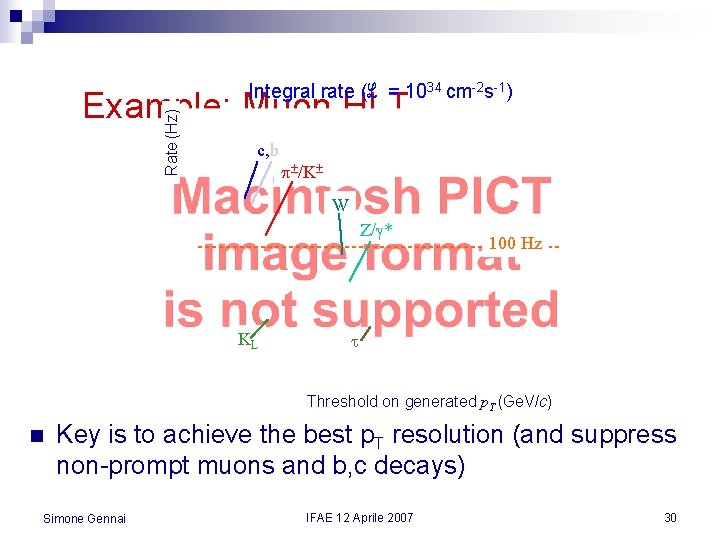
Integral rate (ℒ = 1034 cm-2 s-1) Rate (Hz) Example: Muon HLT c, b p /K W Z/g* KL 100 Hz Threshold on generated p. T (Ge. V/c) n Key is to achieve the best p. T resolution (and suppress non-prompt muons and b, c decays) Simone Gennai IFAE 12 Aprile 2007 30
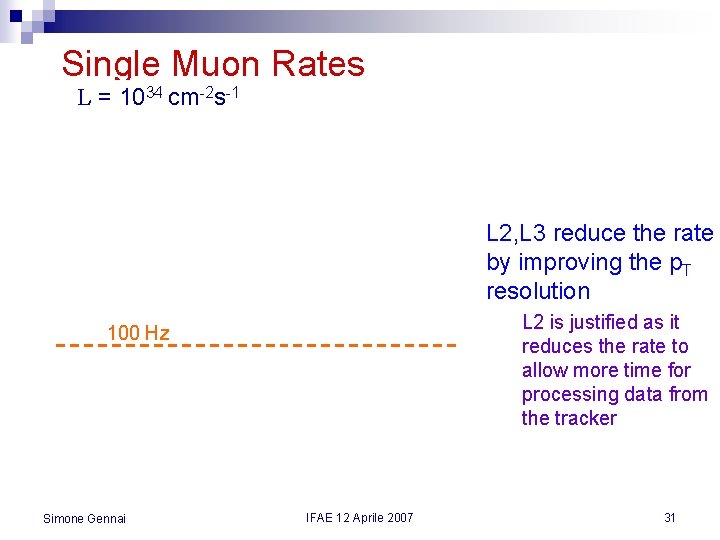
Single Muon Rates L = 1034 cm-2 s-1 L 2, L 3 reduce the rate by improving the p. T resolution L 2 is justified as it reduces the rate to allow more time for processing data from the tracker 100 Hz Simone Gennai IFAE 12 Aprile 2007 31
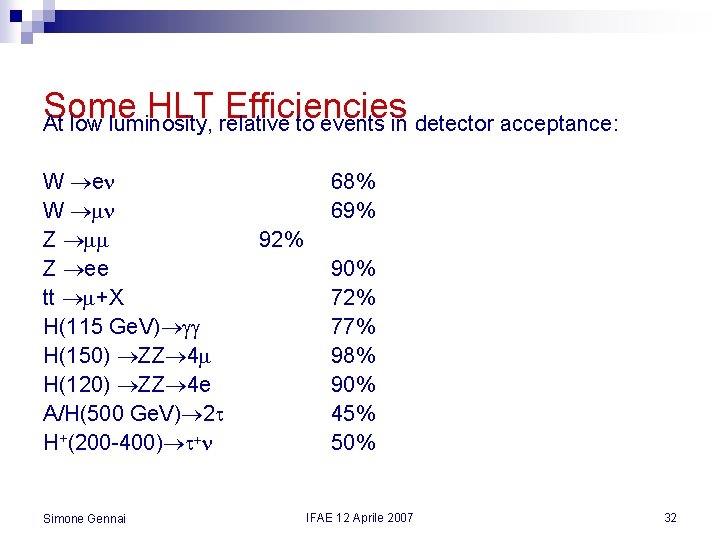
Some HLT Efficiencies At low luminosity, relative to events in detector acceptance: W en W mn Z mm Z ee tt m+X H(115 Ge. V) gg H(150) ZZ 4 m H(120) ZZ 4 e A/H(500 Ge. V) 2 H+(200 -400) +n Simone Gennai 68% 69% 92% 90% 72% 77% 98% 90% 45% 50% IFAE 12 Aprile 2007 32
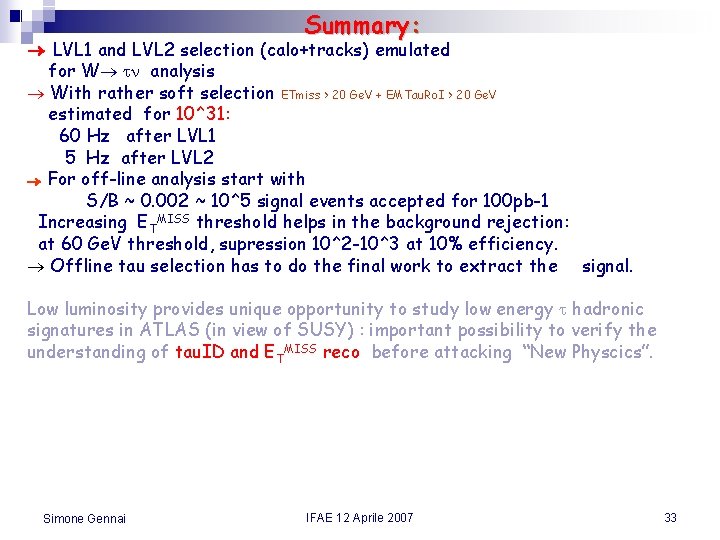
Summary: LVL 1 and LVL 2 selection (calo+tracks) emulated for W n analysis With rather soft selection ETmiss > 20 Ge. V + EMTau. Ro. I > 20 Ge. V estimated for 10^31: 60 Hz after LVL 1 5 Hz after LVL 2 For off-line analysis start with S/B ~ 0. 002 ~ 10^5 signal events accepted for 100 pb-1 Increasing ETMISS threshold helps in the background rejection: at 60 Ge. V threshold, supression 10^2 -10^3 at 10% efficiency. Offline tau selection has to do the final work to extract the signal. Low luminosity provides unique opportunity to study low energy hadronic signatures in ATLAS (in view of SUSY) : important possibility to verify the understanding of tau. ID and ETMISS reco before attacking “New Physcics”. Simone Gennai IFAE 12 Aprile 2007 33
- Slides: 33