
High Level Mobility Assessment Tool Bentley Olson Etches
High Level Mobility Assessment Tool Bentley Olson Etches Hayley Hedges Grace Laferriere Blake Schnurr
Overview 1, 2 - Assesses high level motor performance in TBI patients or patients after traumatic orthopedic injuries - Performance measure of functional mobility and balance ICF domains: activity and participation Recommended for more mild TBI or for chronic TBI - Minimum mobility requirement is independent walking over 20 m without an assistive device Highly recommended to be used in OP or Home Health - http: //chittagongit. com/icon/all-ages-icon-26. html

Overview cont. 1, 2, 3 - - Items were developed from existing adult and peds neurologic mobility scales and expert opinion 13 items including walking and running, jumping, balance, stairs, hopping, skipping There is also a version that has 8 items (removes stairs and bound affected leg items) - Hi. MAT-R or revised - High score of 32 Appropriate for adolescents (13 -17), adults (18 -64), and elderly adults (65+) Note: originally developed for patients who could follow two step commands

Administration 1, 2 https: //capitalallocatorspodcast. com/stopwatch/ Free 13 items at max of 5 points each (54 points high score) Equipment needed: stopwatch, tape measure, house brick, 20 m walkway, flight of 14 stairs 5 -10 minutes to administer No special training required to administer: just read the manual Pts allowed a trial of each item to practice before they are actually assessed Perform items at maximum safe speed


Validity 4, 5 ● Content Validity: 28 items generated from pre=existing mobility scales from expert consensus. Testing for content validity resulted in 13 items on the final version. ● Concurrent Validity: Excellent compared to RMA, Adequate compared to motor FIM https: //www. slideshare. net/Siteimprove/analytics-is-more-than-adding-a-script

Reliability 1, 6 ● Interrater Reliability : very high for both individual items and total coded scores. Study used 1 PT with Hi. MAT experience and 2 PT’s with no prior knowledge of Hi. MAT indicating it is also “user friendly” for both 13 and 8 item. ● Intrarater (Retest) Reliability : very high with low typical error. No significant change in scores detected two days apart, however TBI pt’s all tended to improve on retest due to familiarity with testing items. https: //www. forexstrategieswork. com/to p-reliable-forex-brokers-offering-nodeposit-bonus/

Ceiling Effect 7 ● Hi. MAT was specifically developed in response to ceiling effect of Rivermead Motor Assessment and motor FIM for TBI patients ○ Running is the most difficult item on many high-level mobility scales used with TBI. ○ Hi. MAT has 6 items with higher logit scores than running. ● Ceiling effect in healthy 18 -25 yo males

Floor Effect 7 ● Instrument is specifically designed for high-level mobility ○ Minimum mobility requirement is ambulating 20 meters without AD ○ Patients who don’t meet this criteria are susceptible to floor effect ● More appropriate for late stage inpatient rehab and outpatient
Responsiveness 1, 3 TBI ● Hi. MAT is more responsive to change in high level mobility when compared to Motor FIM and RMA Chronic Acquired Brain Injury ● Significant difference between the acute and chronic subgroups http: //www. ventusproxy. com/en/high-responsiveness-our-most -valued-hidden-feature/
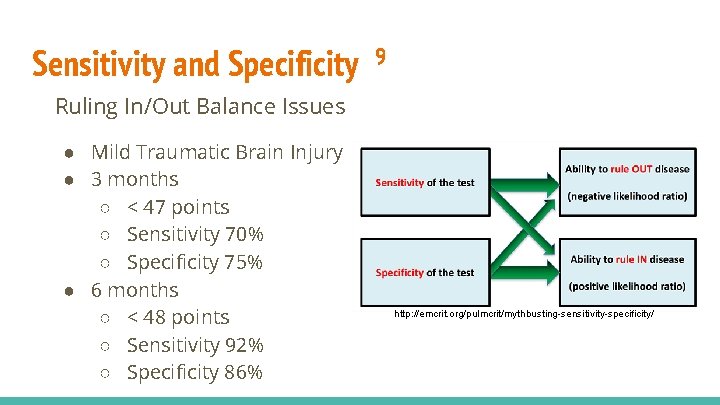
Sensitivity and Specificity 9 Ruling In/Out Balance Issues ● Mild Traumatic Brain Injury ● 3 months ○ < 47 points ○ Sensitivity 70% ○ Specificity 75% ● 6 months ○ < 48 points ○ Sensitivity 92% ○ Specificity 86% http: //emcrit. org/pulmcrit/mythbusting-sensitivity-specificity/
MDC 1, 5, 8 ● Only the MDC was reported for Hi. MAT: ● In the Chronic TBI population: ○ MDC 95: ■ Increase of 4 points or decrease of 2 points ■ “There must be a 4 point improvement, or 2 point deterioration for clinicians to be 95% confident that a real change has occurred” ● In Chronic TBI population for the 8 -item version: ○ MDC 95: ■ Increase of 2 points or decrease of 1 point https: //probonoaustralia. com. au/news/2018/04/sponsoredcontentintroducing-definitive-nonprofit-sector-change-managementmasterclass/
Recommendations and Clinical Application 1 ● Recommendations from NSAPTA: ○ TBI populations: ■ Highly recommended for completely independent and mildly dependent pts ■ Highly recommended in OP and HH settings ■ Limited studies for acute, inpatient rehab, and SNF populations ○ MS and stroke populations: ■ Unable to recommend or not recommended ○ SCI populations ■ Limited studies in acute, subacute, and chronic populations https: //www. brainline. org/article/traumatic-brain-injury-basics
Recommendations and Clinical Application 1 ● Our recommendations: ○ Free, quick, easy to implement tool ○ Hi. MAT-R might be more useful in a single-story clinic without a full flight of stairs ○ Useful for assessing motor performance in TBI patients who are independent ○ May not show improvement for patients who are already functioning at a very high level and do not have significant impairments with mobility ○ Can help identify specific mobility itemswhere pt is struggling most with ■ Help focus intervention training
References 1. 2. 3. 4. 5. 6. Rehabilitation Measures Database. High-level Mobility Assessment Tool. Shirley Ryan Ability Lab. https: //www. sralab. org/rehabilitationmeasures/high-level-mobility-assessment-tool#non-specific-patient-population. Updated January 17, 2013. Accessed February 4, 2019. PTNow. High-Level Mobility Assessment Tool (Hi. MAT) and Hi. MAT-Revised (Hi. MAT-R). American Physical Therapy Association. https: //www. ptnow. org/tests-detail/high-level-mobility-assessment-tool-himat-re. Published March 5, 2015. Updated May 25, 2015. Accessed February 4, 2018. Williams, G. (2006). The High Level Mobility Assessment Tool. The Center for Outcome Measurement in Brain Injury. http: //www. tbims. org/combi/himat. Accessed February 9, 2019. Williams GP, Robertson V, Greenwood KM, Goldie PA, Morris ME. The high-level mobility assessment tool (Hi. MAT) for traumatic brain injury. Part 2: content validity and discriminability. Brain Inj. 2005; 19(10): 833 -843. Williams G, Robertson V, Greenwood K, Goldie P, Morris ME. The concurrent validity and responsiveness of the high-level mobility assessment tool for measuring the mobility limitations of people with traumatic brain injury. Arch Phys Med Rehabil. 2006; 87(3): 437 -442. doi: 10. 1016/j. apmr. 2005. 10. 028 Williams GP, Greenwood KM, Robertson VJ, Goldie PA, Morris ME. High-Level Mobility Assessment Tool (Hi. MAT): interrater reliability, retest reliability, and internal consistency. Phys Ther. 2006; 86(3): 395 -400 7. Williams GP, Rosie J, Denisenko S, Taylor D. Normative values for the high-level mobility assessment tool (Hi. MAT). . . including commentary by Mc. Culloch K. International Journal of Therapy & Rehabilitation. 2009; 16(7): 370 -374. 8. Williams GP, Pallant J, Greenwood K. Further development of the High-level Mobility Assessment Tool (Hi. MAT), Brain Inj. 2010; 24(78): 1027 -1031. doi: 10. 3109/02699052. 2010. 490517. 9. Kleffelgaard I, Roe C, Sandvik L, Hellstrom T, Soberg HL. Measurement Properties of the High-Level Mobility Assessment Tool for Mild Traumatic Brain Injury. Physical Therapy. 2013; 93(7): 900 -910. doi: 10. 2522/ptj. 20120381. 10. Koch, Emily. High-level mobility assessment tool [video]. Youtube, 2016.
- Slides: 15