
High intensity neutron beams for Nucleosynthesis studies at
High intensity neutron beams for Nucleosynthesis studies at CERN M. Barbagallo 1, the n_TOF Collaboration 1 1 -CERN 16 th Rußbach School on Nuclear Astrophysics 12 March 2019
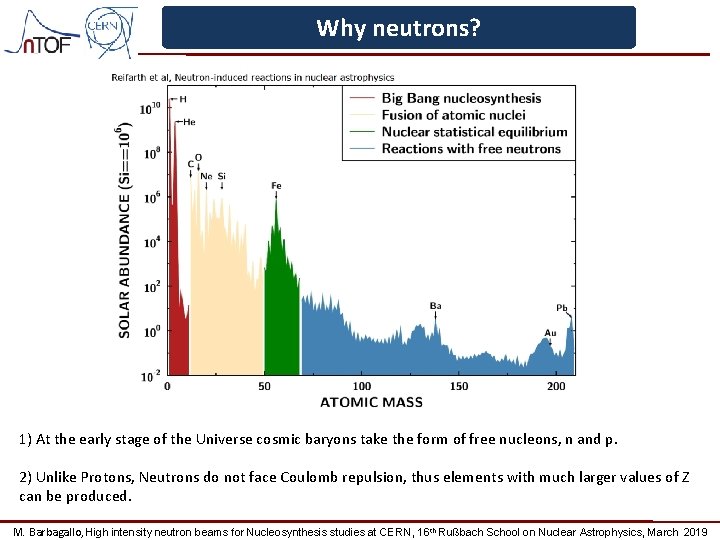
Why neutrons? 1) At the early stage of the Universe cosmic baryons take the form of free nucleons, n and p. 2) Unlike Protons, Neutrons do not face Coulomb repulsion, thus elements with much larger values of Z can be produced. M. Barbagallo, High intensity neutron beams for Nucleosynthesis studies at CERN, 16 th Rußbach School on Nuclear Astrophysics, March 2019
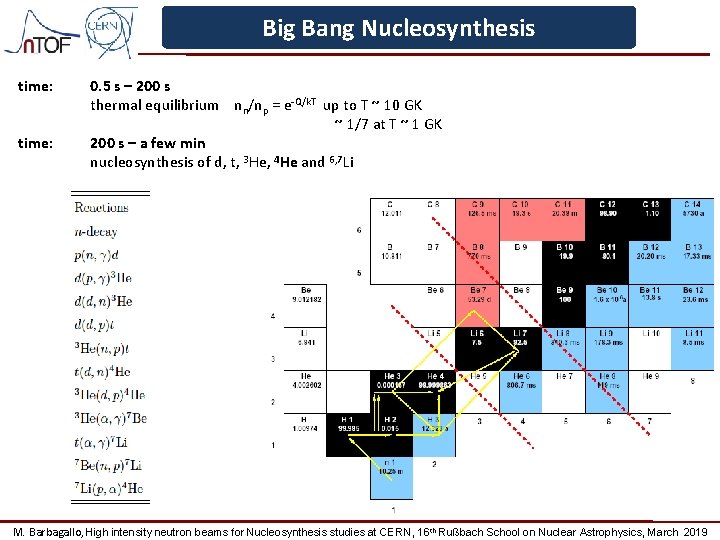
Big Bang Nucleosynthesis time: 0. 5 s – 200 s thermal equilibrium nn/np = e-Q/k. T up to T ~ 10 GK ~ 1/7 at T ~ 1 GK 200 s – a few min nucleosynthesis of d, t, 3 He, 4 He and 6, 7 Li M. Barbagallo, High intensity neutron beams for Nucleosynthesis studies at CERN, 16 th Rußbach School on Nuclear Astrophysics, March 2019
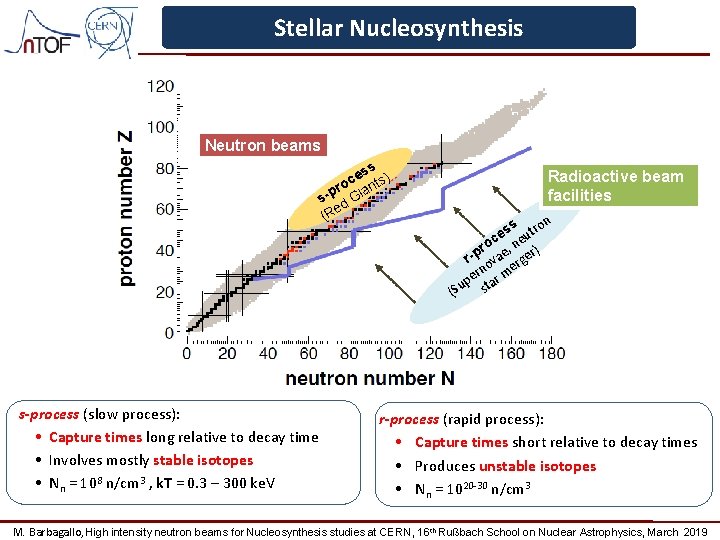
Stellar Nucleosynthesis Neutron beams s es ts) c ro an s-p d Gi e (R s-process (slow process): • Capture times long relative to decay time • Involves mostly stable isotopes • Nn = 108 n/cm 3 , k. T = 0. 3 – 300 ke. V Radioactive beam facilities n ss utro e c e ro e, n r) p r- ova rge e n er ar m p (Su st r-process (rapid process): • Capture times short relative to decay times • Produces unstable isotopes • Nn = 1020 -30 n/cm 3 M. Barbagallo, High intensity neutron beams for Nucleosynthesis studies at CERN, 16 th Rußbach School on Nuclear Astrophysics, March 2019

Stellar Nucleosynthesis Along the b-stability valley s(n, g) is a key quantity in modelling of stellar nucleosyntesis. 63 Cu 9. 74 m 69. 2% 12. 7 h 60 Ni 61 Ni 62 Ni 63 Ni 64 Ni 26. 2% 1. 14% 3. 63% 100 y 0. 93% 58 Co 59 Co 60 Co 61 Co 70. 86 d 100% 5. 272 y 1. 65 h 57 Fe 58 Fe 59 Fe 60 Fe 44. 5 d 1. 5· 106 Fundamental input in calculation of capture rate. s-process 56 Fe 91. 7% s-process (slow process): • Capture times long relative to decay time • Involves mostly stable isotopes • Nn = 108 n/cm 3 , k. T = 0. 3 – 300 ke. V 64 Cu 62 Cu 2. 2% 0. 28% 61 Fe y 6 m r-process (rapid process): • Capture times short relative to decay times • Produces unstable isotopes • Nn = 1020 -30 n/cm 3 M. Barbagallo, High intensity neutron beams for Nucleosynthesis studies at CERN, 16 th Rußbach School on Nuclear Astrophysics, March 2019
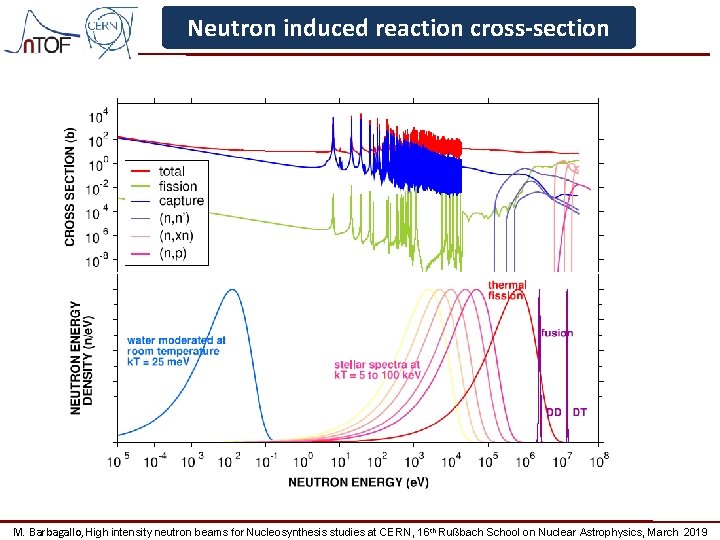
Neutron induced reaction cross-section M. Barbagallo, High intensity neutron beams for Nucleosynthesis studies at CERN, 16 th Rußbach School on Nuclear Astrophysics, March 2019
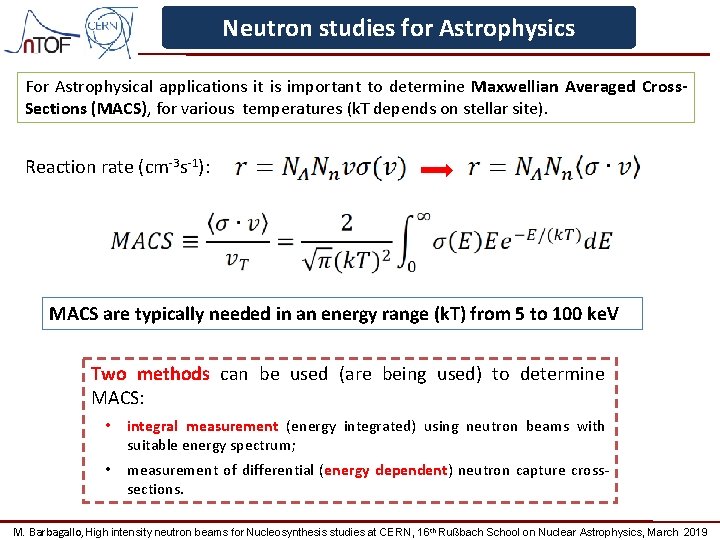
Neutron studies for Astrophysics For Astrophysical applications it is important to determine Maxwellian Averaged Cross. Sections (MACS), for various temperatures (k. T depends on stellar site). Reaction rate (cm-3 s-1): MACS are typically needed in an energy range (k. T) from 5 to 100 ke. V Two methods can be used (are being used) to determine MACS: • integral measurement (energy integrated) using neutron beams with suitable energy spectrum; • measurement of differential (energy dependent) neutron capture crosssections. M. Barbagallo, High intensity neutron beams for Nucleosynthesis studies at CERN, 16 th Rußbach School on Nuclear Astrophysics, March 2019
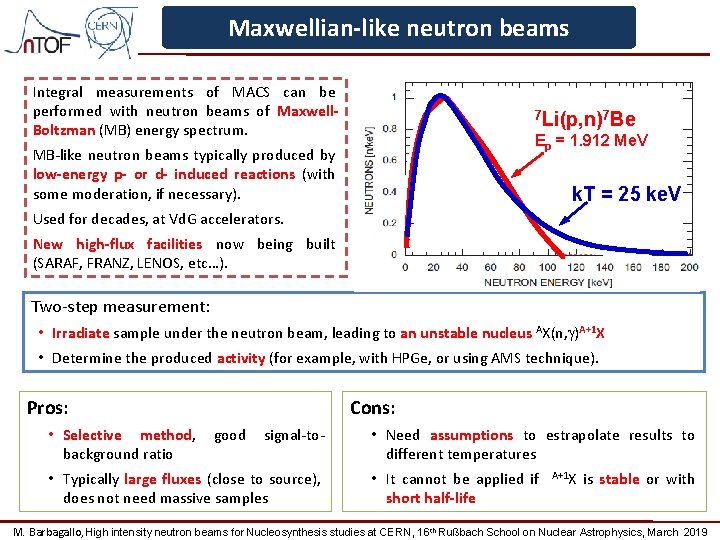
Maxwellian-like neutron beams Integral measurements of MACS can be performed with neutron beams of Maxwell. Boltzman (MB) energy spectrum. 7 Li(p, n)7 Be Ep = 1. 912 Me. V MB-like neutron beams typically produced by low-energy p- or d- induced reactions (with some moderation, if necessary). k. T = 25 ke. V Used for decades, at Vd. G accelerators. New high-flux facilities now being built (SARAF, FRANZ, LENOS, etc…). Two-step measurement: • Irradiate sample under the neutron beam, leading to an unstable nucleus AX(n, g)A+1 X • Determine the produced activity (for example, with HPGe, or using AMS technique). Pros: • Selective method, background ratio Cons: good signal-to- • Typically large fluxes (close to source), does not need massive samples • Need assumptions to estrapolate results to different temperatures • It cannot be applied if short half-life A+1 X is stable or with M. Barbagallo, High intensity neutron beams for Nucleosynthesis studies at CERN, 16 th Rußbach School on Nuclear Astrophysics, March 2019
Time of Flight Technique Time-of-flight method allows to measure directly s(En): • (n, g) events are determined by detecting the de-excitation cascade; • Neutron energy determined from the time between production of the neutron beam and detection of the capture g-rays. In principle, more powerful and accurate than activation: • MACS can be calculated for ANY stellar temperature • ANY isotope can be measured. Problems with To. F method: • sample has to be at some distance from the neutron source, thus reducing the flux • requires pulsed neutron beams (possibly with low repetition rate, to avoid wrap around); • more difficult to discriminate background (including natural radioactivity of sample); • requires relatively pure samples and in large amount. “Difficult” measurements require high-flux facilities !! M. Barbagallo, High intensity neutron beams for Nucleosynthesis studies at CERN, 16 th Rußbach School on Nuclear Astrophysics, March 2019
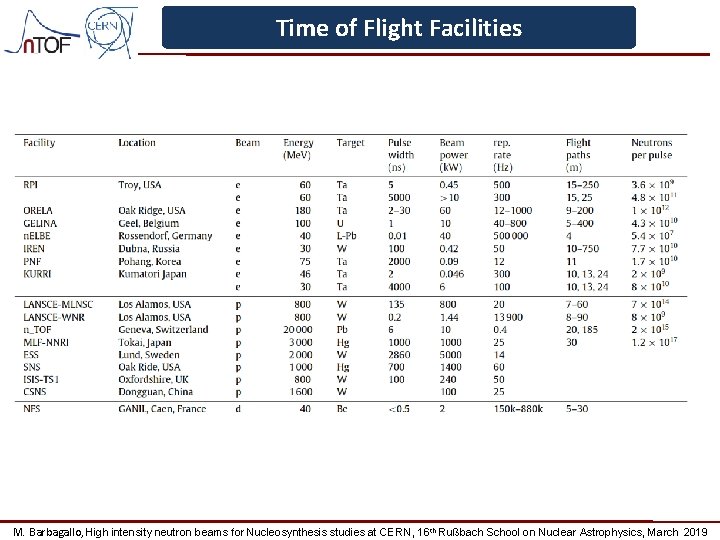
Time of Flight Facilities M. Barbagallo, High intensity neutron beams for Nucleosynthesis studies at CERN, 16 th Rußbach School on Nuclear Astrophysics, March 2019
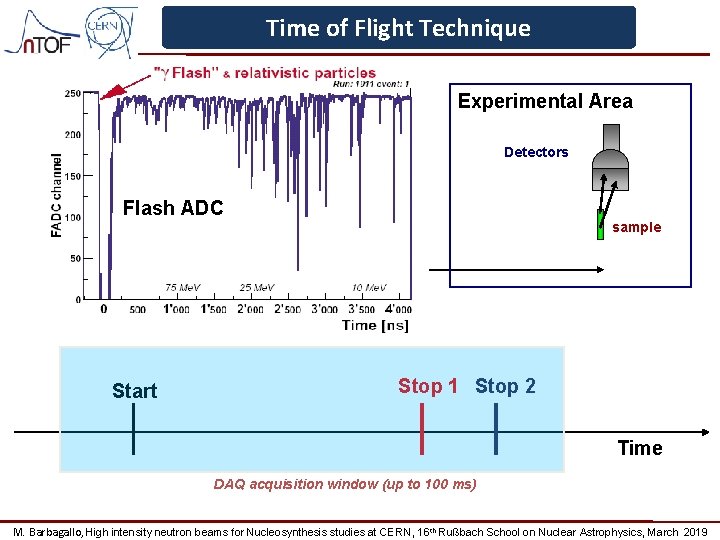
Time of Flight Technique Experimental Area Detectors Spallation target protons Flash ADC sample Base line (180 and 20 m) Start Stop 1 Stop 2 Time DAQ acquisition window (up to 100 ms) M. Barbagallo, High intensity neutron beams for Nucleosynthesis studies at CERN, 16 th Rußbach School on Nuclear Astrophysics, March 2019
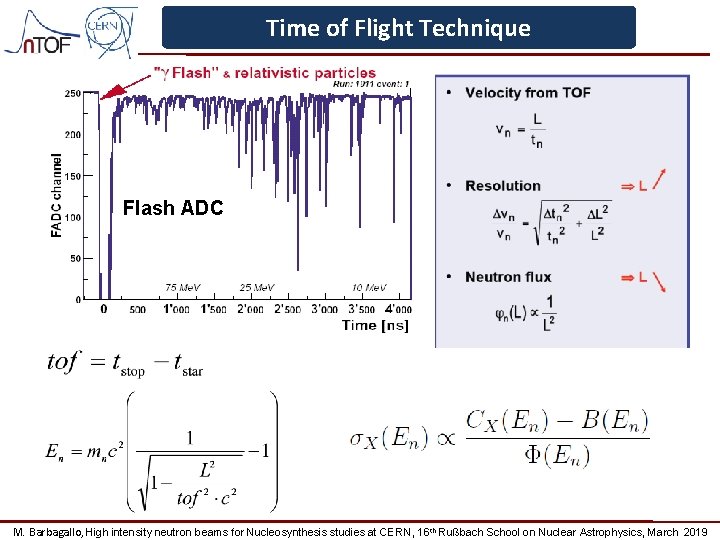
Time of Flight Technique Spallation target protons Flash ADC Base line (180 and 20 m) M. Barbagallo, High intensity neutron beams for Nucleosynthesis studies at CERN, 16 th Rußbach School on Nuclear Astrophysics, March 2019
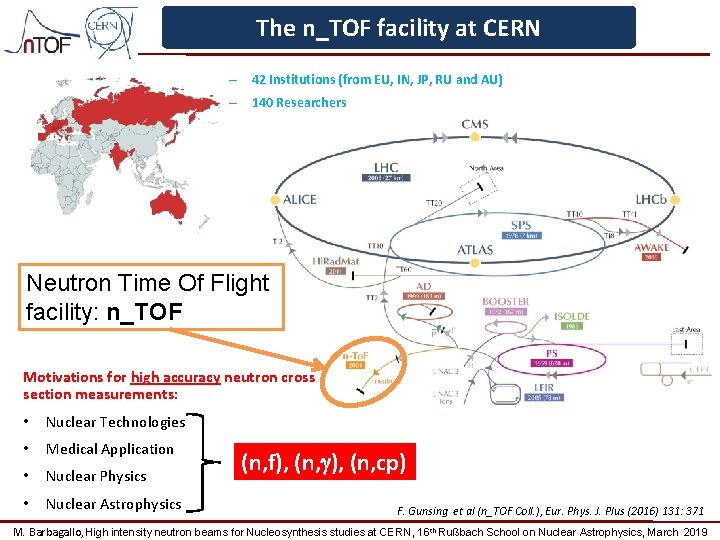
The n_TOF facility at CERN – 42 Institutions (from EU, IN, JP, RU and AU) – 140 Researchers Neutron Time Of Flight facility: n_TOF Motivations for high accuracy neutron cross section measurements: • Nuclear Technologies • Medical Application • Nuclear Physics • Nuclear Astrophysics (n, f), (n, g), (n, cp) F. Gunsing et al (n_TOF Coll. ), Eur. Phys. J. Plus (2016) 131: 371 M. Barbagallo, High intensity neutron beams for Nucleosynthesis studies at CERN, 16 th Rußbach School on Nuclear Astrophysics, March 2019
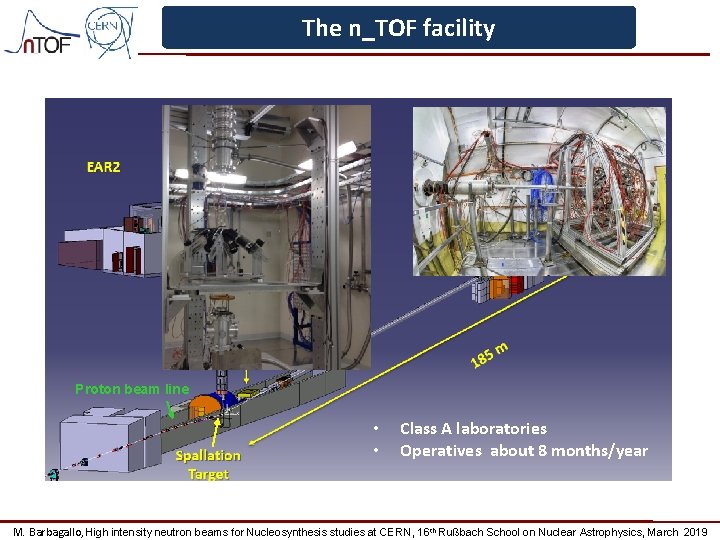
The n_TOF facility Proton beam line • • Class A laboratories Operatives about 8 months/year M. Barbagallo, High intensity neutron beams for Nucleosynthesis studies at CERN, 16 th Rußbach School on Nuclear Astrophysics, March 2019
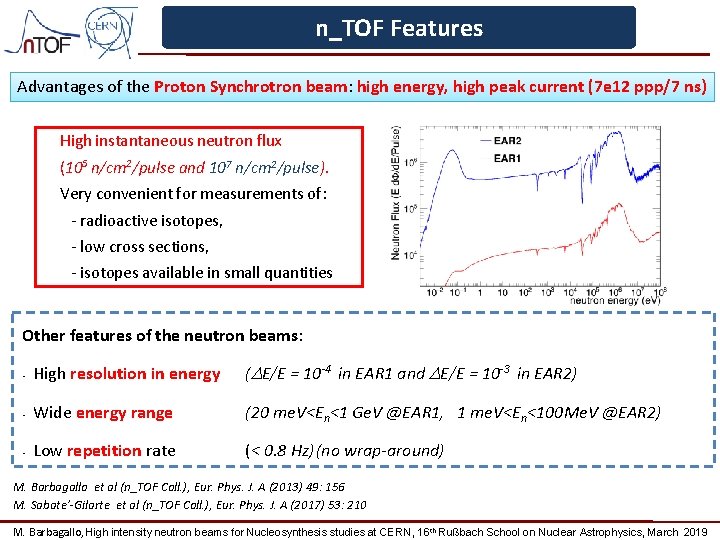
n_TOF Features Advantages of the Proton Synchrotron beam: high energy, high peak current (7 e 12 ppp/7 ns) High instantaneous neutron flux (105 n/cm 2/pulse and 107 n/cm 2/pulse). Very convenient for measurements of: - radioactive isotopes, - low cross sections, - isotopes available in small quantities Other features of the neutron beams: • High resolution in energy (DE/E = 10 -4 in EAR 1 and DE/E = 10 -3 in EAR 2) • Wide energy range (20 me. V<En<1 Ge. V @EAR 1, 1 me. V<En<100 Me. V @EAR 2) • Low repetition rate (< 0. 8 Hz)(no wrap-around) M. Barbagallo et al (n_TOF Coll. ), Eur. Phys. J. A (2013) 49: 156 M. Sabate’-Gilarte et al (n_TOF Coll. ), Eur. Phys. J. A (2017) 53: 210 M. Barbagallo, High intensity neutron beams for Nucleosynthesis studies at CERN, 16 th Rußbach School on Nuclear Astrophysics, March 2019
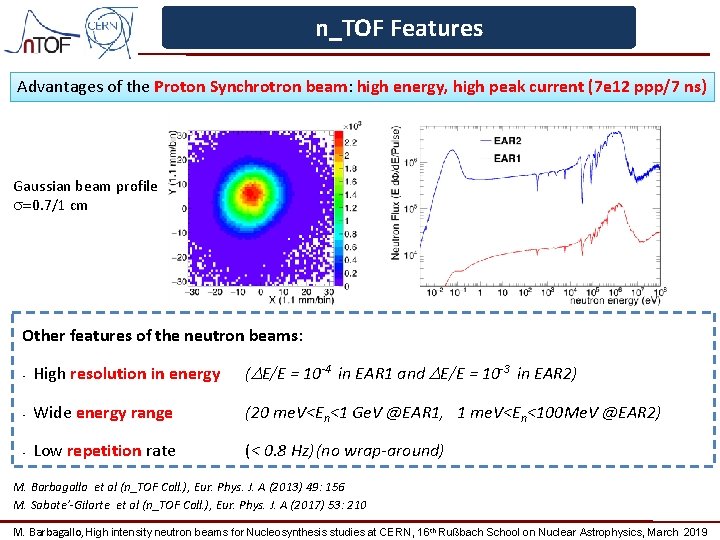
n_TOF Features Advantages of the Proton Synchrotron beam: high energy, high peak current (7 e 12 ppp/7 ns) Gaussian beam profile s=0. 7/1 cm Other features of the neutron beams: • High resolution in energy (DE/E = 10 -4 in EAR 1 and DE/E = 10 -3 in EAR 2) • Wide energy range (20 me. V<En<1 Ge. V @EAR 1, 1 me. V<En<100 Me. V @EAR 2) • Low repetition rate (< 0. 8 Hz)(no wrap-around) M. Barbagallo et al (n_TOF Coll. ), Eur. Phys. J. A (2013) 49: 156 M. Sabate’-Gilarte et al (n_TOF Coll. ), Eur. Phys. J. A (2017) 53: 210 M. Barbagallo, High intensity neutron beams for Nucleosynthesis studies at CERN, 16 th Rußbach School on Nuclear Astrophysics, March 2019
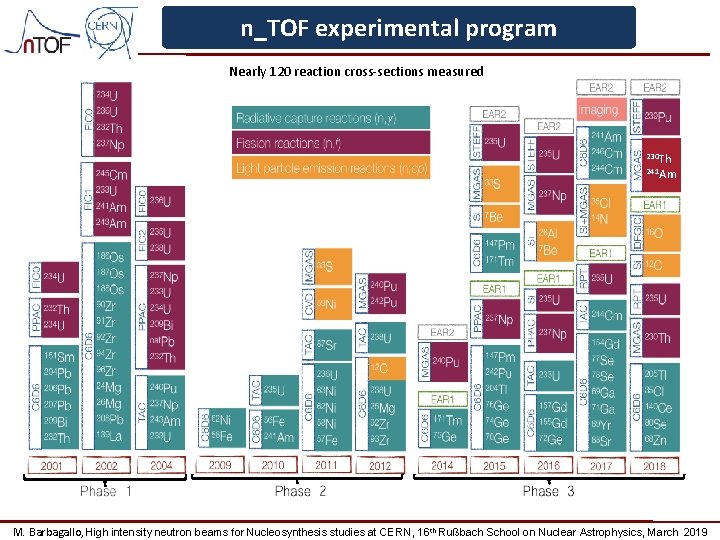
n_TOF experimental program Nearly 120 reaction cross-sections measured 230 Th 241 Am M. Barbagallo, High intensity neutron beams for Nucleosynthesis studies at CERN, 16 th Rußbach School on Nuclear Astrophysics, March 2019
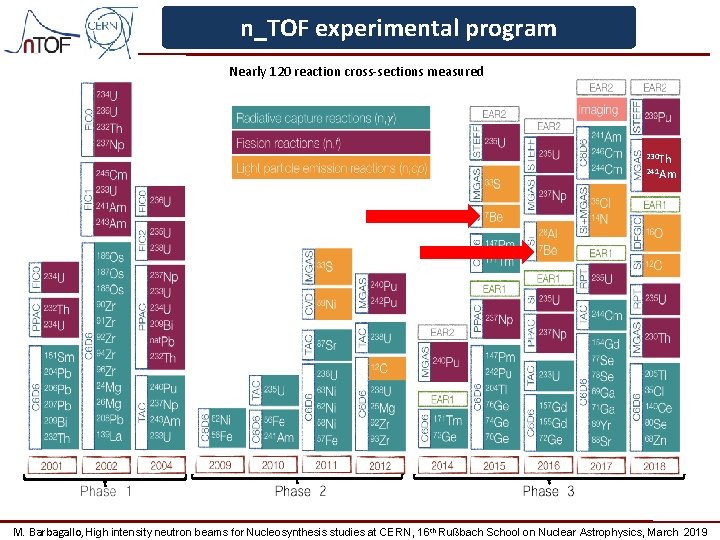
n_TOF experimental program Nearly 120 reaction cross-sections measured 230 Th 241 Am M. Barbagallo, High intensity neutron beams for Nucleosynthesis studies at CERN, 16 th Rußbach School on Nuclear Astrophysics, March 2019
Big Bang Nucleosynthesis “When we were young. . . ” Le big bang, L. Gailly M. Barbagallo, High intensity neutron beams for Nucleosynthesis studies at CERN, 16 th Rußbach School on Nuclear Astrophysics, March 2019
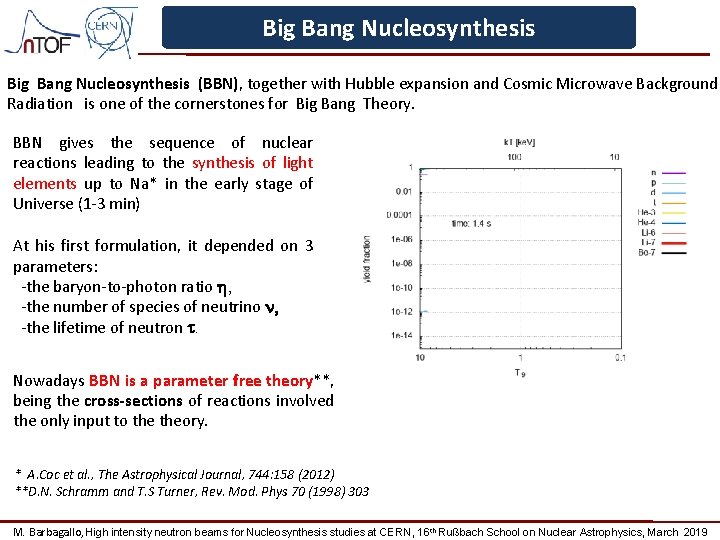
Big Bang Nucleosynthesis (BBN), together with Hubble expansion and Cosmic Microwave Background Radiation is one of the cornerstones for Big Bang Theory. BBN gives the sequence of nuclear reactions leading to the synthesis of light elements up to Na* in the early stage of Universe (1 -3 min) At his first formulation, it depended on 3 parameters: -the baryon-to-photon ratio h, -the number of species of neutrino n, -the lifetime of neutron t. Nowadays BBN is a parameter free theory**, being the cross-sections of reactions involved the only input to theory. * A. Coc et al. , The Astrophysical Journal, 744: 158 (2012) **D. N. Schramm and T. S Turner, Rev. Mod. Phys 70 (1998) 303 M. Barbagallo, High intensity neutron beams for Nucleosynthesis studies at CERN, 16 th Rußbach School on Nuclear Astrophysics, March 2019
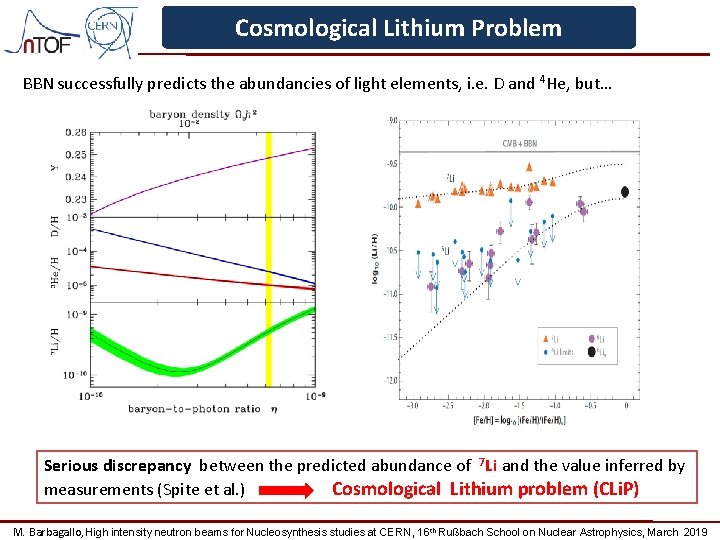
Cosmological Lithium Problem BBN successfully predicts the abundancies of light elements, i. e. D and 4 He, but… Serious discrepancy between the predicted abundance of 7 Li and the value inferred by measurements (Spite et al. ) Cosmological Lithium problem (CLi. P) M. Barbagallo, High intensity neutron beams for Nucleosynthesis studies at CERN, 16 th Rußbach School on Nuclear Astrophysics, March 2019
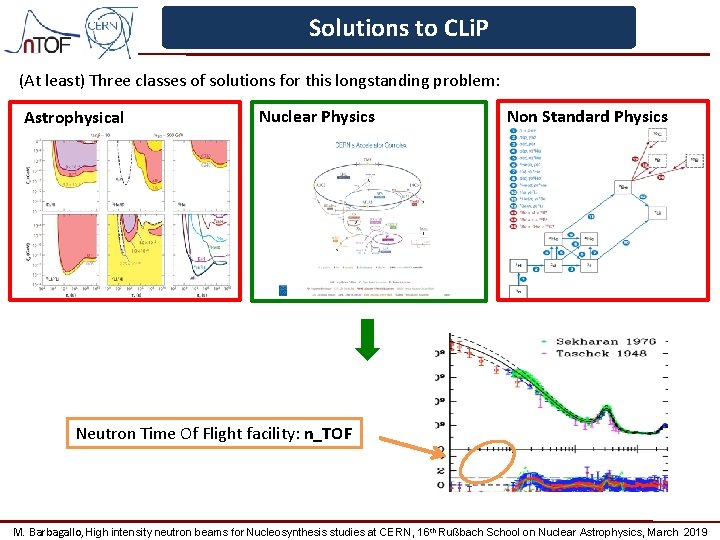
Solutions to CLi. P (At least) Three classes of solutions for this longstanding problem: Astrophysical Nuclear Physics Non Standard Physics Neutron Time Of Flight facility: n_TOF M. Barbagallo, High intensity neutron beams for Nucleosynthesis studies at CERN, 16 th Rußbach School on Nuclear Astrophysics, March 2019
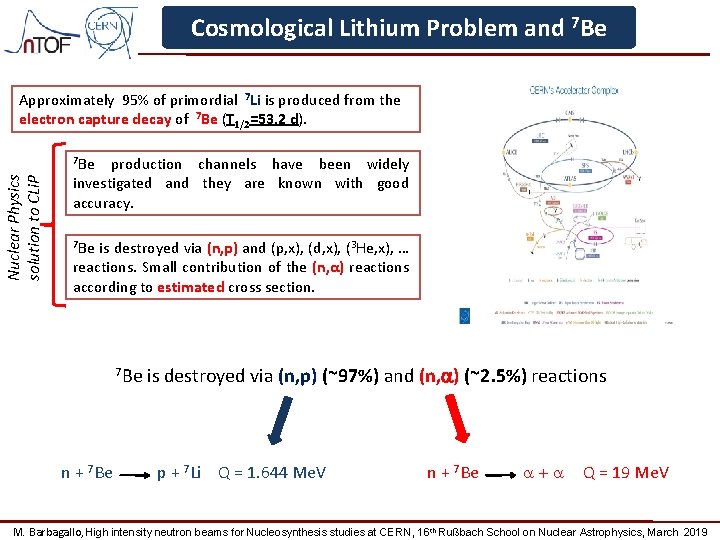
Cosmological Lithium Problem and 7 Be Approximately 95% of primordial 7 Li is produced from the electron capture decay of 7 Be (T 1/2=53. 2 d). Nuclear Physics solution to CLi. P 7 Be production channels have been widely investigated and they are known with good accuracy. 7 Be is destroyed via (n, p) and (p, x), (d, x), (3 He, x), … reactions. Small contribution of the (n, α) reactions according to estimated cross section. 7 Be n + 7 Be is destroyed via (n, p) (~97%) and (n, a) (~2. 5%) reactions p + 7 Li Q = 1. 644 Me. V n + 7 Be a+a Q = 19 Me. V M. Barbagallo, High intensity neutron beams for Nucleosynthesis studies at CERN, 16 th Rußbach School on Nuclear Astrophysics, March 2019
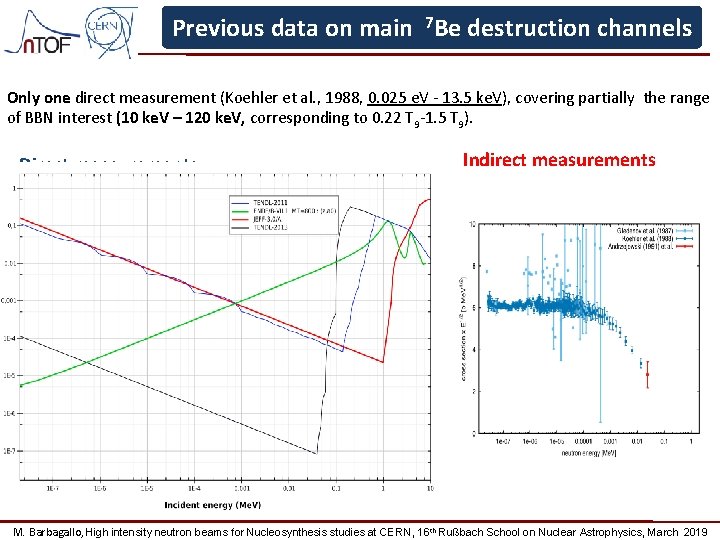
Previous data on main 7 Be destruction channels Only one direct measurement (Koehler et al. , 1988, 0. 025 e. V - 13. 5 ke. V), covering partially the range of BBN interest (10 ke. V – 120 ke. V, corresponding to 0. 22 T 9 -1. 5 T 9). Direct measurements Indirect measurements M. Barbagallo, High intensity neutron beams for Nucleosynthesis studies at CERN, 16 th Rußbach School on Nuclear Astrophysics, March 2019
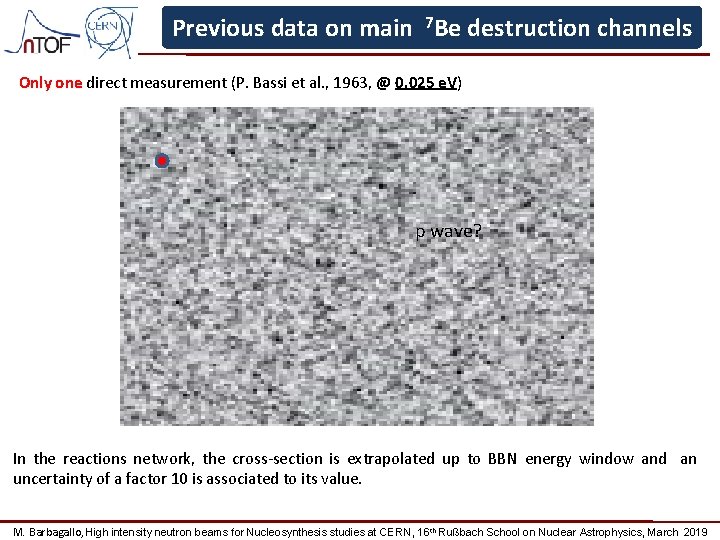
Previous data on main 7 Be destruction channels Only one direct measurement (P. Bassi et al. , 1963, @ 0. 025 e. V) p wave? In the reactions network, the cross-section is extrapolated up to BBN energy window and an uncertainty of a factor 10 is associated to its value. M. Barbagallo, High intensity neutron beams for Nucleosynthesis studies at CERN, 16 th Rußbach School on Nuclear Astrophysics, March 2019
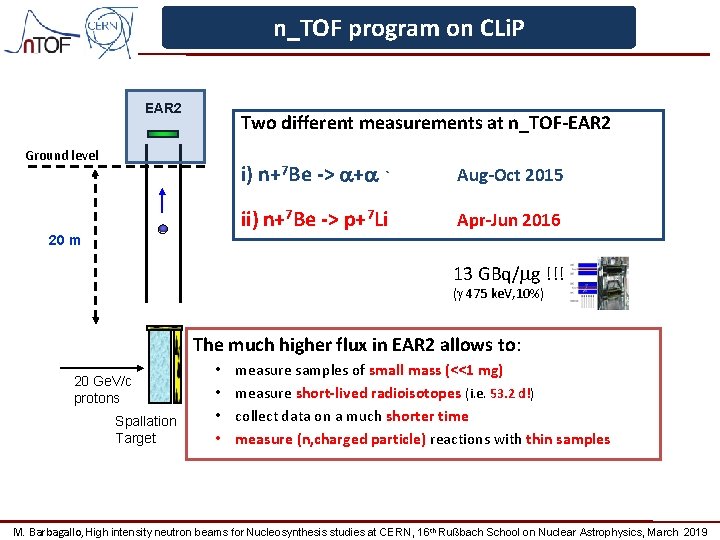
n_TOF program on CLi. P EAR 2 Two different measurements at n_TOF-EAR 2 Ground level i) n+7 Be -> a+a ` Aug-Oct 2015 ii) n+7 Be -> p+7 Li Apr-Jun 2016 20 m 13 GBq/mg !!! (g 475 ke. V, 10%) The much higher flux in EAR 2 allows to: 20 Ge. V/c protons Spallation Target • • measure samples of small mass (<<1 mg) measure short-lived radioisotopes (i. e. 53. 2 d!) EAR 1 collect data on a much shorter time 185 particle) m measure (n, charged reactions with thin samples M. Barbagallo, High intensity neutron beams for Nucleosynthesis studies at CERN, 16 th Rußbach School on Nuclear Astrophysics, March 2019
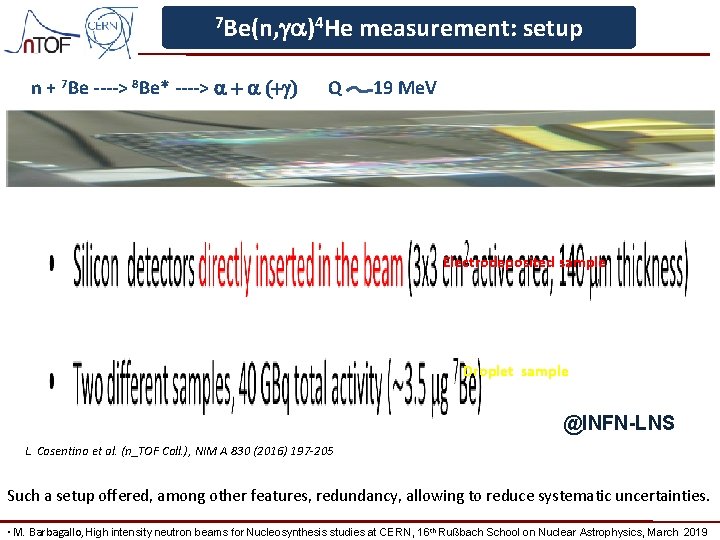
7 Be(n, ga)4 He n + 7 Be ----> 8 Be* ----> a + a (+g) Q measurement: setup 19 Me. V Electrodeposited sample Droplet sample @INFN-LNS L. Cosentino et al. (n_TOF Coll. ), NIM A 830 (2016) 197 -205 Such a setup offered, among other features, redundancy, allowing to reduce systematic uncertainties. . M. Barbagallo, High intensity neutron beams for Nucleosynthesis studies at CERN, 16 th Rußbach School on Nuclear Astrophysics, March 2019
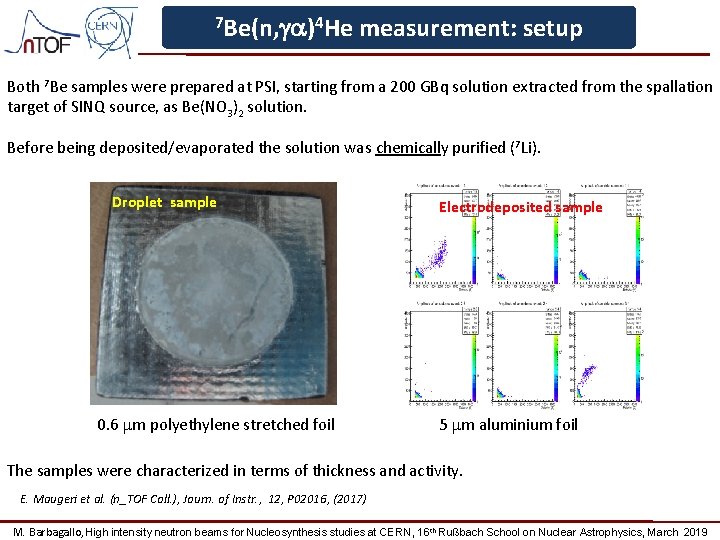
7 Be(n, ga)4 He measurement: setup Both 7 Be samples were prepared at PSI, starting from a 200 GBq solution extracted from the spallation target of SINQ source, as Be(NO 3)2 solution. Before being deposited/evaporated the solution was chemically purified (7 Li). Droplet sample 0. 6 mm polyethylene stretched foil Electrodeposited sample 5 mm aluminium foil The samples were characterized in terms of thickness and activity. E. Maugeri et al. (n_TOF Coll. ), Journ. of Instr. , 12, P 02016, (2017) M. Barbagallo, High intensity neutron beams for Nucleosynthesis studies at CERN, 16 th Rußbach School on Nuclear Astrophysics, March 2019
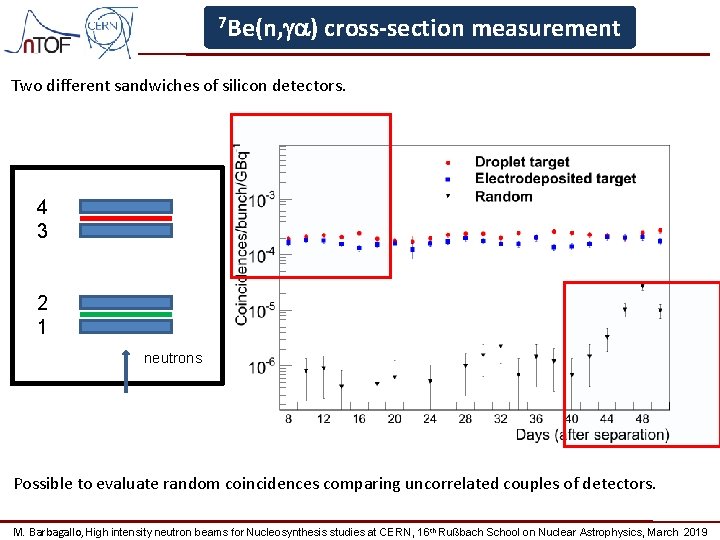
7 Be(n, ga) cross-section measurement Two different sandwiches of silicon detectors. 4 3 2 1 neutrons Possible to evaluate random coincidences comparing uncorrelated couples of detectors. M. Barbagallo, High intensity neutron beams for Nucleosynthesis studies at CERN, 16 th Rußbach School on Nuclear Astrophysics, March 2019
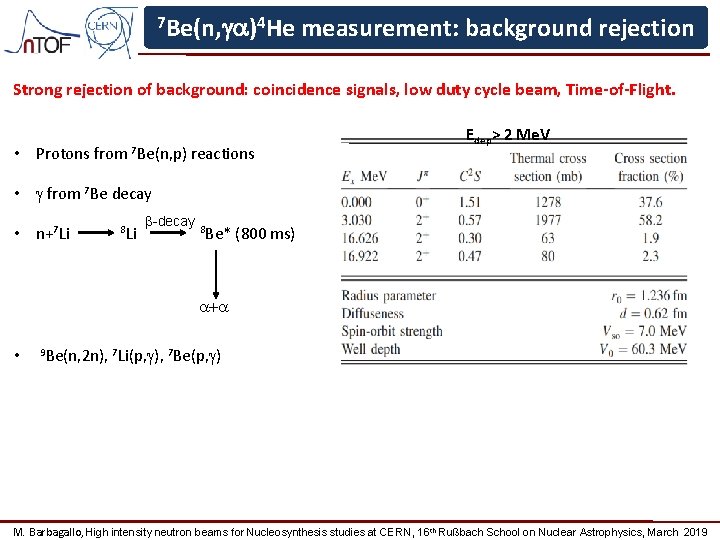
7 Be(n, ga)4 He measurement: background rejection Strong rejection of background: coincidence signals, low duty cycle beam, Time-of-Flight. • Protons from 7 Be(n, p) reactions Edep> 2 Me. V • g from 7 Be decay • n+7 Li 8 Li b-decay 8 Be* (800 ms) a+a • 9 Be(n, 2 n), 7 Li(p, g), 7 Be(p, g) M. Barbagallo, High intensity neutron beams for Nucleosynthesis studies at CERN, 16 th Rußbach School on Nuclear Astrophysics, March 2019
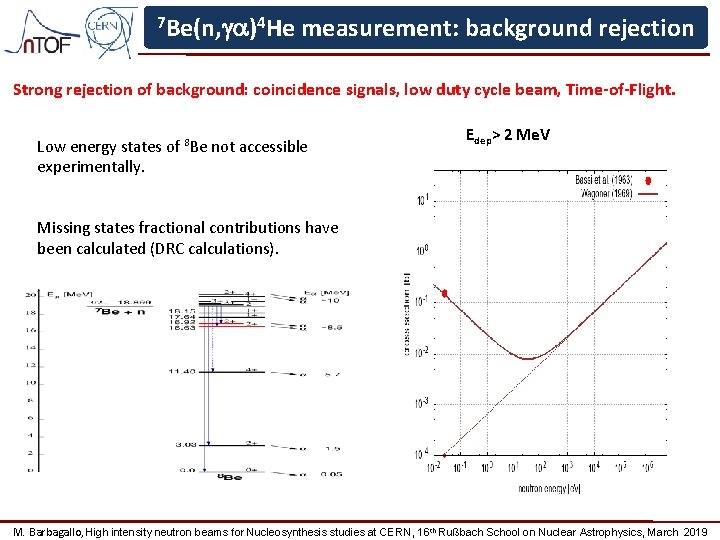
7 Be(n, ga)4 He measurement: background rejection Strong rejection of background: coincidence signals, low duty cycle beam, Time-of-Flight. Low energy states of 8 Be not accessible experimentally. Edep> 2 Me. V Missing states fractional contributions have been calculated (DRC calculations). M. Barbagallo, High intensity neutron beams for Nucleosynthesis studies at CERN, 16 th Rußbach School on Nuclear Astrophysics, March 2019
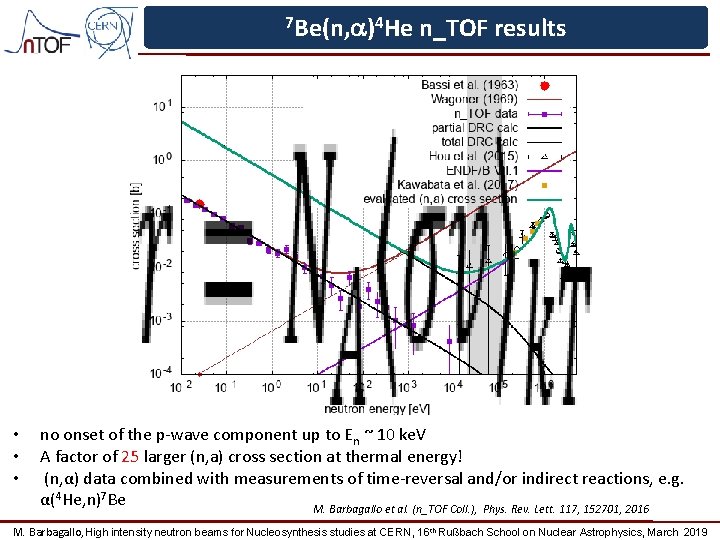
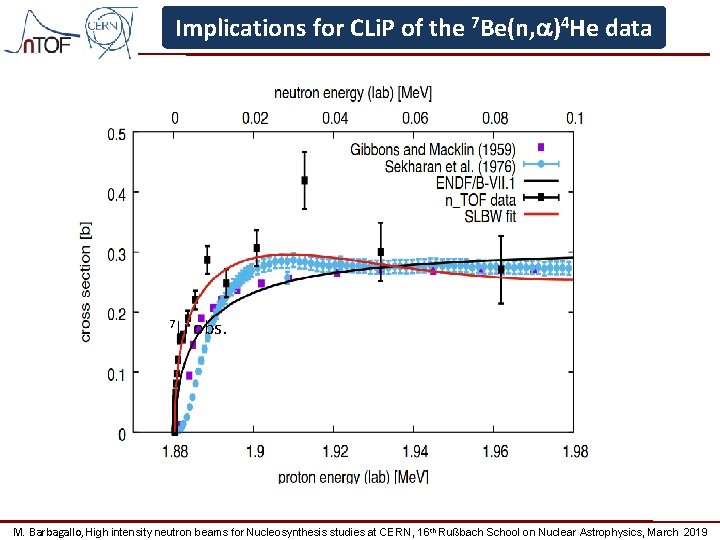
7 Be(n, a)4 He • • • n_TOF results no onset of the p-wave component up to En ~ 10 ke. V A factor of 25 larger (n, a) cross section at thermal energy! (n, α) data combined with measurements of time-reversal and/or indirect reactions, e. g. α(4 He, n)7 Be M. Barbagallo et al. (n_TOF Coll. ), Phys. Rev. Lett. 117, 152701, 2016 M. Barbagallo, High intensity neutron beams for Nucleosynthesis studies at CERN, 16 th Rußbach School on Nuclear Astrophysics, March 2019
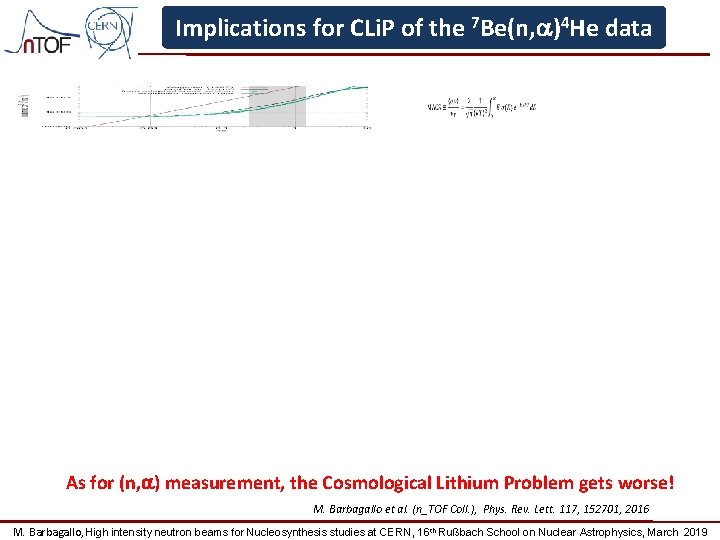
Implications for CLi. P of the 7 Be(n, a)4 He data As for (n, a) measurement, the Cosmological Lithium Problem gets worse! M. Barbagallo et al. (n_TOF Coll. ), Phys. Rev. Lett. 117, 152701, 2016 M. Barbagallo, High intensity neutron beams for Nucleosynthesis studies at CERN, 16 th Rußbach School on Nuclear Astrophysics, March 2019
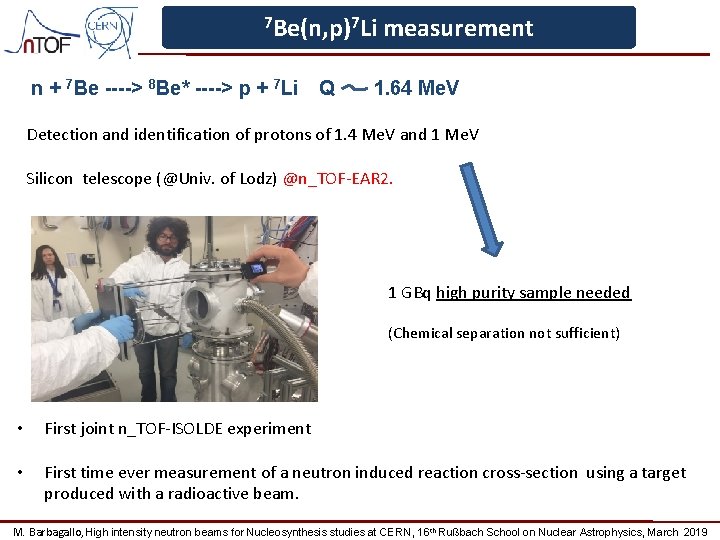
7 Be(n, p)7 Li n + 7 Be ----> 8 Be* ----> p + 7 Li Q measurement 1. 64 Me. V Detection and identification of protons of 1. 4 Me. V and 1 Me. V Silicon telescope (@Univ. of Lodz) @n_TOF-EAR 2. 1 GBq high purity sample needed (Chemical separation not sufficient) • First joint n_TOF-ISOLDE experiment • First time ever measurement of a neutron induced reaction cross-section using a target produced with a radioactive beam. M. Barbagallo, High intensity neutron beams for Nucleosynthesis studies at CERN, 16 th Rußbach School on Nuclear Astrophysics, March 2019
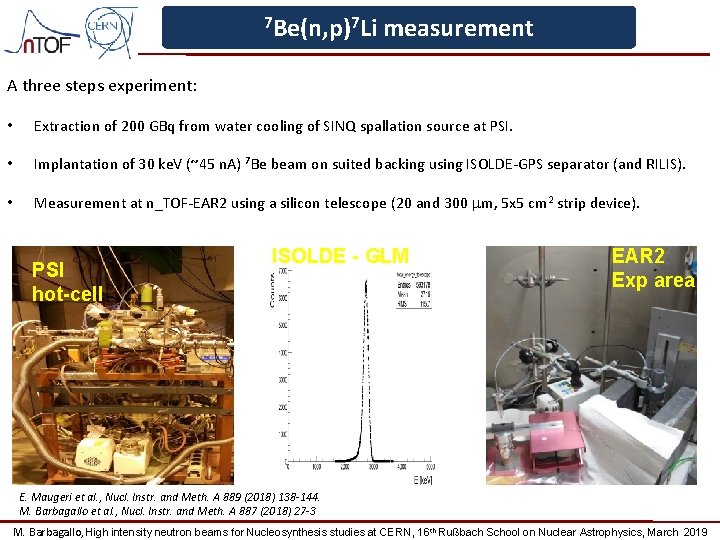
7 Be(n, p)7 Li measurement A three steps experiment: • Extraction of 200 GBq from water cooling of SINQ spallation source at PSI. • Implantation of 30 ke. V (~45 n. A) 7 Be beam on suited backing using ISOLDE-GPS separator (and RILIS). • Measurement at n_TOF-EAR 2 using a silicon telescope (20 and 300 mm, 5 x 5 cm 2 strip device). PSI hot-cell ISOLDE - GLM EAR 2 Exp area E. Maugeri et al. , Nucl. Instr. and Meth. A 889 (2018) 138 -144. M. Barbagallo et al. , Nucl. Instr. and Meth. A 887 (2018) 27 -3 M. Barbagallo, High intensity neutron beams for Nucleosynthesis studies at CERN, 16 th Rußbach School on Nuclear Astrophysics, March 2019
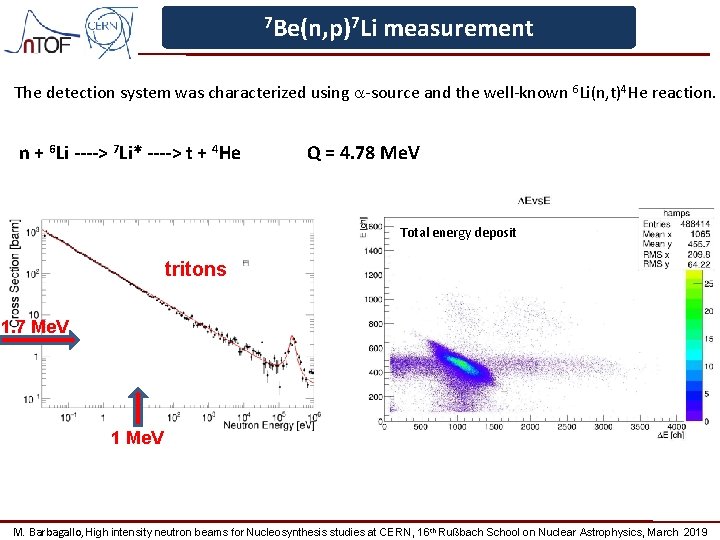
7 Be(n, p)7 Li measurement The detection system was characterized using a-source and the well-known 6 Li(n, t)4 He reaction. n + 6 Li ----> 7 Li* ----> t + 4 He Q = 4. 78 Me. V Total energy deposit tritons 1. 7 Me. V 1 Me. V M. Barbagallo, High intensity neutron beams for Nucleosynthesis studies at CERN, 16 th Rußbach School on Nuclear Astrophysics, March 2019
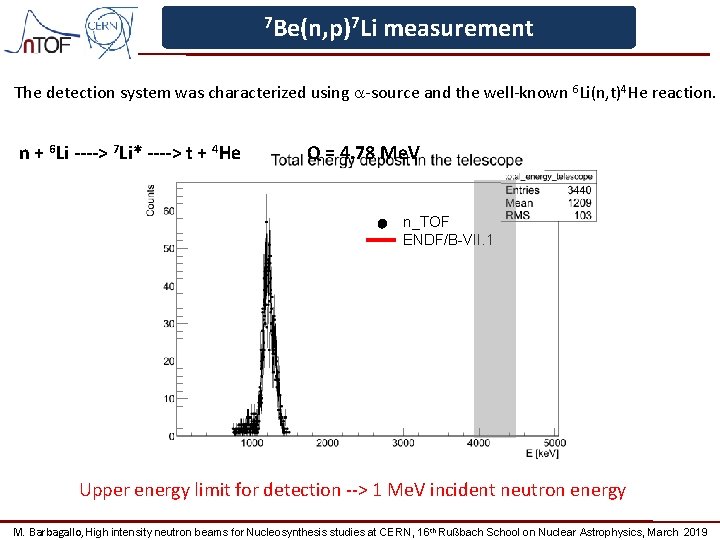
7 Be(n, p)7 Li measurement The detection system was characterized using a-source and the well-known 6 Li(n, t)4 He reaction. n + 6 Li ----> 7 Li* ----> t + 4 He Q = 4. 78 Me. V n_TOF ENDF/B-VII. 1 Upper energy limit for detection --> 1 Me. V incident neutron energy M. Barbagallo, High intensity neutron beams for Nucleosynthesis studies at CERN, 16 th Rußbach School on Nuclear Astrophysics, March 2019
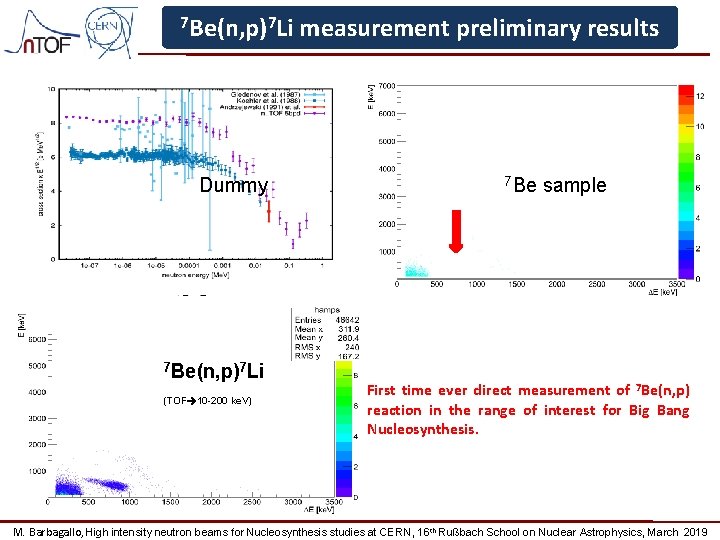
7 Be(n, p)7 Li Dummy 7 Be(n, p)7 Li (TOF 10 -200 ke. V) measurement preliminary results 7 Be sample First time ever direct measurement of 7 Be(n, p) reaction in the range of interest for Big Bang Nucleosynthesis. M. Barbagallo, High intensity neutron beams for Nucleosynthesis studies at CERN, 16 th Rußbach School on Nuclear Astrophysics, March 2019
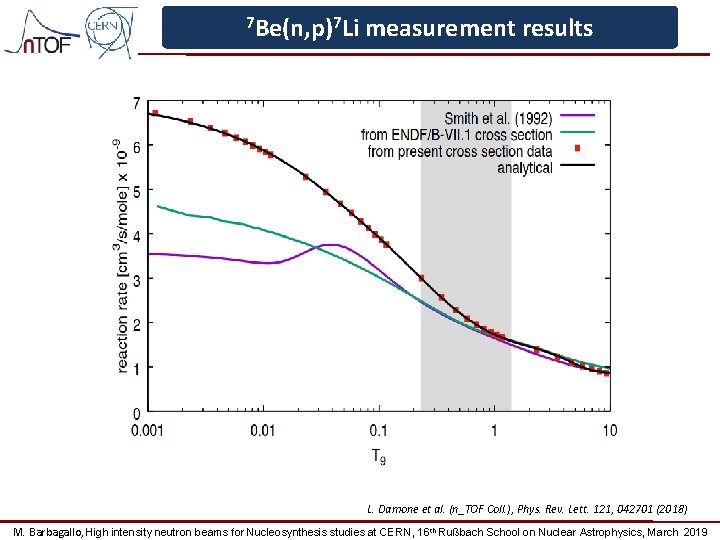
7 Be(n, p)7 Li measurement results L. Damone et al. (n_TOF Coll. ), Phys. Rev. Lett. 121, 042701 (2018) M. Barbagallo, High intensity neutron beams for Nucleosynthesis studies at CERN, 16 th Rußbach School on Nuclear Astrophysics, March 2019
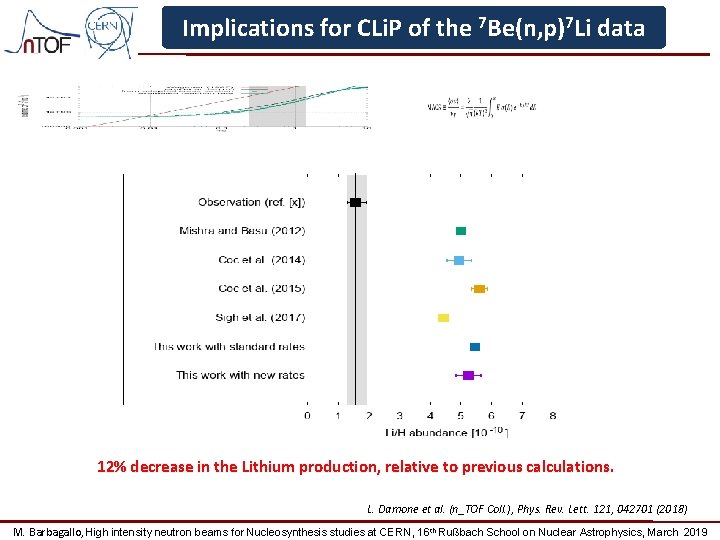
Implications for CLi. P of the 7 Be(n, p)7 Li data 12% decrease in the Lithium production, relative to previous calculations. L. Damone et al. (n_TOF Coll. ), Phys. Rev. Lett. 121, 042701 (2018) M. Barbagallo, High intensity neutron beams for Nucleosynthesis studies at CERN, 16 th Rußbach School on Nuclear Astrophysics, March 2019
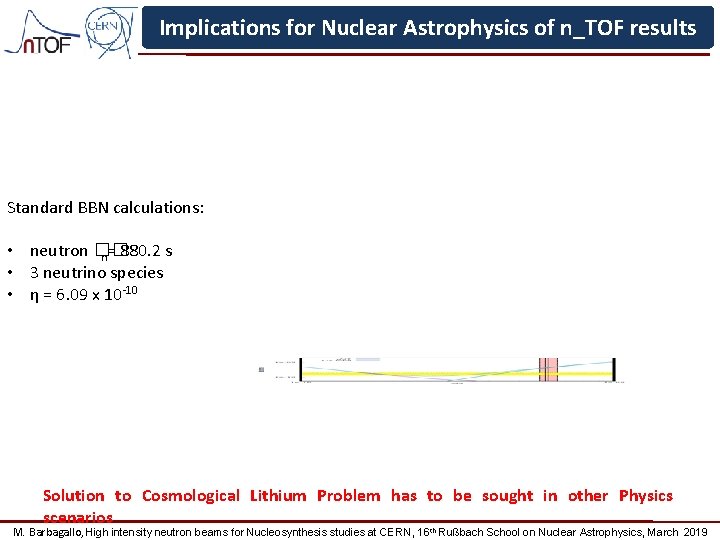
Implications for Nuclear Astrophysics of n_TOF results Standard BBN calculations: • neutron �� n= 880. 2 s • 3 neutrino species • η = 6. 09 x 10 -10 Solution to Cosmological Lithium Problem has to be sought in other Physics scenarios M. Barbagallo, High intensity neutron beams for Nucleosynthesis studies at CERN, 16 th Rußbach School on Nuclear Astrophysics, March 2019
Thanks for your kind attention M. Barbagallo, High intensity neutron beams for Nucleosynthesis studies at CERN, 16 th Rußbach School on Nuclear Astrophysics, March 2019
Implications for CLi. P of the 7 Be(n, a)4 He data 7 Li obs. M. Barbagallo, High intensity neutron beams for Nucleosynthesis studies at CERN, 16 th Rußbach School on Nuclear Astrophysics, March 2019
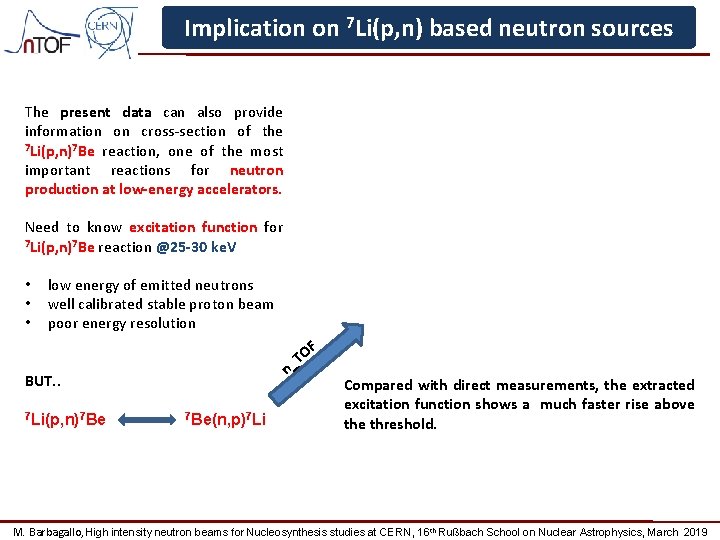
Implication on 7 Li(p, n) based neutron sources The present data can also provide information on cross-section of the 7 Li(p, n)7 Be reaction, one of the most important reactions for neutron production at low-energy accelerators. Need to know excitation function for 7 Li(p, n)7 Be reaction @25 -30 ke. V • • • low energy of emitted neutrons well calibrated stable proton beam poor energy resolution OF T n_ BUT. . 7 Li(p, n)7 Be 7 Be(n, p)7 Li Compared with direct measurements, the extracted excitation function shows a much faster rise above threshold. M. Barbagallo, High intensity neutron beams for Nucleosynthesis studies at CERN, 16 th Rußbach School on Nuclear Astrophysics, March 2019
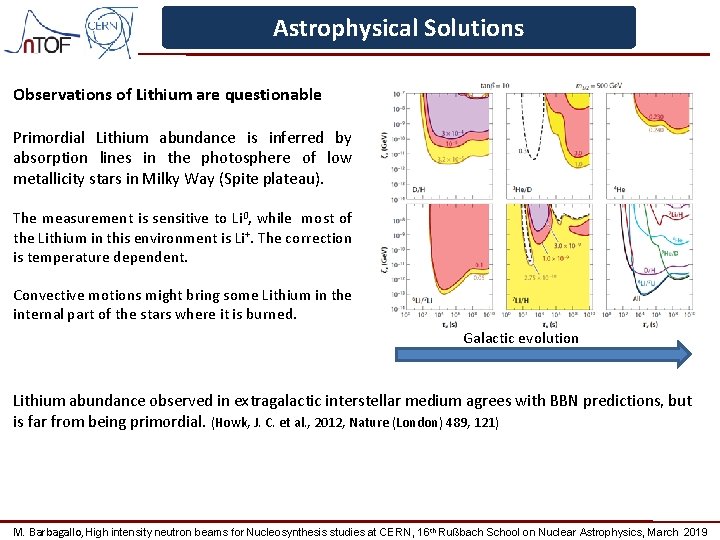
Astrophysical Solutions Observations of Lithium are questionable Primordial Lithium abundance is inferred by absorption lines in the photosphere of low metallicity stars in Milky Way (Spite plateau). The measurement is sensitive to Li 0, while most of the Lithium in this environment is Li+. The correction is temperature dependent. Convective motions might bring some Lithium in the internal part of the stars where it is burned. Galactic evolution Lithium abundance observed in extragalactic interstellar medium agrees with BBN predictions, but is far from being primordial. (Howk, J. C. et al. , 2012, Nature (London) 489, 121) M. Barbagallo, High intensity neutron beams for Nucleosynthesis studies at CERN, 16 th Rußbach School on Nuclear Astrophysics, March 2019
Non standard solutions • Beyond Standard Model of particles: Supersymmetric dark matter decaying could provide an extra-contribution of neutrons (mass and decay time constrained by other elements abundances). • Beyond Standard Cosmology: Inhomogeneities in cosmic density could affect value of lithium abundance measured locally, while deuterium and CMB (thus h) are measured at high red-shift, or viceversa. Do we really need these “exotic” solutions? M. Barbagallo, High intensity neutron beams for Nucleosynthesis studies at CERN, 16 th Rußbach School on Nuclear Astrophysics, March 2019
- Slides: 46