
High Impact Change Model Managing Transfers of Care
- Slides: 15
High Impact Change Model Managing Transfers of Care
HIGH IMPACT CHANGES FOR MANAGING TRANSFERS OF CARE • Ensuring people do not stay in hospital for longer than they need to is an important issue – maintaining patient flow, having access to responsive health and care services and supporting families are essential. • We learnt valuable lessons from the Health and Care system across the Country last winter about what works well and we have built those into a High Impact Change model. • This model has been endorsed in a joint meeting between local government leaders and Secretaries of State for Health and for Communities and Local Government in October. • We know there is no simple solution to creating an effective system of health and social care, but local government , the NHS and Department of Health are committed to working together to identifying what can be done to improve our current ways of working.
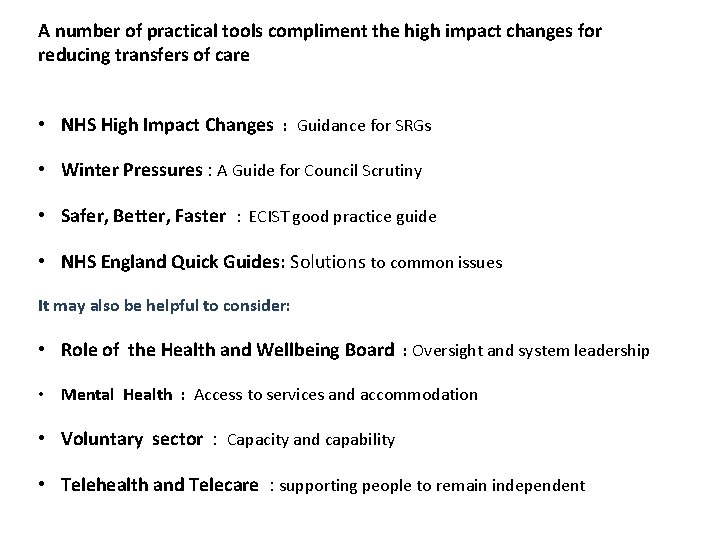
A number of practical tools compliment the high impact changes for reducing transfers of care • NHS High Impact Changes : Guidance for SRGs • Winter Pressures : A Guide for Council Scrutiny • Safer, Better, Faster : ECIST good practice guide • NHS England Quick Guides: Solutions to common issues It may also be helpful to consider: • Role of the Health and Wellbeing Board : Oversight and system leadership • Mental Health : Access to services and accommodation • Voluntary sector : Capacity and capability • Telehealth and Telecare : supporting people to remain independent
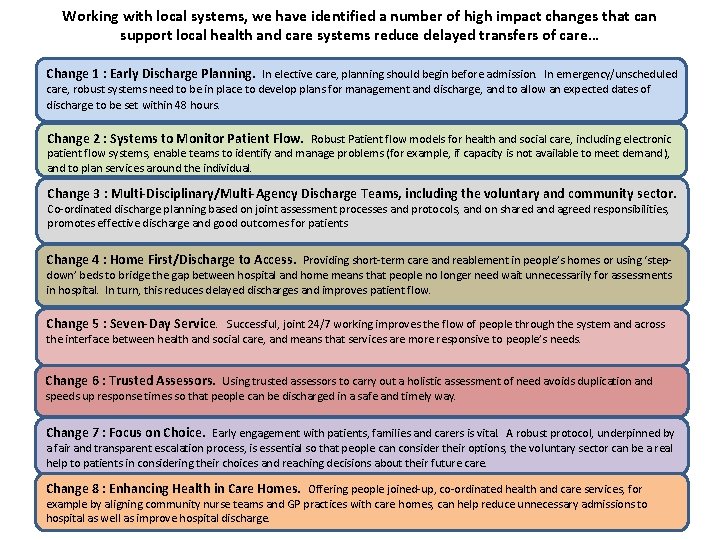
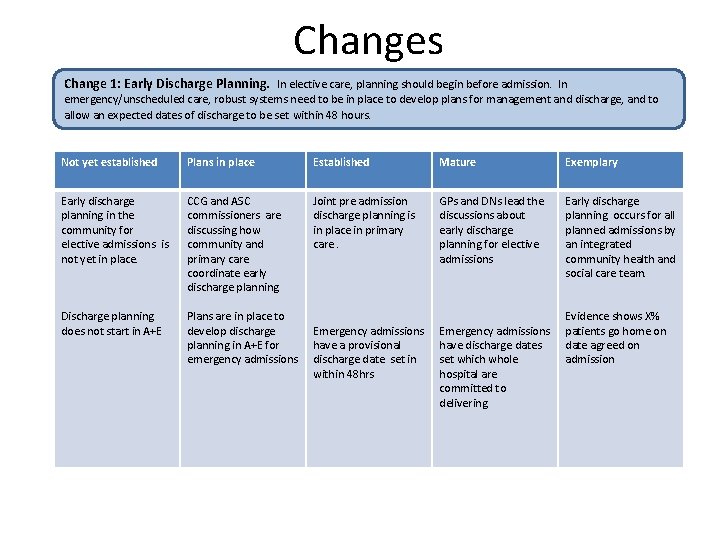
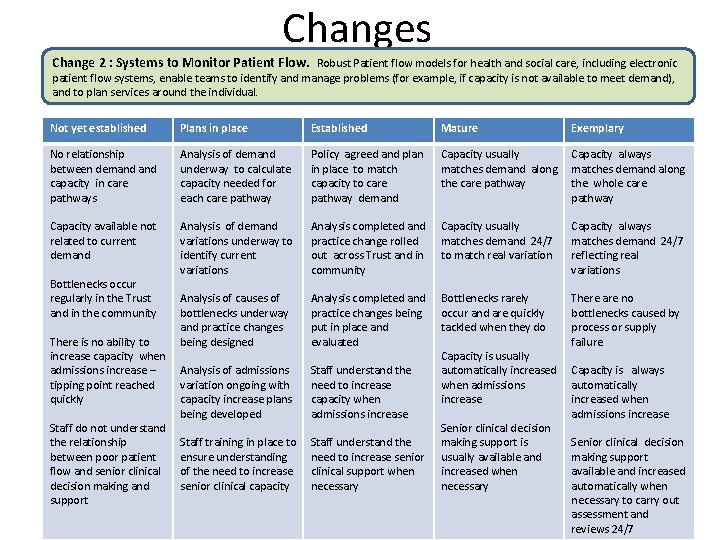
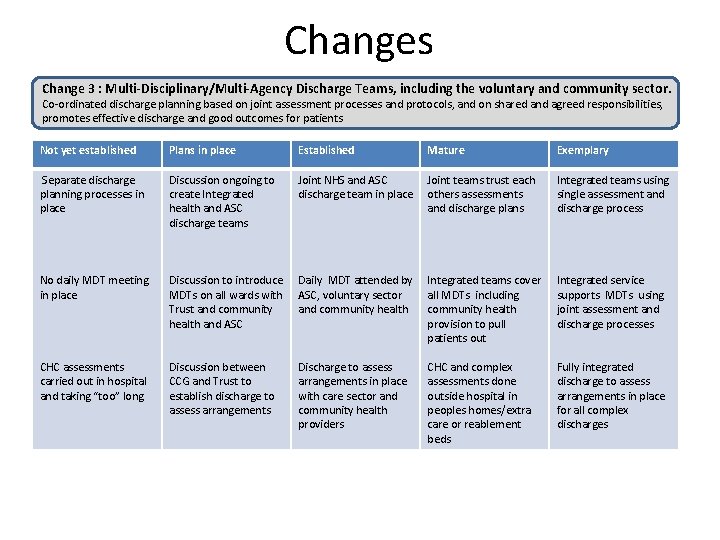
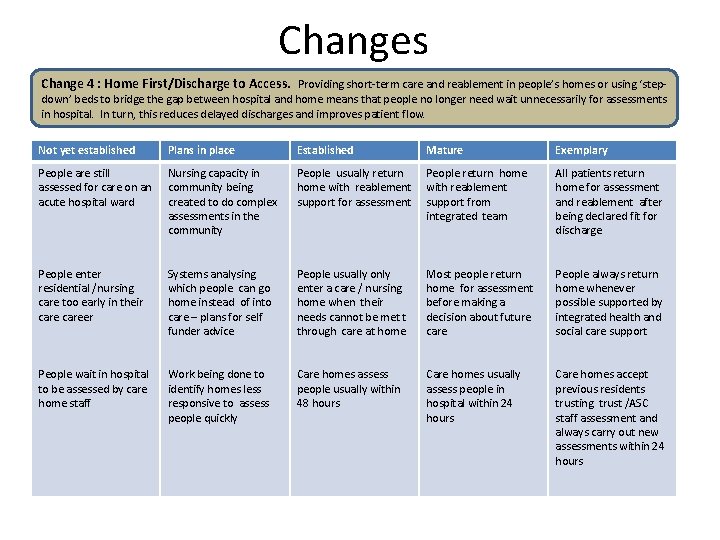
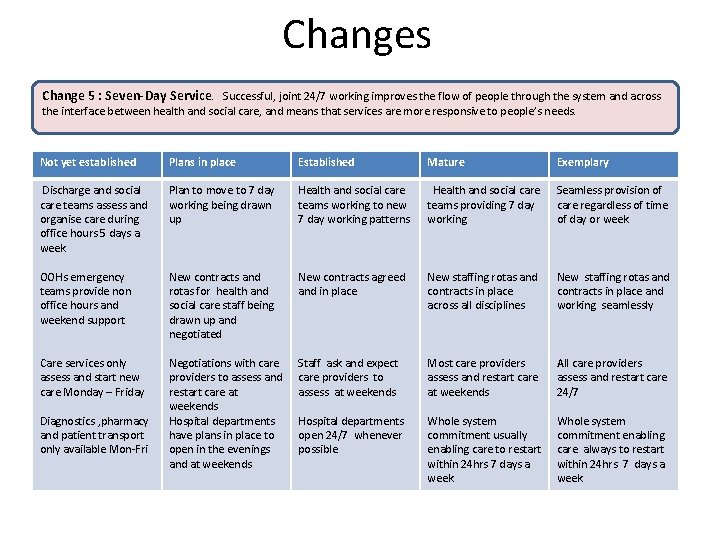
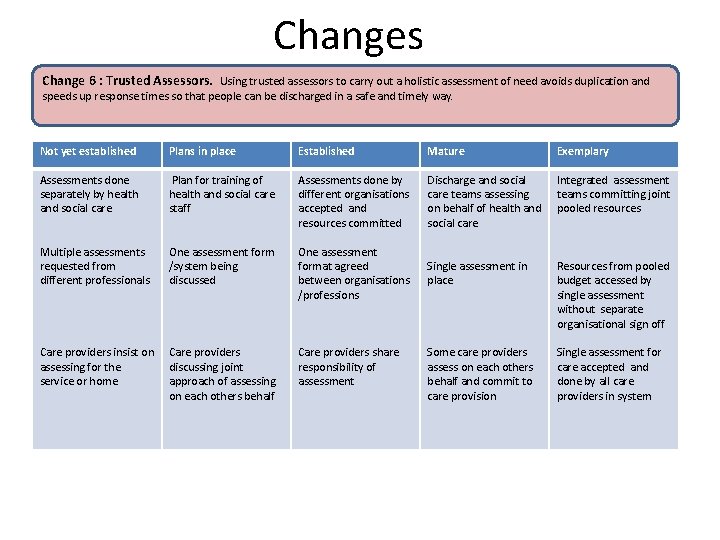
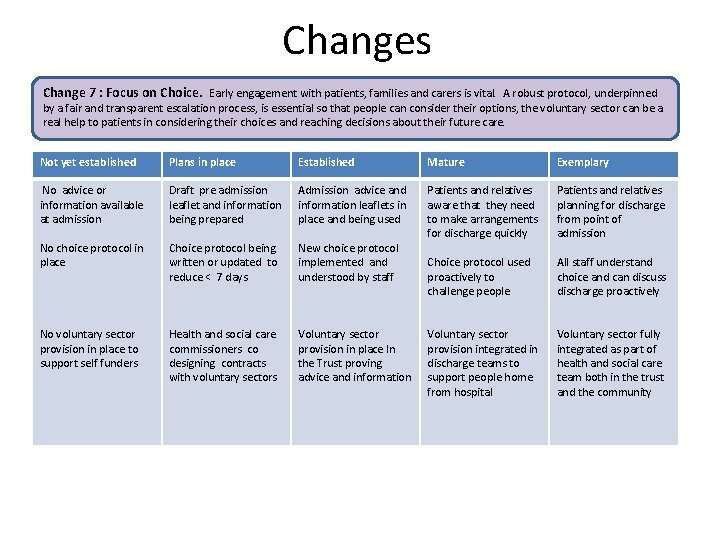
Working with local systems, we have identified a number of high impact changes that can support local health and care systems reduce delayed transfers of care… Change 1 : Early Discharge Planning. In elective care, planning should begin before admission. In emergency/unscheduled care, robust systems need to be in place to develop plans for management and discharge, and to allow an expected dates of discharge to be set within 48 hours. Change 2 : Systems to Monitor Patient Flow. Robust Patient flow models for health and social care, including electronic patient flow systems, enable teams to identify and manage problems (for example, if capacity is not available to meet demand), and to plan services around the individual. Change 3 : Multi-Disciplinary/Multi-Agency Discharge Teams, including the voluntary and community sector. Co-ordinated discharge planning based on joint assessment processes and protocols, and on shared and agreed responsibilities, promotes effective discharge and good outcomes for patients Change 4 : Home First/Discharge to Access. Providing short-term care and reablement in people’s homes or using ‘step- down’ beds to bridge the gap between hospital and home means that people no longer need wait unnecessarily for assessments in hospital. In turn, this reduces delayed discharges and improves patient flow. Change 5 : Seven-Day Service. Successful, joint 24/7 working improves the flow of people through the system and across the interface between health and social care, and means that services are more responsive to people’s needs. Change 6 : Trusted Assessors. Using trusted assessors to carry out a holistic assessment of need avoids duplication and speeds up response times so that people can be discharged in a safe and timely way. Change 7 : Focus on Choice. Early engagement with patients, families and carers is vital. A robust protocol, underpinned by a fair and transparent escalation process, is essential so that people can consider their options, the voluntary sector can be a real help to patients in considering their choices and reaching decisions about their future care. Change 8 : Enhancing Health in Care Homes. Offering people joined-up, co-ordinated health and care services, for example by aligning community nurse teams and GP practices with care homes, can help reduce unnecessary admissions to hospital as well as improve hospital discharge.
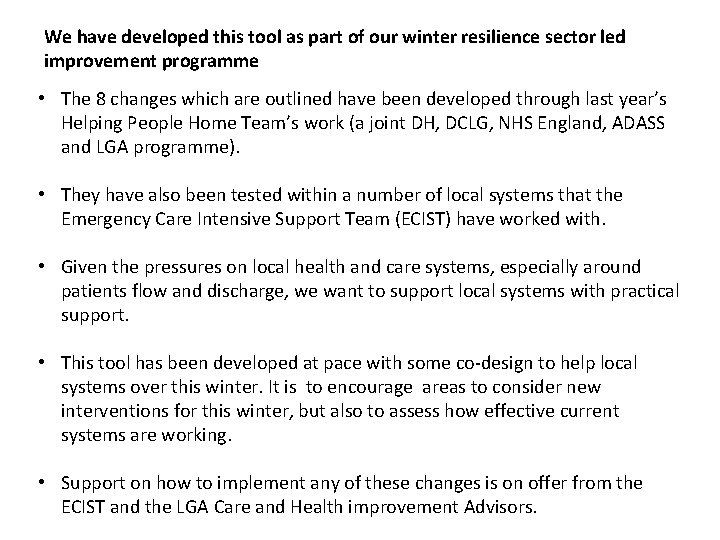
We have developed this tool as part of our winter resilience sector led improvement programme • The 8 changes which are outlined have been developed through last year’s Helping People Home Team’s work (a joint DH, DCLG, NHS England, ADASS and LGA programme). • They have also been tested within a number of local systems that the Emergency Care Intensive Support Team (ECIST) have worked with. • Given the pressures on local health and care systems, especially around patients flow and discharge, we want to support local systems with practical support. • This tool has been developed at pace with some co-design to help local systems over this winter. It is to encourage areas to consider new interventions for this winter, but also to assess how effective current systems are working. • Support on how to implement any of these changes is on offer from the ECIST and the LGA Care and Health improvement Advisors.
Changes Change 1: Early Discharge Planning. In elective care, planning should begin before admission. In emergency/unscheduled care, robust systems need to be in place to develop plans for management and discharge, and to allow an expected dates of discharge to be set within 48 hours. Not yet established Plans in place Established Mature Exemplary Early discharge planning in the community for elective admissions is not yet in place. CCG and ASC commissioners are discussing how community and primary care coordinate early discharge planning. Joint pre admission discharge planning is in place in primary care. GPs and DNs lead the discussions about early discharge planning for elective admissions Early discharge planning occurs for all planned admissions by an integrated community health and social care team. Discharge planning does not start in A+E Plans are in place to develop discharge planning in A+E for emergency admissions Emergency admissions have a provisional discharge date set in within 48 hrs Emergency admissions have discharge dates set which whole hospital are committed to delivering Evidence shows X% patients go home on date agreed on admission
Changes Change 2 : Systems to Monitor Patient Flow. Robust Patient flow models for health and social care, including electronic patient flow systems, enable teams to identify and manage problems (for example, if capacity is not available to meet demand), and to plan services around the individual. Not yet established Plans in place Established Mature Exemplary No relationship between demand capacity in care pathways Analysis of demand underway to calculate capacity needed for each care pathway Policy agreed and plan in place to match capacity to care pathway demand Capacity usually matches demand along the care pathway Capacity always matches demand along the whole care pathway Capacity available not related to current demand Analysis of demand variations underway to identify current variations Analysis completed and practice change rolled out across Trust and in community Capacity usually matches demand 24/7 to match real variation Capacity always matches demand 24/7 reflecting real variations Analysis of causes of bottlenecks underway and practice changes being designed Analysis completed and practice changes being put in place and evaluated Bottlenecks rarely occur and are quickly tackled when they do There are no bottlenecks caused by process or supply failure Analysis of admissions variation ongoing with capacity increase plans being developed Staff understand the need to increase capacity when admissions increase Staff training in place to ensure understanding of the need to increase senior clinical capacity Staff understand the need to increase senior clinical support when necessary Bottlenecks occur regularly in the Trust and in the community There is no ability to increase capacity when admissions increase – tipping point reached quickly Staff do not understand the relationship between poor patient flow and senior clinical decision making and support Capacity is usually automatically increased when admissions increase Senior clinical decision making support is usually available and increased when necessary Capacity is always automatically increased when admissions increase Senior clinical decision making support available and increased automatically when necessary to carry out assessment and reviews 24/7
Changes Change 3 : Multi-Disciplinary/Multi-Agency Discharge Teams, including the voluntary and community sector. Co-ordinated discharge planning based on joint assessment processes and protocols, and on shared and agreed responsibilities, promotes effective discharge and good outcomes for patients Not yet established Plans in place Established Mature Exemplary Separate discharge planning processes in place Discussion ongoing to create Integrated health and ASC discharge teams Joint NHS and ASC discharge team in place Joint teams trust each others assessments and discharge plans Integrated teams usingle assessment and discharge process No daily MDT meeting in place Discussion to introduce MDTs on all wards with Trust and community health and ASC Daily MDT attended by ASC, voluntary sector and community health Integrated teams cover all MDTs including community health provision to pull patients out Integrated service supports MDTs using joint assessment and discharge processes CHC assessments carried out in hospital and taking “too” long Discussion between CCG and Trust to establish discharge to assess arrangements Discharge to assess arrangements in place with care sector and community health providers CHC and complex assessments done outside hospital in peoples homes/extra care or reablement beds Fully integrated discharge to assess arrangements in place for all complex discharges
Changes Change 4 : Home First/Discharge to Access. Providing short-term care and reablement in people’s homes or using ‘step- down’ beds to bridge the gap between hospital and home means that people no longer need wait unnecessarily for assessments in hospital. In turn, this reduces delayed discharges and improves patient flow. Not yet established Plans in place Established Mature Exemplary People are still assessed for care on an acute hospital ward Nursing capacity in community being created to do complex assessments in the community People usually return home with reablement support for assessment People return home with reablement support from integrated team All patients return home for assessment and reablement after being declared fit for discharge People enter residential /nursing care too early in their career Systems analysing which people can go home instead of into care – plans for self funder advice People usually only enter a care / nursing home when their needs cannot be met t through care at home Most people return home for assessment before making a decision about future care People always return home whenever possible supported by integrated health and social care support People wait in hospital to be assessed by care home staff Work being done to identify homes less responsive to assess people quickly Care homes assess people usually within 48 hours Care homes usually assess people in hospital within 24 hours Care homes accept previous residents trusting trust /ASC staff assessment and always carry out new assessments within 24 hours
Changes Change 5 : Seven-Day Service. Successful, joint 24/7 working improves the flow of people through the system and across the interface between health and social care, and means that services are more responsive to people’s needs. Not yet established Plans in place Established Mature Exemplary Discharge and social care teams assess and organise care during office hours 5 days a week Plan to move to 7 day working being drawn up Health and social care teams working to new 7 day working patterns Health and social care teams providing 7 day working Seamless provision of care regardless of time of day or week OOHs emergency teams provide non office hours and weekend support New contracts and rotas for health and social care staff being drawn up and negotiated New contracts agreed and in place New staffing rotas and contracts in place across all disciplines New staffing rotas and contracts in place and working seamlessly Care services only assess and start new care Monday – Friday Negotiations with care providers to assess and restart care at weekends Hospital departments have plans in place to open in the evenings and at weekends Staff ask and expect care providers to assess at weekends Most care providers assess and restart care at weekends All care providers assess and restart care 24/7 Hospital departments open 24/7 whenever possible Whole system commitment usually enabling care to restart within 24 hrs 7 days a week Whole system commitment enabling care always to restart within 24 hrs 7 days a week Diagnostics , pharmacy and patient transport only available Mon-Fri
Changes Change 6 : Trusted Assessors. Using trusted assessors to carry out a holistic assessment of need avoids duplication and speeds up response times so that people can be discharged in a safe and timely way. Not yet established Plans in place Established Mature Exemplary Assessments done separately by health and social care Plan for training of health and social care staff Assessments done by different organisations accepted and resources committed Discharge and social care teams assessing on behalf of health and social care Integrated assessment teams committing joint pooled resources Multiple assessments requested from different professionals One assessment form /system being discussed One assessment format agreed between organisations /professions Single assessment in place Resources from pooled budget accessed by single assessment without separate organisational sign off Care providers insist on assessing for the service or home Care providers discussing joint approach of assessing on each others behalf Care providers share responsibility of assessment Some care providers assess on each others behalf and commit to care provision Single assessment for care accepted and done by all care providers in system
Changes Change 7 : Focus on Choice. Early engagement with patients, families and carers is vital. A robust protocol, underpinned by a fair and transparent escalation process, is essential so that people can consider their options, the voluntary sector can be a real help to patients in considering their choices and reaching decisions about their future care. Not yet established Plans in place Established Mature Exemplary No advice or information available at admission Draft pre admission leaflet and information being prepared Admission advice and information leaflets in place and being used No choice protocol in place Choice protocol being written or updated to reduce < 7 days New choice protocol implemented and understood by staff Patients and relatives aware that they need to make arrangements for discharge quickly Patients and relatives planning for discharge from point of admission Choice protocol used proactively to challenge people All staff understand choice and can discuss discharge proactively No voluntary sector provision in place to support self funders Health and social care commissioners co designing contracts with voluntary sectors Voluntary sector provision in place In the Trust proving advice and information Voluntary sector provision integrated in discharge teams to support people home from hospital Voluntary sector fully integrated as part of health and social care team both in the trust and the community
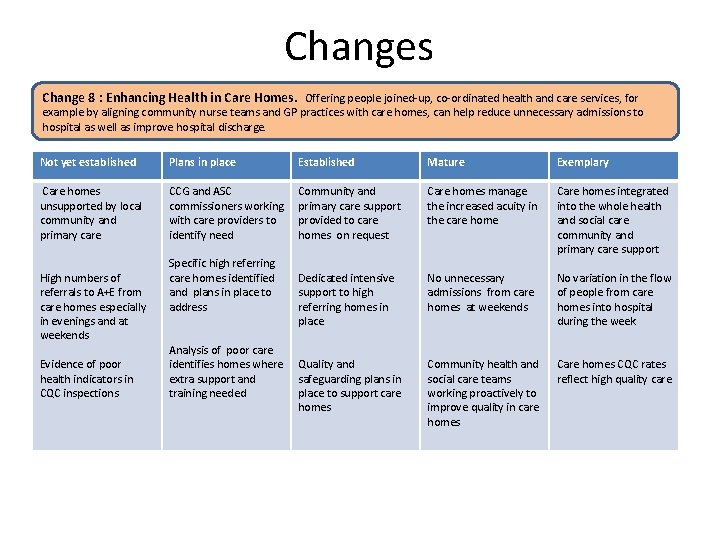
Changes Change 8 : Enhancing Health in Care Homes. Offering people joined-up, co-ordinated health and care services, for example by aligning community nurse teams and GP practices with care homes, can help reduce unnecessary admissions to hospital as well as improve hospital discharge. Not yet established Plans in place Established Mature Exemplary Care homes unsupported by local community and primary care CCG and ASC commissioners working with care providers to identify need Community and primary care support provided to care homes on request Care homes manage the increased acuity in the care home Care homes integrated into the whole health and social care community and primary care support Dedicated intensive support to high referring homes in place No unnecessary admissions from care homes at weekends No variation in the flow of people from care homes into hospital during the week Quality and safeguarding plans in place to support care homes Community health and social care teams working proactively to improve quality in care homes CQC rates reflect high quality care High numbers of referrals to A+E from care homes especially in evenings and at weekends Evidence of poor health indicators in CQC inspections Specific high referring care homes identified and plans in place to address Analysis of poor care identifies homes where extra support and training needed
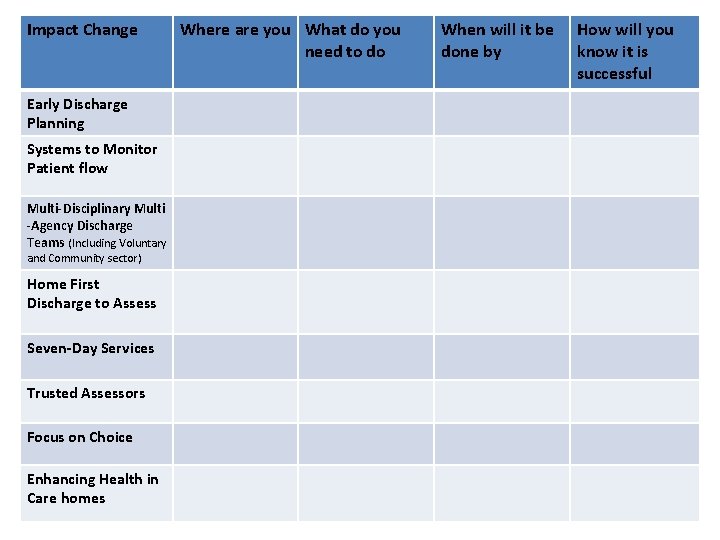
Impact Change Early Discharge Planning Systems to Monitor Patient flow Multi-Disciplinary Multi -Agency Discharge Teams (Including Voluntary and Community sector) Home First Discharge to Assess Seven-Day Services Trusted Assessors Focus on Choice Enhancing Health in Care homes Where are you What do you need to do When will it be done by How will you know it is successful
Contact details Sarah Mitchell Director Towards Excellence in Adult Social Care Programme(TEASC), Local Government Association sarah. mitchell@local. gov. uk Better Care Exchange website https: //bettercare. tibbr. com/tibbr/web/login Emergency Care Improvement Programme website http: //www. ecip. nhs. uk/