
High gradient test results Linac 4 RFQ and
- Slides: 21
High gradient test results: Linac 4 RFQ and S-band medical linac structure Anna Vnuchenko CSIC / IFIC – Instituto de Fisica Corpuscular (CSIC-UV) BE RF and BE ABP group, CERN HG Workshop 2019, Chamonix, France 11 June 2019
Outline I. Further analysis of 3 GHz structure tested at CERN S-box. Ø Conditioning of the structure Ø Breakdown position analysis II. Review of the study of the 352 MHz RFQ of Linac 4 Ø Technical specification of the RFQ Ø Breakdown study q Conclusions HG Workshop 2019 2
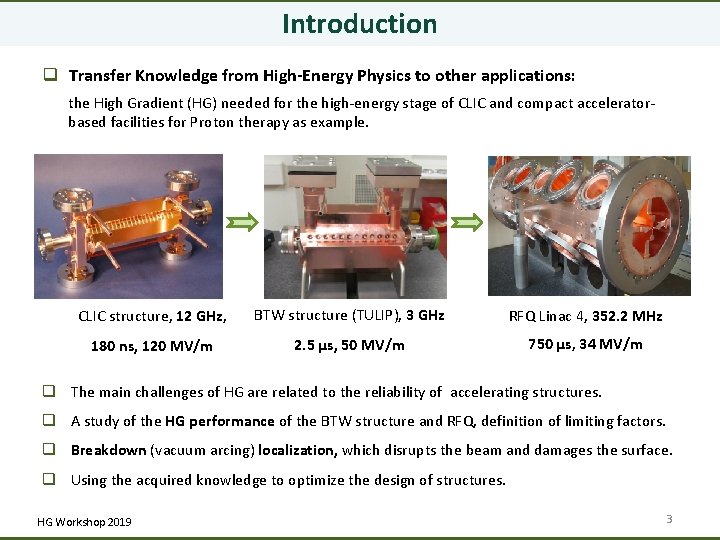
Introduction q Transfer Knowledge from High-Energy Physics to other applications: the High Gradient (HG) needed for the high-energy stage of CLIC and compact acceleratorbased facilities for Proton therapy as example. CLIC structure, 12 GHz, BTW structure (TULIP), 3 GHz RFQ Linac 4, 352. 2 MHz 180 ns, 120 MV/m 2. 5 μs, 50 MV/m 750 µs, 34 MV/m q The main challenges of HG are related to the reliability of accelerating structures. q A study of the HG performance of the BTW structure and RFQ, definition of limiting factors. q Breakdown (vacuum arcing) localization, which disrupts the beam and damages the surface. q Using the acquired knowledge to optimize the design of structures. HG Workshop 2019 3
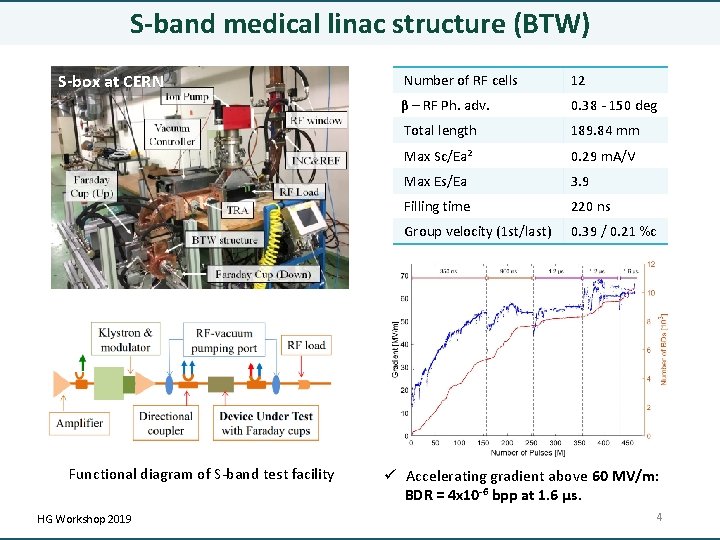
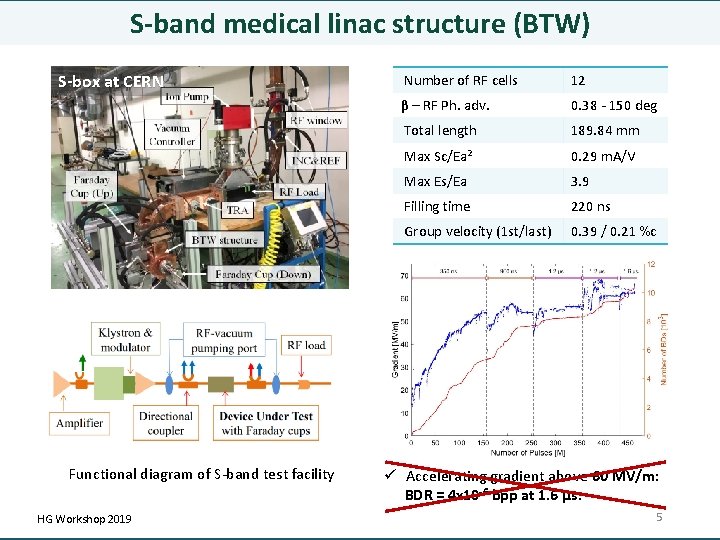
S-band medical linac structure (BTW) S-box at CERN Functional diagram of S-band test facility HG Workshop 2019 Number of RF cells 12 β – RF Ph. adv. 0. 38 - 150 deg Total length 189. 84 mm Max Sc/Ea 2 0. 29 m. A/V Max Es/Ea 3. 9 Filling time 220 ns Group velocity (1 st/last) 0. 39 / 0. 21 %c ü Accelerating gradient above 60 MV/m: BDR = 4 x 10 -6 bpp at 1. 6 μs. 4
S-band medical linac structure (BTW) S-box at CERN Functional diagram of S-band test facility HG Workshop 2019 Number of RF cells 12 β – RF Ph. adv. 0. 38 - 150 deg Total length 189. 84 mm Max Sc/Ea 2 0. 29 m. A/V Max Es/Ea 3. 9 Filling time 220 ns Group velocity (1 st/last) 0. 39 / 0. 21 %c ü Accelerating gradient above 60 MV/m: BDR = 4 x 10 -6 bpp at 1. 6 μs. 5
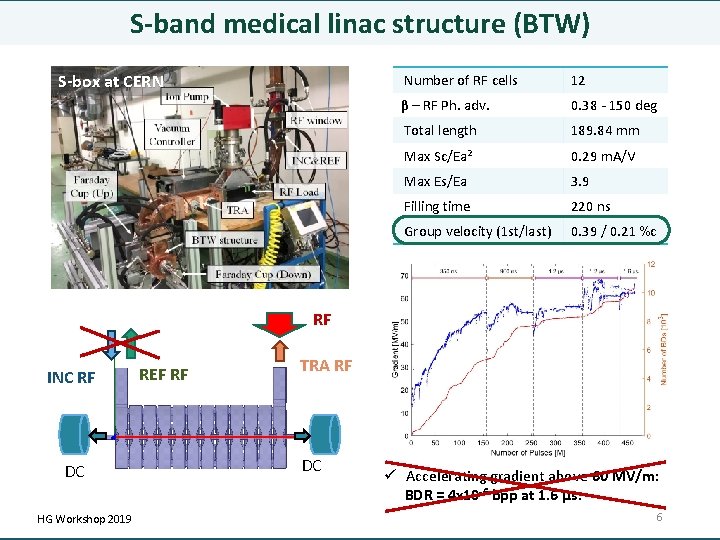
S-band medical linac structure (BTW) S-box at CERN Number of RF cells 12 β – RF Ph. adv. 0. 38 - 150 deg Total length 189. 84 mm Max Sc/Ea 2 0. 29 m. A/V Max Es/Ea 3. 9 Filling time 220 ns Group velocity (1 st/last) 0. 39 / 0. 21 %c RF INC RF DC HG Workshop 2019 REF RF TRA RF DC ü Accelerating gradient above 60 MV/m: BDR = 4 x 10 -6 bpp at 1. 6 μs. 6
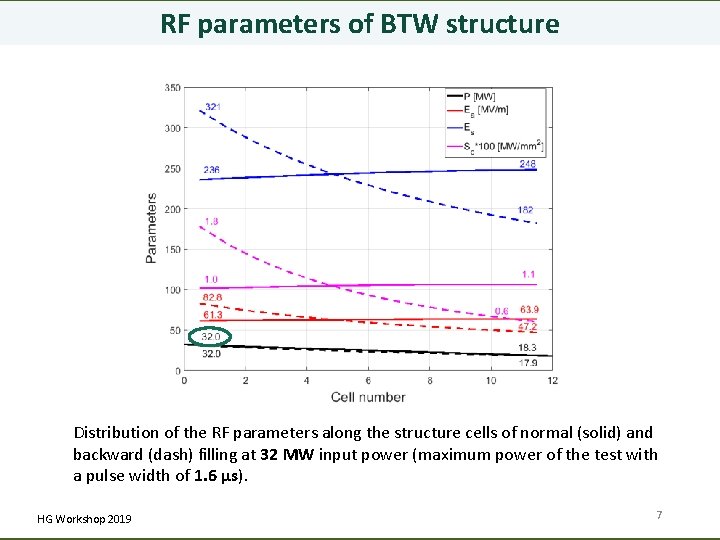
RF parameters of BTW structure Distribution of the RF parameters along the structure cells of normal (solid) and backward (dash) filling at 32 MW input power (maximum power of the test with a pulse width of 1. 6 μs). HG Workshop 2019 7
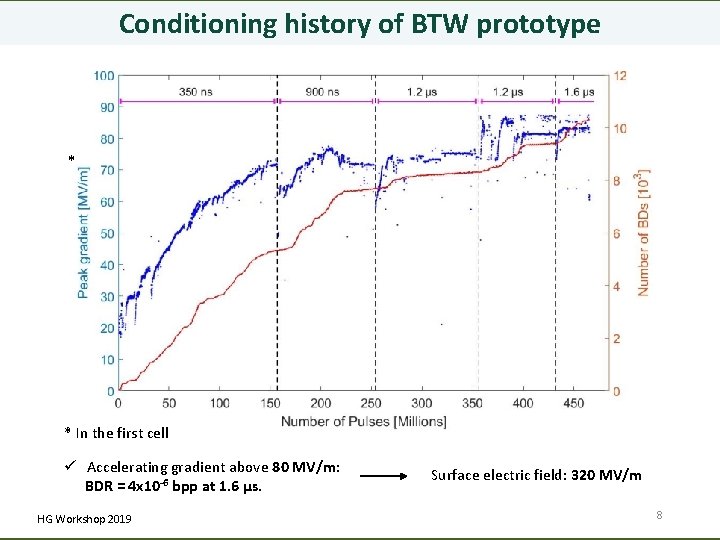
Conditioning history of BTW prototype * * In the first cell ü Accelerating gradient above 80 MV/m: BDR = 4 x 10 -6 bpp at 1. 6 μs. HG Workshop 2019 Surface electric field: 320 MV/m 8
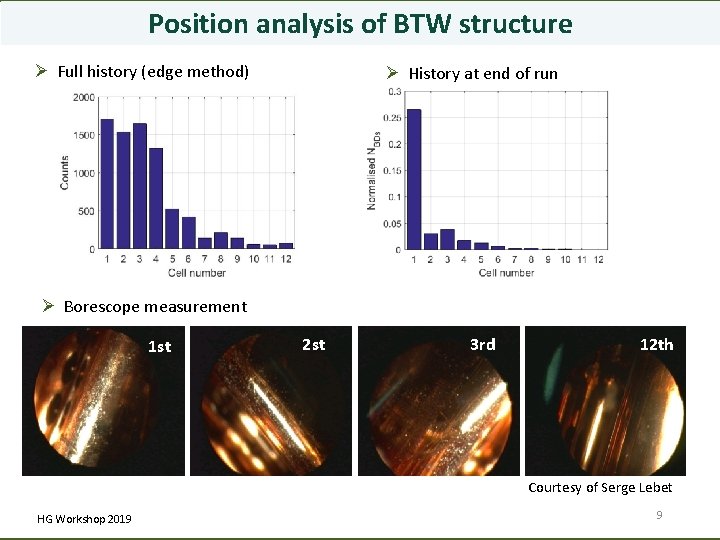
Position analysis of BTW structure Ø Full history (edge method) Ø History at end of run Ø Borescope measurement 1 st 2 st 3 rd 12 th Courtesy of Serge Lebet HG Workshop 2019 9
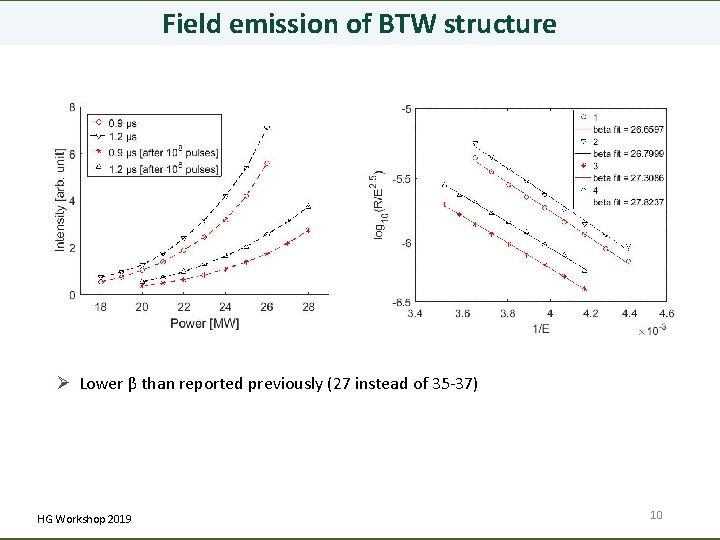
Field emission of BTW structure Ø Lower β than reported previously (27 instead of 35 -37) HG Workshop 2019 10
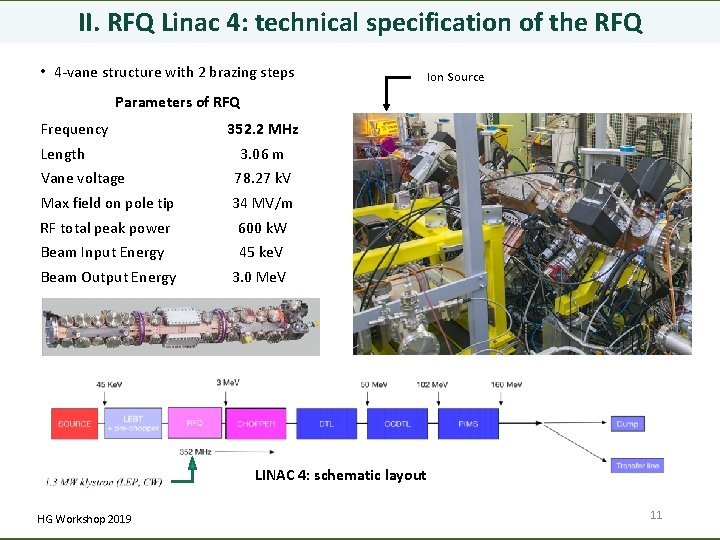
II. RFQ Linac 4: technical specification of the RFQ • 4 -vane structure with 2 brazing steps Ion Source Parameters of RFQ Frequency Length 352. 2 MHz 3. 06 m Vane voltage 78. 27 k. V Max field on pole tip 34 MV/m RF total peak power 600 k. W Beam Input Energy 45 ke. V Beam Output Energy 3. 0 Me. V LINAC 4: schematic layout HG Workshop 2019 11
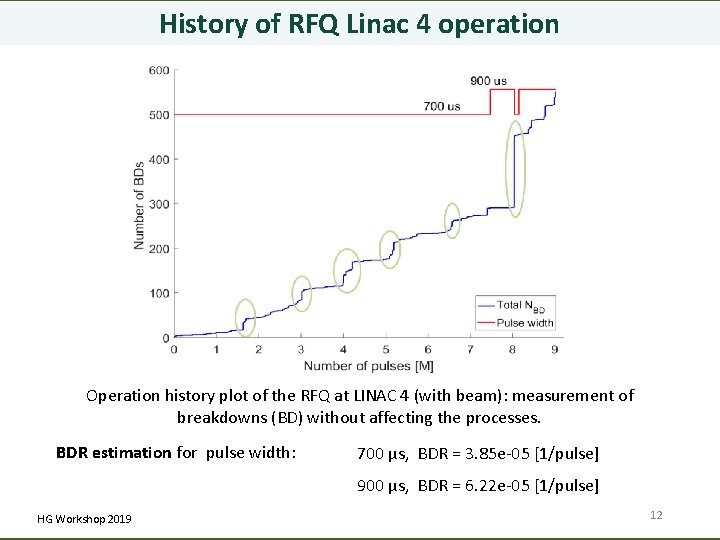
History of RFQ Linac 4 operation Operation history plot of the RFQ at LINAC 4 (with beam): measurement of breakdowns (BD) without affecting the processes. BDR estimation for pulse width: 700 µs, BDR = 3. 85 e-05 [1/pulse] 900 µs, BDR = 6. 22 e-05 [1/pulse] HG Workshop 2019 12
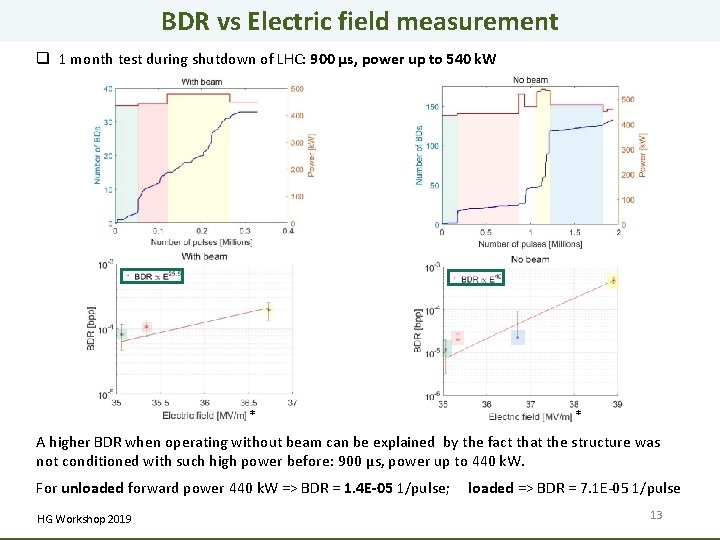
BDR vs Electric field measurement q 1 month test during shutdown of LHC: 900 μs, power up to 540 k. W * * A higher BDR when operating without beam can be explained by the fact that the structure was not conditioned with such high power before: 900 μs, power up to 440 k. W. For unloaded forward power 440 k. W => BDR = 1. 4 E-05 1/pulse; HG Workshop 2019 loaded => BDR = 7. 1 E-05 1/pulse 13
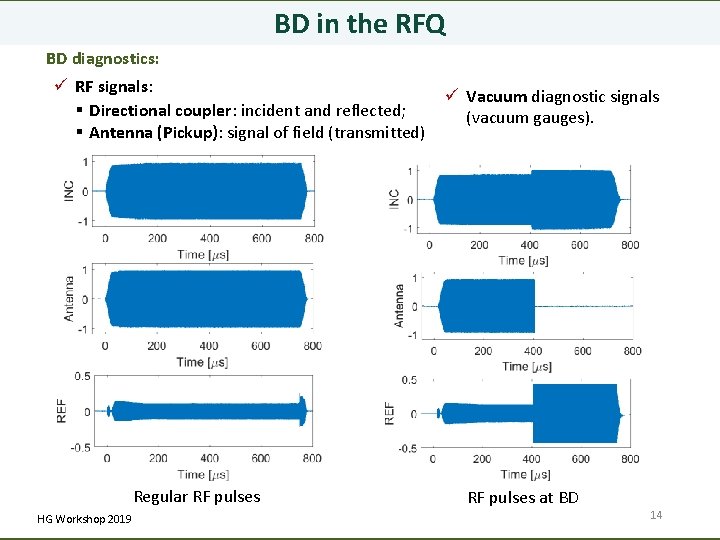
BD in the RFQ BD diagnostics: ü RF signals: § Directional coupler: incident and reflected; § Antenna (Pickup): signal of field (transmitted) Regular RF pulses HG Workshop 2019 ü Vacuum diagnostic signals (vacuum gauges). RF pulses at BD 14
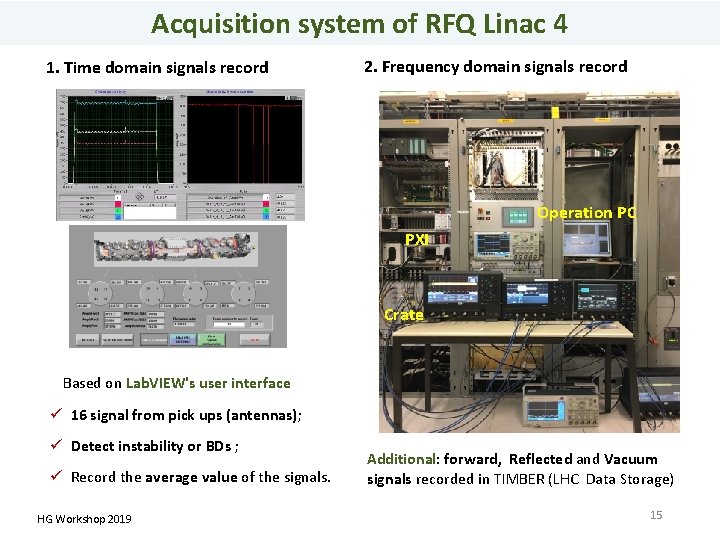
Acquisition system of RFQ Linac 4 1. Time domain signals record 2. Frequency domain signals record Operation PC PXI Crate Based on Lab. VIEW's user interface ü 16 signal from pick ups (antennas); ü Detect instability or BDs ; ü Record the average value of the signals. HG Workshop 2019 Additional: forward, Reflected and Vacuum signals recorded in TIMBER (LHC Data Storage) 15
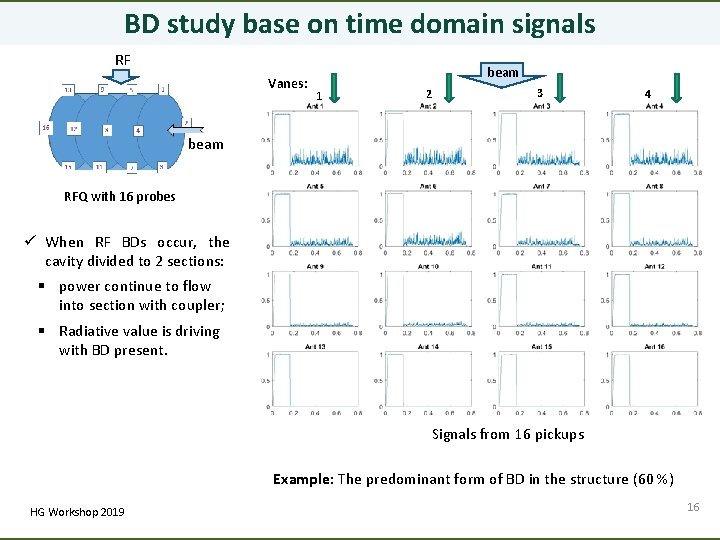
BD study base on time domain signals RF Vanes: beam 1 2 3 4 beam RFQ with 16 probes ü When RF BDs occur, the cavity divided to 2 sections: § power continue to flow into section with coupler; § Radiative value is driving with BD present. Signals from 16 pickups Example: The predominant form of BD in the structure (60 %) HG Workshop 2019 16
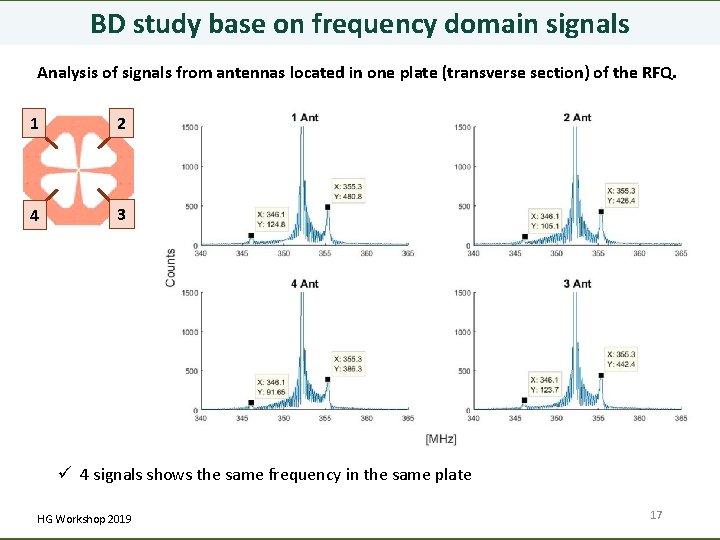
BD study base on frequency domain signals Analysis of signals from antennas located in one plate (transverse section) of the RFQ. 1 2 4 3 ü 4 signals shows the same frequency in the same plate HG Workshop 2019 17
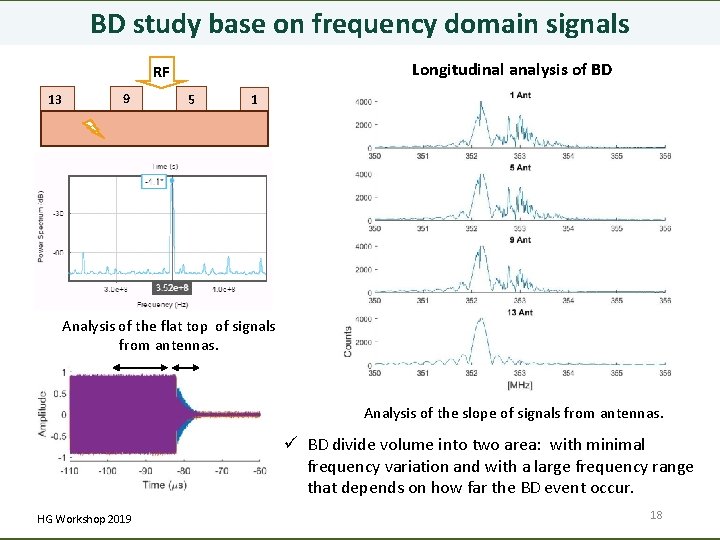
BD study base on frequency domain signals Longitudinal analysis of BD RF 13 9 5 1 Analysis of the flat top of signals from antennas. Analysis of the slope of signals from antennas. ü BD divide volume into two area: with minimal frequency variation and with a large frequency range that depends on how far the BD event occur. HG Workshop 2019 18
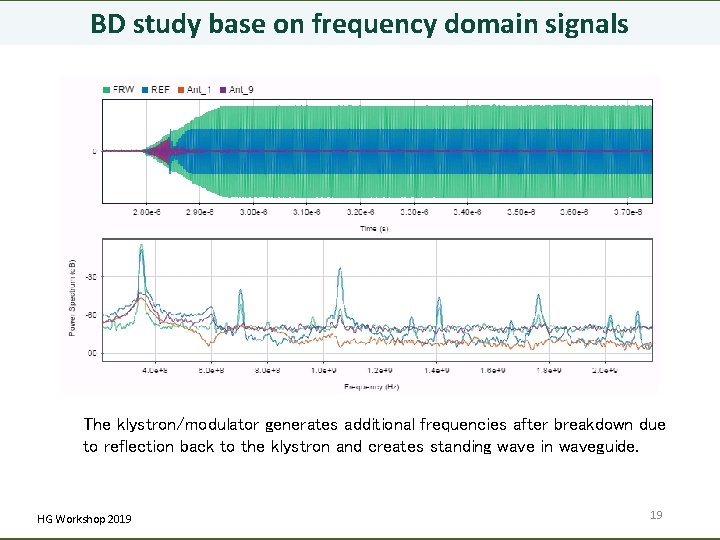
BD study base on frequency domain signals The klystron/modulator generates additional frequencies after breakdown due to reflection back to the klystron and creates standing wave in waveguide. HG Workshop 2019 19
Conclusions: q The high-power test of the BTW N 1 structure was being performed at the Sband test facility at CERN. Due to backward installation, a new recalculated parameters was achieved: a local accelerating gradient at the input of 81 MV/m at a pulse length of 1. 6 µs and a breakdown rate of 5 x 10 -6 1/pulse. q The high gradient experience of CLIC cannot directly scale to the RFQ because the operating regime is completely different: pulse length, repetition frequency and way of filling (standing wave structure + ion source). q The first study of BD phenomena was performed in the RFQ Linac 4. Ø Preliminary analysis shows that the main number of BD was due to the beam entering the structure. Ø Non resonant frequency occurred at BD. q Measurement of BDs in RFQ require proper conditions in order to avoid the influence of additional factors: gaz and charge particle from Ion source, reflecting from the structure causing a series of BDs. HG Workshop 2019 20
Thank you for your attention! This project has received funding from the European Union's Horizon 2020 research and innovation programme under the Marie Skłodowska-Curie grant agreement No 675265. HG Workshop 2019