
High fidelity prototyping Highfidelity prototyping Uses materials that
- Slides: 9
High fidelity prototyping
High-fidelity prototyping • Uses materials that you would expect to be in the final product. • Prototype looks more like the final system than a lowfidelity version. • For a high-fidelity software prototype common environments include Macromedia Director, Visual Basic, and Smalltalk. • Danger that users think they have a full system
High-fidelity prototyping • Can’t prototype everything – Horizontal: Look and feel of everything, but little functionality – Vertical: Few crucial pieces of functionality
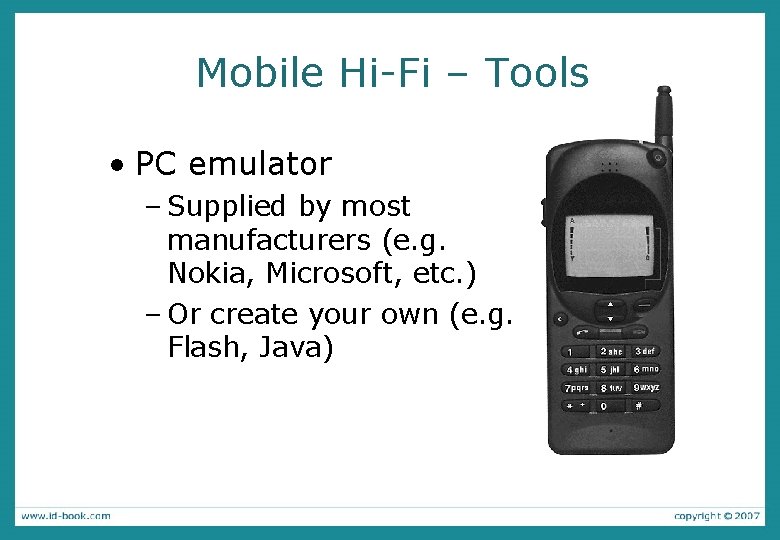
Mobile Hi-Fi – Tools • PC emulator – Supplied by most manufacturers (e. g. Nokia, Microsoft, etc. ) – Or create your own (e. g. Flash, Java)
PC – Be Warned • Text input (no keyboards) • Pointing device (no mice) • Portability (limited to lab evaluation) • Performance (PC faster than device) • Custom hardware (mobiles can have hardware not found on PC)
Moving to Implementation • Evolutionary – Tidy up the prototype and release – Rarely a good idea • Revolutionary – Use the prototype as a specification – Re-implement from scratch
Compromises in prototyping • All prototypes involve compromises • For software-based prototyping maybe there is a slow response? sketchy icons? limited functionality? • Two common types of compromise • ‘horizontal’: provide a wide range of functions, but with little detail • ‘vertical’: provide a lot of detail for only a few functions • Compromises in prototypes mustn’t be ignored. Product needs engineering
Construction • Taking the prototypes (or learning from them) and creating a whole • Quality must be attended to: usability (of course), reliability, robustness, maintainability, integrity, portability, efficiency, etc • Product must be engineered Evolutionary prototyping ‘Throw-away’ prototyping
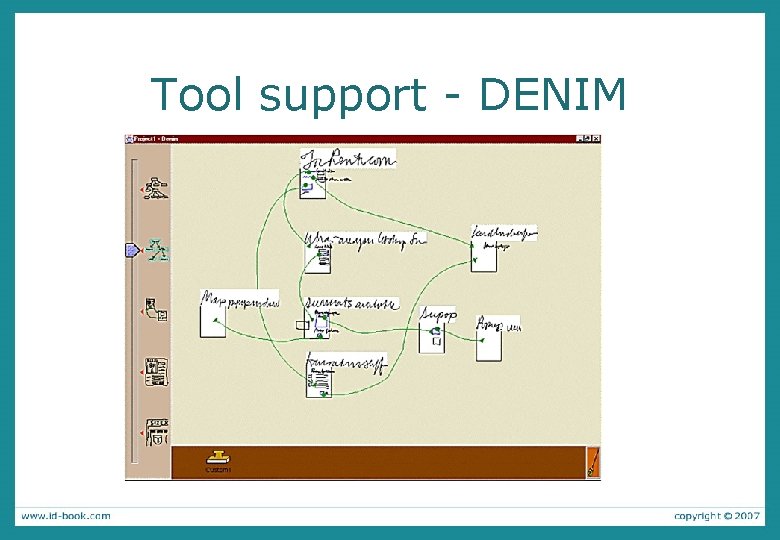
Tool support - DENIM