
High Energy Spin Physics Theory Overview Hiroyuki Kawamura
- Slides: 13
High Energy Spin Physics: Theory Overview Hiroyuki Kawamura (KEK) RHIC/PHENIX spin-workshop Sep. 16, 2010 @SNU Hiroyuki Kawamura (KEK) 1
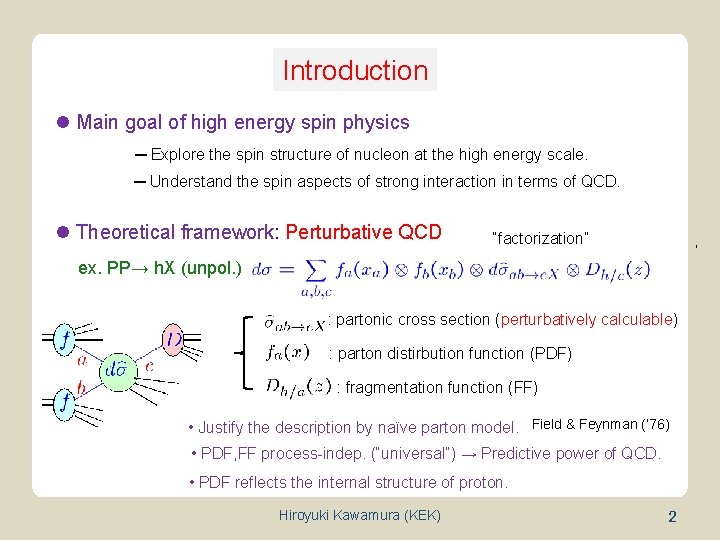
Introduction l Main goal of high energy spin physics ─ Explore the spin structure of nucleon at the high energy scale. ─ Understand the spin aspects of strong interaction in terms of QCD. l Theoretical framework: Perturbative QCD “factorization” ‘ ex. PP→ h. X (unpol. ) : partonic cross section (perturbatively calculable) : parton distirbution function (PDF) : fragmentation function (FF) • Justify the description by naïve parton model. Field & Feynman (‘ 76) • PDF, FF process-indep. (“universal”) → Predictive power of QCD. • PDF reflects the internal structure of proton. Hiroyuki Kawamura (KEK) 2
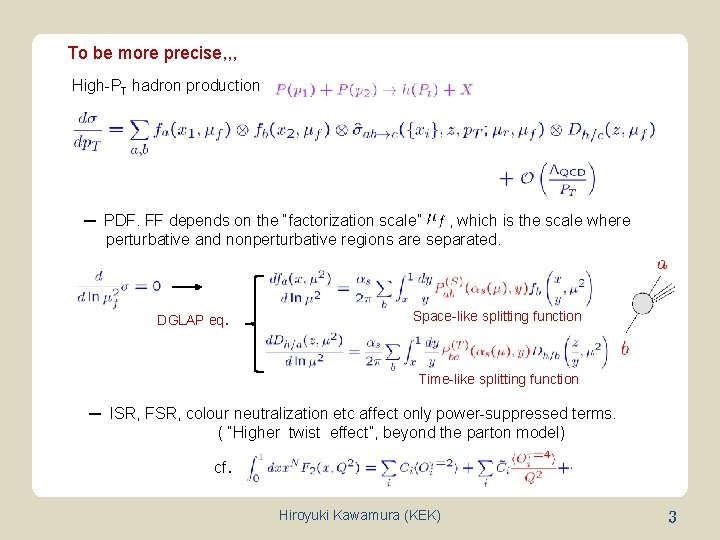
To be more precise, , , High-PT hadron production ─ PDF. FF depends on the “factorization scale” , which is the scale where perturbative and nonperturbative regions are separated. DGLAP eq. Space-like splitting function Time-like splitting function ─ ISR, FSR, colour neutralization etc affect only power-suppressed terms. ( “Higher twist effect”, beyond the parton model) cf. Hiroyuki Kawamura (KEK) 3
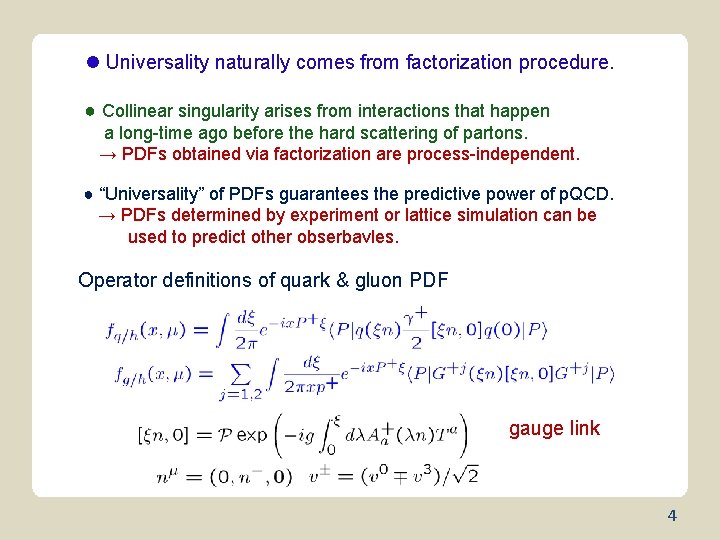
l Universality naturally comes from factorization procedure. ● Collinear singularity arises from interactions that happen a long-time ago before the hard scattering of partons. → PDFs obtained via factorization are process-independent. ● “Universality” of PDFs guarantees the predictive power of p. QCD. → PDFs determined by experiment or lattice simulation can be used to predict other obserbavles. Operator definitions of quark & gluon PDF gauge link 4
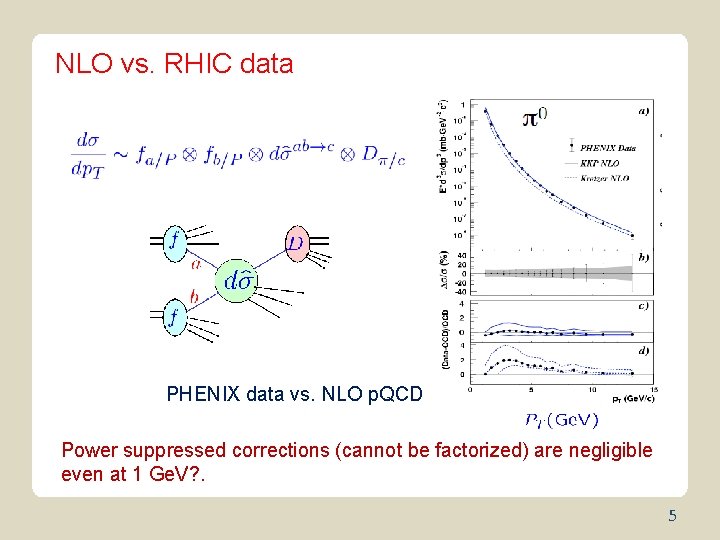
NLO vs. RHIC data PHENIX data vs. NLO p. QCD Power suppressed corrections (cannot be factorized) are negligible even at 1 Ge. V? . 5
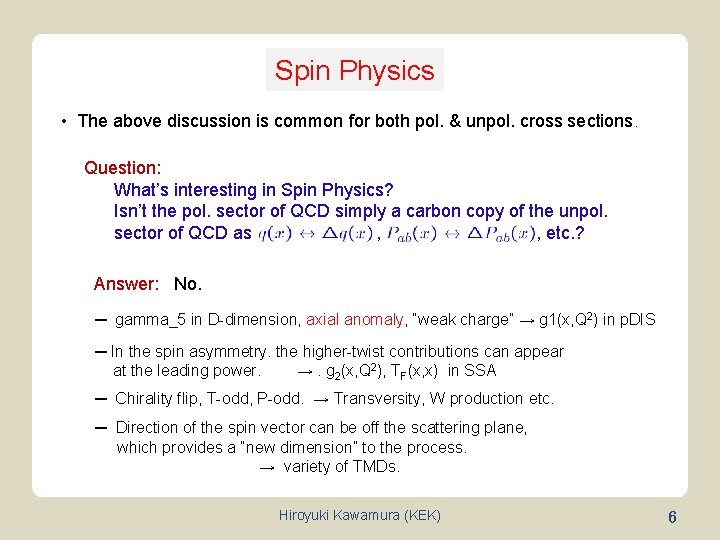
Spin Physics • The above discussion is common for both pol. & unpol. cross sections. Question: What’s interesting in Spin Physics? Isn’t the pol. sector of QCD simply a carbon copy of the unpol. sector of QCD as , , etc. ? Answer: No. ─ gamma_5 in D-dimension, axial anomaly, “weak charge” → g 1(x, Q 2) in p. DIS ─ In the spin asymmetry. the higher-twist contributions can appear at the leading power. →. g 2(x, Q 2), TF(x, x) in SSA ─ Chirality flip, T-odd, P-odd. → Transversity, W production etc. ─ Direction of the spin vector can be off the scattering plane, which provides a “new dimension” to the process. → variety of TMDs. Hiroyuki Kawamura (KEK) 6
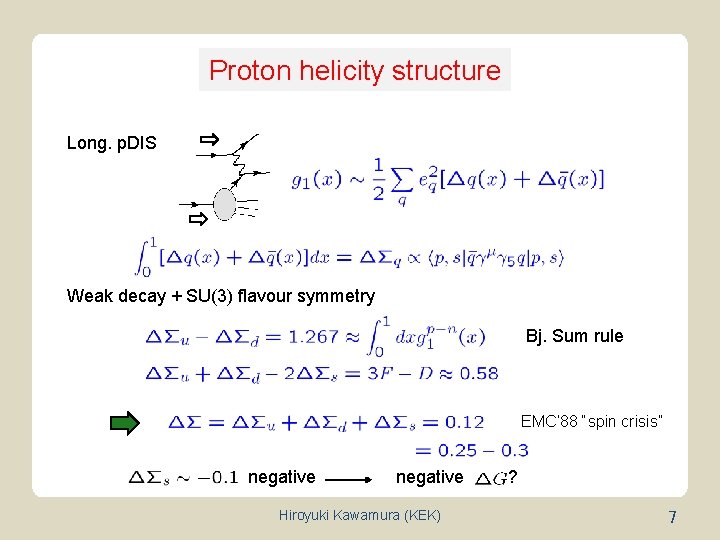
Proton helicity structure Long. p. DIS Weak decay + SU(3) flavour symmetry Bj. Sum rule EMC’ 88 “spin crisis” negative Hiroyuki Kawamura (KEK) ? 7
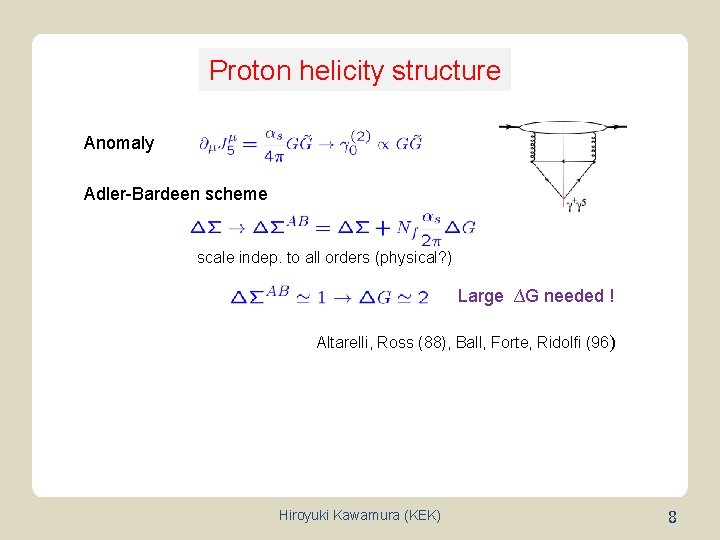
Proton helicity structure Anomaly Adler-Bardeen scheme scale indep. to all orders (physical? ) Large ∆G needed ! Altarelli, Ross (88), Ball, Forte, Ridolfi (96) Hiroyuki Kawamura (KEK) 8
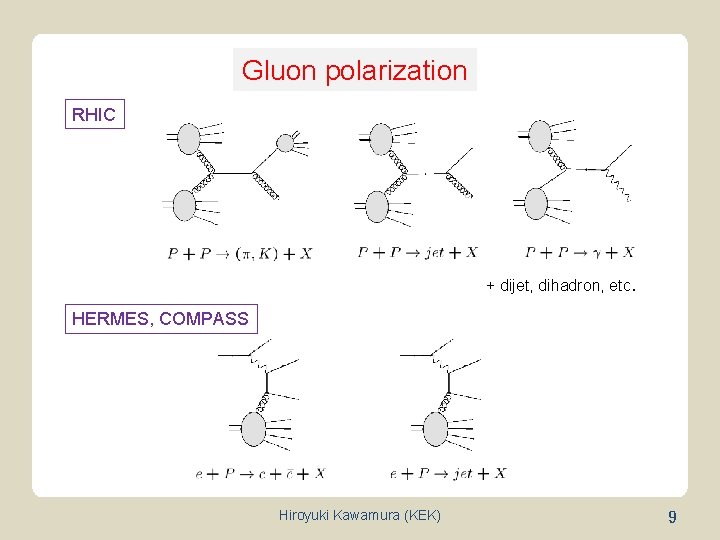
Gluon polarization RHIC + dijet, dihadron, etc. HERMES, COMPASS Hiroyuki Kawamura (KEK) 9
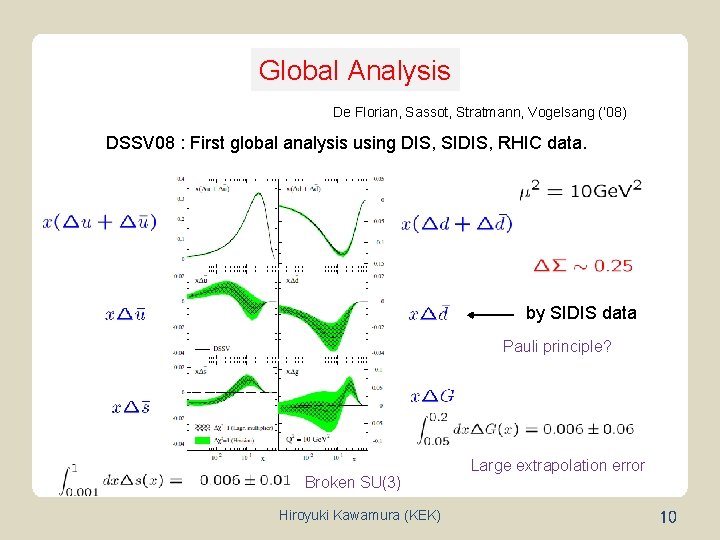
Global Analysis De Florian, Sassot, Stratmann, Vogelsang (’ 08) DSSV 08 : First global analysis using DIS, SIDIS, RHIC data. by SIDIS data Pauli principle? Broken SU(3) Hiroyuki Kawamura (KEK) Large extrapolation error 10
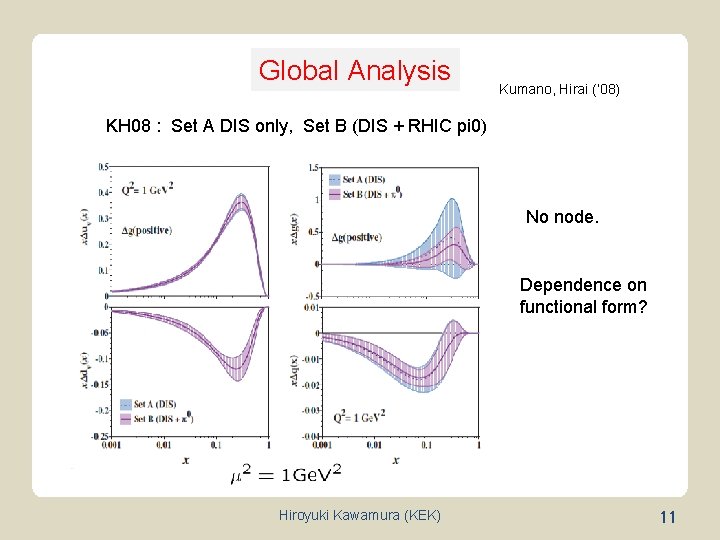
Global Analysis Kumano, Hirai (’ 08) KH 08 : Set A DIS only, Set B (DIS + RHIC pi 0) No node. Dependence on functional form? Hiroyuki Kawamura (KEK) 11
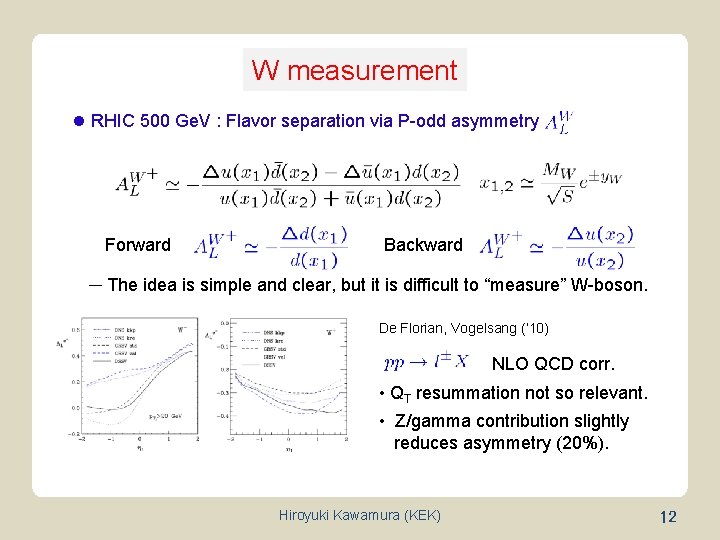
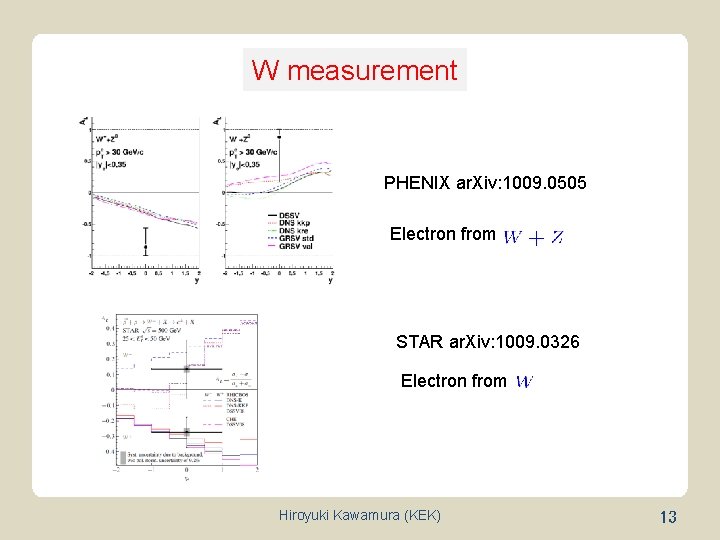
W measurement l RHIC 500 Ge. V : Flavor separation via P-odd asymmetry Forward Backward ─ The idea is simple and clear, but it is difficult to “measure” W-boson. De Florian, Vogelsang (‘ 10) NLO QCD corr. • QT resummation not so relevant. • Z/gamma contribution slightly reduces asymmetry (20%). Hiroyuki Kawamura (KEK) 12
W measurement PHENIX ar. Xiv: 1009. 0505 Electron from STAR ar. Xiv: 1009. 0326 Electron from Hiroyuki Kawamura (KEK) 13