
High Energy Rate Forming HERF or High Velocity
- Slides: 30
High Energy Rate Forming (HERF) or High Velocity Forming (HVF)
Contents • • • Definition Classification Introduction to Explosive Forming Introduction to Electrohydraulic Forming (EHF) Introduction to Electromagnetic Forming (EMF) Operational Problems in HERF
Definition of HERF • Processes using electrical, magnetic & chemical energy in addition to conventional energy are known as HERF. • The rate of energy flow is of much higher order, so called as high-energy-rate forming.
Need of HERF or HVF • A press of capacity 500 k. N moving over a distance of 0. 15 m delivers energy of 75 KJ. • But the system is so big and bulky that can only be used for large workpieces. • A system consuming less time, compact & more powerful is the requirement. • So, development of HVF takes place.
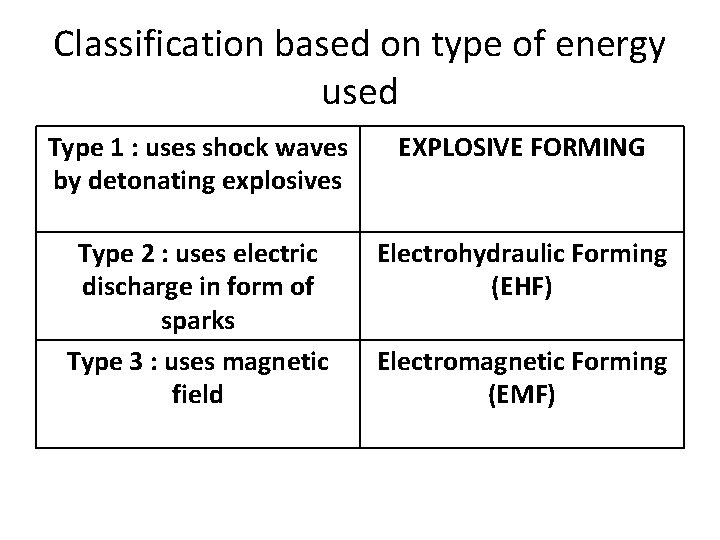
Classification based on type of energy used Type 1 : uses shock waves by detonating explosives EXPLOSIVE FORMING Type 2 : uses electric discharge in form of sparks Type 3 : uses magnetic field Electrohydraulic Forming (EHF) Electromagnetic Forming (EMF)
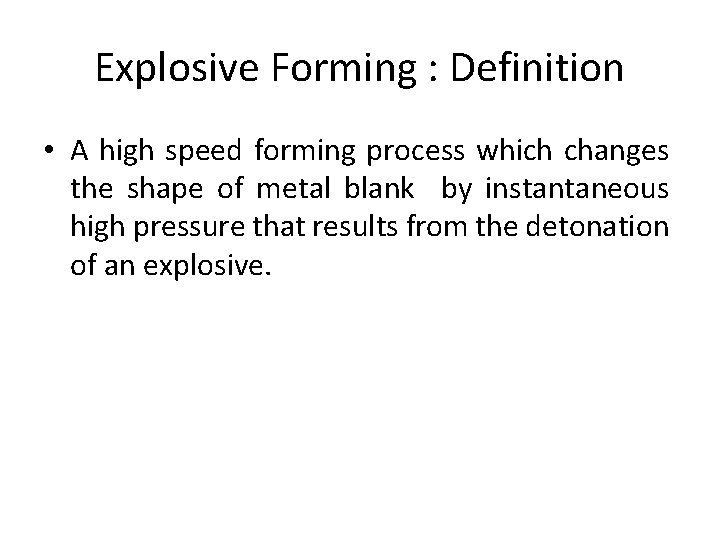
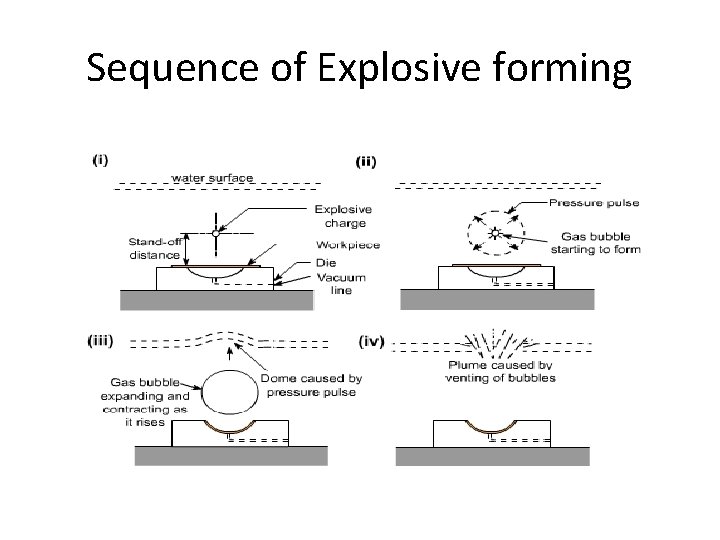
Explosive Forming : Definition • A high speed forming process which changes the shape of metal blank by instantaneous high pressure that results from the detonation of an explosive.
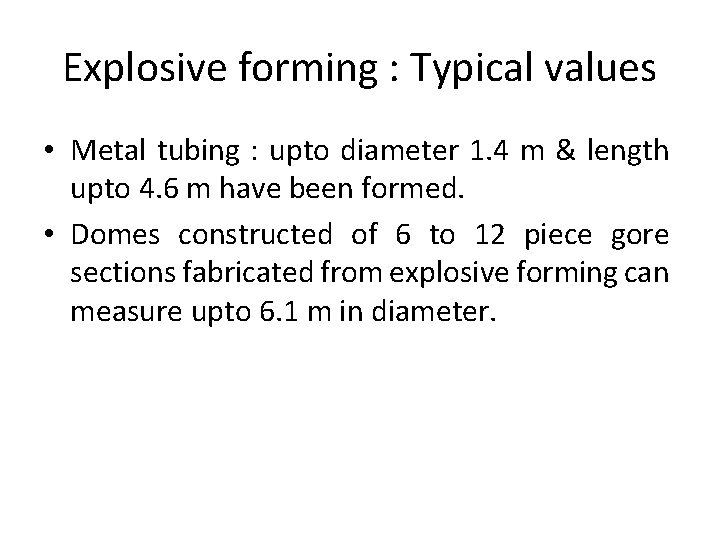
Explosive forming : Typical values • Metal tubing : upto diameter 1. 4 m & length upto 4. 6 m have been formed. • Domes constructed of 6 to 12 piece gore sections fabricated from explosive forming can measure upto 6. 1 m in diameter.
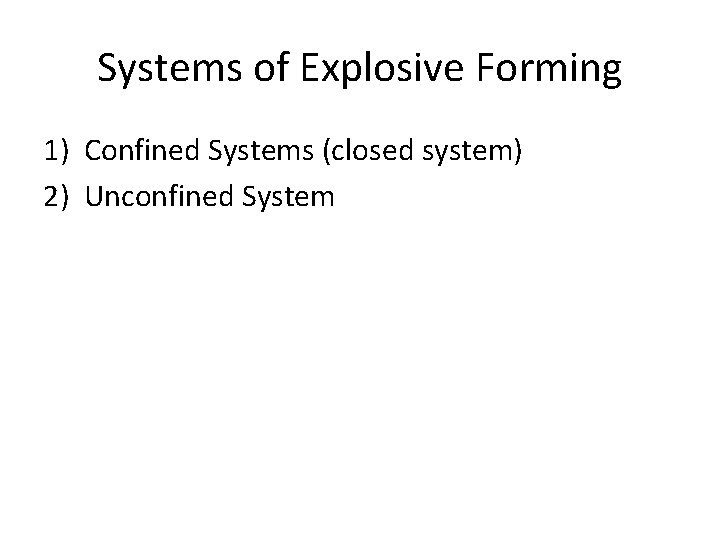
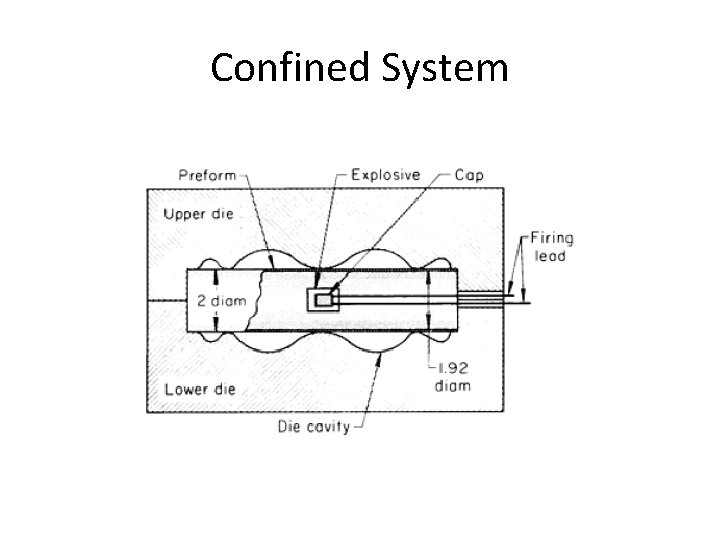
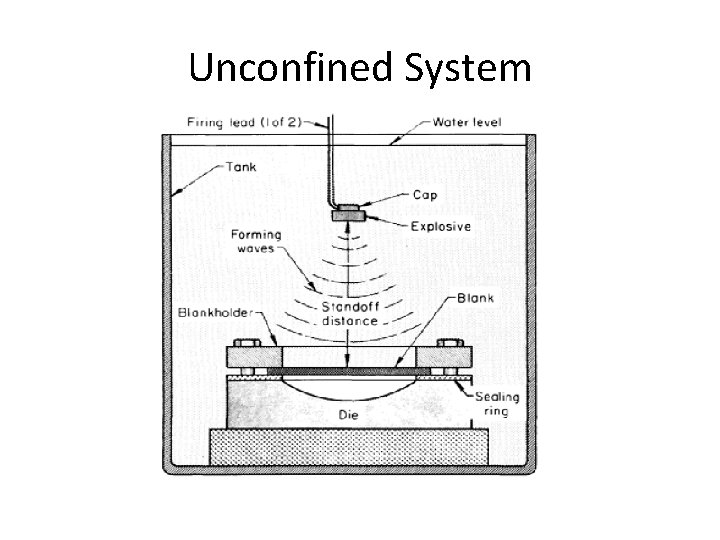
Systems of Explosive Forming 1) Confined Systems (closed system) 2) Unconfined System
Confined System
Unconfined System
Sequence of Explosive forming
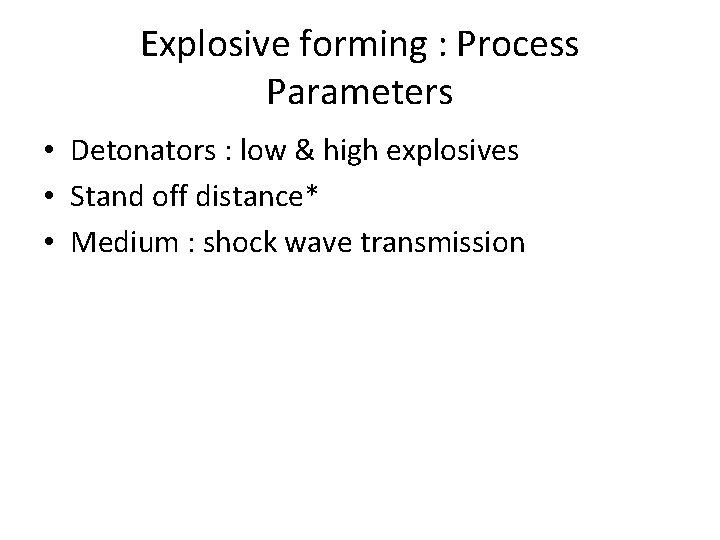
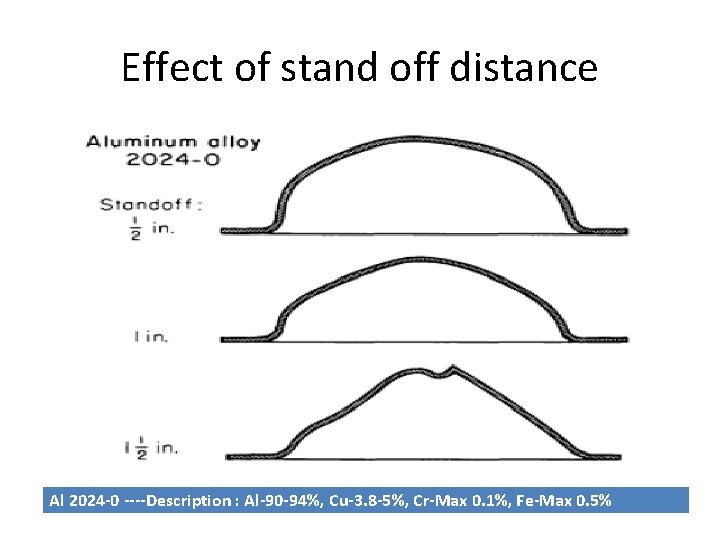
Explosive forming : Process Parameters • Detonators : low & high explosives • Stand off distance* • Medium : shock wave transmission
Explosive froming • The use of water as the energy transfer medium ensures a uniform transmission of energy and muffles the sound of the explosive blast. • The process has been successfully used to form steel plates 25 mm thick x 4 m diameter and to bulge steel tubes as thick as 25 mm.
Effect of stand off distance Al 2024 -0 ----Description : Al-90 -94%, Cu-3. 8 -5%, Cr-Max 0. 1%, Fe-Max 0. 5%
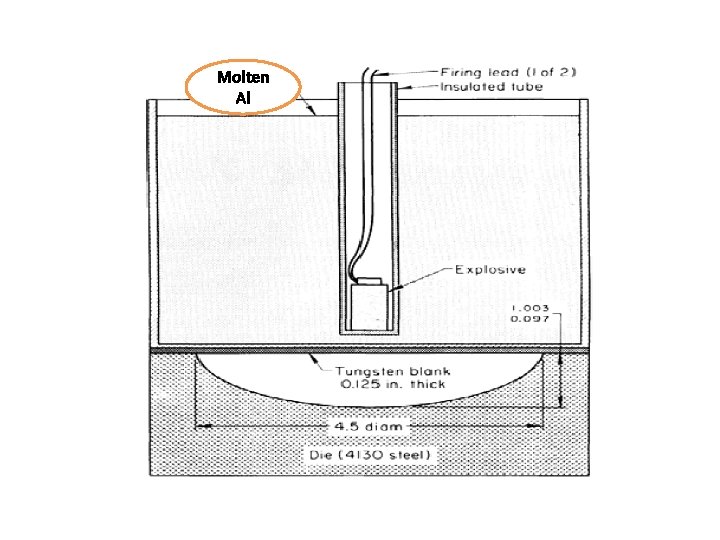
Molten Al
Unconfined System : Equipments • • Water Tank Crane Vacuum Pump Detonator Control Box
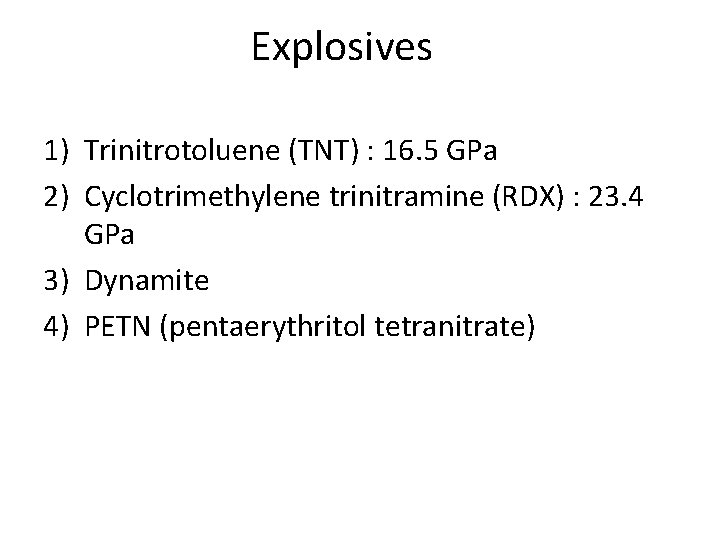
Explosives 1) Trinitrotoluene (TNT) : 16. 5 GPa 2) Cyclotrimethylene trinitramine (RDX) : 23. 4 GPa 3) Dynamite 4) PETN (pentaerythritol tetranitrate)
Electromagnetic Forming • Definition : It is an impulse or high speed forming technology using pulsed magnetic field to apply Lorentz forces to workpieces preferably made of highly electrically conductive material without mechanical contact and without a working medium. • Note: - EMF mainly depends on electrical properties of the material being formed
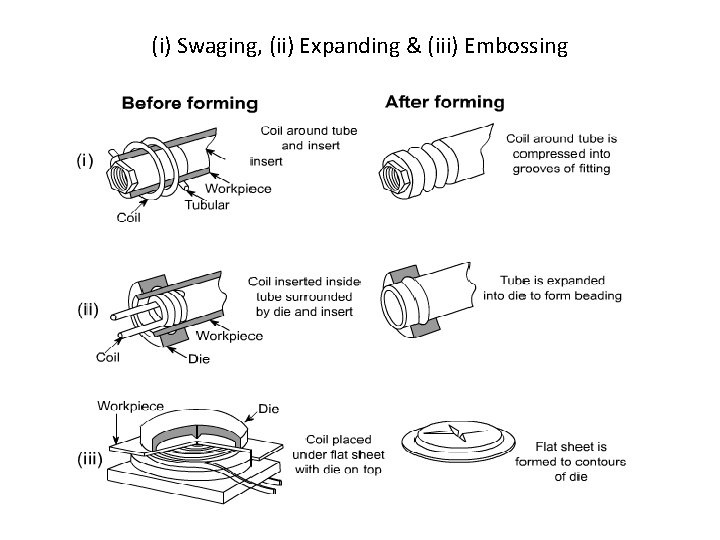
(i) Swaging, (ii) Expanding & (iii) Embossing
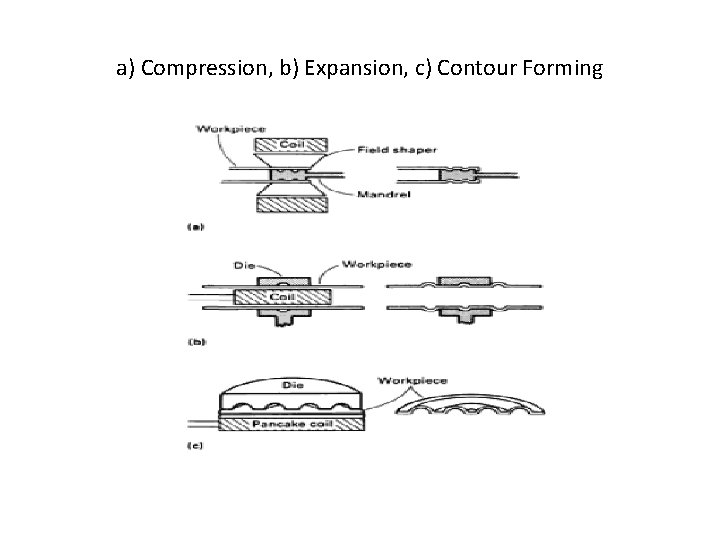
a) Compression, b) Expansion, c) Contour Forming
EMF theory • In electromagnetic forming, the initial gap between the work piece and the die surface, called the fly distance , must be sufficient to permit the material to deform plastically.
Advantages over conventional forming • Hollow profiles can be compressed or expanded and flat or three dimensional performed sheet metal can be shaped and joined as well as cutting operations can be performed.
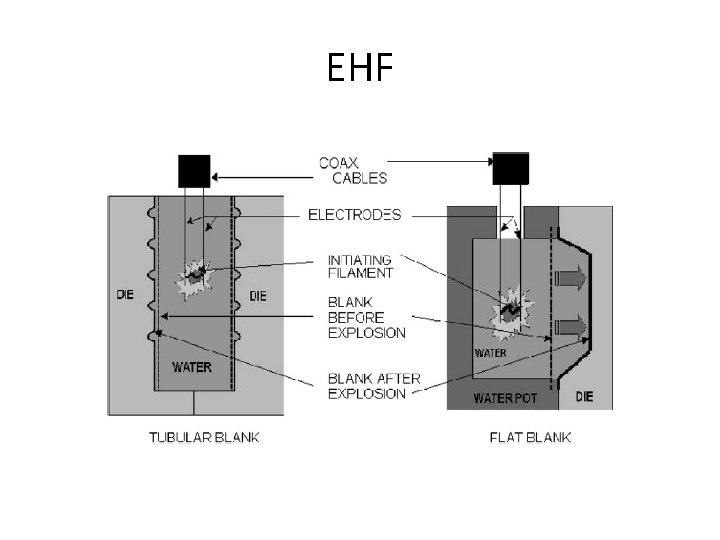
Electrohydraulic Forming (EHF) • Electro hydraulic forming (EHF), also known as electro spark forming. • A process in which electrical energy is converted into mechanical energy for the forming of metallic parts.
EHF theory • A bank of capacitors is first charged to a high voltage and then discharged across a gap between two electrodes, causing explosions inside the hollow work piece, which is filled with some suitable medium, generally water. • These explosions produce shock waves that travel radially in all directions at high velocity until they meet some obstruction. • If the discharge energy is sufficiently high, the hollow work piece is deformed.
EHF
Advantages • EHF can form hollow shapes with much ease and at less cost compared to other forming techniques. • EHF is more adaptable to automatic production compared to other high energy rate forming techniques. • EHF can produce small – to intermediate sized parts that don't have excessive energy requirements.
Materials formed with EHF • • • Aluminum alloys, Nickel alloys, Stainless steels, Titanium, and Inconel 718
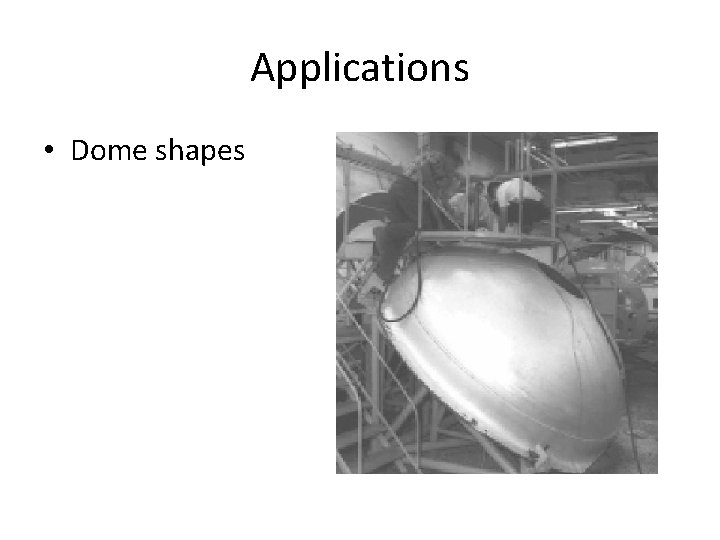
Applications • Dome shapes
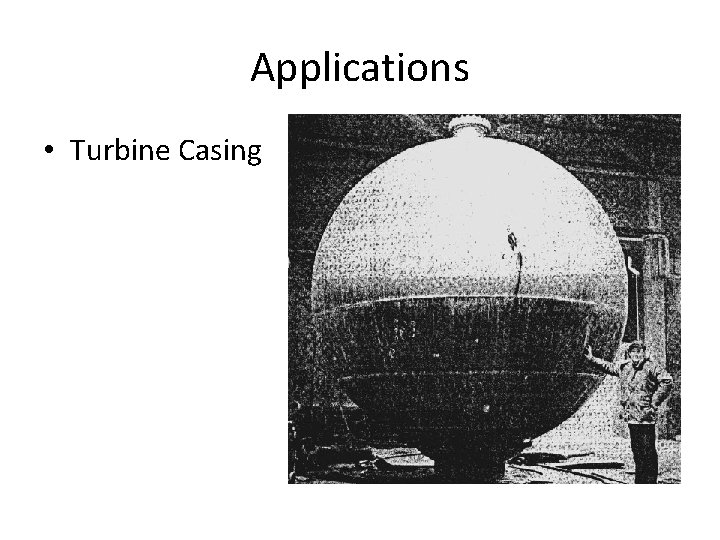
Applications • Turbine Casing
Applications • • Shallow & Deep Rectangular boxes Manhole Access covers Equipment covers Turbojet engine casing