
High Energy Physics Snowmass and P 5 Processes
- Slides: 15
High Energy Physics Snowmass and P 5 Processes Dmitri Denisov October 3, 2019
Particle Physics Planning in “Good Old Times” • How the process of funding new projects progressed in 60’s, 70’s and 80’s (somewhat simplified description) – Smart physicists/engineers propose new project and send a proposal to a Laboratory – The laboratory considered the proposal including recommendation of the Physics Advisory Committee (PAC) • DZero experiment proposal was “E 740” – proposal number 740 among experiments proposed at Fermilab accelerators – Director of the Laboratory decided to support (or not) the project, in consultation with DOE, with main construction funding provided to the laboratory • Substantial flexibility, lack of excessive reviews/bureaucracy – Majority of the projects were completed on schedule and produced fundamental physics results 2
Why Changes to the Selection/Funding Model • Increase in the cost and duration of the projects – What could have been studied/built “easily” already has been done – Only few accelerators working/experiments progressing • Projects in most cases no longer “belong to a single Laboratory” – ATLAS experiment has many US national laboratories and Universities participating as well as from around the globe • DOE formalized approval/construction process and controls the funding – From “get it done” to “follow formal rules” – Not just for particle physics • Large number of interesting proposals available – With long time to construct and collect/analyze data • Erosion of the science funding 3
How to Proceed in the New Environment? • The field, all of us together, have to develop approach how to decide “what projects to do” • Final decision belongs to funding agencies DOE and NSF in our case – They need input from us to decide where to spend money! • Important points in providing recommendations – The science has to be excellent – The selection process has to be community wide – We all have to agree to the process and support the outcome • If many of us will complain about outcome, implementing recommendations will be hard • The selected projects costs have to fit into “available envelope” 4
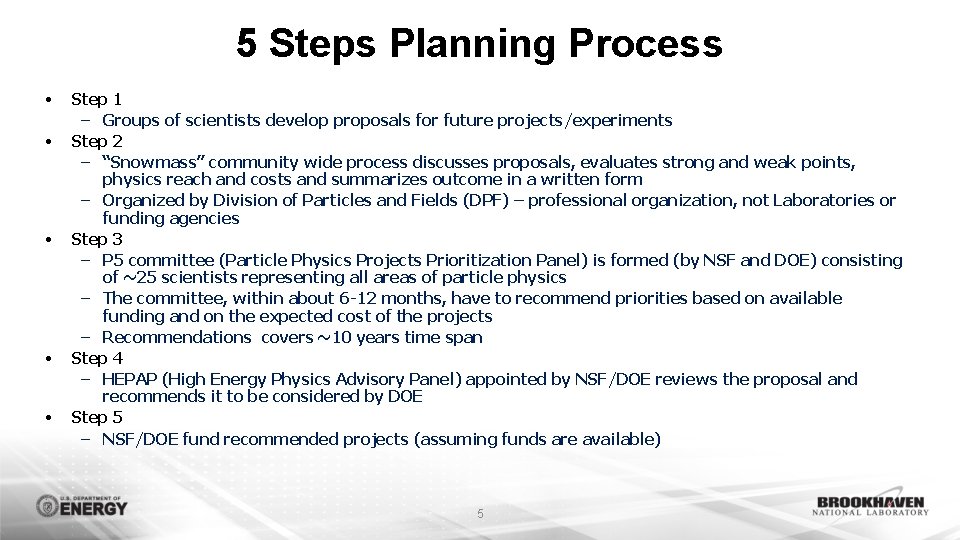
5 Steps Planning Process • • • Step 1 – Groups of scientists develop proposals for future projects/experiments Step 2 – “Snowmass” community wide process discusses proposals, evaluates strong and weak points, physics reach and costs and summarizes outcome in a written form – Organized by Division of Particles and Fields (DPF) – professional organization, not Laboratories or funding agencies Step 3 – P 5 committee (Particle Physics Projects Prioritization Panel) is formed (by NSF and DOE) consisting of ~25 scientists representing all areas of particle physics – The committee, within about 6 -12 months, have to recommend priorities based on available funding and on the expected cost of the projects – Recommendations covers ~10 years time span Step 4 – HEPAP (High Energy Physics Advisory Panel) appointed by NSF/DOE reviews the proposal and recommends it to be considered by DOE Step 5 – NSF/DOE fund recommended projects (assuming funds are available) 5
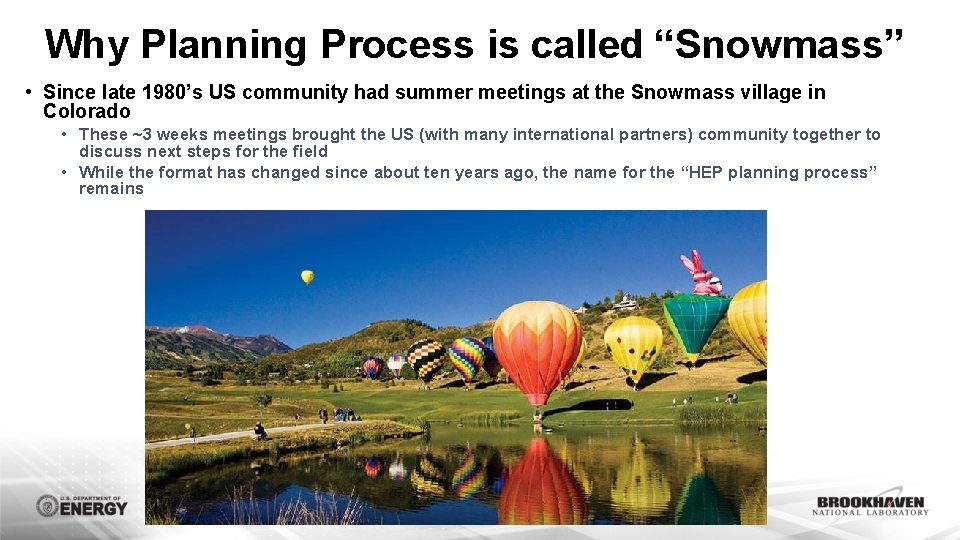
Why Planning Process is called “Snowmass” • Since late 1980’s US community had summer meetings at the Snowmass village in Colorado • These ~3 weeks meetings brought the US (with many international partners) community together to discuss next steps for the field • While the format has changed since about ten years ago, the name for the “HEP planning process” remains 6
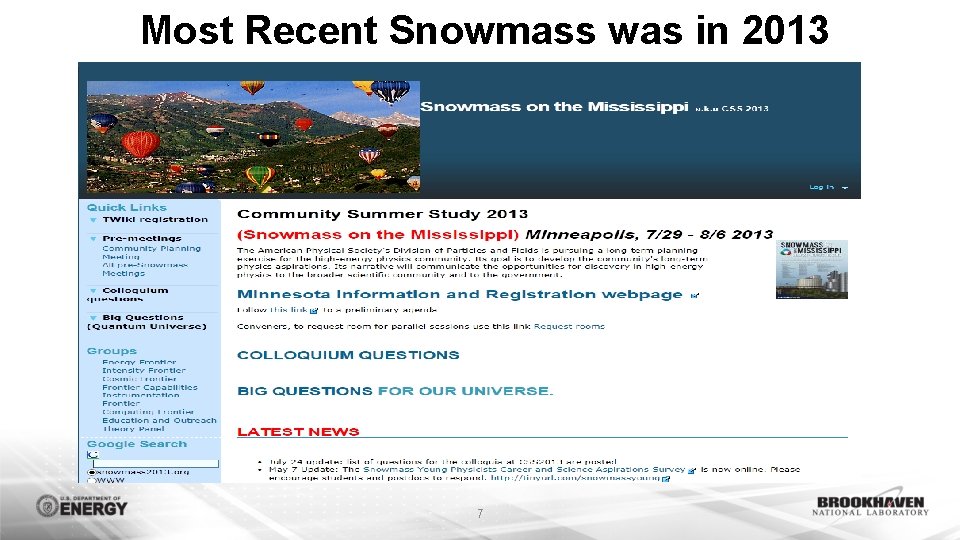
Most Recent Snowmass was in 2013 7
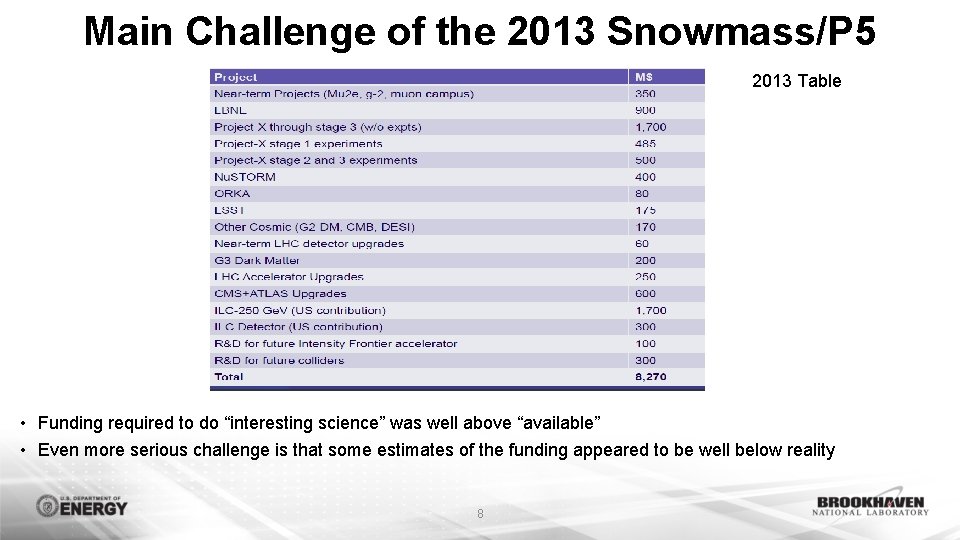
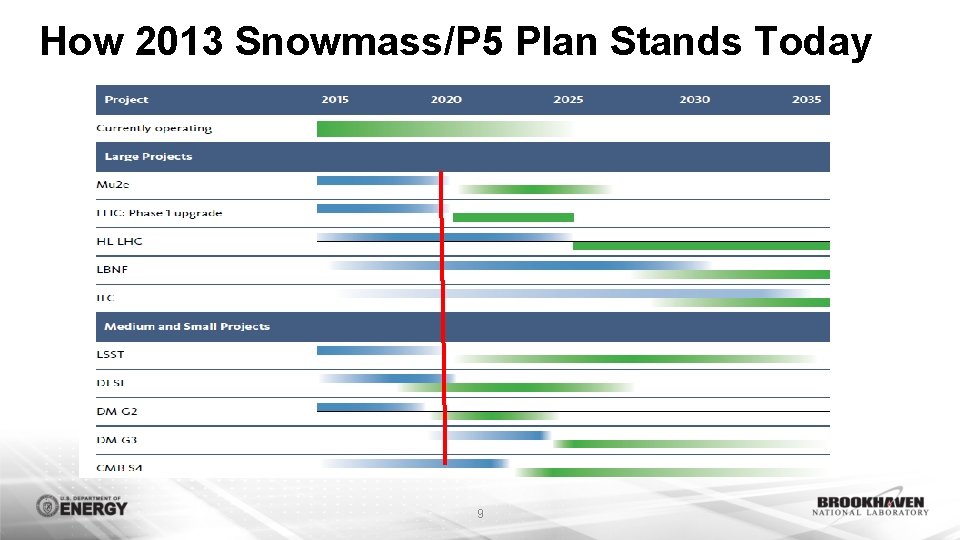
Main Challenge of the 2013 Snowmass/P 5 2013 Table • Funding required to do “interesting science” was well above “available” • Even more serious challenge is that some estimates of the funding appeared to be well below reality 8
How 2013 Snowmass/P 5 Plan Stands Today 9
Preparations for the Next Snowmass • Why next Snowmass • New science and technological developments accumulated over past ~8 years • Beyond 2026 funding in HEP is expected to become available for “next large/medium projects” • In the “new” Snowmass format • Proposals have to be developed in advance • Good proposal includes • Excellent physics goals • Technical implementation description • Cost estimate and schedule • To develop a proposal at least a year of concentrated efforts is usually required • With Snowmass coming in 2020 preparations of the new proposals have to start soon • Projects already listed in previous P 5 plan and under execution are not expected to be part of the discussion • While substantial upgrades, such as Mu 2 e-II or DUNE upgrades, are naturally to be discussed • Examples • ATLAS/CMS upgrades beyond HL-LHC • Various cosmic and dark matter experiments • FCC, ILC and colliders in China • It is not “BNL projects” planning, it is developing scientific proposals for US particle physics • Joint efforts between laboratories and universities and in close cooperation with international HEP community 10
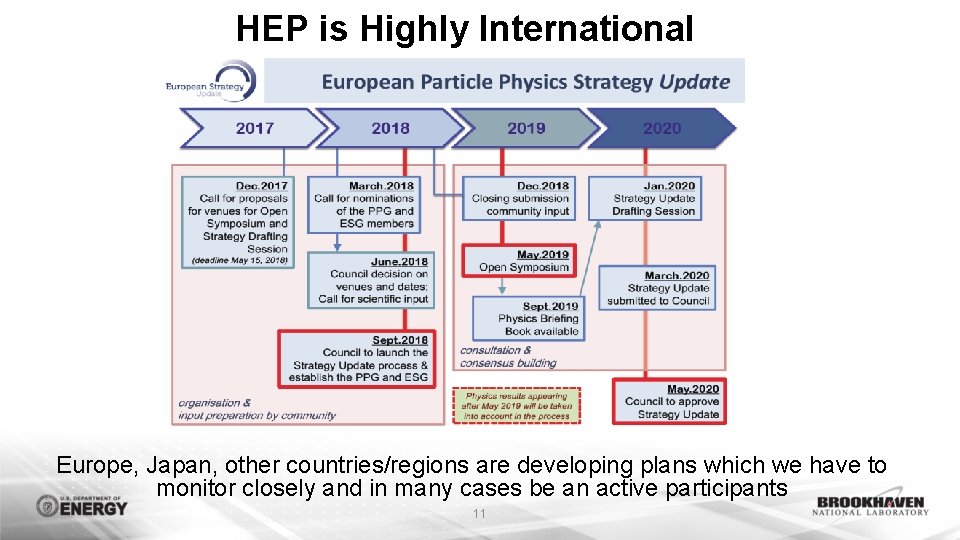
HEP is Highly International Europe, Japan, other countries/regions are developing plans which we have to monitor closely and in many cases be an active participants 11
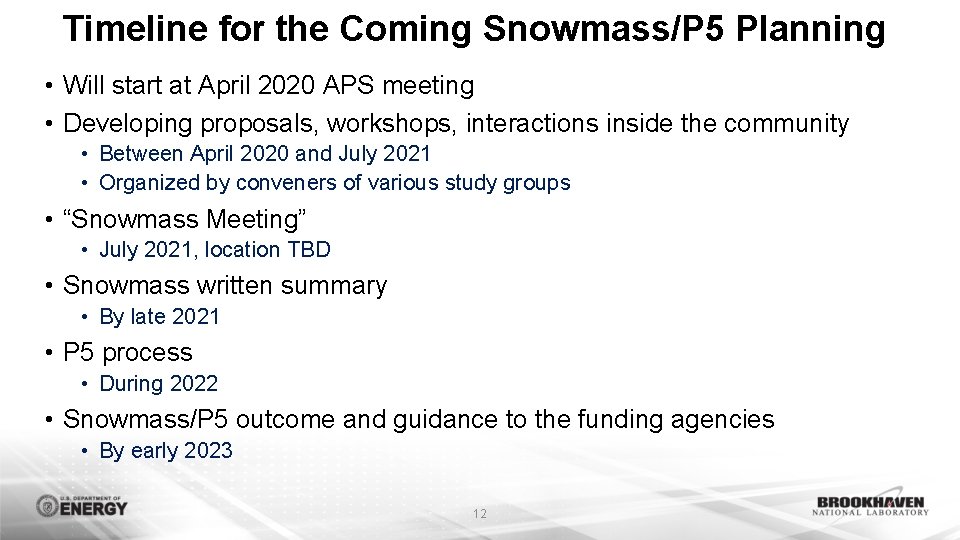
Timeline for the Coming Snowmass/P 5 Planning • Will start at April 2020 APS meeting • Developing proposals, workshops, interactions inside the community • Between April 2020 and July 2021 • Organized by conveners of various study groups • “Snowmass Meeting” • July 2021, location TBD • Snowmass written summary • By late 2021 • P 5 process • During 2022 • Snowmass/P 5 outcome and guidance to the funding agencies • By early 2023 12
Concluding Remarks • Next HEP planning process is about to start • It is important for us to participate to shape the future of our field! • DPF is working on finalizing working groups • Call for conveners will be issued soon • The process is guided by DPF – not funding agencies or laboratories • Funding agencies are not planning to provide “special funding” to support Snowmass activities, while expect all of us will spend a fraction of time planning for long term future • We will work on providing support • Snowmass efforts should not jeopardies existing programs • We will have a series of meetings at BNL in the coming months to discuss various potential future activities/ideas/projects • If there is no time for you to present your ideas today – there will be plenty of opportunities in the future • At some point we will select areas where we would like to concentrate 13
2013 Snowmass Aspirations - I • Probe the highest possible energies and smallest distance scales with the existing and upgraded Large Hadron Collider and reach for even higher precision with a lepton collider; study the properties of the Higgs boson in full detail • Develop technologies for the long-term future to build multi-Te. V lepton colliders and 100 Te. V hadron colliders • Execute a program with the U. S. as host that provides precision tests of the neutrino sector with an underground detector; search for new physics in quark and lepton decays in conjunction with precision measurements of electric dipole and anomalous magnetic moments • Identify the particles that make up dark matter through complementary experiments deep underground, on the Earth’s surface, and in space, and determine the properties of the dark sector • Map the evolution of the universe to reveal the origin of cosmic inflation, unravel the mystery of dark energy, and determine the ultimate fate of the cosmos 14
2013 Snowmass Aspirations - II • Invest in the development of new, enabling instrumentation and accelerator technologies • Invest in advanced computing technology and programming expertise essential to both experiment and theory • Carry on theoretical work in support of these projects and to explore new unifying frameworks • Invest in the training of physicists to develop the most creative minds to generate new ideas in theory and experiment that advance science and benefit the broader society • Increase our efforts to convey the excitement of our field to others 15