
High Energy Physics Program Status Jim Siegrist Associate



- Slides: 33
High Energy Physics Program Status Jim Siegrist Associate Director Office of High Energy Physics Office of Science, U. S. Department of Energy
Outline • • • Overview Program Status and Accomplishments HEP Budget and Issues HEP Funding Opportunities Office News 2
Take-Away Messages • HEP is global – P 5 strategic plan explicitly recognizes this fact, as does DOE implementation – Highest priority major projects are LHC upgrades (near-term) and LBNF (mid-term) • LBNF will be the first truly international experiment hosted by the U. S. , with management modeled after the successful LHC scheme • We share the community’s enthusiastic response to the P 5 strategic plan – We are moving forward with implementation in targeted areas – But given the current fiscal environment, full implementation of the plan will take some time • 2015 will be an important year – First results from LHC Run 2, NOn. A – Further development of short- and long-baseline neutrino program – International agreements start coming into view 3
HEP PROGRAM STATUS
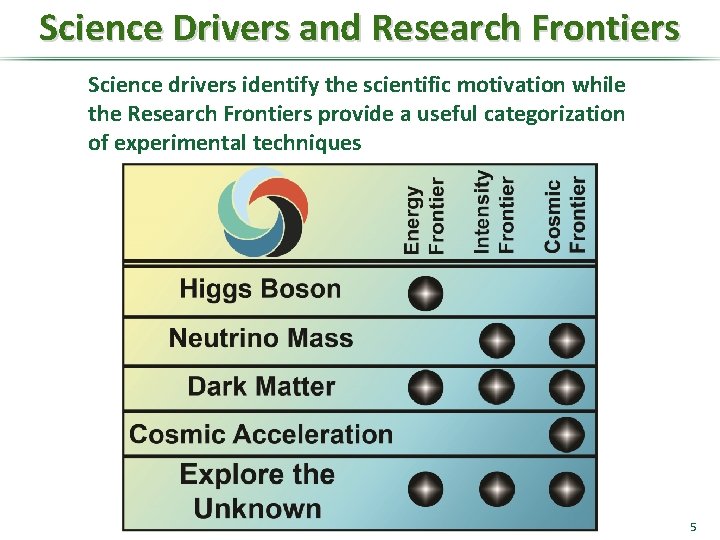
Science Drivers and Research Frontiers Science drivers identify the scientific motivation while the Research Frontiers provide a useful categorization of experimental techniques 5
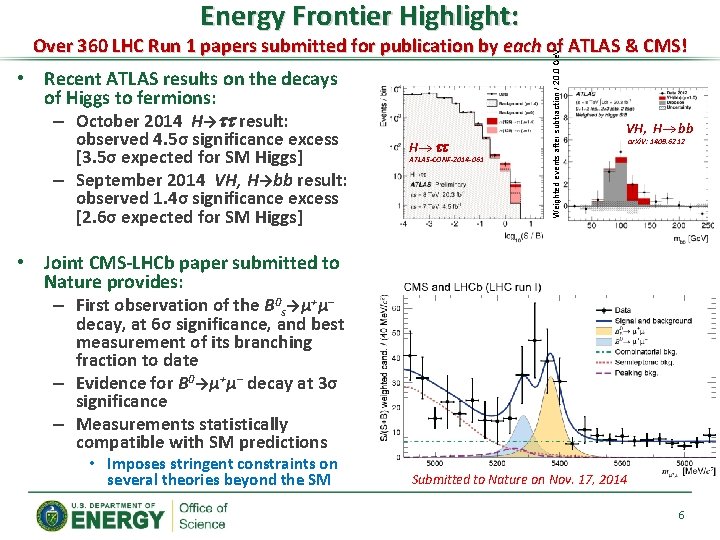
Energy Frontier Highlight: • Recent ATLAS results on the decays of Higgs to fermions: – October 2014 H→tt result: observed 4. 5σ significance excess [3. 5σ expected for SM Higgs] – September 2014 VH, H→bb result: observed 1. 4σ significance excess [2. 6σ expected for SM Higgs] H ® tt ATLAS-CONF-2014 -061 Weighted events after subtraction / 20. 0 Ge. V Over 360 LHC Run 1 papers submitted for publication by each of ATLAS & CMS! VH, H ® bb ar. Xi. V: 1409. 6212 • Joint CMS-LHCb paper submitted to Nature provides: – First observation of the B 0 s→μ+μ− decay, at 6σ significance, and best measurement of its branching fraction to date – Evidence for B 0→μ+μ− decay at 3σ significance – Measurements statistically compatible with SM predictions • Imposes stringent constraints on several theories beyond the SM Submitted to Nature on Nov. 17, 2014 6
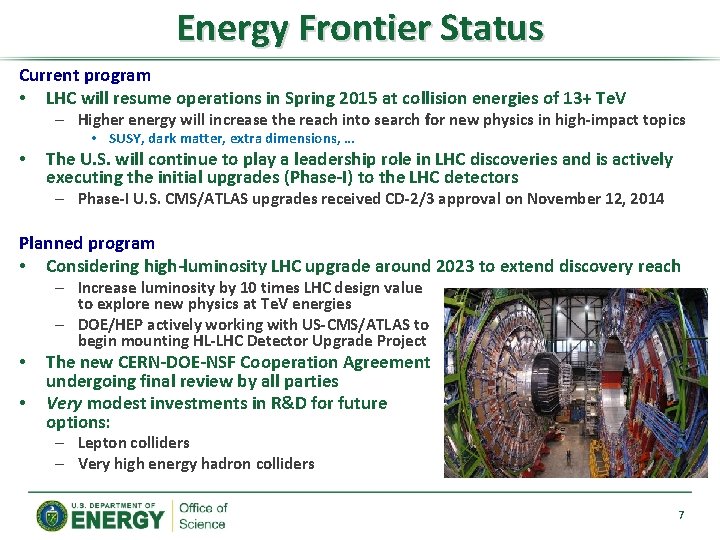
Energy Frontier Status Current program • LHC will resume operations in Spring 2015 at collision energies of 13+ Te. V – Higher energy will increase the reach into search for new physics in high-impact topics • SUSY, dark matter, extra dimensions, … • The U. S. will continue to play a leadership role in LHC discoveries and is actively executing the initial upgrades (Phase-I) to the LHC detectors – Phase-I U. S. CMS/ATLAS upgrades received CD-2/3 approval on November 12, 2014 Planned program • Considering high-luminosity LHC upgrade around 2023 to extend discovery reach – Increase luminosity by 10 times LHC design value to explore new physics at Te. V energies – DOE/HEP actively working with US-CMS/ATLAS to begin mounting HL-LHC Detector Upgrade Project • • The new CERN-DOE-NSF Cooperation Agreement undergoing final review by all parties Very modest investments in R&D for future options: – Lepton colliders – Very high energy hadron colliders 7
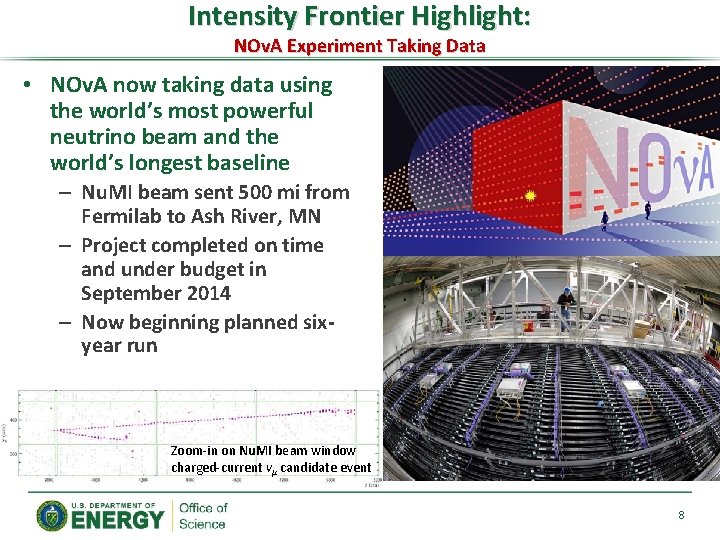
Intensity Frontier Highlight: NOv. A Experiment Taking Data • NOv. A now taking data using the world’s most powerful neutrino beam and the world’s longest baseline – Nu. MI beam sent 500 mi from Fermilab to Ash River, MN – Project completed on time and under budget in September 2014 – Now beginning planned sixyear run Zoom-in on Nu. MI beam window charged-current νμ candidate event 8
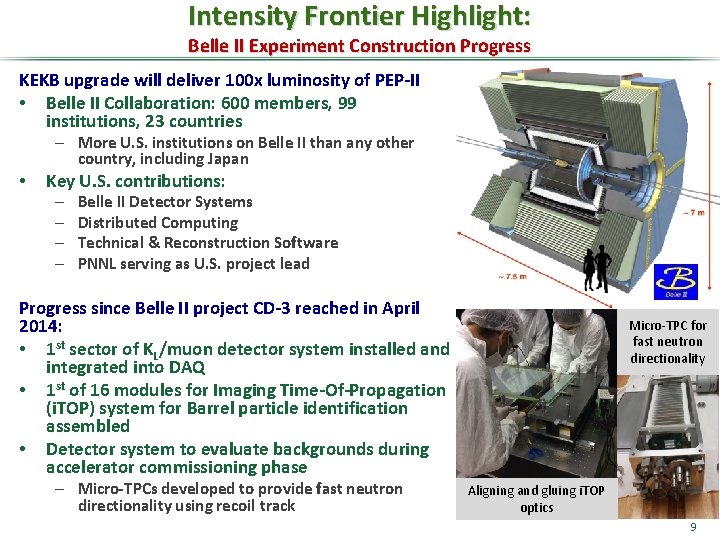
Intensity Frontier Highlight: Belle II Experiment Construction Progress KEKB upgrade will deliver 100 x luminosity of PEP-II • Belle II Collaboration: 600 members, 99 institutions, 23 countries – More U. S. institutions on Belle II than any other country, including Japan • Key U. S. contributions: – – Belle II Detector Systems Distributed Computing Technical & Reconstruction Software PNNL serving as U. S. project lead Progress since Belle II project CD-3 reached in April 2014: • 1 st sector of KL/muon detector system installed and integrated into DAQ • 1 st of 16 modules for Imaging Time-Of-Propagation (i. TOP) system for Barrel particle identification assembled • Detector system to evaluate backgrounds during accelerator commissioning phase – Micro-TPCs developed to provide fast neutron directionality using recoil track Micro-TPC for fast neutron directionality Aligning and gluing i. TOP optics 9
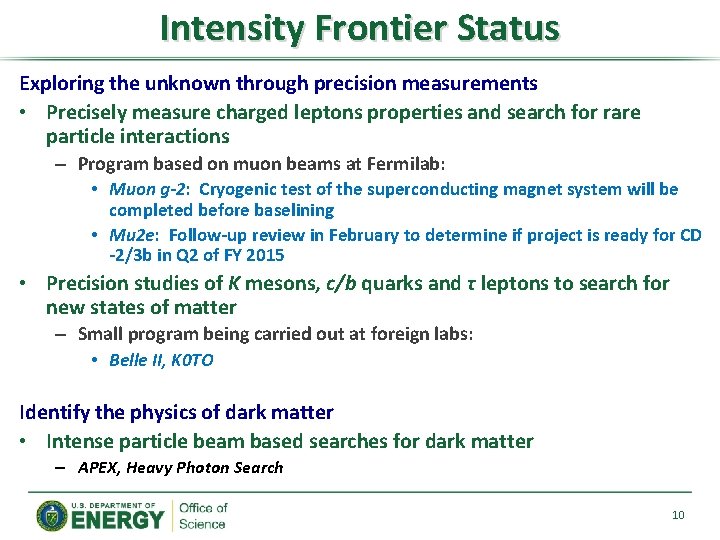
Intensity Frontier Status Exploring the unknown through precision measurements • Precisely measure charged leptons properties and search for rare particle interactions – Program based on muon beams at Fermilab: • Muon g-2: Cryogenic test of the superconducting magnet system will be completed before baselining • Mu 2 e: Follow-up review in February to determine if project is ready for CD -2/3 b in Q 2 of FY 2015 • Precision studies of K mesons, c/b quarks and τ leptons to search for new states of matter – Small program being carried out at foreign labs: • Belle II, K 0 TO Identify the physics of dark matter • Intense particle beam based searches for dark matter – APEX, Heavy Photon Search 10
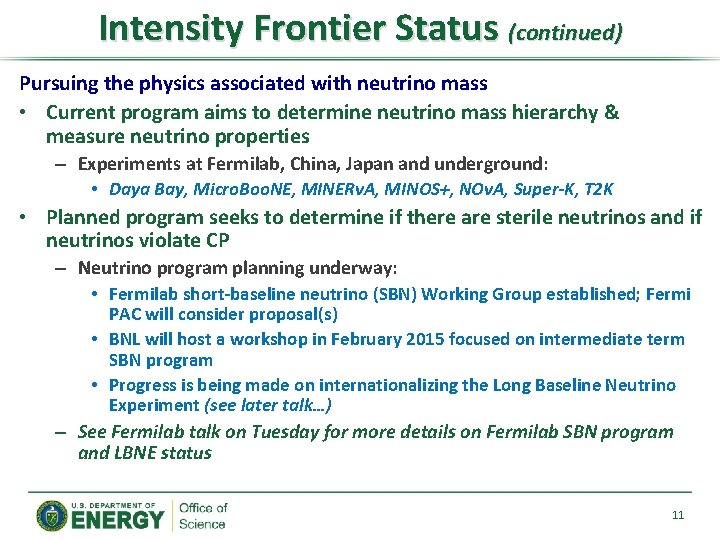
Intensity Frontier Status (continued) Pursuing the physics associated with neutrino mass • Current program aims to determine neutrino mass hierarchy & measure neutrino properties – Experiments at Fermilab, China, Japan and underground: • Daya Bay, Micro. Boo. NE, MINERv. A, MINOS+, NOv. A, Super-K, T 2 K • Planned program seeks to determine if there are sterile neutrinos and if neutrinos violate CP – Neutrino program planning underway: • Fermilab short-baseline neutrino (SBN) Working Group established; Fermi PAC will consider proposal(s) • BNL will host a workshop in February 2015 focused on intermediate term SBN program • Progress is being made on internationalizing the Long Baseline Neutrino Experiment (see later talk…) – See Fermilab talk on Tuesday for more details on Fermilab SBN program and LBNE status 11
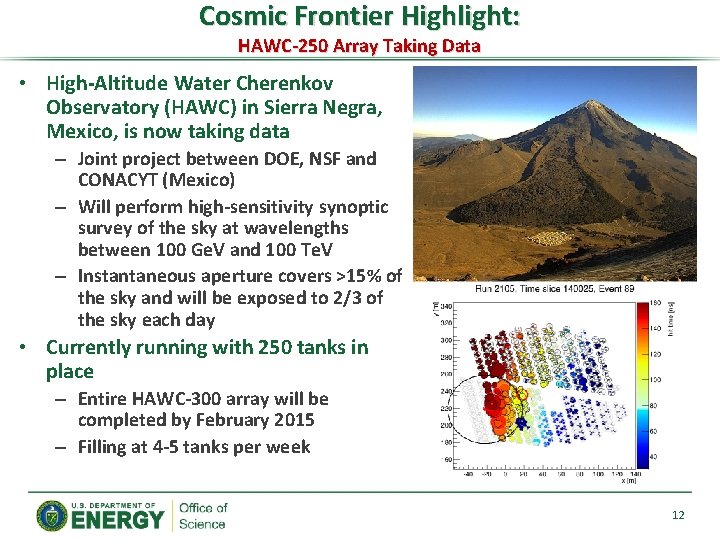
Cosmic Frontier Highlight: HAWC-250 Array Taking Data • High-Altitude Water Cherenkov Observatory (HAWC) in Sierra Negra, Mexico, is now taking data – Joint project between DOE, NSF and CONACYT (Mexico) – Will perform high-sensitivity synoptic survey of the sky at wavelengths between 100 Ge. V and 100 Te. V – Instantaneous aperture covers >15% of the sky and will be exposed to 2/3 of the sky each day • Currently running with 250 tanks in place – Entire HAWC-300 array will be completed by February 2015 – Filling at 4 -5 tanks per week 12
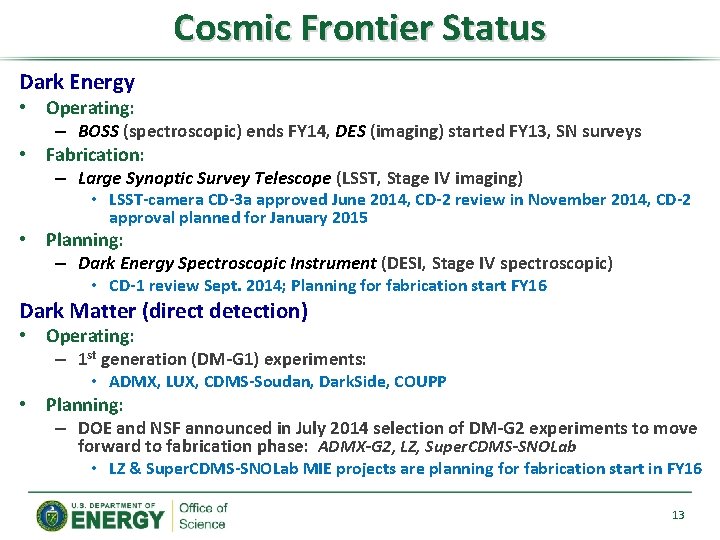
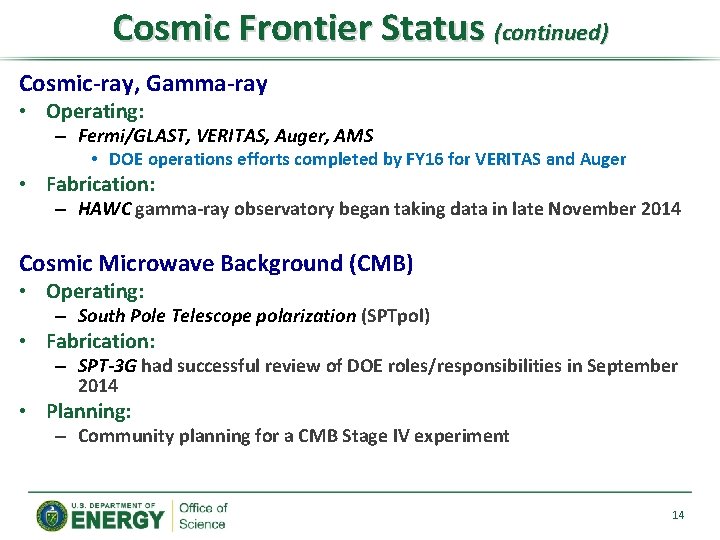
Cosmic Frontier Status Dark Energy • Operating: – BOSS (spectroscopic) ends FY 14, DES (imaging) started FY 13, SN surveys • Fabrication: – Large Synoptic Survey Telescope (LSST, Stage IV imaging) • LSST-camera CD-3 a approved June 2014, CD-2 review in November 2014, CD-2 approval planned for January 2015 • Planning: – Dark Energy Spectroscopic Instrument (DESI, Stage IV spectroscopic) • CD-1 review Sept. 2014; Planning for fabrication start FY 16 Dark Matter (direct detection) • Operating: – 1 st generation (DM-G 1) experiments: • ADMX, LUX, CDMS-Soudan, Dark. Side, COUPP • Planning: – DOE and NSF announced in July 2014 selection of DM-G 2 experiments to move forward to fabrication phase: ADMX-G 2, LZ, Super. CDMS-SNOLab • LZ & Super. CDMS-SNOLab MIE projects are planning for fabrication start in FY 16 13
Cosmic Frontier Status (continued) Cosmic-ray, Gamma-ray • Operating: – Fermi/GLAST, VERITAS, Auger, AMS • DOE operations efforts completed by FY 16 for VERITAS and Auger • Fabrication: – HAWC gamma-ray observatory began taking data in late November 2014 Cosmic Microwave Background (CMB) • Operating: – South Pole Telescope polarization (SPTpol) • Fabrication: – SPT-3 G had successful review of DOE roles/responsibilities in September 2014 • Planning: – Community planning for a CMB Stage IV experiment 14
INTERNATIONAL AGREEMENTS See International Status talk later today…
HEP BUDGET AND ISSUES
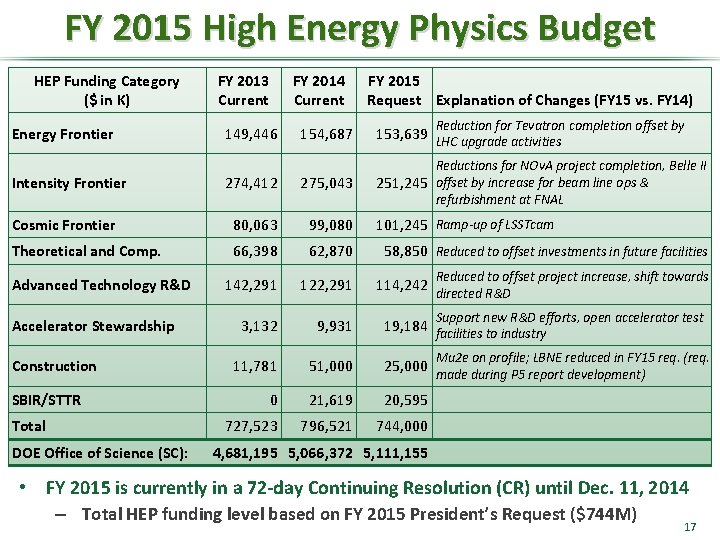
FY 2015 High Energy Physics Budget HEP Funding Category ($ in K) Energy Frontier FY 2013 Current FY 2014 Current Reduction for Tevatron completion offset by 154, 687 153, 639 LHC upgrade activities 274, 412 275, 043 Reductions for NOv. A project completion, Belle II 251, 245 offset by increase for beam line ops & refurbishment at FNAL Cosmic Frontier 80, 063 99, 080 Theoretical and Comp. 66, 398 62, 870 142, 291 122, 291 3, 132 9, 931 11, 781 51, 000 25, 000 made during P 5 report development) 0 21, 619 20, 595 727, 523 796, 521 744, 000 Intensity Frontier Advanced Technology R&D Accelerator Stewardship Construction SBIR/STTR Total DOE Office of Science (SC): 149, 446 FY 2015 Request Explanation of Changes (FY 15 vs. FY 14) 101, 245 Ramp-up of LSSTcam 58, 850 Reduced to offset investments in future facilities Reduced to offset project increase, shift towards 114, 242 directed R&D Support new R&D efforts, open accelerator test 19, 184 facilities to industry Mu 2 e on profile; LBNE reduced in FY 15 req. (req. 4, 681, 195 5, 066, 372 5, 111, 155 • FY 2015 is currently in a 72 -day Continuing Resolution (CR) until Dec. 11, 2014 – Total HEP funding level based on FY 2015 President’s Request ($744 M) 17
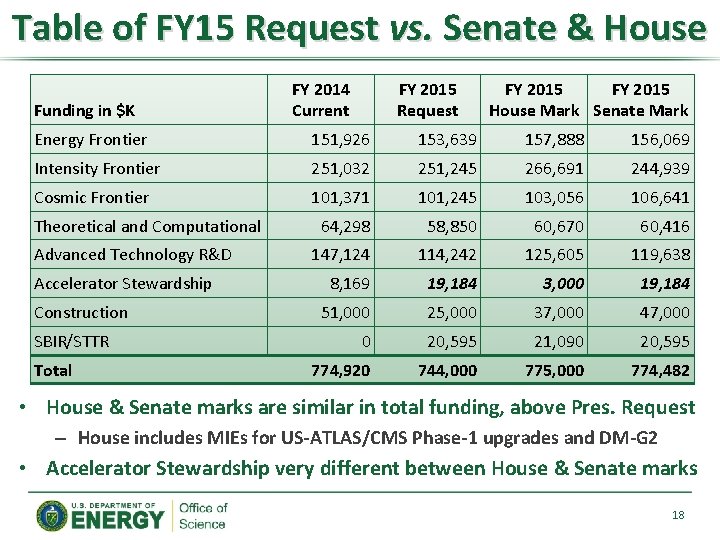
Table of FY 15 Request vs. Senate & House Funding in $K FY 2014 Current FY 2015 Request FY 2015 House Mark Senate Mark Energy Frontier 151, 926 153, 639 157, 888 156, 069 Intensity Frontier 251, 032 251, 245 266, 691 244, 939 Cosmic Frontier 101, 371 101, 245 103, 056 106, 641 64, 298 58, 850 60, 670 60, 416 147, 124 114, 242 125, 605 119, 638 8, 169 19, 184 3, 000 19, 184 51, 000 25, 000 37, 000 47, 000 0 20, 595 21, 090 20, 595 774, 920 744, 000 775, 000 774, 482 Theoretical and Computational Advanced Technology R&D Accelerator Stewardship Construction SBIR/STTR Total • House & Senate marks are similar in total funding, above Pres. Request – House includes MIEs for US-ATLAS/CMS Phase-1 upgrades and DM-G 2 • Accelerator Stewardship very different between House & Senate marks 18
Implementing the P 5 Plan • DOE HEP has updated the staff in the House and Senate about how the P 5 report strategy affects our plans for FY 15 • Current Continuing Resolution (CR) ends December 11 (this week) • Plans for implementing our program depend on the final appropriation: – A CR at the FY 15 Request level creates complications, but should enable us to implement Scenario A of the P 5 report strategy – A full appropriation or CR at the House/Senate markup level would allow us to begin implementation of Scenario B of the P 5 report strategy 19
Implementing the P 5 Plan (continued) • We are working through project profiles with the laboratories to ensure the P 5 priorities are respected and there is no damage to the program under the possible funding scenarios – Projects that are baselined or nearly baselined will be fully funded • This includes the LHC Phase I upgrades, Mu 2 e, and LSST – High-priority near-term efforts like DM-G 2 experiments will get enough funding to keep them going through the CR • We will try to enhance their funding after an appropriation is passed • Laboratories have been asked to defer costs in anticipation of shortfalls • University research may also be impacted – CR at current level (FY 15 Request) would lead to 3 -5% reductions in university grant support – Will try to restore this to “flat cash” in the case of an appropriation near Congressional marks 20
HEP FUNDING OPPORTUNITIES
Funding Opportunity Announcement Status • Scientific Discovery through Advanced Computing (Sci. DAC) FOA is open (High Energy Physics joint with ASCR) – will close Jan 7, 2015 – http: //science. energy. gov/~/media/grants/pdf/foas/2015/SC_FOA_0001210. pdf • The HEP research FY 2015 Funding Opportunity Announcement (FOA) is closed and we are performing the comparative review – Review process underway and PIs will start to be informed of funding decisions in January • The Accelerator Stewardship FOA is now closed – Reviews completed, consulting with partners in SC and other agencies – Final decisions will not be made until after FY 15 appropriation • Early Career Research Program FOA is now closed – Proposals were due by November 20, and we are now preparing for review • DOE Office of Science Graduate Student Research (SCGSR) Program is now closed – Review process near completion and award notifications planned to be sent out in December 22
OFFICE NEWS AND MISCELLANY
HEP Program Status Updates • New Assignments – Abid Patwa is managing U. S. LHC Operations • Comings and Goings William Kilgore (Detailee) is now helping in Theoretical Physics Eric Linder (Cosmic IPA) will begin in January 2015 New Contractors and IPA (Intensity) identified, starting soon David Boehnlein (Energy Frontier IPA), Peter Kim (Detector R&D Detailee), and Larry Price (Computing Detailee) finish their terms in early 2015 – Working on new Fed staff position TBA – Additional help welcome to aid with P 5 implementation! – – • Interested parties should contact HEP management 24
HEP S&T Connections Thrust • Aim of thrust is to strengthen connections with other SC Programs and the broader national Science & Technology enterprise – Advance our mission by probing new windows to discovery by synergistic collaborations – Accelerate science productivity by drawing on unique expertise and strengths within partnering disciplines • Near-term plans include: – Exploit designer materials capabilities for HEP science and technology – Discover research techniques using expertise from partnering programs – Explore condensed matter & atomic systems that advance HEP science and verify models – Pursue Quantum Information Systems as a window to the Universe – Broaden the user communities for HEP facilities through new applications outside HEP 25
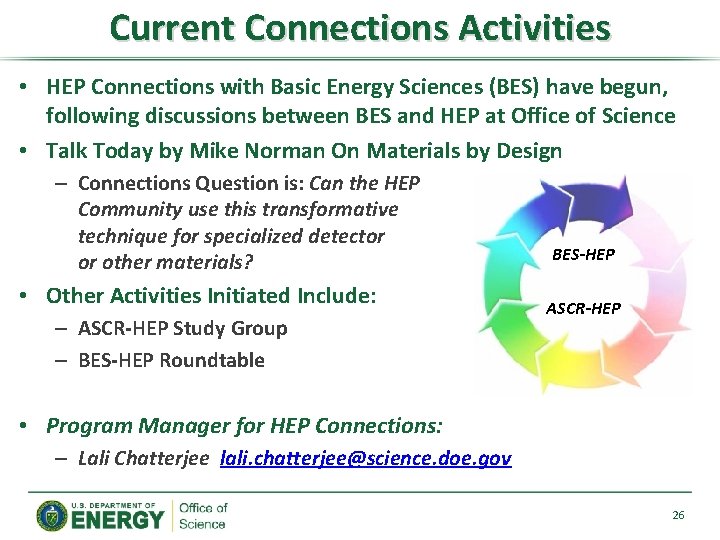
Current Connections Activities • HEP Connections with Basic Energy Sciences (BES) have begun, following discussions between BES and HEP at Office of Science • Talk Today by Mike Norman On Materials by Design – Connections Question is: Can the HEP Community use this transformative technique for specialized detector or other materials? • Other Activities Initiated Include: – ASCR-HEP Study Group – BES-HEP Roundtable BES-HEP ASCR-HEP • Program Manager for HEP Connections: – Lali Chatterjee lali. chatterjee@science. doe. gov 26
Take-Away Messages • HEP is global – P 5 strategic plan explicitly recognizes this fact, as does DOE implementation – Highest priority major projects are LHC upgrades (near-term) and LBNF (mid-term) • LBNF will be the first truly international experiment hosted by the U. S. , with management modeled after the successful LHC scheme • We share the community’s enthusiastic response to the P 5 strategic plan – We are moving forward with implementation in targeted areas – But given the current fiscal environment, full implementation of the plan will take some time • 2015 will be an important year – First results from LHC Run 2, NOn. A – Further development of short- and long-baseline neutrino program – International agreements start coming into view 27
BACKUP
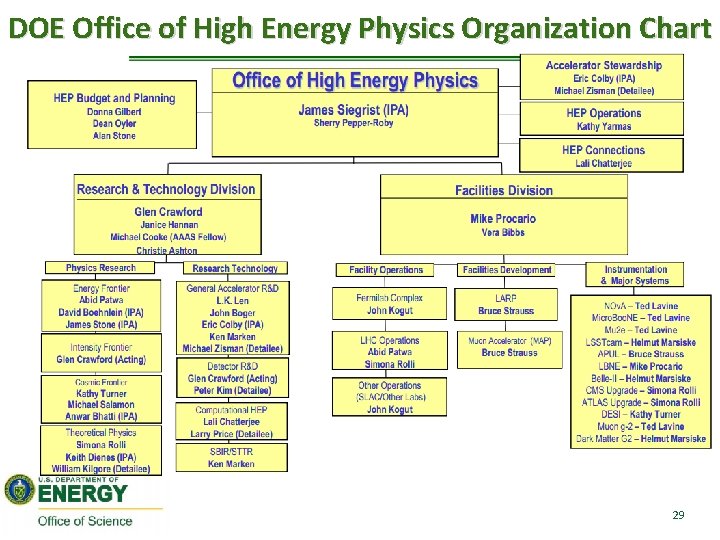
DOE Office of High Energy Physics Organization Chart 29 29
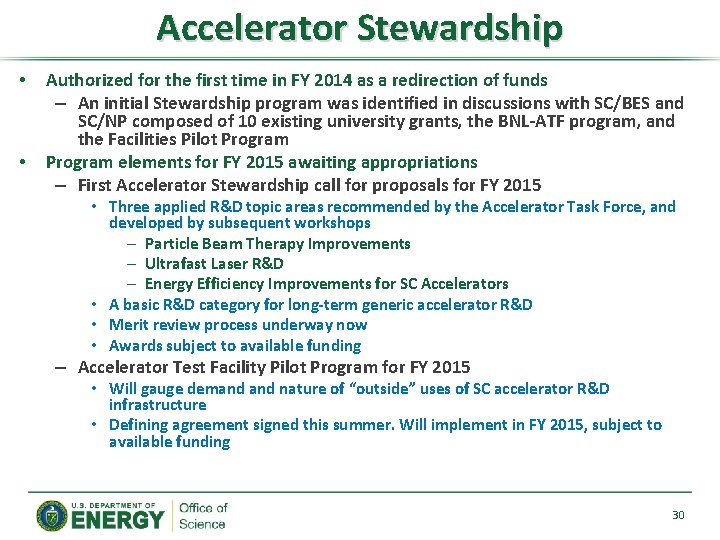
Accelerator Stewardship • • Authorized for the first time in FY 2014 as a redirection of funds – An initial Stewardship program was identified in discussions with SC/BES and SC/NP composed of 10 existing university grants, the BNL-ATF program, and the Facilities Pilot Program elements for FY 2015 awaiting appropriations – First Accelerator Stewardship call for proposals for FY 2015 • Three applied R&D topic areas recommended by the Accelerator Task Force, and developed by subsequent workshops – Particle Beam Therapy Improvements – Ultrafast Laser R&D – Energy Efficiency Improvements for SC Accelerators • A basic R&D category for long-term generic accelerator R&D • Merit review process underway now • Awards subject to available funding – Accelerator Test Facility Pilot Program for FY 2015 • Will gauge demand nature of “outside” uses of SC accelerator R&D infrastructure • Defining agreement signed this summer. Will implement in FY 2015, subject to available funding 30
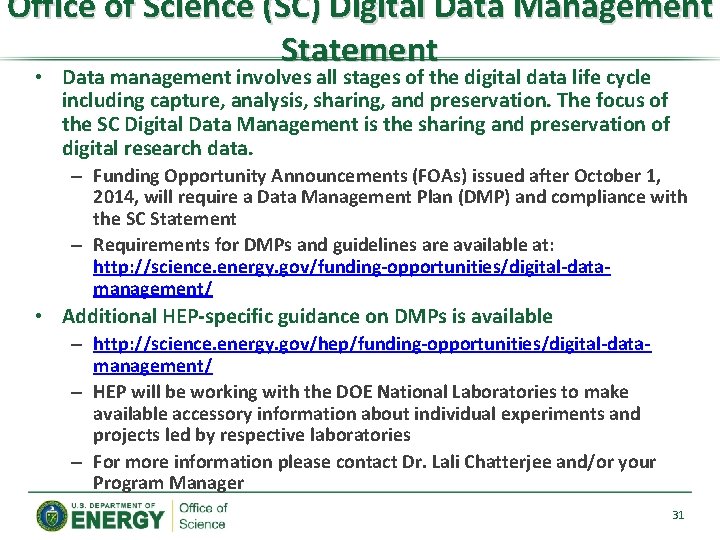
Office of Science (SC) Digital Data Management Statement • Data management involves all stages of the digital data life cycle including capture, analysis, sharing, and preservation. The focus of the SC Digital Data Management is the sharing and preservation of digital research data. – Funding Opportunity Announcements (FOAs) issued after October 1, 2014, will require a Data Management Plan (DMP) and compliance with the SC Statement – Requirements for DMPs and guidelines are available at: http: //science. energy. gov/funding-opportunities/digital-datamanagement/ • Additional HEP-specific guidance on DMPs is available – http: //science. energy. gov/hep/funding-opportunities/digital-datamanagement/ – HEP will be working with the DOE National Laboratories to make available accessory information about individual experiments and projects led by respective laboratories – For more information please contact Dr. Lali Chatterjee and/or your Program Manager 31
HEP Science & Technology Connections Thrust P 5 noted the importance of our Benefits and Connections to Society • HEP has initiated discussions internally with some of the other SC Programs to start building stronger connections – Explore new experimental systems and techniques – Exploit transformative capabilities available in adjacent scientific disciplines With aims to advance HEP science drivers, test our models and contribute to our S&T environment • Thanks to those who submitted Nominations for an HEP Connections Committee – We are not forming this HEP specific committee at this time – We will keep your nominees in mind as planning progresses with potential partner communities • For more information contact Lali Chatterjee: lali. chatterjee@science. doe. gov 32
HEP Forum for Computational Excellence (FCE) • HEP-FCE is a pilot project to strengthen scientific computing within our field as part of DOE HEP’s response to P 5 Recommendations on Computing – Explore next-generation hardware and data-science software and foster more crosslaboratory and university-laboratory collaboration – Current website: http: //press 3. mcs. anl. gov/hepfce/ • FCE Roles – – – – • Computing planning input R&D portfolio focused on cross-cutting tasks Computational support for smaller experiments Cross-cutting knowledge/capability base Training/Workshop activities Data archiving/curation/management contact point Strategic connectivity for DOE HEP program Build HEP-FCE community hub FCE Organization – Directors: S. Habib (ANL) and R. Roser (FNAL) – Advisory Panel Members: D. Asner (PNNL), P. Avery (Florida), A. Boehnlein (SLAC), C. Tull (LBNL), T. Wenaus (BNL), + Additional University Members. • Currently, three FCE working groups are looking at cross-cutting HEP computing needs 33