
High Energy Particle Physics group and the AstroParticle

- Slides: 26
High Energy Particle Physics group and the Astro-Particle Physics group of the Institute of Physics Brian R Bowsher STFC Chief Executive 11 April 2017
CONTENTS 1. 2. 3. 4. 5. Highlights Balance of Programmes - PPAN Budget issues Horizon scanning Questions
Impact Report 2016 -2017 • Our frontier research in astronomy, particle physics and nuclear physics ranks first in the world measured by citation impact. We invested more than £ 160 million in 2015/16 in these areas, supporting a community of over 1, 000 academics in 86 universities.
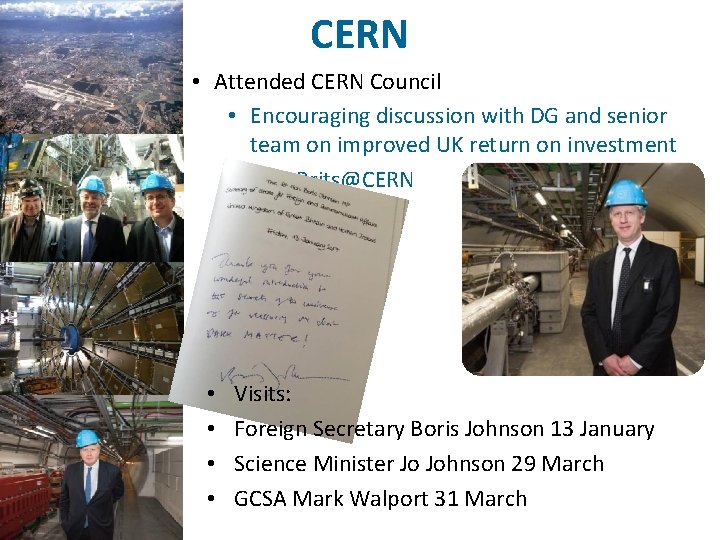
CERN • Attended CERN Council • Encouraging discussion with DG and senior team on improved UK return on investment • Met Brits@CERN • • Visits: Foreign Secretary Boris Johnson 13 January Science Minister Jo Johnson 29 March GCSA Mark Walport 31 March
Particle astrophysics • Strong support for vibrant UK gravitational waves (GW) community • UK institutes had critical development role in first LIGO detection • Direct dark matter searches with LUX-ZEPLIN • UK is major partner in construction phase of this US-led project • LZ has now successfully passed the DOE CD-2 and CD-3 reviews - final design accepted and construction phase formally launched • VHE gamma ray astronomy with international Cherenkov Telescope Array (CTA) project • Project currently in pre-production phase
Consolidated Grants • Particle Physics Theory (PPT) consolidated grants announced in November 2016 • Awards to 23 UK institutes (including IPPP from October 2018). Total funding £ 17. 8 M over 3 years from October 2017. • Particle Physics Experimental (PPE) grants capital equipment announced in January 2017 • Final part of the PPE 2015 consolidated grants round • Proposals encouraged for more strategic investments to sustain international UK leadership and enhance UK technology capability. • Total funding £ 1. 5 M awarded to end of current CG period
CONTENTS 1. 2. 3. 4. 5. Highlights Balance of Programmes - PPAN Budget issues Horizon scanning Questions
Background: Nature of Issues • PPAN budget ~35% real reduction from 2010 to 2020 based on indicative allocations • STFC’s strategic core programme has unique characteristics • Strong linkage with international subscriptions • Significant component of programme is development, construction and delivery of national commitments • Decadal nature of infrastructure investments in astronomy, nuclear and particle physics • Often linked with international experiments funded directly through the core programme • High level commitment of programme to exploit the experiments or analyse data • Long term planning results in minimal forward ‘headroom’ (all 17/18 budget is effectively committed)
Terms of Reference • The Science Board Sub Group was asked to advise the most appropriate balance between STFC’s key research areas: • Astronomy • Nuclear Physics • Particle Astrophysics • Accelerators for the above • Computing for the above • Sub-Group considered the breadth within each research area, the balance between R&D, construction and scientific exploitation, and possible financial scenarios
Programme Balance 1 • Computing support at critical level with increase in capacity required to maintain UK competitiveness in PPAN disciplines • Particle Astrophysics area should be reviewed to allow it to mature into an established element of the PPAN programme • Nuclear Physics support at critical level, support needed to provide an appropriate level for PDRA funding • Accelerator Physics support also at critical level
Programme Balance 2 • Astronomy overall balance is about right, and just adequate in breadth but signs that UK scientists lack the resources needed to lead key scientific exploitation of our large, international projects. Exploitation funding widely seen as under intense pressure • Particle Physics lacks sufficient funds to support the ATLAS and CMS Phase II upgrades, maintain UK leadership in the DUNE and Hyper-K future neutrino experiments, and maintain the current programme diversity • Increase in support for computing for the LHC and other PP exploitation (via Grid. PP) has placed additional pressure on available funds
Recommendations and next steps • Bo. P produced clear advice to STFC council and executive • In continuing flat cash world we must protect existing science wherever possible, even at the expense of future investment • Council considered the report and implications on 22 March • Welcomed the quality of advice and the huge volume of work • Executive will report more fully to Council in May • Implications of flat cash reviewed with BEIS throughout the last CSR and since our allocation was announced
CONTENTS 1. 2. 3. 4. 5. Highlights Balance of Programmes - PPAN Budget issues Horizon scanning Questions
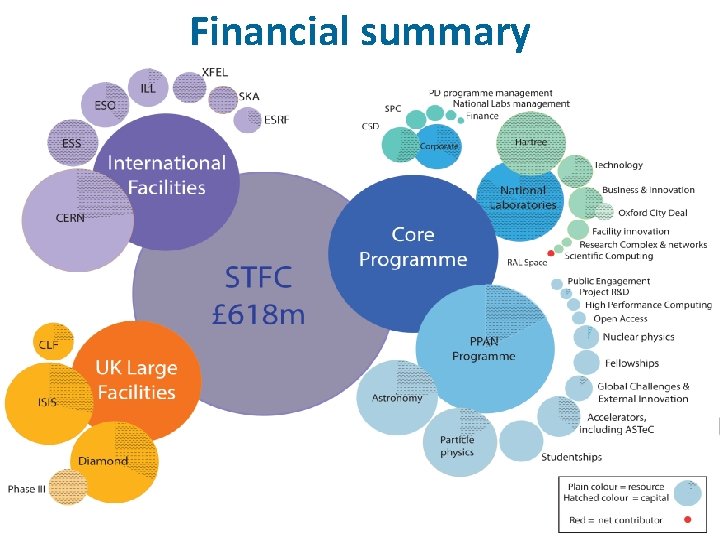
Financial summary
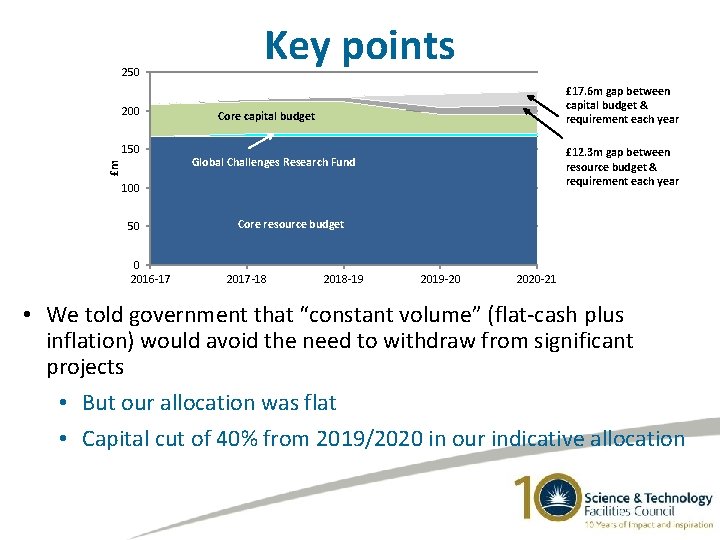
250 200 £m 150 Key points £ 17. 6 m gap between capital budget & requirement each year Core capital budget £ 12. 3 m gap between resource budget & requirement each year Global Challenges Research Fund 100 50 0 2016 -17 Core resource budget 2017 -18 2018 -19 2019 -20 2020 -21 • We told government that “constant volume” (flat-cash plus inflation) would avoid the need to withdraw from significant projects • But our allocation was flat • Capital cut of 40% from 2019/2020 in our indicative allocation
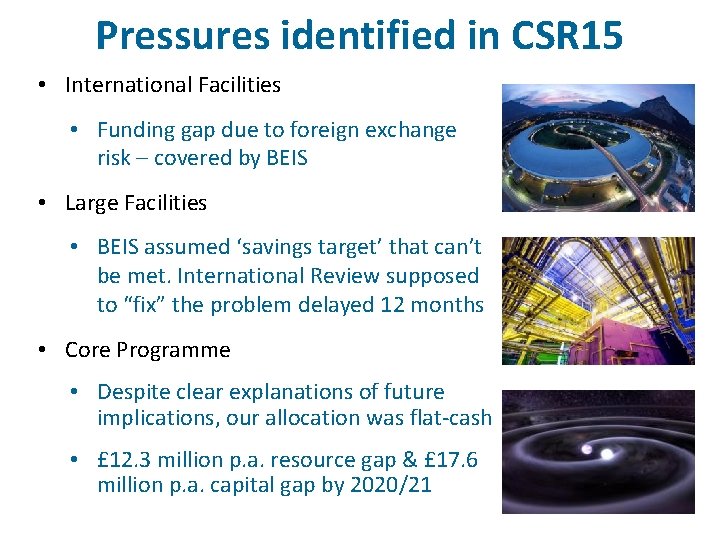
Pressures identified in CSR 15 • International Facilities • Funding gap due to foreign exchange risk – covered by BEIS • Large Facilities • BEIS assumed ‘savings target’ that can’t be met. International Review supposed to “fix” the problem delayed 12 months • Core Programme • Despite clear explanations of future implications, our allocation was flat-cash • £ 12. 3 million p. a. resource gap & £ 17. 6 million p. a. capital gap by 2020/21
Autumn Statement • Additional £ 4. 7 billion over four years for science and innovation • £ 425 million in 2017/18, rising to £ 2 billion in 2020/21 • Industrial Strategy Challenge Fund dominated the allocation • Relatively little extra for ‘research capacity’ or capital • Bids from STFC’s core programme areas unsuccessful • No GCRF funding for STFC’s science areas from first “open” call • Possibility of some new capital projects in 2018/19 but would need to ensure that ‘batteries not included’ isn’t exacerbated
STFC budget - 2017/18 • Rosalind Franklin Institute at Harwell, likely funding for NSTF • Autumn statement uplift in studentships across all Councils; likelihood of support for CDTs • Hints of support for facility issues But • Flat Cash in core, reduction in capital • Little benefit from centrally held funds like ISCF and GCRF • Exchange rate changes since referendum impacting on core programme, facilities (and future years’ subscriptions) • Increasing inflation • Inability to recruit appropriate skills within pay constraints • Apprentice levy • Energy increases
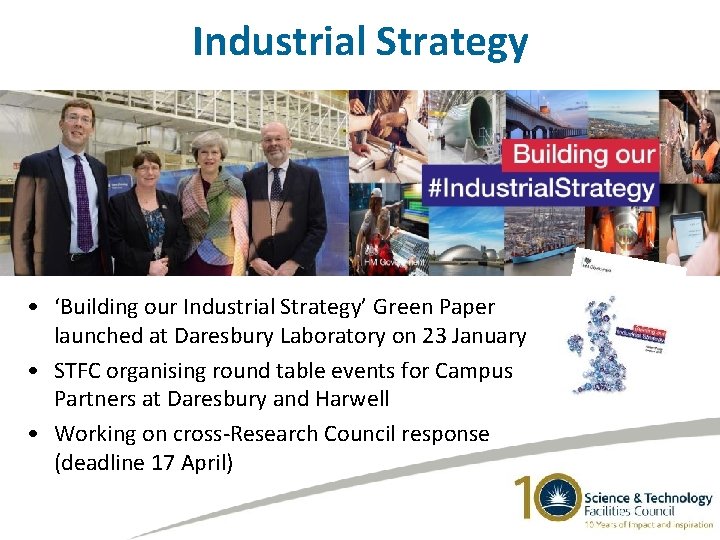
Industrial Strategy • ‘Building our Industrial Strategy’ Green Paper launched at Daresbury Laboratory on 23 January • STFC organising round table events for Campus Partners at Daresbury and Harwell • Working on cross-Research Council response (deadline 17 April)
Industrial Strategy Challenge Fund March Budget announcements, relating to: • Battery technology for electric vehicles • Artificial intelligence and robotics systems • New medicine manufacturing technologies • Ph. Ds and Fellowships in areas aligned with Industrial Strategy Further announcements expected for other challenges including satellites and space technology and transformative digital technologies
CONTENTS 1. 2. 3. 4. 5. Highlights Balance of Programmes - PPAN Budget issues Horizon scanning Questions
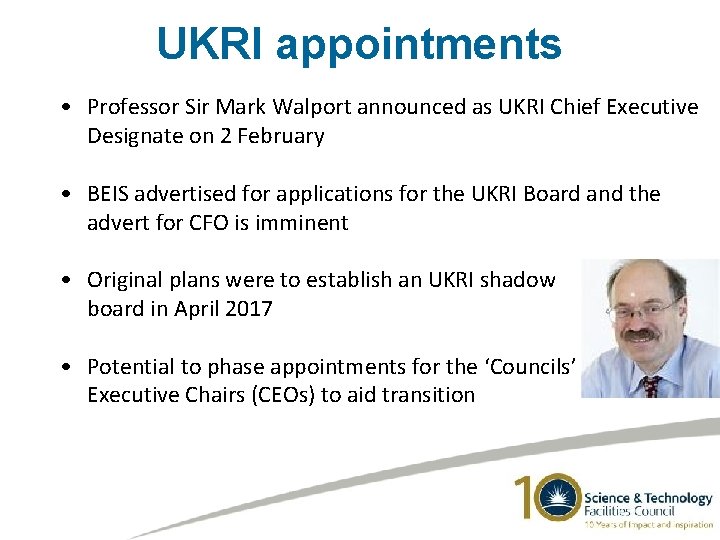
UKRI appointments • Professor Sir Mark Walport announced as UKRI Chief Executive Designate on 2 February • BEIS advertised for applications for the UKRI Board and the advert for CFO is imminent • Original plans were to establish an UKRI shadow board in April 2017 • Potential to phase appointments for the ‘Councils’ and Executive Chairs (CEOs) to aid transition
Brexit
Areas of potential impact • 10% of STFC staff are non-UK EU or EEA nationals • 80% of our EU staff are in SET roles • Large facility usage by non-UK EU academics • Foreign exchange rate fluctuations: • International subs variation covered by BEIS but LTA/T&S/procurement impact not covered • Loss of EU funding for university groups • Seven years of flat cash and loss of EU = real trouble for some
What next? • Focus on providing high quality data and analysis to Government • We want Ministers to understand the impact so they can plan to mitigate in advance, e. g. funding, movement of people, UK’s reputation as science lead • Brian Bowsher chairing group to advise Science Minister on impact on large scale infrastruture • Government committed to maintaining world leading position – one of their top Brexit negotiating positions • Looking for opportunities from the Government’s desire for UK to remain a world-class research nation
Questions?