
High energy cosmic rays ROBERTA SPARVOLI ROME TOR
High energy cosmic rays ROBERTA SPARVOLI ROME “TOR VERGATA” UNIVERSITY AND INFN, ITALY Nijmegen 2012

Lecture # 2 : outline ü SATELLITE AND ISS EXPERIMENTS ü FUTURE ACTIVITIES
Click to edit Master text styles Satellite flights
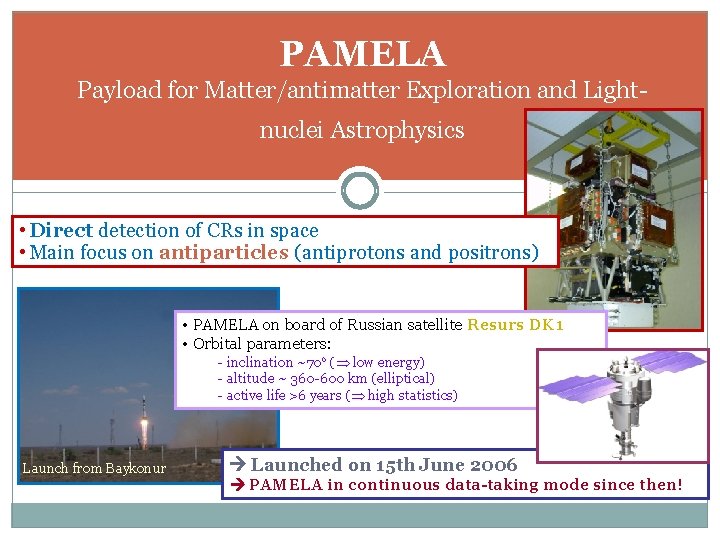
PAMELA Payload for Matter/antimatter Exploration and Lightnuclei Astrophysics • Direct detection of CRs in space • Main focus on antiparticles (antiprotons and positrons) • PAMELA on board of Russian satellite Resurs DK 1 • Orbital parameters: - inclination ~70 o ( low energy) - altitude ~ 360 -600 km (elliptical) - active life >6 years ( high statistics) Launch from Baykonur Launched on 15 th June 2006 PAMELA in continuous data-taking mode since then!
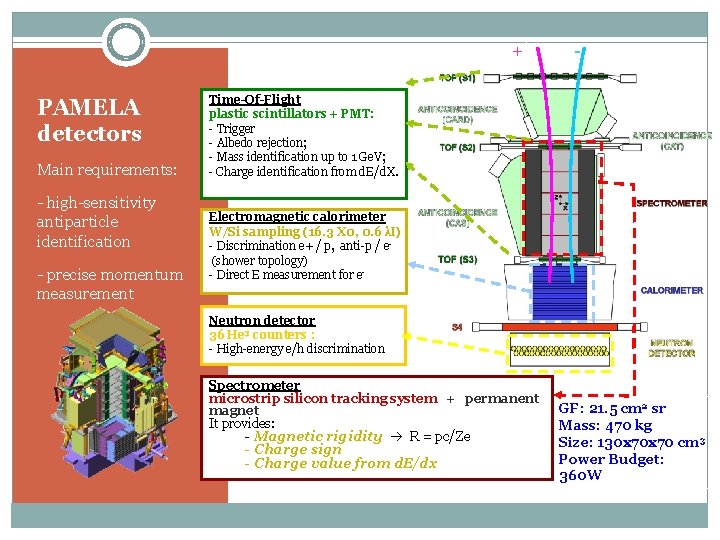
+ - PAMELA detectors Main requirements: - high-sensitivity antiparticle identification - precise momentum measurement Time-Of-Flight plastic scintillators + PMT: - Trigger - Albedo rejection; - Mass identification up to 1 Ge. V; - Charge identification from d. E/d. X. Electromagnetic calorimeter W/Si sampling (16. 3 X 0, 0. 6 λI) - Discrimination e+ / p, anti-p / e- (shower topology) - Direct E measurement for e- Neutron detector 36 He 3 counters : - High-energy e/h discrimination Spectrometer microstrip silicon tracking system + permanent magnet It provides: - Magnetic rigidity R = pc/Ze - Charge sign - Charge value from d. E/dx GF: 21. 5 cm 2 sr Mass: 470 kg Size: 130 x 70 cm 3 Power Budget: 360 W
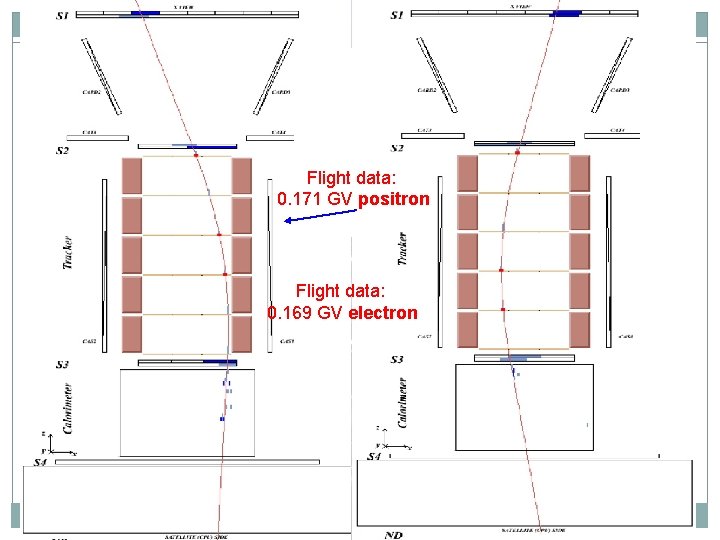
Click to edit Master text styles Flight data: 0. 171 GV positron Flight data: 0. 169 GV electron
Antiparticles SECONDARY ORIGIN, COMING FROM INTERACTION OF PRIMARY CR WITH THE INTERSTELLAR MEDIUM
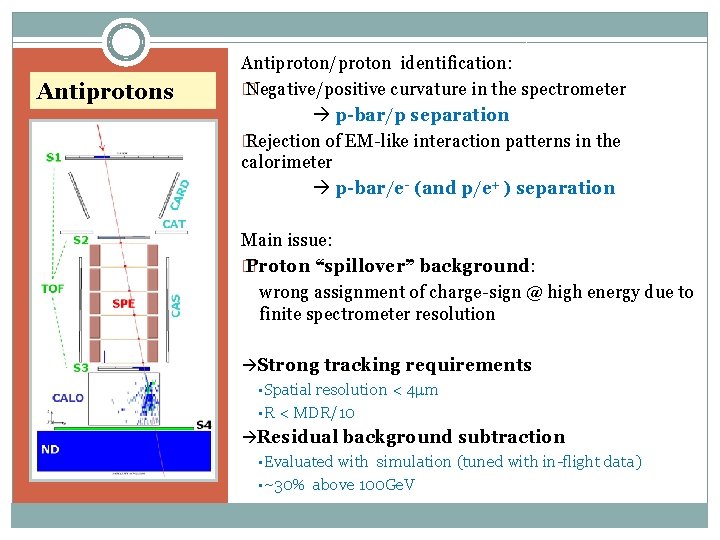
Antiprotons Antiproton/proton identification: � Negative/positive curvature in the spectrometer p-bar/p separation � Rejection of EM-like interaction patterns in the calorimeter p-bar/e- (and p/e+ ) separation Main issue: � Proton “spillover” background: wrong assignment of charge-sign @ high energy due to finite spectrometer resolution Strong tracking requirements • Spatial resolution < 4 mm • R < MDR/10 Residual background subtraction • Evaluated with simulation (tuned with in-flight data) • ~30% above 100 Ge. V
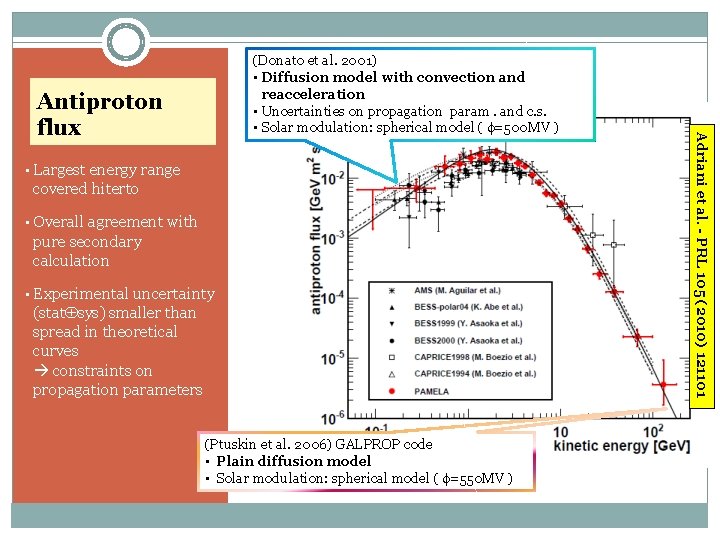
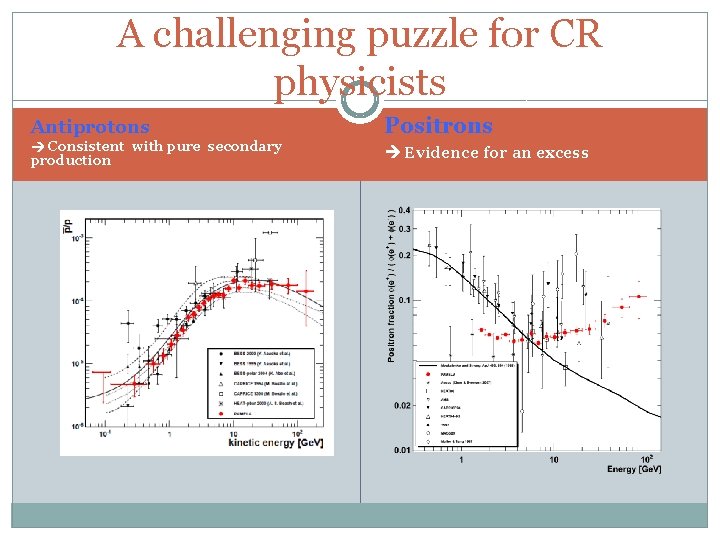
Antiproton flux • Largest energy range covered hiterto • Overall agreement with pure secondary calculation • Experimental uncertainty (stat sys) smaller than spread in theoretical curves constraints on propagation parameters (Ptuskin et al. 2006) GALPROP code • Plain diffusion model • Solar modulation: spherical model ( f=550 MV ) Adriani et al. - PRL 105 (2010) 121101 (Donato et al. 2001) • Diffusion model with convection and reacceleration • Uncertainties on propagation param. and c. s. • Solar modulation: spherical model ( f=500 MV )
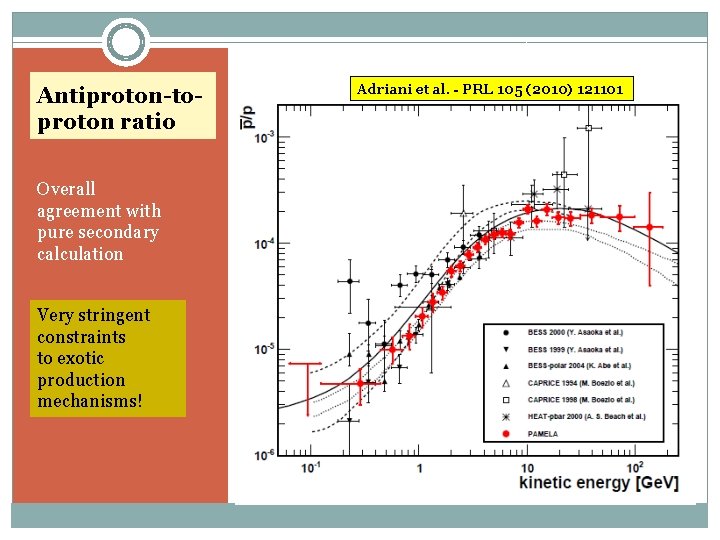
Antiproton-toproton ratio Overall agreement with pure secondary calculation Very stringent constraints to exotic production mechanisms! Adriani et al. - PRL 105 (2010) 121101
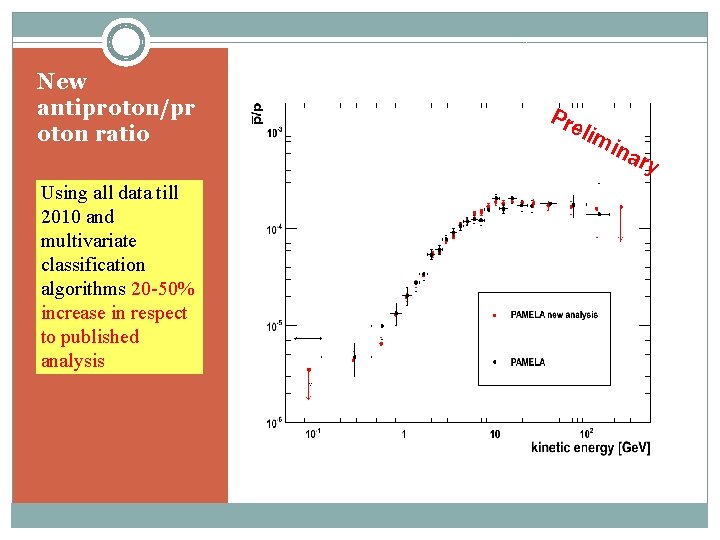
New antiproton/pr oton ratio Pre lim ina r y Using all data till 2010 and multivariate classification algorithms 20 -50% increase in respect to published analysis
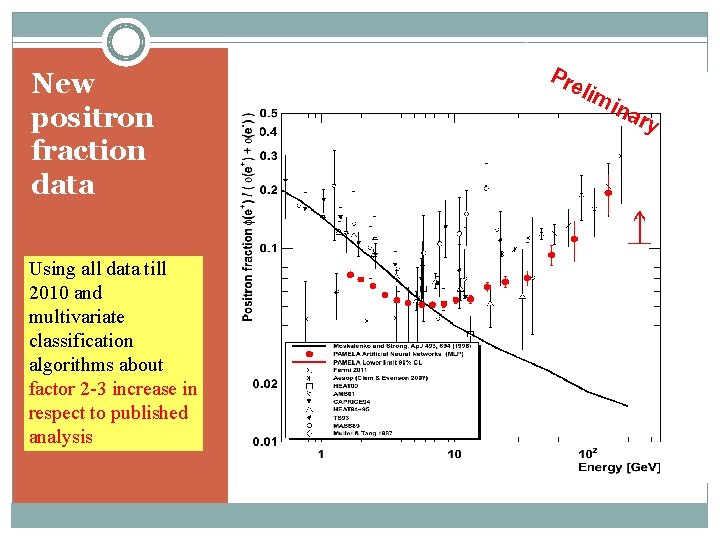
New positron fraction data Using all data till 2010 and multivariate classification algorithms about factor 2 -3 increase in respect to published analysis Pre lim ina r y
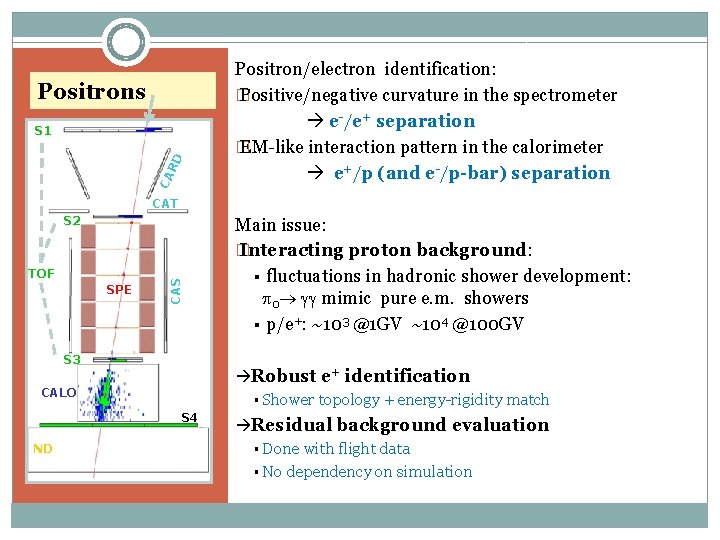
Positrons CA RD S 1 Positron/electron identification: � Positive/negative curvature in the spectrometer e-/e+ separation � EM-like interaction pattern in the calorimeter e+/p (and e-/p-bar) separation CAT TOF SPE CAS S 2 S 3 Robust e+ identification § Shower topology + energy-rigidity match CALO S 4 ND Main issue: � Interacting proton background: § fluctuations in hadronic shower development: p 0 mimic pure e. m. showers § p/e+: ~103 @1 GV ~104 @100 GV Residual background evaluation § Done with flight data § No dependency on simulation
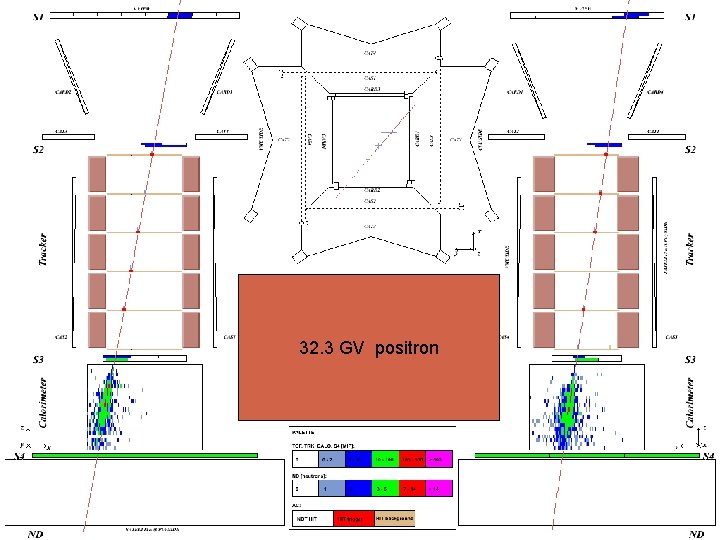
Click to edit Master text styles 32. 3 GV positron
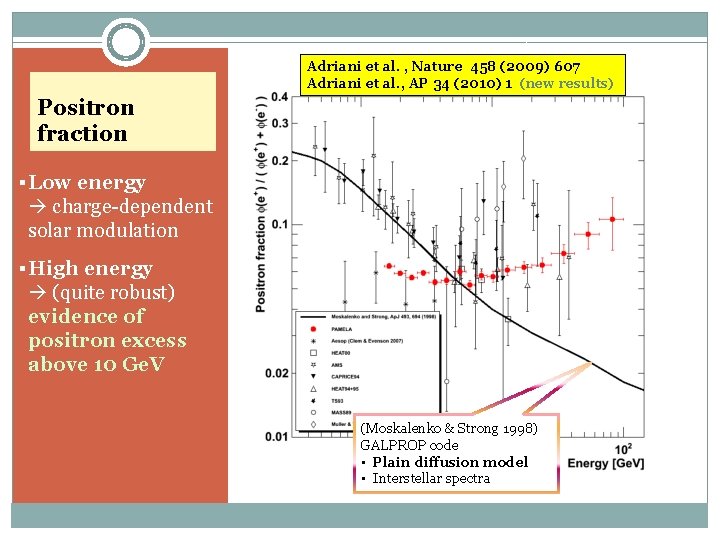
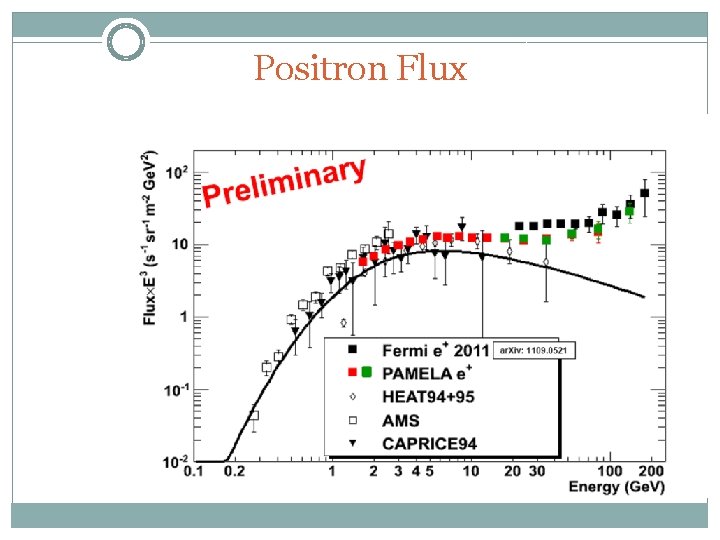
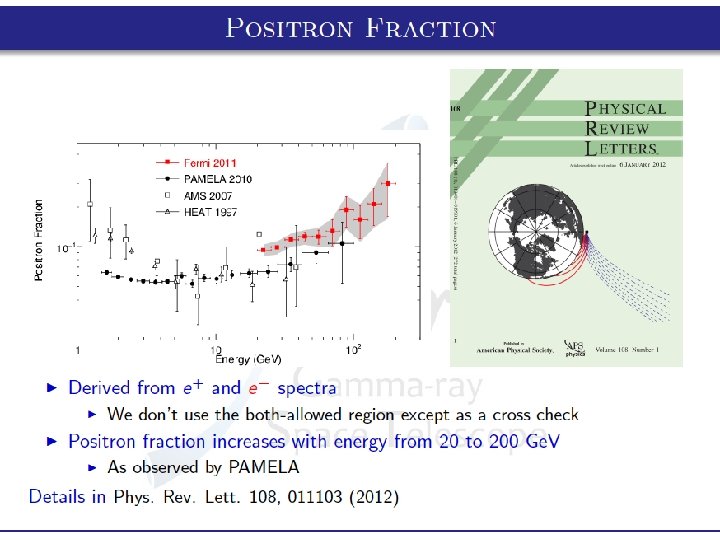
Adriani et al. , Nature 458 (2009) 607 Adriani et al. , AP 34 (2010) 1 (new results) Positron fraction § Low energy charge-dependent solar modulation § High energy (quite robust) evidence of positron excess above 10 Ge. V (Moskalenko & Strong 1998) GALPROP code • Plain diffusion model • Interstellar spectra
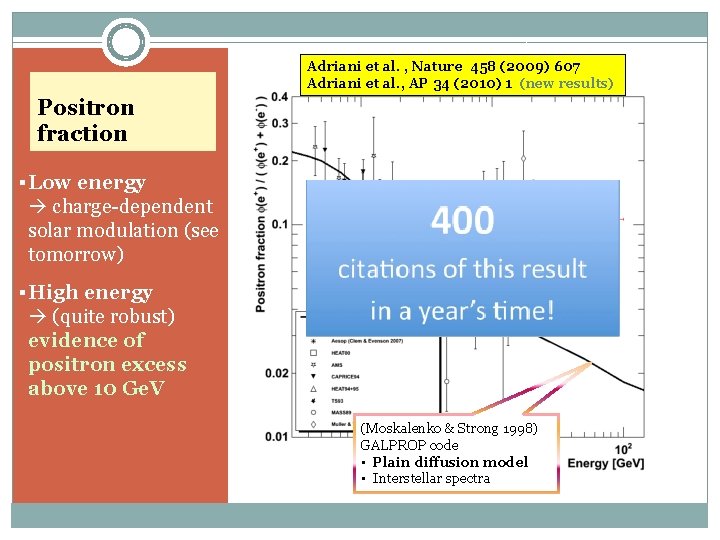
Adriani et al. , Nature 458 (2009) 607 Adriani et al. , AP 34 (2010) 1 (new results) Positron fraction § Low energy charge-dependent solar modulation (see tomorrow) § High energy (quite robust) evidence of positron excess above 10 Ge. V (Moskalenko & Strong 1998) GALPROP code • Plain diffusion model • Interstellar spectra
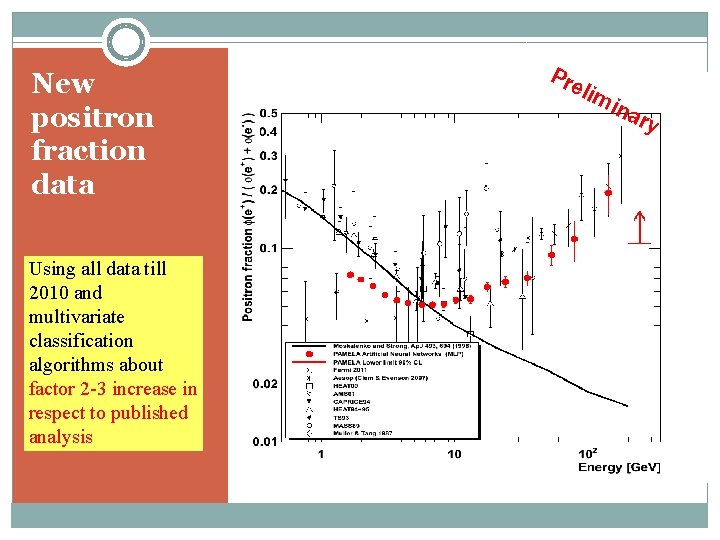
New positron fraction data Using all data till 2010 and multivariate classification algorithms about factor 2 -3 increase in respect to published analysis Pre lim ina r y
Positron Flux Click to edit Master text styles
A challenging puzzle for CR physicists Antiprotons Positrons Consistent with pure secondary production Evidence for an excess
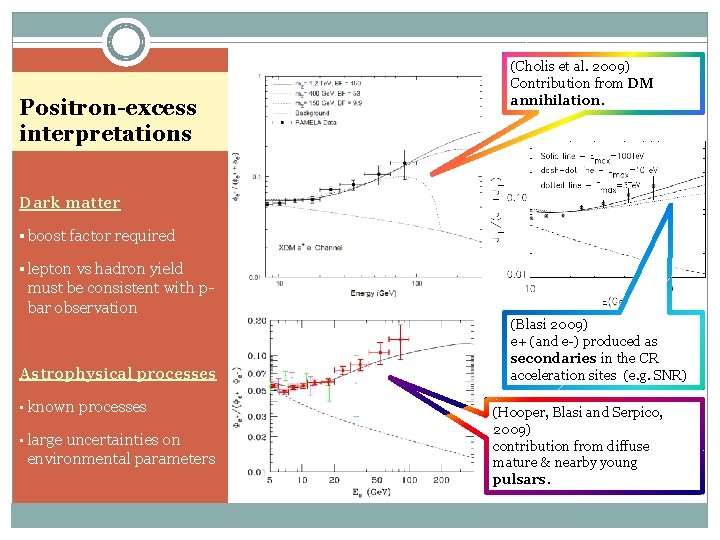
Positron-excess interpretations (Cholis et al. 2009) Contribution from DM annihilation. Dark matter § boost factor required § lepton vs hadron yield must be consistent with pbar observation Astrophysical processes • known processes • large uncertainties on environmental parameters (Blasi 2009) e+ (and e-) produced as secondaries in the CR acceleration sites (e. g. SNR) (Hooper, Blasi and Serpico, 2009) contribution from diffuse mature & nearby young pulsars.
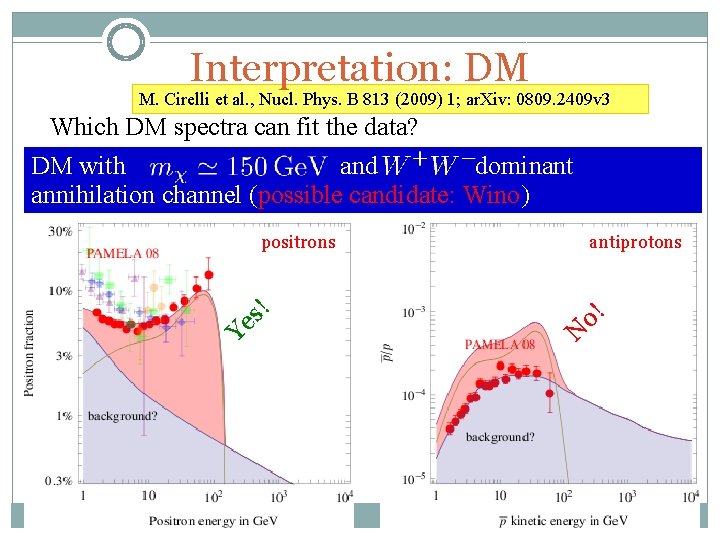
Interpretation: DM M. Cirelli et al. , Nucl. Phys. B 813 (2009) 1; ar. Xiv: 0809. 2409 v 3 Which DM spectra can fit the data? DM with and dominant Click to edit Master text styles annihilation channel (possible candidate: Wino) positrons ! s Ye antiprotons N o!
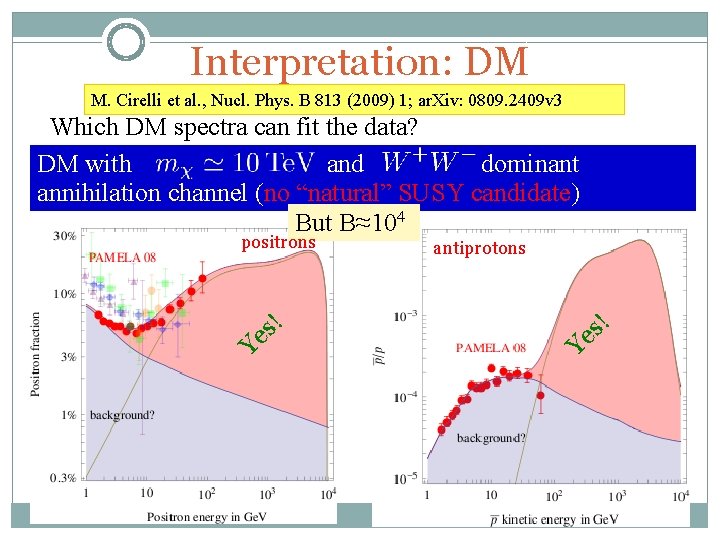
Interpretation: DM M. Cirelli et al. , Nucl. Phys. B 813 (2009) 1; ar. Xiv: 0809. 2409 v 3 Which DM spectra can fit the data? DM with and dominant Click to edit Master text styles annihilation channel (no “natural” SUSY candidate) But B≈104 positrons Y ! s e antiprotons ! s Ye
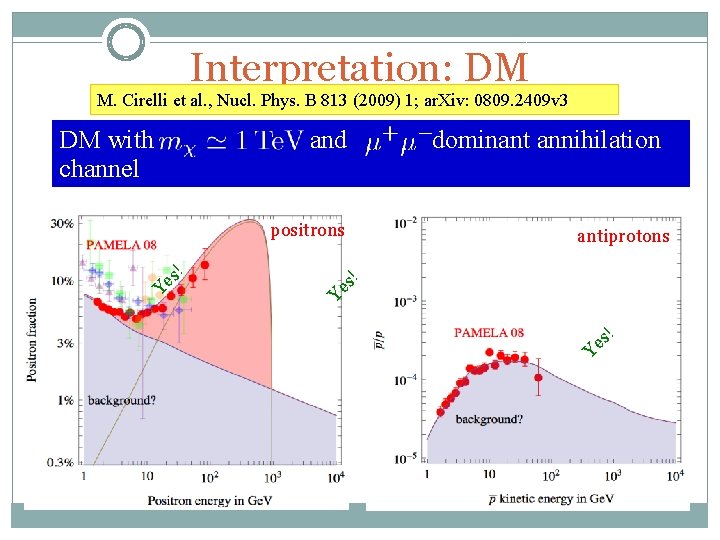
Interpretation: DM M. Cirelli et al. , Nucl. Phys. B 813 (2009) 1; ar. Xiv: 0809. 2409 v 3 DM with Click to edit Master text channel and dominant annihilation styles positrons ! s Ye antiprotons ! s e Y ! s Ye
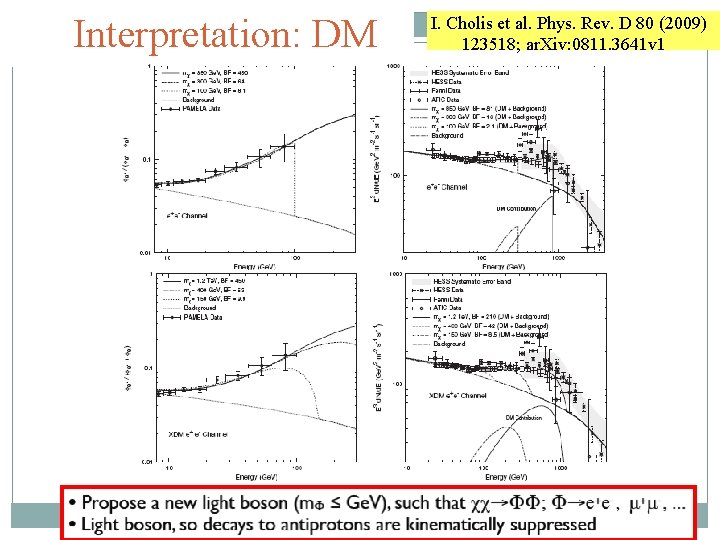
Interpretation: DM Click to edit Master text styles I. Cholis et al. Phys. Rev. D 80 (2009) 123518; ar. Xiv: 0811. 3641 v 1
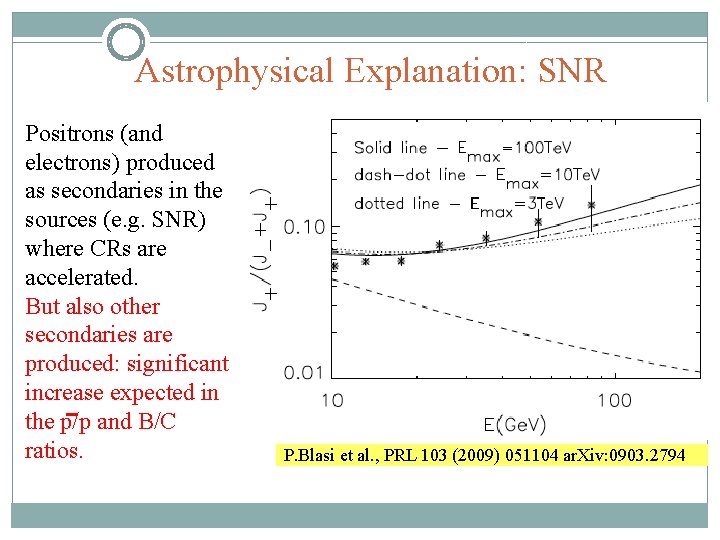
Astrophysical Explanation: SNR Positrons (and electrons) produced Click to edit Master text asstyles secondaries in the sources (e. g. SNR) where CRs are accelerated. But also other secondaries are produced: significant increase expected in the p/p and B/C ratios. P. Blasi et al. , PRL 103 (2009) 051104 ar. Xiv: 0903. 2794
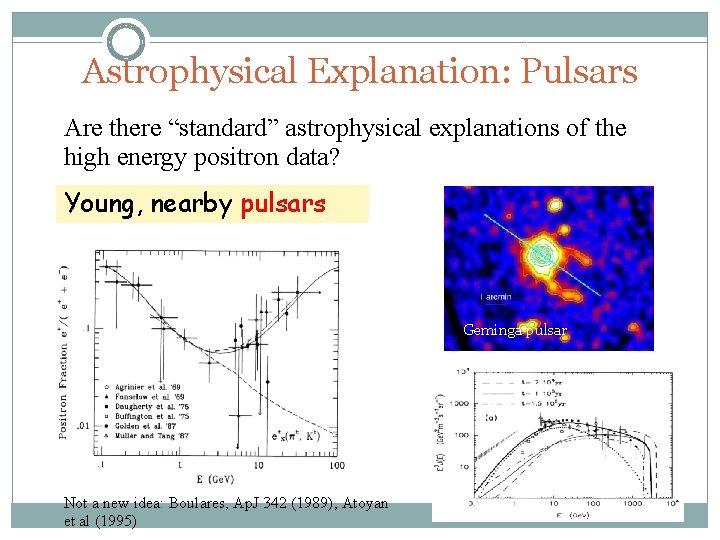
Astrophysical Explanation: Pulsars Are there “standard” astrophysical explanations of the high energy positron data? Click to edit Master text styles Young, nearby pulsars Geminga pulsar Not a new idea: Boulares, Ap. J 342 (1989), Atoyan et al (1995)
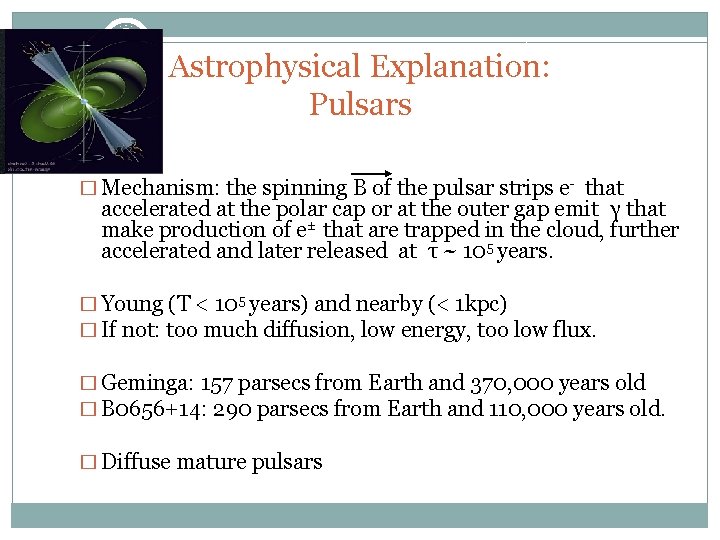
Astrophysical Explanation: Pulsars Click to edit Master text styles � Mechanism: the spinning B of the pulsar strips e- that accelerated at the polar cap or at the outer gap emit γ that make production of e± that are trapped in the cloud, further accelerated and later released at τ ~ 105 years. � Young (T < 105 years) and nearby (< 1 kpc) � If not: too much diffusion, low energy, too low flux. � Geminga: 157 parsecs from Earth and 370, 000 years old � B 0656+14: 290 parsecs from Earth and 110, 000 years old. � Diffuse mature pulsars
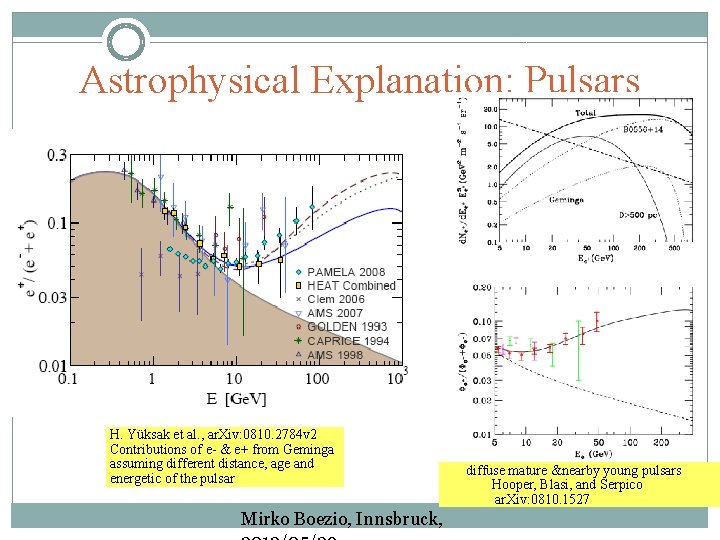
Astrophysical Explanation: Pulsars Click to edit Master text styles H. Yüksak et al. , ar. Xiv: 0810. 2784 v 2 Contributions of e- & e+ from Geminga assuming different distance, age and energetic of the pulsar diffuse mature &nearby young pulsars Hooper, Blasi, and Serpico ar. Xiv: 0810. 1527 Mirko Boezio, Innsbruck,
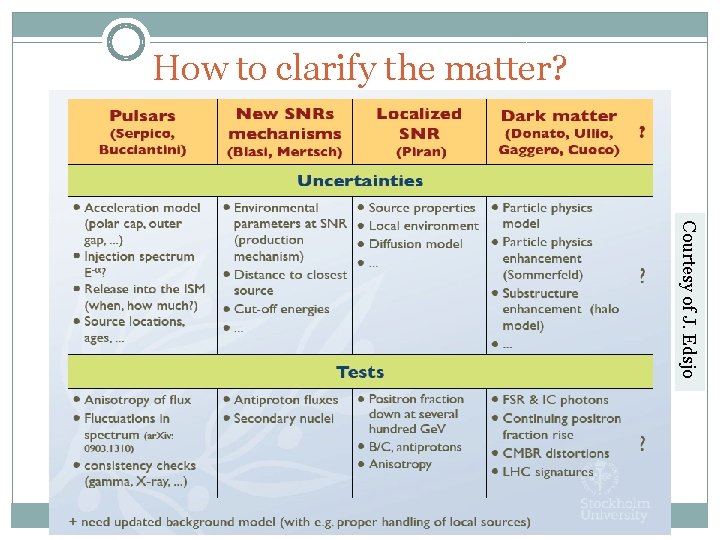
How to clarify the matter? Click to edit Master text styles Courtesy of J. Edsjo
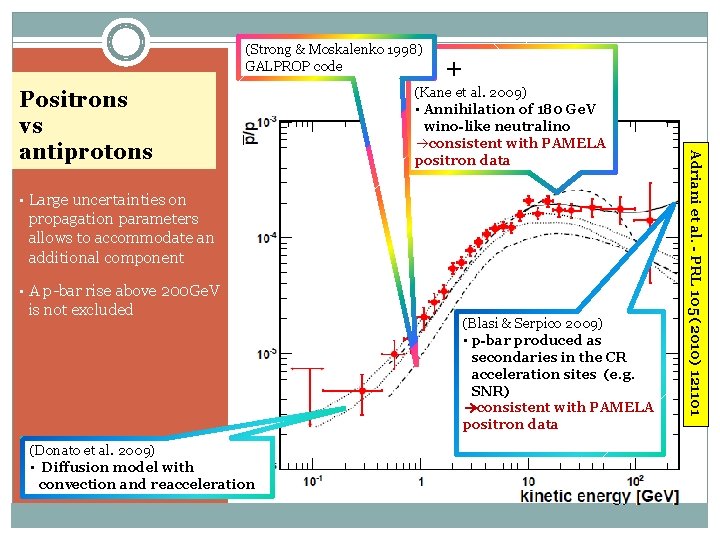
(Strong & Moskalenko 1998) GALPROP code + (Kane et al. 2009) • Annihilation of 180 Ge. V wino-like neutralino consistent with PAMELA positron data • Large uncertainties on propagation parameters allows to accommodate an additional component • A p-bar rise above 200 Ge. V is not excluded (Donato et al. 2009) • Diffusion model with convection and reacceleration (Blasi & Serpico 2009) • p-bar produced as secondaries in the CR acceleration sites (e. g. SNR) consistent with PAMELA positron data Adriani et al. - PRL 105 (2010) 121101 Positrons vs antiprotons
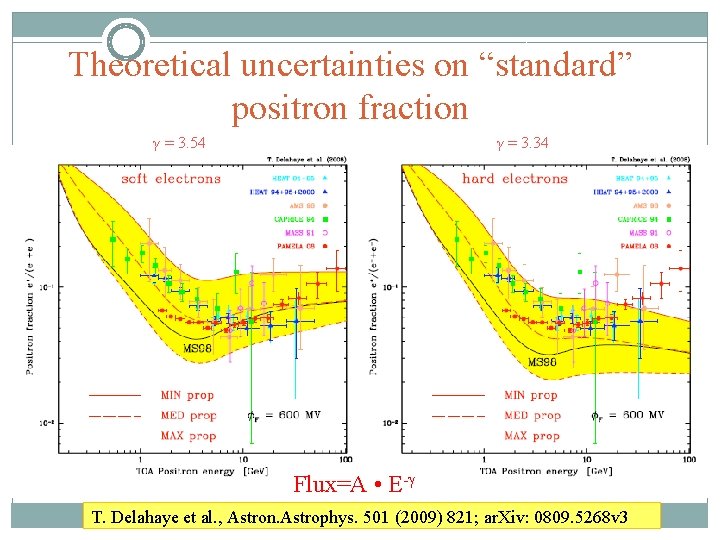
Theoretical uncertainties on “standard” positron fraction γ = 3. 54 γ = 3. 34 Click to edit Master text styles Flux=A • E- T. Delahaye et al. , Astron. Astrophys. 501 (2009) 821; ar. Xiv: 0809. 5268 v 3
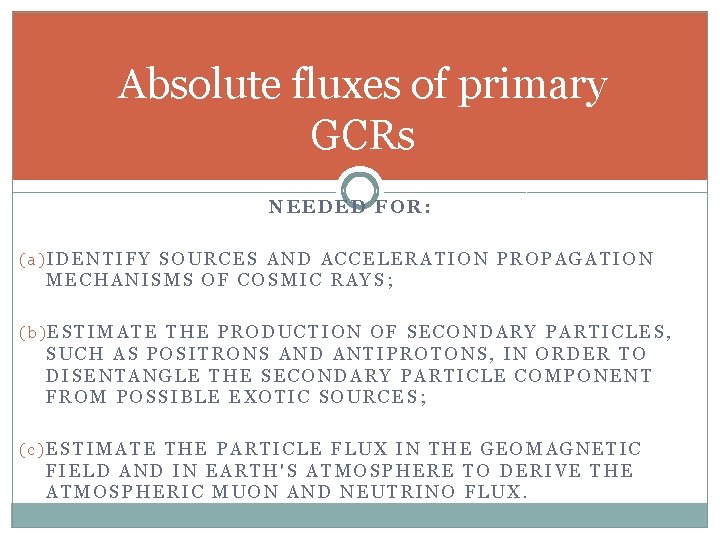
Absolute fluxes of primary GCRs NEEDED FOR: (a)IDENTIFY SOURCES AND ACCELERATION PROPAGATION MECHANISMS OF COSMIC RAYS; (b)ESTIMATE THE PRODUCTION OF SECONDARY PARTICLES, SUCH AS POSITRONS AND ANTIPROTONS, IN ORDER TO DISENTANGLE THE SECONDARY PARTICLE COMPONENT FROM POSSIBLE EXOTIC SOURCES; (c)ESTIMATE THE PARTICLE FLUX IN THE GEOMAGNETIC FIELD AND IN EARTH'S ATMOSPHERE TO DERIVE THE ATMOSPHERIC MUON AND NEUTRINO FLUX.
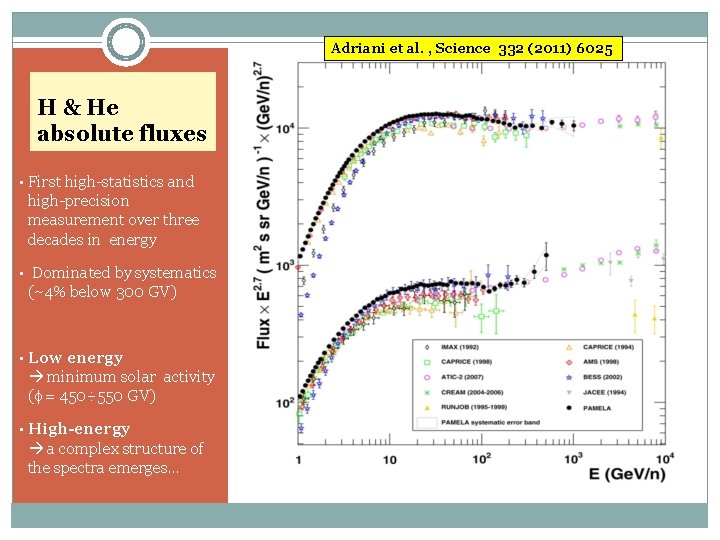
Adriani et al. , Science 332 (2011) 6025 H & He absolute fluxes • First high-statistics and high-precision measurement over three decades in energy • Dominated by systematics (~4% below 300 GV) • Low energy minimum solar activity (f = 450÷ 550 GV) • High-energy a complex structure of the spectra emerges…
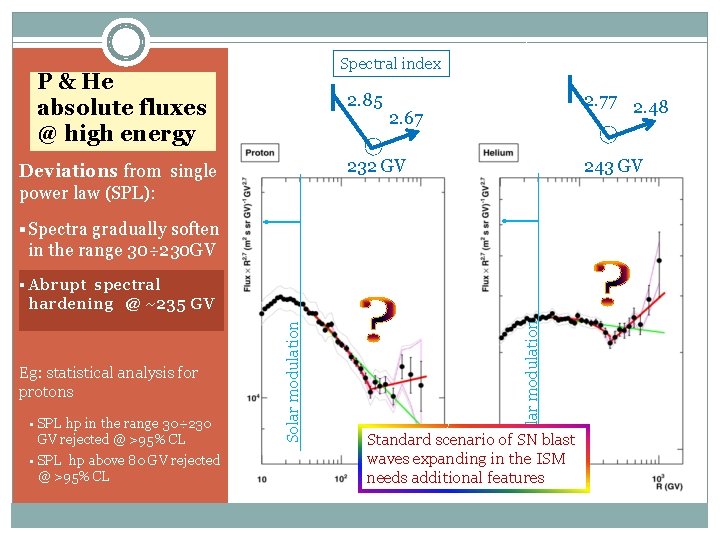
Spectral index P & He absolute fluxes @ high energy 2. 85 2. 77 2. 48 2. 67 232 GV Deviations from single power law (SPL): 243 GV § Spectra gradually soften in the range 30÷ 230 GV § Abrupt spectral SPL hp in the range 30÷ 230 GV rejected @ >95% CL § SPL hp above 80 GV rejected @ >95% CL § Solar modulation Eg: statistical analysis for protons Solar modulation hardening @ ~235 GV Standard scenario of SN blast waves expanding in the ISM needs additional features
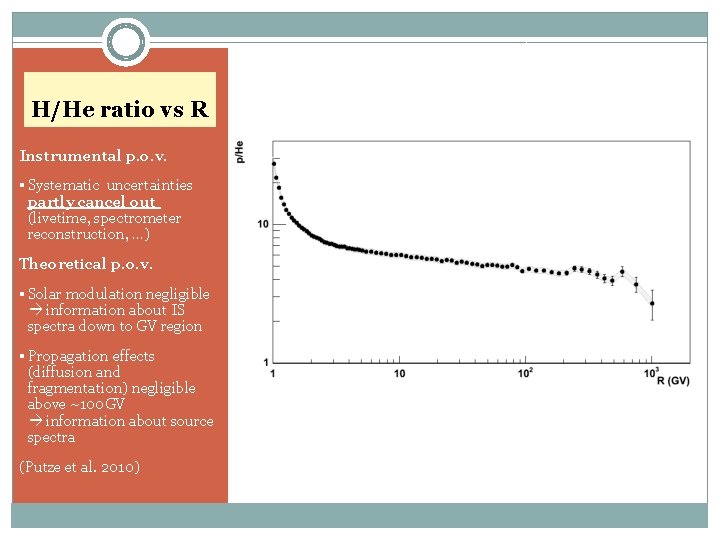
H/He ratio vs R Instrumental p. o. v. § Systematic uncertainties partly cancel out (livetime, spectrometer reconstruction, …) Theoretical p. o. v. § Solar modulation negligible information about IS spectra down to GV region § Propagation effects (diffusion and fragmentation) negligible above ~100 GV information about source spectra (Putze et al. 2010)
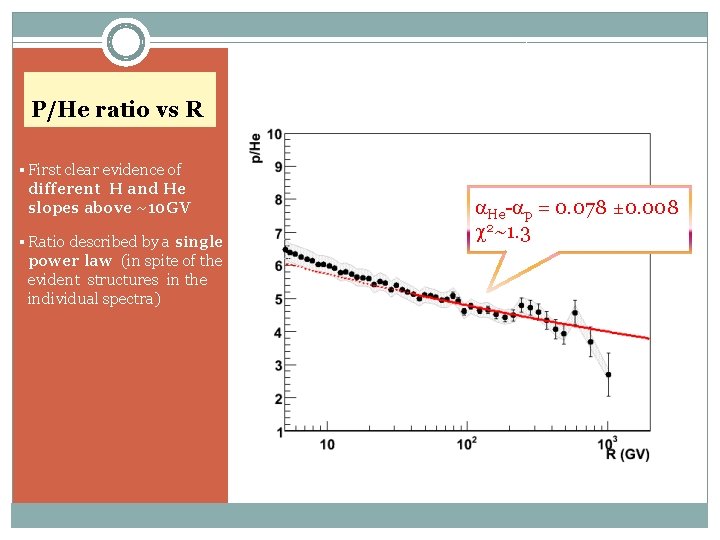
P/He ratio vs R § First clear evidence of different H and He slopes above ~10 GV § Ratio described by a single power law (in spite of the evident structures in the individual spectra) a. He-ap = 0. 078 ± 0. 008 c 2~1. 3
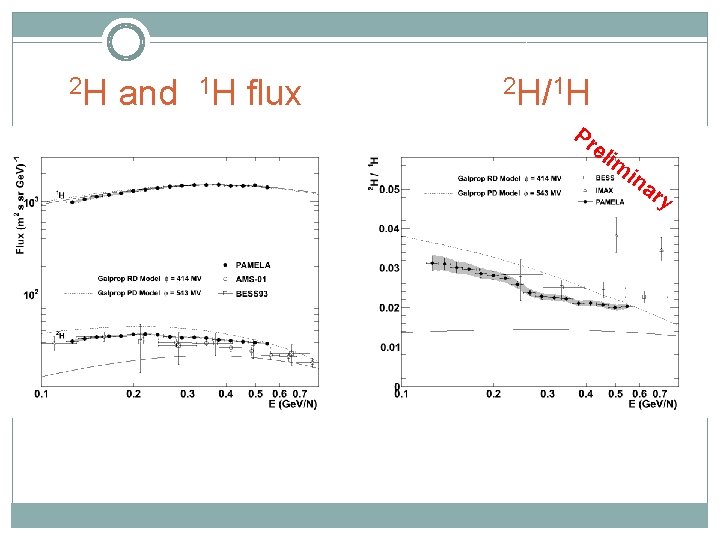
2 H and 1 H flux Click to edit Master text styles 2 H/1 H Pr eli m ina ry
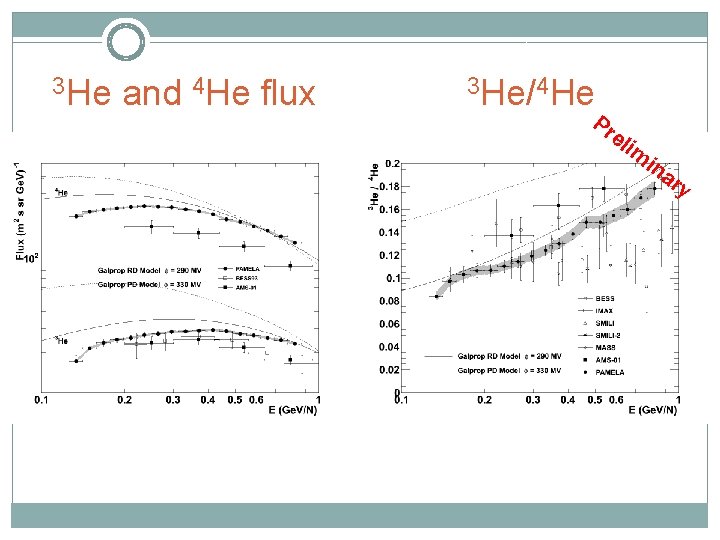
3 He and 4 He flux Click to edit Master text styles 3 He/4 He Pr eli m ina ry
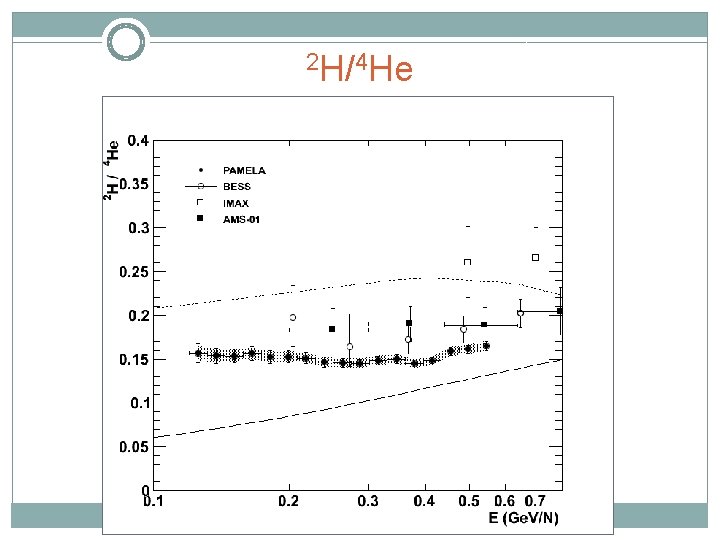
2 H/4 He Click to edit Master text styles
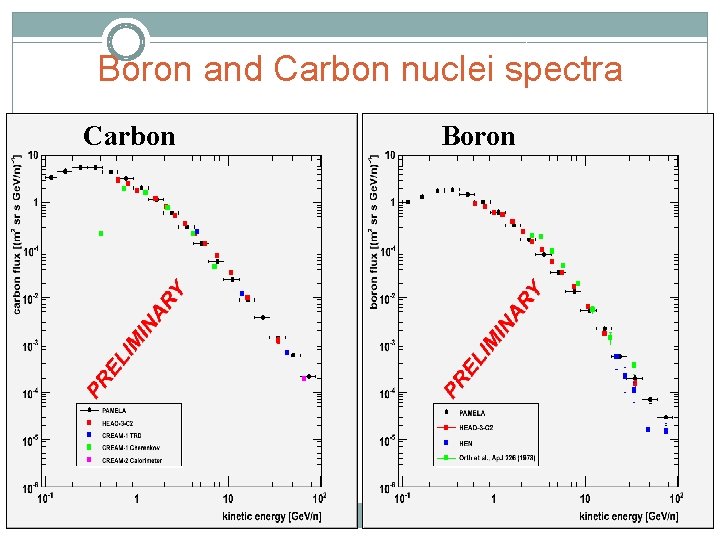
Boron and Carbon nuclei spectra Carbon Click to edit Master text styles Boron
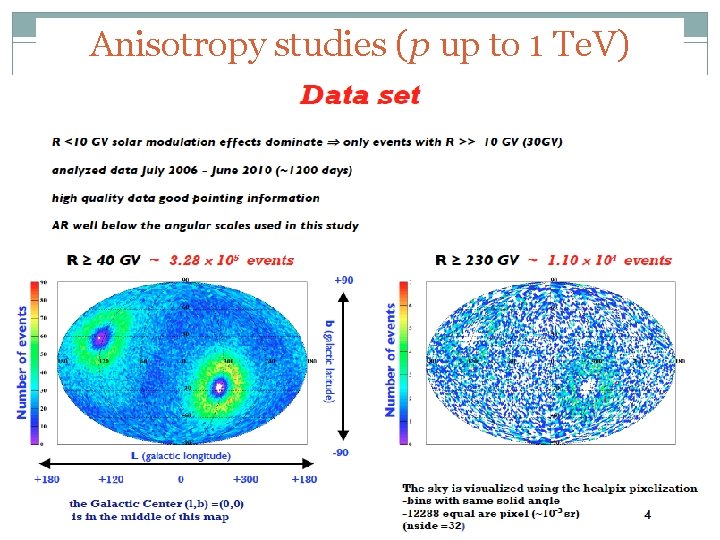
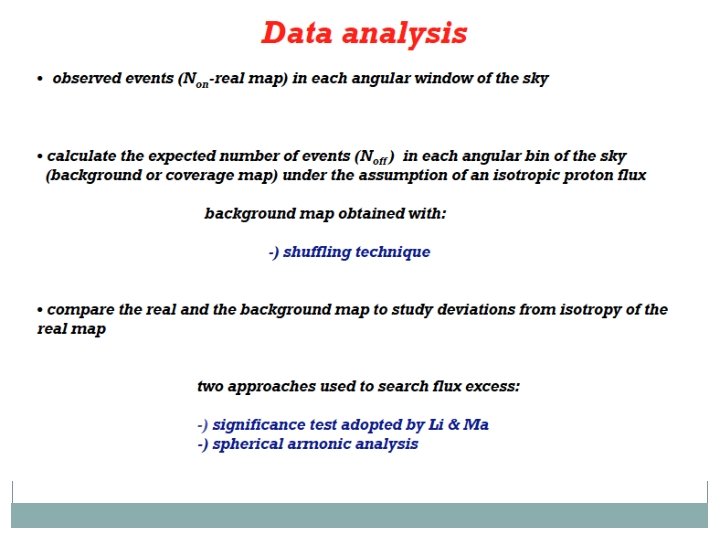
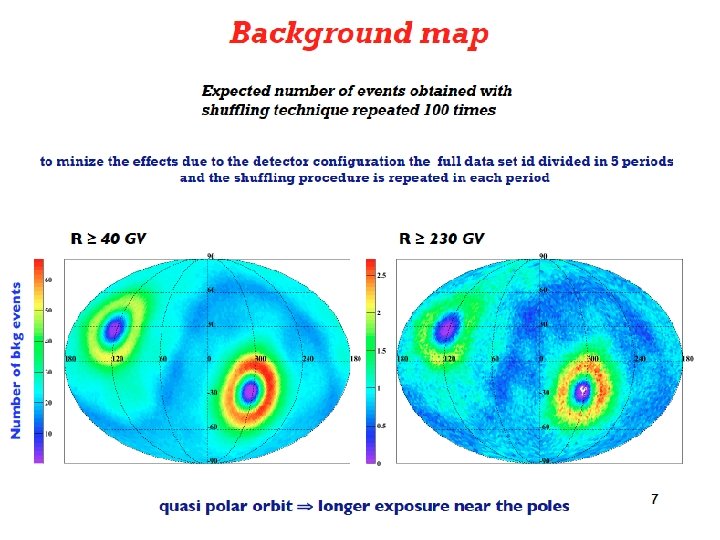
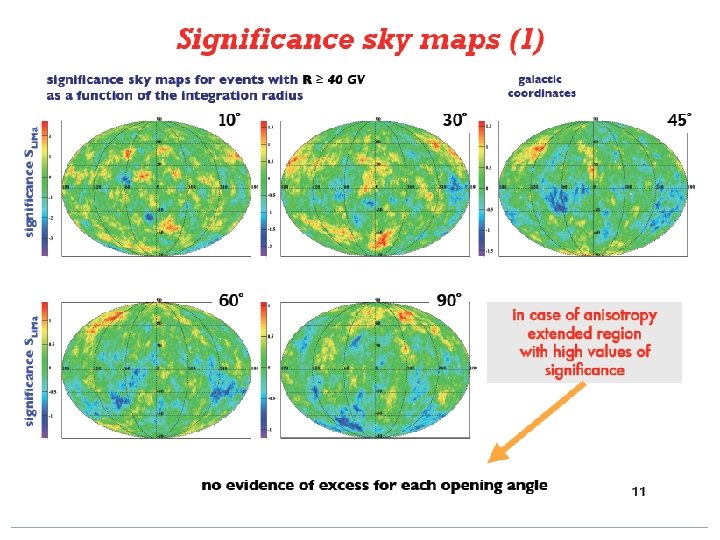
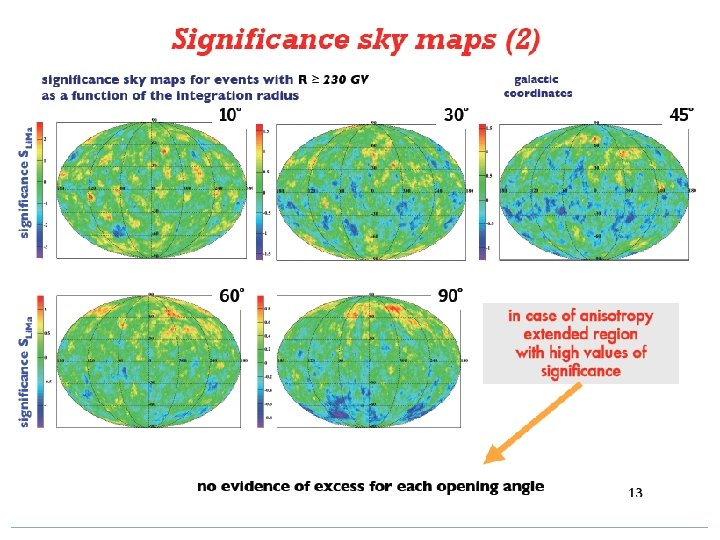
Anisotropy studies (p up to 1 Te. V) Click to edit Master text styles
Electrons NEEDED FOR: (a)RECALCULATHE EXPECTED POSITRON FRACTION WITH BETTER ACCURACY (b)CLOSEBY SOURCES?
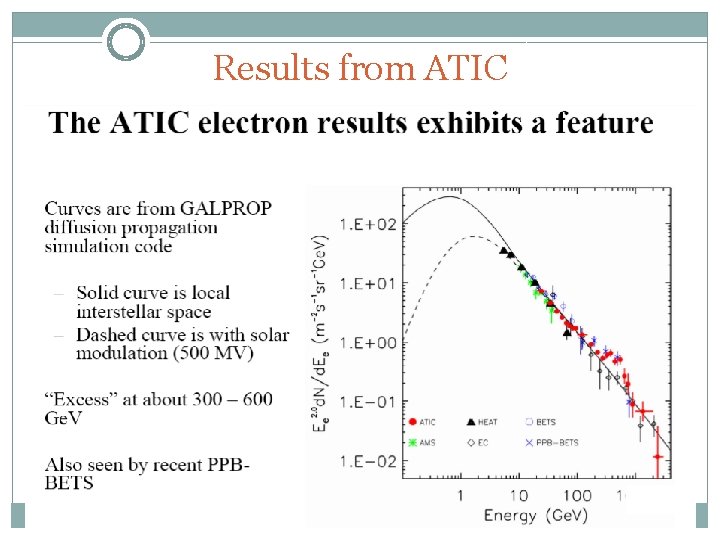
Results from ATIC Click to edit Master text styles
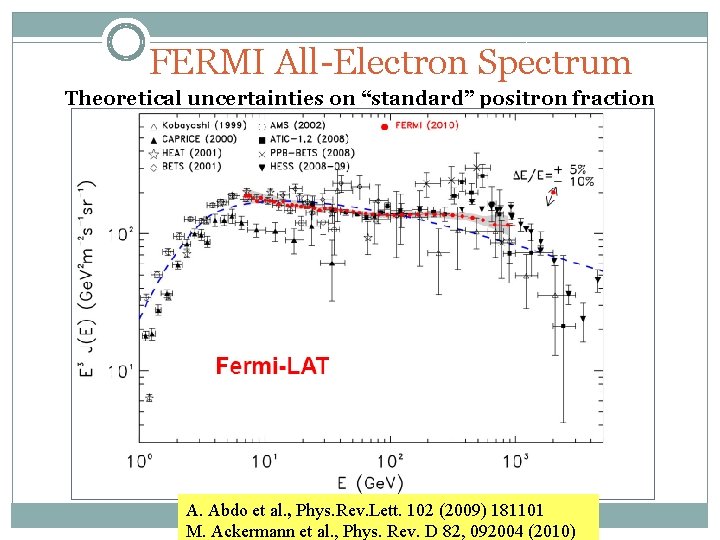
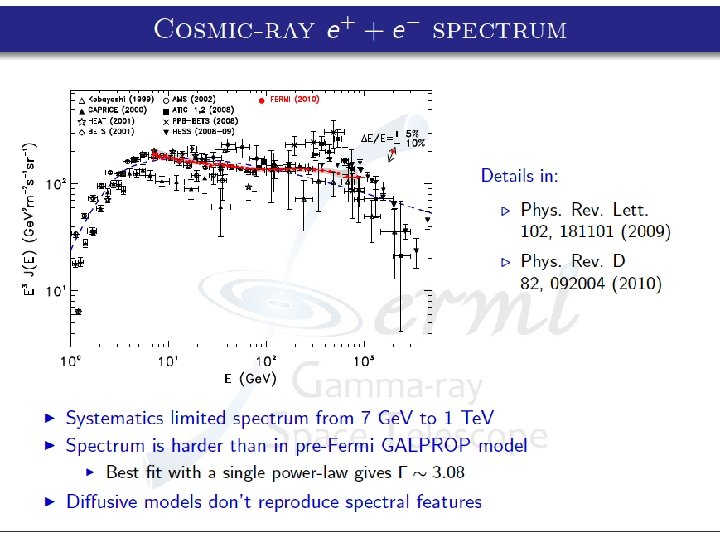
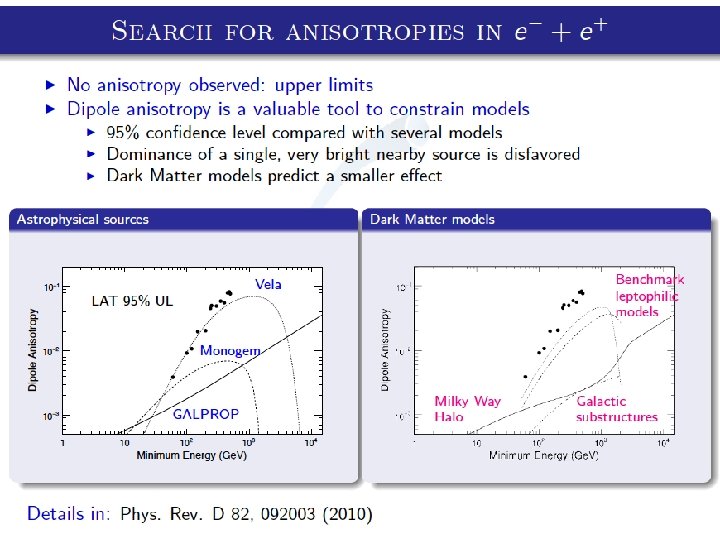
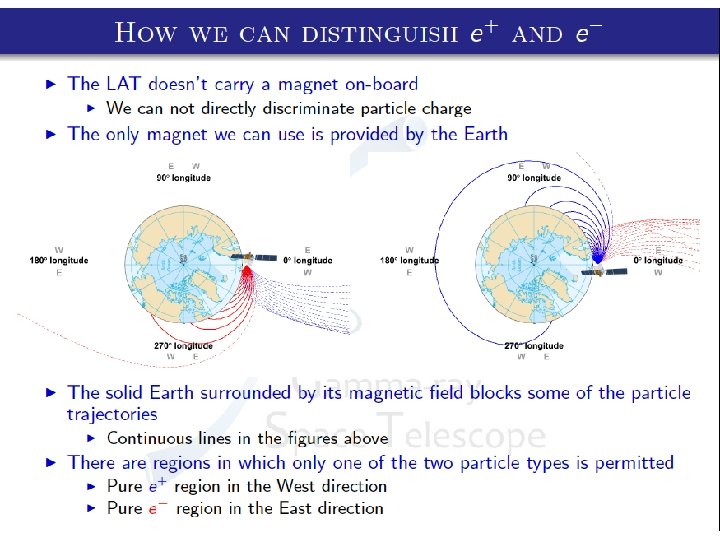
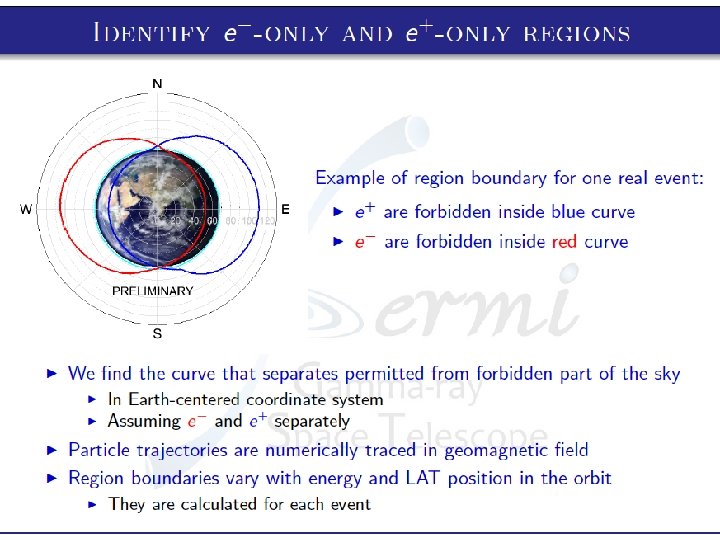
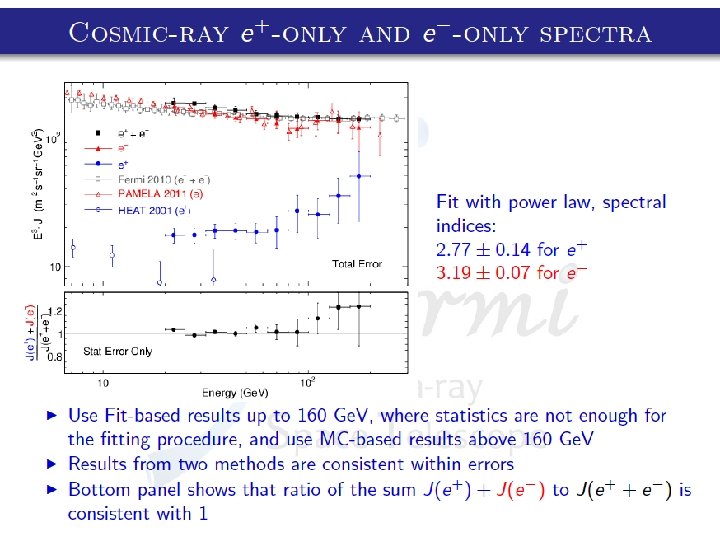
FERMI All-Electron Spectrum Theoretical uncertainties on “standard” positron fraction Click to edit Master text styles FERMI e+ + e- flux (2009) A. Abdo et al. , Phys. Rev. Lett. 102 (2009) 181101 M. Ackermann et al. , Phys. Rev. D 82, 092004 (2010)
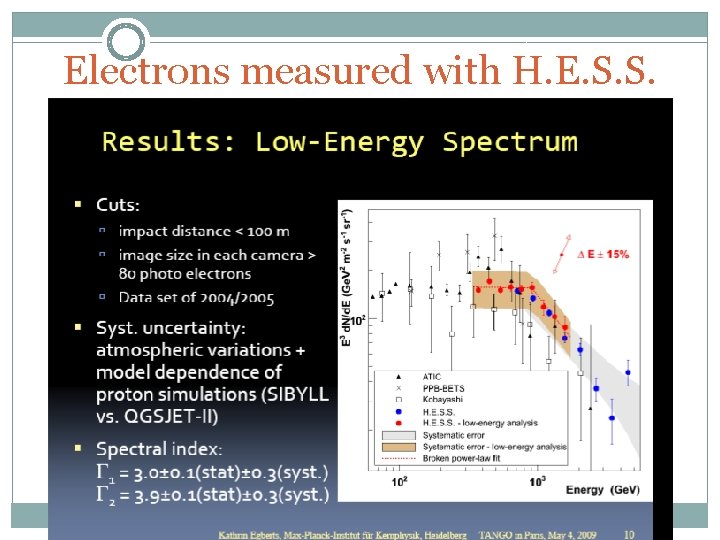
Electrons measured with H. E. S. S. Click to edit Master text styles
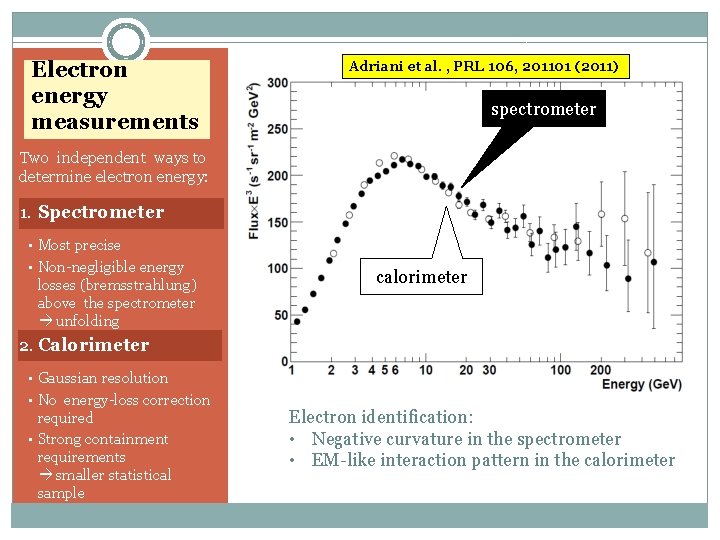
Electron energy measurements Adriani et al. , PRL 106, 201101 (2011) spectrometer Two independent ways to determine electron energy: 1. Spectrometer • • Most precise Non-negligible energy losses (bremsstrahlung) above the spectrometer unfolding calorimeter 2. Calorimeter • • • Gaussian resolution No energy-loss correction required Strong containment requirements smaller statistical sample Electron identification: • Negative curvature in the spectrometer • EM-like interaction pattern in the calorimeter
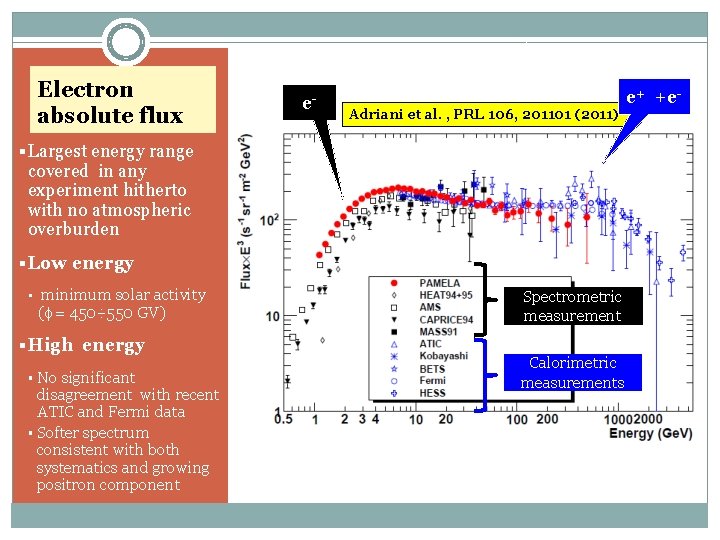
Electron absolute flux e- Adriani et al. , PRL 106, 201101 (2011) e+ +e- § Largest energy range covered in any experiment hitherto with no atmospheric overburden § Low energy • minimum solar activity (f = 450÷ 550 GV) § High energy § No significant disagreement with recent ATIC and Fermi data § Softer spectrum consistent with both systematics and growing positron component Spectrometric measurement Calorimetric measurements
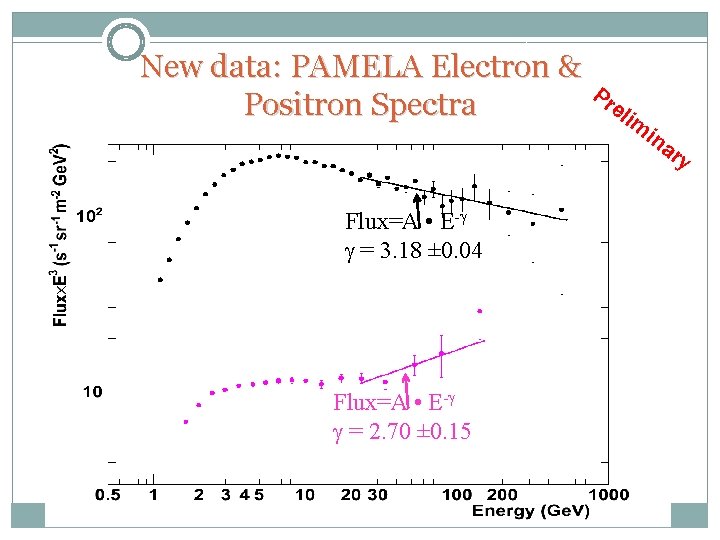
New data: PAMELA Electron & Pr eli Positron Spectra m ina ry Click to edit Master text styles Flux=A • E- = 3. 18 ± 0. 04 Flux=A • E- = 2. 70 ± 0. 15
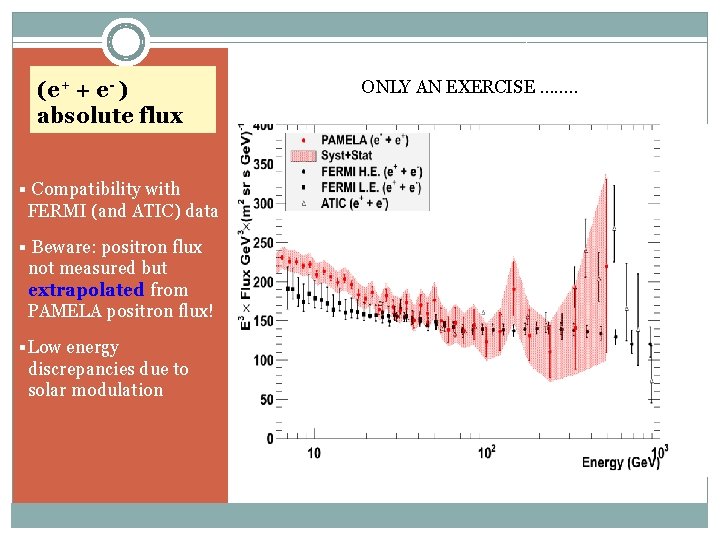
(e+ + e- ) absolute flux § Compatibility with FERMI (and ATIC) data § Beware: positron flux not measured but extrapolated from PAMELA positron flux! § Low energy discrepancies due to solar modulation ONLY AN EXERCISE ……. .
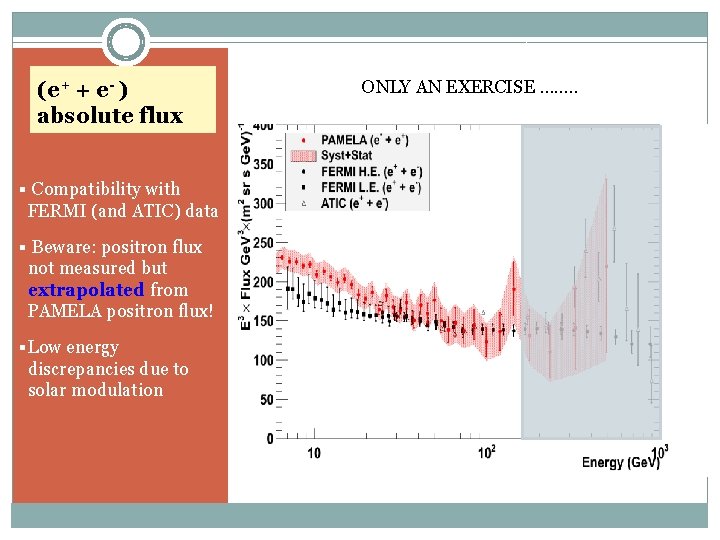
(e+ + e- ) absolute flux § Compatibility with FERMI (and ATIC) data § Beware: positron flux not measured but extrapolated from PAMELA positron flux! § Low energy discrepancies due to solar modulation ONLY AN EXERCISE ……. .
Solar and terrestrial physics
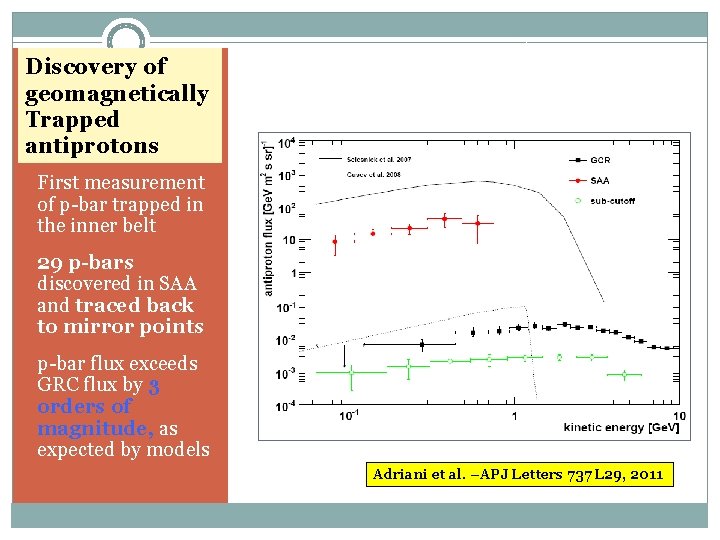
Discovery of geomagnetically Trapped antiprotons First measurement of p-bar trapped in the inner belt 29 p-bars discovered in SAA and traced back to mirror points p-bar flux exceeds GRC flux by 3 orders of magnitude, as expected by models Adriani et al. –APJ Letters 737 L 29, 2011
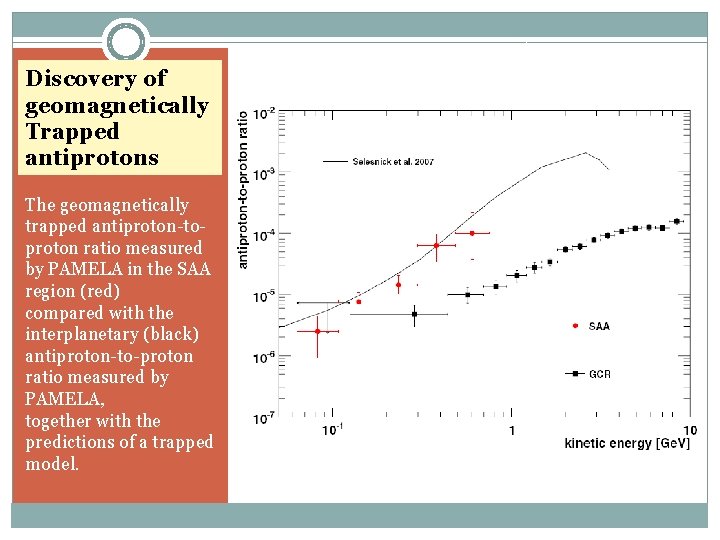
Discovery of geomagnetically Trapped antiprotons The geomagnetically trapped antiproton-toproton ratio measured by PAMELA in the SAA region (red) compared with the interplanetary (black) antiproton-to-proton ratio measured by PAMELA, together with the predictions of a trapped model.
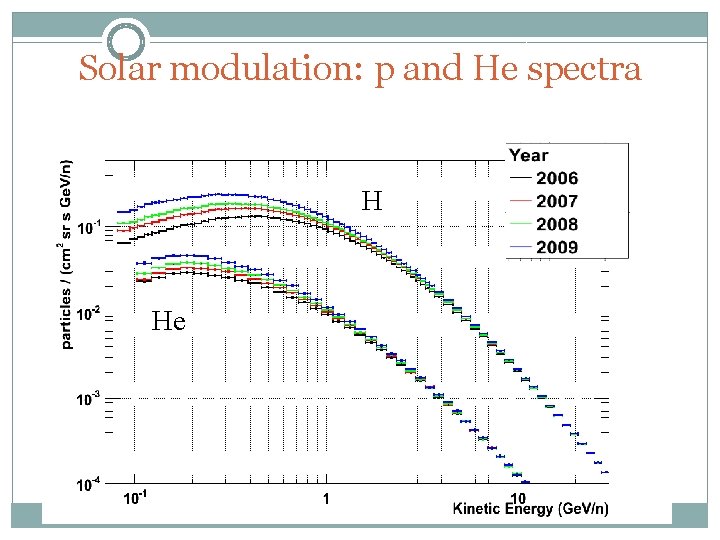
Solar modulation: p and He spectra Click to edit Master text styles He H
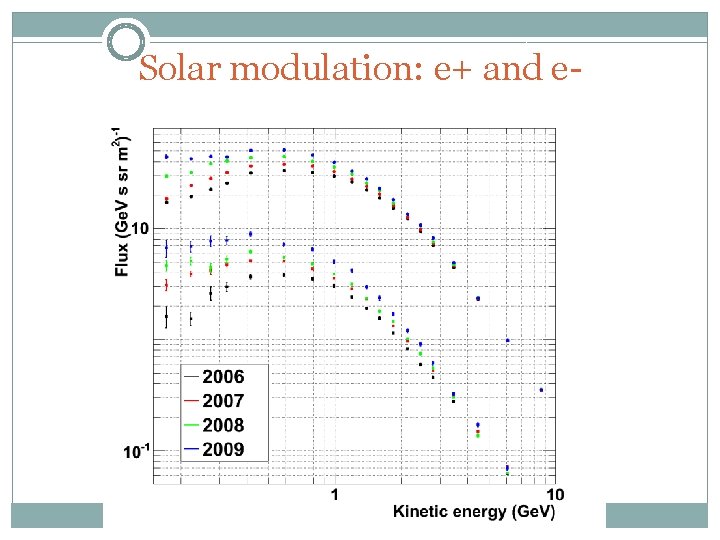
Solar modulation: e+ and e. Click to edit Master text styles
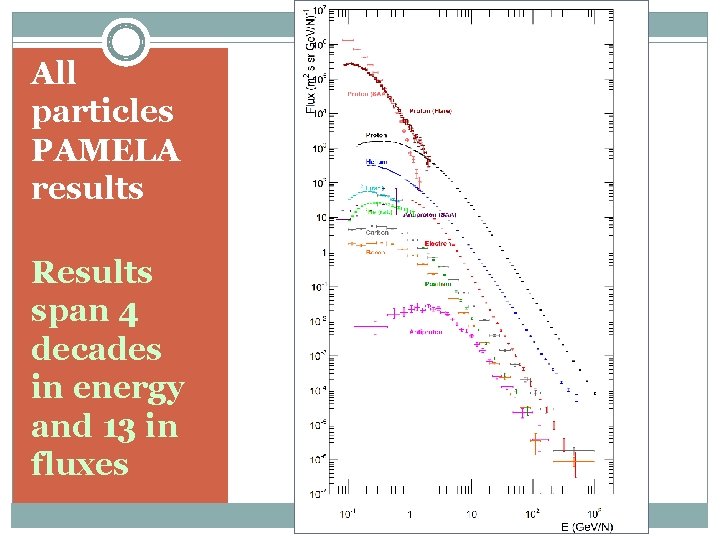
All particles PAMELA results Results span 4 decades in energy and 13 in fluxes
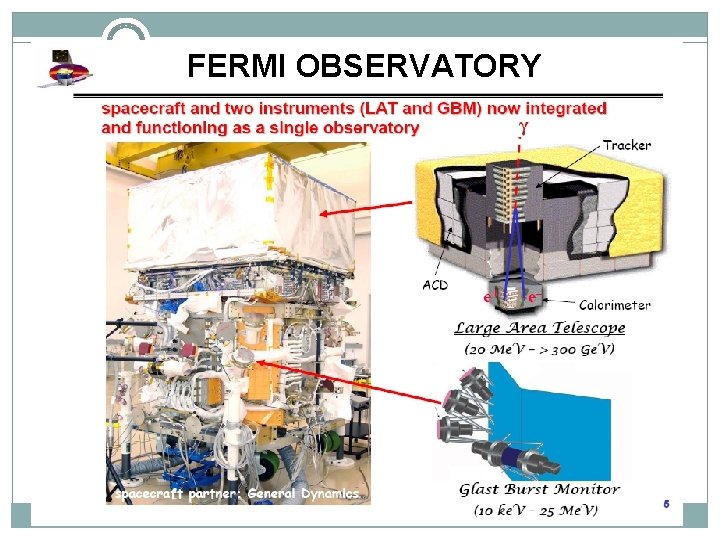
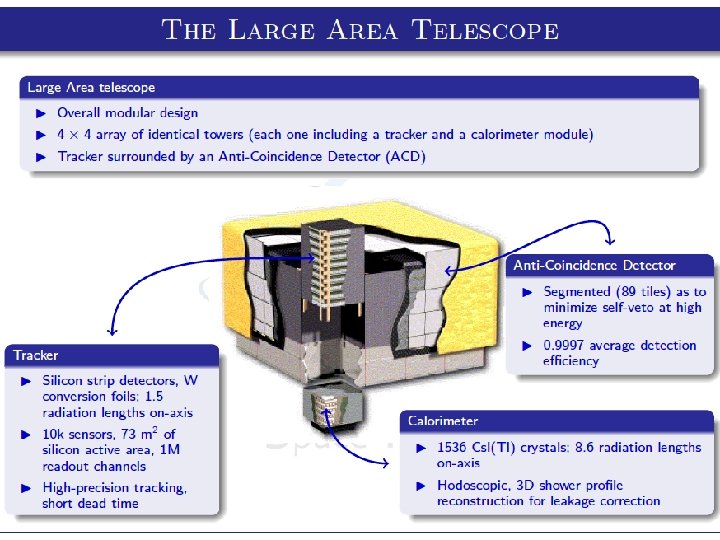
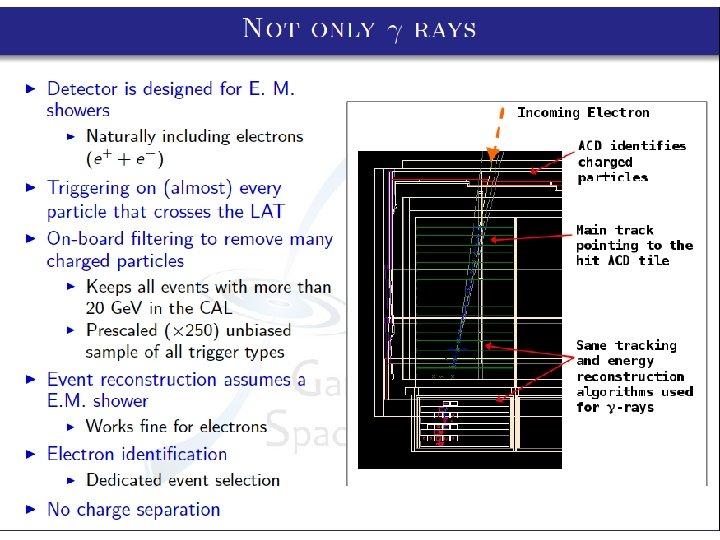
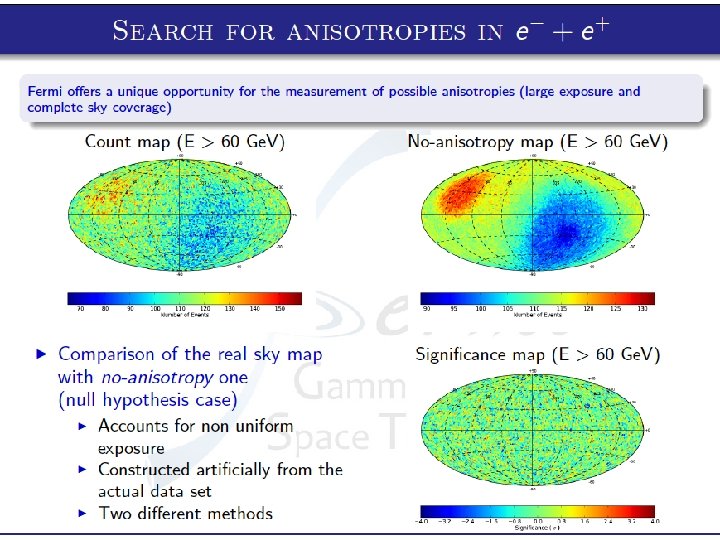
FERMI OBSERVATORY Click to edit Master text styles

Orbiting Space Station Click to edit Master text styles
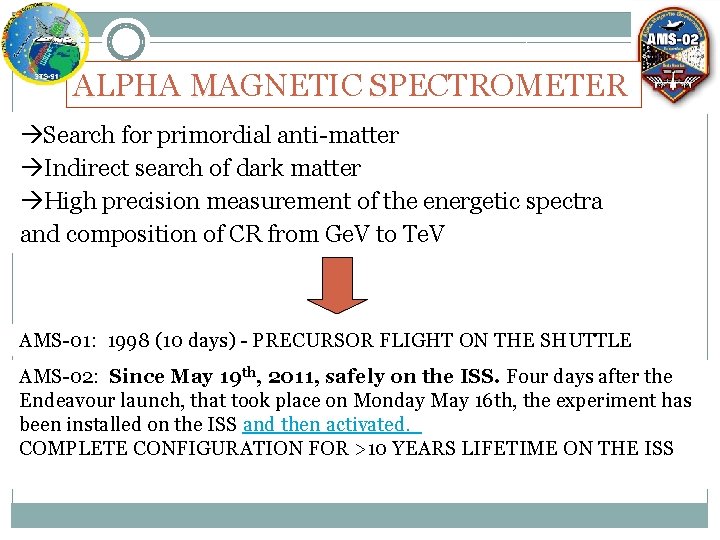
ALPHA MAGNETIC SPECTROMETER Search for primordial anti-matter Indirect search of dark matter High precision measurement of the energetic spectra and composition of CR from Ge. V to Te. V AMS-01: 1998 (10 days) - PRECURSOR FLIGHT ON THE SHUTTLE AMS-02: Since May 19 th, 2011, safely on the ISS. Four days after the Endeavour launch, that took place on Monday May 16 th, the experiment has been installed on the ISS and then activated. COMPLETE CONFIGURATION FOR >10 YEARS LIFETIME ON THE ISS
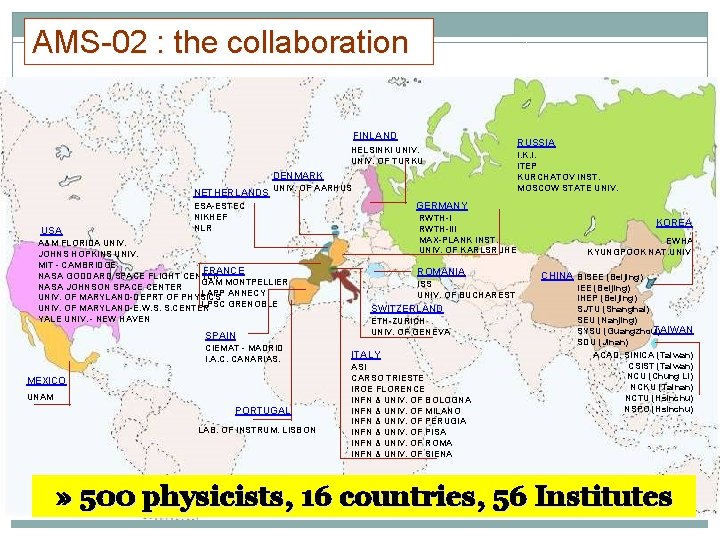
AMS-02 : the collaboration FINLAND HELSINKI UNIV. OF TURKU DENMARK NETHERLANDS USA UNIV. OF AARHUS SPAIN CIEMAT - MADRID I. A. C. CANARIAS. MEXICO UNAM PORTUGAL LAB. OF INSTRUM. LISBON I. K. I. ITEP KURCHATOV INST. MOSCOW STATE UNIV. GERMANY ESA-ESTEC NIKHEF NLR A&M FLORIDA UNIV. JOHNS HOPKINS UNIV. MIT - CAMBRIDGE FRANCE NASA GODDARD SPACE FLIGHT CENTER GAM MONTPELLIER NASA JOHNSON SPACE CENTER LAPP UNIV. OF MARYLAND-DEPRT OF PHYSICS ANNECY LPSC GRENOBLE UNIV. OF MARYLAND-E. W. S. S. CENTER YALE UNIV. - NEW HAVEN RUSSIA RWTH-III MAX-PLANK INST. UNIV. OF KARLSRUHE ROMANIA ISS UNIV. OF BUCHAREST SWITZERLAND ETH-ZURICH UNIV. OF GENEVA ITALY ASI CARSO TRIESTE IROE FLORENCE INFN & UNIV. OF BOLOGNA INFN & UNIV. OF MILANO INFN & UNIV. OF PERUGIA INFN & UNIV. OF PISA INFN & UNIV. OF ROMA INFN & UNIV. OF SIENA KOREA EWHA KYUNGPOOK NAT. UNIV. CHINA BISEE (Beijing) IHEP (Beijing) SJTU (Shanghai) SEU (Nanjing) TAIWAN SYSU (Guangzhou) SDU (Jinan) ACAD. SINICA (Taiwan) CSIST (Taiwan) NCU (Chung Li) NCKU (Tainan) NCTU (Hsinchu) NSPO (Hsinchu) » 500 physicists, 16 countries, 56 Institutes
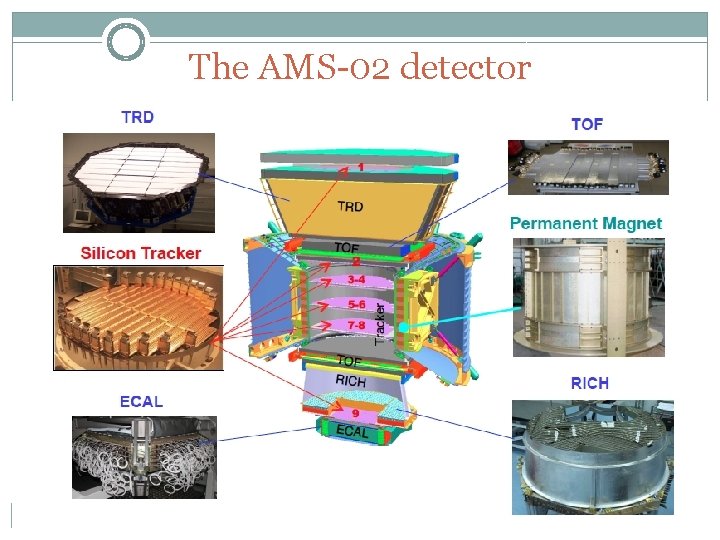
The AMS-02 detector Click to edit Master text styles
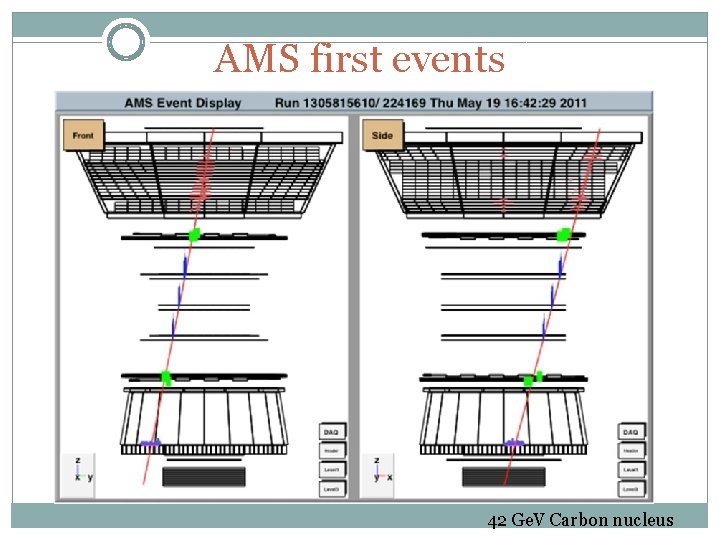
AMS first events Click to edit Master text styles 42 Ge. V Carbon nucleus
FIRST AMS RESULT? Click to edit Master text styles � So far no physics results given by the collaboration to the science community; �First results expected for the 4 th International Conference on Particle and Fundamental Physics in Space (Space. Part), which will take place at CERN from November 5 th to November 7 th 2012.

Click to edit Master text styles Future experiments
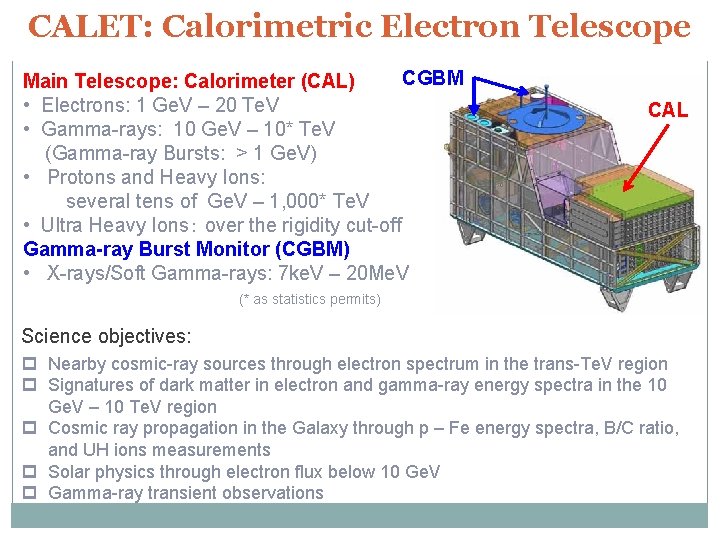
CALET: Calorimetric Electron Telescope 78 CGBM Main Telescope: Calorimeter (CAL) • Electrons: 1 Ge. V – 20 Te. V • Gamma-rays: 10 Ge. V – 10* Te. V (Gamma-ray Bursts: > 1 Ge. V) • Protons and Heavy Ions: several tens of Ge. V – 1, 000* Te. V • Ultra Heavy Ions: over the rigidity cut-off Gamma-ray Burst Monitor (CGBM) • X-rays/Soft Gamma-rays: 7 ke. V – 20 Me. V CAL (* as statistics permits) Science objectives: p Nearby cosmic-ray sources through electron spectrum in the trans-Te. V region p Signatures of dark matter in electron and gamma-ray energy spectra in the 10 Ge. V – 10 Te. V region p Cosmic ray propagation in the Galaxy through p – Fe energy spectra, B/C ratio, and UH ions measurements p Solar physics through electron flux below 10 Ge. V p Gamma-ray transient observations
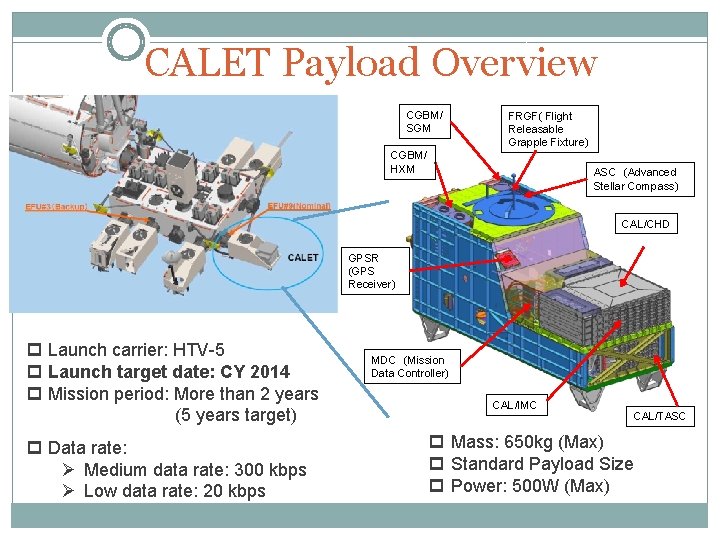
CALET Payload Overview CGBM/ SGM Click to edit Master text styles FRGF( Flight Releasable Grapple Fixture) CGBM/ HXM ASC (Advanced Stellar Compass) CAL/CHD GPSR (GPS Receiver) p Launch carrier: HTV-5 p Launch target date: CY 2014 p Mission period: More than 2 years (5 years target) p Data rate: Ø Medium data rate: 300 kbps Ø Low data rate: 20 kbps MDC (Mission Data Controller) CAL/IMC CAL/TASC p Mass: 650 kg (Max) p Standard Payload Size p Power: 500 W (Max)
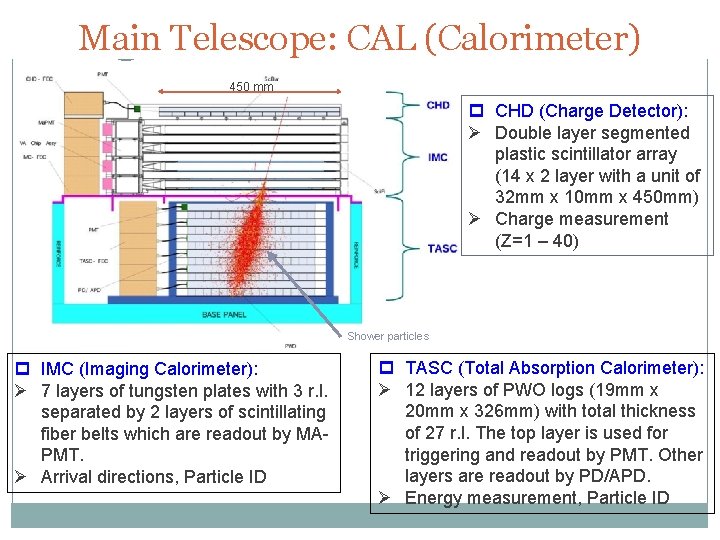
Main Telescope: CAL (Calorimeter) 450 mm p CHD (Charge Detector): Ø Double layer segmented plastic scintillator array (14 x 2 layer with a unit of 32 mm x 10 mm x 450 mm) Ø Charge measurement (Z=1 – 40) Click to edit Master text styles Shower particles p IMC (Imaging Calorimeter): Ø 7 layers of tungsten plates with 3 r. l. separated by 2 layers of scintillating fiber belts which are readout by MAPMT. Ø Arrival directions, Particle ID p TASC (Total Absorption Calorimeter): Ø 12 layers of PWO logs (19 mm x 20 mm x 326 mm) with total thickness of 27 r. l. The top layer is used for triggering and readout by PMT. Other layers are readout by PD/APD. Ø Energy measurement, Particle ID
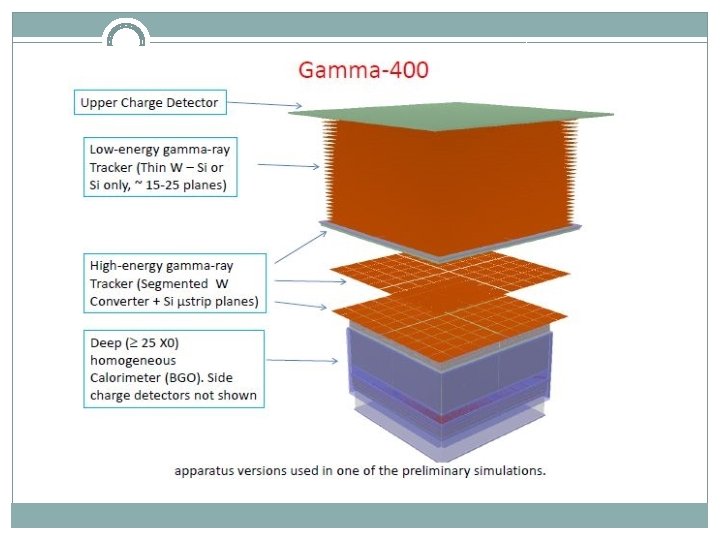
Gamma-400 on Russian satellite It will combine for the first time photon and particle (electrons and nuclei) detection in a unique way Click to edit Master text � styles Excellent Silicon Tracker (30 Me. V – 300 Ge. V), breakthrough angular resolution 4 -5 times better than Fermi -LAT at 1 Ge. V improved sensitivity compared with Fermi-LAT by a factor of 5 -10 in the energy range 30 Me. V – 10 Ge. V �Heavy Calorimeter (25 X 0) with optimal energy resolution and particle discrimination Electron/positron detection up to Te. V energies Nuclei detection up to 1015 e. V energies
Click to edit Master text styles
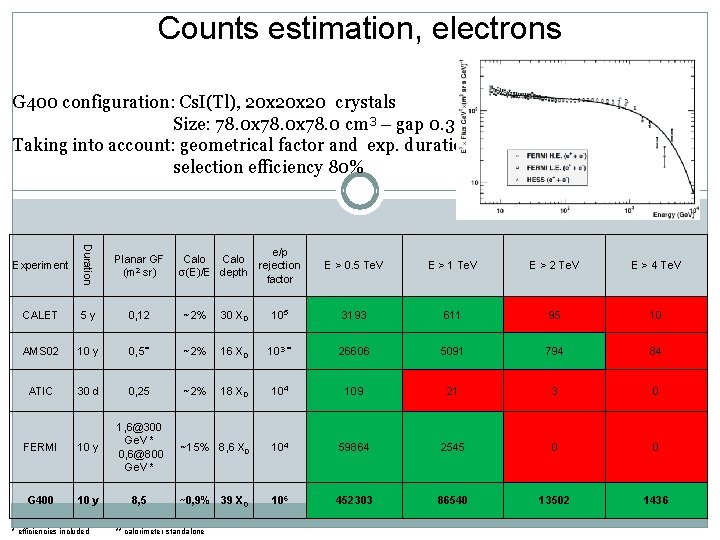
Counts estimation, electrons G 400 configuration: Cs. I(Tl), 20 x 20 crystals Size: 78. 0 x 78. 0 cm 3 – gap 0. 3 cm Taking into account: geometrical factor and exp. duration + selection efficiency 80% Experiment Duration Planar GF (m 2 sr) CALET 5 y 0, 12 ~2% AMS 02 10 y 0, 5** ATIC 30 d 0, 25 FERMI G 400 e/p rejection factor E > 0. 5 Te. V E > 1 Te. V E > 2 Te. V E > 4 Te. V 30 X 0 105 3193 611 95 10 ~2% 16 X 0 103 ** 26606 5091 794 84 ~2% 18 X 0 104 109 21 3 0 10 y 1, 6@300 Ge. V * 0, 6@800 Ge. V * ~15% 8, 6 X 0 104 59864 2545 0 0 10 y 8, 5 ~0, 9% 39 X 0 106 452303 86540 13502 1436 * efficiencies included Calo s(E)/E depth ** calorimeter standalone
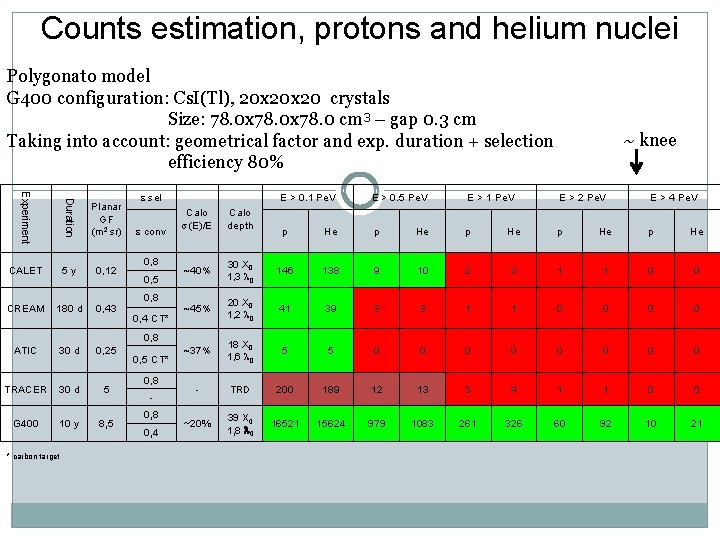
Counts estimation, protons and helium nuclei Polygonato model G 400 configuration: Cs. I(Tl), 20 x 20 crystals Size: 78. 0 x 78. 0 cm 3 – gap 0. 3 cm ~ knee Taking into account: geometrical factor and exp. duration + selection efficiency 80% Experiment Duration Planar GF (m 2 sr) CALET 5 y 0, 12 CREAM 180 d 0, 43 ATIC 30 d 0, 25 TRACER 30 d 5 G 400 10 y 8, 5 e sel e conv 0, 8 0, 5 0, 8 0, 4 CT* * carbon target 0, 8 0, 4 E > 0. 5 Pe. V E > 1 Pe. V E > 2 Pe. V E > 4 Pe. V p He p He Calo s(E)/E Calo depth ~40% 30 X 0 1, 3 l 0 146 138 9 10 2 3 1 1 0 0 ~45% 20 X 0 1, 2 l 0 41 39 3 3 1 1 0 0 ~37% 18 X 0 1, 6 l 0 5 5 0 0 0 0 - TRD 200 189 12 13 3 4 1 1 0 0 ~20% 39 X 0 1, 8 l 0 16521 15624 979 1083 261 326 60 92 10 21 0, 8 0, 5 CT* E > 0. 1 Pe. V
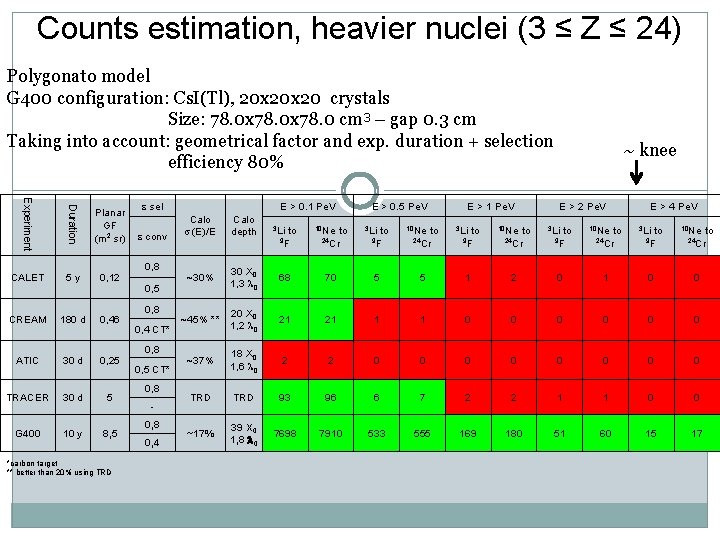
Counts estimation, heavier nuclei (3 ≤ Z ≤ 24) Polygonato model G 400 configuration: Cs. I(Tl), 20 x 20 crystals Size: 78. 0 x 78. 0 cm 3 – gap 0. 3 cm Taking into account: geometrical factor and exp. duration + selection ~ knee efficiency 80% Experiment Duration Planar GF (m 2 sr) CALET 5 y 0, 12 CREAM 180 d 0, 46 ATIC 30 d 0, 25 TRACER 30 d 5 G 400 10 y 8, 5 *carbon target ** better than 20% using TRD e sel e conv 0, 8 0, 5 0, 8 0, 4 CT* 0, 8 0, 5 CT* 0, 8 0, 4 E > 0. 1 Pe. V Calo s(E)/E Calo depth ~30% 3 Li to 10 Ne E > 0. 5 Pe. V to 3 Li to 10 Ne E > 1 Pe. V to 3 Li to 10 Ne E > 2 Pe. V to 3 Li to 10 Ne E > 4 Pe. V to 3 Li to 10 Ne to 9 F 24 Cr 9 F 24 Cr 30 X 0 1, 3 l 0 68 70 5 5 1 2 0 1 0 0 ~45% ** 20 X 0 1, 2 l 0 21 21 1 1 0 0 0 ~37% 18 X 0 1, 6 l 0 2 2 0 0 0 0 TRD 93 96 6 7 2 2 1 1 0 0 ~17% 39 X 0 1, 8 l 0 7698 7910 533 555 169 180 51 60 15 17
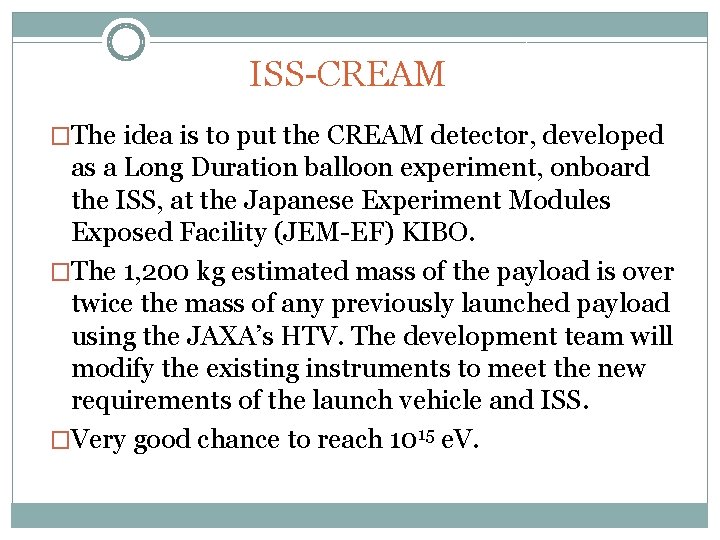
ISS-CREAM �The idea is to put the CREAM detector, developed as a Long Duration balloon experiment, onboard the ISS, at the Japanese Experiment Modules Exposed Facility (JEM-EF) KIBO. �The 1, 200 kg estimated mass of the payload is over twice the mass of any previously launched payload using the JAXA’s HTV. The development team will modify the existing instruments to meet the new requirements of the launch vehicle and ISS. �Very good chance to reach 1015 e. V. Click to edit Master text styles
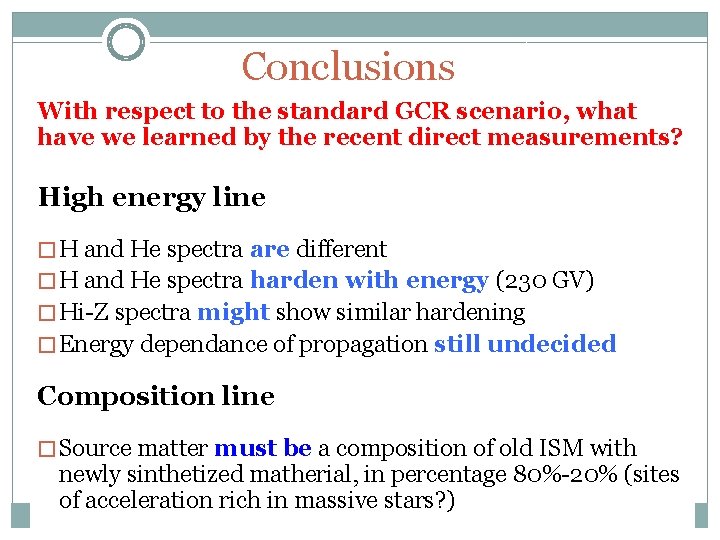
Conclusions With respect to the standard GCR scenario, what have we learned by the recent direct measurements? Click to edit Master text styles High energy line � H and He spectra are different � H and He spectra harden with energy (230 GV) � Hi-Z spectra might show similar hardening � Energy dependance of propagation still undecided Composition line � Source matter must be a composition of old ISM with newly sinthetized matherial, in percentage 80%-20% (sites of acceleration rich in massive stars? )
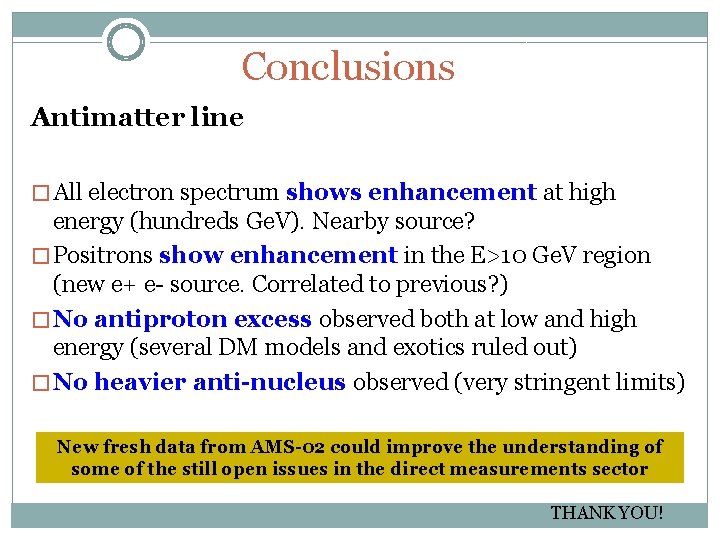
Conclusions Antimatter line Click to edit Master text styles � All electron spectrum shows enhancement at high energy (hundreds Ge. V). Nearby source? � Positrons show enhancement in the E>10 Ge. V region (new e+ e- source. Correlated to previous? ) � No antiproton excess observed both at low and high energy (several DM models and exotics ruled out) � No heavier anti-nucleus observed (very stringent limits) New fresh data from AMS-02 could improve the understanding of some of the still open issues in the direct measurements sector THANK YOU!
- Slides: 88