
High Electron Mobility Transistors HEMT BY AARON BUEHLER
High Electron Mobility Transistors (HEMT) BY: AARON BUEHLER & JASON VANDERLINDE
Outline • Brief History • What are they? • How they Work • Different Types • Band Structure and Diagrams • Applications • Key Points • References
Brief History • Developed by Takashi Mimura and colleagues at Fujitsu in Japan in 1979 • Faced several issues along the way • Early Applications: • Low noise amplifiers • Installed in radio telescope • Other space and military applications • Commercialization began in 1987 for satellite broadcasting receivers • Commercial production took off in the 90’s
What are they? • Referred to as heterojunction field-effect transistor (FET) • Abrupt discontinuities • Two layers of different semiconductor with two different band gap energies • Separating majority carriers and ionized impurities minimizes the degradation in mobility and peak velocity • The 2 -D electron gas = less electron collisions = less noise
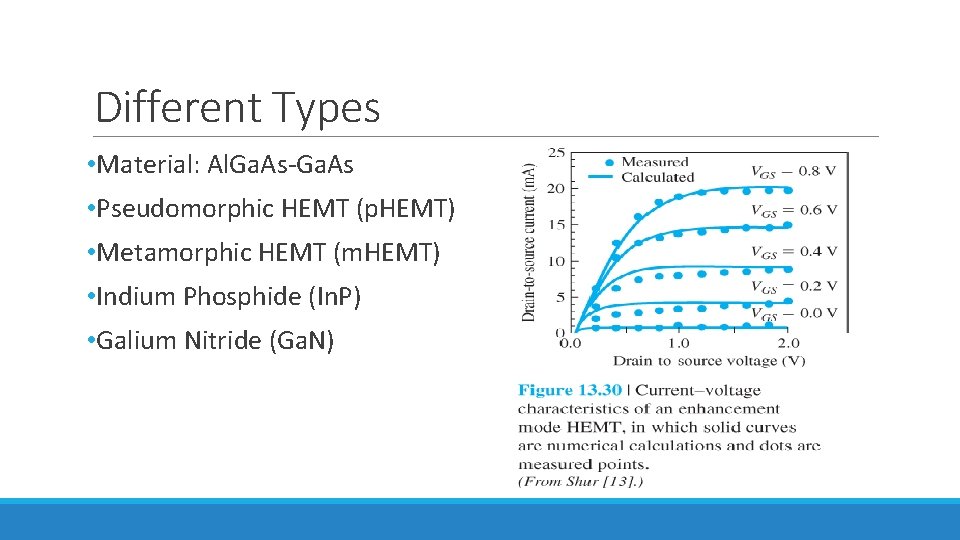
Different Types • Material: Al. Ga. As-Ga. As • Pseudomorphic HEMT (p. HEMT) • Metamorphic HEMT (m. HEMT) • Indium Phosphide (In. P) • Galium Nitride (Ga. N)
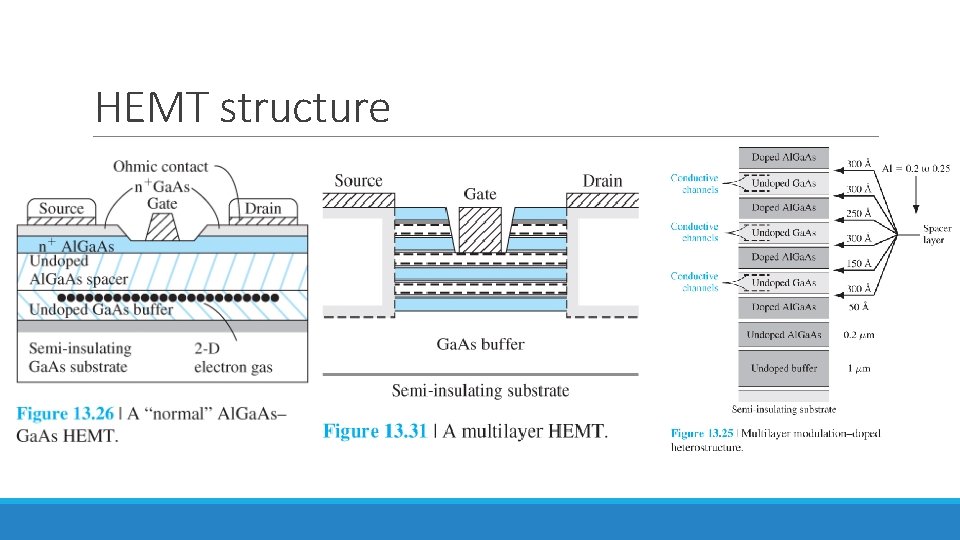
HEMT structure
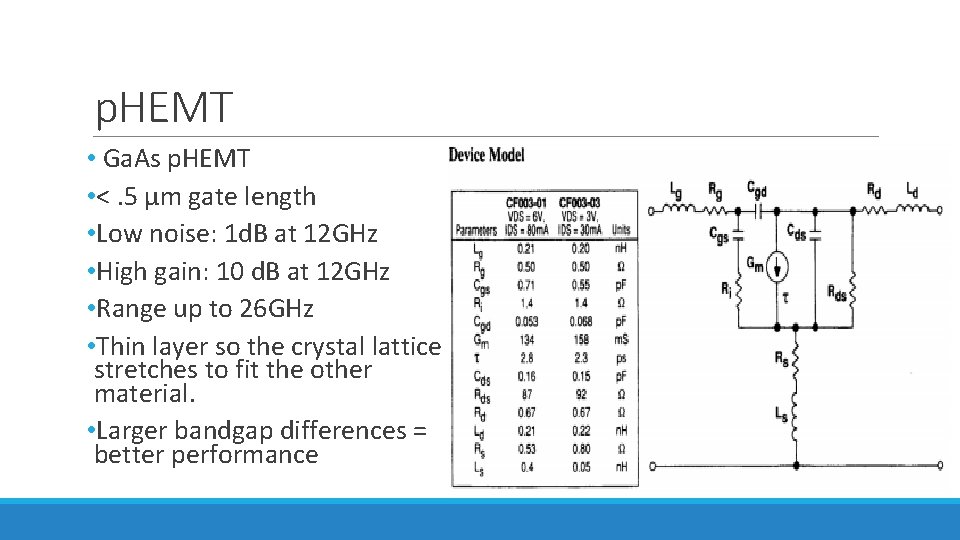
p. HEMT • Ga. As p. HEMT • <. 5 µm gate length • Low noise: 1 d. B at 12 GHz • High gain: 10 d. B at 12 GHz • Range up to 26 GHz • Thin layer so the crystal lattice stretches to fit the other material. • Larger bandgap differences = better performance
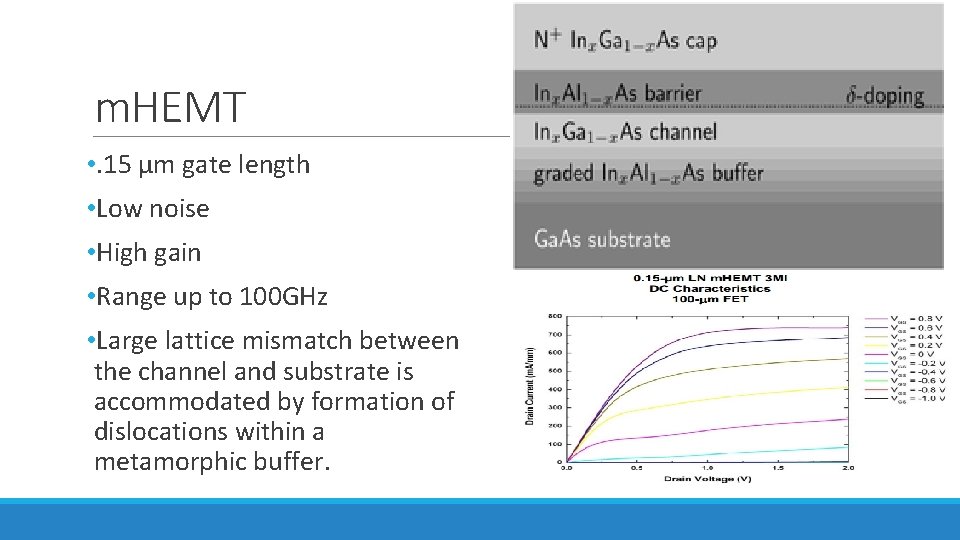
m. HEMT • . 15 µm gate length • Low noise • High gain • Range up to 100 GHz • Large lattice mismatch between the channel and substrate is accommodated by formation of dislocations within a metamorphic buffer.
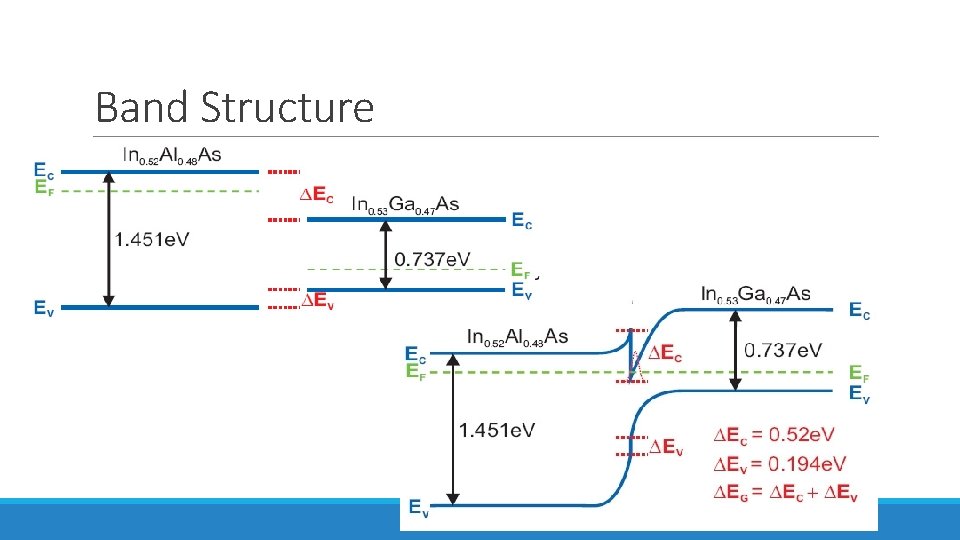
Band Structure
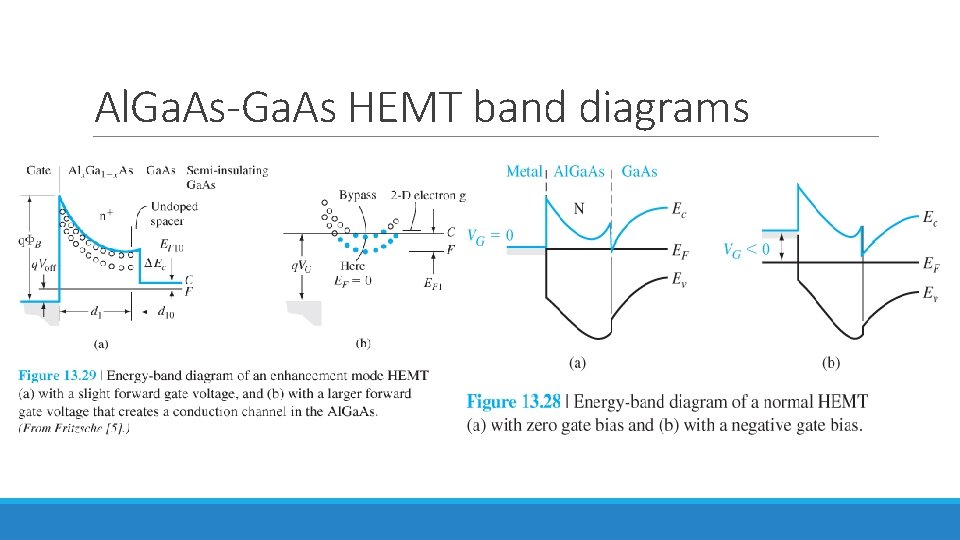
Al. Ga. As-Ga. As HEMT band diagrams
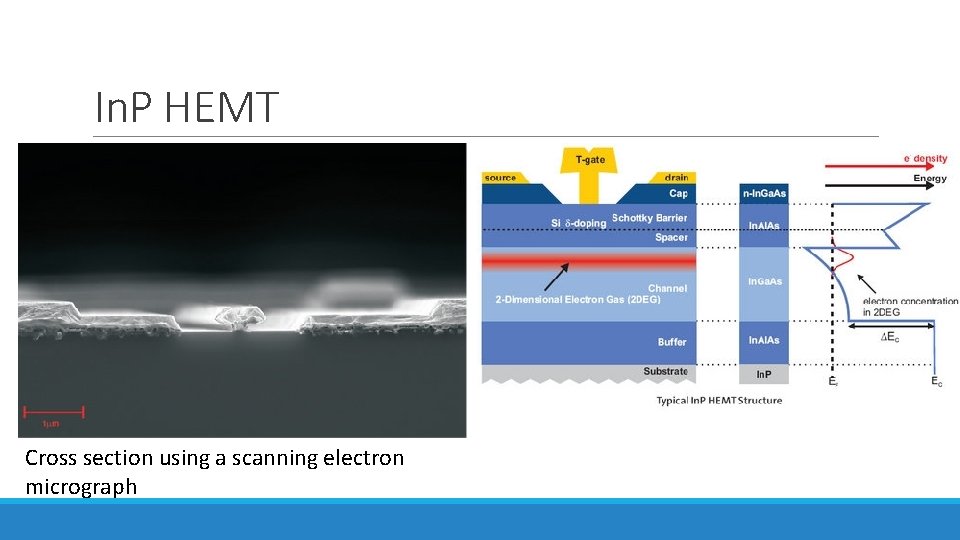
In. P HEMT Cross section using a scanning electron micrograph
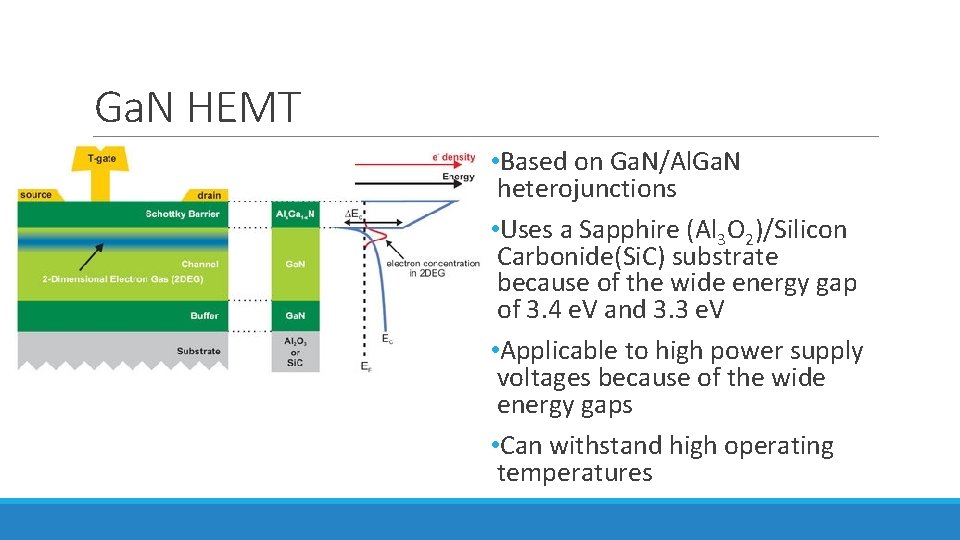
Ga. N HEMT • Based on Ga. N/Al. Ga. N heterojunctions • Uses a Sapphire (Al 3 O 2)/Silicon Carbonide(Si. C) substrate because of the wide energy gap of 3. 4 e. V and 3. 3 e. V • Applicable to high power supply voltages because of the wide energy gaps • Can withstand high operating temperatures
Applications • Originally for high speed applications • High power/ high temperature microwave applications • Power amplifiers • Oscillators • Cell Phones • Radar • Most MMIC’s radio frequency applications
Key Points • Its two main features are low noise and high frequency capability • A heterojunction is two layers different semiconductors with different band gap energies • The 2 -D electron gas is essential to the low noise feature • Al. Ga. As and Ga. As are the most common materials for heterojunction • Used in MMIC’s and radio frequency applications for high performance
Sources • "Ga. As Pseudomorphic HEMT Transistor. " Mimix Broadband, Inc. N. p. , 19 July 2008. Web. 30 Apr. 2013. <http: //www. richardsonrfpd. com/resources/Rell. Documents/SYS_4/CF 00303. pdf>. • Grunenputt, Erik. "Pseudomorphic and Metamorphic HEMT-technologies for Industrial W-band Low-noise and Power Applications. ” Youscribe. N. p. , Dec. 2009. Web. 30 Apr. 2013. <http: //www. youscribe. com/catalogue/rapports-et-theses/savoirs/pseudomorphic-and metamorphic-hemt-technologies-for-industrial-w-band-1426512>. • Poole, Ian. "HEMT, High Electron Mobility Transistor. " Radio-Electronics. com. Adrio Communications, June 2010. Web. 30 Apr. 2013. <http: //www. radioelectronics. com/info/data/semicond/fet-field-effect-transistor/hemt-phemttransistor. php>.
Sources continued • "0. 15 -um LN MHEMT 3 MI. " Tri. Quint. com. N. p. , 29 Nov. 2007. Web. <http: //www. triquint. com/prodserv/foundry/docs/0. 15. LN. m. HEMT. 3 MI. pdf>. • Göran, Andersson, ed. "High Electron Mobility Transistors (HEMT). " Laboratory for Millimeter-Wave Electronics. ETH Zurich, 2 Mar 2010. Web. 30 Apr 2013. <http: //www. mwe. ethz. ch/en/aboutmwe-group/research/vision-and-aim/high-electron-mobility-transistors-hemt. html>. • Neamen, Donald. Semiconductor Physics and Devices Basic Principles. 4 th ed. New York: Mc. Graw-Hill, 2012. 602 -9. Print. • Mimura, Takashi. "The Early History of the High Electron Mobility Transistor (HEMT). " Early History of the High Electron Mobility Transistor (HEMT). 50. 3 (2002): 780 -82. Web. 30 Apr. 2013. <http: //ieeexplore. ieee. org. libpdb. d. umn. edu: 2048/stamp. jsp? tp=&arnumber=98996 1&tag=1>.
- Slides: 16