
High efficiency Si solar cells 3 D Junction
- Slides: 40
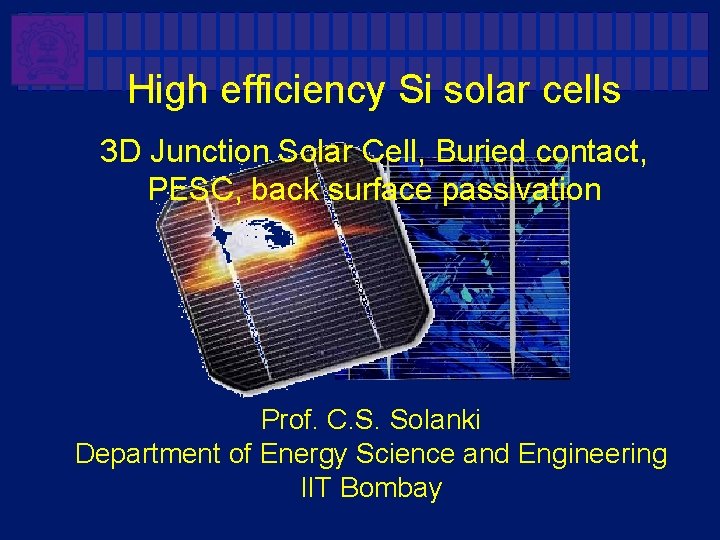
High efficiency Si solar cells 3 D Junction Solar Cell, Buried contact, PESC, back surface passivation Prof. C. S. Solanki Department of Energy Science and Engineering IIT Bombay
3 -D junction solar cell simulation
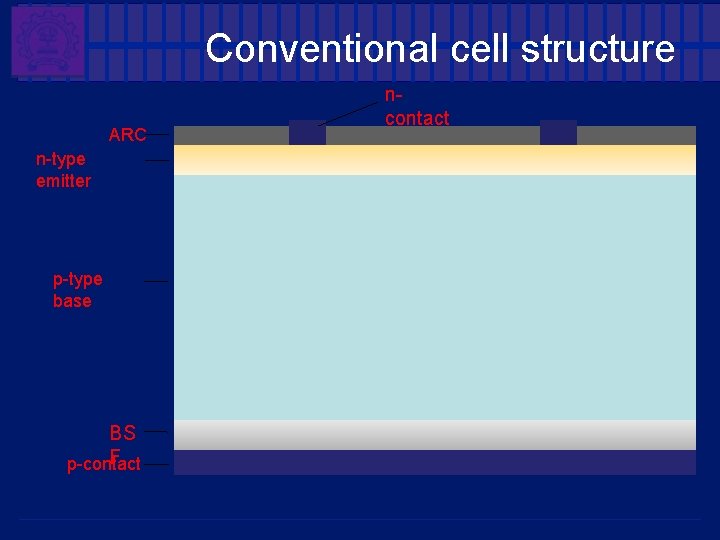
Conventional cell structure ARC n-type emitter p-type base BS F p-contact ncontact
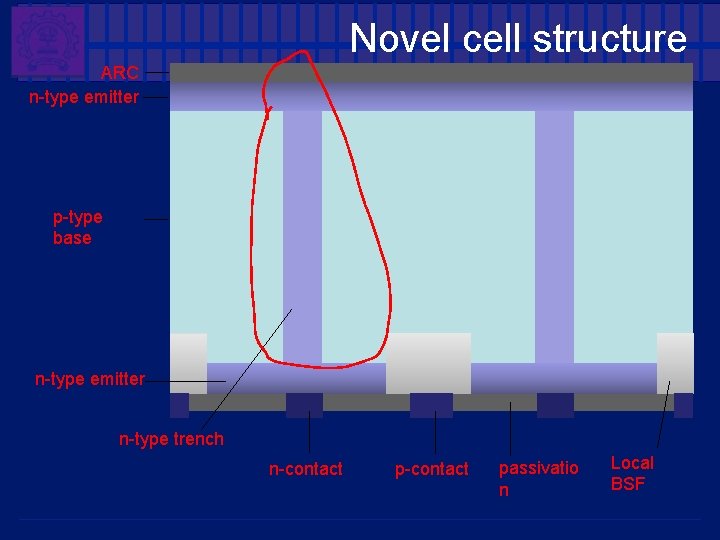
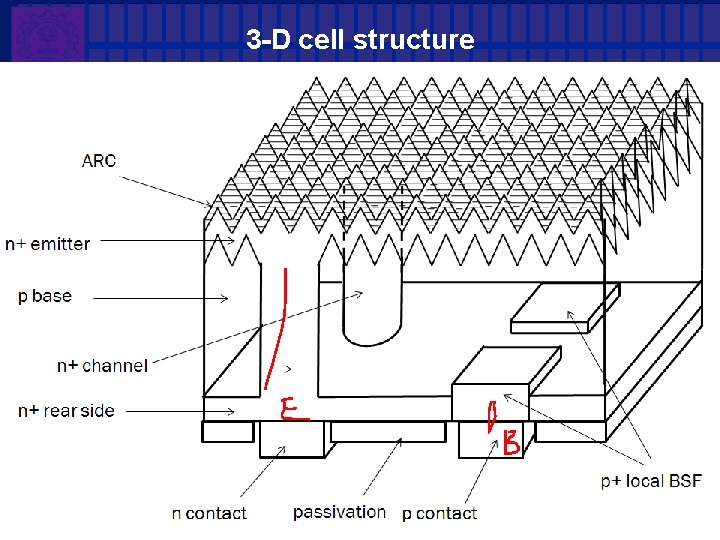
Novel cell structure ARC n-type emitter p-type base n-type emitter n-type trench n-contact passivatio n Local BSF
3 -D cell structure
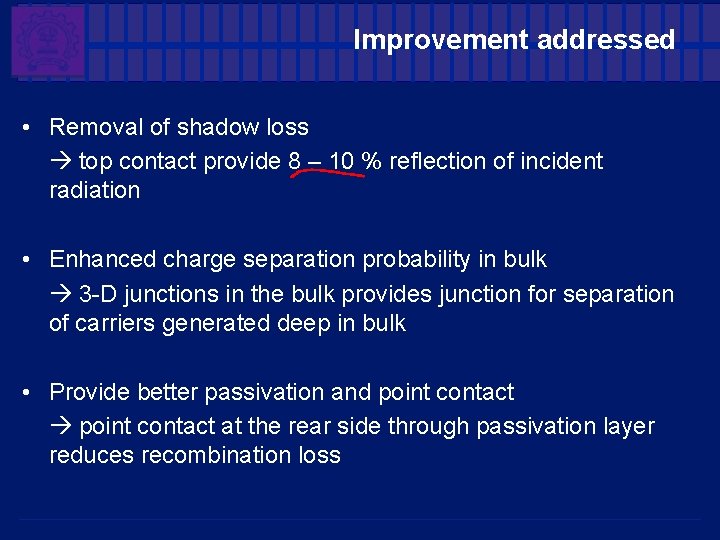
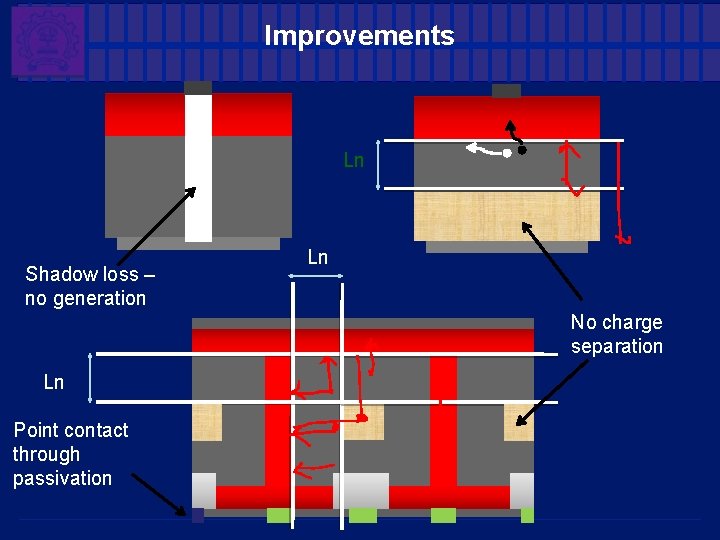
Improvement addressed • Removal of shadow loss top contact provide 8 – 10 % reflection of incident radiation • Enhanced charge separation probability in bulk 3 -D junctions in the bulk provides junction for separation of carriers generated deep in bulk • Provide better passivation and point contact at the rear side through passivation layer reduces recombination loss
Improvements Ln Shadow loss – no generation Ln No charge separation Ln Point contact through passivation
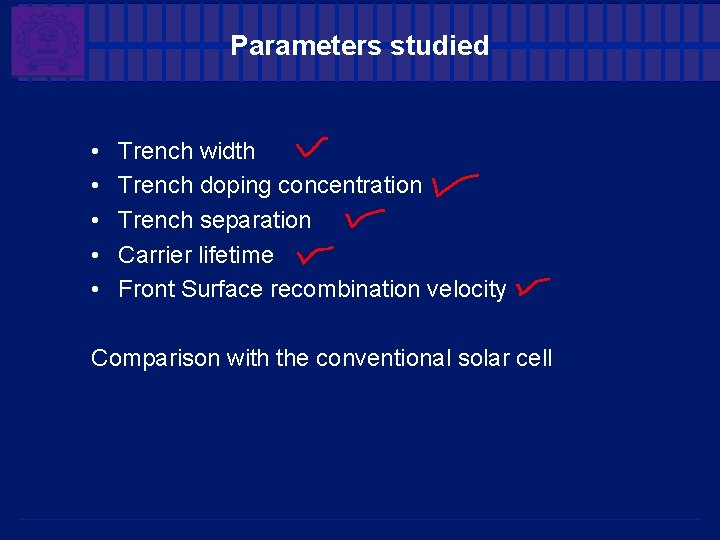
Parameters studied • • • Trench width Trench doping concentration Trench separation Carrier lifetime Front Surface recombination velocity Comparison with the conventional solar cell
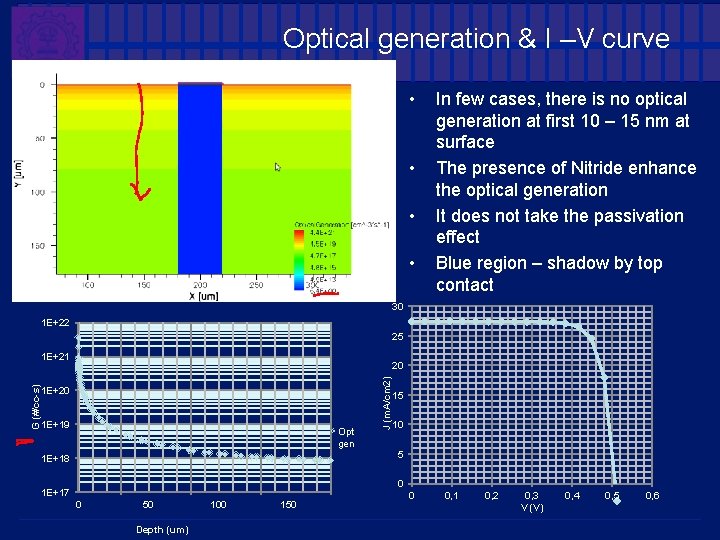
Optical generation & I –V curve • • In few cases, there is no optical generation at first 10 – 15 nm at surface The presence of Nitride enhance the optical generation It does not take the passivation effect Blue region – shadow by top contact 30 1 E+22 25 20 1 E+20 J (m. A/cm 2) G (#/cc-s) 1 E+21 15 1 E+19 Opt gen 1 E+18 10 5 0 1 E+17 0 50 Depth (um) 100 150 0 0, 1 0, 2 0, 3 V (V) 0, 4 0, 5 0, 6
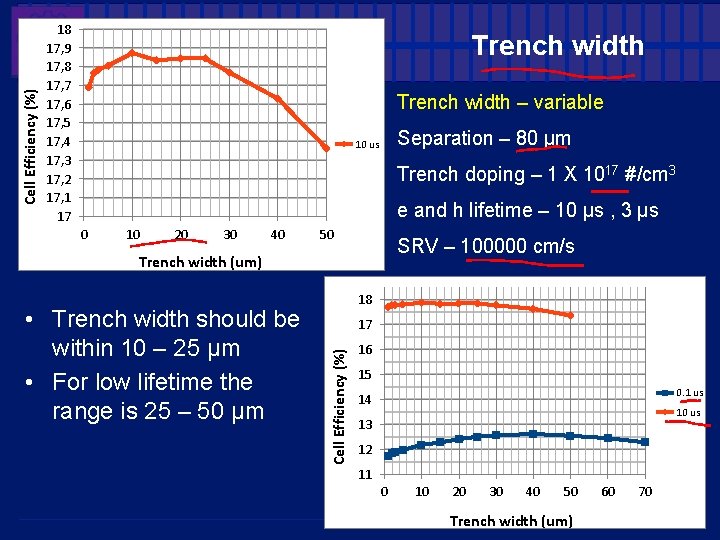
Cell Efficiency (%) 18 17, 9 17, 8 17, 7 17, 6 17, 5 17, 4 17, 3 17, 2 17, 1 17 Trench width – variable Separation – 80 µm 10 us Trench doping – 1 X 10¹⁷ #/cm 3 e and h lifetime – 10 µs , 3 µs 0 10 20 30 40 50 SRV – 100000 cm/s Trench width (um) 17 Cell Efficiency (%) • Trench width should be within 10 – 25 µm • For low lifetime the range is 25 – 50 µm 18 16 15 0. 1 us 14 10 us 13 12 11 0 10 20 30 40 50 Trench width (um) 60 70
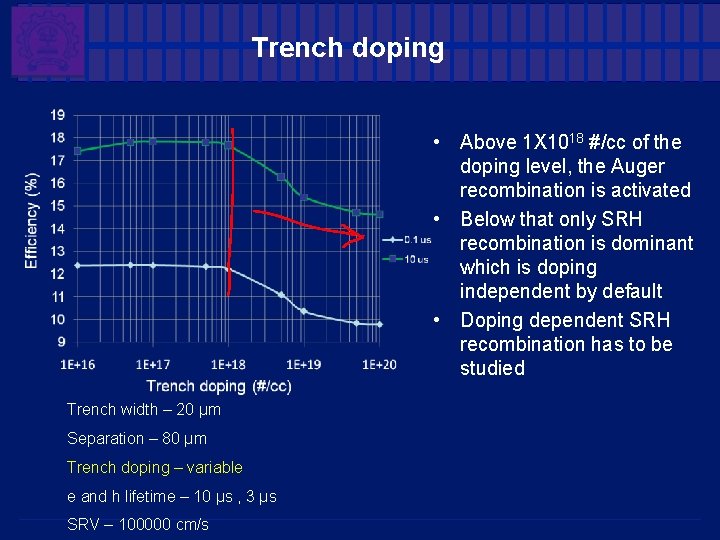
Trench doping • Above 1 X 10¹⁸ #/cc of the doping level, the Auger recombination is activated • Below that only SRH recombination is dominant which is doping independent by default • Doping dependent SRH recombination has to be studied Trench width – 20 µm Separation – 80 µm Trench doping – variable e and h lifetime – 10 µs , 3 µs SRV – 100000 cm/s
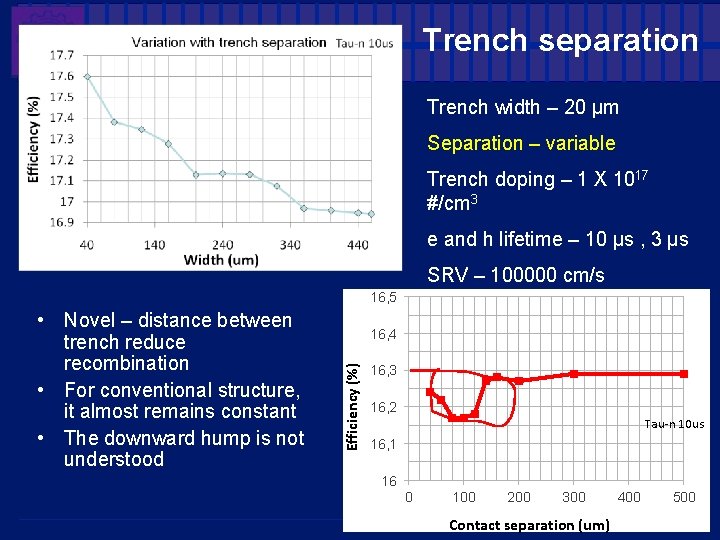
Trench separation Trench width – 20 µm Separation – variable Trench doping – 1 X 10¹⁷ #/cm 3 e and h lifetime – 10 µs , 3 µs SRV – 100000 cm/s 16, 5 16, 4 Efficiency (%) • Novel – distance between trench reduce recombination • For conventional structure, it almost remains constant • The downward hump is not understood 16, 3 16, 2 Tau-n 10 us 16, 1 16 0 100 200 300 Contact separation (um) 400 500
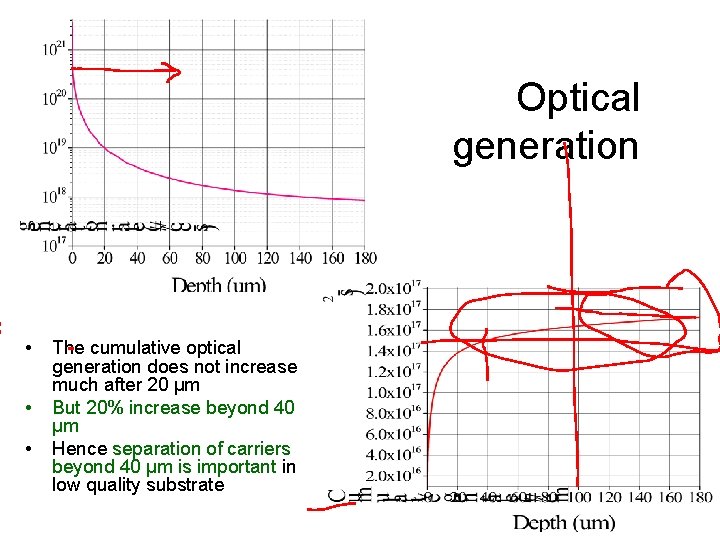
Optical generation • • • The cumulative optical generation does not increase much after 20 µm But 20% increase beyond 40 µm Hence separation of carriers beyond 40 µm is important in low quality substrate
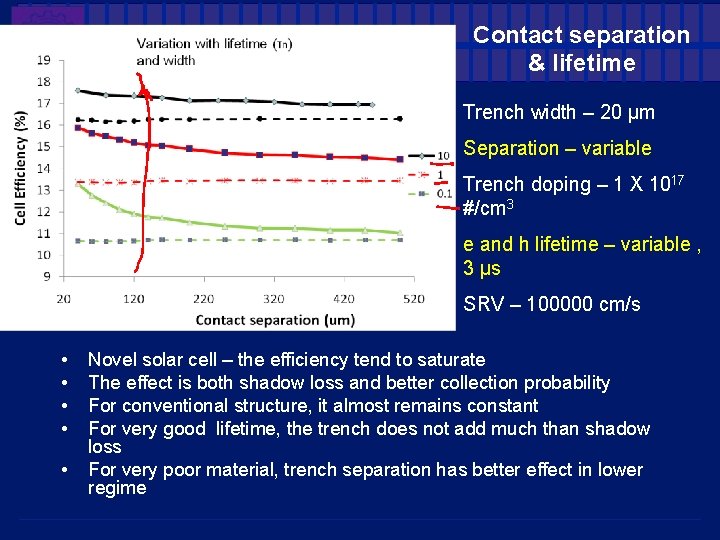
Contact separation & lifetime Trench width – 20 µm Separation – variable Trench doping – 1 X 10¹⁷ #/cm 3 e and h lifetime – variable , 3 µs SRV – 100000 cm/s • • • Novel solar cell – the efficiency tend to saturate The effect is both shadow loss and better collection probability For conventional structure, it almost remains constant For very good lifetime, the trench does not add much than shadow loss For very poor material, trench separation has better effect in lower regime
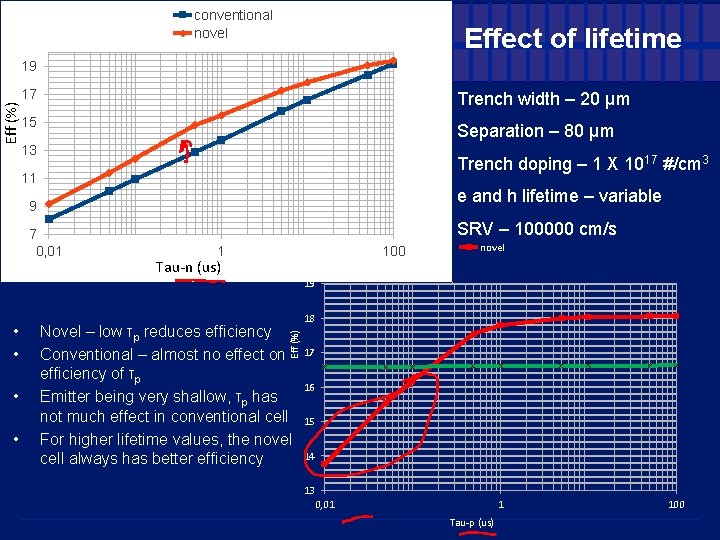
conventional novel Effect of lifetime Eff (%) 19 17 Trench width – 20 µm 15 Separation – 80 µm 13 Trench doping – 1 X 10¹⁷ #/cm 3 11 e and h lifetime – variable 9 7 0, 01 SRV – 100000 cm/s 1 100 Tau-n (us) novel 19 • • Novel – low τp reduces efficiency Conventional – almost no effect on efficiency of τp Emitter being very shallow, τp has not much effect in conventional cell For higher lifetime values, the novel cell always has better efficiency Eff (%) • • 18 17 16 15 14 13 0, 01 1 Tau-p (us) 100
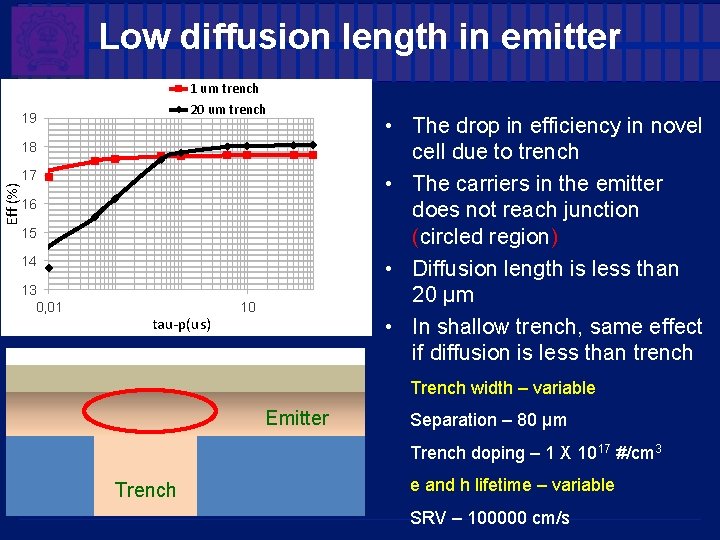
Low diffusion length in emitter 1 um trench 20 um trench 19 Eff (%) 18 17 16 15 14 13 0, 01 tau-p(us) 10 • The drop in efficiency in novel cell due to trench • The carriers in the emitter does not reach junction (circled region) • Diffusion length is less than 20 µm • In shallow trench, same effect if diffusion is less than trench Trench width – variable Emitter Separation – 80 µm Trench doping – 1 X 10¹⁷ #/cm 3 Trench e and h lifetime – variable SRV – 100000 cm/s
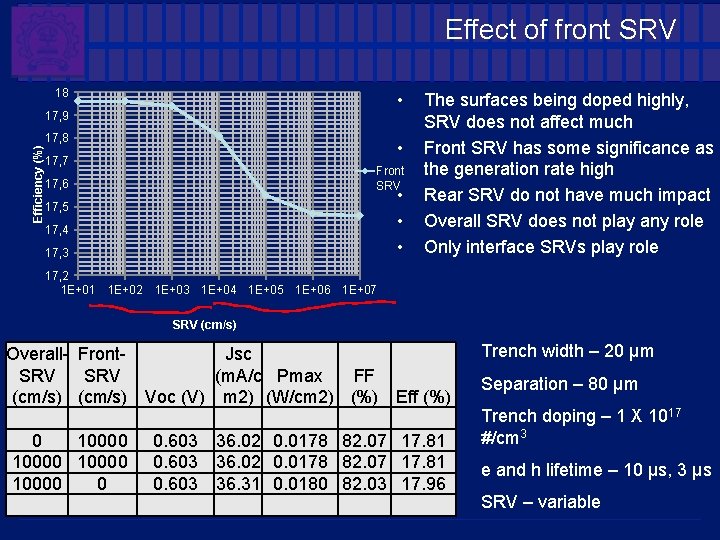
Effect of front SRV 18 • Efficiency (%) 17, 9 17, 8 • 17, 7 Front SRV 17, 6 • • • 17, 5 17, 4 17, 3 The surfaces being doped highly, SRV does not affect much Front SRV has some significance as the generation rate high Rear SRV do not have much impact Overall SRV does not play any role Only interface SRVs play role 17, 2 1 E+01 1 E+02 1 E+03 1 E+04 1 E+05 1 E+06 1 E+07 SRV (cm/s) Overall- Front. Jsc SRV (m. A/c Pmax FF (cm/s) Voc (V) m 2) (W/cm 2) (%) Eff (%) 0 10000 0 0. 603 36. 02 0. 0178 82. 07 17. 81 0. 603 36. 31 0. 0180 82. 03 17. 96 Trench width – 20 µm Separation – 80 µm Trench doping – 1 X 10¹⁷ #/cm 3 e and h lifetime – 10 µs, 3 µs SRV – variable
High Efficiency Si Cells Progress 1/5/2022 © IIT Bombay, C. S. Solanki Advanced Concepts in Solar Photovoltaic Technologies 18
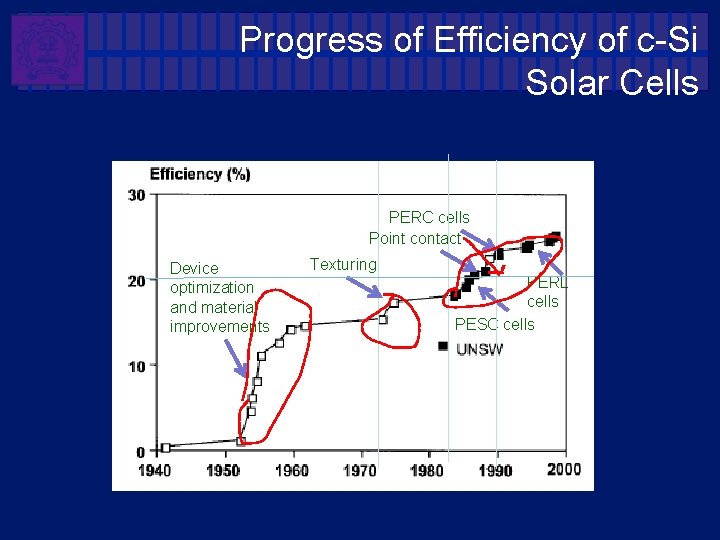
Progress of Efficiency of c-Si Solar Cells PERC cells Point contact Device optimization and material improvements Texturing PERL cells PESC cells
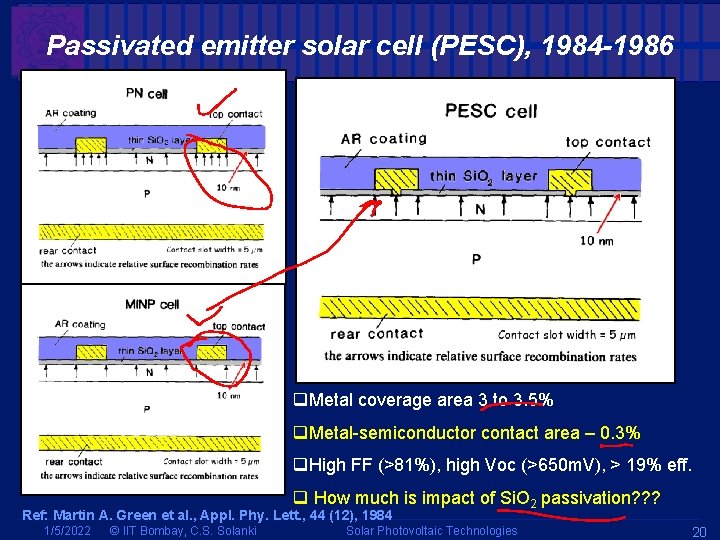
Passivated emitter solar cell (PESC), 1984 -1986 q. Metal coverage area 3 to 3. 5% q. Metal-semiconductor contact area – 0. 3% q. High FF (>81%), high Voc (>650 m. V), > 19% eff. q How much is impact of Si. O 2 passivation? ? ? Ref: Martin A. Green et al. , Appl. Phy. Lett. , 44 (12), 1984 1/5/2022 © IIT Bombay, C. S. Solanki Solar Photovoltaic Technologies 20
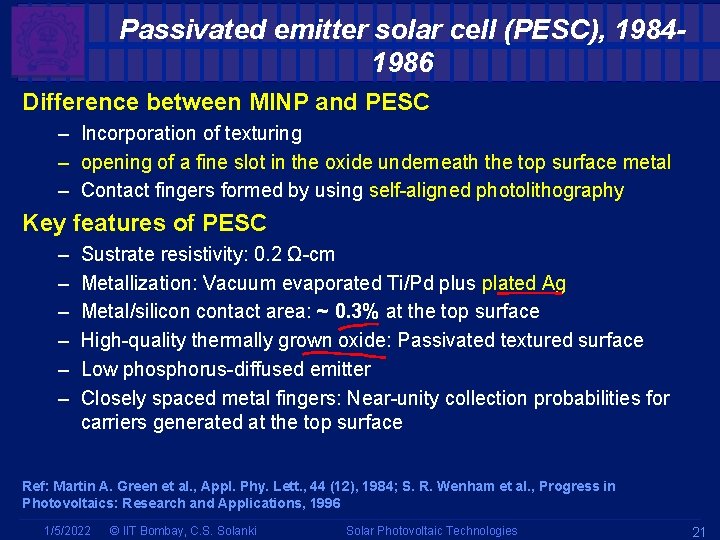
Passivated emitter solar cell (PESC), 19841986 Difference between MINP and PESC – Incorporation of texturing – opening of a fine slot in the oxide underneath the top surface metal – Contact fingers formed by using self-aligned photolithography Key features of PESC – – – Sustrate resistivity: 0. 2 Ω-cm Metallization: Vacuum evaporated Ti/Pd plus plated Ag Metal/silicon contact area: ~ 0. 3% at the top surface High-quality thermally grown oxide: Passivated textured surface Low phosphorus-diffused emitter Closely spaced metal fingers: Near-unity collection probabilities for carriers generated at the top surface Ref: Martin A. Green et al. , Appl. Phy. Lett. , 44 (12), 1984; S. R. Wenham et al. , Progress in Photovoltaics: Research and Applications, 1996 1/5/2022 © IIT Bombay, C. S. Solanki Solar Photovoltaic Technologies 21
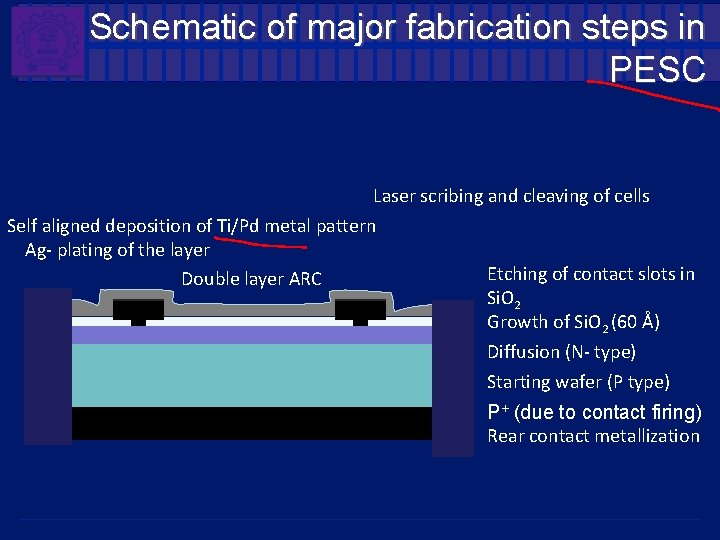
Schematic of major fabrication steps in PESC Laser scribing and cleaving of cells Self aligned deposition of Ti/Pd metal pattern Ag- plating of the layer Etching of contact slots in Double layer ARC Si. O 2 Growth of Si. O 2 (60 Å) Diffusion (N- type) Starting wafer (P type) P+ (due to contact firing) Rear contact metallization
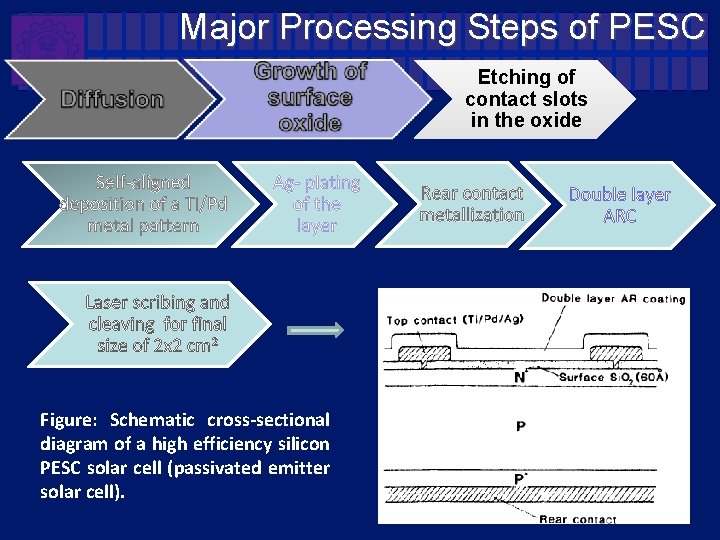
Major Processing Steps of PESC Etching of contact slots in the oxide Self-aligned deposition of a Ti/Pd metal pattern Ag- plating of the layer Laser scribing and cleaving for final size of 2 x 2 cm 2 Figure: Schematic cross-sectional diagram of a high efficiency silicon PESC solar cell (passivated emitter solar cell). Rear contact metallization Double layer ARC
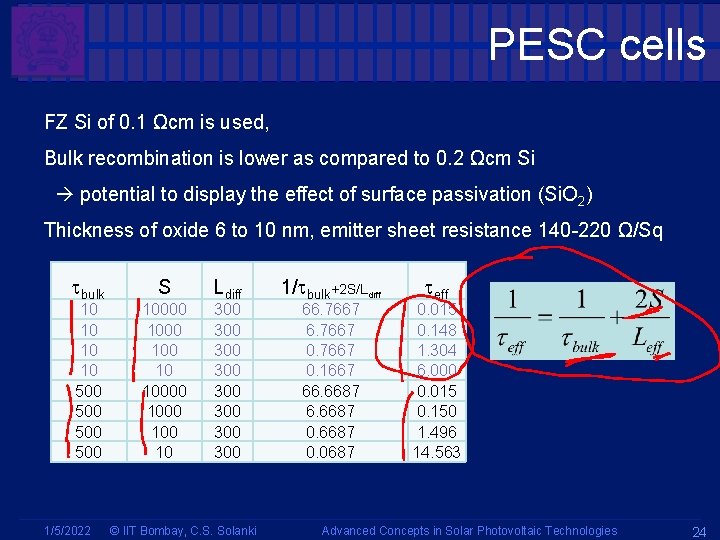
PESC cells FZ Si of 0. 1 Ωcm is used, Bulk recombination is lower as compared to 0. 2 Ωcm Si potential to display the effect of surface passivation (Si. O 2) Thickness of oxide 6 to 10 nm, emitter sheet resistance 140 -220 Ω/Sq bulk 10 10 500 500 1/5/2022 S 10000 1000 100 10 Ldiff 300 300 © IIT Bombay, C. S. Solanki 1/ bulk+2 S/Ldiff 66. 7667 0. 1667 66. 6687 0. 0687 eff 0. 015 0. 148 1. 304 6. 000 0. 015 0. 150 1. 496 14. 563 Advanced Concepts in Solar Photovoltaic Technologies 24
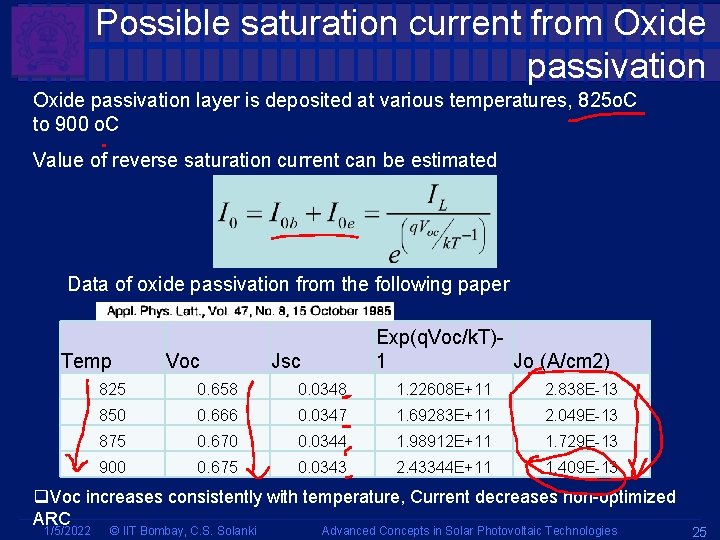
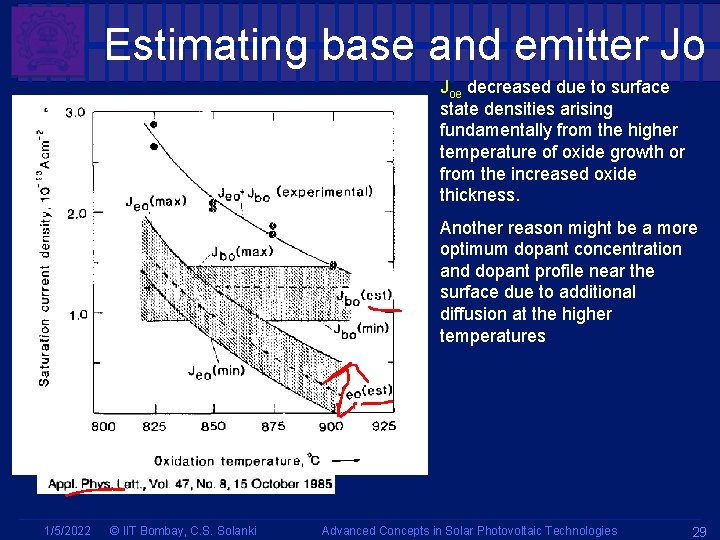
Possible saturation current from Oxide passivation layer is deposited at various temperatures, 825 o. C to 900 o. C Value of reverse saturation current can be estimated Data of oxide passivation from the following paper Temp Voc Exp(q. Voc/k. T)1 Jo (A/cm 2) Jsc 825 0. 658 0. 0348 1. 22608 E+11 2. 838 E-13 850 0. 666 0. 0347 1. 69283 E+11 2. 049 E-13 875 0. 670 0. 0344 1. 98912 E+11 1. 729 E-13 900 0. 675 0. 0343 2. 43344 E+11 1. 409 E-13 q. Voc increases consistently with temperature, Current decreases non-optimized ARC 1/5/2022 © IIT Bombay, C. S. Solanki Advanced Concepts in Solar Photovoltaic Technologies 25
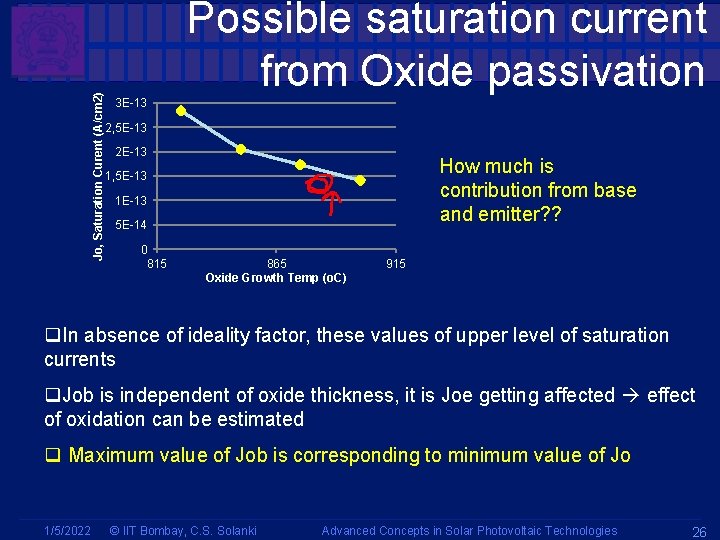
Jo, Saturation Curent (A/cm 2) Possible saturation current from Oxide passivation 3 E-13 2, 5 E-13 2 E-13 How much is contribution from base and emitter? ? 1, 5 E-13 1 E-13 5 E-14 0 815 865 Oxide Growth Temp (o. C) 915 q. In absence of ideality factor, these values of upper level of saturation currents q. Job is independent of oxide thickness, it is Joe getting affected effect of oxidation can be estimated q Maximum value of Job is corresponding to minimum value of Jo 1/5/2022 © IIT Bombay, C. S. Solanki Advanced Concepts in Solar Photovoltaic Technologies 26
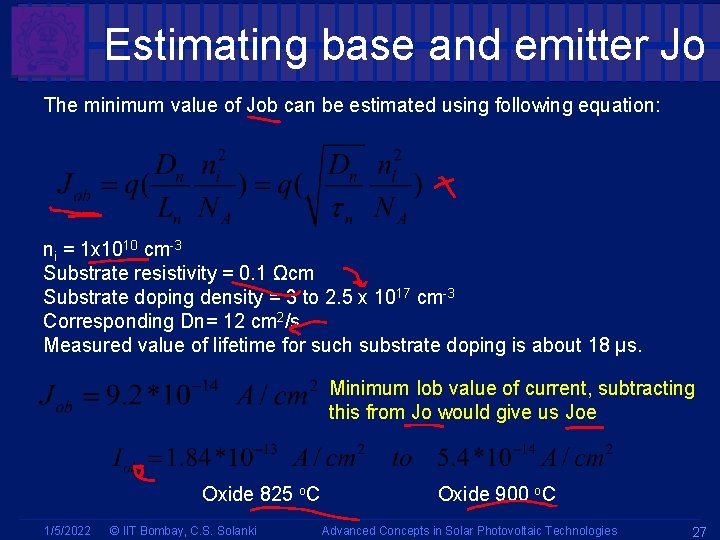
Estimating base and emitter Jo The minimum value of Job can be estimated using following equation: ni = 1 x 1010 cm-3 Substrate resistivity = 0. 1 Ωcm Substrate doping density = 3 to 2. 5 x 1017 cm-3 Corresponding Dn= 12 cm 2/s Measured value of lifetime for such substrate doping is about 18 µs. Minimum Iob value of current, subtracting this from Jo would give us Joe Oxide 825 o. C 1/5/2022 © IIT Bombay, C. S. Solanki Oxide 900 o. C Advanced Concepts in Solar Photovoltaic Technologies 27
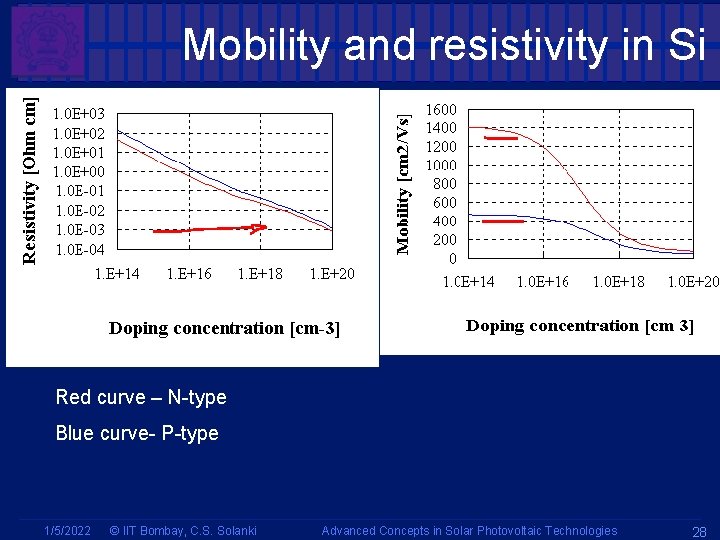
Mobility and resistivity in Si Red curve – N-type Blue curve- P-type 1/5/2022 © IIT Bombay, C. S. Solanki Advanced Concepts in Solar Photovoltaic Technologies 28
Estimating base and emitter Jo Joe decreased due to surface state densities arising fundamentally from the higher temperature of oxide growth or from the increased oxide thickness. Another reason might be a more optimum dopant concentration and dopant profile near the surface due to additional diffusion at the higher temperatures 1/5/2022 © IIT Bombay, C. S. Solanki Advanced Concepts in Solar Photovoltaic Technologies 29
Higher value of Voc? PESC cell approach is inherently capable of reducing contributions to cell saturation current densities to values below 5 X 10 -14 A/cm 2 and probably as low as 2 X 10 -14 A/cm 2 if the recombination in the base can be suppressed • With such value of recombination currents Voc in excess of 720 m. V under standard terrestrial test condition can be obtained Check this? 1/5/2022 © IIT Bombay, C. S. Solanki Advanced Concepts in Solar Photovoltaic Technologies 30
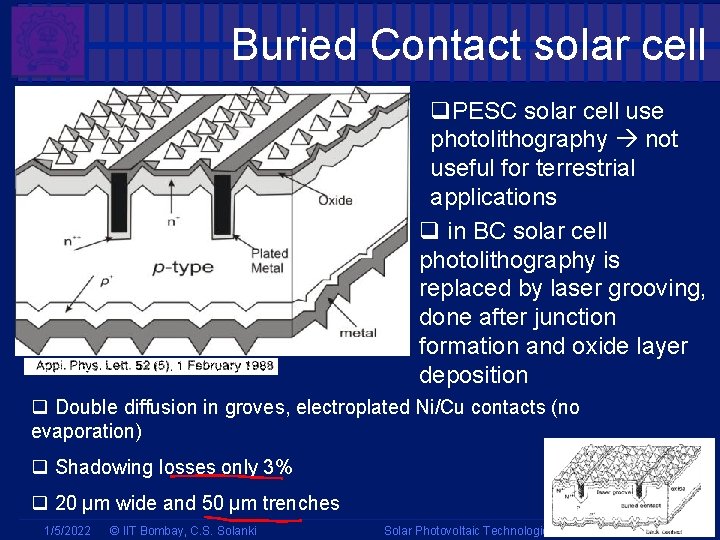
Buried Contact solar cell q. PESC solar cell use photolithography not useful for terrestrial applications q in BC solar cell photolithography is replaced by laser grooving, done after junction formation and oxide layer deposition q Double diffusion in groves, electroplated Ni/Cu contacts (no evaporation) q Shadowing losses only 3% q 20 µm wide and 50 µm trenches 1/5/2022 © IIT Bombay, C. S. Solanki Solar Photovoltaic Technologies 31
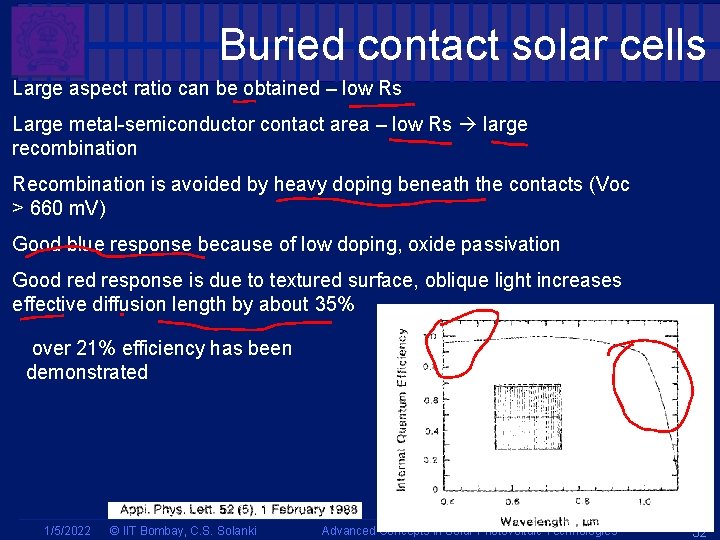
Buried contact solar cells Large aspect ratio can be obtained – low Rs Large metal-semiconductor contact area – low Rs large recombination Recombination is avoided by heavy doping beneath the contacts (Voc > 660 m. V) Good blue response because of low doping, oxide passivation Good response is due to textured surface, oblique light increases effective diffusion length by about 35% over 21% efficiency has been demonstrated 1/5/2022 © IIT Bombay, C. S. Solanki Advanced Concepts in Solar Photovoltaic Technologies 32
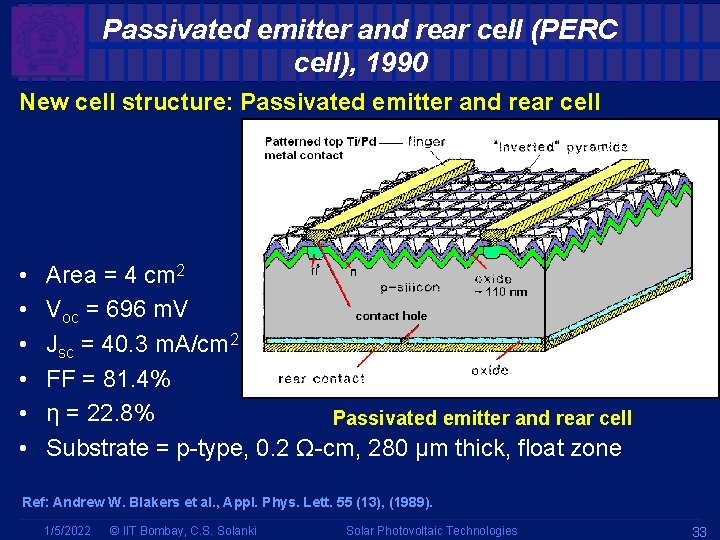
Passivated emitter and rear cell (PERC cell), 1990 New cell structure: Passivated emitter and rear cell • • • Area = 4 cm 2 Voc = 696 m. V Jsc = 40. 3 m. A/cm 2 FF = 81. 4% η = 22. 8% Passivated emitter and rear cell Substrate = p-type, 0. 2 Ω-cm, 280 µm thick, float zone Ref: Andrew W. Blakers et al. , Appl. Phys. Lett. 55 (13), (1989). 1/5/2022 © IIT Bombay, C. S. Solanki Solar Photovoltaic Technologies 33
Passivated emitter and rear cell (PERC cell), 1990 Key difference compared to PESC cell – Top contact: separate doping levels in contacted and non-contacted areas of the top surface – Structural: Large no. of contact holes through passivating oxide layer – Processing: Chlorine based process - improved quality of passivating oxide – Rear Al alloying step (getter bulk region): reduce bulk recombination High Voc • Well passivated surfaces • Lightly phosphorus diffused top surface: reduce surface recombination • High bulk lifetime (minority carrier) Ref: Andrew W. Blakers et al. , Appl. Phys. Lett. 55 (13), (1989). 1/5/2022 © IIT Bombay, C. S. Solanki Solar Photovoltaic Technologies 34
Passivated emitter and rear cell (PERC cell), 1990 High Jsc • Rear Al layer: effective reflector • Inverted pyramid structure: – Reduce reflection – In combination with rear reflector forms light trapping scheme – Superior to upright pyramid • Rear Contact holes: 200 µm dia. on 2 mm x 2 mm matrix Separation distance between the contact area, larger than the thickness of the silicon substrate Ref: Andrew W. Blakers et al. , Appl. Phys. Lett. 55 (13), (1989). 1/5/2022 © IIT Bombay, C. S. Solanki Solar Photovoltaic Technologies 35
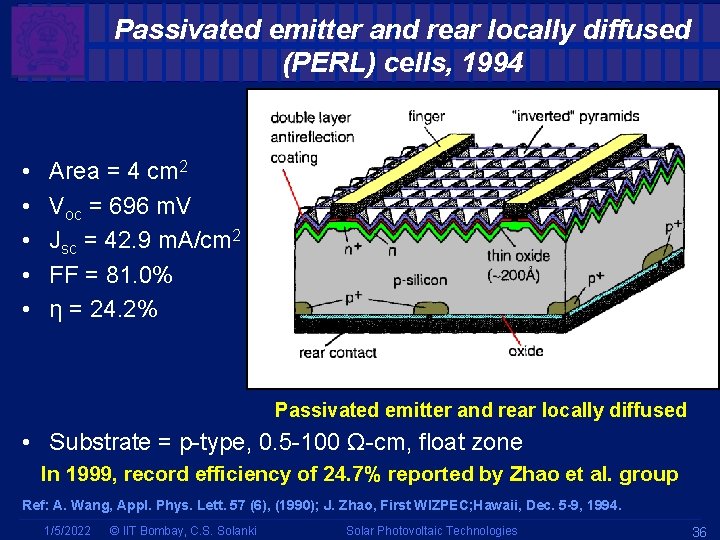
Passivated emitter and rear locally diffused (PERL) cells, 1994 • • • Area = 4 cm 2 Voc = 696 m. V Jsc = 42. 9 m. A/cm 2 FF = 81. 0% η = 24. 2% Passivated emitter and rear locally diffused • Substrate = p-type, 0. 5 -100 Ω-cm, float zone In 1999, record efficiency of 24. 7% reported by Zhao et al. group Ref: A. Wang, Appl. Phys. Lett. 57 (6), (1990); J. Zhao, First WIZPEC; Hawaii, Dec. 5 -9, 1994. 1/5/2022 © IIT Bombay, C. S. Solanki Solar Photovoltaic Technologies 36
Passivated emitter and rear locally diffused (PERL) cells, 1994 Additional refinement : • Top and bottom contact – Separate doping levels in contacted and non-contacted areas • Reduced recombination – Local diffusion of boron in rear contact – Improved passivation of the Si/Si. O 2 interface at the cell front surface – Atomic H 2 passivation: Improved passivation of thin oxides • Double layer anti-reflection (DLAR) – 3% higher current density than the Si. O 2, single layer antireflection (SLAR) coating • Reduced resistive loss – Two step plating process was used: Increased metal grid conductivity – Zn. S and Mg. F, DLAR coating - Improved EQE (400 -1100 nm) Ref: A. Wang, Appl. Phys. Lett. 57 (6), (1990); J. Zhao, First WIZPEC; Hawaii, Dec. 5 -9, 1994 1/5/2022 © IIT Bombay, C. S. Solanki Solar Photovoltaic Technologies 37
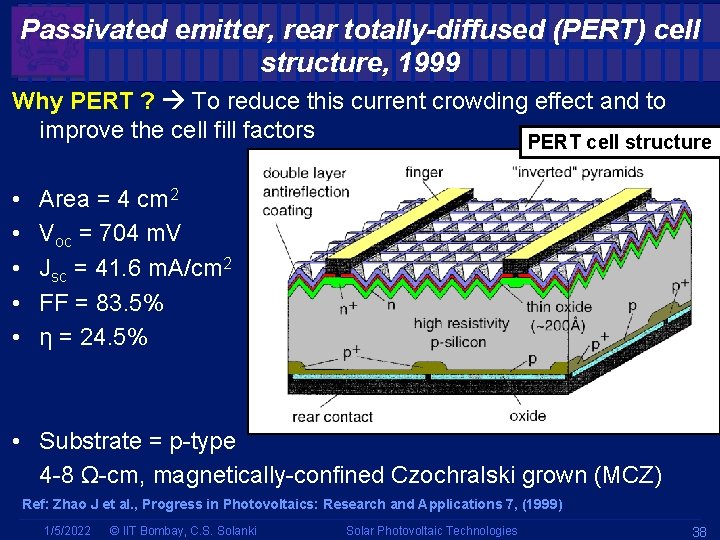
Passivated emitter, rear totally-diffused (PERT) cell structure, 1999 Why PERT ? To reduce this current crowding effect and to improve the cell fill factors PERT cell structure • • • Area = 4 cm 2 Voc = 704 m. V Jsc = 41. 6 m. A/cm 2 FF = 83. 5% η = 24. 5% • Substrate = p-type 4 -8 Ω-cm, magnetically-confined Czochralski grown (MCZ) Ref: Zhao J et al. , Progress in Photovoltaics: Research and Applications 7, (1999) 1/5/2022 © IIT Bombay, C. S. Solanki Solar Photovoltaic Technologies 38
Passivated emitter, rear totally-diffused (PERT) cell structure, 1999 Difference between PERL and PERT • Lightly boron diffused layer along the entire rear surface of the PERT cell Ref: Zhao J et al. , Progress in Photovoltaics: Research and Applications 7, (1999) 1/5/2022 © IIT Bombay, C. S. Solanki Solar Photovoltaic Technologies 39
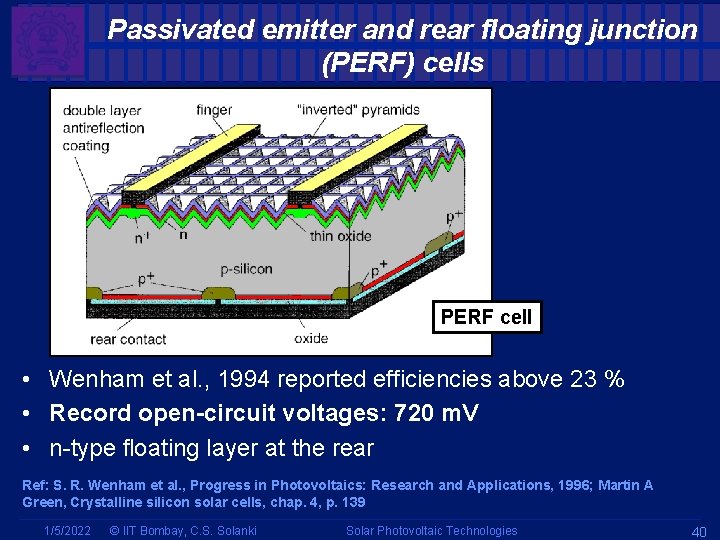
Passivated emitter and rear floating junction (PERF) cells PERF cell • Wenham et al. , 1994 reported efficiencies above 23 % • Record open-circuit voltages: 720 m. V • n-type floating layer at the rear Ref: S. R. Wenham et al. , Progress in Photovoltaics: Research and Applications, 1996; Martin A Green, Crystalline silicon solar cells, chap. 4, p. 139 1/5/2022 © IIT Bombay, C. S. Solanki Solar Photovoltaic Technologies 40