
High Efficiency Methanol Engines Latest Research and Promising

- Slides: 16
High Efficiency Methanol Engines: Latest Research and Promising Next Steps Prof. Sebastian Verhelst Ghent University Methanol Engine Advancement For Sustainable Transport Symposium, Reykjavik – 22 -24 Feb 2016 Sebastian Verhelst – Department of Flow, Heat and Combustion Mechanics 1
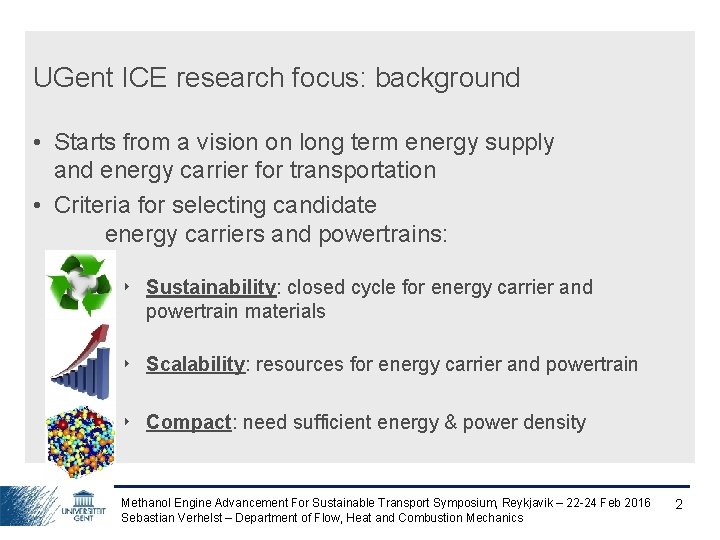
UGent ICE research focus: background • Starts from a vision on long term energy supply and energy carrier for transportation • Criteria for selecting candidate energy carriers and powertrains: ‣ Sustainability: closed cycle for energy carrier and powertrain materials ‣ Scalability: resources for energy carrier and powertrain ‣ Compact: need sufficient energy & power density Methanol Engine Advancement For Sustainable Transport Symposium, Reykjavik – 22 -24 Feb 2016 Sebastian Verhelst – Department of Flow, Heat and Combustion Mechanics 2
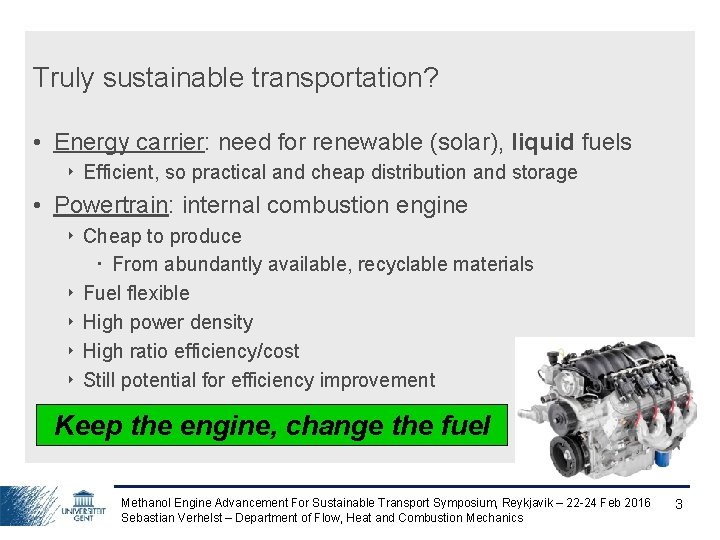
Truly sustainable transportation? • Energy carrier: need for renewable (solar), liquid fuels ‣ Efficient, so practical and cheap distribution and storage • Powertrain: internal combustion engine ‣ Cheap to produce ‧ From abundantly available, recyclable materials ‣ Fuel flexible ‣ High power density ‣ High ratio efficiency/cost ‣ Still potential for efficiency improvement Keep the engine, change the fuel Methanol Engine Advancement For Sustainable Transport Symposium, Reykjavik – 22 -24 Feb 2016 Sebastian Verhelst – Department of Flow, Heat and Combustion Mechanics 3
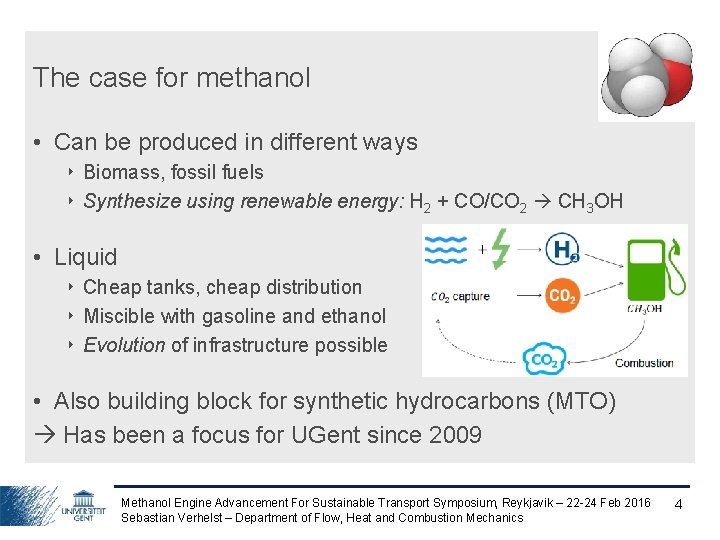
The case for methanol • Can be produced in different ways ‣ Biomass, fossil fuels ‣ Synthesize using renewable energy: H 2 + CO/CO 2 CH 3 OH • Liquid ‣ Cheap tanks, cheap distribution ‣ Miscible with gasoline and ethanol ‣ Evolution of infrastructure possible • Also building block for synthetic hydrocarbons (MTO) Has been a focus for UGent since 2009 Methanol Engine Advancement For Sustainable Transport Symposium, Reykjavik – 22 -24 Feb 2016 Sebastian Verhelst – Department of Flow, Heat and Combustion Mechanics 4
Methanol Gasoline Methanol as an engine fuel Polarity determines much of its differences vs. gasoline 1100 • High heat of vaporization (k. J/kg) 325 ‣ Challenge for cold start ‣ But great for engine efficiency, emissions and performance • Corrosive to some metals Additionally: • High octane number 109 95 RON Laminar burning velocity at NTP (cm/s) ‣ Good for efficiency • Higher burning velocity 45 30 ‣ High dilution tolerance good for efficiency&emissions Methanol Engine Advancement For Sustainable Transport Symposium, Reykjavik – 22 -24 Feb 2016 Sebastian Verhelst – Department of Flow, Heat and Combustion Mechanics 5
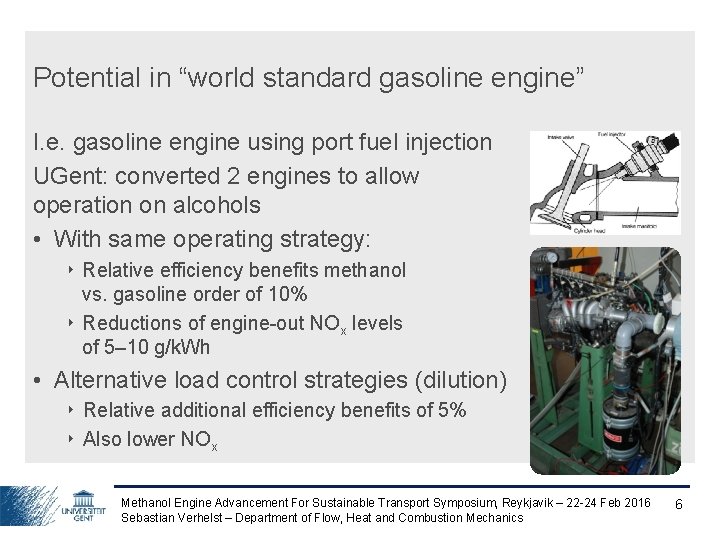
Potential in “world standard gasoline engine” I. e. gasoline engine using port fuel injection UGent: converted 2 engines to allow operation on alcohols • With same operating strategy: ‣ Relative efficiency benefits methanol vs. gasoline order of 10% ‣ Reductions of engine-out NOx levels of 5– 10 g/k. Wh • Alternative load control strategies (dilution) ‣ Relative additional efficiency benefits of 5% ‣ Also lower NOx Methanol Engine Advancement For Sustainable Transport Symposium, Reykjavik – 22 -24 Feb 2016 Sebastian Verhelst – Department of Flow, Heat and Combustion Mechanics 6
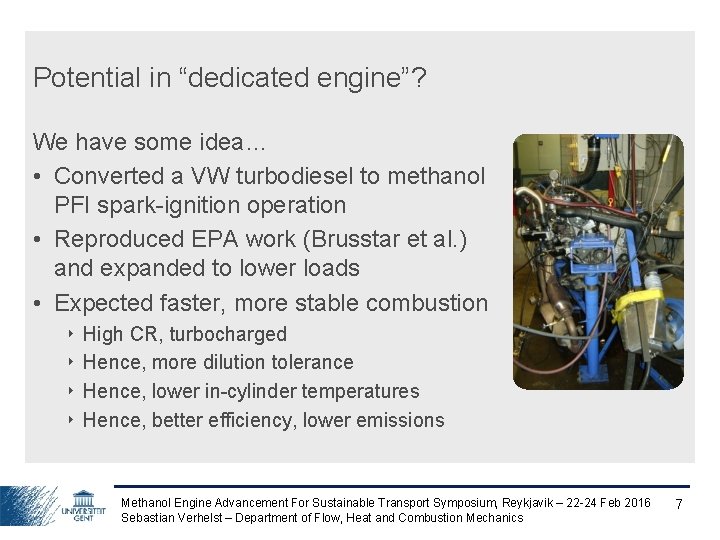
Potential in “dedicated engine”? We have some idea… • Converted a VW turbodiesel to methanol PFI spark-ignition operation • Reproduced EPA work (Brusstar et al. ) and expanded to lower loads • Expected faster, more stable combustion ‣ ‣ High CR, turbocharged Hence, more dilution tolerance Hence, lower in-cylinder temperatures Hence, better efficiency, lower emissions Methanol Engine Advancement For Sustainable Transport Symposium, Reykjavik – 22 -24 Feb 2016 Sebastian Verhelst – Department of Flow, Heat and Combustion Mechanics 7
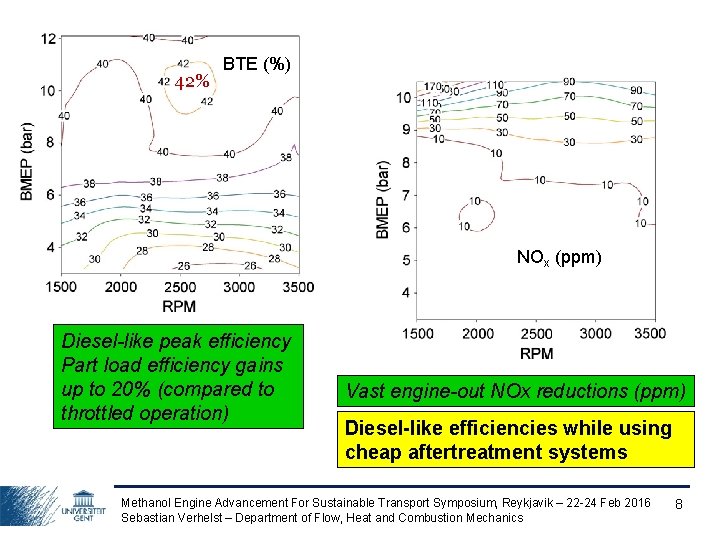
42% BTE (%) NOx (ppm) Diesel-like peak efficiency Part load efficiency gains up to 20% (compared to throttled operation) Vast engine-out NOx reductions (ppm) Diesel-like efficiencies while using cheap aftertreatment systems Methanol Engine Advancement For Sustainable Transport Symposium, Reykjavik – 22 -24 Feb 2016 Sebastian Verhelst – Department of Flow, Heat and Combustion Mechanics 8
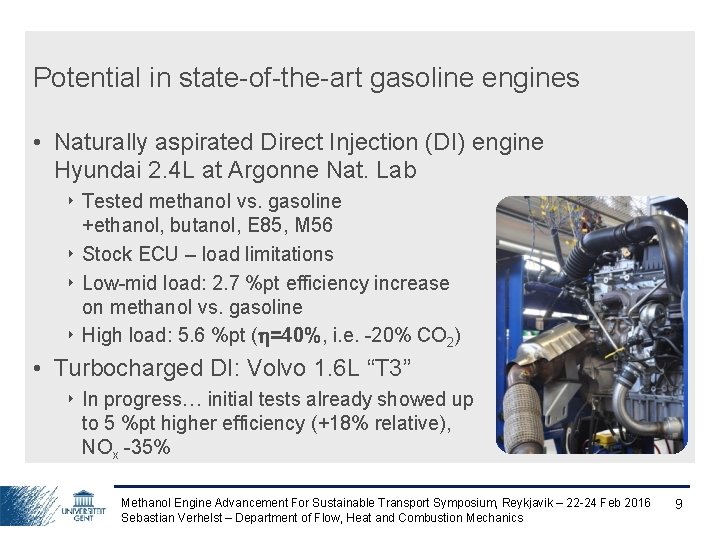
Potential in state-of-the-art gasoline engines • Naturally aspirated Direct Injection (DI) engine Hyundai 2. 4 L at Argonne Nat. Lab ‣ Tested methanol vs. gasoline +ethanol, butanol, E 85, M 56 ‣ Stock ECU – load limitations ‣ Low-mid load: 2. 7 %pt efficiency increase on methanol vs. gasoline ‣ High load: 5. 6 %pt (h=40%, i. e. -20% CO 2) • Turbocharged DI: Volvo 1. 6 L “T 3” ‣ In progress… initial tests already showed up to 5 %pt higher efficiency (+18% relative), NOx -35% Methanol Engine Advancement For Sustainable Transport Symposium, Reykjavik – 22 -24 Feb 2016 Sebastian Verhelst – Department of Flow, Heat and Combustion Mechanics 9
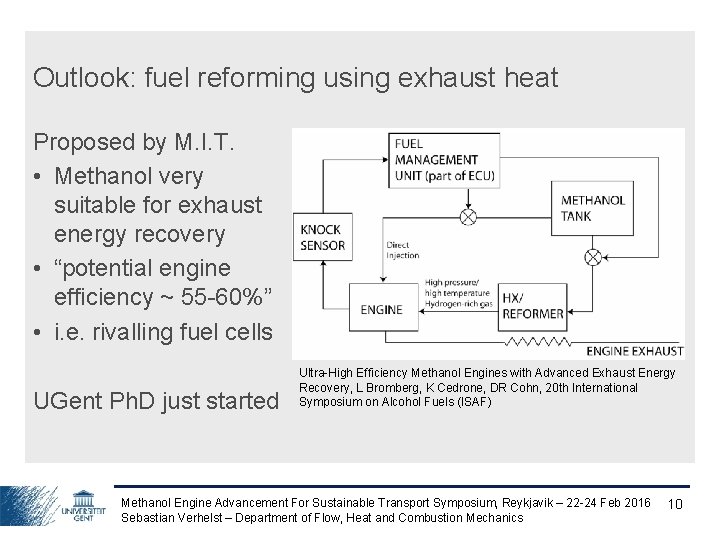
Outlook: fuel reforming using exhaust heat Proposed by M. I. T. • Methanol very suitable for exhaust energy recovery • “potential engine efficiency ~ 55 -60%” • i. e. rivalling fuel cells UGent Ph. D just started Ultra-High Efficiency Methanol Engines with Advanced Exhaust Energy Recovery, L Bromberg, K Cedrone, DR Cohn, 20 th International Symposium on Alcohol Fuels (ISAF) Methanol Engine Advancement For Sustainable Transport Symposium, Reykjavik – 22 -24 Feb 2016 Sebastian Verhelst – Department of Flow, Heat and Combustion Mechanics 10
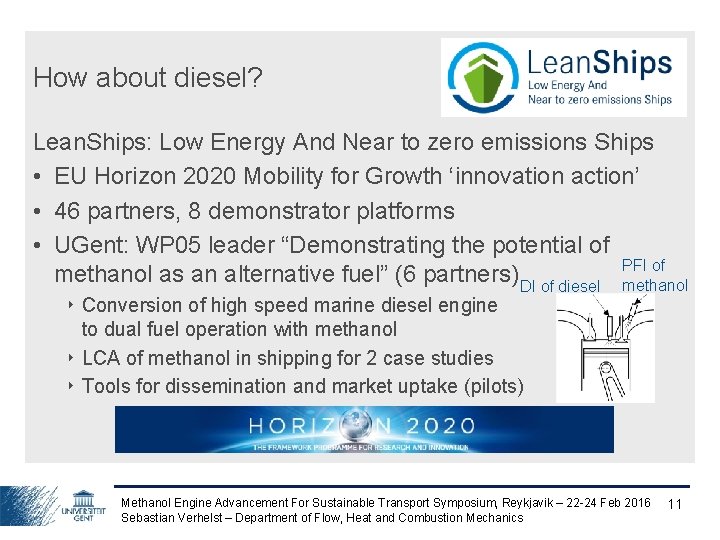
How about diesel? Lean. Ships: Low Energy And Near to zero emissions Ships • EU Horizon 2020 Mobility for Growth ‘innovation action’ • 46 partners, 8 demonstrator platforms • UGent: WP 05 leader “Demonstrating the potential of of methanol as an alternative fuel” (6 partners) DI of diesel PFI methanol ‣ Conversion of high speed marine diesel engine to dual fuel operation with methanol ‣ LCA of methanol in shipping for 2 case studies ‣ Tools for dissemination and market uptake (pilots) Methanol Engine Advancement For Sustainable Transport Symposium, Reykjavik – 22 -24 Feb 2016 Sebastian Verhelst – Department of Flow, Heat and Combustion Mechanics 11
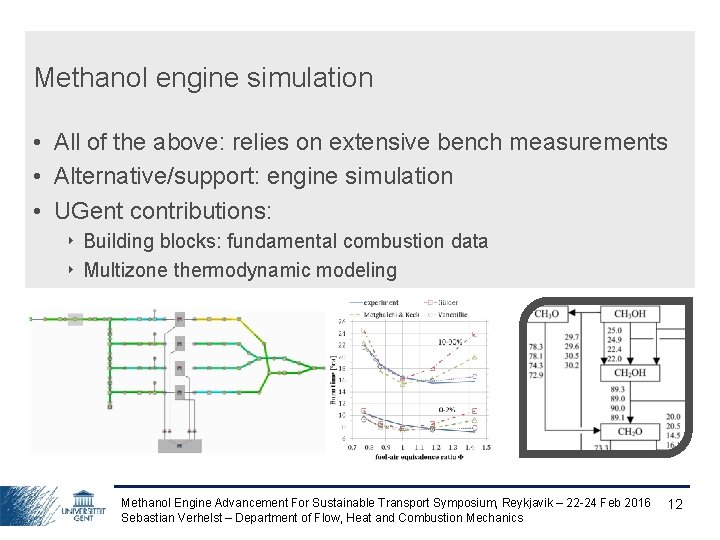
Methanol engine simulation • All of the above: relies on extensive bench measurements • Alternative/support: engine simulation • UGent contributions: ‣ Building blocks: fundamental combustion data ‣ Multizone thermodynamic modeling Methanol Engine Advancement For Sustainable Transport Symposium, Reykjavik – 22 -24 Feb 2016 Sebastian Verhelst – Department of Flow, Heat and Combustion Mechanics 12
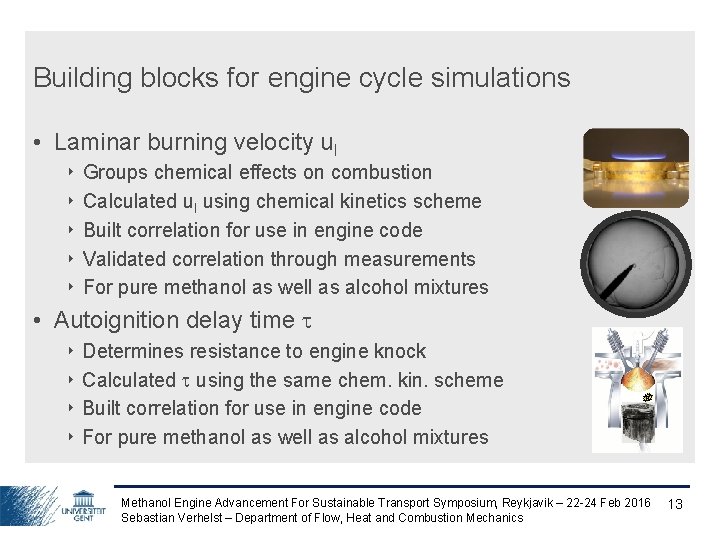
Building blocks for engine cycle simulations • Laminar burning velocity ul ‣ ‣ ‣ Groups chemical effects on combustion Calculated ul using chemical kinetics scheme Built correlation for use in engine code Validated correlation through measurements For pure methanol as well as alcohol mixtures • Autoignition delay time t ‣ ‣ Determines resistance to engine knock Calculated t using the same chem. kin. scheme Built correlation for use in engine code For pure methanol as well as alcohol mixtures Methanol Engine Advancement For Sustainable Transport Symposium, Reykjavik – 22 -24 Feb 2016 Sebastian Verhelst – Department of Flow, Heat and Combustion Mechanics 13
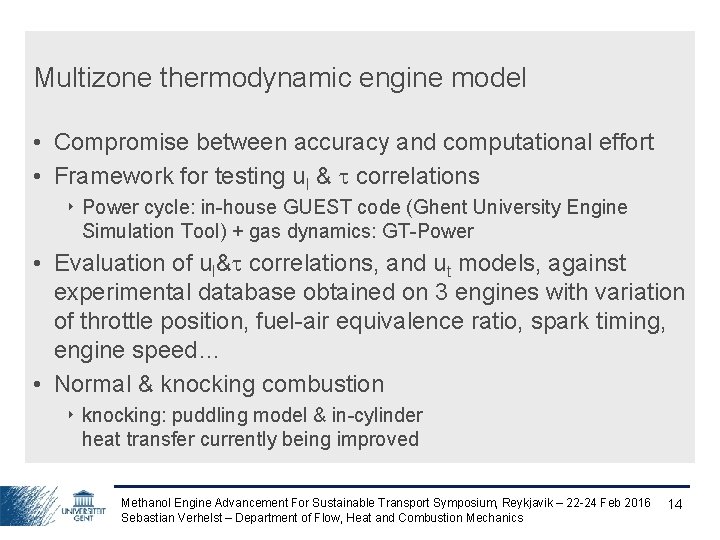
Multizone thermodynamic engine model • Compromise between accuracy and computational effort • Framework for testing ul & t correlations ‣ Power cycle: in-house GUEST code (Ghent University Engine Simulation Tool) + gas dynamics: GT-Power • Evaluation of ul&t correlations, and ut models, against experimental database obtained on 3 engines with variation of throttle position, fuel-air equivalence ratio, spark timing, engine speed… • Normal & knocking combustion ‣ knocking: puddling model & in-cylinder heat transfer currently being improved Methanol Engine Advancement For Sustainable Transport Symposium, Reykjavik – 22 -24 Feb 2016 Sebastian Verhelst – Department of Flow, Heat and Combustion Mechanics 14
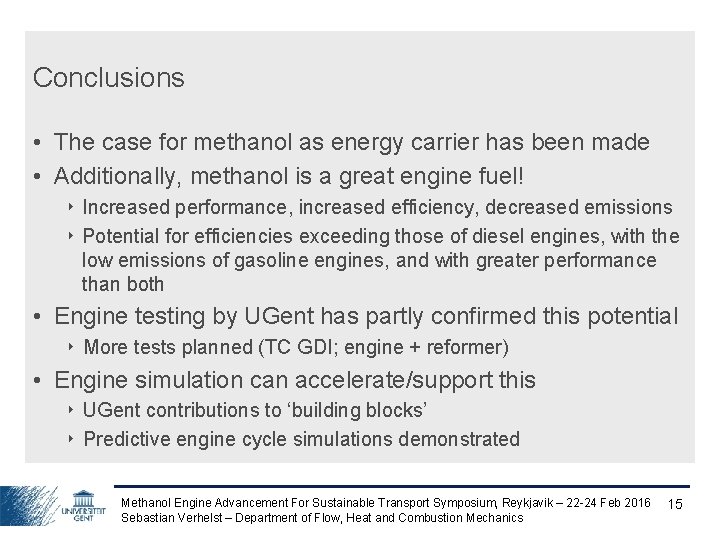
Conclusions • The case for methanol as energy carrier has been made • Additionally, methanol is a great engine fuel! ‣ Increased performance, increased efficiency, decreased emissions ‣ Potential for efficiencies exceeding those of diesel engines, with the low emissions of gasoline engines, and with greater performance than both • Engine testing by UGent has partly confirmed this potential ‣ More tests planned (TC GDI; engine + reformer) • Engine simulation can accelerate/support this ‣ UGent contributions to ‘building blocks’ ‣ Predictive engine cycle simulations demonstrated Methanol Engine Advancement For Sustainable Transport Symposium, Reykjavik – 22 -24 Feb 2016 Sebastian Verhelst – Department of Flow, Heat and Combustion Mechanics 15
Thank you for your attention! & thanks to drs. Richard Pearson (ex-Lotus), Jamie Turner (U-Bath), Thomas Wallner (ANL), Jeroen Vancoillie (ex-UGent), Louis Sileghem (ex-UGent), … Sebastian Verhelst sebastian. verhelst@UGent. be http: //users. ugent. be/~sverhels Methanol Engine Advancement For Sustainable Transport Symposium, Reykjavik – 22 -24 Feb 2016 Sebastian Verhelst – Department of Flow, Heat and Combustion Mechanics 16