
High dose insulin for calcium channel blocker overdose
High dose insulin for calcium channel blocker overdose 1 PAN WONG PGY 1 PHARMACY PRACTICE RESIDENT UWMC ED ROTATION APRIL 2014
Outline 2 �Background �Basic Pharmacology Review �Clinical Presentation �Mechanism of Toxicity �Pharmacological management �High Dose Insulin at UWMC
Background 3 �Calcium channel blockers (CCB) overdose is associated with significant morbidity and mortality �American Association of Poison Control Centers Exposure Surveillance System Annual Report 2012 Calcium channel blockers: � 11, 910 cases with 24 deaths �Highest mortality rate amongst cardiovascular agents Lyden AE, et al. Clin Toxicol. 2013 Dec; 51(10): 949 -1229
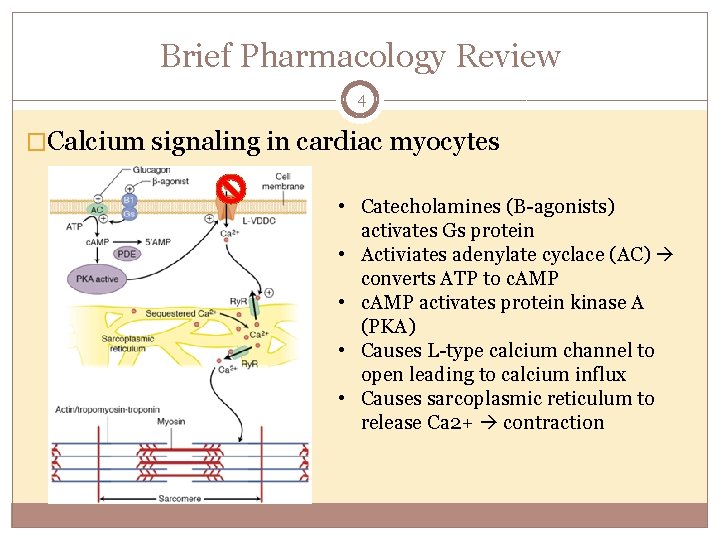
Brief Pharmacology Review 4 �Calcium signaling in cardiac myocytes • Catecholamines (B-agonists) activates Gs protein • Activiates adenylate cyclace (AC) converts ATP to c. AMP • c. AMP activates protein kinase A (PKA) • Causes L-type calcium channel to open leading to calcium influx • Causes sarcoplasmic reticulum to release Ca 2+ contraction
Calcium Channel Blocker Mechanism of toxicity 5 �The life-threatening toxicities are an extension of therapeutic effects on the cardiovascular system �Dihydropyridine Acts predominately on peripheral vasculature �Non-dihydropyridine Less selective- both cardiac & peripheral vasculature �In overdose, receptor selectivity is lost Distinction between these agents may not be clinically evident Shepherd G, et al. Ann Pharmacother. 2005 May; 39(5): 923 -30.
Calcium Channel Blocker Mechanism of toxicity 6 �Blockade of L-type calcium channels: Myocardial cells � Weaken cardiac contraction & blunt cardiac automaticity bradycardia & heart blocks Smooth muscles � Relaxation of vascular smooth muscles hypotension B-islet cells of pancreas � Inhibits insulin secretion Reduces myocardial cells ability to use glucose reduced tissue perfusion metabolic acidosis Hyperglycemia
Clinical Presentation 7 �Hypotension �Bradycardia �Cardiogenic shock �Heart block �Hyperglycemia �Metabolic acidosis �CNS: confusion, seizure, coma
Management 8 �Supportive Care Maintain airway Treat hypotension with IV fluid boluses Give atropine for initial treatment (0. 5 -1 mg IV up to 3 doses) Continuous cardiac monitoring Consider GI decontamination � Gastric lavage Within 1 -2 hours of ingestion � Whole bowel irrigation For consumption of extended release formulations Engebretsen KM, et al. Clin Toxicol. 2011 Apr; 49(4): 277 -83.
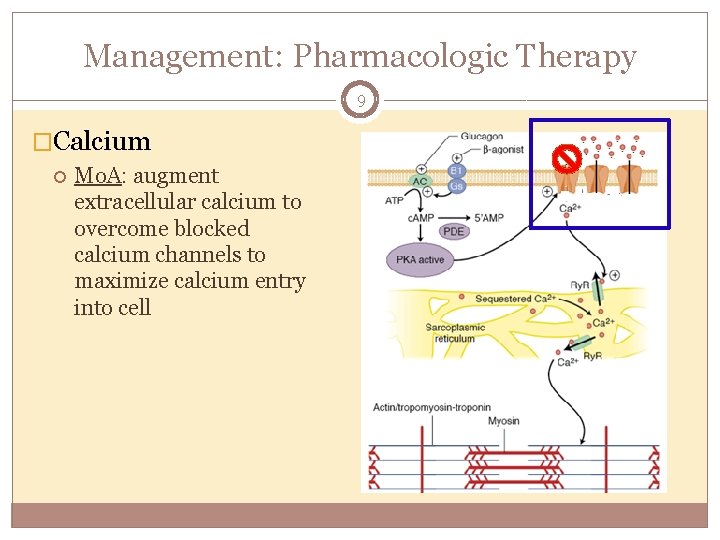
Management: Pharmacologic Therapy 9 �Calcium Mo. A: augment extracellular calcium to overcome blocked calcium channels to maximize calcium entry into cell
Management: Pharmacologic Therapy 10 �Calcium No optimal dosing has been established � Bolus Calcium chloride: 10 to 20 m. L of a 10% solution Calcium gluconate: 30 to 60 m. L of 10% solution � Continuous Infusion Calcium chloride: 0. 2 to 0. 4 m. L/kg per hour of 10% solution Calcium gluconate: 0. 6 to 1. 2 m. L/kg per hour of 10% solution Precautions � Close monitoring of serum calcium � Use central line for calcium chloride � Safest agent is calcium gluconate Efficacy: � Mixed clinical experience Kerns, W. Emerg med Clin N Am 25 (2007): 209 -331.
Management: Pharmacologic Therapy 11 �Inotropes and vasopressors Mo. A: Could increase inotropy, chronotropy, and vasoconstriction (depending on selected agents) Various agents cited in case reports: � Epinephrine, Norepinephrine, Dopamine, Isoproterenol, Dobutamine Efficacy: � No selected agent is universally effective Best approach is to choose an agent based on hemodynamics Kerns, W. Emerg med Clin N Am 25 (2007): 209 -331.
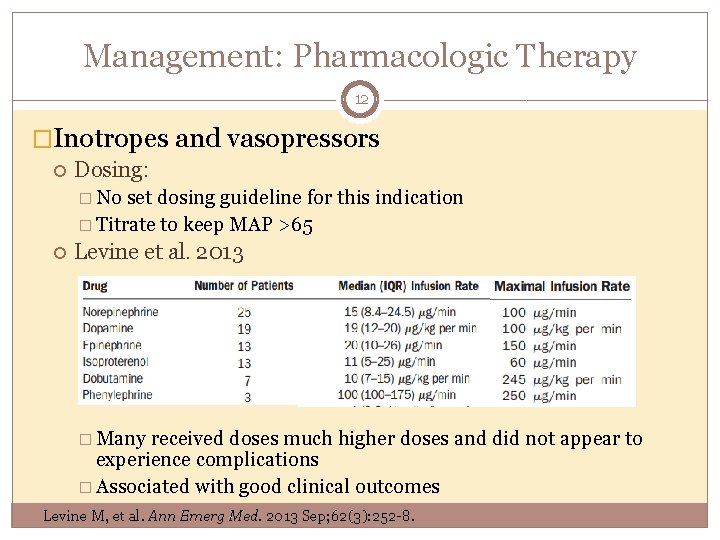
Management: Pharmacologic Therapy 12 �Inotropes and vasopressors Dosing: � No set dosing guideline for this indication � Titrate to keep MAP >65 Levine et al. 2013 � Many received doses much higher doses and did not appear to experience complications � Associated with good clinical outcomes Levine M, et al. Ann Emerg Med. 2013 Sep; 62(3): 252 -8.
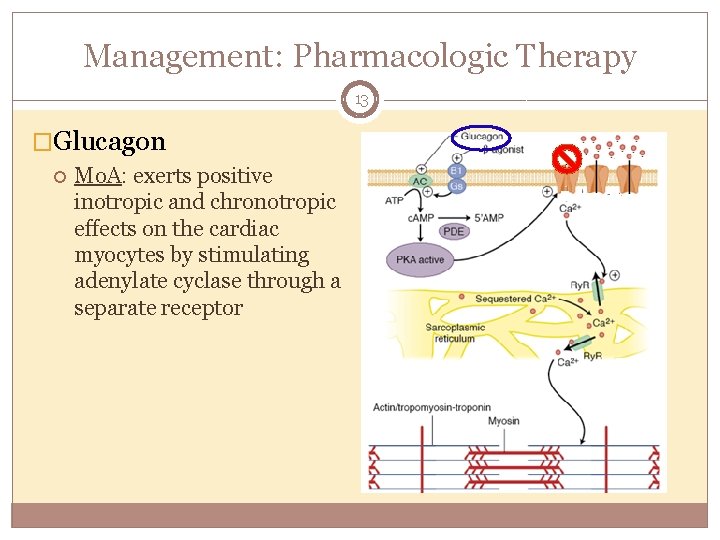
Management: Pharmacologic Therapy 13 �Glucagon Mo. A: exerts positive inotropic and chronotropic effects on the cardiac myocytes by stimulating adenylate cyclase through a separate receptor
Management: Pharmacologic Therapy 14 �Glucagon Dosing � Start with 5 mg IV bolus (watch for response within 10 mins) � Repeat with 10 mg IV bolus if no response � If response is seen, start IV continuous infusion at 3 -5 mg/hr and uptitrate Precautions/adverse events: � Nausea/vomiting Pre-medicate with ondansteron 4 mg IV prior to glucagon Efficacy: � Mixed clinical experiences Woodward C, et al. DARU J Pharm Sci 2014 22: 36.
Management: Pharmacologic Therapy 15 �High Dose Insulin (HDI) CCB toxicity and insulin � Healthy myocardial tissue depends on free fatty acid for metabolic needs Note this is different from skeletal tissues � CCB overdose forces these cells to use glucose as fuel � CCB inhibits secretion of insulin � Cells unable to uptake glucose efficiently MOA: � Promotes cellular uptake of glucose to provide fuel and energy � Positive inotropic effects Rizvi I, et al. BMJ Case Reports 2012; 10.
Management: Pharmacologic Therapy 16 �High Dose Insulin (HDI) Efficacy: � No clinical trials comparing use of HDI to other treatments in humans � Majority of case reports use HDI after inadequate response to other treatments � Appears beneficial in serious intoxication with hypotension � Many case reports demonstrated benefits with HDI therapy Precautions/Adverse Effects � Hypoglycemia � Hypokalemia Shepherd G, et al. Ann Pharmacother. 2005 May; 39(5): 923 -30.
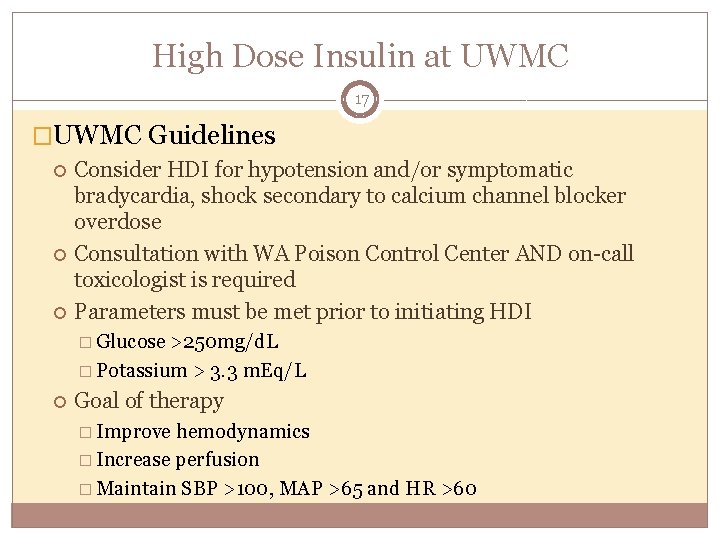
High Dose Insulin at UWMC 17 �UWMC Guidelines Consider HDI for hypotension and/or symptomatic bradycardia, shock secondary to calcium channel blocker overdose Consultation with WA Poison Control Center AND on-call toxicologist is required Parameters must be met prior to initiating HDI � Glucose >250 mg/d. L � Potassium > 3. 3 m. Eq/L Goal of therapy � Improve hemodynamics � Increase perfusion � Maintain SBP >100, MAP >65 and HR >60
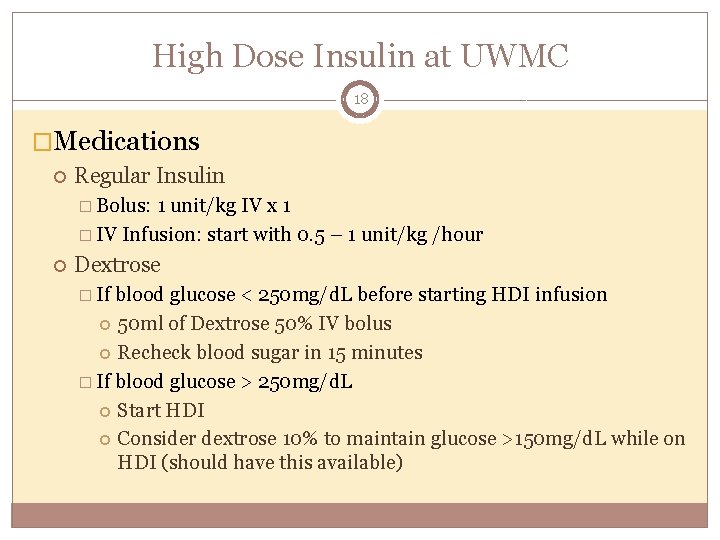
High Dose Insulin at UWMC 18 �Medications Regular Insulin � Bolus: 1 unit/kg IV x 1 � IV Infusion: start with 0. 5 – 1 unit/kg /hour Dextrose � If blood glucose < 250 mg/d. L before starting HDI infusion 50 ml of Dextrose 50% IV bolus Recheck blood sugar in 15 minutes � If blood glucose > 250 mg/d. L Start HDI Consider dextrose 10% to maintain glucose >150 mg/d. L while on HDI (should have this available)
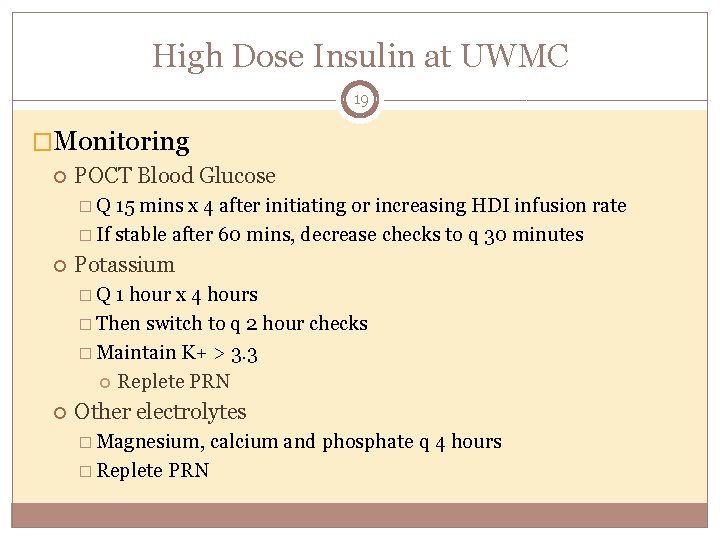
High Dose Insulin at UWMC 19 �Monitoring POCT Blood Glucose �Q 15 mins x 4 after initiating or increasing HDI infusion rate � If stable after 60 mins, decrease checks to q 30 minutes Potassium �Q 1 hour x 4 hours � Then switch to q 2 hour checks � Maintain K+ > 3. 3 Replete PRN Other electrolytes � Magnesium, � Replete PRN calcium and phosphate q 4 hours
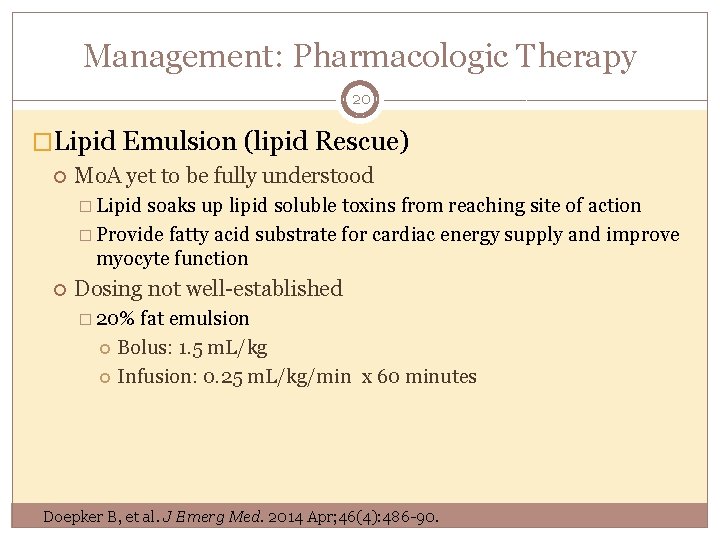
Management: Pharmacologic Therapy 20 �Lipid Emulsion (lipid Rescue) Mo. A yet to be fully understood � Lipid soaks up lipid soluble toxins from reaching site of action � Provide fatty acid substrate for cardiac energy supply and improve myocyte function Dosing not well-established � 20% fat emulsion Bolus: 1. 5 m. L/kg Infusion: 0. 25 m. L/kg/min x 60 minutes Doepker B, et al. J Emerg Med. 2014 Apr; 46(4): 486 -90.
Conclusion 21 �Calcium channel blockers (CCB) overdose are associated with significant morbidity and mortality �Various antidotes reported Calcium Glucagon Vasopressors and Inotropes High Dose Insulin Lipid Emulsion �Evidence come mainly from animal studies, case reports, and case series �High dose insulin is promising Published experience shows good benefit as a rescue agents in patients unresponsive to other regimens
High dose insulin for calcium channel blocker overdose 22 PAN WONG PGY 1 PHARMACY PRACTICE RESIDENT UWMC ED ROTATION APRIL 2014
References 23 � Doepker B, Healy W, Cortez E, Adkins EJ. High-dose insulin and intravenous lipid emulsion therapy for � � � � � cardiogenic shock induced by intentional calcium-channel blocker and Beta-blocker overdose: a case series. J Emerg Med. 2014 Apr; 46(4): 486 -90. Engebretsen KM, et al. High-dose insulin therapy in beta-blocker and calcium channel-blocker poisoning. Clin Toxicol. 2011 Apr; 49(4): 277 -83. Englund J. L. , Kerns W. P. , II (2011). Chapter 188. β-Blockers. In Tintinalli J. E. , Stapczynski J, Ma O, Cline D. M. , Cydulka R. K. , Meckler G. D. , T (Eds), Tintinalli's Emergency Medicine: A Comprehensive Study Guide, 7 e. Retrieved April 29, 2014 from http: //accessmedicine. mhmedical. com. offcampus. lib. washington. edu/content. aspx? bookid=348&Sectionid= 40381669. Kerns, W. Management beta-adrenergic blocker and calcium channel antagonist toxicity. Emerg med Clin N Am 25 (2007): 209 -331. Levine M, et al. Critical care management of verapamil and diltiazem overdose with a focus on vasopressors: a 25 -year experience at a single center. Ann Emerg Med. 2013 Sep; 62(3): 252 -8. Mowry JB, et al. 2012 Annual Report of the American Association of Poison Control Centers' National Poison Data System (NPDS): 30 th Annual Report. Clin Toxicol. 2013 Dec; 51(10): 949 -1229. Lyden AE, et al. Beta-Blocker Overdose Treated with Extended Duration High Dose Insulin Therapy. J Pharmacol Clin Toxicol 2(1): 1015 Minns A. B. , Tomaszewski C (2011). Chapter 189. Calcium Channel Blockers. In Tintinalli J. E. , Stapczynski J, Ma O, Cline D. M. , Cydulka R. K. , Meckler G. D. , T (Eds), Tintinalli's Emergency Medicine: A Comprehensive Study Guide, 7 e. Retrieved April 28, 2014 from http: //accessmedicine. mhmedical. com. offcampus. lib. washington. edu/content. aspx? bookid=348&Sectionid= 40381670 Rizvi I, et al. Life -threatening calcium channel blocker overdose and its management. BMJ Case Reports 2012; 10. Shepherd G, Klein-Schwartz W. High-dose insulin therapy for calcium-channel blocker overdose. Ann Pharmacother. 2005 May; 39(5): 923 -30. Woodward C, et al. High dose insulin therapy, an evidence based approach to beta blocker/calcium channel blocker toxicity. DARU J Pharm Sci 2014 22: 36.
- Slides: 23