
High Density Concrete The density of normal concrete
- Slides: 4
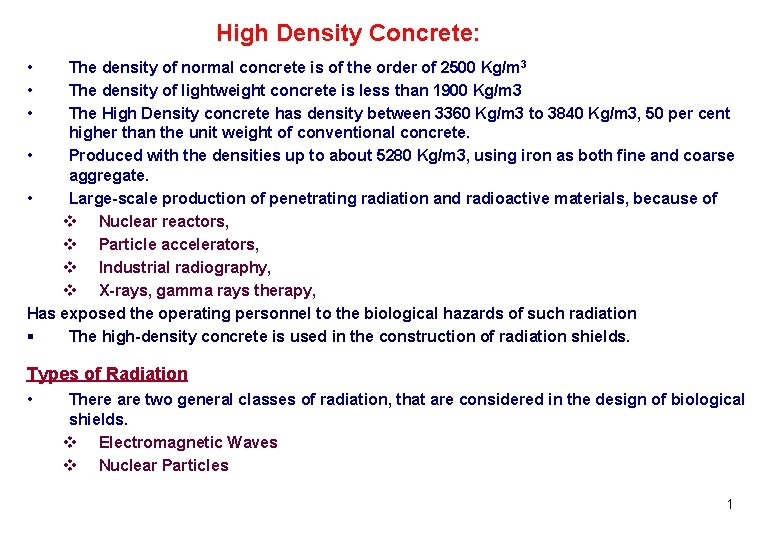
High Density Concrete: • • • The density of normal concrete is of the order of 2500 Kg/m 3 The density of lightweight concrete is less than 1900 Kg/m 3 The High Density concrete has density between 3360 Kg/m 3 to 3840 Kg/m 3, 50 per cent higher than the unit weight of conventional concrete. • Produced with the densities up to about 5280 Kg/m 3, using iron as both fine and coarse aggregate. • Large-scale production of penetrating radiation and radioactive materials, because of v Nuclear reactors, v Particle accelerators, v Industrial radiography, v X-rays, gamma rays therapy, Has exposed the operating personnel to the biological hazards of such radiation § The high-density concrete is used in the construction of radiation shields. Types of Radiation • There are two general classes of radiation, that are considered in the design of biological shields. v Electromagnetic Waves v Nuclear Particles 1
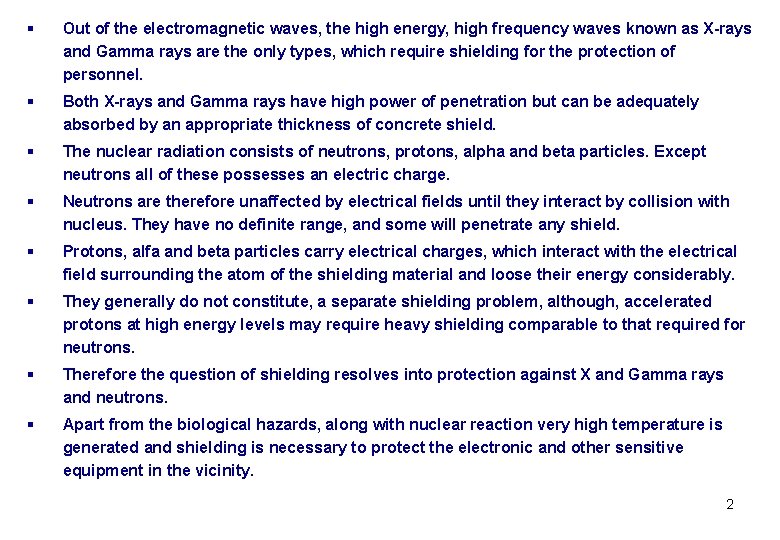
§ Out of the electromagnetic waves, the high energy, high frequency waves known as X-rays and Gamma rays are the only types, which require shielding for the protection of personnel. § Both X-rays and Gamma rays have high power of penetration but can be adequately absorbed by an appropriate thickness of concrete shield. § The nuclear radiation consists of neutrons, protons, alpha and beta particles. Except neutrons all of these possesses an electric charge. § Neutrons are therefore unaffected by electrical fields until they interact by collision with nucleus. They have no definite range, and some will penetrate any shield. § Protons, alfa and beta particles carry electrical charges, which interact with the electrical field surrounding the atom of the shielding material and loose their energy considerably. § They generally do not constitute, a separate shielding problem, although, accelerated protons at high energy levels may require heavy shielding comparable to that required for neutrons. § Therefore the question of shielding resolves into protection against X and Gamma rays and neutrons. § Apart from the biological hazards, along with nuclear reaction very high temperature is generated and shielding is necessary to protect the electronic and other sensitive equipment in the vicinity. 2
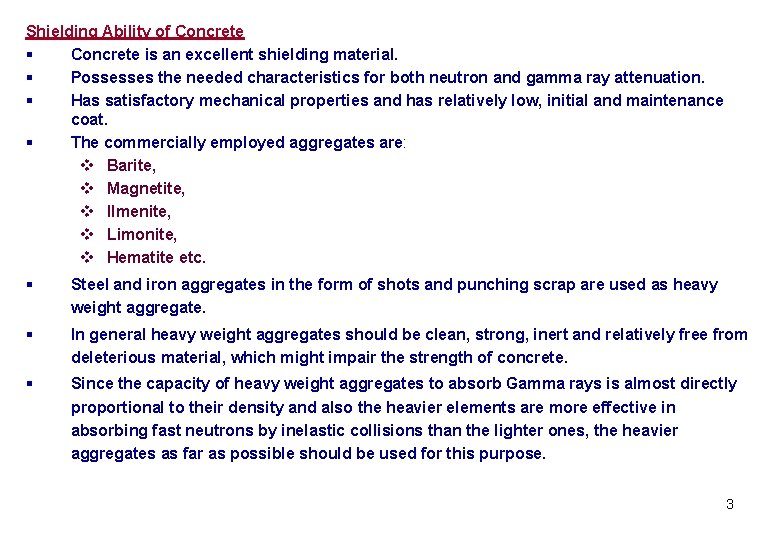
Shielding Ability of Concrete § Concrete is an excellent shielding material. § Possesses the needed characteristics for both neutron and gamma ray attenuation. § Has satisfactory mechanical properties and has relatively low, initial and maintenance coat. § The commercially employed aggregates are: v Barite, v Magnetite, v Ilmenite, v Limonite, v Hematite etc. § Steel and iron aggregates in the form of shots and punching scrap are used as heavy weight aggregate. § In general heavy weight aggregates should be clean, strong, inert and relatively free from deleterious material, which might impair the strength of concrete. § Since the capacity of heavy weight aggregates to absorb Gamma rays is almost directly proportional to their density and also the heavier elements are more effective in absorbing fast neutrons by inelastic collisions than the lighter ones, the heavier aggregates as far as possible should be used for this purpose. 3
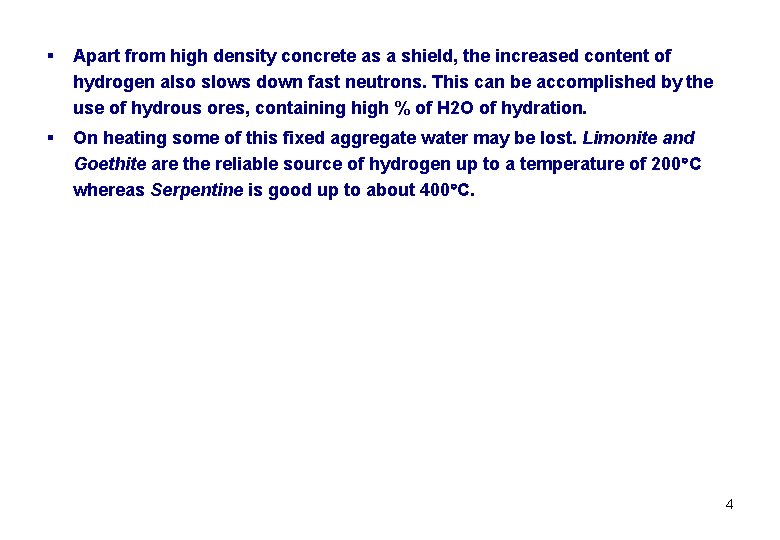
§ Apart from high density concrete as a shield, the increased content of hydrogen also slows down fast neutrons. This can be accomplished by the use of hydrous ores, containing high % of H 2 O of hydration. § On heating some of this fixed aggregate water may be lost. Limonite and Goethite are the reliable source of hydrogen up to a temperature of 200 C whereas Serpentine is good up to about 400 C. 4