
HIGH CHALLENGE HIGH SUPPORT PEDAGOGY FOR ENGLISH COMPOSITION


- Slides: 28
HIGH CHALLENGE, HIGH SUPPORT PEDAGOGY FOR ENGLISH COMPOSITION Conference on Acceleration in Developmental Education Pre-Conference Workshop June 5, 2019 Summer Serpas Assistant Director, CAP Professor of English, Irvine Valley College Acceleration. Project. org
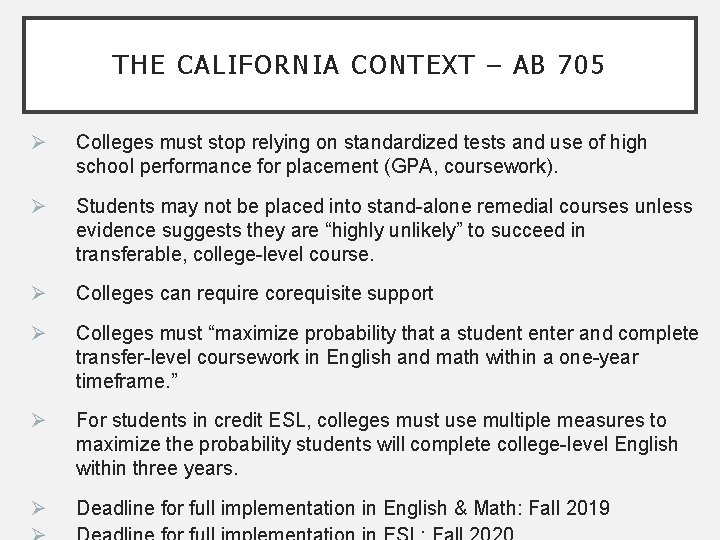
THE CALIFORNIA CONTEXT – AB 705 Ø Colleges must stop relying on standardized tests and use of high school performance for placement (GPA, coursework). Ø Students may not be placed into stand-alone remedial courses unless evidence suggests they are “highly unlikely” to succeed in transferable, college-level course. Ø Colleges can require corequisite support Ø Colleges must “maximize probability that a student enter and complete transfer-level coursework in English and math within a one-year timeframe. ” Ø For students in credit ESL, colleges must use multiple measures to maximize the probability students will complete college-level English within three years. Ø Deadline for full implementation in English & Math: Fall 2019
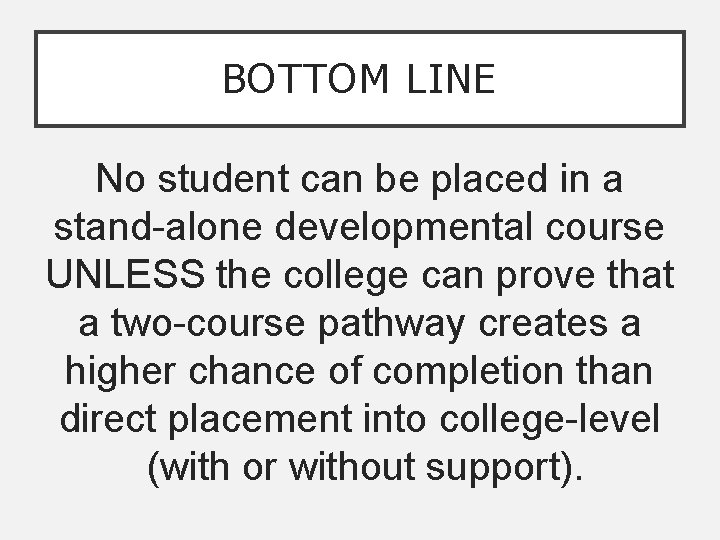
BOTTOM LINE No student can be placed in a stand-alone developmental course UNLESS the college can prove that a two-course pathway creates a higher chance of completion than direct placement into college-level (with or without support).
THE SPIRIT OF THE LAW “AB 705 invites the California community colleges to shift the thinking in favor of what students can do, rather than making assumptions about what students cannot do. ”
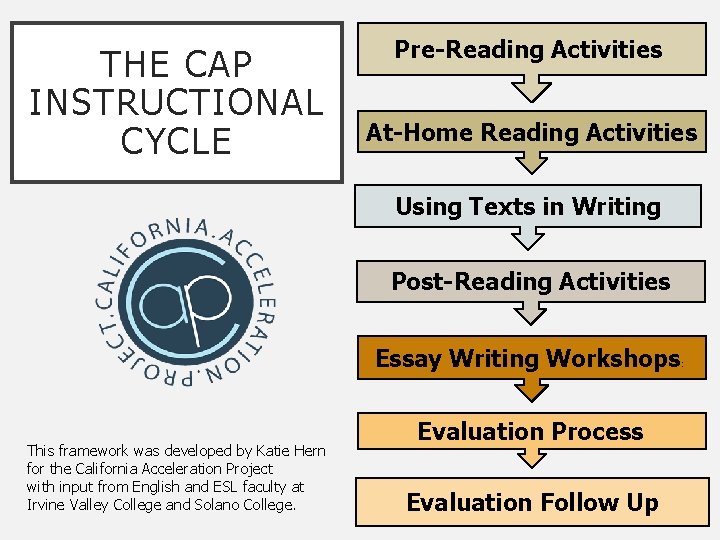
THE CAP INSTRUCTIONAL CYCLE Pre-Reading Activities At-Home Reading Activities Using Texts in Writing Post-Reading Activities Essay Writing Workshops: This framework was developed by Katie Hern for the California Acceleration Project with input from English and ESL faculty at Irvine Valley College and Solano College. Evaluation Process Evaluation Follow Up
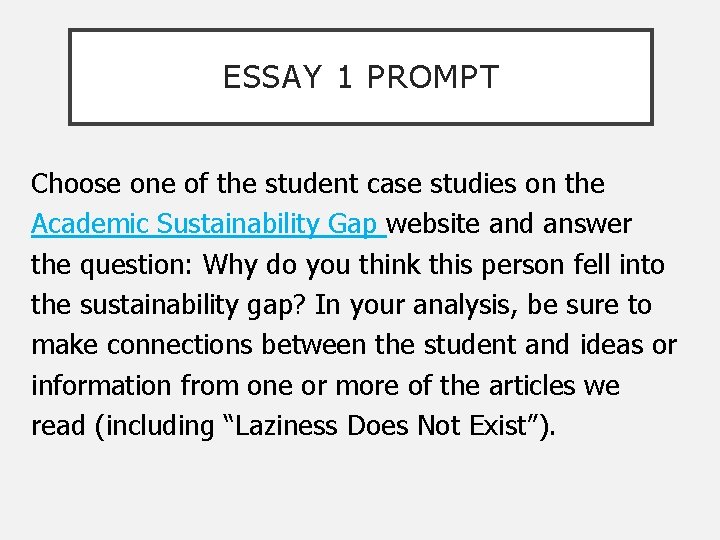
ESSAY 1 PROMPT Choose one of the student case studies on the Academic Sustainability Gap website and answer the question: Why do you think this person fell into the sustainability gap? In your analysis, be sure to make connections between the student and ideas or information from one or more of the articles we read (including “Laziness Does Not Exist”).
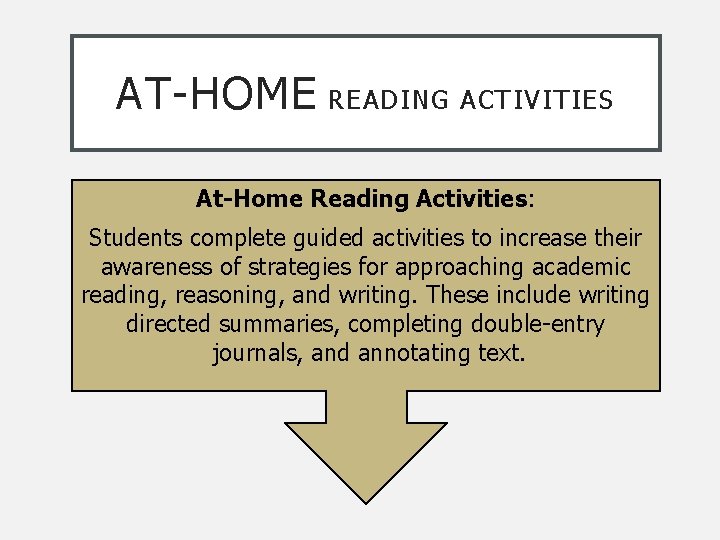
AT-HOME READING ACTIVITIES At-Home Reading Activities: Students complete guided activities to increase their awareness of strategies for approaching academic reading, reasoning, and writing. These include writing directed summaries, completing double-entry journals, and annotating text.
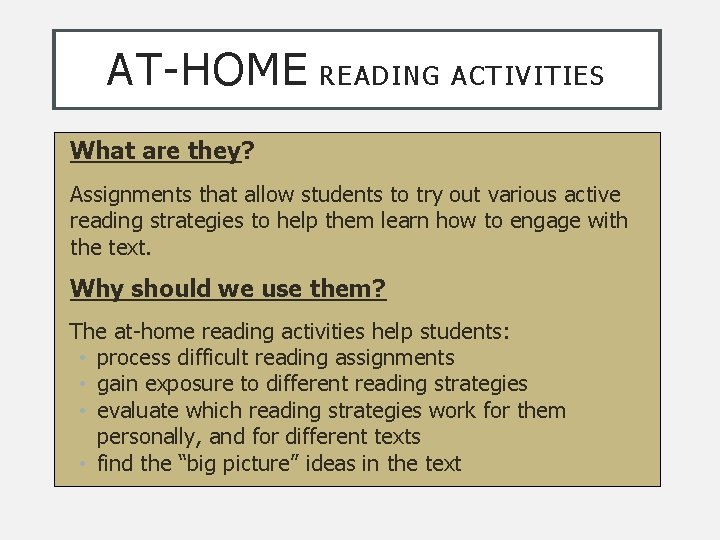
AT-HOME READING ACTIVITIES What are they? Assignments that allow students to try out various active reading strategies to help them learn how to engage with the text. Why should we use them? The at-home reading activities help students: • process difficult reading assignments • gain exposure to different reading strategies • evaluate which reading strategies work for them personally, and for different texts • find the “big picture” ideas in the text
AT-HOME READING ACTIVITY PRACTICE • Read the article “Laziness Does Not Exist, but Unseen Barriers Do” by Devon Price. • Annotate the text however you normally would to help you understand critically engage with it. • You will be sharing these annotations with a group in a few minutes.
AT-HOME READING ACTIVITIES Tips for Creating Good At-Home Reading Activities: • Avoid the “treasure hunt. ” Try to focus on big picture ideas. • Consider grading these for “thoughtful completion. ” • Create a variety of activities to help students gain exposure to different active reading strategies. • In an ideal world, at-home reading activities should connect with in-class reading activities to help students see the relevance of these assignments.
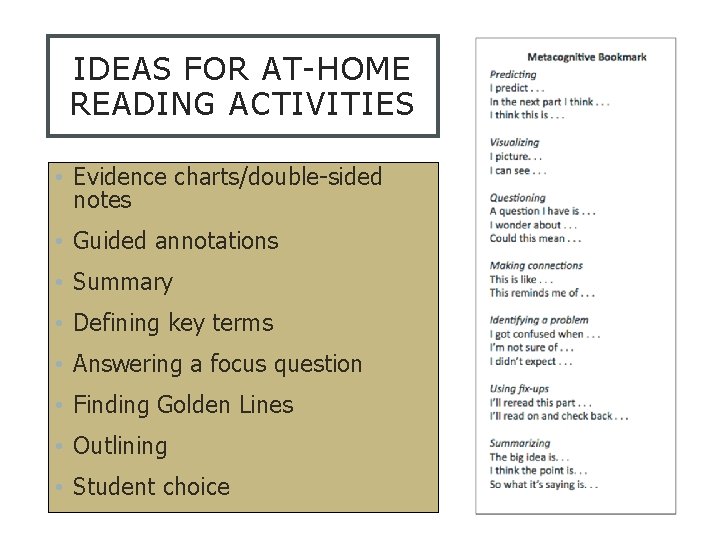
IDEAS FOR AT-HOME READING ACTIVITIES • Evidence charts/double-sided notes • Guided annotations • Summary • Defining key terms • Answering a focus question • Finding Golden Lines • Outlining • Student choice
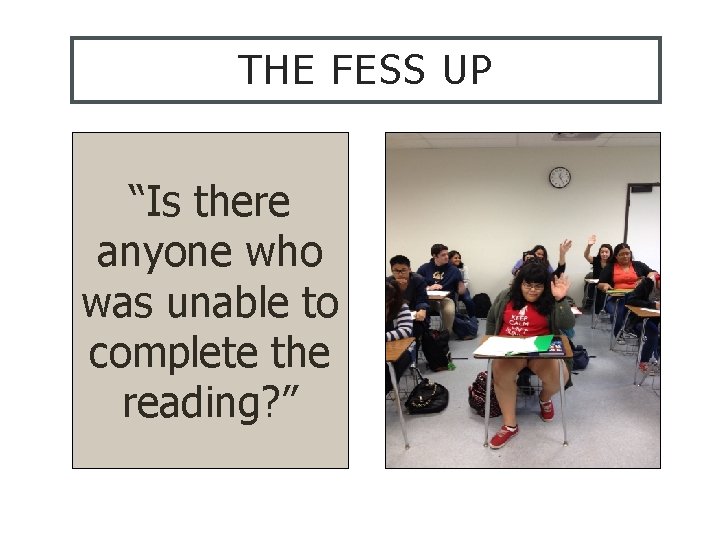
THE FESS UP “Is there anyone who was unable to complete the reading? ”
IN-CLASS READING ACTIVITIES Post-Reading Activities: In-class group activities for students to process, clarify, and engage with ideas from the readings. These practices include group discussions, debates, poster sessions and games, such as “speed-dating. ” Focus first on comprehension then move to building analysis.
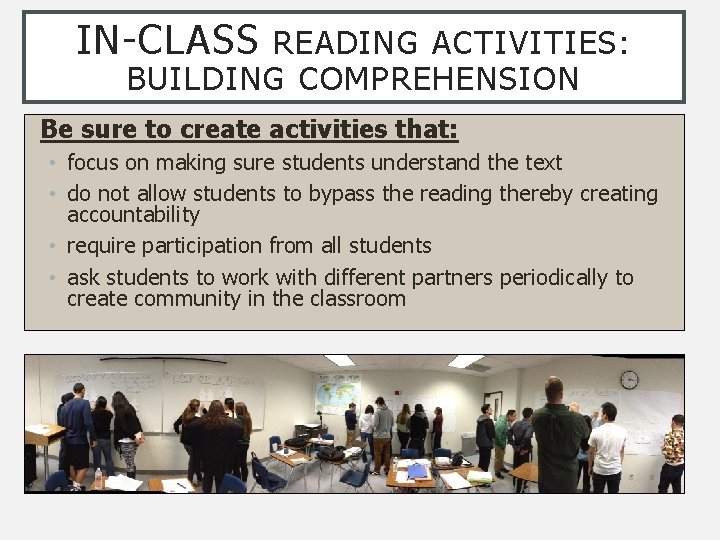
IN-CLASS READING ACTIVITIES: BUILDING COMPREHENSION What are they? In class, we should facilitate “low-stakes, collaborative practice” activities that focus on comprehension of the text, making sure students understand the content of the text before moving to critical analysis. Why should we use them? The in-class comprehension activities help students: • build confidence in the content of the text and clarify confusion • see that reading and understanding texts is not always a solitary process • provide peer-to-peer support and community-building in the classroom • make the invisible • reduce their fear of reading • find an incentive for completing the reading assignments • prepare to develop deeper critical analysis
IN-CLASS COMPREHENSION ACTIVITIES PRACTICE Part 1: Annotation Activity We’re going to divide into small groups. Each group will get a section of the text. With your group, • First, compare your annotations on the section your group was assigned and discuss the important passages. • Next, create a one-sentence summary of your section(s). • Finally, • Write the one-sentence summary across the top of your poster. • Tape your assigned section to the poster. • Annotate the most important passages of this section on the poster (write your annotations on the poster so others can easily see) • In your annotations, include some critical responses, such as questions that come up for you about this content, connections to your own experience, reflections on the passage.
IN-CLASS COMPREHENSION ACTIVITIES PRACTICE Part 2: Gallery Walk • Circulate around the room. Be sure to bring your text with you. • Review other sections of the text (particularly any that were confusing to you). • Add any important annotations to your copy of the text.
IN-CLASS READING ACTIVITIES: BUILDING COMPREHENSION Be sure to create activities that: • focus on making sure students understand the text • do not allow students to bypass the reading thereby creating accountability • require participation from all students • ask students to work with different partners periodically to create community in the classroom
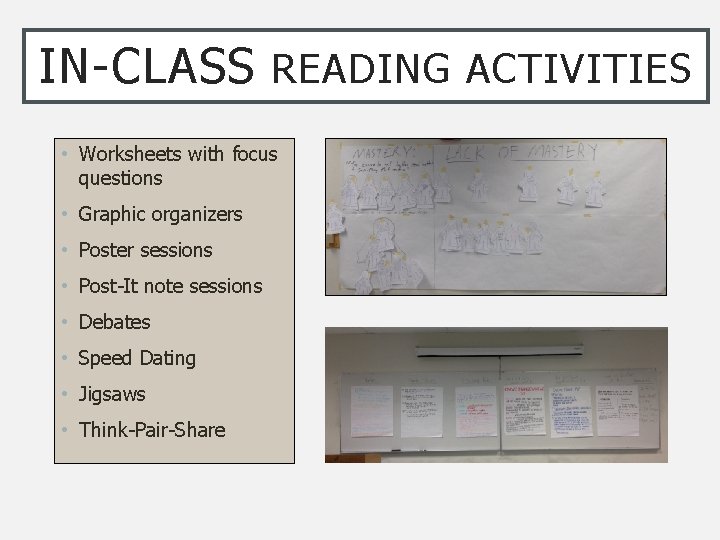
IN-CLASS READING ACTIVITIES • Worksheets with focus questions • Graphic organizers • Poster sessions • Post-It note sessions • Debates • Speed Dating • Jigsaws • Think-Pair-Share
IN-CLASS READING ACTIVITIES BUILDING ANALYSIS What are they? These “low-stakes, collaborative practice” activities move students toward critical analysis of the text and help them build the analysis they will need to answer the essay prompt. Why should we use them? The in-class building analysis activities help students: • think critically about the text • prepare to answer the essay prompt • write more thoughtful and critical essays • build deeper analysis by working with their peers to explore the topics in the text
IN-CLASS BUILDING ANALYSIS ACTIVITY PRACTICE Part 3: Sustainability Gap First, let’s review the Sustainability Gap website. Next, we’ll get into groups. • Each table has a case study from the Sustainability Gap website. • Move to the table for the case study you’d like to review. In your group: • Using your assigned case study, complete the graphic organizer. Try to complete at least 2 -3 entries.
IN-CLASS BUILDING ANALYSIS ACTIVITY PRACTICE Part 4: Share Out Find someone who was working on a different case study in a different group: • Briefly summarize your case study. • Share the best connection your group made between the text and the case study. • Add notes to your graphic organizer.
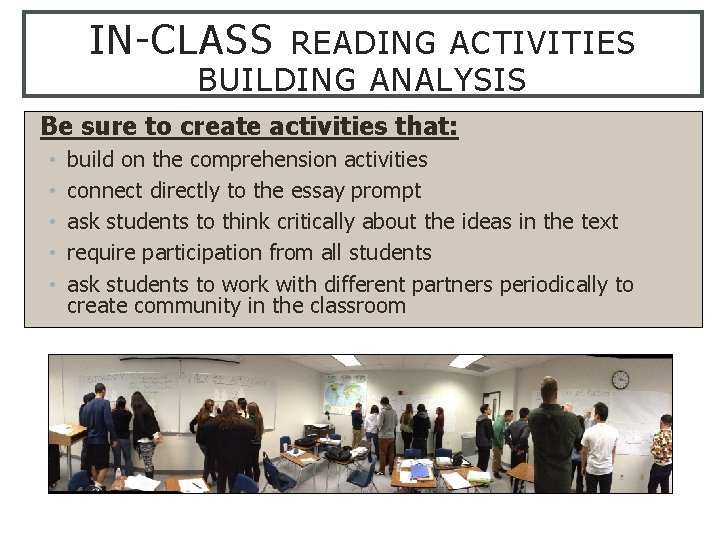
IN-CLASS READING ACTIVITIES BUILDING ANALYSIS Be sure to create activities that: • • • build on the comprehension activities connect directly to the essay prompt ask students to think critically about the ideas in the text require participation from all students ask students to work with different partners periodically to create community in the classroom
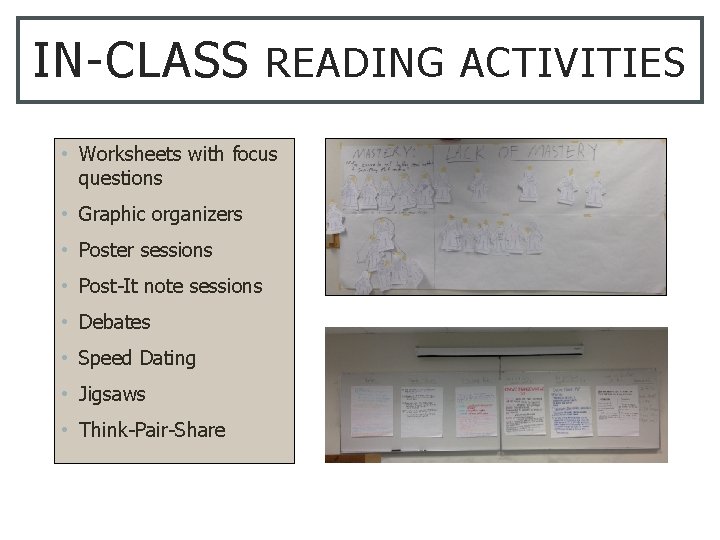
IN-CLASS READING ACTIVITIES • Worksheets with focus questions • Graphic organizers • Poster sessions • Post-It note sessions • Debates • Speed Dating • Jigsaws • Think-Pair-Share
SPEED DATING WITH CAP PEDAGOGY
LOW-STAKES, COLLABORATIVE PRACTICE In-class activities are designed to give students practice with the most high-priority skills and content needed for later, graded assessments. Prompt: • Summarize the pedagogical concept • Discuss examples you saw during today’s workshop activities
JUST-IN-TIME REMEDIATION An alternative to separating out and teaching discrete sub-skills in advance, this approach provides only the support students specifically need to grapple with challenging college-level tasks; includes individualized grammar guidance on students’ own writing and asneeded review of the arithmetic or algebra required to answer intellectually engaging questions with data. Prompt: • Summarize the pedagogical concept • Discuss examples you saw during today’s workshop activities
ATTENTION TO AFFECTIVE ISSUES Pedagogical practices are employed to reduce students’ fear, increase their willingness to engage with challenging tasks, and make them less likely to sabotage their own success in a class. Prompt: • Summarize the pedagogical concept • Discuss examples you saw during today’s workshop activities
GET CONNECTED! JOIN THE CAP FACEBOOK PAGE • Over 1, 100 members from across the country • Search “California Acceleration Project” and answer 2 questions to join