
High Burnup Radioactive Spent Fuel Dr Paul Dorfman
High Burn-up Radioactive Spent Fuel Dr Paul Dorfman Nuclear Consultation Group Helsinki, 8 May 2009
Rad waste – US experience • Obama withdraws funding from Yucca Mountain geological rad waste dump • ‘After spending billions of dollars on the Yucca Mountain Project, there are still significant questions about whether nuclear waste can be safely stored there’ – Barack Obama, Feb 2009
UK rad waste experience • Current legacy - 75 billion sterling • Co. RWM 1 – deep disposal concept subject to intensive research and development • To date very limited R & D undertaken • Rhetoric of deep disposal • Until then - surface storage
Prof Andy Blowers OBE, Open University, member of NIREX, member of Committee on Radioactive Waste Management 1 (Co. RWM) ‘There is, as yet, no proven technical solution for the long-term management of radioactive wastes’
Rad waste – French experience • 2006 - after 15 years of inconclusive research on deep underground burial, the failure to find a solution led the French parliament to authorize continuation of research on disposal and on long-term storage of the wastes
Liberalisation of the energy market in Europe • Pressured Electricité de France (EDF) to become more competitive • Resulted in the testing of high burn-up fuel • European Pressurised water Reactor (EPR) ‘re-engineered’
Ed. F ‘Optimization’ study • Decrease in cost could be achieved if: 1. 15% increase in the reactor’s power 2. Fuel was enriched to up to 4. 9% uranium 235 3. Spent fuel discharged at a burn-up of 60, 000 Mega. Watt days per tonne of Uranium (MWd/t. U)
High burn-up fuel • More enriched uranium used as reactor fuel to increase burn-up rate • Left in the reactor for longer • High burn-up spent fuel is hotter and more radioactive than conventional spent fuel • Much tighter ‘safety envelope’
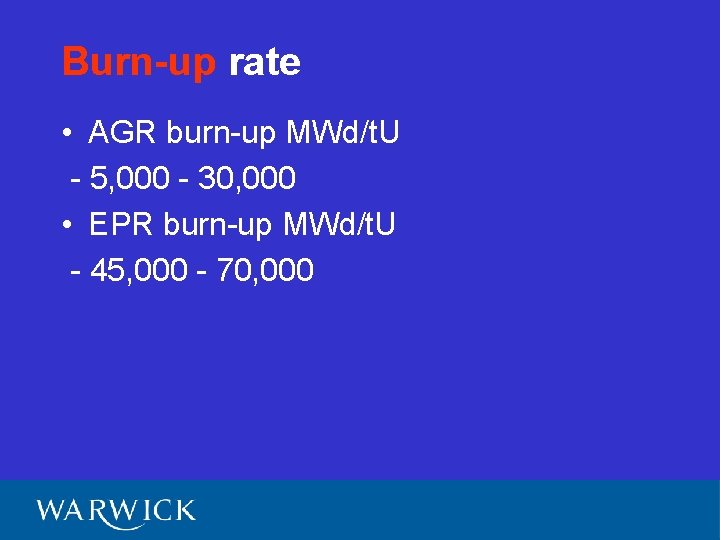
Burn-up rate • AGR burn-up MWd/t. U - 5, 000 - 30, 000 • EPR burn-up MWd/t. U - 45, 000 - 70, 000
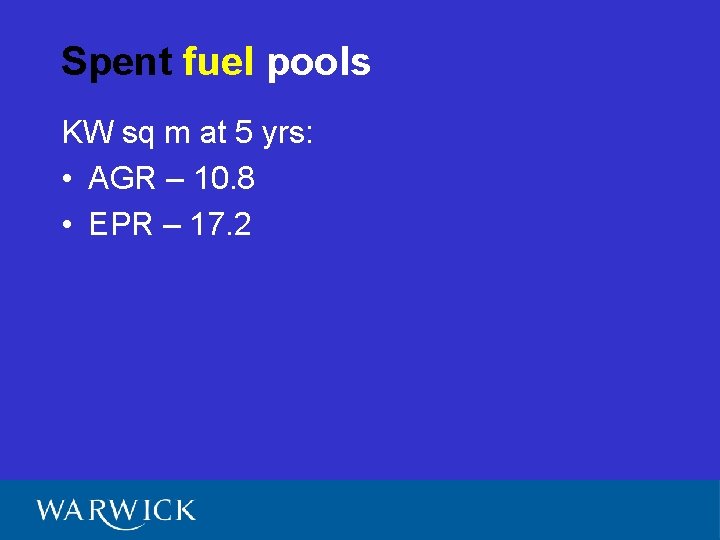
Spent fuel pools KW sq m at 5 yrs: • AGR – 10. 8 • EPR – 17. 2
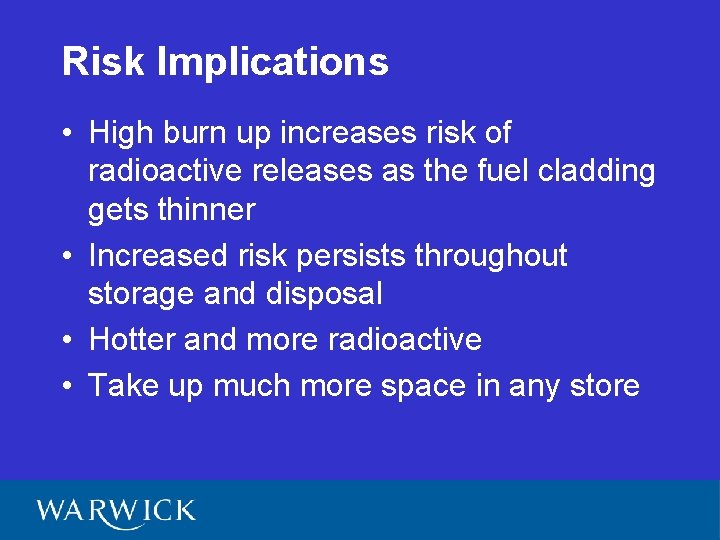
Risk Implications • High burn up increases risk of radioactive releases as the fuel cladding gets thinner • Increased risk persists throughout storage and disposal • Hotter and more radioactive • Take up much more space in any store
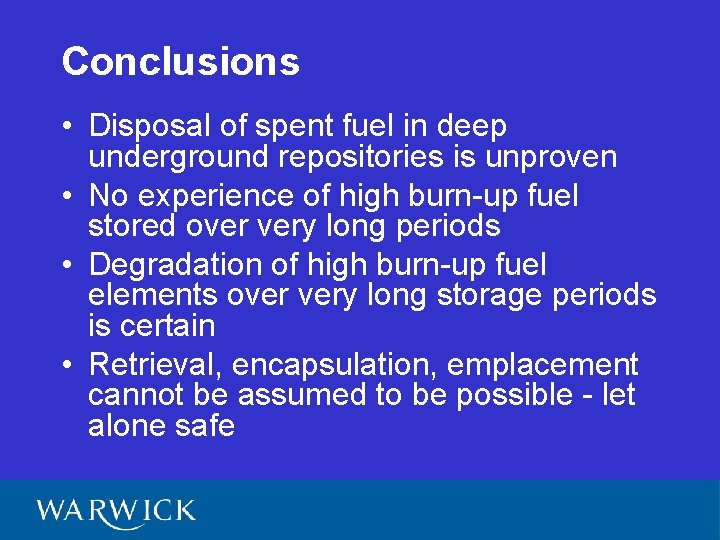
Conclusions • Disposal of spent fuel in deep underground repositories is unproven • No experience of high burn-up fuel stored over very long periods • Degradation of high burn-up fuel elements over very long storage periods is certain • Retrieval, encapsulation, emplacement cannot be assumed to be possible - let alone safe
Very little experience of spent fuel over 60, 000 MWd/t. U • Containment materials after cooling pond are still experimental • Decades additional cooling time • Spaced out in repositories - increasing ‘footprint’ • Uncertainties about high burn-up spent fuel - any fixed disposal cost exposes future taxpayer to huge liabilities
Driven by financial constraints • Nuclear industry has raised the power output of proposed reactors • Difficulties of managing and disposing radioactive waste are becoming insuperable • Burdens of cost, effort, worker radiation dose transferred to future generations
- Slides: 14