
High Ankle Sprain Initial XRays Mortise lateral talar


- Slides: 14
High Ankle Sprain: Initial X-Rays Mortise (lateral talar shift) 1. tibio-fibular clear space >5 mm 2. Tibiofibular overlap < 1 mm
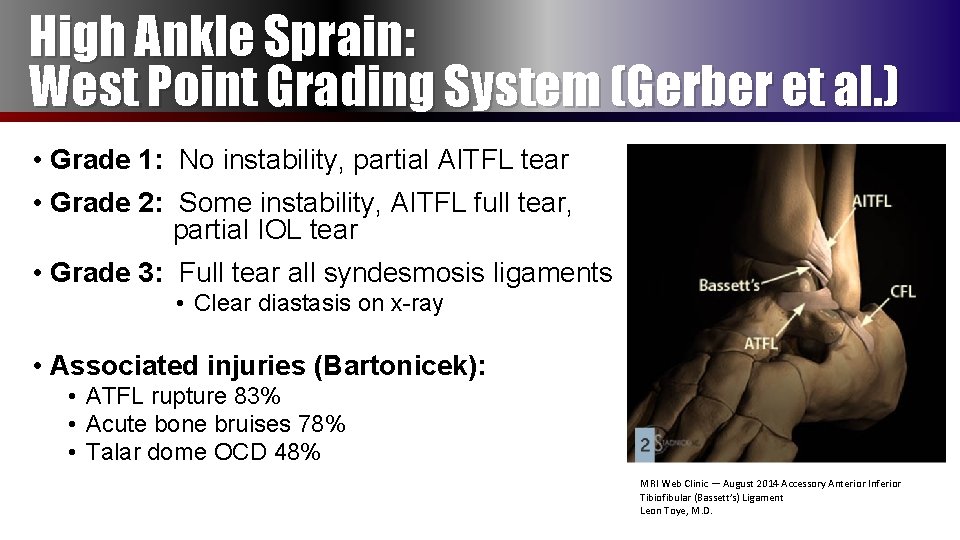
High Ankle Sprain: West Point Grading System (Gerber et al. ) • Grade 1: No instability, partial AITFL tear • Grade 2: Some instability, AITFL full tear, partial IOL tear • Grade 3: Full tear all syndesmosis ligaments • Clear diastasis on x-ray • Associated injuries (Bartonicek): • ATFL rupture 83% • Acute bone bruises 78% • Talar dome OCD 48% MRI Web Clinic — August 2014 Accessory Anterior Inferior Tibiofibular (Bassett’s) Ligament Leon Toye, M. D.
High Ankle Sprain: Treatment 3 stage conservative treatment: 1. Short period of protection in Aircast boot • • Grade 1 or 2: Like grade 3 ATFL sprain – PWBAT 7 -10 days Grade 3: NWB 4 -6/52 2. Active rehabilitation • Strengthening 3. Return to play
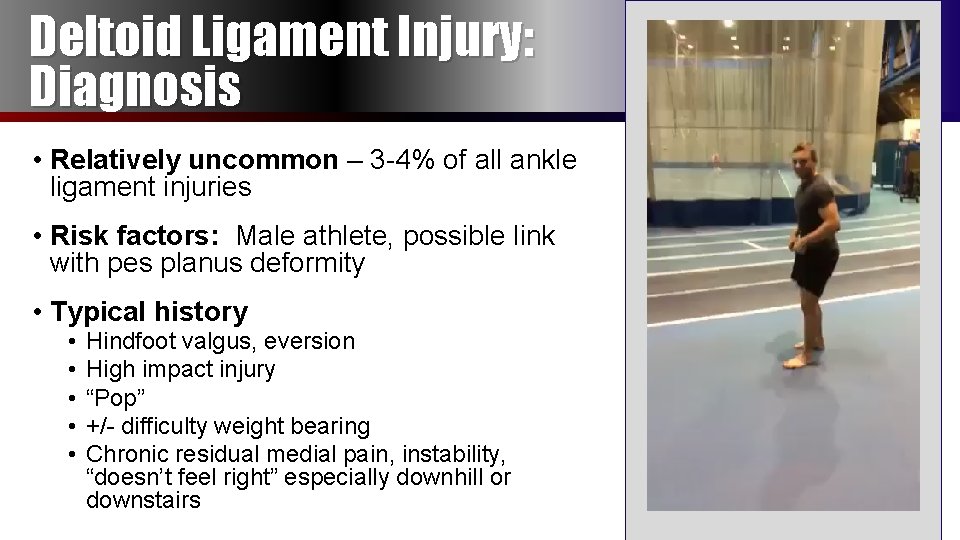
Deltoid Ligament Injury: Diagnosis • Relatively uncommon – 3 -4% of all ankle ligament injuries • Risk factors: Male athlete, possible link with pes planus deformity • Typical history • • • Hindfoot valgus, eversion High impact injury “Pop” +/- difficulty weight bearing Chronic residual medial pain, instability, “doesn’t feel right” especially downhill or downstairs
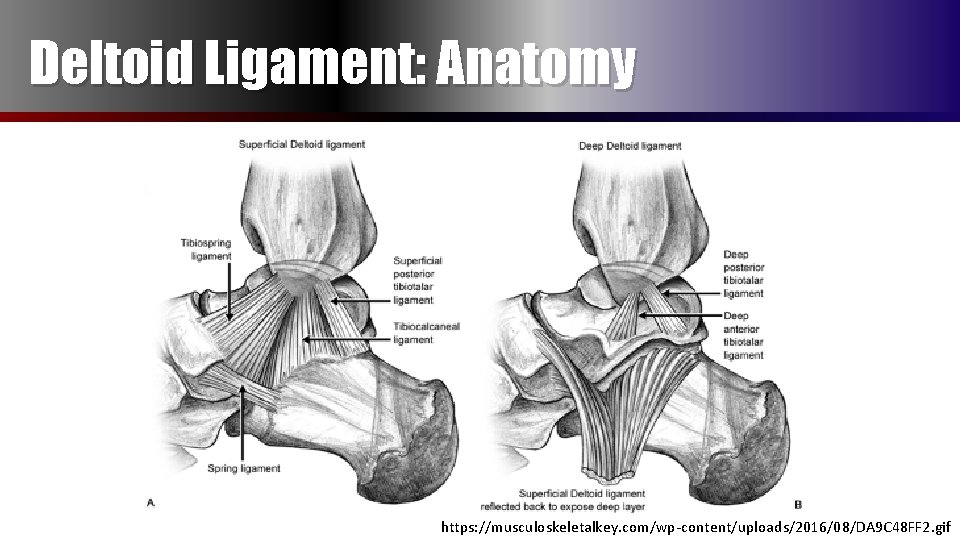
Deltoid Ligament: Anatomy https: //musculoskeletalkey. com/wp-content/uploads/2016/08/DA 9 C 48 FF 2. gif
Deltoid Ligament: Diagnosis • Typical history • Focused physical exam maneuvres for deltoid ligament • Examine superficial deltoid • Palpation anterior MM • External rotation in slight plantar flexion • Examine deep deltoid • Prone posterior translation of talus (relative to tibia) • Positive medial malleolar pointing sign (chronic) • Common associated injuries that change management: • Rule out high ankle sprain – squeeze test, forced ER test, TOP over high ankle • Rule out spring ligament tear – hindfoot valgus, corrects with single leg heel raise to hindfoot varus • Rule out significant PTT dysfunction – hindfoot valgus that fails to correct
Deltoid Ligament: Treatment • Combined injuries with spring ligament or PTT – foot/ankle referral • Isolated deltoid sprain: • Grade 1 sprain: Semi-rigid brace, WBAT, early active rehab, return to play over 4 -6 weeks • Grade 2 and 3 sprain: • • Evaluate for clinical instability if rupture suspected foot/ankle referral If conservative, cast or boot with medial longitudinal arch, WBAT, ROM limited. 4 weeks increase to 5 -30 deg ROM, starting active ROM. 6 weeks unlock boot and start active rehab, transition to brace
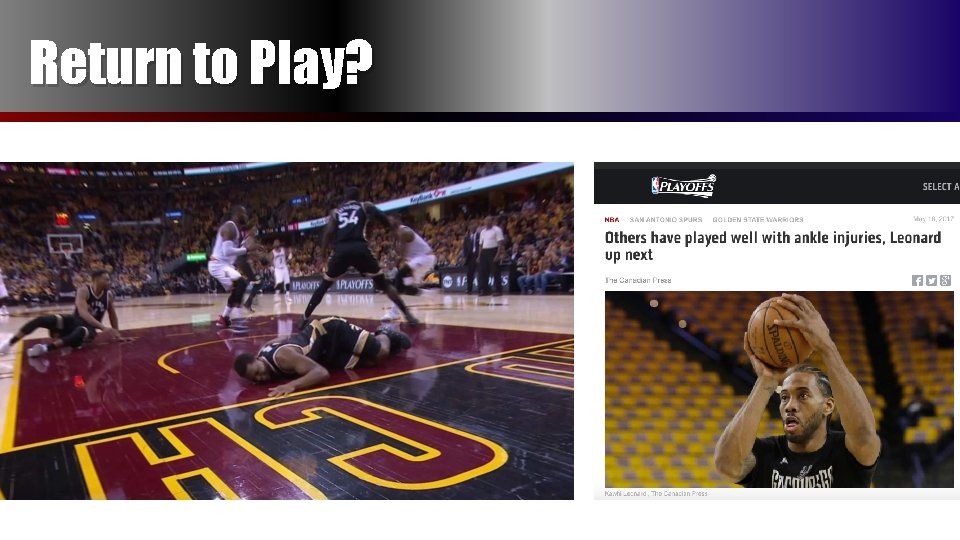
Return to Play?
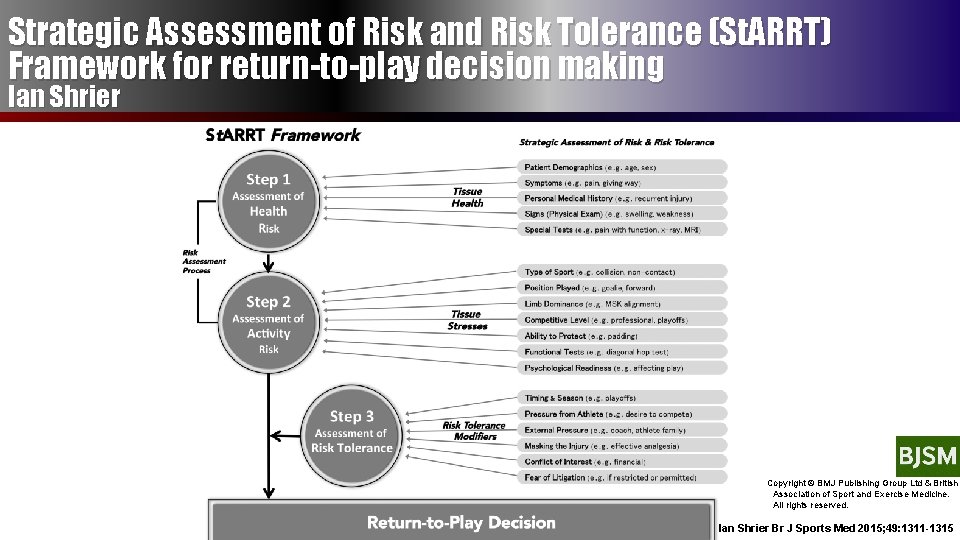
Strategic Assessment of Risk and Risk Tolerance (St. ARRT) Framework for return-to-play decision making Ian Shrier Copyright © BMJ Publishing Group Ltd & British Association of Sport and Exercise Medicine. All rights reserved. Ian Shrier Br J Sports Med 2015; 49: 1311 -1315
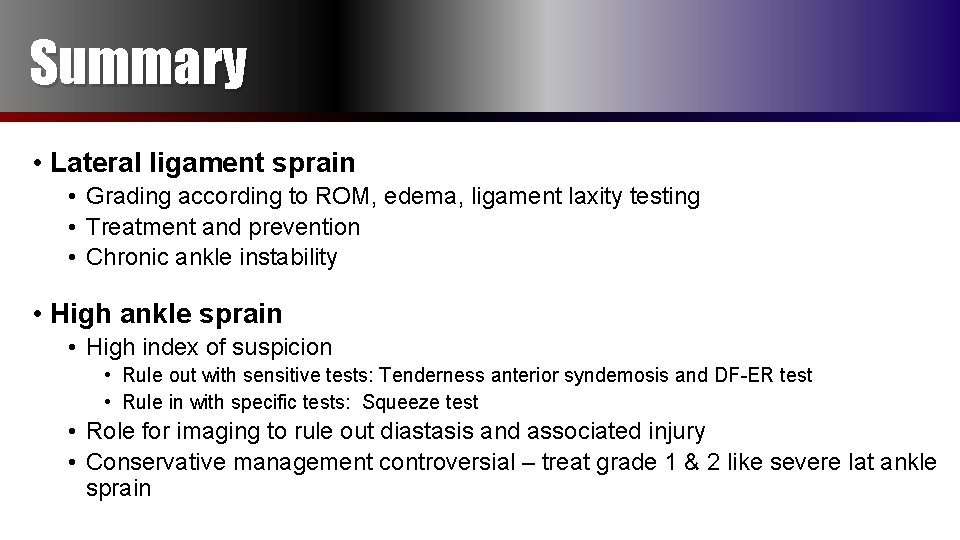
Summary • Lateral ligament sprain • Grading according to ROM, edema, ligament laxity testing • Treatment and prevention • Chronic ankle instability • High ankle sprain • High index of suspicion • Rule out with sensitive tests: Tenderness anterior syndemosis and DF-ER test • Rule in with specific tests: Squeeze test • Role for imaging to rule out diastasis and associated injury • Conservative management controversial – treat grade 1 & 2 like severe lat ankle sprain
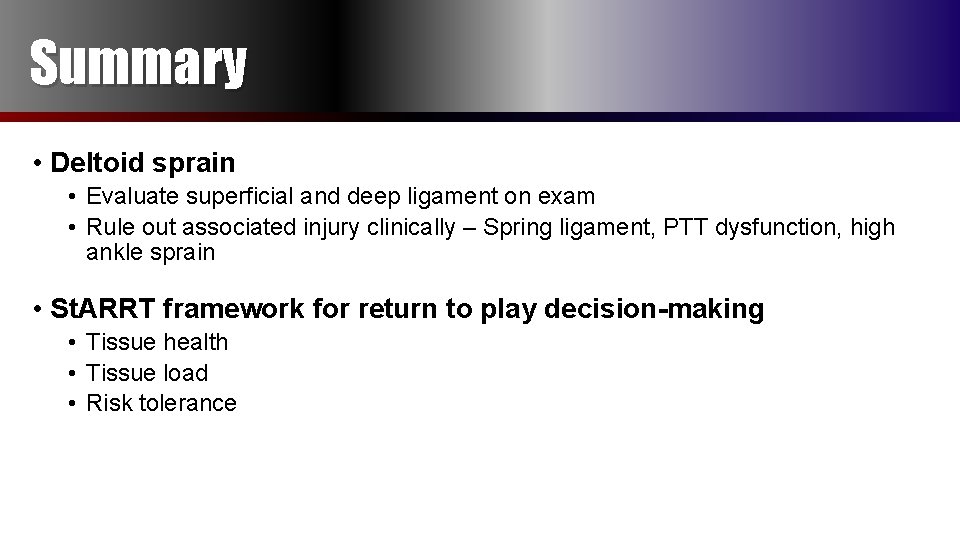
Summary • Deltoid sprain • Evaluate superficial and deep ligament on exam • Rule out associated injury clinically – Spring ligament, PTT dysfunction, high ankle sprain • St. ARRT framework for return to play decision-making • Tissue health • Tissue load • Risk tolerance
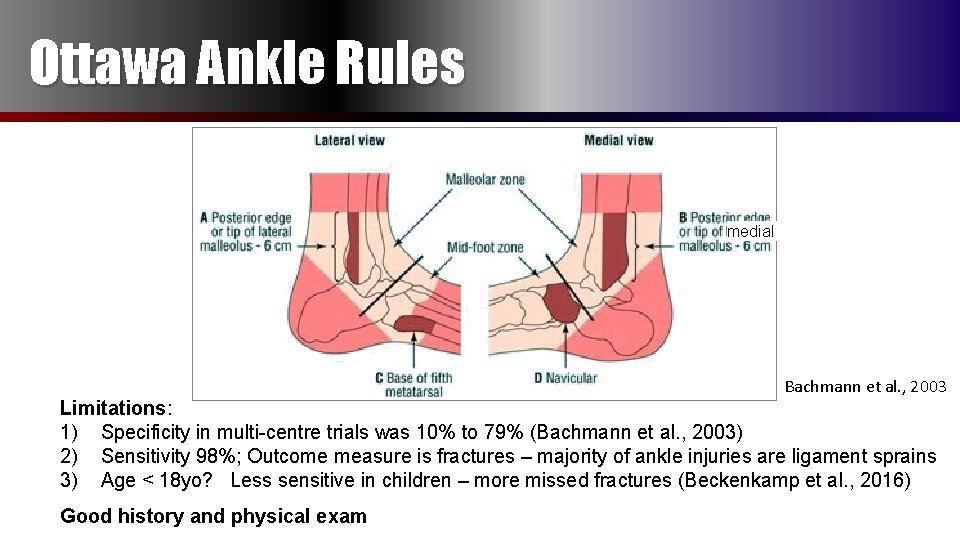
Ottawa Ankle Rules medial Bachmann et al. , 2003 Limitations: 1) Specificity in multi-centre trials was 10% to 79% (Bachmann et al. , 2003) 2) Sensitivity 98%; Outcome measure is fractures – majority of ankle injuries are ligament sprains 3) Age < 18 yo? Less sensitive in children – more missed fractures (Beckenkamp et al. , 2016) Good history and physical exam
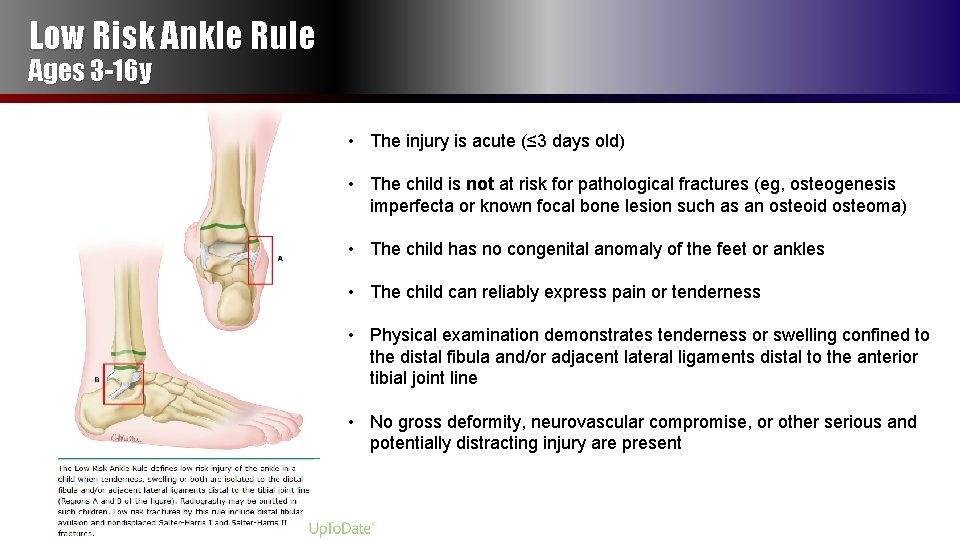
Low Risk Ankle Rule Ages 3 -16 y • The injury is acute (≤ 3 days old) • The child is not at risk for pathological fractures (eg, osteogenesis imperfecta or known focal bone lesion such as an osteoid osteoma) • The child has no congenital anomaly of the feet or ankles • The child can reliably express pain or tenderness • Physical examination demonstrates tenderness or swelling confined to the distal fibula and/or adjacent lateral ligaments distal to the anterior tibial joint line • No gross deformity, neurovascular compromise, or other serious and potentially distracting injury are present