
High and Lowcontext Communication Styles Highcontext and lowcontext




- Slides: 25
High- and Low-context Communication Styles
High-context and low-context communication refers to how much speakers rely on things other than words to convey meaning 11/24/2020 Praveen Shetty
Categorize It is cold today. / Could you shut the window please? It may be possible! / It is not going to work I earn 6000 Euros a week. / I earn enough to keep my family happy. We will find a way. / It is all in the contract. 11/24/2020 Praveen Shetty
Understanding High Context… 11/24/2020 Praveen Shetty
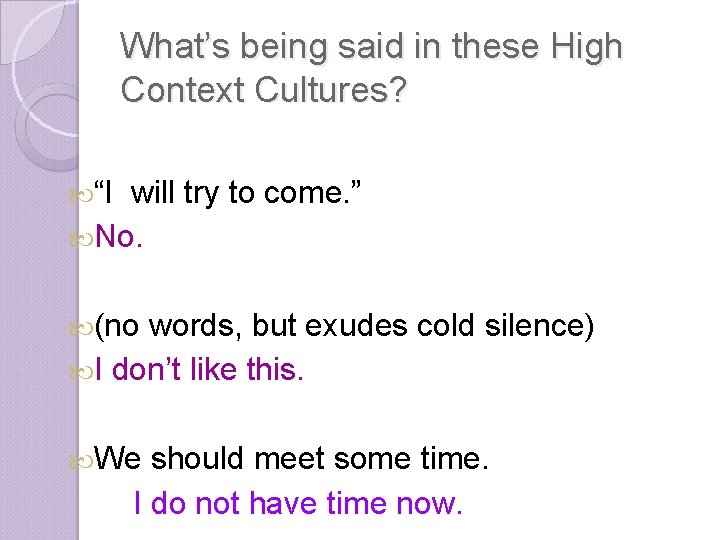
What’s being said in these High Context Cultures? “I will try to come. ” No. (no words, but exudes cold silence) I don’t like this. We should meet some time. I do not have time now.
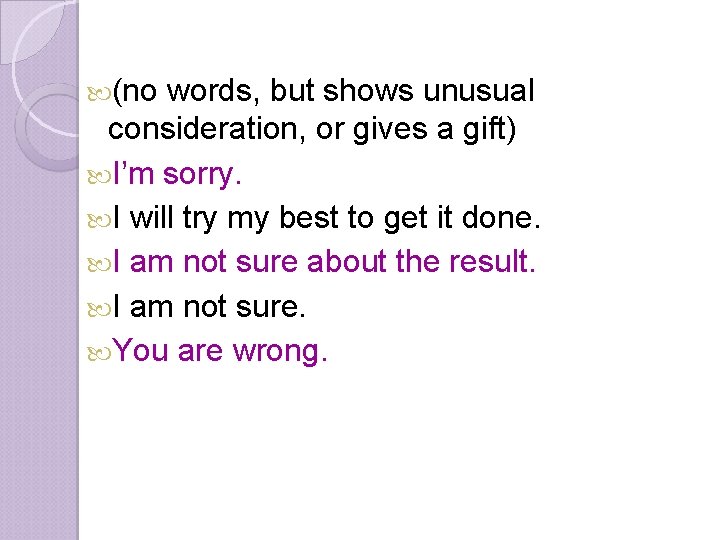
(no words, but shows unusual consideration, or gives a gift) I’m sorry. I will try my best to get it done. I am not sure about the result. I am not sure. You are wrong.
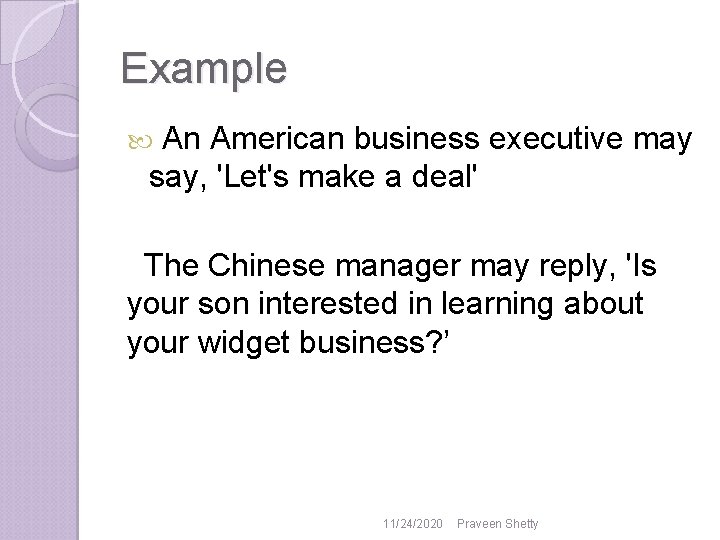
Example An American business executive may say, 'Let's make a deal' The Chinese manager may reply, 'Is your son interested in learning about your widget business? ’ 11/24/2020 Praveen Shetty
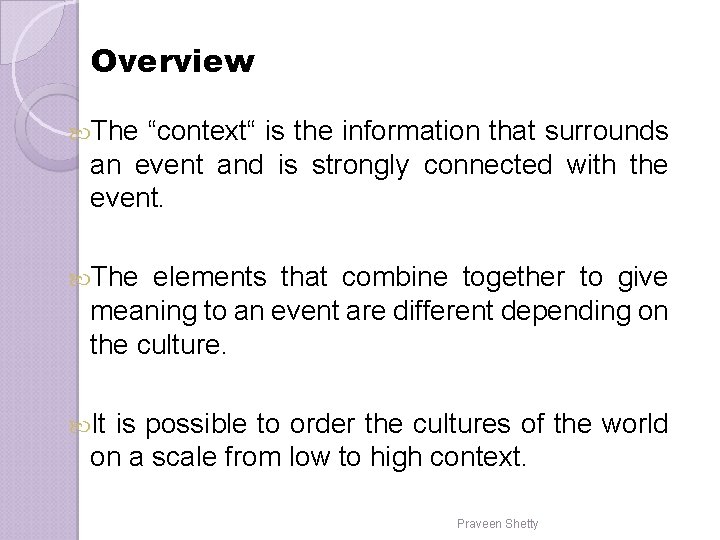
Overview The “context“ is the information that surrounds an event and is strongly connected with the event. The elements that combine together to give meaning to an event are different depending on the culture. It is possible to order the cultures of the world on a scale from low to high context. Praveen Shetty
Do I recognize implied messages from others, and am I aware of the verbal and nonverbal cues that let me understand the speaker's meaning? (High-Context) Do I "let my words speak for themselves? " Do I prefer to be more direct, relying on what is explicitly stated in my speech? (Low-Context) Praveen Shetty
High-context Communication In high-context cultures the members’ messages are implicit and not stated directly. The bulk of the message resides either in the physical context or is internalized in the communicators. The message is one in which most of the information is already “in the person. ” Praveen Shetty
High use of nonverbal elements; voice tone, facial expression, gestures, and eye movement carry significant parts of conversation. Verbal message is indirect; one talks around the point and embellishes it. Communication is seen as an art form-a way of engaging someone. 11/24/2020 Praveen Shetty
Disagreement is personalized. One is sensitive to conflict expressed in another's nonverbal communication. Conflict either must be solved before work can progress or must be avoided. Relationships depend on trust, build up slowly, and are stable. Identity is rooted in group 11/24/2020 Praveen Shetty
High-context Communication (con’t) Any words used depend on the setting, past experiences with each other, age, gender, etc. Members read nonverbal cues skillfully and are capable of understanding facial and bodily movements, subtle gestures, and environmental signs. Example: Two twins who have grown up together can and do communicate very economically. There is a high amount of context which they share and which need not be explicitly stated. Praveen Shetty
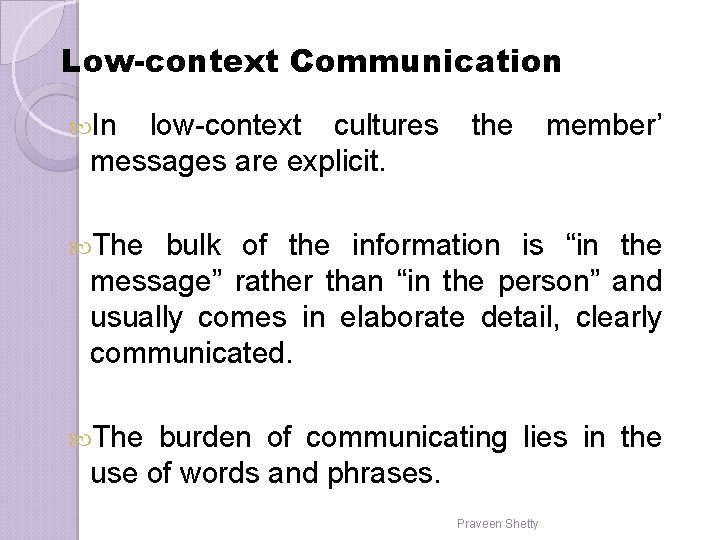
Low-context Communication In low-context cultures messages are explicit. the member’ The bulk of the information is “in the message” rather than “in the person” and usually comes in elaborate detail, clearly communicated. The burden of communicating lies in the use of words and phrases. Praveen Shetty
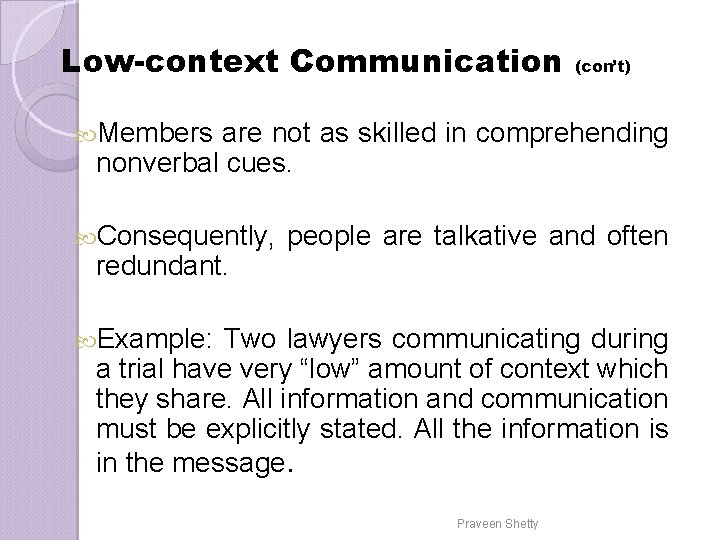
Low-context Communication (con’t) Members are not as skilled in comprehending nonverbal cues. Consequently, redundant. people are talkative and often Example: Two lawyers communicating during a trial have very “low” amount of context which they share. All information and communication must be explicitly stated. All the information is in the message. Praveen Shetty
Message is carried more by words than by nonverbal means. Verbal message is direct; one spells things out exactly. Communication is seen as a way of exchanging information, ideas, and opinions. Disagreement is depersonalized. One withdraws from conflict with another and gets on with the task. Focus is on rational solutions, not personal ones. 11/24/2020 Praveen Shetty
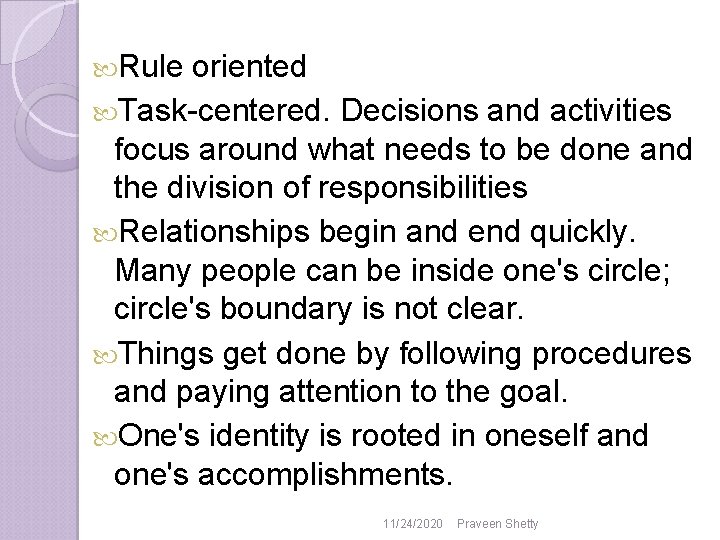
Rule oriented Task-centered. Decisions and activities focus around what needs to be done and the division of responsibilities Relationships begin and end quickly. Many people can be inside one's circle; circle's boundary is not clear. Things get done by following procedures and paying attention to the goal. One's identity is rooted in oneself and one's accomplishments. 11/24/2020 Praveen Shetty
Context Scale High-context Asian Arab Southern European African South American Northern European Australian North American Scandinavian German Swiss Low-context Praveen Shetty
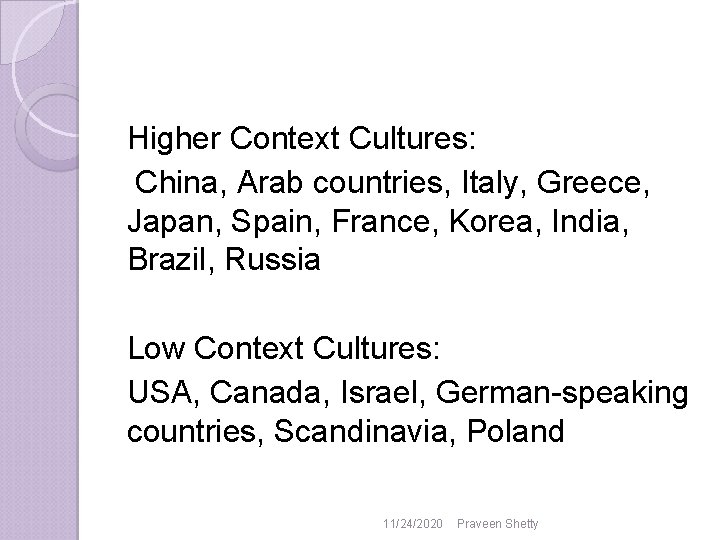
Higher Context Cultures: China, Arab countries, Italy, Greece, Japan, Spain, France, Korea, India, Brazil, Russia Low Context Cultures: USA, Canada, Israel, German-speaking countries, Scandinavia, Poland 11/24/2020 Praveen Shetty
High-context Cultures Nonverbal communication important Information flows freely Rely on physical context for information Environment, situation, guides, gestures, mood, cues, hints are all taken into account Maintain extensive information network Accustomed to interruptions Praveen Shetty
Low-context Cultures Less aware of nonverbal cues, environment, and situation Lack well-developed networks Need detailed background information Tend to segment and compartmentalize information Control information on a “need-to-know” basis Praveen Shetty
Low-context Languages If what one has to say is complex, then one needs a complex language and grammar to express it. Relatively speaking, these languages are complex and have a large number of words: ◦ German ◦ Russian & Slavic ◦ Scandinavian languages ◦ English Praveen Shetty
High-context Languages With high-context language, the grammar can be very simple and efficient. The information exchanged is not in the words, but rather in the context and in the shared meaning and experiences. Examples: ◦ ◦ ◦ Air traffic controller language Football team language Policeman language Prisoner language Military language Praveen Shetty
Meeting of High and High At times it is very difficult to go from one high-context culture to another highcontext culture. Even though they are both “high”, the context is different. Praveen Shetty
Meeting of High and Low When “high” meets “low”, you can’t meet in the middle. Rather you must go lower than the low. Everything must be spelled out verbally Once a certain amount of shared experiences are had, then the context level can be raised. Praveen Shetty