
High Altitude Balloon Flight of an Experimental Reentry
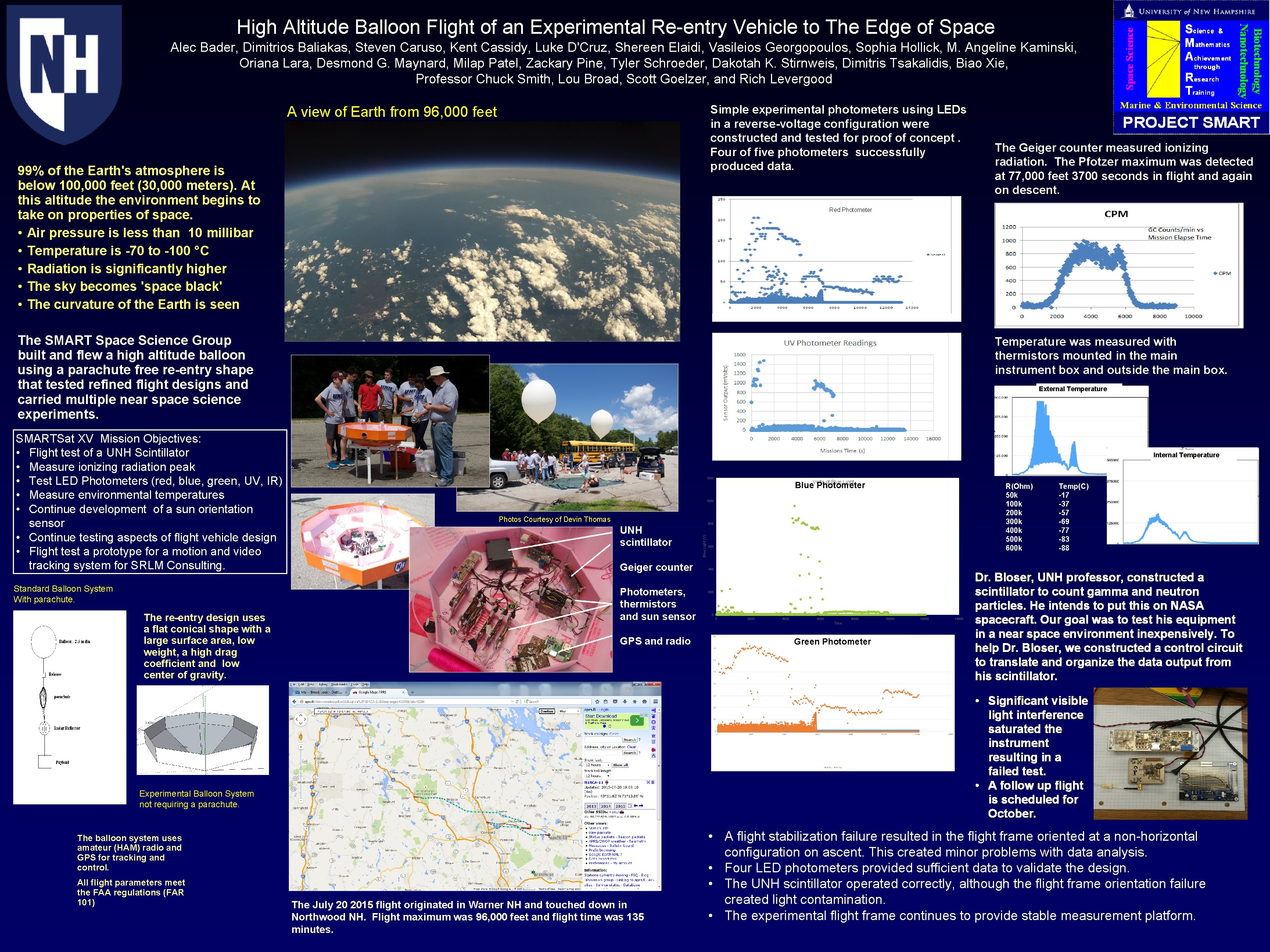
High Altitude Balloon Flight of an Experimental Re-entry Vehicle to The Edge of Space Alec Bader, Dimitrios Baliakas, Steven Caruso, Kent Cassidy, Luke D'Cruz, Shereen Elaidi, Vasileios Georgopoulos, Sophia Hollick, M. Angeline Kaminski, Oriana Lara, Desmond G. Maynard, Milap Patel, Zackary Pine, Tyler Schroeder, Dakotah K. Stirnweis, Dimitris Tsakalidis, Biao Xie, Professor Chuck Smith, Lou Broad, Scott Goelzer, and Rich Levergood Simple experimental photometers using LEDs in a reverse-voltage configuration were constructed and tested for proof of concept. Four of five photometers successfully produced data. A view of Earth from 96, 000 feet 99% of the Earth's atmosphere is below 100, 000 feet (30, 000 meters). At this altitude the environment begins to take on properties of space. • Air pressure is less than 10 millibar • Temperature is -70 to -100 °C • Radiation is significantly higher • The sky becomes 'space black' • The curvature of the Earth is seen Red Photometer The SMART Space Science Group built and flew a high altitude balloon using a parachute free re-entry shape that tested refined flight designs and carried multiple near space science experiments. Standard Balloon System With parachute. The re-entry design uses a flat conical shape with a large surface area, low weight, a high drag coefficient and low center of gravity. Temperature was measured with thermistors mounted in the main instrument box and outside the main box. External Temperature Internal Temperature 1200 Photos Courtesy of Devin Thomas UNH scintillator Geiger counter Photometers, thermistors and sun sensor GPS and radio R(Ohm) 50 k 100 k 200 k 300 k 400 k 500 k 600 k 800 600 400 200 0 0 2000 4000 6000 8000 Time Green Photometer 10000 12000 14000 Temp(C) -17 -37 -57 -69 -77 -83 -88 Dr. Bloser, UNH professor, constructed a scintillator to count gamma and neutron particles. He intends to put this on NASA spacecraft. Our goal was to test his equipment in a near space environment inexpensively. To help Dr. Bloser, we constructed a control circuit to translate and organize the data output from his scintillator. • Significant visible light interference saturated the instrument resulting in a failed test. • A follow up flight is scheduled for October. Experimental Balloon System not requiring a parachute. The balloon system uses amateur (HAM) radio and GPS for tracking and control. All flight parameters meet the FAA regulations (FAR 101) of Blue Light Blue. Volts Photometer 1000 Blue Light (V) SMARTSat XV Mission Objectives: • Flight test of a UNH Scintillator • Measure ionizing radiation peak • Test LED Photometers (red, blue, green, UV, IR) • Measure environmental temperatures • Continue development of a sun orientation sensor • Continue testing aspects of flight vehicle design • Flight test a prototype for a motion and video tracking system for SRLM Consulting. The Geiger counter measured ionizing radiation. The Pfotzer maximum was detected at 77, 000 feet 3700 seconds in flight and again on descent. The July 20 2015 flight originated in Warner NH and touched down in Northwood NH. Flight maximum was 96, 000 feet and flight time was 135 minutes. • A flight stabilization failure resulted in the flight frame oriented at a non-horizontal configuration on ascent. This created minor problems with data analysis. • Four LED photometers provided sufficient data to validate the design. • The UNH scintillator operated correctly, although the flight frame orientation failure created light contamination. • The experimental flight frame continues to provide stable measurement platform.
- Slides: 1