
HIGH ALTITUDE AERONAUTICAL PLATFORM SYSTEMS Shibu lijack Contents
HIGH ALTITUDE AERONAUTICAL PLATFORM SYSTEMS Shibu lijack
Contents: § § § § Introduction to “HAAPS”? History. Conceptual Image of the Platform Airship. Why at “Stratosphere”? What is “Stratospheric Platform”? HAAPS Infrastructure. Technical Details. Application Image of HAAPS. Performance Major Projects. Potential Applications. Problems. Future. HAAPS in WORKING. Conclusion.
Introduction to HAAPS § High Altitude Aeronautical Platform Stations (HAAPS) is the name of a technology for providing wireless narrowband broadband telecommunication services as well as broadcasting services with either airships or aircrafts. The HAAPS are operating at altitudes between 3 to 22 km.
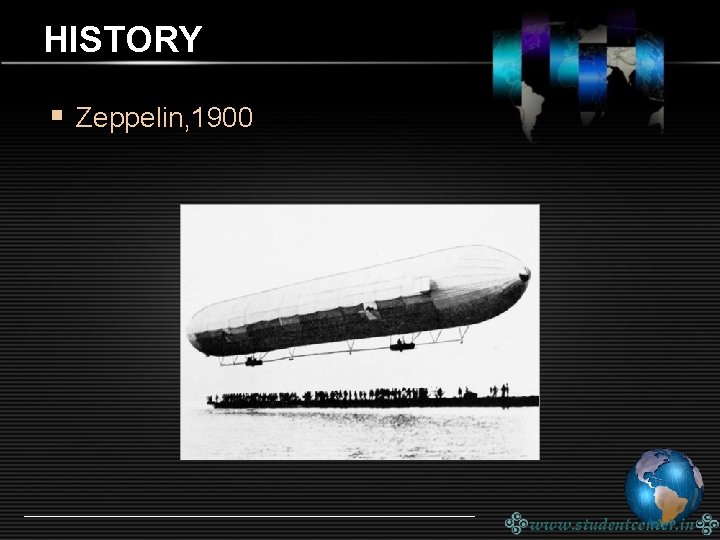
HISTORY § Zeppelin, 1900
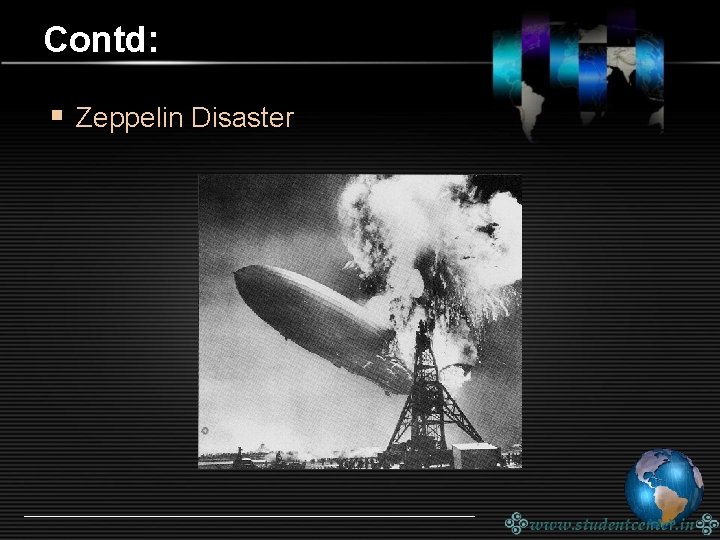
Contd: § Zeppelin Disaster
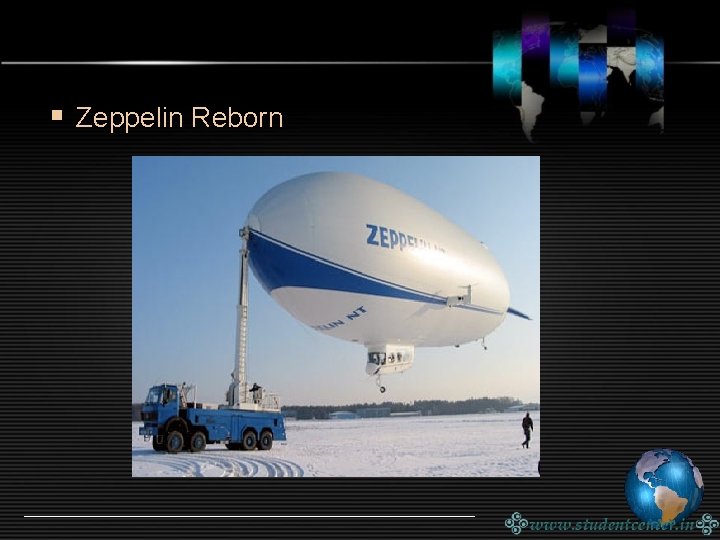
§ Zeppelin Reborn
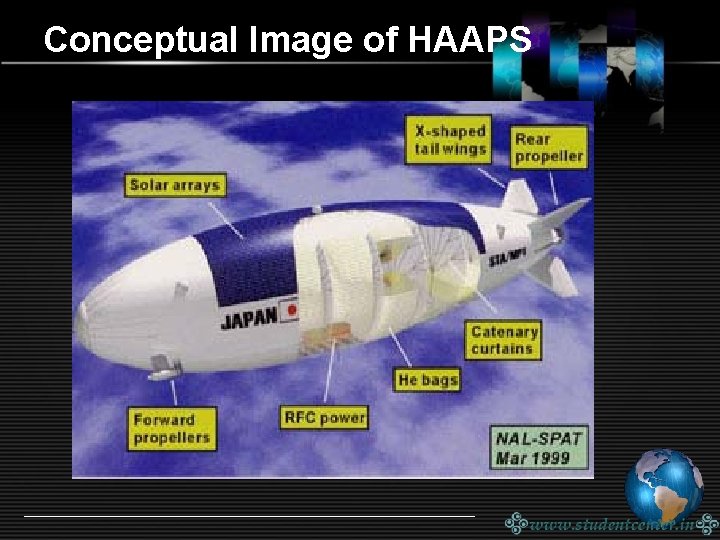
Conceptual Image of HAAPS
Why at STRATOSPHERE? § Above aircraft routes. § Winds relatively mild here, depending upon the location and season.
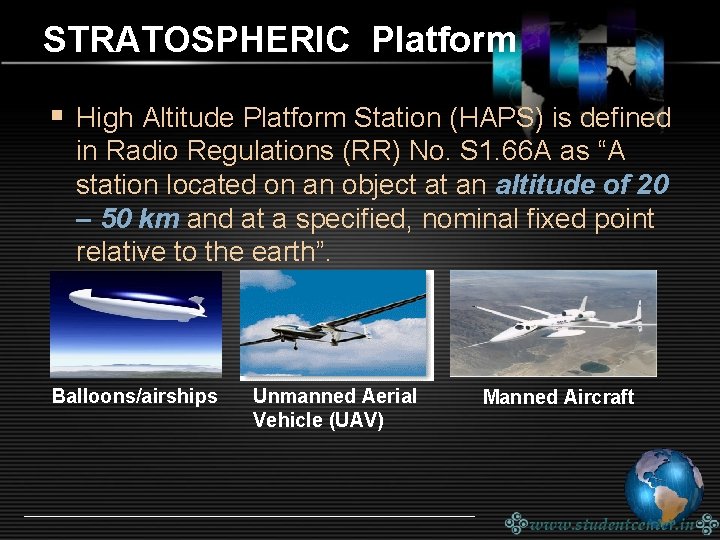
STRATOSPHERIC Platform § High Altitude Platform Station (HAPS) is defined in Radio Regulations (RR) No. S 1. 66 A as “A station located on an object at an altitude of 20 – 50 km and at a specified, nominal fixed point relative to the earth”. Balloons/airships Unmanned Aerial Vehicle (UAV) Manned Aircraft
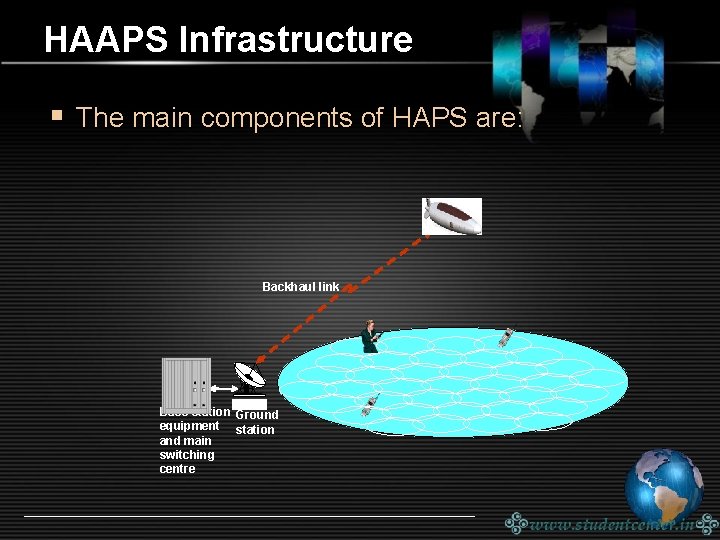
HAAPS Infrastructure § The main components of HAPS are: Backhaul link Base station Ground equipment station and main switching centre
Technical Details § Fixed services for HAPS: § 47. 2 GHz – 47. 5 GHz and 47. 9 GHz – 48. 2 GHz for fixed services • allocated in World Radio Conference-97 § 3 G Mobile services: § IMT-2000/UMTS • Region 1&3 Europe/Africa/Australia/Asia/etc: 1885 -1980 MHz, 2010 -2025 MHz and 2110 -2170 • Region 2 USA: 1885 -1980 and 2110 -2160 MHz
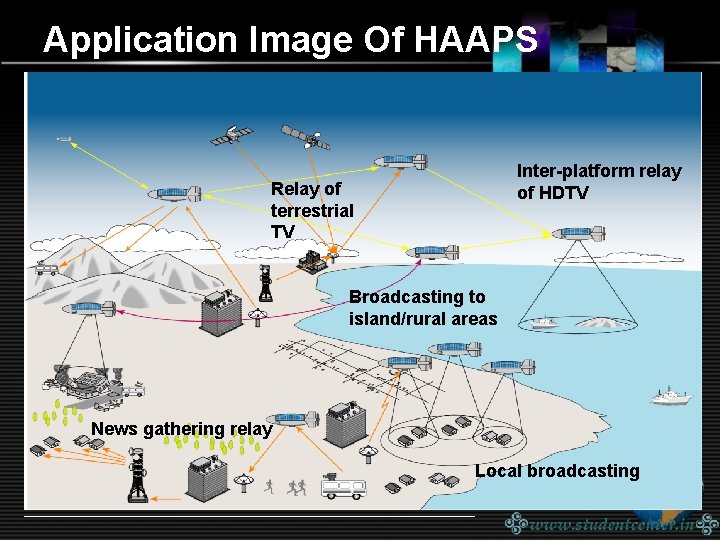
Application Image Of HAAPS Inter-platform relay of HDTV Relay of terrestrial TV Broadcasting to island/rural areas News gathering relay Local broadcasting
Performance § HAPS has the potential to deliver 3 G and beyond 3 G services in a more spectrally efficient and cost effective way § HAPS’s unique interference characteristics allow higher system capacity to be achieved § The centralized architecture inherent in HAPS allows the implementation of more efficient and effective resource management schemes that are seen to be impractical or impossible for terrestrial tower-based systems
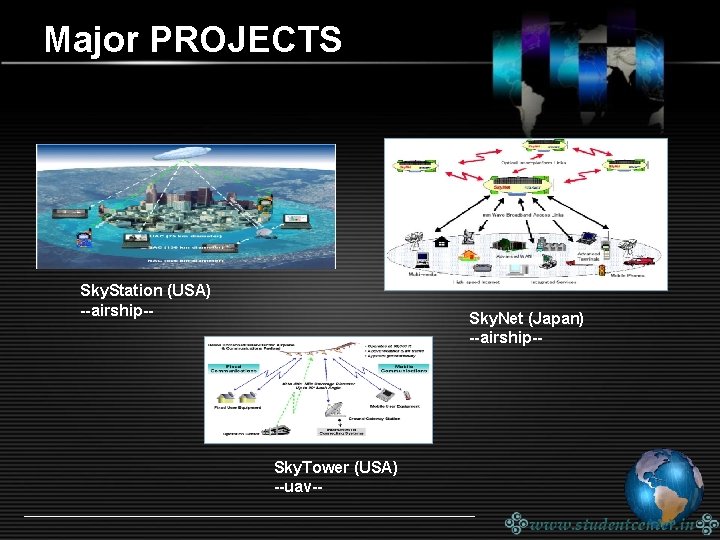
Major PROJECTS Sky. Station (USA) --airship-- Sky. Net (Japan) --airship-- Sky. Tower (USA) --uav--
Potential Applications § Fixed services § High speed internet § Mobile services § 3 G Mobile (UMTS) at S-band § Broadband services at V-band (? ) § Broadcasting Services § Digital TV, news gathering § Other services § Remote sensing, radio monitoring, traffic monitoring, weather monitoring
Problems § Lightweight. § Strength of the ENGINE. § WIND Factor. § Getting them UP and DOWN. § Safety. § COST
FUTURE § HAPS will be deployed together with terrestrial and satellites elements to provide another degree of flexibility for system deployment that can be easily adjusted to the needs of the network operators and users’ traffic demands § HAPS will play a complementary role in future mobile system infrastructure e. g. consisting of W -LAN, cellular, and satellite mobile systems to ease the deployment and roll out of the 3 G and beyond 3 G services

Conclusion

For Power Point Presentation (PPT) download & more visit: www. studentcenter. in Shibu lijack
- Slides: 19