
HIGH AIRBORNE RADIOACTIVITY IN TERRESTRIAL ENVIRONMENTS OF ARCTIC
HIGH AIRBORNE RADIOACTIVITY IN TERRESTRIAL ENVIRONMENTS OF ARCTIC REGION Łokas E. 1, Zagórski P. 2, Sobota I. 3, Zawierucha K. 4, Pawłowski Ł. 5, Singh SM. 6, Ziaja W. 7, Gaca P. 8 1 Institute of Nuclear Physics, Polish Academy of Sciences, Krakow, Poland, Edyta. Lokas@ifj. edu. pl Curie Sklodowska University, Lublin, Poland 3 Nicholas Copernicus University, Toruń, Poland 4 Adam Mickiewicz University in Poznań, Poland 5 University of Wrocław, Poland 6 Earth System Science Organisation, National Centre for Antarctic and Ocean Research, India 7 Jagiellonian University in Cracow, Kraków, Poland. 8 University of Southampton, United Kingdom. 2 Marie BIOMAP 8, DUBNA 2018 1
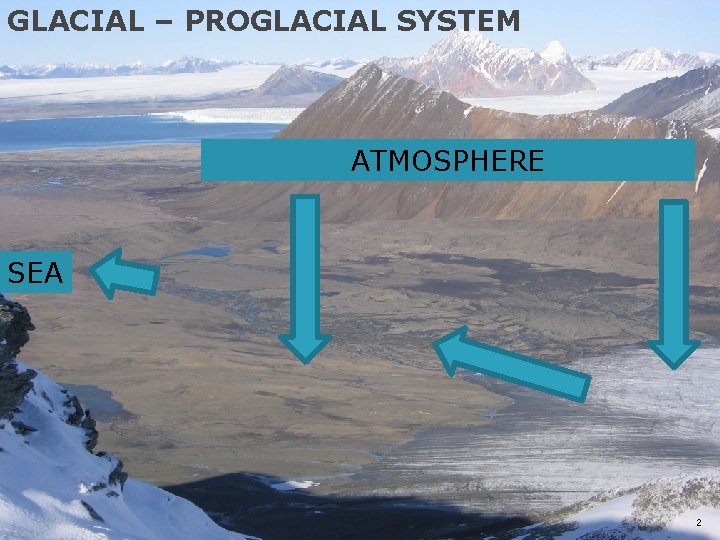
GLACIAL – PROGLACIAL SYSTEM ATMOSPHERE SEA 2
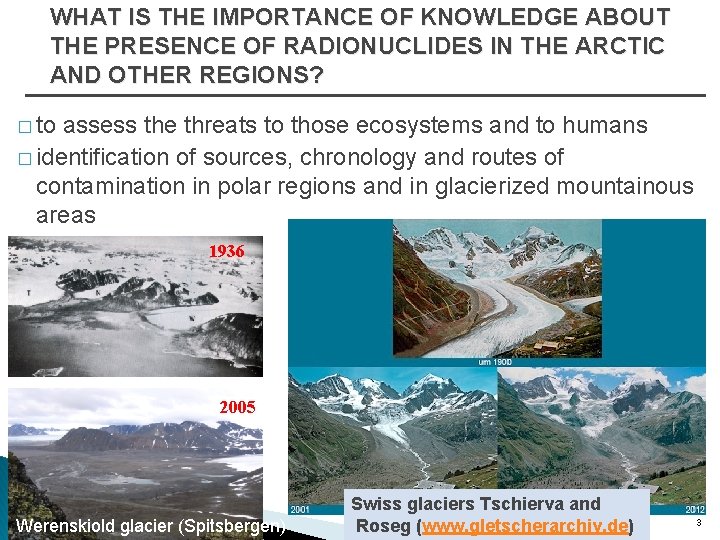
WHAT IS THE IMPORTANCE OF KNOWLEDGE ABOUT THE PRESENCE OF RADIONUCLIDES IN THE ARCTIC AND OTHER REGIONS? � to assess the threats to those ecosystems and to humans � identification of sources, chronology and routes of contamination in polar regions and in glacierized mountainous areas 1936 2005 Werenskiold glacier (Spitsbergen) Swiss glaciers Tschierva and 07/01/2022 Roseg (www. gletscherarchiv. de) 3
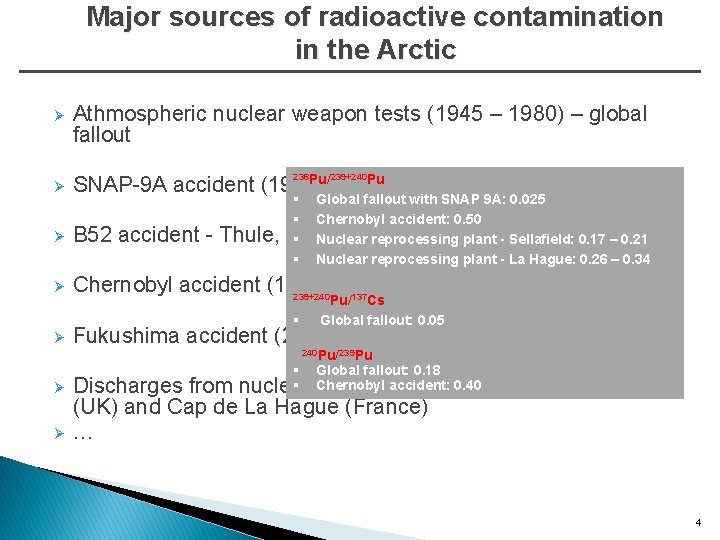
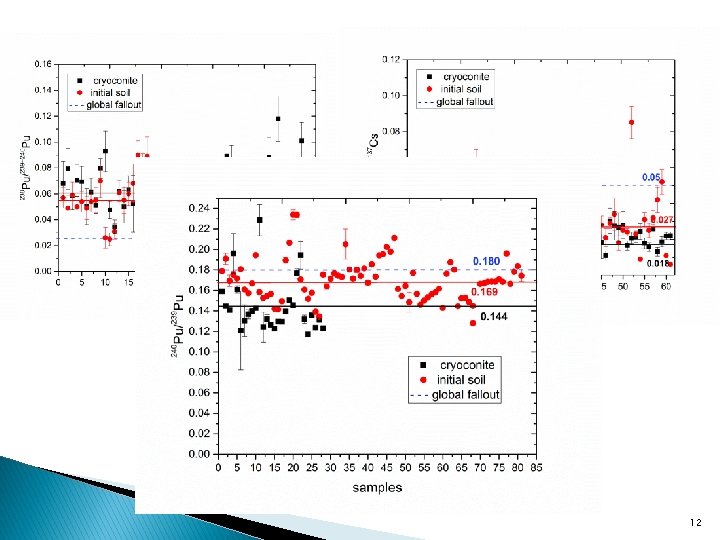
Major sources of radioactive contamination in the Arctic Ø Athmospheric nuclear weapon tests (1945 – 1980) – global fallout Ø Pu/ SNAP-9 A accident (1964) over. Puthe Madagascar Ø B 52 accident - Thule, Ø Chernobyl accident (1986 r. ) 137 239+240 238 § Global fallout with SNAP 9 A: 0. 025 § Chernobyl accident: 0. 50 Greenland (1968) plant - Sellafield: 0. 17 – 0. 21 § Nuclear reprocessing plant - La Hague: 0. 26 – 0. 34 § Ø 239+240 Pu/ Cs Global fallout: 0. 05 Fukushima accident (2011 r. ) 240 Pu/239 Pu Ø Ø § Global fallout: 0. 18 § Chernobyl accident: 0. 40 nuclear fuel reprocessing Discharges from (UK) and Cap de La Hague (France) … plants - Sellafield 4
OBJECTIVES (1) (2) evaluate the contamination levels of airborne radionuclides (137 Cs, 210 Pb and Pu isotopes) in soils and cryoconites from Arctic; identify the sources of contamination based on artificial radionuclides ratios (238 Pu/239+240 Pu, 239+240 Pu/137 Cs, 240 Pu/239 Pu). IMPORTANCE OF CRYOCONITE INVESTi. GATION Current changes in the Arctic environments may result in release of cryoconite-bound contamination to ecosystems. 5
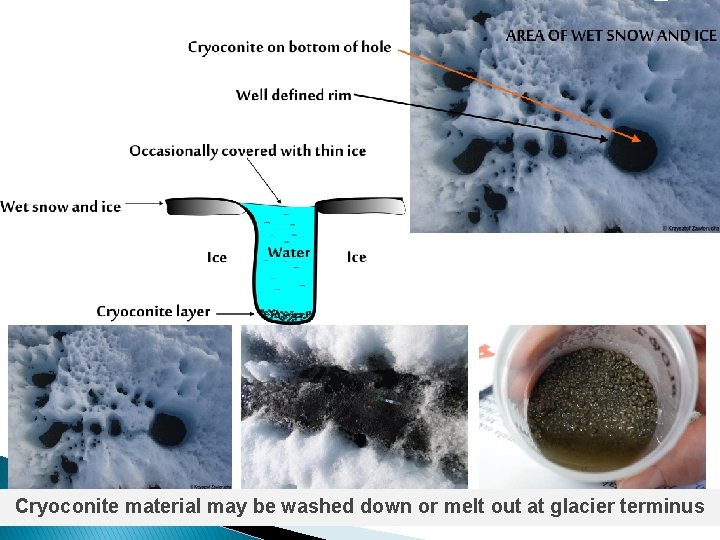
RESEARCH METERIAL INITIAL SOILS from the proglacial zone of glaciers TUNDRA SOILS CRYOCONITES - accumulations of atmospheric dust on glacier surface Cryoconite material may be washed down or melt out at glacier terminus 6
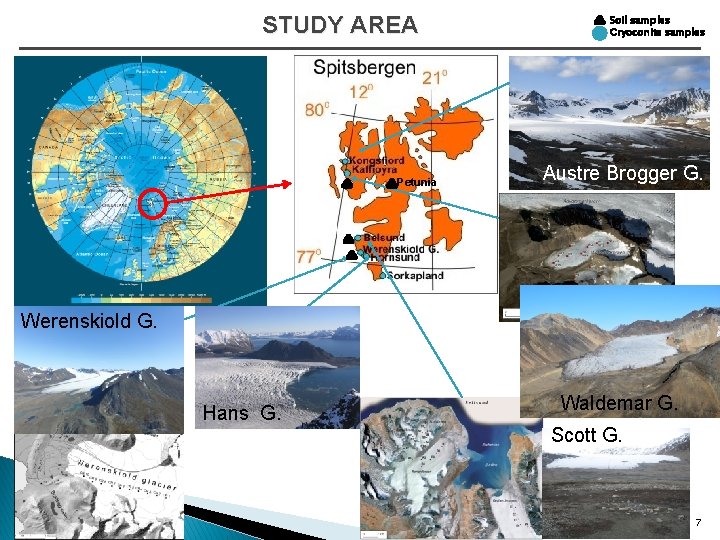
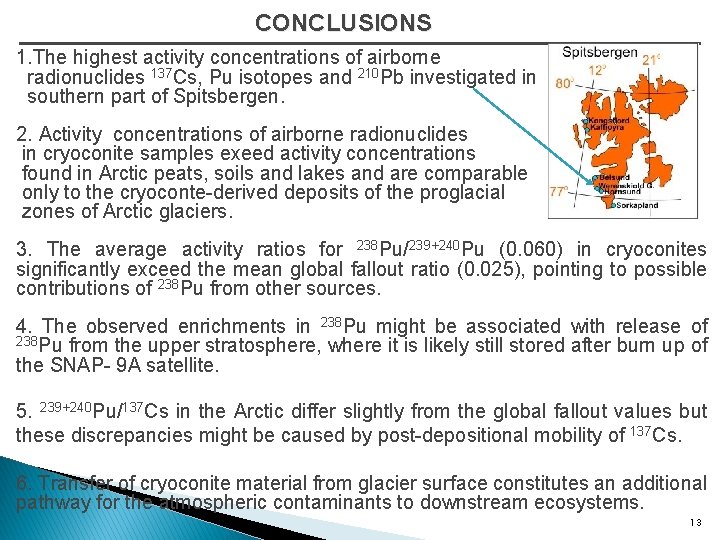
STUDY AREA Petunia Soil samples Cryoconite samples Austre Brogger G. Werenskiold G. Hans G. Waldemar G. Scott G. 7
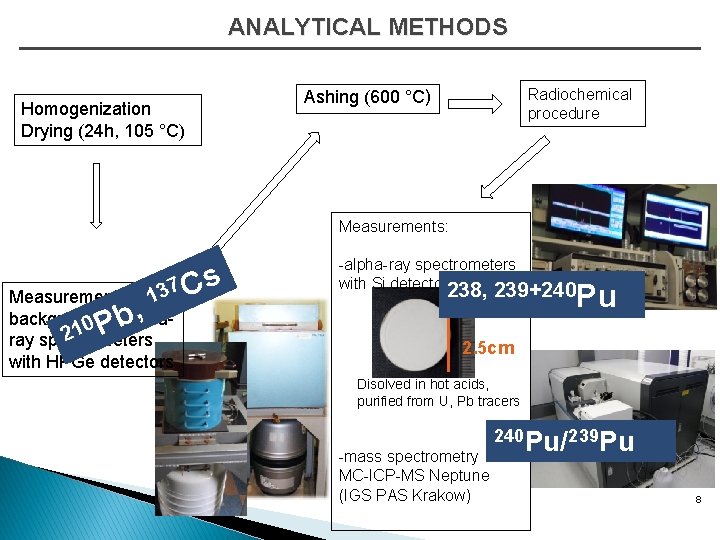
ANALYTICAL METHODS Homogenization Drying (24 h, 105 °C) Radiochemical procedure Ashing (600 °C) Measurements: 7 Cs Measurements-low 13 background gamma 0 1 2 ray spectrometers with HPGe detectors P b, -alpha-ray spectrometers with Si detectors 238, 239+240 Pu 2. 5 cm Disolved in hot acids, purified from U, Pb tracers -mass spectrometry MC-ICP-MS Neptune (IGS PAS Krakow) 240 Pu/239 Pu 8
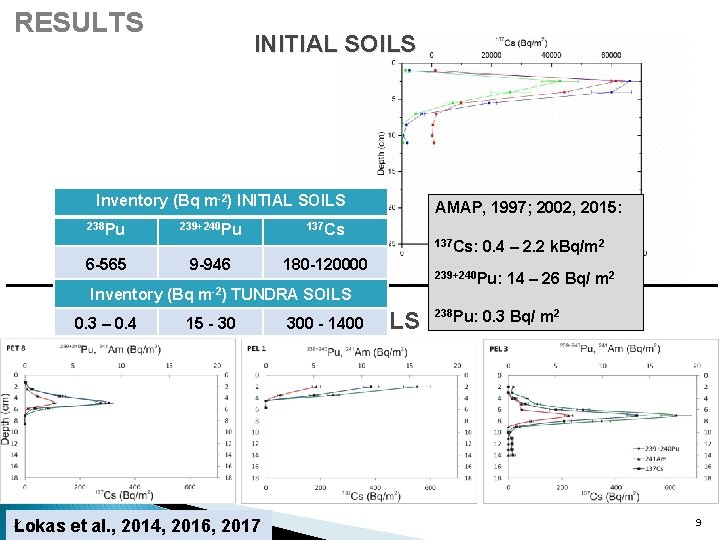
RESULTS INITIAL SOILS Inventory (Bq m-2) INITIAL SOILS 238 Pu 239+240 Pu 137 Cs 6 -565 9 -946 180 -120000 Inventory (Bq m-2) TUNDRA SOILS 0. 3 – 0. 4 15 - 30 TUNDRA 300 - 1400 SOILS Łokas et al. , 2014, 2016, 2017 AMAP, 1997; 2002, 2015: 137 Cs: 0. 4 – 2. 2 k. Bq/m 2 239+240 Pu: 238 Pu: 14 – 26 Bq/ m 2 0. 3 Bq/ m 2 9
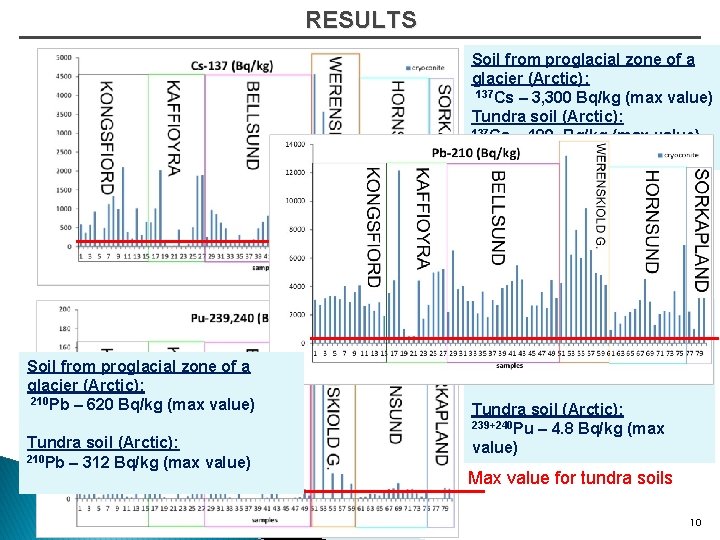
RESULTS Soil from proglacial zone of a glacier (Arctic): 137 Cs – 3, 300 Bq/kg (max value) Tundra soil (Arctic): 137 Cs – 180 Bq/kg (max value) Max value for tundra soils Soil from proglacial zone of a glacier (Arctic): 210 Pb – 620 Bq/kg (max value) Tundra soil (Arctic): 210 Pb – 312 Bq/kg (max value) Soil from proglacial zone of a glacier (Arctic): 239+240 Pu – 20 Bq/kg (max value) Tundra soil (Arctic): 239+240 Pu – 4. 8 Bq/kg (max value) Max value for tundra soils 10
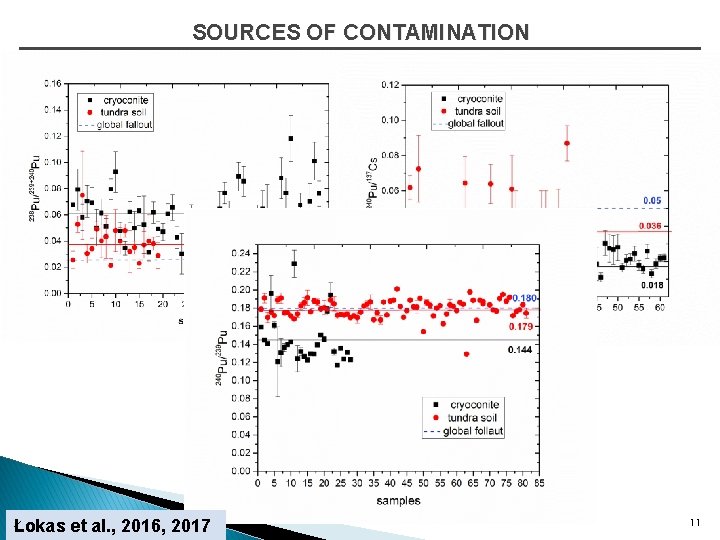
SOURCES OF CONTAMINATION Łokas et al. , 2016, 2017 11
12
CONCLUSIONS 1. The highest activity concentrations of airborne radionuclides 137 Cs, Pu isotopes and 210 Pb investigated in southern part of Spitsbergen. 2. Activity concentrations of airborne radionuclides in cryoconite samples exeed activity concentrations found in Arctic peats, soils and lakes and are comparable only to the cryoconte-derived deposits of the proglacial zones of Arctic glaciers. 3. The average activity ratios for 238 Pu/239+240 Pu (0. 060) in cryoconites significantly exceed the mean global fallout ratio (0. 025), pointing to possible contributions of 238 Pu from other sources. 4. The observed enrichments in 238 Pu might be associated with release of 238 Pu from the upper stratosphere, where it is likely still stored after burn up of the SNAP- 9 A satellite. 5. 239+240 Pu/137 Cs in the Arctic differ slightly from the global fallout values but these discrepancies might be caused by post-depositional mobility of 137 Cs. 6. Transfer of cryoconite material from glacier surface constitutes an additional pathway for the atmospheric contaminants to downstream ecosystems. 13
FUNDING This study was supported by the National Science Center grant no. NCN 2016/21/B/ST 10/02327. Samples from SE Spitsberegn were taken during the Jagiellonian University Expedition, 2016, co-financed by the Prince Albert II of Monaco Foundation. 14

THANK YOU
- Slides: 15