
Hieroglyphics HIEROGLYPHIC ALPHABET The hieroglyphs The problem with
Hieroglyphics
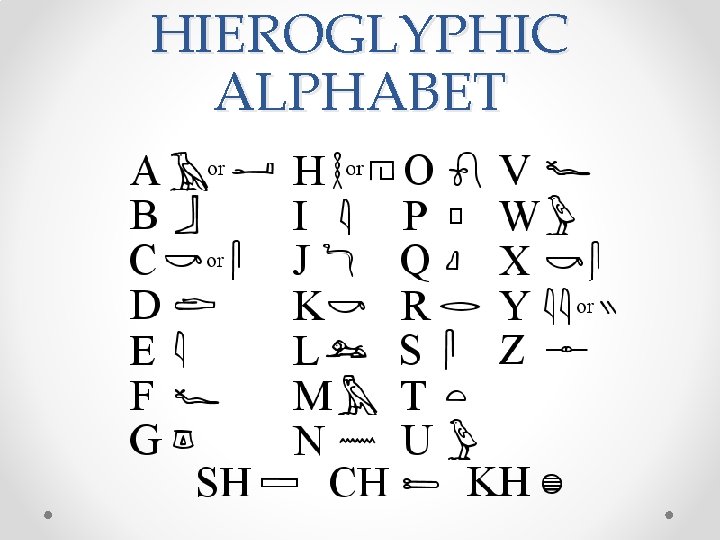
HIEROGLYPHIC ALPHABET
The hieroglyphs • The problem with pictures, though, is that not everybody agrees on what they mean. • There were a few different types of hieroglyphs. Some stood for entire words, others were used for individual sounds, and still others represented groups of sounds or syllables.

HIEROGLYPHIC ALPHABET
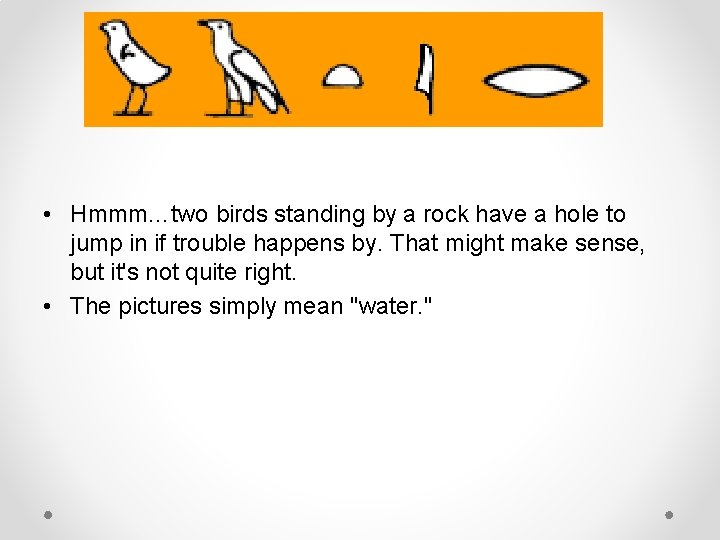
• Hmmm…two birds standing by a rock have a hole to jump in if trouble happens by. That might make sense, but it's not quite right. • The pictures simply mean "water. "
Hieroglyphic writing is phonetic. . . • That means symbols stand for certain sounds (unlike the English alphabet where some letters have many sounds or can be silent).
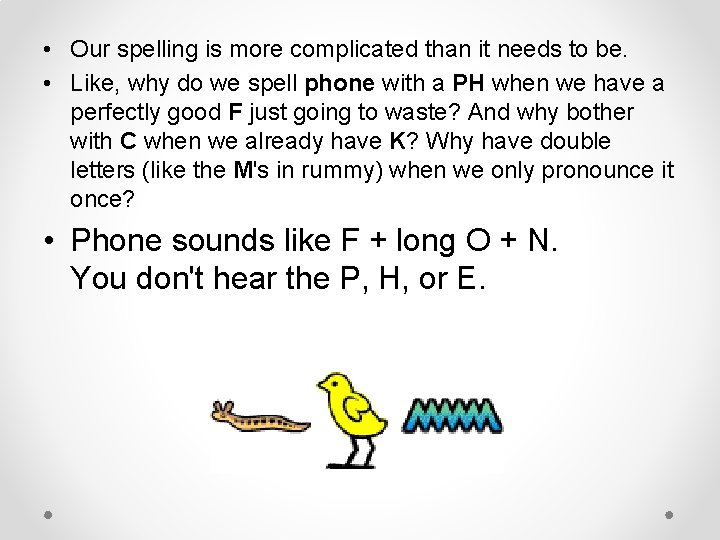
• Our spelling is more complicated than it needs to be. • Like, why do we spell phone with a PH when we have a perfectly good F just going to waste? And why bother with C when we already have K? Why have double letters (like the M's in rummy) when we only pronounce it once? • Phone sounds like F + long O + N. You don't hear the P, H, or E.
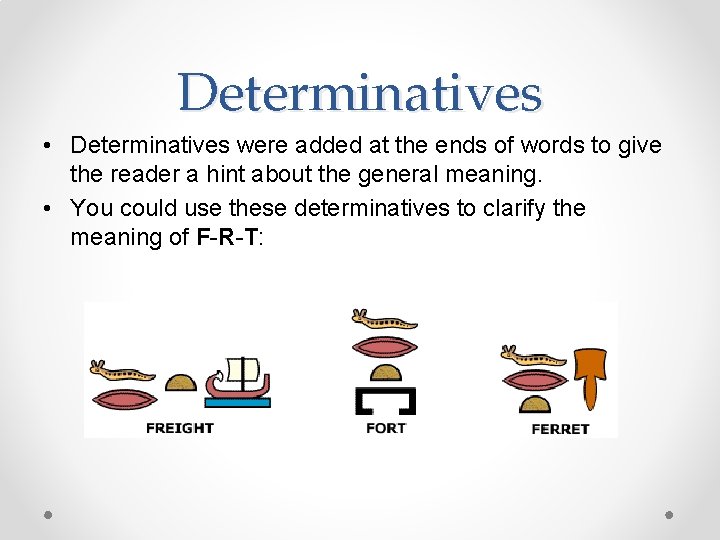
Determinatives • Determinatives were added at the ends of words to give the reader a hint about the general meaning. • You could use these determinatives to clarify the meaning of F-R-T:
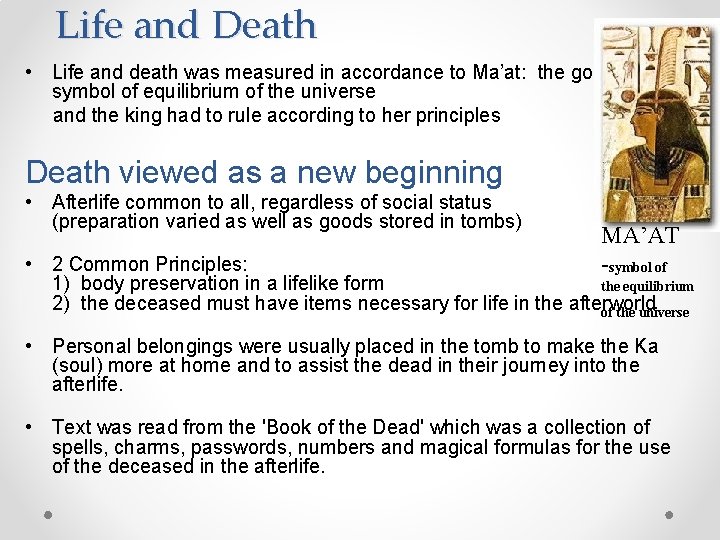
Life and Death • Life and death was measured in accordance to Ma’at: the goddess and symbol of equilibrium of the universe and the king had to rule according to her principles Death viewed as a new beginning • Afterlife common to all, regardless of social status (preparation varied as well as goods stored in tombs) MA’AT -symbol of • 2 Common Principles: 1) body preservation in a lifelike form the equilibrium 2) the deceased must have items necessary for life in the afterworld of the universe • Personal belongings were usually placed in the tomb to make the Ka (soul) more at home and to assist the dead in their journey into the afterlife. • Text was read from the 'Book of the Dead' which was a collection of spells, charms, passwords, numbers and magical formulas for the use of the deceased in the afterlife.
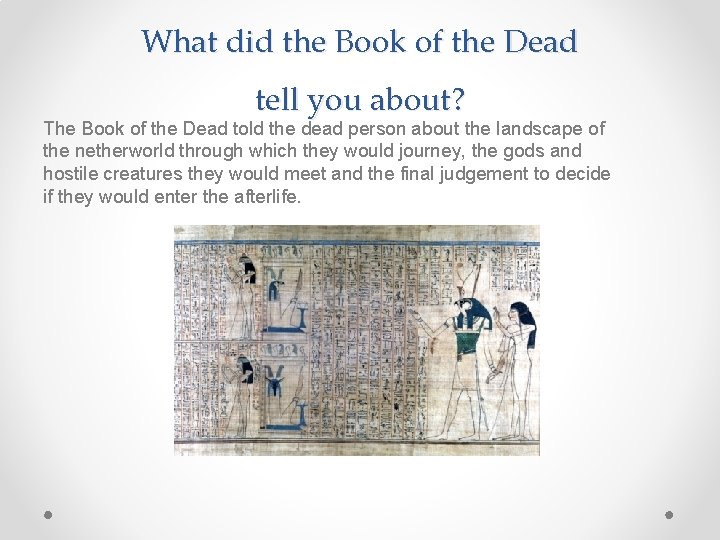
What did the Book of the Dead tell you about? The Book of the Dead told the dead person about the landscape of the netherworld through which they would journey, the gods and hostile creatures they would meet and the final judgement to decide if they would enter the afterlife. Book of the Dead of Anhai
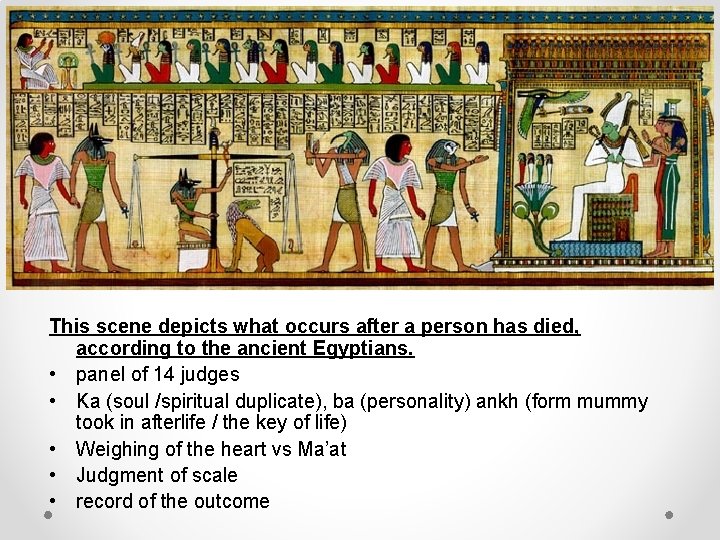
This scene depicts what occurs after a person has died, according to the ancient Egyptians. • panel of 14 judges • Ka (soul /spiritual duplicate), ba (personality) ankh (form mummy took in afterlife / the key of life) • Weighing of the heart vs Ma’at • Judgment of scale • record of the outcome
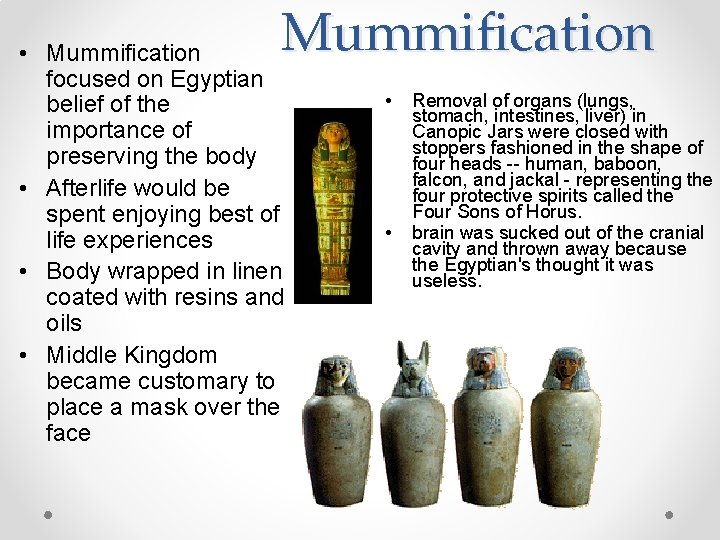
Mummification • Mummification focused on Egyptian belief of the importance of preserving the body • Afterlife would be spent enjoying best of life experiences • Body wrapped in linen coated with resins and oils • Middle Kingdom became customary to place a mask over the face • • Removal of organs (lungs, stomach, intestines, liver) in Canopic Jars were closed with stoppers fashioned in the shape of four heads -- human, baboon, falcon, and jackal - representing the four protective spirits called the Four Sons of Horus. brain was sucked out of the cranial cavity and thrown away because the Egyptian's thought it was useless.
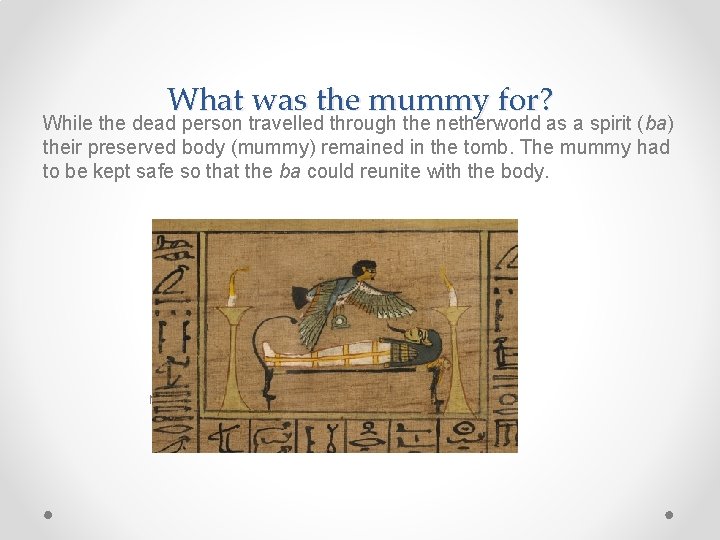
What was the mummy for? While the dead person travelled through the netherworld as a spirit (ba) their preserved body (mummy) remained in the tomb. The mummy had to be kept safe so that the ba could reunite with the body. Mummy and ba bird from the Book of the Dead of Ani
- Slides: 13