
Hierarchy of Needs What motivates behavior According to
Hierarchy of Needs
What motivates behavior? According to humanist psychologist Abraham Maslow, our actions are motivated in order achieve certain needs. Maslow first introduced his concept of a hierarchy of needs in his 1943 paper "A Theory of Human Motivation" and his subsequent book Motivation and Personality. This hierarchy suggests that people are motivated to fulfill basic needs before moving on to other, more advanced needs. While some of the existing schools of thought at the time (such as psychoanalysis and behaviorism) tended to focus on problematic behaviors, Maslow was much more interested in learning more about what makes people happy and the things that they do to achieve that aim. As a humanist, Maslow believed that people have an inborn desire to be self-actualized, to be all they can be. In order to achieve this ultimate goal, however, a number of more basic needs must be met first such as the need for food, safety, love, and self-esteem.
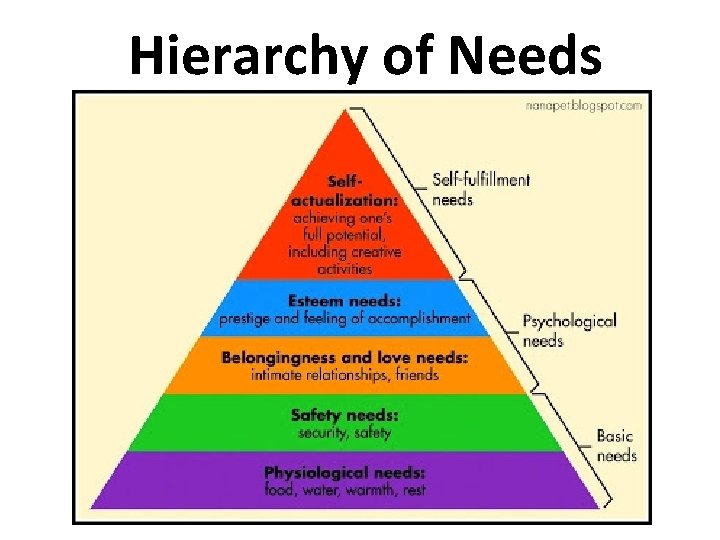
From Basic to More Complex Needs This hierarchy is most often displayed as a pyramid. The lowest levels of the pyramid are made up of the most basic needs, while the more complex needs are located at the top of the pyramid. Needs at the bottom of the pyramid are basic physical requirements including the need for food, water, sleep, and warmth. Once these lower-level needs have been met, people can move on to the next level of needs, which are for safety and security. As people progress up the pyramid, needs become increasingly psychological and social. Soon, the need for love, friendship, and intimacy become important. Further up the pyramid, the need for personal esteem and feelings of accomplishment take priority.
Five Levels of Hierarchy Needs 1. Physiological Needs 2. Security Needs 3. Social Needs 4. Esteem Needs 5. Self-actualizing Needs This is the highest level of Maslow’s hierarchy of needs. Selfactualizing people are self-aware, concerned with personal growth, less concerned with the opinions of others, and interested fulfilling their potential.
What is Self-Actualization? What exactly is self-actualization? Located at the peak of Abraham Maslow's hierarchy, he described this high-level need in the following way: "What a man can be, he must be. This need we may call self-actualization. . . It refers to the desire for self-fulfillment, namely, to the tendency for him to become actualized in what he is potentially. This tendency might be phrased as the desire to become more and more what one is, to become everything that one is capable of becoming. "While theory is generally portrayed as a fairly rigid hierarchy, Maslow noted that the order in which these needs are fulfilled does not always follow this standard progression. For example, he notes that for some individuals, the need for self-esteem is more important than the need for love. For others, the need for creative fulfillment may supersede even the most basic needs.
Characteristics of Self-Actualized People • Acceptance and Realism: Self-actualized people have realistic perceptions of themselves, others and the world around them. • Problem-centering: Self-actualized individuals are concerned with solving problems outside of themselves, including helping others and finding solutions to problems in the external world. These people are often motivated by a sense of personal responsibility and ethics. • Spontaneity: Self-actualized people are spontaneous in their internal thoughts and outward behavior. While they can conform to rules and social expectations, they also tend to be open and unconventional.
Characteristics of Self-Actualized People • Autonomy and Solitude: Another characteristic of selfactualized people is the need for independence and privacy. While they enjoy the company of others, these individuals need time to focus on developing their own individual potential. • Continued Freshness of Appreciation: Self-actualized people tend to view the world with a continual sense of appreciation, wonder and awe. Even simple experiences continue to be a source of inspiration and pleasure. • Peak Experiences: Individuals who are self-actualized often have what Maslow termed peak experiences, or moments of intense joy, wonder, awe and ecstasy. After these experiences, people feel inspired, strengthened, renewed or transformed.
- Slides: 7