
Hierarchical theoretical methods for understanding and predicting anisotropic
- Slides: 34
Hierarchical theoretical methods for understanding and predicting anisotropic thermal transport and energy release in rocket propellant formulations M. Ortiz California Institute of Technology University of Missouri PI: Thomas D. Sewell Subcontract: EC-SRP-12 -0053 Program Review, January 21, 2015 Michael Ortiz AFOSR 01/15
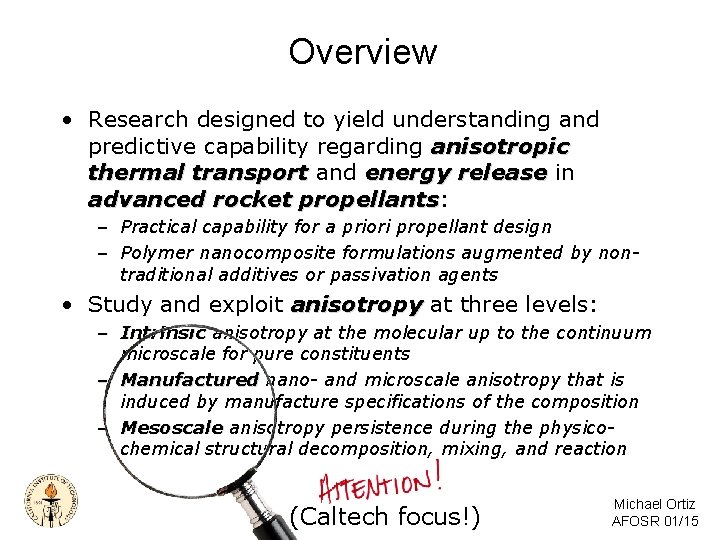
Overview • Research designed to yield understanding and predictive capability regarding anisotropic thermal transport and energy release in advanced rocket propellants: propellants – Practical capability for a priori propellant design – Polymer nanocomposite formulations augmented by nontraditional additives or passivation agents • Study and exploit anisotropy at three levels: – Intrinsic anisotropy at the molecular up to the continuum microscale for pure constituents – Manufactured nano- and microscale anisotropy that is induced by manufacture specifications of the composition – Mesoscale anisotropy persistence during the physicochemical structural decomposition, mixing, and reaction (Caltech focus!) Michael Ortiz AFOSR 01/15
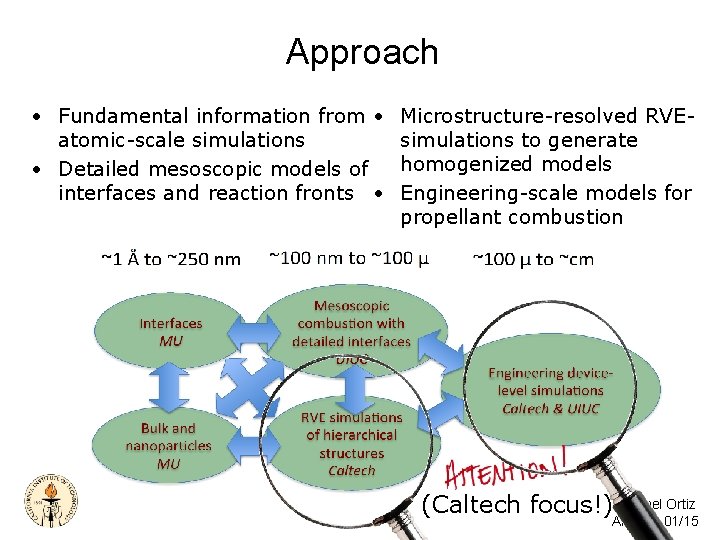
Approach • Fundamental information from • atomic-scale simulations • Detailed mesoscopic models of interfaces and reaction fronts • Microstructure-resolved RVEsimulations to generate homogenized models Engineering-scale models for propellant combustion (Caltech focus!) Michael Ortiz AFOSR 01/15
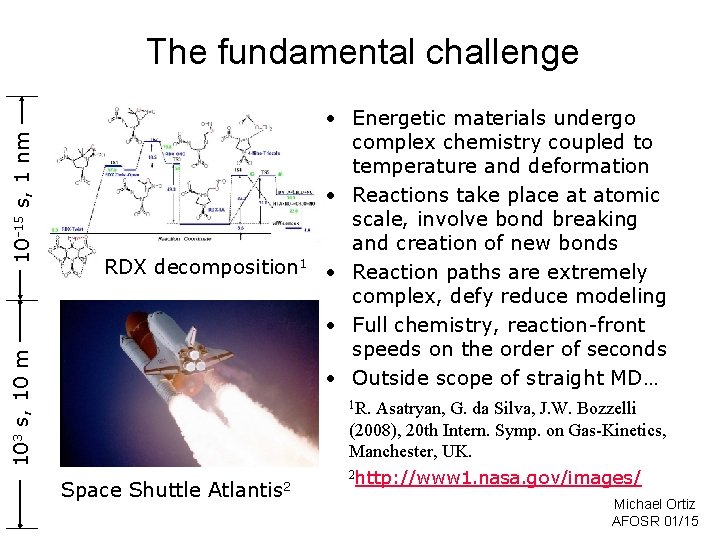
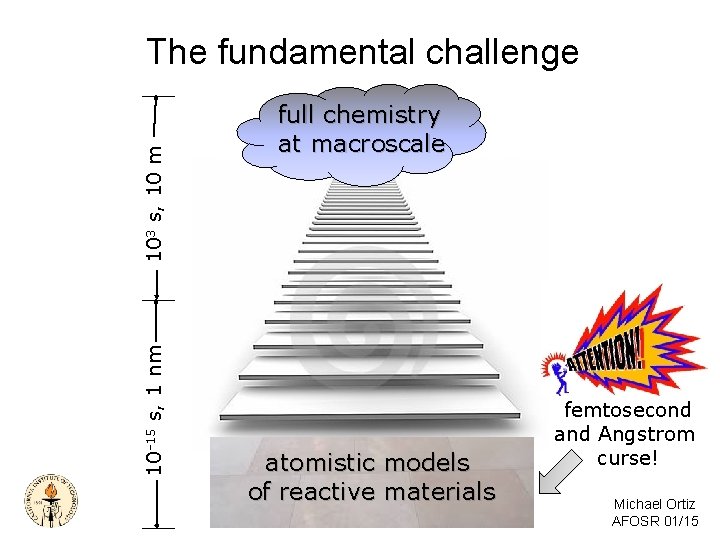
RDX decomposition 1 103 s, 10 m 10 -15 s, 1 nm The fundamental challenge • Energetic materials undergo complex chemistry coupled to temperature and deformation • Reactions take place at atomic scale, involve bond breaking and creation of new bonds • Reaction paths are extremely complex, defy reduce modeling • Full chemistry, reaction-front speeds on the order of seconds • Outside scope of straight MD… 1 R. Asatryan, G. da Silva, J. W. Bozzelli (2008), 20 th Intern. Symp. on Gas-Kinetics, Manchester, UK. Space Shuttle Atlantis 2 2 http: //www 1. nasa. gov/images/ Michael Ortiz AFOSR 01/15
10 -15 s, 1 nm 103 s, 10 m The fundamental challenge full chemistry at macroscale atomistic models of reactive materials femtosecond and Angstrom curse! Michael Ortiz AFOSR 01/15
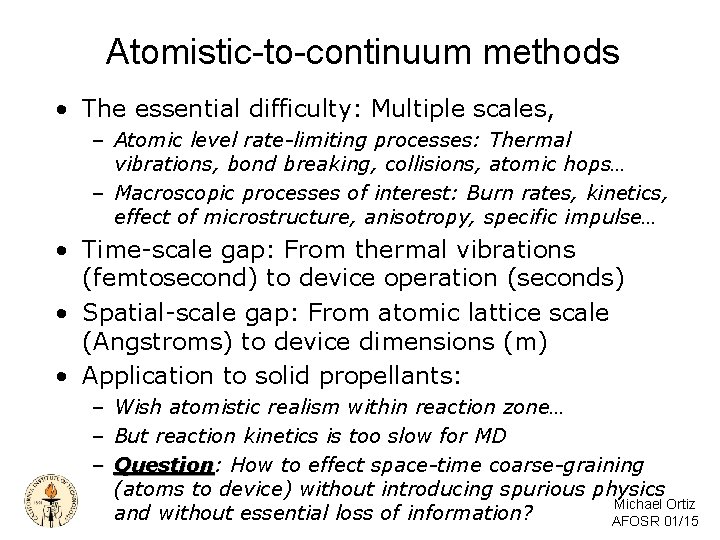
Atomistic-to-continuum methods • The essential difficulty: Multiple scales, – Atomic level rate-limiting processes: Thermal vibrations, bond breaking, collisions, atomic hops… – Macroscopic processes of interest: Burn rates, kinetics, effect of microstructure, anisotropy, specific impulse… • Time-scale gap: From thermal vibrations (femtosecond) to device operation (seconds) • Spatial-scale gap: From atomic lattice scale (Angstroms) to device dimensions (m) • Application to solid propellants: – – – Wish atomistic realism within reaction zone… But reaction kinetics is too slow for MD Question: Question How to effect space-time coarse-graining (atoms to device) without introducing spurious physics Michael Ortiz and without essential loss of information? AFOSR 01/15
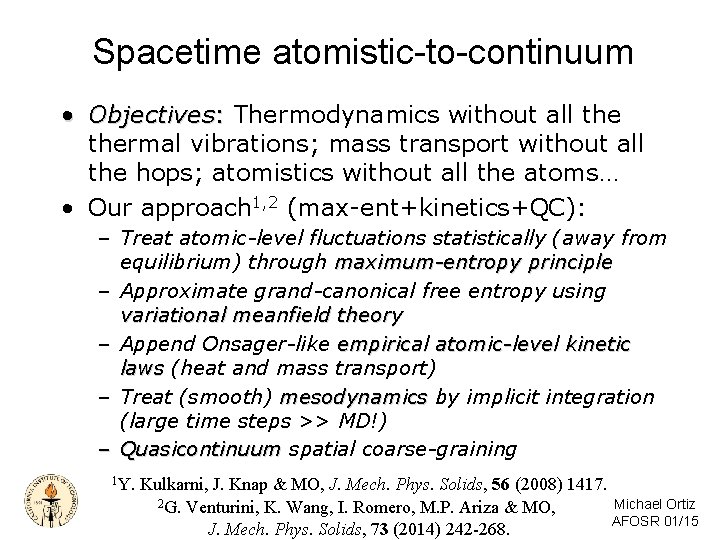
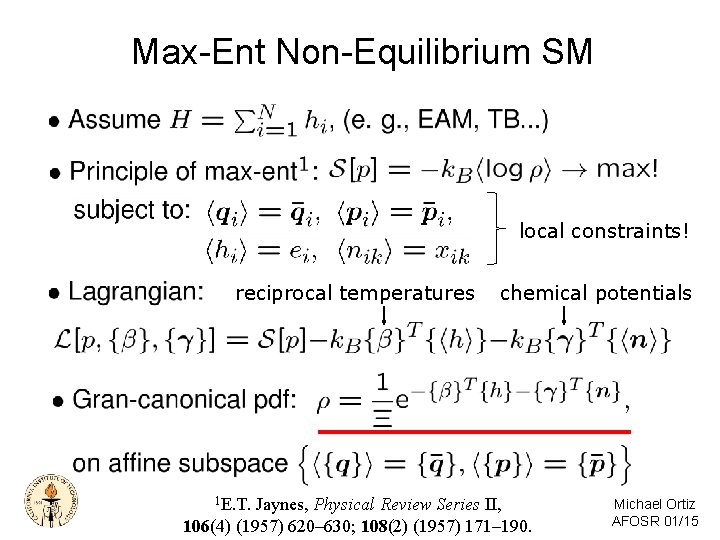
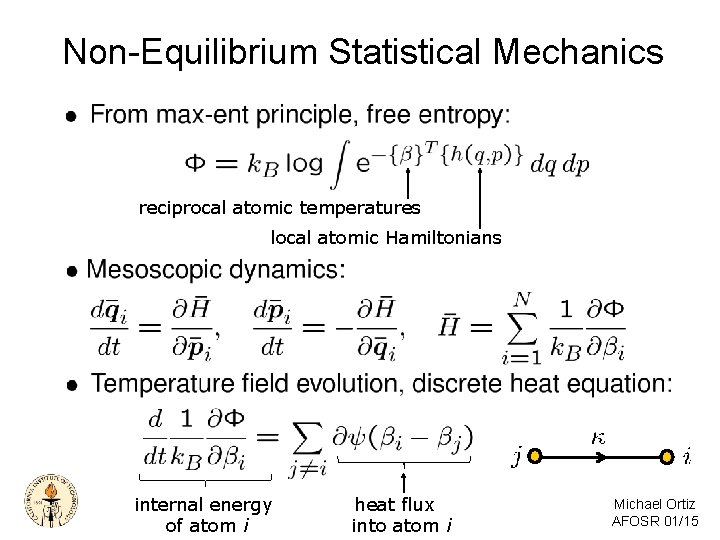
Spacetime atomistic-to-continuum • Objectives: Thermodynamics without all thermal vibrations; mass transport without all the hops; atomistics without all the atoms… • Our approach 1, 2 (max-ent+kinetics+QC): – Treat atomic-level fluctuations statistically (away from equilibrium) through maximum-entropy principle – Approximate grand-canonical free entropy using variational meanfield theory – Append Onsager-like empirical atomic-level kinetic laws (heat and mass transport) – Treat (smooth) mesodynamics by implicit integration (large time steps >> MD!) – Quasicontinuum spatial coarse-graining 1 Y. Kulkarni, J. Knap & MO, J. Mech. Phys. Solids, 56 (2008) 1417. 2 G. Venturini, K. Wang, I. Romero, M. P. Ariza & MO, Michael Ortiz AFOSR 01/15 J. Mech. Phys. Solids, 73 (2014) 242 -268.
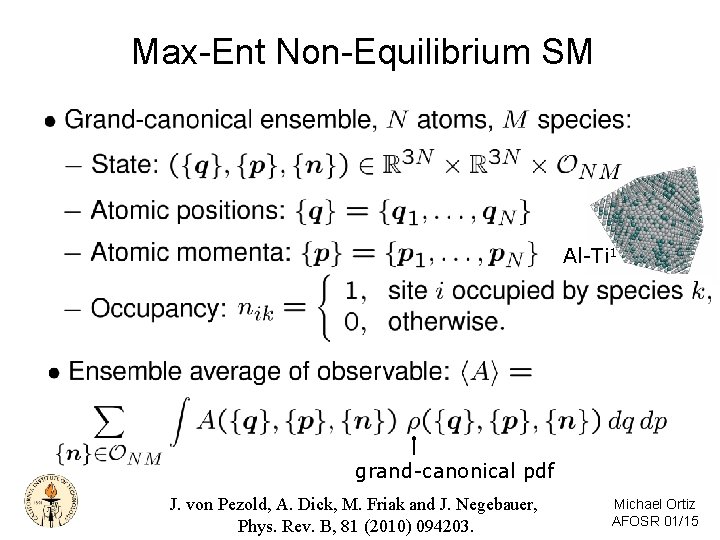
Max-Ent Non-Equilibrium SM Al-Ti 1 grand-canonical pdf J. von Pezold, A. Dick, M. Friak and J. Negebauer, Phys. Rev. B, 81 (2010) 094203. Michael Ortiz AFOSR 01/15
Max-Ent Non-Equilibrium SM local constraints! reciprocal temperatures 1 E. T. chemical potentials Jaynes, Physical Review Series II, 106(4) (1957) 620– 630; 108(2) (1957) 171– 190. Michael Ortiz AFOSR 01/15
Non-Equilibrium Statistical Mechanics reciprocal atomic temperatures local atomic Hamiltonians internal energy of atom i heat flux into atom i Michael Ortiz AFOSR 01/15
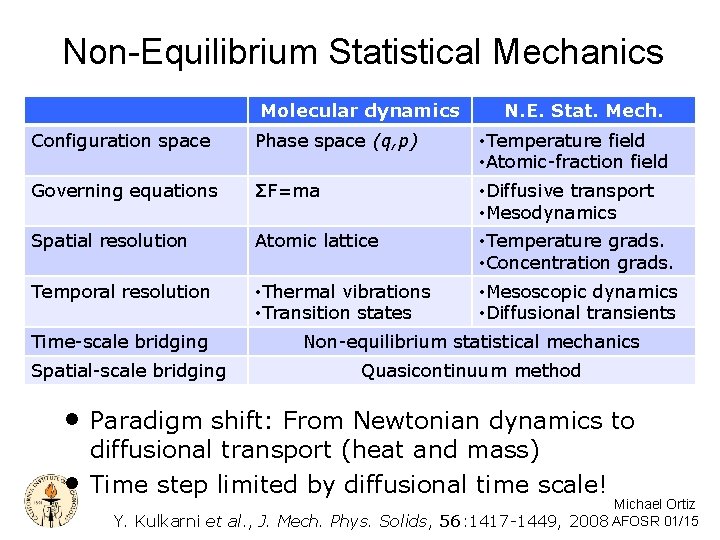
Non-Equilibrium Statistical Mechanics Molecular dynamics N. E. Stat. Mech. Configuration space Phase space (q, p) • Temperature field • Atomic-fraction field Governing equations ΣF=ma • Diffusive transport • Mesodynamics Spatial resolution Atomic lattice • Temperature grads. • Concentration grads. Temporal resolution • Thermal vibrations • Transition states • Mesoscopic dynamics • Diffusional transients Time-scale bridging Spatial-scale bridging • • Non-equilibrium statistical mechanics Quasicontinuum method Paradigm shift: From Newtonian dynamics to diffusional transport (heat and mass) Time step limited by diffusional time scale! Michael Ortiz Y. Kulkarni et al. , J. Mech. Phys. Solids, 56: 1417 -1449, 2008 AFOSR 01/15
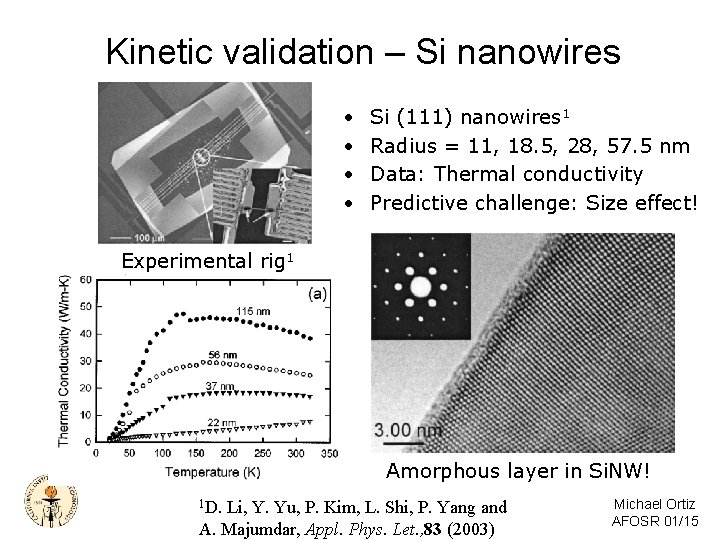
Kinetic validation – Si nanowires • • Si (111) nanowires 1 Radius = 11, 18. 5, 28, 57. 5 nm Data: Thermal conductivity Predictive challenge: Size effect! Experimental rig 1 Amorphous layer in Si. NW! 1 D. Li, Y. Yu, P. Kim, L. Shi, P. Yang and A. Majumdar, Appl. Phys. Let. , 83 (2003) Michael Ortiz AFOSR 01/15
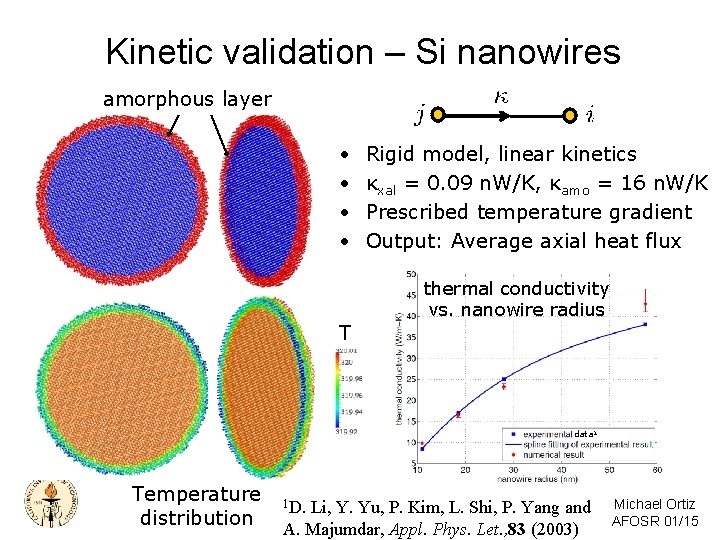
Kinetic validation – Si nanowires amorphous layer • • T Rigid model, linear kinetics κxal = 0. 09 n. W/K, κamo = 16 n. W/K Prescribed temperature gradient Output: Average axial heat flux thermal conductivity vs. nanowire radius data 1 Temperature distribution 1 D. Li, Y. Yu, P. Kim, L. Shi, P. Yang and A. Majumdar, Appl. Phys. Let. , 83 (2003) Michael Ortiz AFOSR 01/15
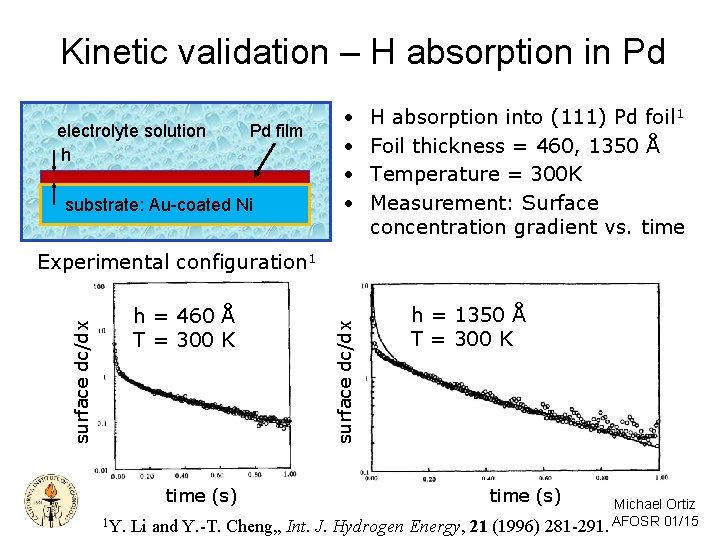
Kinetic validation – H absorption in Pd electrolyte solution h Pd film substrate: Au-coated Ni • • H absorption into (111) Pd foil 1 Foil thickness = 460, 1350 Å Temperature = 300 K Measurement: Surface concentration gradient vs. time surface dc/dx h = 460 Å T = 300 K time (s) 1 Y. surface dc/dx Experimental configuration 1 h = 1350 Å T = 300 K time (s) Li and Y. -T. Cheng, , Int. J. Hydrogen Energy, 21 (1996) Michael Ortiz 281 -291. AFOSR 01/15
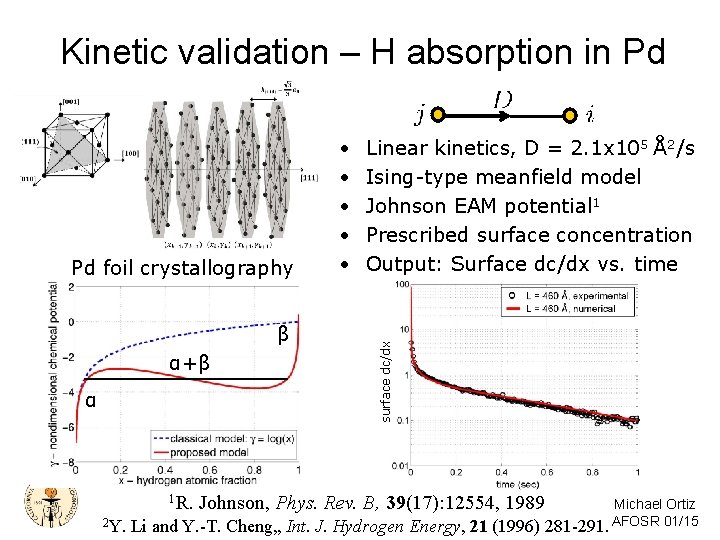
Kinetic validation – H absorption in Pd β α+β α 1 R. 2 Y. Linear kinetics, D = 2. 1 x 10⁵ Å2/s Ising-type meanfield model Johnson EAM potential 1 Prescribed surface concentration Output: Surface dc/dx vs. time surface dc/dx Pd foil crystallography • • • Johnson, Phys. Rev. B, 39(17): 12554, 1989 Li and Y. -T. Cheng, , Int. J. Hydrogen Energy, 21 (1996) Michael Ortiz 281 -291. AFOSR 01/15
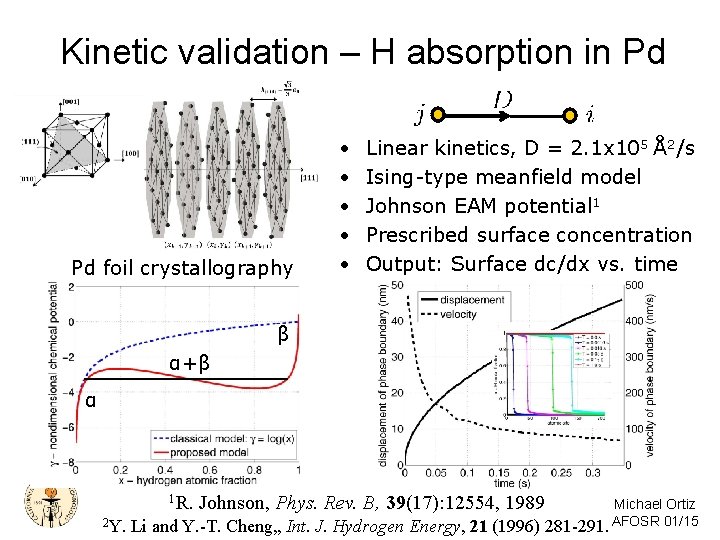
Kinetic validation – H absorption in Pd Pd foil crystallography • • • Linear kinetics, D = 2. 1 x 10⁵ Å2/s Ising-type meanfield model Johnson EAM potential 1 Prescribed surface concentration Output: Surface dc/dx vs. time β α+β α 1 R. 2 Y. Johnson, Phys. Rev. B, 39(17): 12554, 1989 Li and Y. -T. Cheng, , Int. J. Hydrogen Energy, 21 (1996) Michael Ortiz 281 -291. AFOSR 01/15
Non-Equilibrium Statistical Mechanics • N. E. Stat. Mech. (max-ent + kinetics) provides atomistic realism without the femtosecond curse • Time step is limited by diffusive scale • N. E. Stat. Mech. is built on arbitrary interatomic potentials + kinetic models • Challenge: Challenge Applications involving chemical reactions (modeled through reactive force fields, e. g. , Reax. FF) • Expect chemical reaction rates to be controlled by heat transport/anisotroy Michael Ortiz AFOSR 01/15
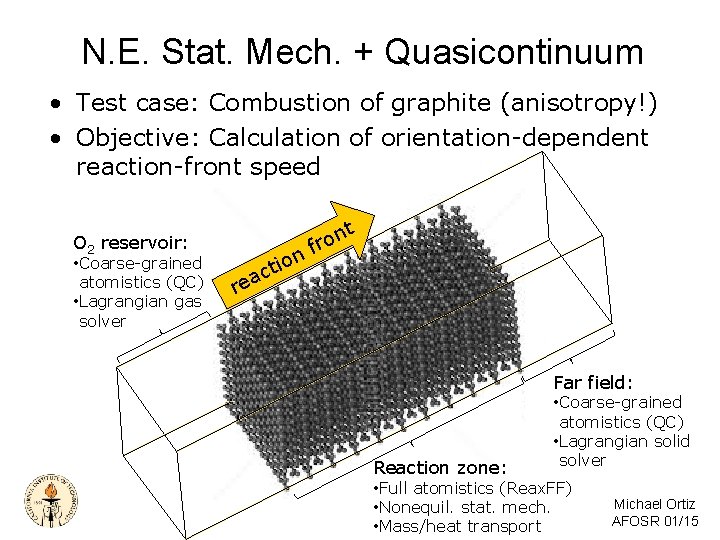
N. E. Stat. Mech. + Quasicontinuum • Test case: Combustion of graphite (anisotropy!) • Objective: Calculation of orientation-dependent reaction-front speed t O 2 reservoir: • Coarse-grained atomistics (QC) • Lagrangian gas solver rea o cti n n fro Far field: Reaction zone: • Coarse-grained atomistics (QC) • Lagrangian solid solver • Full atomistics (Reax. FF) • Nonequil. stat. mech. • Mass/heat transport Michael Ortiz AFOSR 01/15
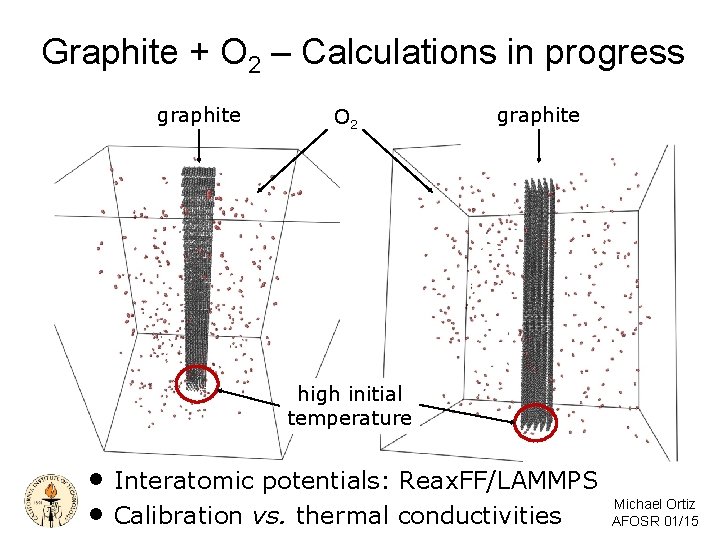
Graphite + O 2 – Calculations in progress graphite O 2 graphite high initial temperature • • Interatomic potentials: Reax. FF/LAMMPS Calibration vs. thermal conductivities Michael Ortiz AFOSR 01/15
Outlook: Optimal propellant microstructures • Build on fundamental information from atomicscale calculations: – Orientation-dependent reaction-front speed – Anisotropic thermal conductivity tensor • Parameterize microstructures of interest: – Composites: Polymer binder + oxidizer granules + additives (e. g. , NH 4 Cl. O 4 Composite Propellant, APCP) – Parameters: volume fractions, texture, morphology… • Simulate passage of reaction fronts through representative volume elements (front tracking) • Determine effective/macroscopic burning rates • Optimize microstructure for maximum specific impulse Michael Ortiz AFOSR 01/15
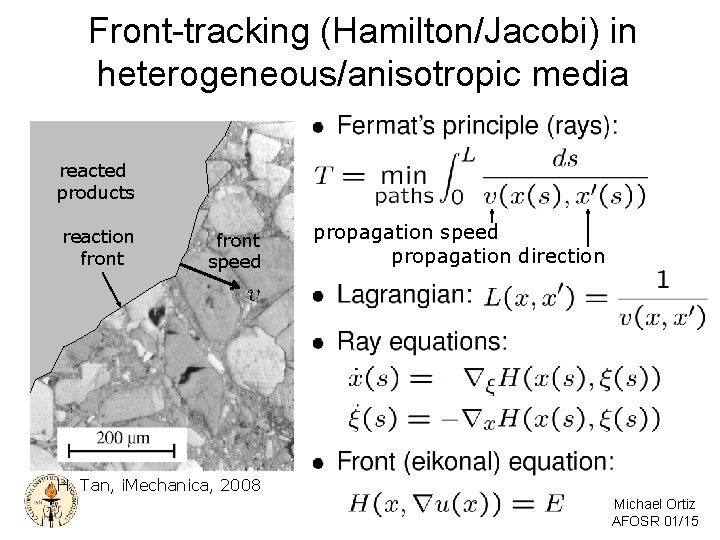
Front-tracking (Hamilton/Jacobi) in heterogeneous/anisotropic media reacted products reaction front speed propagation direction H. Tan, i. Mechanica, 2008 Michael Ortiz AFOSR 01/15
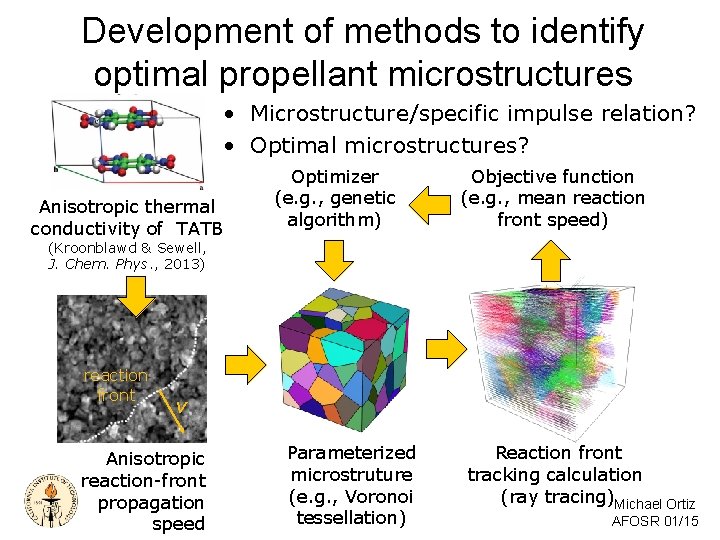
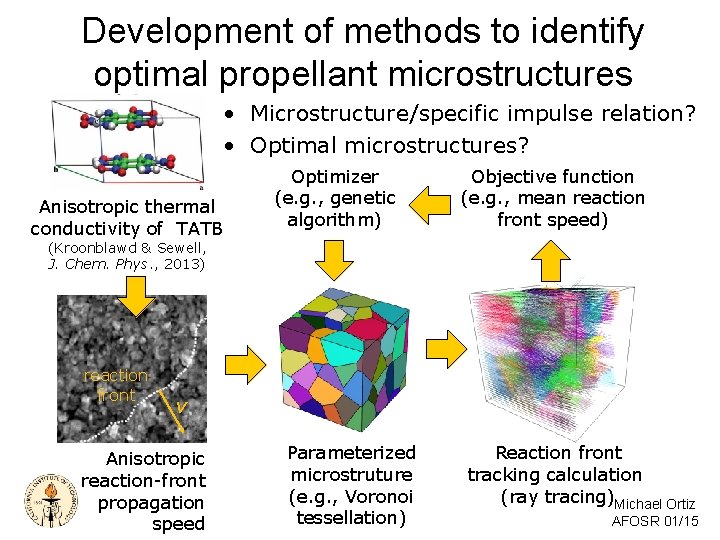
Development of methods to identify optimal propellant microstructures • Microstructure/specific impulse relation? • Optimal microstructures? Anisotropic thermal conductivity of TATB Optimizer (e. g. , genetic algorithm) Objective function (e. g. , mean reaction front speed) (Kroonblawd & Sewell, J. Chem. Phys. , 2013) reaction front v Anisotropic reaction-front propagation speed Parameterized microstruture (e. g. , Voronoi tessellation) Reaction front tracking calculation (ray tracing)Michael Ortiz AFOSR 01/15
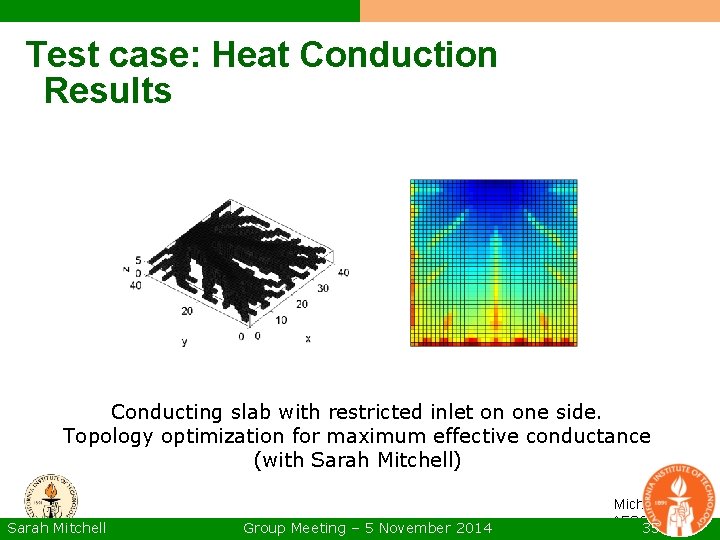
Test case: Heat Conduction Results Conducting slab with restricted inlet on one side. Topology optimization for maximum effective conductance (with Sarah Mitchell) Sarah Mitchell Group Meeting – 5 November 2014 Michael Ortiz AFOSR 01/15 35
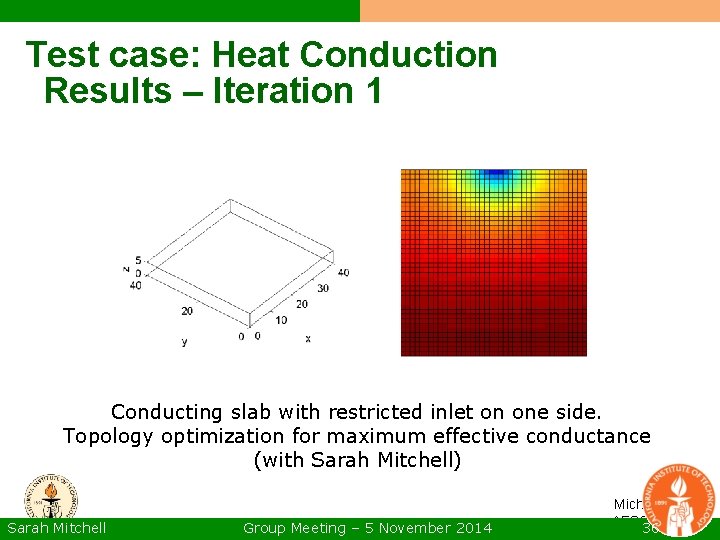
Test case: Heat Conduction Results – Iteration 1 Conducting slab with restricted inlet on one side. Topology optimization for maximum effective conductance (with Sarah Mitchell) Sarah Mitchell Group Meeting – 5 November 2014 Michael Ortiz AFOSR 01/15 36
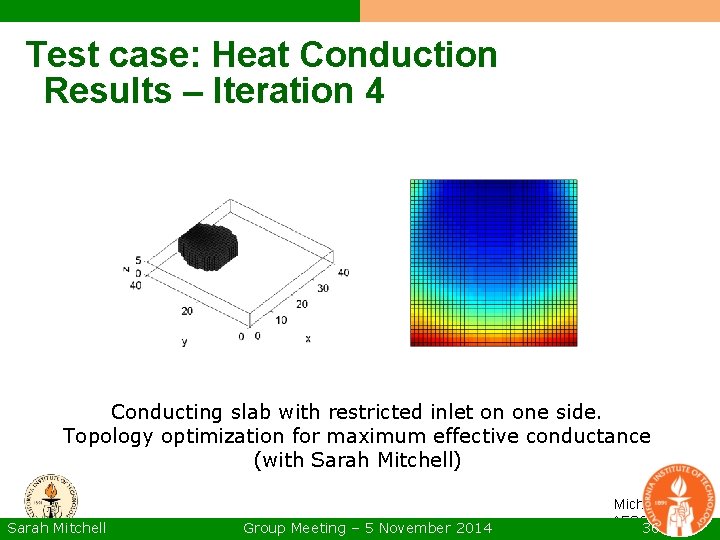
Test case: Heat Conduction Results – Iteration 4 Conducting slab with restricted inlet on one side. Topology optimization for maximum effective conductance (with Sarah Mitchell) Sarah Mitchell Group Meeting – 5 November 2014 Michael Ortiz AFOSR 01/15 36
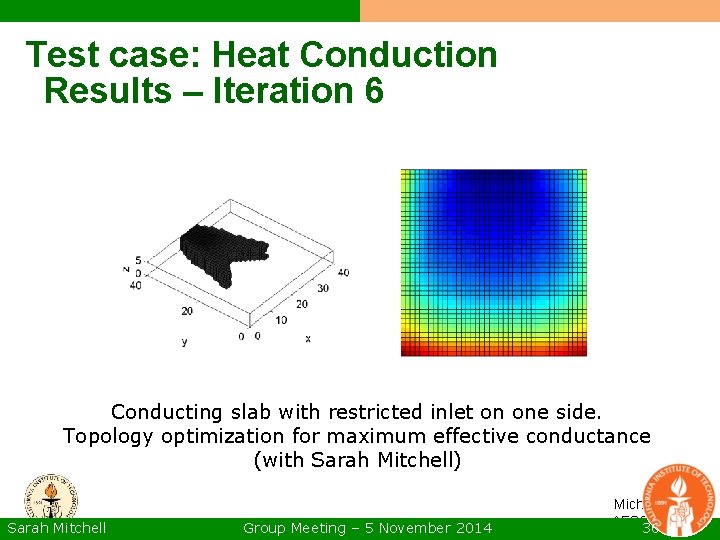
Test case: Heat Conduction Results – Iteration 6 Conducting slab with restricted inlet on one side. Topology optimization for maximum effective conductance (with Sarah Mitchell) Sarah Mitchell Group Meeting – 5 November 2014 Michael Ortiz AFOSR 01/15 36
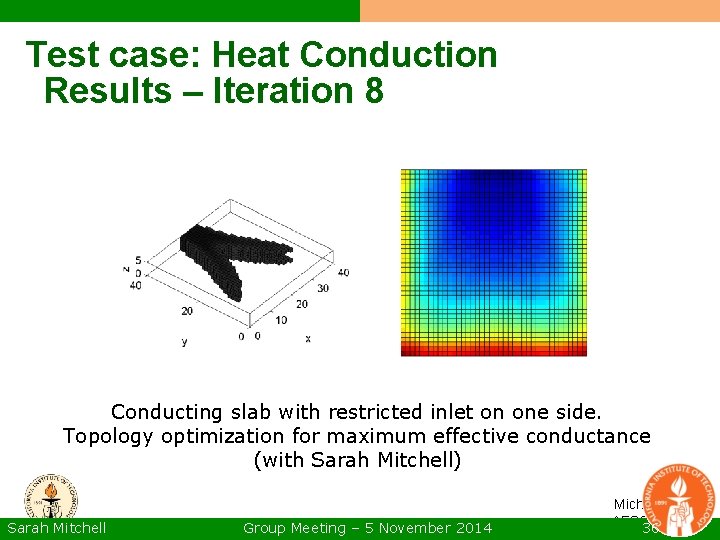
Test case: Heat Conduction Results – Iteration 8 Conducting slab with restricted inlet on one side. Topology optimization for maximum effective conductance (with Sarah Mitchell) Sarah Mitchell Group Meeting – 5 November 2014 Michael Ortiz AFOSR 01/15 36
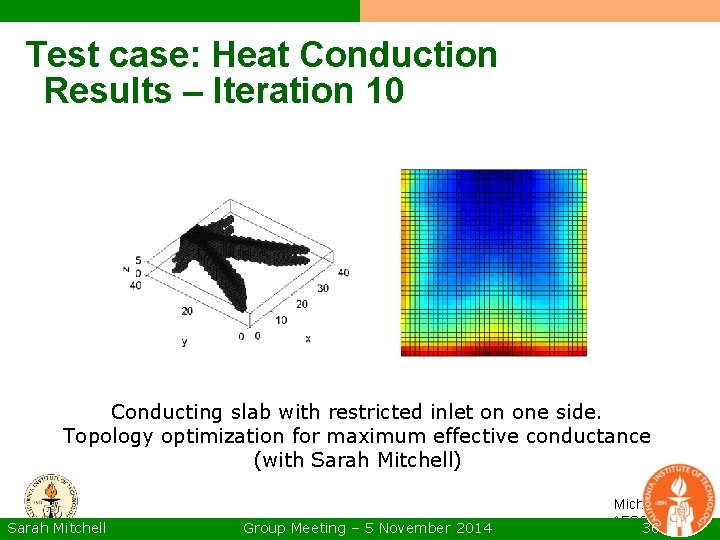
Test case: Heat Conduction Results – Iteration 10 Conducting slab with restricted inlet on one side. Topology optimization for maximum effective conductance (with Sarah Mitchell) Sarah Mitchell Group Meeting – 5 November 2014 Michael Ortiz AFOSR 01/15 36
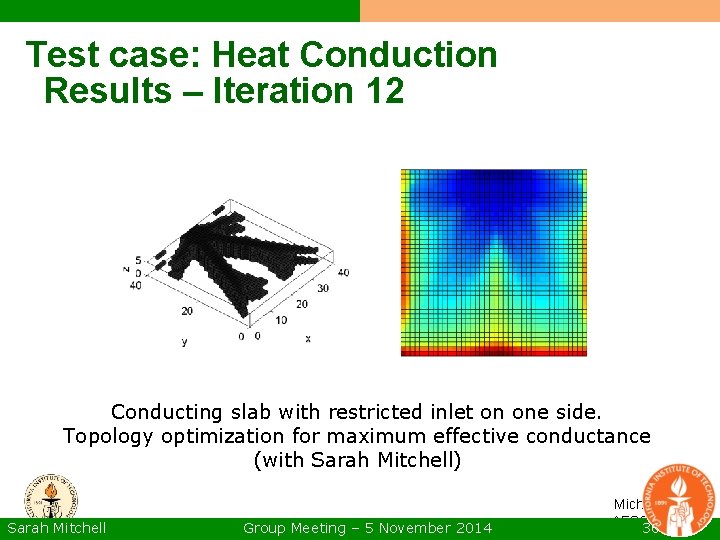
Test case: Heat Conduction Results – Iteration 12 Conducting slab with restricted inlet on one side. Topology optimization for maximum effective conductance (with Sarah Mitchell) Sarah Mitchell Group Meeting – 5 November 2014 Michael Ortiz AFOSR 01/15 36
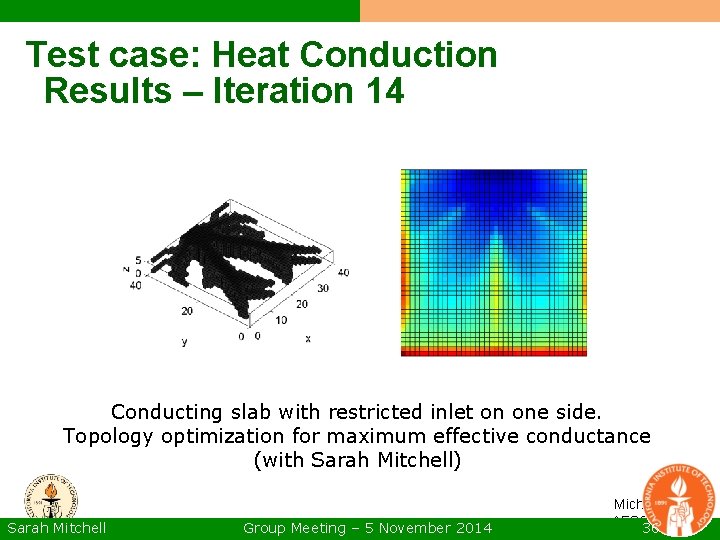
Test case: Heat Conduction Results – Iteration 14 Conducting slab with restricted inlet on one side. Topology optimization for maximum effective conductance (with Sarah Mitchell) Sarah Mitchell Group Meeting – 5 November 2014 Michael Ortiz AFOSR 01/15 36
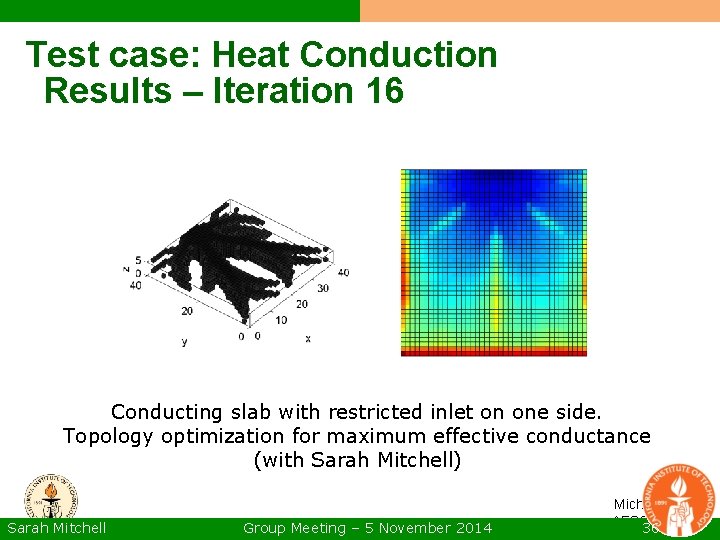
Test case: Heat Conduction Results – Iteration 16 Conducting slab with restricted inlet on one side. Topology optimization for maximum effective conductance (with Sarah Mitchell) Sarah Mitchell Group Meeting – 5 November 2014 Michael Ortiz AFOSR 01/15 36
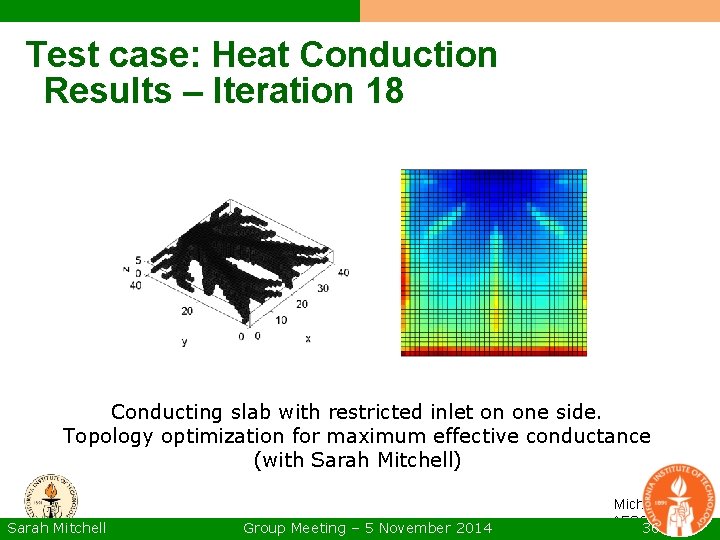
Test case: Heat Conduction Results – Iteration 18 Conducting slab with restricted inlet on one side. Topology optimization for maximum effective conductance (with Sarah Mitchell) Sarah Mitchell Group Meeting – 5 November 2014 Michael Ortiz AFOSR 01/15 36
Development of methods to identify optimal propellant microstructures • Microstructure/specific impulse relation? • Optimal microstructures? Anisotropic thermal conductivity of TATB Optimizer (e. g. , genetic algorithm) Objective function (e. g. , mean reaction front speed) (Kroonblawd & Sewell, J. Chem. Phys. , 2013) reaction front v Anisotropic reaction-front propagation speed Parameterized microstruture (e. g. , Voronoi tessellation) Reaction front tracking calculation (ray tracing)Michael Ortiz AFOSR 01/15
full chemistry at macroscale Thank you! atomistic models of reactive materials Michael Ortiz AFOSR 01/15