
Hierarchical Task Networks Planning to perform tasks rather


- Slides: 61
Hierarchical Task Networks Planning to perform tasks rather than to achieve goals Hierarchical Task Networks
Literature l l l Malik Ghallab, Dana Nau, and Paolo Traverso. Automated Planning – Theory and Practice, chapter 11. Elsevier/Morgan Kaufmann, 2004. E. Sacerdoti. The nonlinear nature of plans. In: Proc. IJCAI, pages 206 -214, 1975. A. Tate. Generating project networks. In: Proc. IJCAI, pages 888 -893, 1977. Hierarchical Task Networks 2
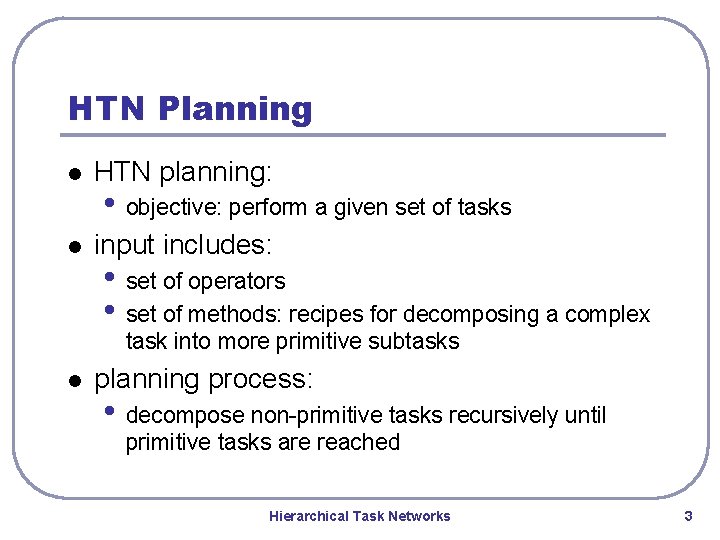
HTN Planning l HTN planning: l input includes: • objective: perform a given set of tasks • set of operators • set of methods: recipes for decomposing a complex task into more primitive subtasks l planning process: • decompose non-primitive tasks recursively until primitive tasks are reached Hierarchical Task Networks 3
Overview l l l Simple Task Networks HTN Planning Extensions State-Variable Representation Hierarchical Task Networks 4
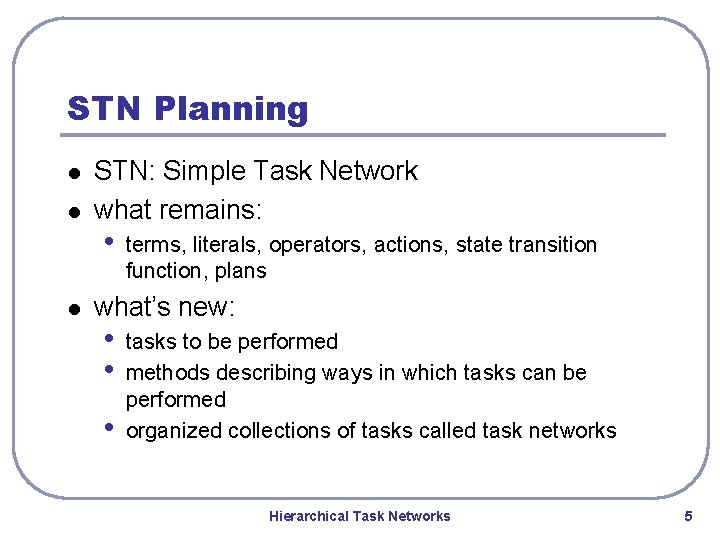
STN Planning l l l STN: Simple Task Network what remains: • terms, literals, operators, actions, state transition function, plans what’s new: • • • tasks to be performed methods describing ways in which tasks can be performed organized collections of tasks called task networks Hierarchical Task Networks 5
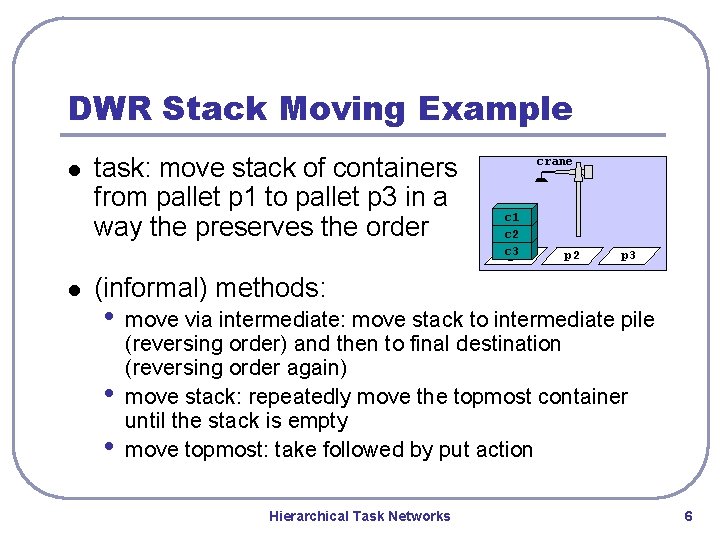
DWR Stack Moving Example l l task: move stack of containers from pallet p 1 to pallet p 3 in a way the preserves the order crane c 1 c 2 c 3 p 1 p 2 p 3 (informal) methods: • • • move via intermediate: move stack to intermediate pile (reversing order) and then to final destination (reversing order again) move stack: repeatedly move the topmost container until the stack is empty move topmost: take followed by put action Hierarchical Task Networks 6
Tasks l l l task symbols: TS = {t 1, …, tn} • • operator names ⊊ TS: primitive tasks non-primitive task symbols: TS - operator names task: ti(r 1, …, rk) • • • ti: task symbol (primitive or non-primitive) r 1, …, rk: terms, objects manipulated by the task ground task: are ground action a accomplishes ground primitive task ti(r 1, …, rk) in state s iff • • name(a) = ti and a is applicable in s Hierarchical Task Networks 7
Simple Task Networks l A simple task network w is an acyclic directed graph (U, E) in which • the node set U = {t 1, …, tn} is a set of tasks and • the edges in E define a partial ordering of the tasks in U. l A task network w is ground/primitive if all tasks tu∈U are ground/primitive, otherwise it is unground/non-primitive. Hierarchical Task Networks 8
Totally Ordered STNs l l ordering: tu≺tv in w=(U, E) iff there is a path from tu to tv STN w is totally ordered iff E defines a total order on U • l w is a sequence of tasks: � t 1, …, tn� Let w = � t 1, …, tn�be a totally ordered, ground, primitive STN. Then the plan π(w) is defined as: • π(w) = �a 1, …, an�where ai = ti; 1 ≤ i ≤ n Hierarchical Task Networks 9
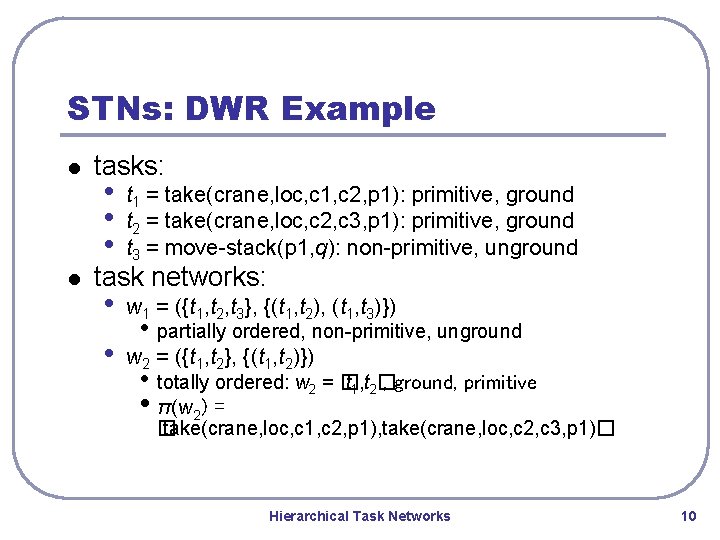
STNs: DWR Example l l tasks: • • • t 1 = take(crane, loc, c 1, c 2, p 1): primitive, ground t 2 = take(crane, loc, c 2, c 3, p 1): primitive, ground t 3 = move-stack(p 1, q): non-primitive, unground • w 1 = ({t 1, t 2, t 3}, {(t 1, t 2), (t 1, t 3)}) • w 2 = ({t 1, t 2}, {(t 1, t 2)}) task networks: • partially ordered, non-primitive, unground • totally ordered: w 2 = �t 1, t 2�, ground, primitive • π(w 2) = � take(crane, loc, c 1, c 2, p 1), take(crane, loc, c 2, c 3, p 1)� Hierarchical Task Networks 10
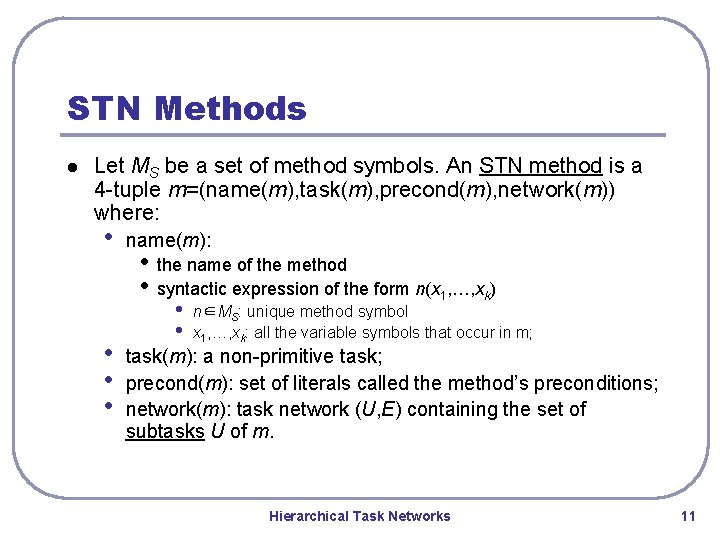
STN Methods l Let MS be a set of method symbols. An STN method is a 4 -tuple m=(name(m), task(m), precond(m), network(m)) where: • • name(m): • • the name of the method syntactic expression of the form n(x 1, …, xk) • • n∈MS: unique method symbol x 1, …, xk: all the variable symbols that occur in m; task(m): a non-primitive task; precond(m): set of literals called the method’s preconditions; network(m): task network (U, E) containing the set of subtasks U of m. Hierarchical Task Networks 11
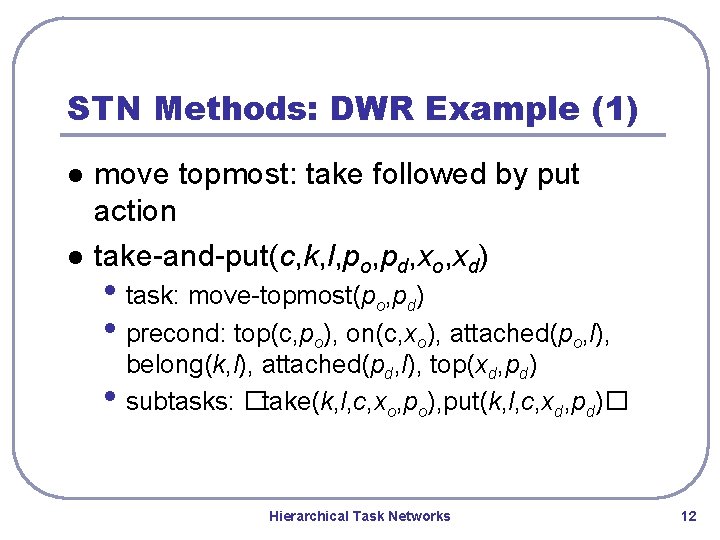
STN Methods: DWR Example (1) l l move topmost: take followed by put action take-and-put(c, k, l, po, pd, xo, xd) • task: move-topmost(po, pd) • precond: top(c, po), on(c, xo), attached(po, l), • belong(k, l), attached(pd, l), top(xd, pd) subtasks: �take(k, l, c, xo, po), put(k, l, c, xd, pd)� Hierarchical Task Networks 12
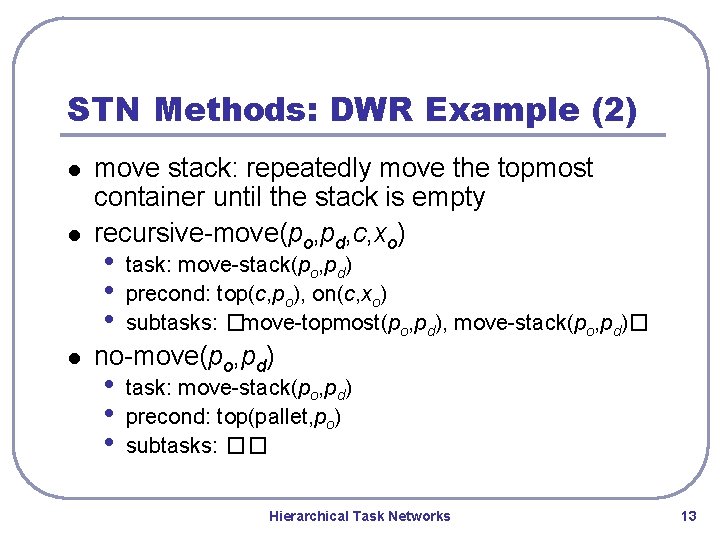
STN Methods: DWR Example (2) l l l move stack: repeatedly move the topmost container until the stack is empty recursive-move(po, pd, c, xo) • • • task: move-stack(po, pd) precond: top(c, po), on(c, xo) subtasks: �move-topmost(po, pd), move-stack(po, pd)� no-move(po, pd) • • • task: move-stack(po, pd) precond: top(pallet, po) subtasks: �� Hierarchical Task Networks 13
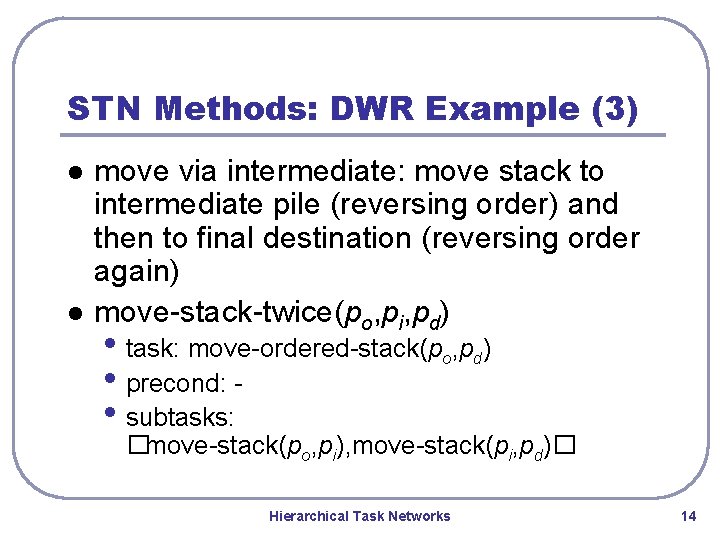
STN Methods: DWR Example (3) l l move via intermediate: move stack to intermediate pile (reversing order) and then to final destination (reversing order again) move-stack-twice(po, pi, pd) • task: move-ordered-stack(po, pd) • precond: • subtasks: �move-stack(po, pi), move-stack(pi, pd)� Hierarchical Task Networks 14
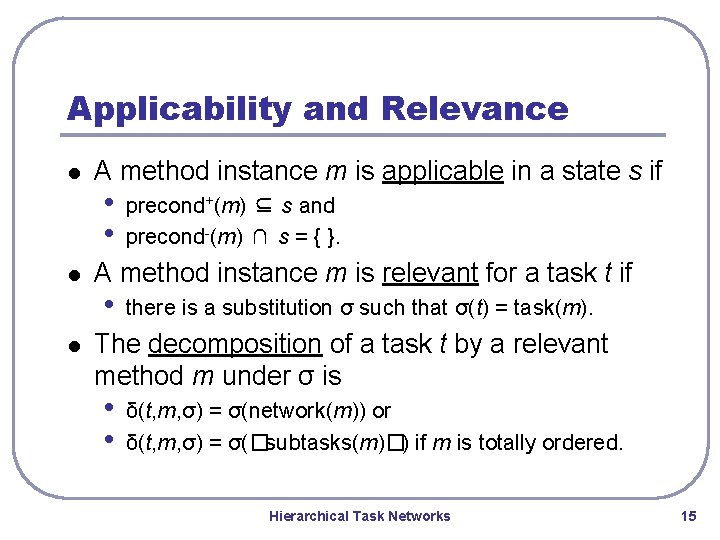
Applicability and Relevance l l l A method instance m is applicable in a state s if • • precond+(m) ⊆ s and precond-(m) ∩ s = { }. A method instance m is relevant for a task t if • there is a substitution σ such that σ(t) = task(m). The decomposition of a task t by a relevant method m under σ is • • δ(t, m, σ) = σ(network(m)) or δ(t, m, σ) = σ(�subtasks(m)�) if m is totally ordered. Hierarchical Task Networks 15
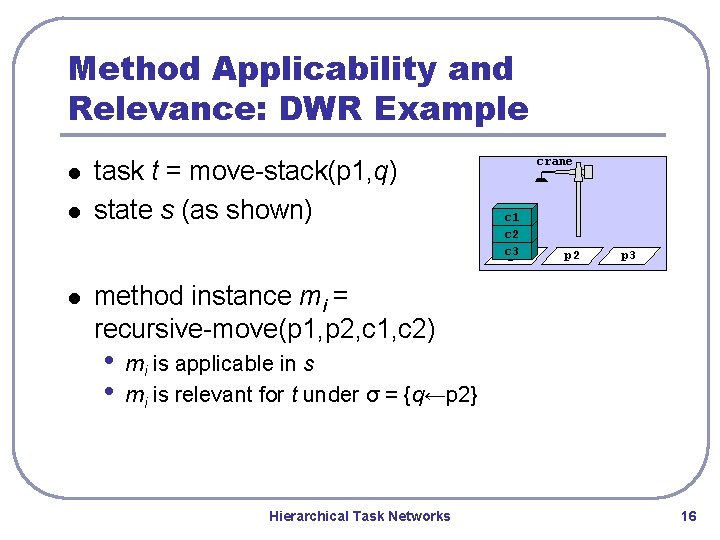
Method Applicability and Relevance: DWR Example l l l task t = move-stack(p 1, q) state s (as shown) crane c 1 c 2 c 3 p 1 p 2 p 3 method instance mi = recursive-move(p 1, p 2, c 1, c 2) • • mi is applicable in s mi is relevant for t under σ = {q←p 2} Hierarchical Task Networks 16
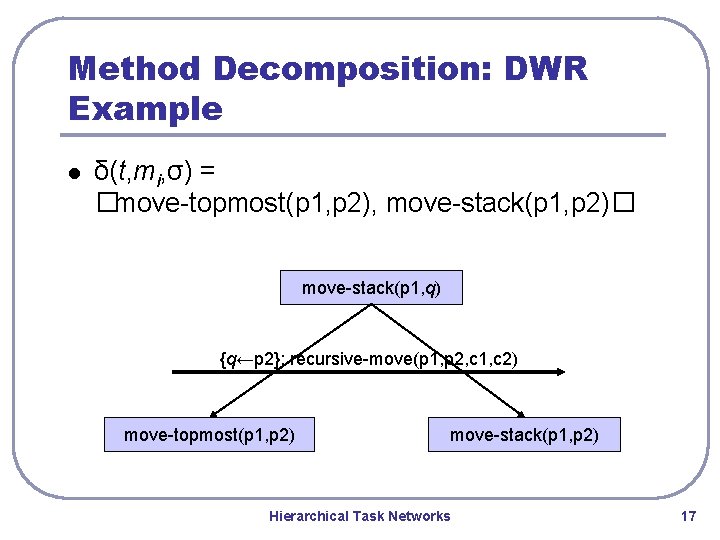
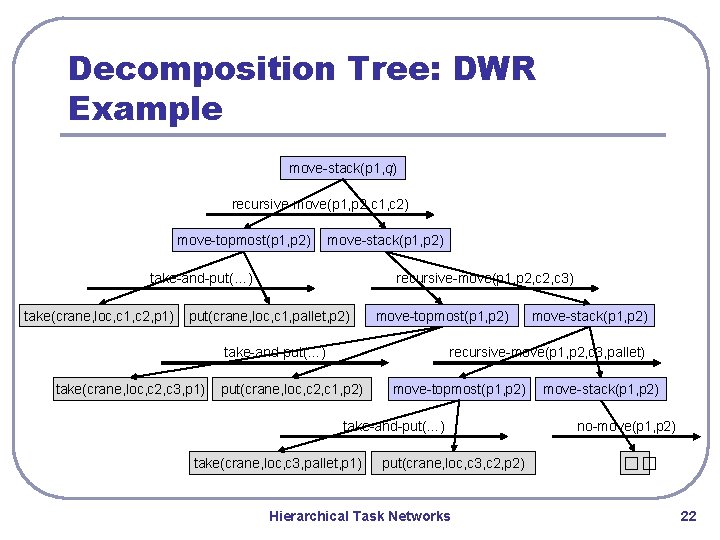
Method Decomposition: DWR Example l δ(t, mi, σ) = �move-topmost(p 1, p 2), move-stack(p 1, p 2)� move-stack(p 1, q) {q←p 2}: recursive-move(p 1, p 2, c 1, c 2) move-topmost(p 1, p 2) move-stack(p 1, p 2) Hierarchical Task Networks 17
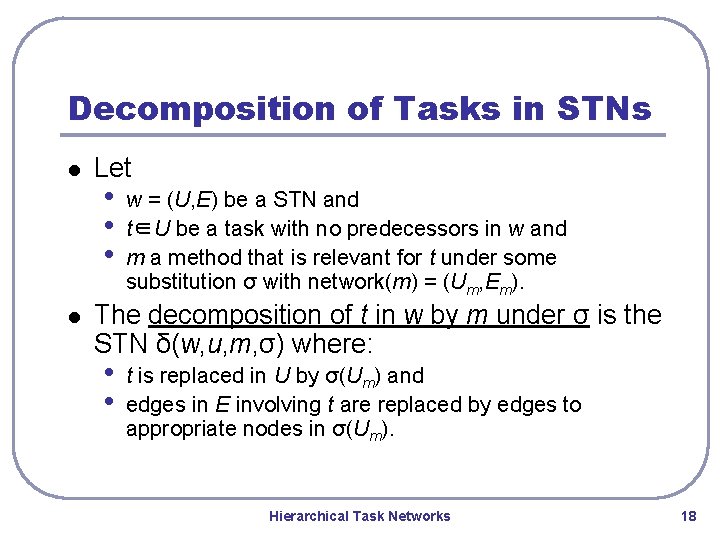
Decomposition of Tasks in STNs l l Let • • • w = (U, E) be a STN and t∈U be a task with no predecessors in w and m a method that is relevant for t under some substitution σ with network(m) = (Um, Em). The decomposition of t in w by m under σ is the STN δ(w, u, m, σ) where: • • t is replaced in U by σ(Um) and edges in E involving t are replaced by edges to appropriate nodes in σ(Um). Hierarchical Task Networks 18
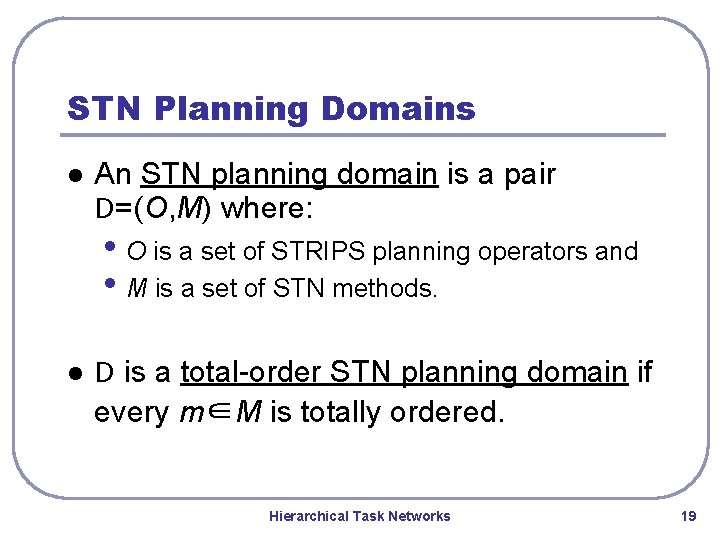
STN Planning Domains l An STN planning domain is a pair D=(O, M) where: • O is a set of STRIPS planning operators and • M is a set of STN methods. l D is a total-order STN planning domain if every m∈M is totally ordered. Hierarchical Task Networks 19
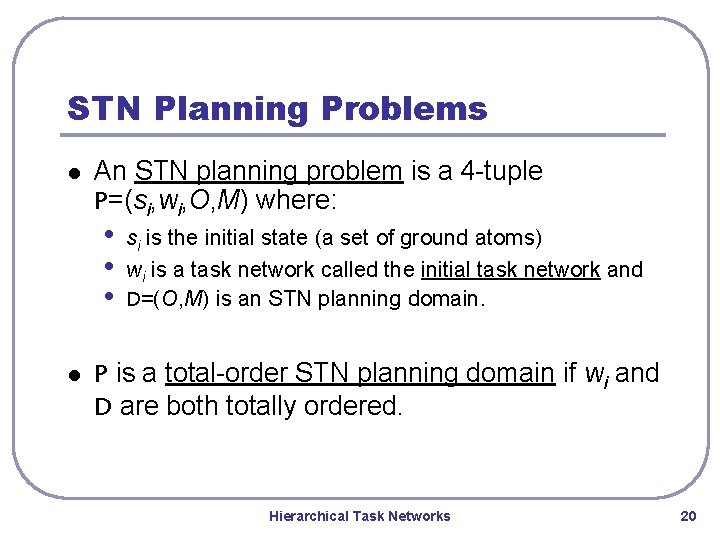
STN Planning Problems l An STN planning problem is a 4 -tuple P=(si, wi, O, M) where: • si is the initial state (a set of ground atoms) • wi is a task network called the initial task network and • D=(O, M) is an STN planning domain. l P is a total-order STN planning domain if wi and D are both totally ordered. Hierarchical Task Networks 20
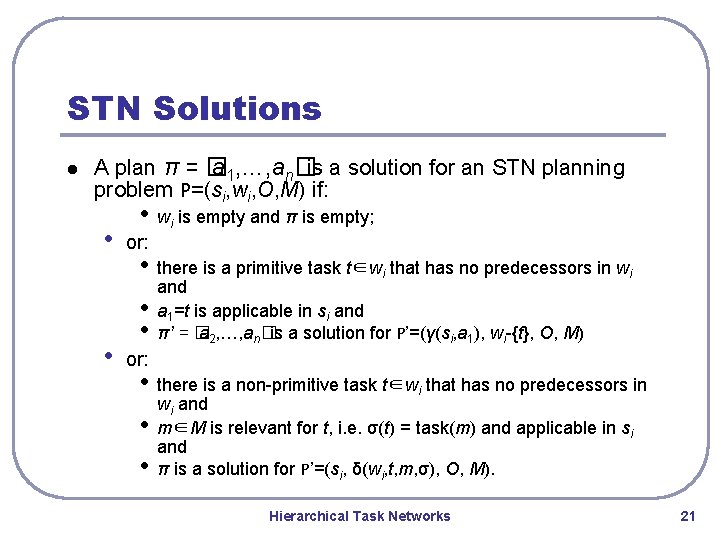
STN Solutions l A plan π = � a 1, …, an�is a solution for an STN planning problem P=(si, wi, O, M) if: • • • wi is empty and π is empty; or: • • • there is a primitive task t∈wi that has no predecessors in wi and a 1=t is applicable in si and π’ = � a 2, …, an�is a solution for P’=(γ(si, a 1), wi-{t}, O, M) or: • • • there is a non-primitive task t∈wi that has no predecessors in wi and m∈M is relevant for t, i. e. σ(t) = task(m) and applicable in si and π is a solution for P’=(si, δ(wi, t, m, σ), O, M). Hierarchical Task Networks 21
Decomposition Tree: DWR Example move-stack(p 1, q) recursive-move(p 1, p 2, c 1, c 2) move-topmost(p 1, p 2) move-stack(p 1, p 2) take-and-put(…) take(crane, loc, c 1, c 2, p 1) recursive-move(p 1, p 2, c 3) put(crane, loc, c 1, pallet, p 2) move-topmost(p 1, p 2) take-and-put(…) take(crane, loc, c 2, c 3, p 1) move-stack(p 1, p 2) recursive-move(p 1, p 2, c 3, pallet) put(crane, loc, c 2, c 1, p 2) move-topmost(p 1, p 2) take-and-put(…) take(crane, loc, c 3, pallet, p 1) put(crane, loc, c 3, c 2, p 2) Hierarchical Task Networks move-stack(p 1, p 2) no-move(p 1, p 2) �� 22
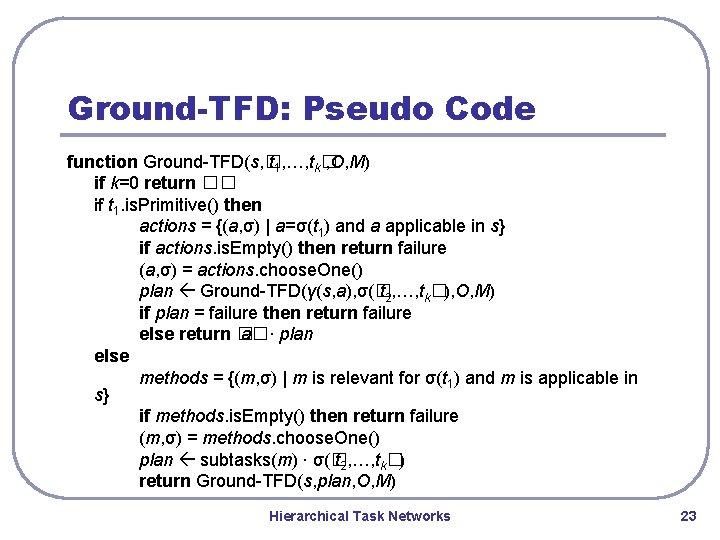
Ground-TFD: Pseudo Code function Ground-TFD(s, � t 1, …, tk� , O, M) if k=0 return �� if t 1. is. Primitive() then actions = {(a, σ) | a=σ(t 1) and a applicable in s} if actions. is. Empty() then return failure (a, σ) = actions. choose. One() plan Ground-TFD(γ(s, a), σ(� t 2, …, tk�), O, M) if plan = failure then return failure else return � a�∙ plan else methods = {(m, σ) | m is relevant for σ(t 1) and m is applicable in s} if methods. is. Empty() then return failure (m, σ) = methods. choose. One() plan subtasks(m) ∙ σ(� t 2, …, tk�) return Ground-TFD(s, plan, O, M) Hierarchical Task Networks 23
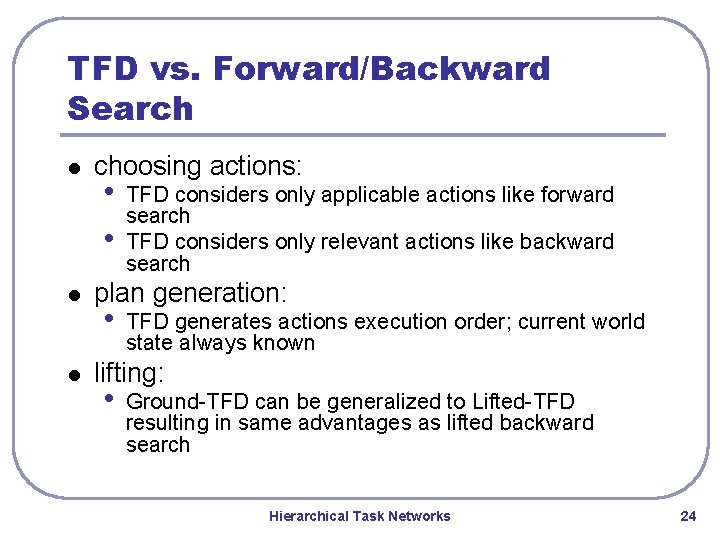
TFD vs. Forward/Backward Search l l l choosing actions: • • TFD considers only applicable actions like forward search TFD considers only relevant actions like backward search plan generation: • TFD generates actions execution order; current world state always known lifting: • Ground-TFD can be generalized to Lifted-TFD resulting in same advantages as lifted backward search Hierarchical Task Networks 24
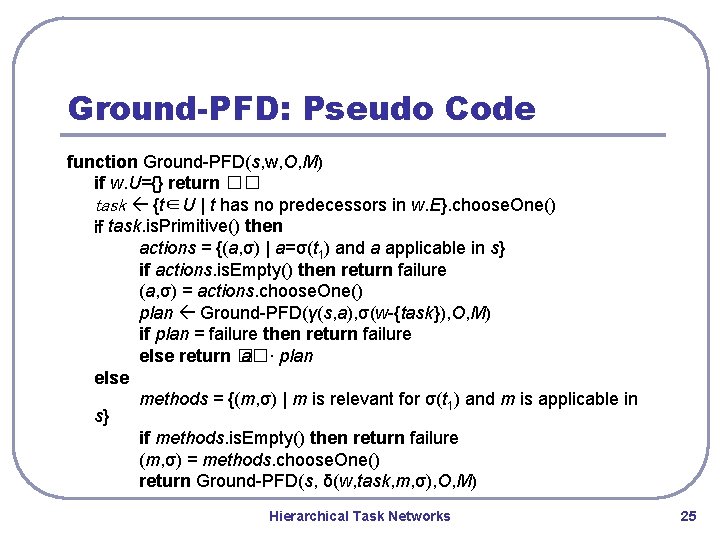
Ground-PFD: Pseudo Code function Ground-PFD(s, w, O, M) if w. U={} return �� task {t∈U | t has no predecessors in w. E}. choose. One() if task. is. Primitive() then actions = {(a, σ) | a=σ(t 1) and a applicable in s} if actions. is. Empty() then return failure (a, σ) = actions. choose. One() plan Ground-PFD(γ(s, a), σ(w-{task}), O, M) if plan = failure then return failure else return � a�∙ plan else methods = {(m, σ) | m is relevant for σ(t 1) and m is applicable in s} if methods. is. Empty() then return failure (m, σ) = methods. choose. One() return Ground-PFD(s, δ(w, task, m, σ), O, M) Hierarchical Task Networks 25
Overview l l l Simple Task Networks HTN Planning Extensions State-Variable Representation Hierarchical Task Networks 26
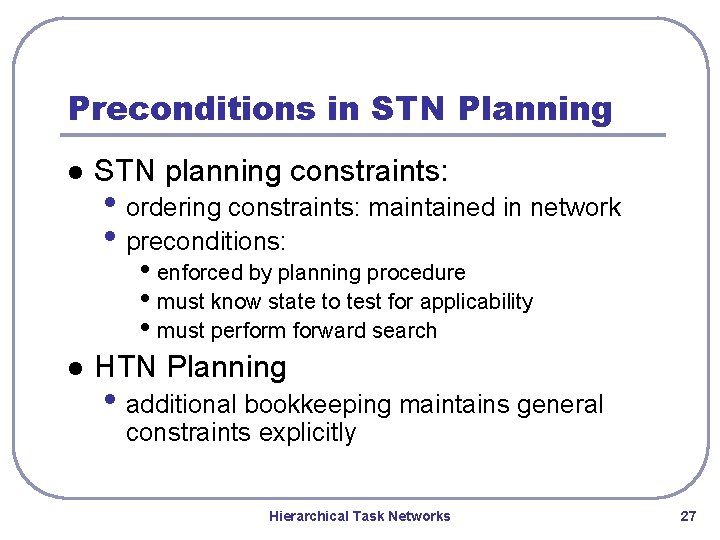
Preconditions in STN Planning l STN planning constraints: • ordering constraints: maintained in network • preconditions: • enforced by planning procedure • must know state to test for applicability • must perform forward search l HTN Planning • additional bookkeeping maintains general constraints explicitly Hierarchical Task Networks 27
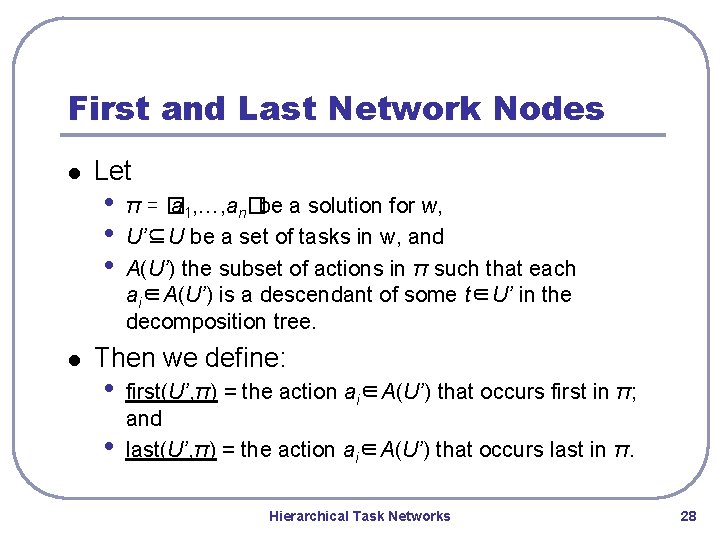
First and Last Network Nodes l l Let • • • π=� a 1, …, an�be a solution for w, U’⊆U be a set of tasks in w, and A(U’) the subset of actions in π such that each ai∈A(U’) is a descendant of some t∈U’ in the decomposition tree. Then we define: • • first(U’, π) = the action ai∈A(U’) that occurs first in π; and last(U’, π) = the action ai∈A(U’) that occurs last in π. Hierarchical Task Networks 28
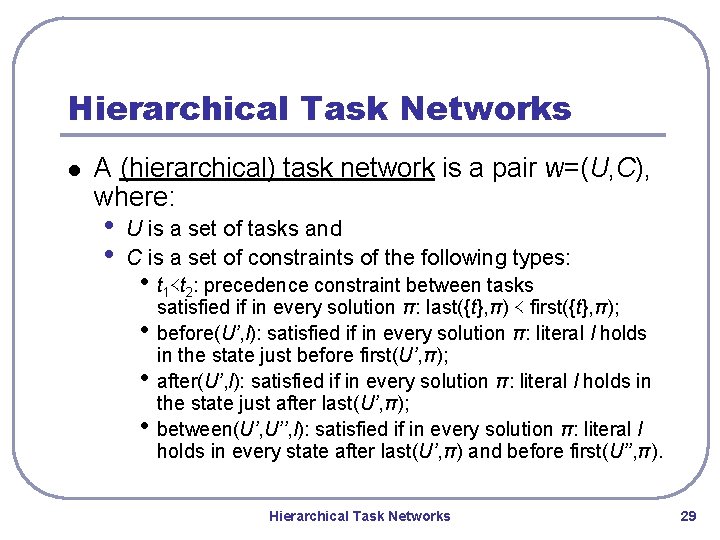
Hierarchical Task Networks l A (hierarchical) task network is a pair w=(U, C), where: • • U is a set of tasks and C is a set of constraints of the following types: • t 1≺t 2: precedence constraint between tasks • • • satisfied if in every solution π: last({t}, π) ≺ first({t}, π); before(U’, l): satisfied if in every solution π: literal l holds in the state just before first(U’, π); after(U’, l): satisfied if in every solution π: literal l holds in the state just after last(U’, π); between(U’, U’’, l): satisfied if in every solution π: literal l holds in every state after last(U’, π) and before first(U’’, π). Hierarchical Task Networks 29
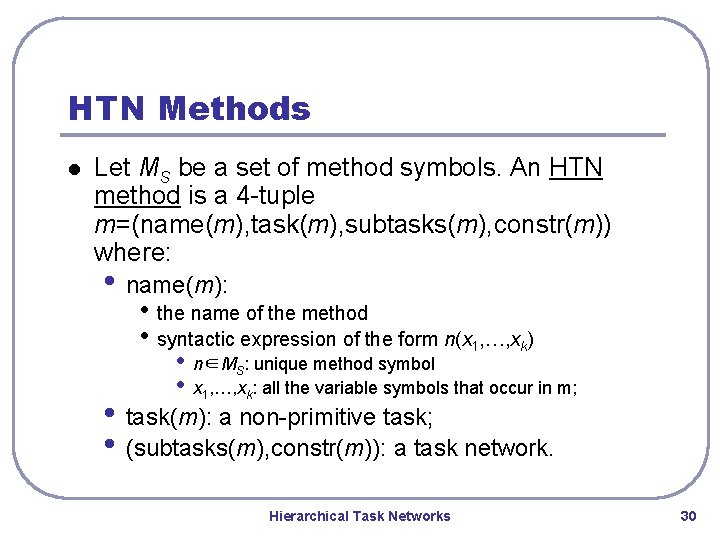
HTN Methods l Let MS be a set of method symbols. An HTN method is a 4 -tuple m=(name(m), task(m), subtasks(m), constr(m)) where: • name(m): • the name of the method • syntactic expression of the form n(x 1, …, xk) • • n∈MS: unique method symbol x 1, …, xk: all the variable symbols that occur in m; • task(m): a non-primitive task; • (subtasks(m), constr(m)): a task network. Hierarchical Task Networks 30
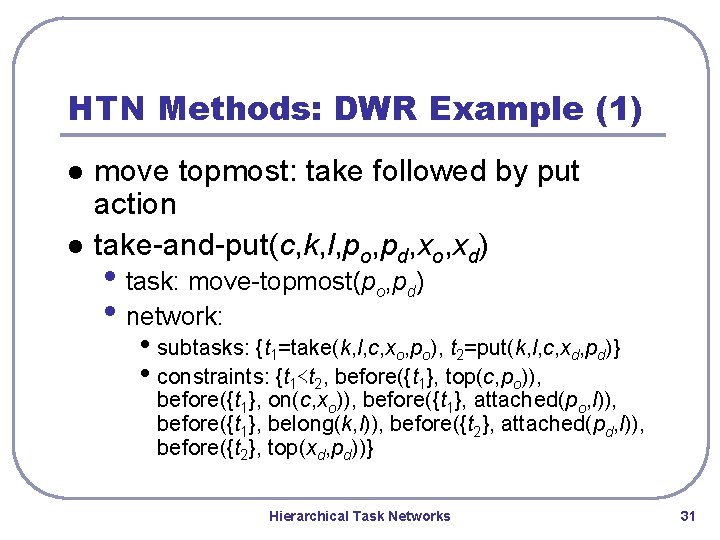
HTN Methods: DWR Example (1) l l move topmost: take followed by put action take-and-put(c, k, l, po, pd, xo, xd) • task: move-topmost(po, pd) • network: • subtasks: {t 1=take(k, l, c, xo, po), t 2=put(k, l, c, xd, pd)} • constraints: {t 1≺t 2, before({t 1}, top(c, po)), before({t 1}, on(c, xo)), before({t 1}, attached(po, l)), before({t 1}, belong(k, l)), before({t 2}, attached(pd, l)), before({t 2}, top(xd, pd))} Hierarchical Task Networks 31
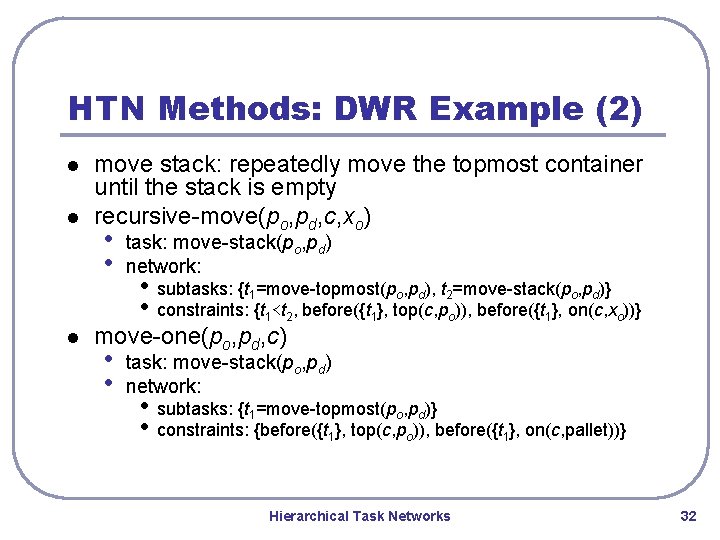
HTN Methods: DWR Example (2) l l l move stack: repeatedly move the topmost container until the stack is empty recursive-move(po, pd, c, xo) • • task: move-stack(po, pd) network: • • subtasks: {t 1=move-topmost(po, pd), t 2=move-stack(po, pd)} constraints: {t 1≺t 2, before({t 1}, top(c, po)), before({t 1}, on(c, xo))} move-one(po, pd, c) • • task: move-stack(po, pd) network: • • subtasks: {t 1=move-topmost(po, pd)} constraints: {before({t 1}, top(c, po)), before({t 1}, on(c, pallet))} Hierarchical Task Networks 32
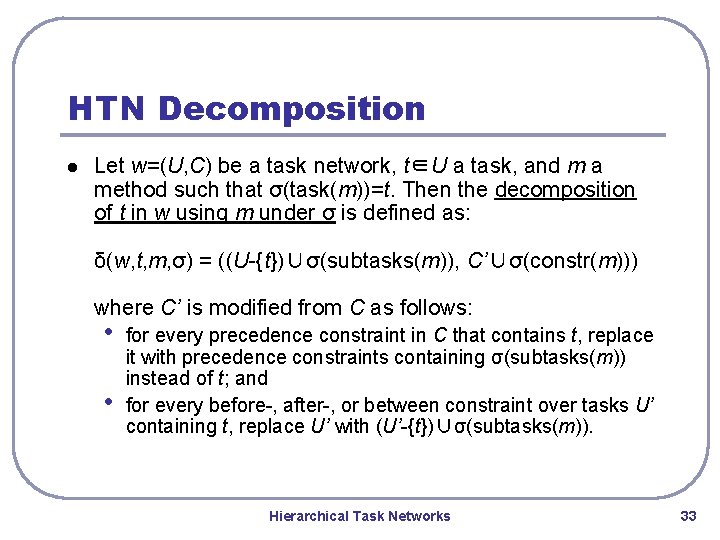
HTN Decomposition l Let w=(U, C) be a task network, t∈U a task, and m a method such that σ(task(m))=t. Then the decomposition of t in w using m under σ is defined as: δ(w, t, m, σ) = ((U-{t})∪σ(subtasks(m)), C’∪σ(constr(m))) where C’ is modified from C as follows: • • for every precedence constraint in C that contains t, replace it with precedence constraints containing σ(subtasks(m)) instead of t; and for every before-, after-, or between constraint over tasks U’ containing t, replace U’ with (U’-{t})∪σ(subtasks(m)). Hierarchical Task Networks 33
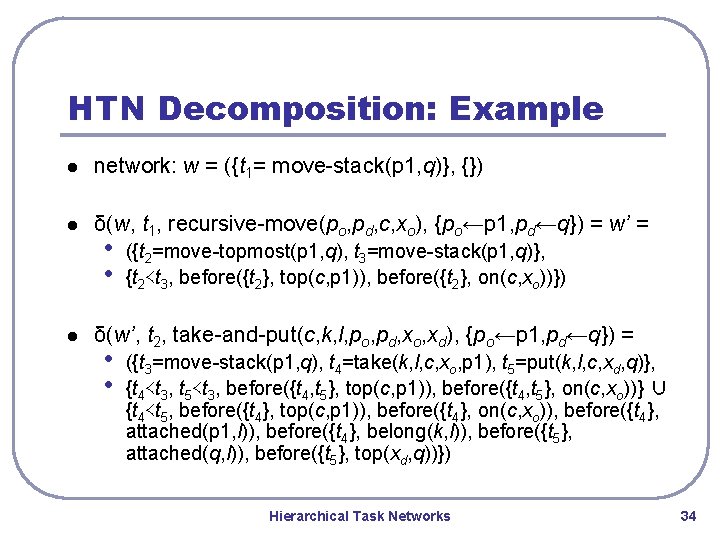
HTN Decomposition: Example l network: w = ({t 1= move-stack(p 1, q)}, {}) l δ(w, t 1, recursive-move(po, pd, c, xo), {po←p 1, pd←q}) = w’ = l • • ({t 2=move-topmost(p 1, q), t 3=move-stack(p 1, q)}, {t 2≺t 3, before({t 2}, top(c, p 1)), before({t 2}, on(c, xo))}) δ(w’, t 2, take-and-put(c, k, l, po, pd, xo, xd), {po←p 1, pd←q}) = • • ({t 3=move-stack(p 1, q), t 4=take(k, l, c, xo, p 1), t 5=put(k, l, c, xd, q)}, {t 4≺t 3, t 5≺t 3, before({t 4, t 5}, top(c, p 1)), before({t 4, t 5}, on(c, xo))} ∪ {t 4≺t 5, before({t 4}, top(c, p 1)), before({t 4}, on(c, xo)), before({t 4}, attached(p 1, l)), before({t 4}, belong(k, l)), before({t 5}, attached(q, l)), before({t 5}, top(xd, q))}) Hierarchical Task Networks 34
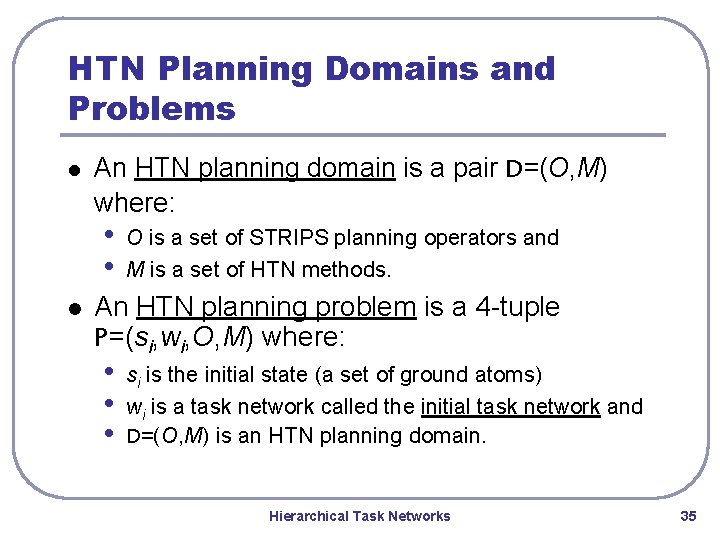
HTN Planning Domains and Problems l An HTN planning domain is a pair D=(O, M) where: • • l O is a set of STRIPS planning operators and M is a set of HTN methods. An HTN planning problem is a 4 -tuple P=(si, wi, O, M) where: • si is the initial state (a set of ground atoms) • wi is a task network called the initial task network and • D=(O, M) is an HTN planning domain. Hierarchical Task Networks 35
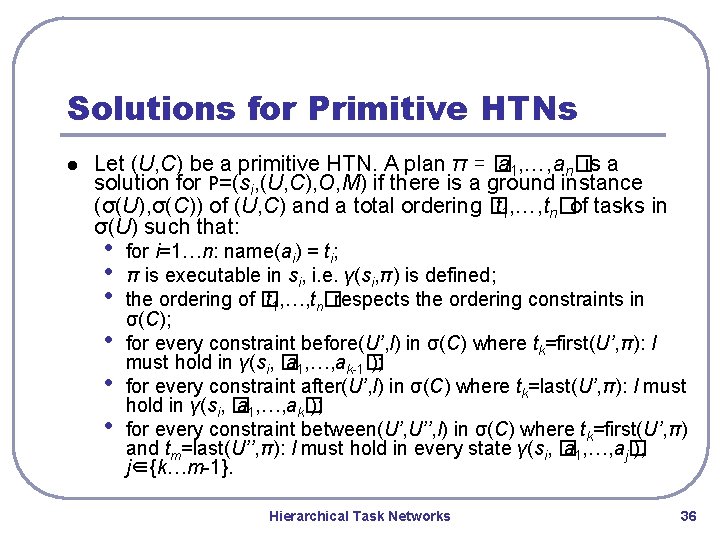
Solutions for Primitive HTNs l Let (U, C) be a primitive HTN. A plan π = � a 1, …, an�is a solution for P=(si, (U, C), O, M) if there is a ground instance (σ(U), σ(C)) of (U, C) and a total ordering � t 1, …, tn�of tasks in σ(U) such that: • • • for i=1…n: name(ai) = ti; π is executable in si, i. e. γ(si, π) is defined; the ordering of � t 1, …, tn�respects the ordering constraints in σ(C); for every constraint before(U’, l) in σ(C) where tk=first(U’, π): l must hold in γ(si, � a 1, …, ak-1� ); for every constraint after(U’, l) in σ(C) where tk=last(U’, π): l must hold in γ(si, � a 1, …, ak� ); for every constraint between(U’, U’’, l) in σ(C) where tk=first(U’, π) and tm=last(U’’, π): l must hold in every state γ(si, � a 1, …, aj� ), j∈{k…m-1}. Hierarchical Task Networks 36
Solutions for Non-Primitive HTNs l Let w = (U, C) be a non-primitive HTN. A plan π = � a 1, …, an�is a solution for P=(si, w, O, M) if there is a sequence of task decompositions that can be applied to w such that: • the result of the decompositions is a primitive • HTN w’; and π is a solution for P’=(si, w’, O, M). Hierarchical Task Networks 37
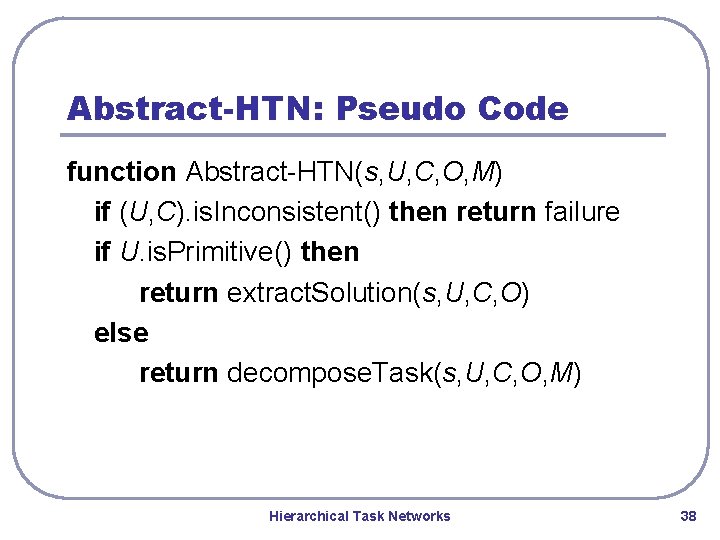
Abstract-HTN: Pseudo Code function Abstract-HTN(s, U, C, O, M) if (U, C). is. Inconsistent() then return failure if U. is. Primitive() then return extract. Solution(s, U, C, O) else return decompose. Task(s, U, C, O, M) Hierarchical Task Networks 38
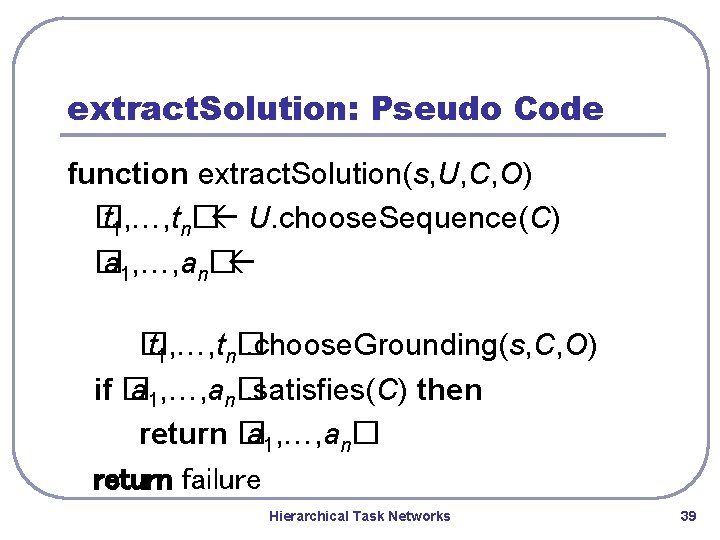
extract. Solution: Pseudo Code function extract. Solution(s, U, C, O) � t 1, …, tn� U. choose. Sequence(C) � a 1, …, an� � t 1, …, tn�. choose. Grounding(s, C, O) if � a 1, …, an�. satisfies(C) then return � a 1, …, an� return failure Hierarchical Task Networks 39
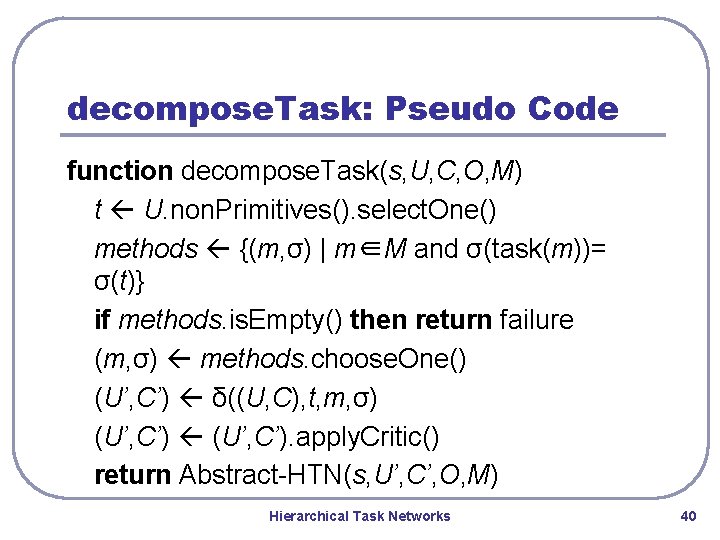
decompose. Task: Pseudo Code function decompose. Task(s, U, C, O, M) t U. non. Primitives(). select. One() methods {(m, σ) | m∈M and σ(task(m))= σ(t)} if methods. is. Empty() then return failure (m, σ) methods. choose. One() (U’, C’) δ((U, C), t, m, σ) (U’, C’). apply. Critic() return Abstract-HTN(s, U’, C’, O, M) Hierarchical Task Networks 40
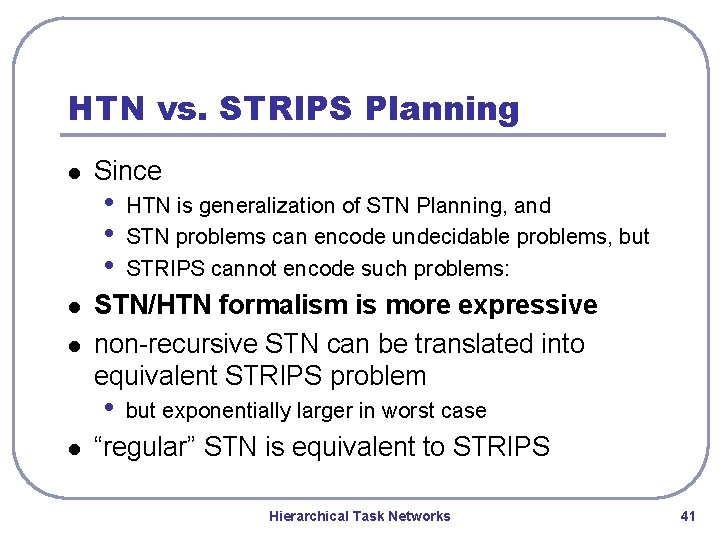
HTN vs. STRIPS Planning l l l Since • • • STN/HTN formalism is more expressive non-recursive STN can be translated into equivalent STRIPS problem • l HTN is generalization of STN Planning, and STN problems can encode undecidable problems, but STRIPS cannot encode such problems: but exponentially larger in worst case “regular” STN is equivalent to STRIPS Hierarchical Task Networks 41
Overview l l l Simple Task Networks HTN Planning Extensions State-Variable Representation Hierarchical Task Networks 42
Functions in Terms l l allow function terms in world state and method constraints ground versions of all planning algorithms may fail • l potentially infinite number of ground instances of a given term lifted algorithms can be applied with most general unifier • • least commitment approach instantiates only as far as necessary plan-existence may not be decidable Hierarchical Task Networks 43
Axiomatic Inference l use theorem prover to infer derived knowledge within world states • undecidability of first-order logic in general l idea: use restricted (decidable) subset of first-order logic: Horn clauses • only positive preconditions can be derived • precondition p is satisfied in state s iff p can be proved in s Hierarchical Task Networks 44
Attached Procedures l l associate predicates with procedures modify planning algorithm • evaluate preconditions by • calling the procedure attached to the predicate symbol if there is such a procedure • test against world state (set-relation, theorem prover) otherwise l soundness and completeness: depends on procedures Hierarchical Task Networks 45
High-Level Effects l l allow user to declare effects for nonprimitive methods aim: • establish preconditions • prune partial plans if high-level effects threaten preconditions l l increases efficiency problem: semantics Hierarchical Task Networks 46
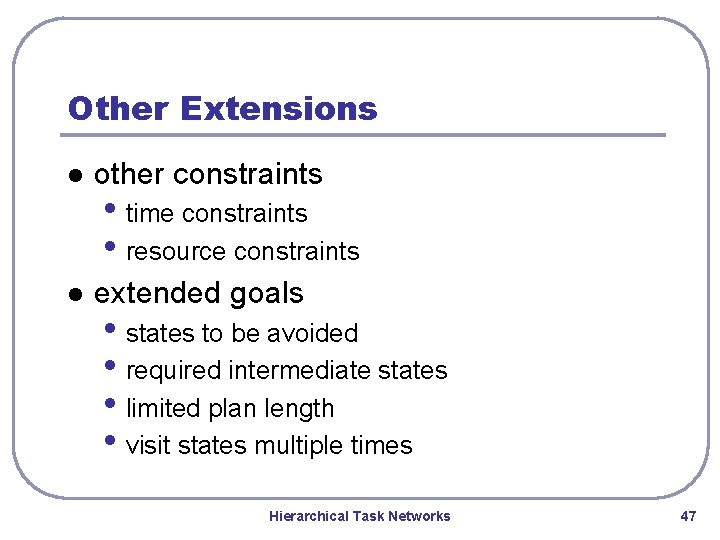
Other Extensions l other constraints l extended goals • time constraints • resource constraints • states to be avoided • required intermediate states • limited plan length • visit states multiple times Hierarchical Task Networks 47
Overview l l l Simple Task Networks HTN Planning Extensions State-Variable Representation Hierarchical Task Networks 48
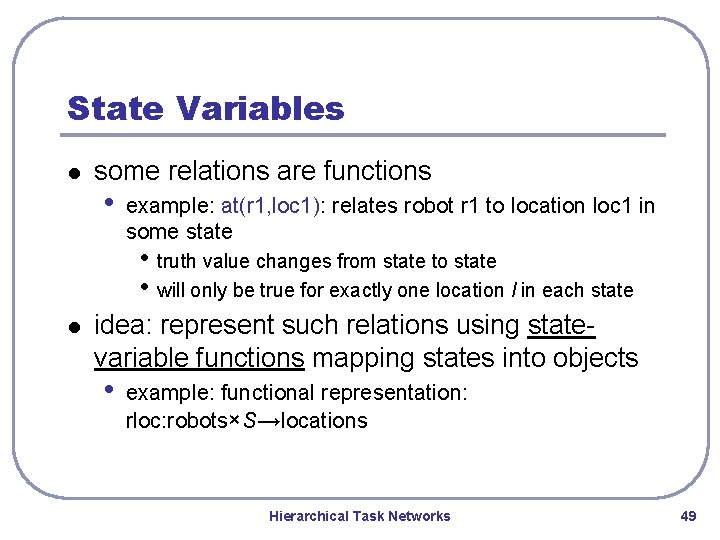
State Variables l some relations are functions • example: at(r 1, loc 1): relates robot r 1 to location loc 1 in some state • truth value changes from state to state • will only be true for exactly one location l in each state l idea: represent such relations using statevariable functions mapping states into objects • example: functional representation: rloc: robots×S→locations Hierarchical Task Networks 49
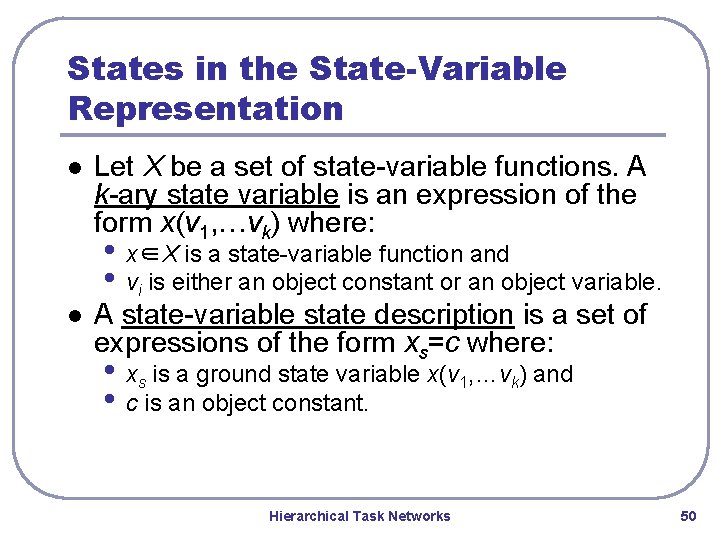
States in the State-Variable Representation l Let X be a set of state-variable functions. A k-ary state variable is an expression of the form x(v 1, …vk) where: • x∈X is a state-variable function and • vi is either an object constant or an object variable. l A state-variable state description is a set of expressions of the form xs=c where: • xs is a ground state variable x(v 1, …vk) and • c is an object constant. Hierarchical Task Networks 50
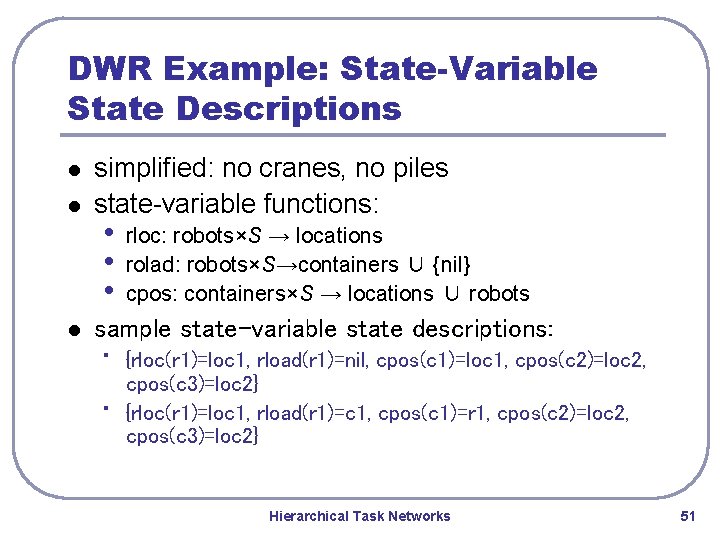
DWR Example: State-Variable State Descriptions l l l simplified: no cranes, no piles state-variable functions: • • • rloc: robots×S → locations rolad: robots×S→containers ∪ {nil} cpos: containers×S → locations ∪ robots sample state-variable state descriptions: • • {rloc(r 1)=loc 1, rload(r 1)=nil, cpos(c 1)=loc 1, cpos(c 2)=loc 2, cpos(c 3)=loc 2} {rloc(r 1)=loc 1, rload(r 1)=c 1, cpos(c 1)=r 1, cpos(c 2)=loc 2, cpos(c 3)=loc 2} Hierarchical Task Networks 51
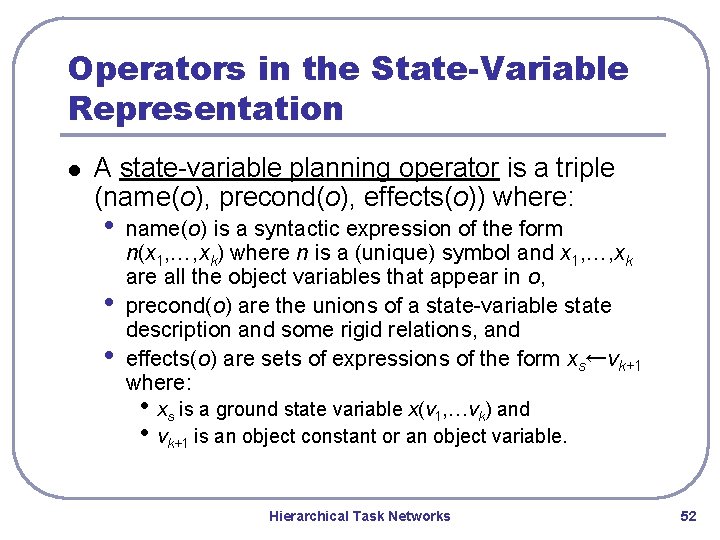
Operators in the State-Variable Representation l A state-variable planning operator is a triple (name(o), precond(o), effects(o)) where: • • • name(o) is a syntactic expression of the form n(x 1, …, xk) where n is a (unique) symbol and x 1, …, xk are all the object variables that appear in o, precond(o) are the unions of a state-variable state description and some rigid relations, and effects(o) are sets of expressions of the form xs←vk+1 where: • xs is a ground state variable x(v 1, …vk) and • vk+1 is an object constant or an object variable. Hierarchical Task Networks 52
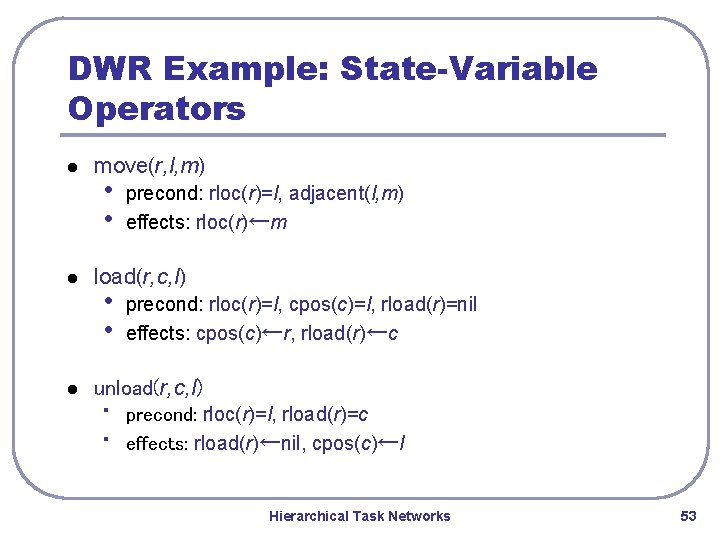
DWR Example: State-Variable Operators l l l move(r, l, m) • • precond: rloc(r)=l, adjacent(l, m) effects: rloc(r)←m load(r, c, l) • • precond: rloc(r)=l, cpos(c)=l, rload(r)=nil effects: cpos(c)←r, rload(r)←c unload(r, c, l) • • precond: rloc(r)=l, rload(r)=c effects: rload(r)←nil, cpos(c)←l Hierarchical Task Networks 53
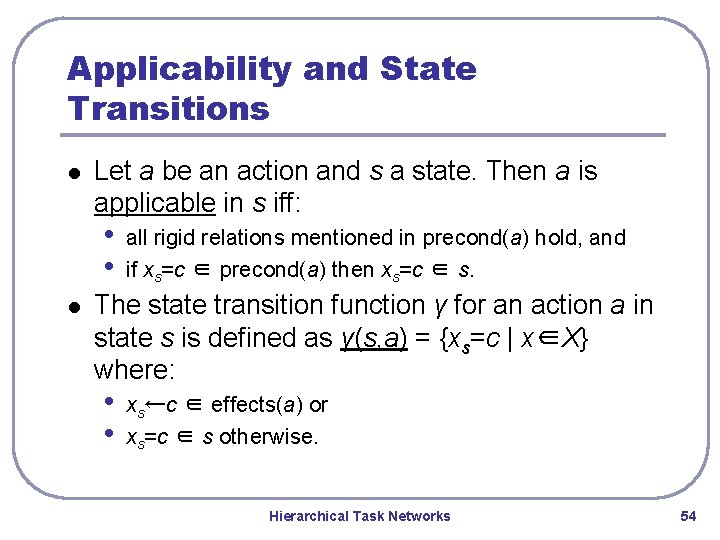
Applicability and State Transitions l Let a be an action and s a state. Then a is applicable in s iff: • • l all rigid relations mentioned in precond(a) hold, and if xs=c ∈ precond(a) then xs=c ∈ s. The state transition function γ for an action a in state s is defined as γ(s, a) = {xs=c | x∈X} where: • • xs←c ∈ effects(a) or xs=c ∈ s otherwise. Hierarchical Task Networks 54
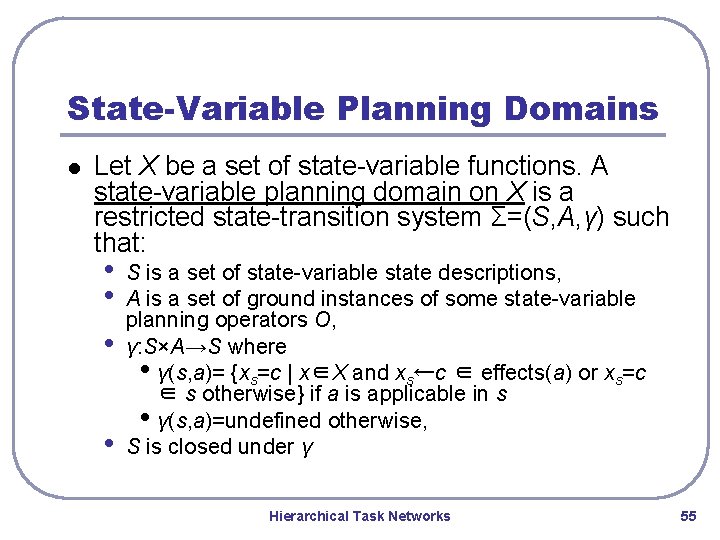
State-Variable Planning Domains l Let X be a set of state-variable functions. A state-variable planning domain on X is a restricted state-transition system Σ=(S, A, γ) such that: • • S is a set of state-variable state descriptions, A is a set of ground instances of some state-variable planning operators O, γ: S×A→S where • γ(s, a)= {xs=c | x∈X and xs←c ∈ effects(a) or xs=c ∈ s otherwise} if a is applicable in s • γ(s, a)=undefined otherwise, S is closed under γ Hierarchical Task Networks 55
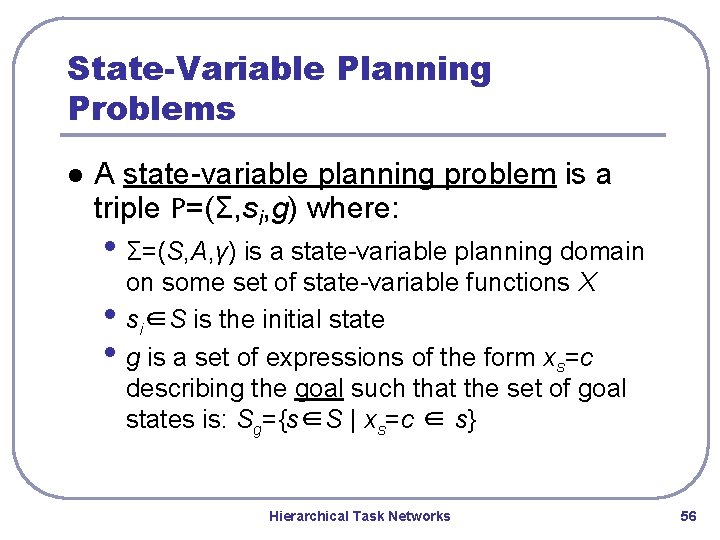
State-Variable Planning Problems l A state-variable planning problem is a triple P=(Σ, si, g) where: • Σ=(S, A, γ) is a state-variable planning domain • • on some set of state-variable functions X si∈S is the initial state g is a set of expressions of the form xs=c describing the goal such that the set of goal states is: Sg={s∈S | xs=c ∈ s} Hierarchical Task Networks 56
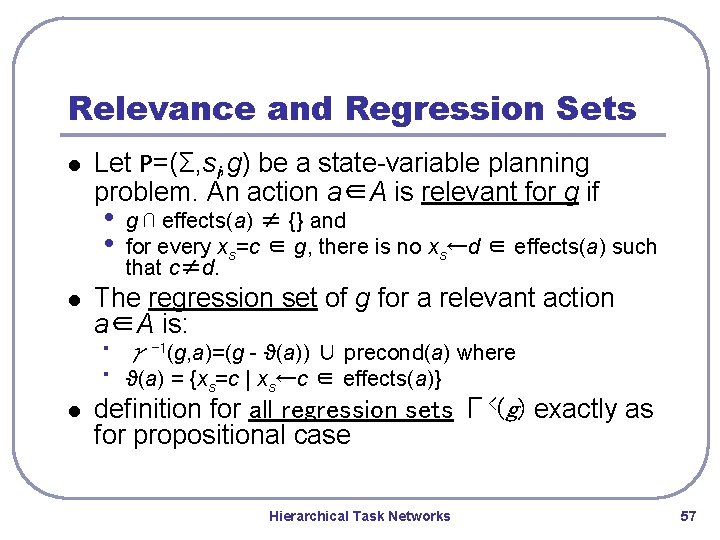
Relevance and Regression Sets l Let P=(Σ, si, g) be a state-variable planning problem. An action a∈A is relevant for g if • • l The regression set of g for a relevant action a∈A is: • • l g ⋂ effects(a) ≠ {} and for every xs=c ∈ g, there is no xs←d ∈ effects(a) such that c≠d. γ -1(g, a)=(g - ϑ(a)) ∪ precond(a) where ϑ(a) = {xs=c | xs←c ∈ effects(a)} definition for all regression sets Γ<(g) exactly as for propositional case Hierarchical Task Networks 57
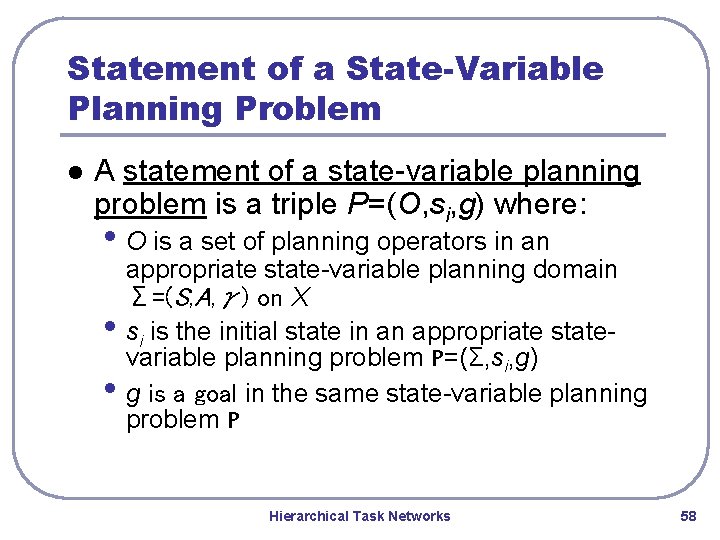
Statement of a State-Variable Planning Problem l A statement of a state-variable planning problem is a triple P=(O, si, g) where: • O is a set of planning operators in an • • appropriate state-variable planning domain Σ=(S, A, γ) on X si is the initial state in an appropriate statevariable planning problem P=(Σ, si, g) g is a goal in the same state-variable planning problem P Hierarchical Task Networks 58
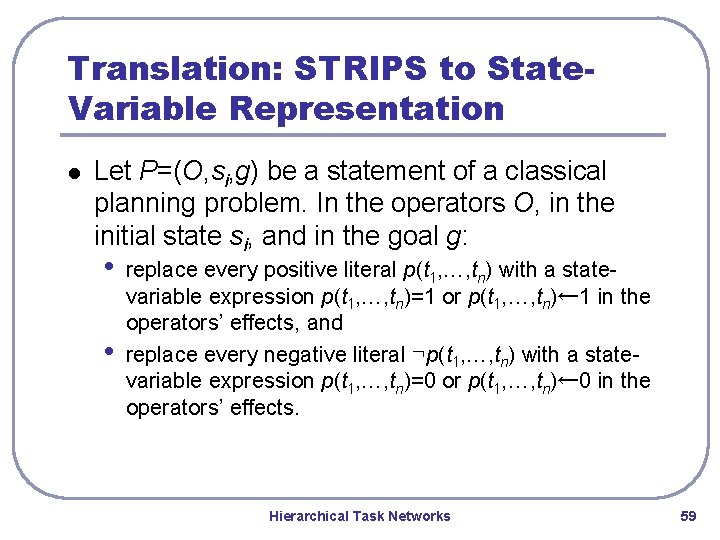
Translation: STRIPS to State. Variable Representation l Let P=(O, si, g) be a statement of a classical planning problem. In the operators O, in the initial state si, and in the goal g: • • replace every positive literal p(t 1, …, tn) with a statevariable expression p(t 1, …, tn)=1 or p(t 1, …, tn)← 1 in the operators’ effects, and replace every negative literal ¬p(t 1, …, tn) with a statevariable expression p(t 1, …, tn)=0 or p(t 1, …, tn)← 0 in the operators’ effects. Hierarchical Task Networks 59
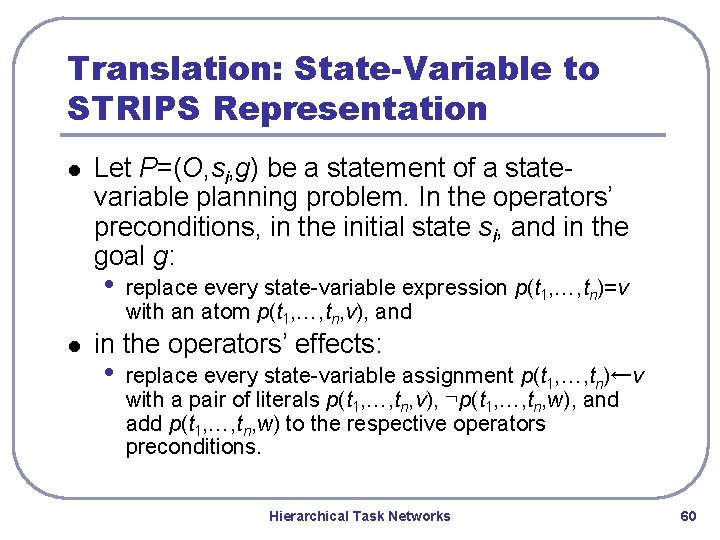
Translation: State-Variable to STRIPS Representation l Let P=(O, si, g) be a statement of a statevariable planning problem. In the operators’ preconditions, in the initial state si, and in the goal g: • l replace every state-variable expression p(t 1, …, tn)=v with an atom p(t 1, …, tn, v), and in the operators’ effects: • replace every state-variable assignment p(t 1, …, tn)←v with a pair of literals p(t 1, …, tn, v), ¬p(t 1, …, tn, w), and add p(t 1, …, tn, w) to the respective operators preconditions. Hierarchical Task Networks 60
Overview l l Simple Task Networks HTN Planning Extensions State-Variable Representation Hierarchical Task Networks 61