
Hierarchical Property Set Merging for SPARQL Query Optimization

- Slides: 20
Hierarchical Property Set Merging for SPARQL Query Optimization Marios Meimaris, Athena Research Center, Greece George Papastefanatos, Athena Research Center, Greece Panos Vassiliadis, University of Ioannina, Greece
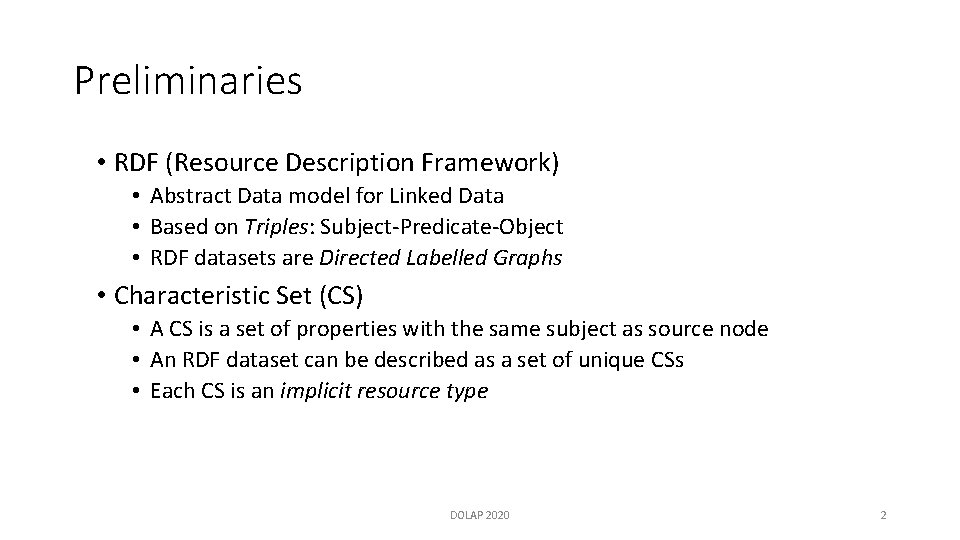
Preliminaries • RDF (Resource Description Framework) • Abstract Data model for Linked Data • Based on Triples: Subject-Predicate-Object • RDF datasets are Directed Labelled Graphs • Characteristic Set (CS) • A CS is a set of properties with the same subject as source node • An RDF dataset can be described as a set of unique CSs • Each CS is an implicit resource type DOLAP 2020 2
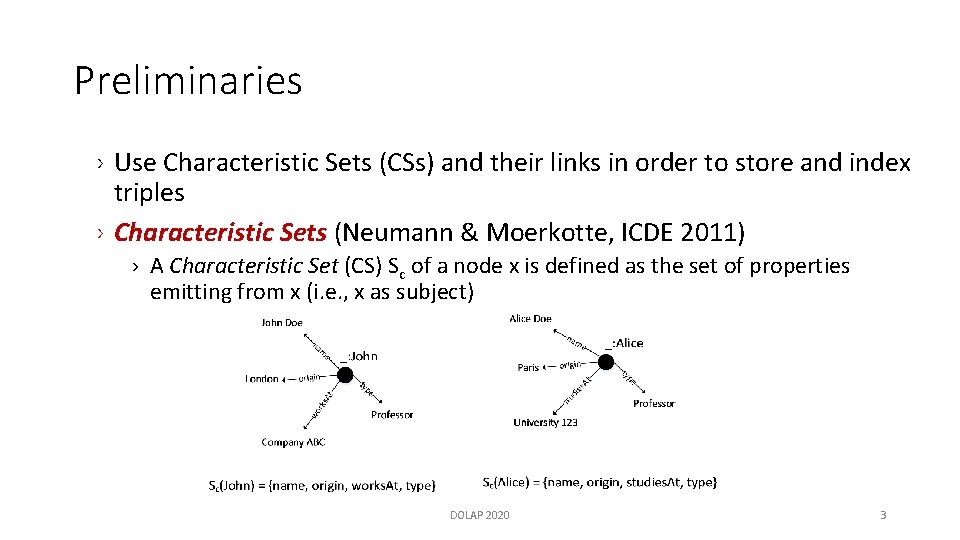
Preliminaries › Use Characteristic Sets (CSs) and their links in order to store and index triples › Characteristic Sets (Neumann & Moerkotte, ICDE 2011) › A Characteristic Set (CS) Sc of a node x is defined as the set of properties emitting from x (i. e. , x as subject) DOLAP 2020 3
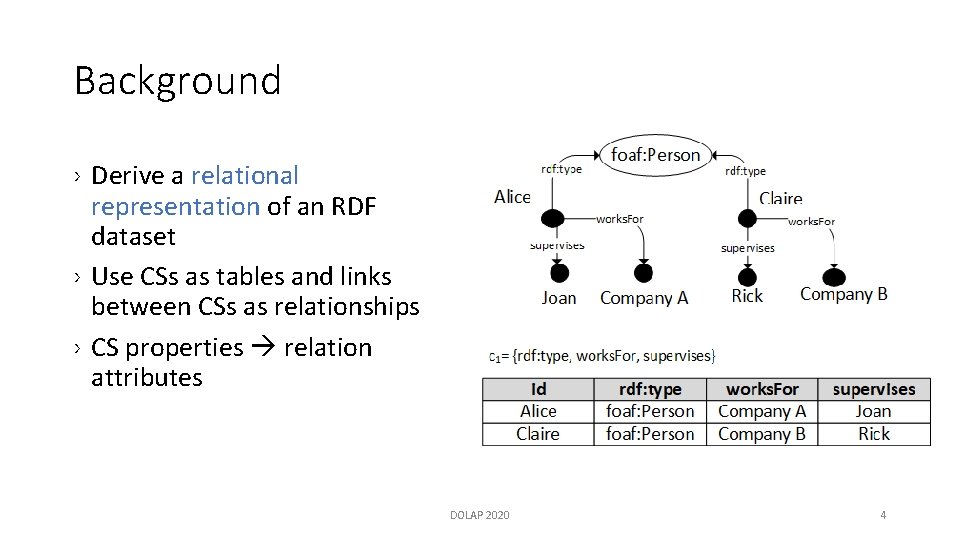
Background › Derive a relational representation of an RDF dataset › Use CSs as tables and links between CSs as relationships › CS properties relation attributes DOLAP 2020 4
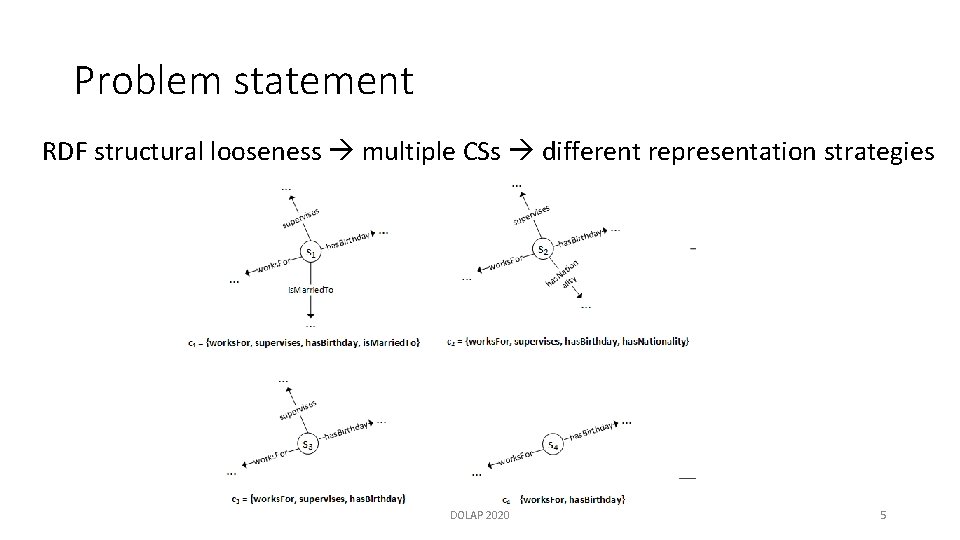
Problem statement RDF structural looseness multiple CSs different representation strategies DOLAP 2020 5
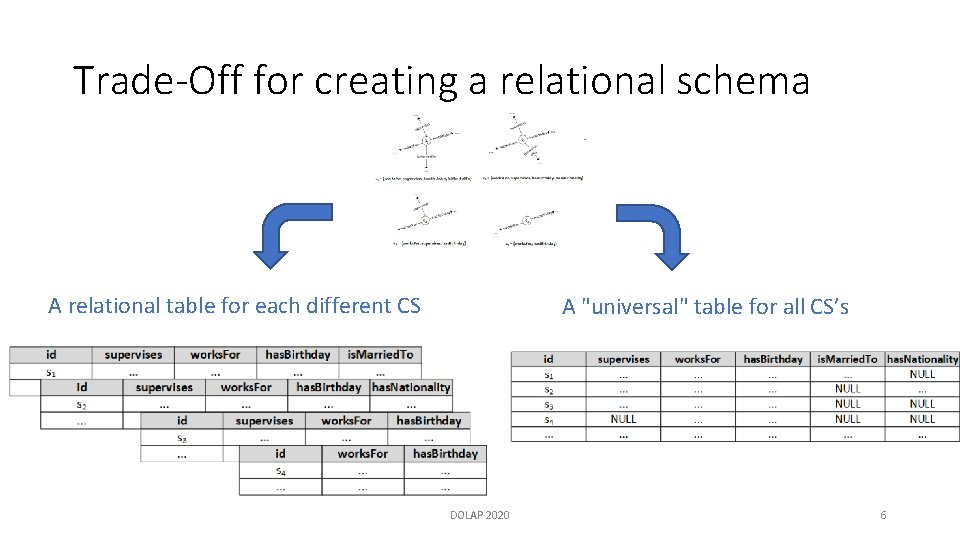
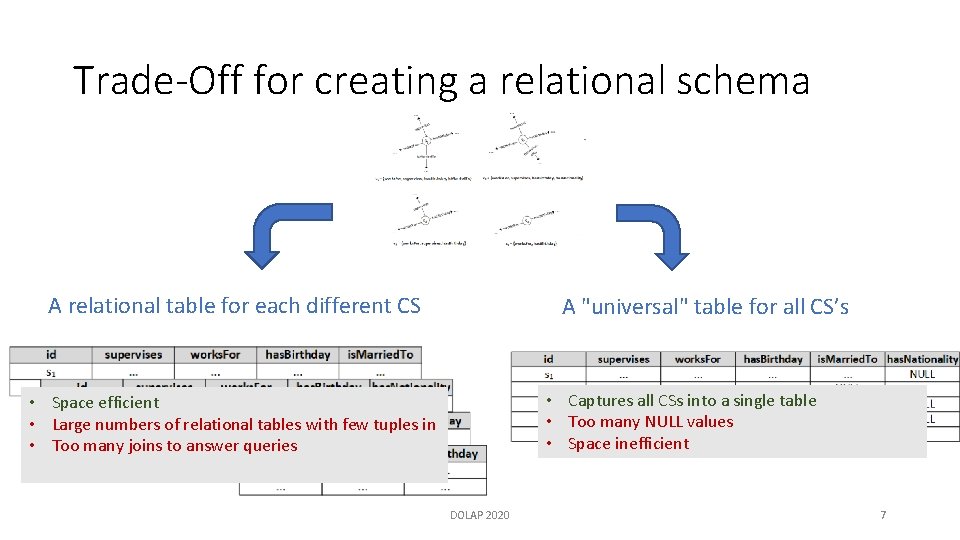
Trade-Off for creating a relational schema A relational table for each different CS A "universal" table for all CS’s DOLAP 2020 6
Trade-Off for creating a relational schema A relational table for each different CS A "universal" table for all CS’s • Captures all CSs into a single table • Too many NULL values • Space inefficient • Space efficient • Large numbers of relational tables with few tuples in • Too many joins to answer queries DOLAP 2020 7
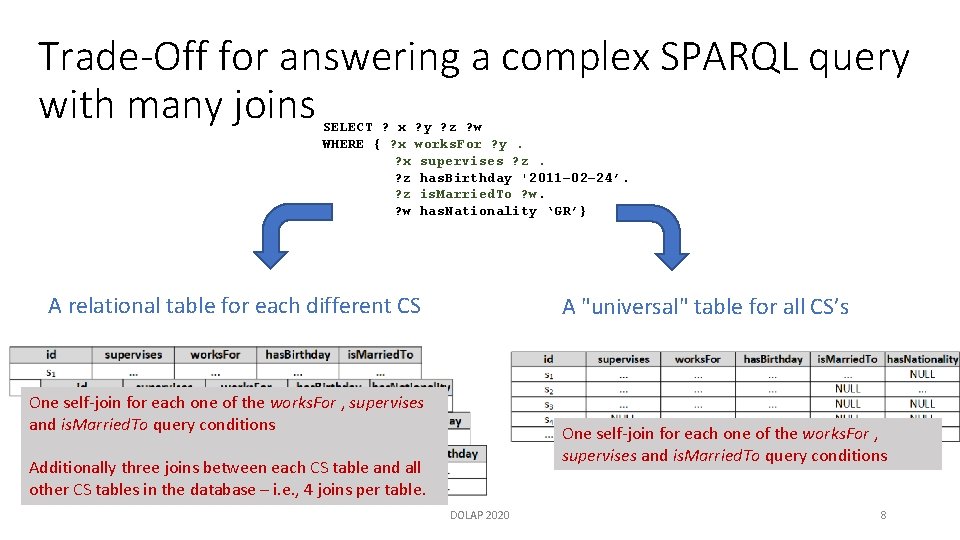
Trade-Off for answering a complex SPARQL query with many joins SELECT ? x ? y ? z ? w WHERE { ? x works. For ? y. ? x supervises ? z has. Birthday '2011− 02− 24’. ? z is. Married. To ? w has. Nationality ‘GR’} A relational table for each different CS A "universal" table for all CS’s One self-join for each one of the works. For , supervises and is. Married. To query conditions Additionally three joins between each CS table and all other CS tables in the database – i. e. , 4 joins per table. DOLAP 2020 8
Problem to be solved Context: Mapping heterogeneous RDF datasets to a relational schema with the aim to facilitate the processing of complex analytical SPARQL queries Solution: automating the decision of which tables will be created for a set of CS, such that there are no overly empty tables and extremely large numbers of joins. DOLAP 2020 9
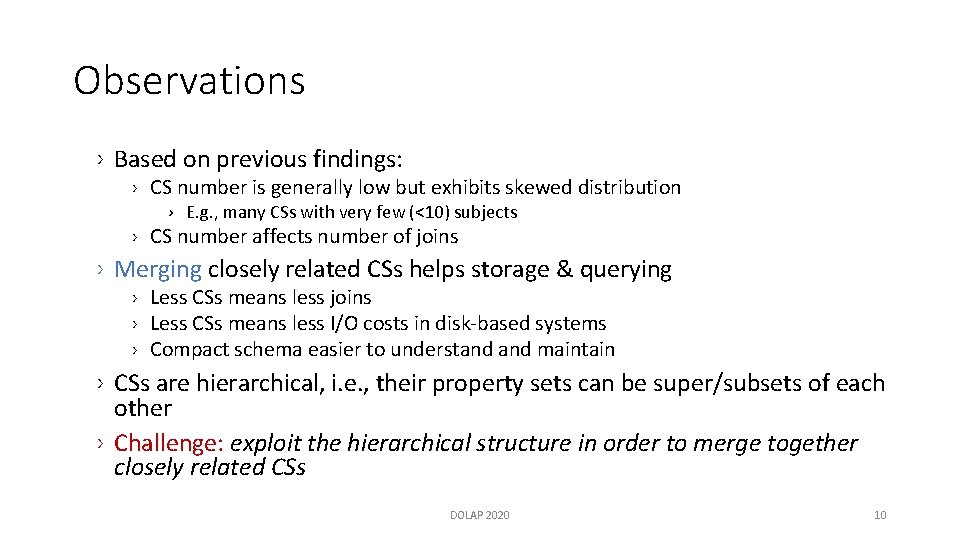
Observations › Based on previous findings: › CS number is generally low but exhibits skewed distribution › E. g. , many CSs with very few (<10) subjects › CS number affects number of joins › Merging closely related CSs helps storage & querying › Less CSs means less joins › Less CSs means less I/O costs in disk-based systems › Compact schema easier to understand maintain › CSs are hierarchical, i. e. , their property sets can be super/subsets of each other › Challenge: exploit the hierarchical structure in order to merge together closely related CSs DOLAP 2020 10
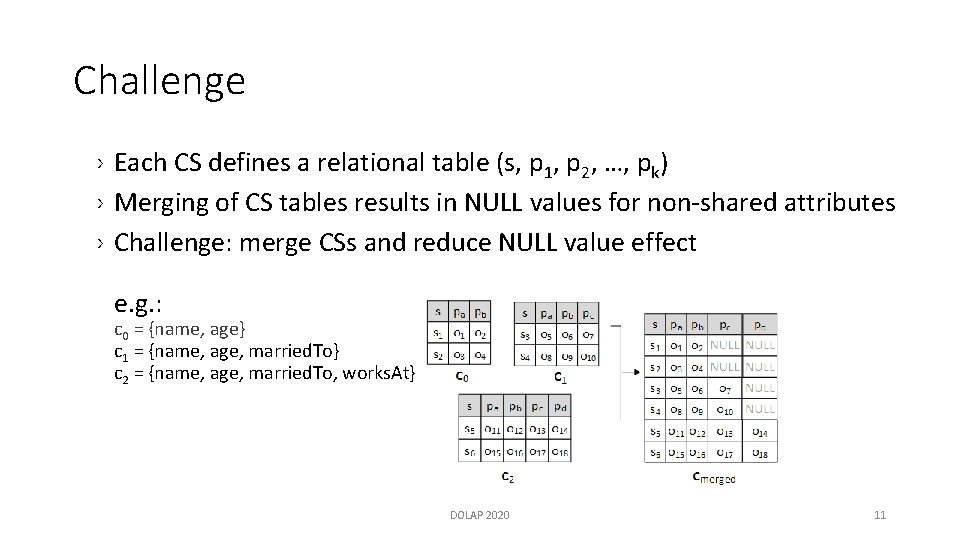
Challenge › Each CS defines a relational table (s, p 1, p 2, …, pk) › Merging of CS tables results in NULL values for non-shared attributes › Challenge: merge CSs and reduce NULL value effect e. g. : c 0 = {name, age} c 1 = {name, age, married. To} c 2 = {name, age, married. To, works. At} DOLAP 2020 11
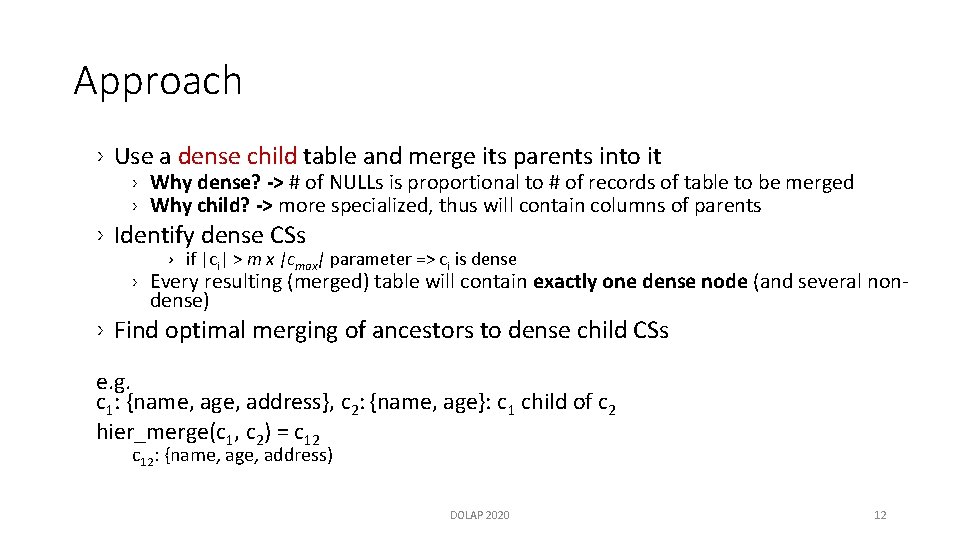
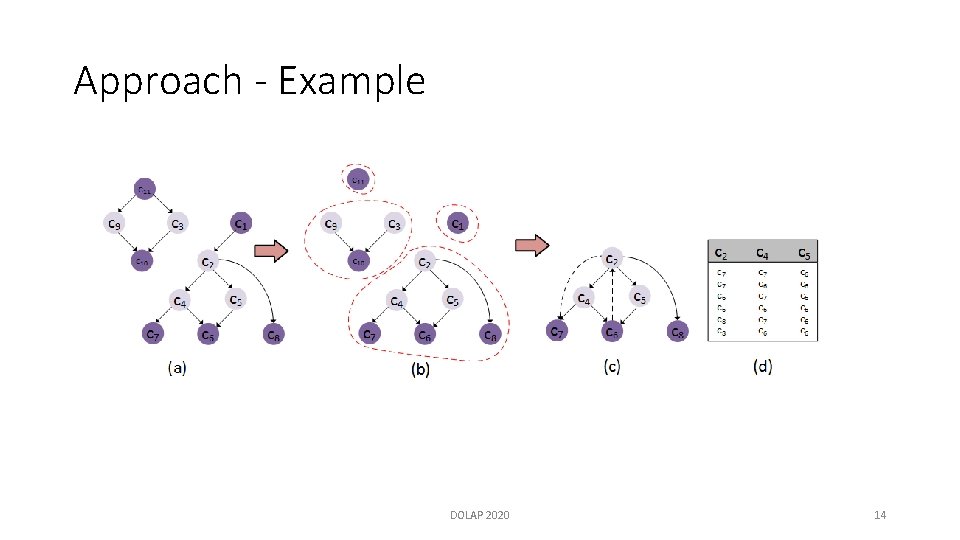
Approach › Use a dense child table and merge its parents into it › Why dense? -> # of NULLs is proportional to # of records of table to be merged › Why child? -> more specialized, thus will contain columns of parents › Identify dense CSs › if |ci| > m x |cmax| parameter => ci is dense › Every resulting (merged) table will contain exactly one dense node (and several nondense) › Find optimal merging of ancestors to dense child CSs e. g. c 1: {name, age, address}, c 2: {name, age}: c 1 child of c 2 hier_merge(c 1, c 2) = c 12: {name, age, address) DOLAP 2020 12
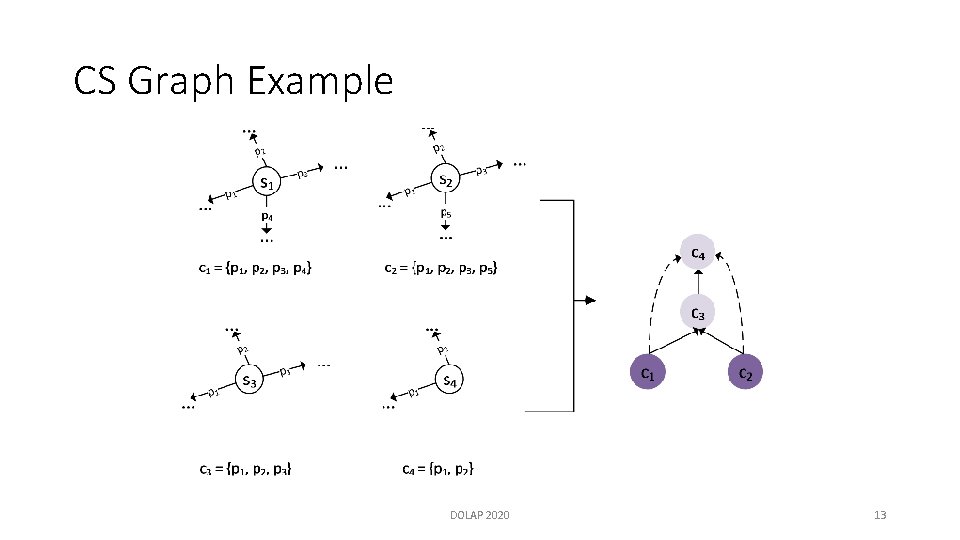
CS Graph Example DOLAP 2020 13
Approach - Example DOLAP 2020 14
Approach – Loading and Merging › Finding the optimal solution is equivalent to enumerating all possible sub-graphs -> exponential › Greedy approximation › At each step, merge parent CS and dense child CS that minimize objective cost function › Cost function minimizes the number of NULL values introduced by the merge › Tuning of m parameter DOLAP 2020 15
Approach – Querying › Parse incoming SPARQL queries › Identify query CSs that match merged CSs in the dataset › Rewrite query as an SQL statement with UNIONs between matched CSs › In case of SO/OS joins, prune off CSs that are not linked › Pass final query to relational optimizer › Build and output results DOLAP 2020 16
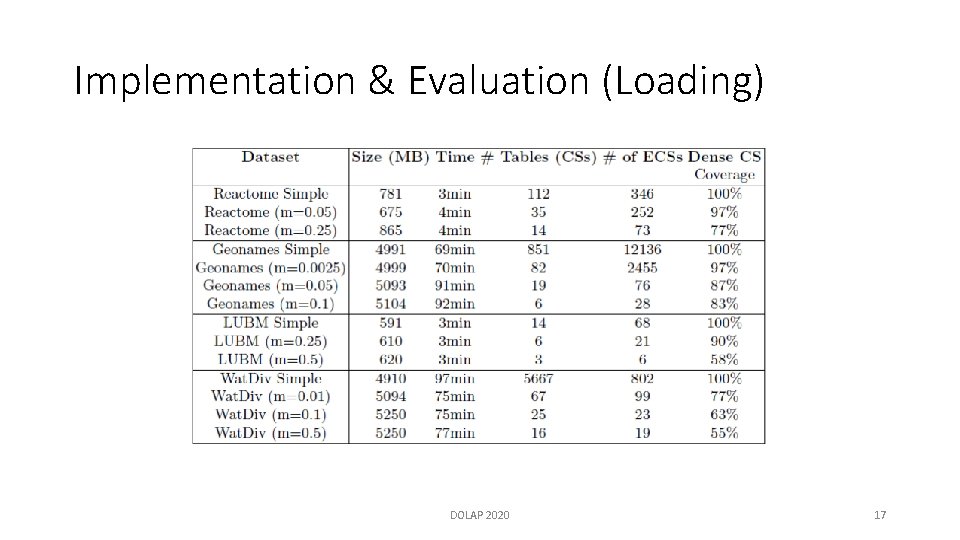
Implementation & Evaluation (Loading) DOLAP 2020 17
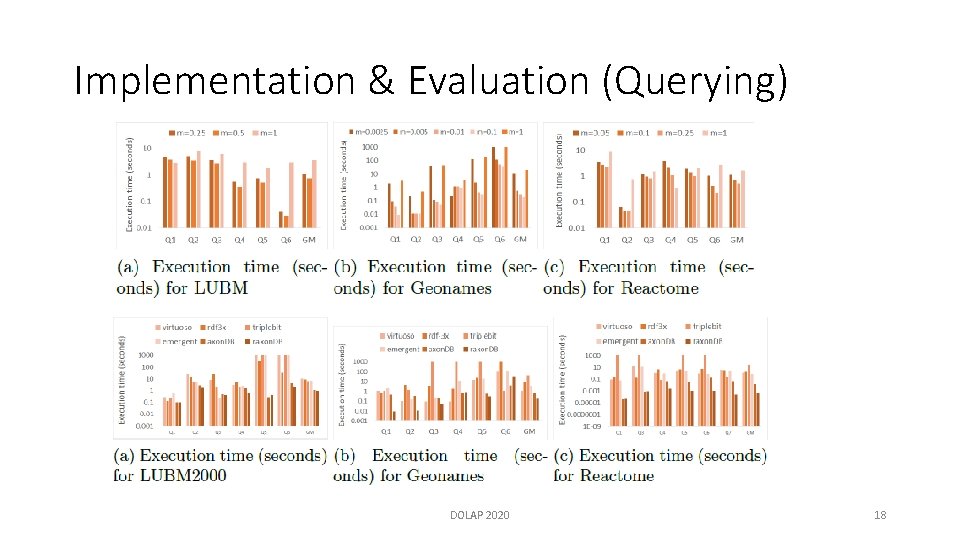
Implementation & Evaluation (Querying) DOLAP 2020 18
Future Work › Distributed version of raxon. DB › CS-based partitioning scheme › Distributed query processing › Refined cost function › Different ways of defining density DOLAP 2020 19
Thank you {m. meimaris, gpapas}@athenarc. gr, pvassil@cs. uoi. gr https: //github. com/mmeimaris/raxon. DB https: //visualfacts. imsi. athenarc. gr/ This research is funded by the project Visual. Facts (#1614) - 1 st Call of the Hellenic Foundation for Research and Innovation Research Projects for the support of post-doctoral researchers. DOLAP 2020 20