
Hierarchical processing in the brain The role of
Hierarchical processing in the brain : The role of automaticity DGIST Department of Brain & Cognitive Sciences Hyeon-Ae Jeon
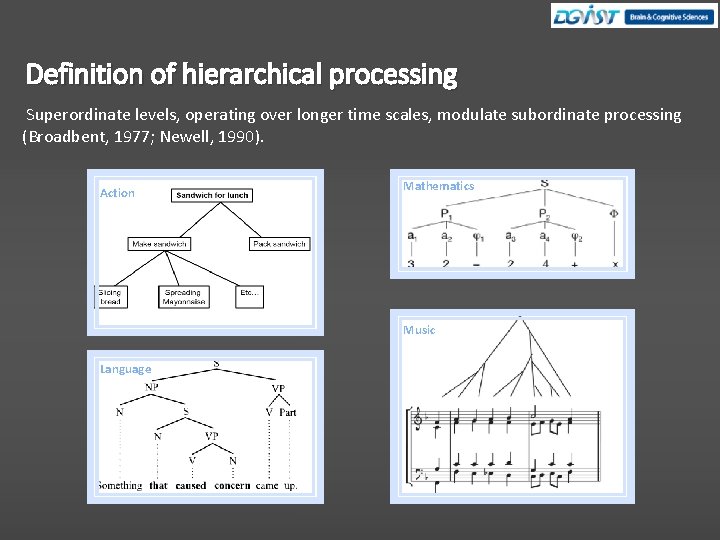
Definition of hierarchical processing Superordinate levels, operating over longer time scales, modulate subordinate processing (Broadbent, 1977; Newell, 1990). Action Mathematics Music Language
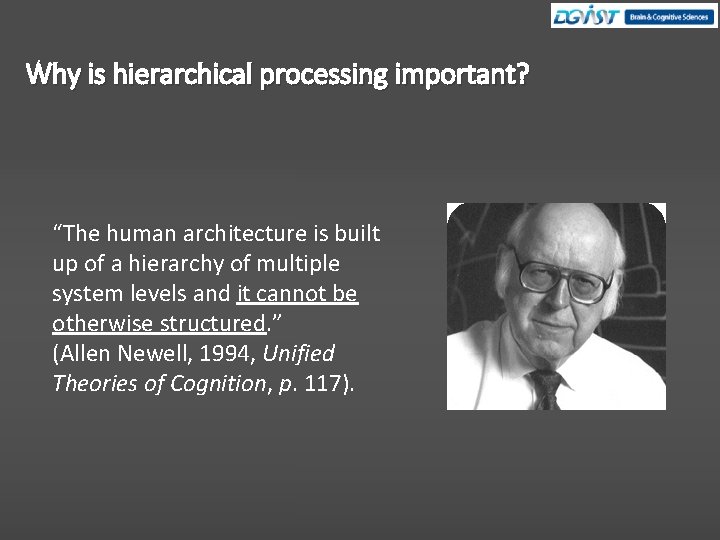
Why is hierarchical processing important? “The human architecture is built up of a hierarchy of multiple system levels and it cannot be otherwise structured. ” (Allen Newell, 1994, Unified Theories of Cognition, p. 117).
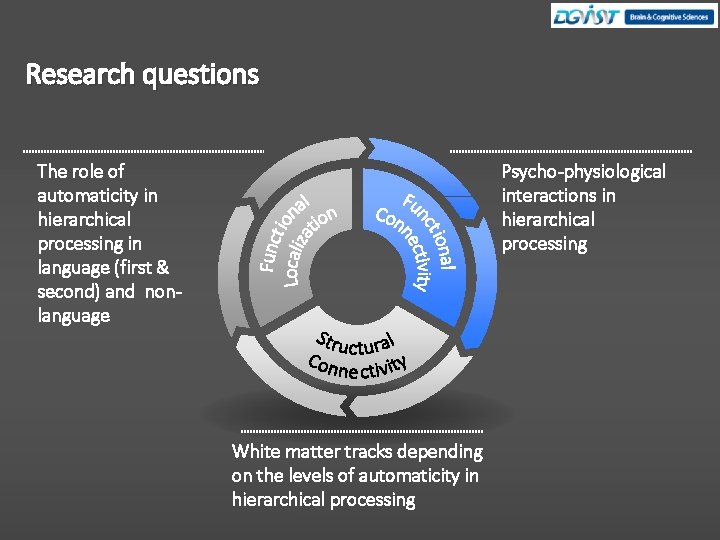
Research questions The role of automaticity in hierarchical processing in language (first & second) and nonlanguage Psycho-physiological interactions in hierarchical processing White matter tracks depending on the levels of automaticity in hierarchical processing
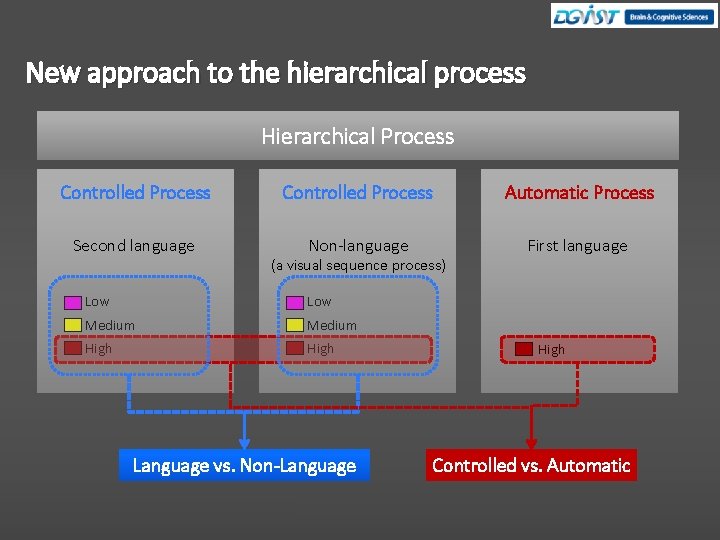
New approach to the hierarchical process Hierarchical Process Controlled Process Automatic Process Second language Non-language First language (a visual sequence process) Low Medium High Language vs. Non-Language High Controlled vs. Automatic
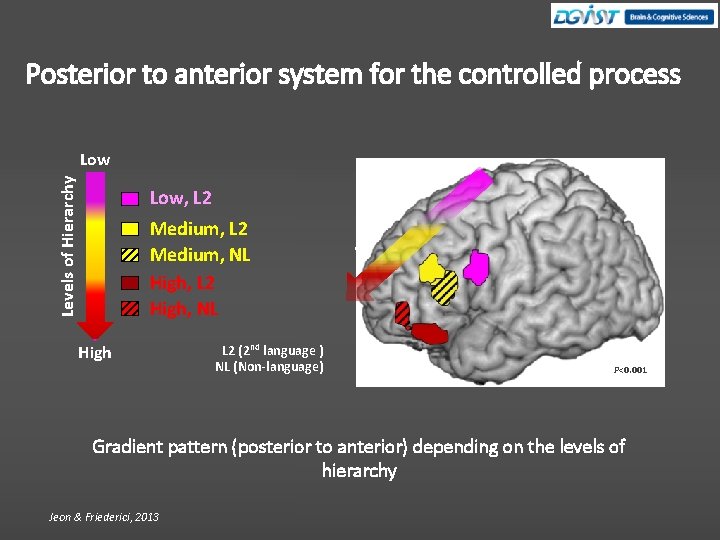
Posterior to anterior system for the controlled process Levels of Hierarchy Low r io r ste Po Low, L 2 Medium, NL High, L 2 High, NL High L 2 (2 nd language ) NL (Non-language) An r io r te P<0. 001 Gradient pattern (posterior to anterior) depending on the levels of hierarchy Jeon & Friederici, 2013
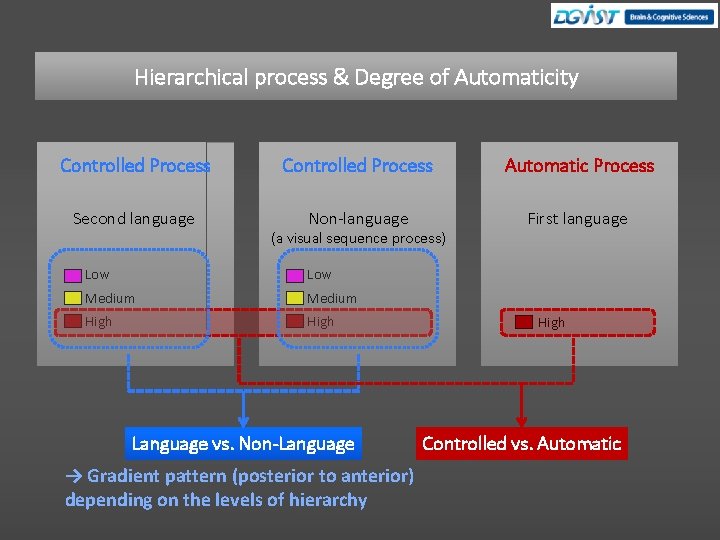
Hierarchical process Cognitive & Degree Controlof Automaticity Controlled Process Automatic Process Second language Non-language First language (a visual sequence process) Low Medium High Language vs. Non-Language → Gradient pattern (posterior to anterior) depending on the levels of hierarchy High Controlled vs. Automatic
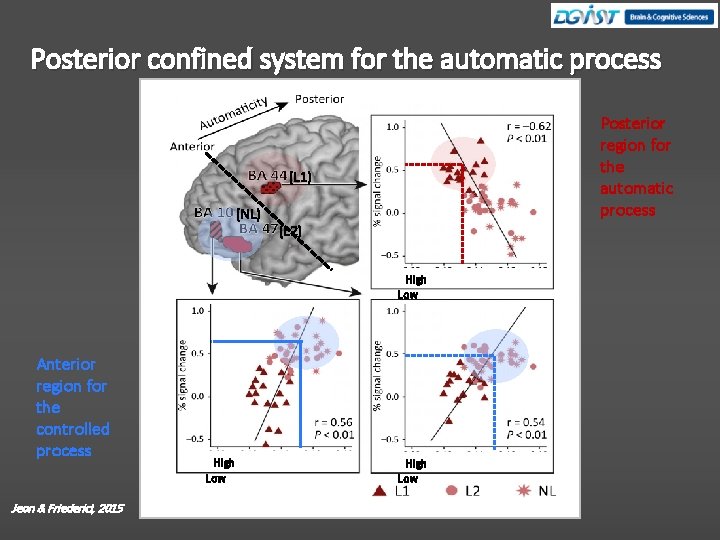
Posterior confined system for the automatic process Posterior region for the automatic process (L 1) (NL) (L 2) High Low Anterior region for the controlled process Jeon & Friederici, 2015 High Low
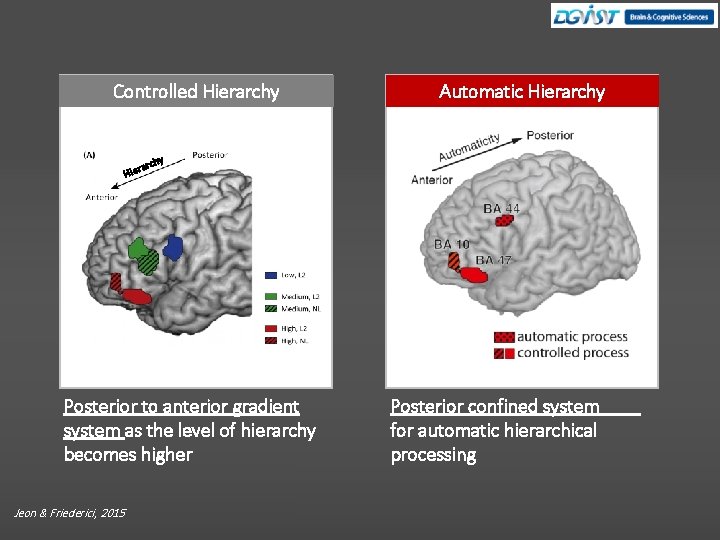
Controlled Hierarchy Automatic Hierarchy y h rarc Hie Posterior to anterior gradient system as the level of hierarchy becomes higher Jeon & Friederici, 2015 Posterior confined system for automatic hierarchical processing
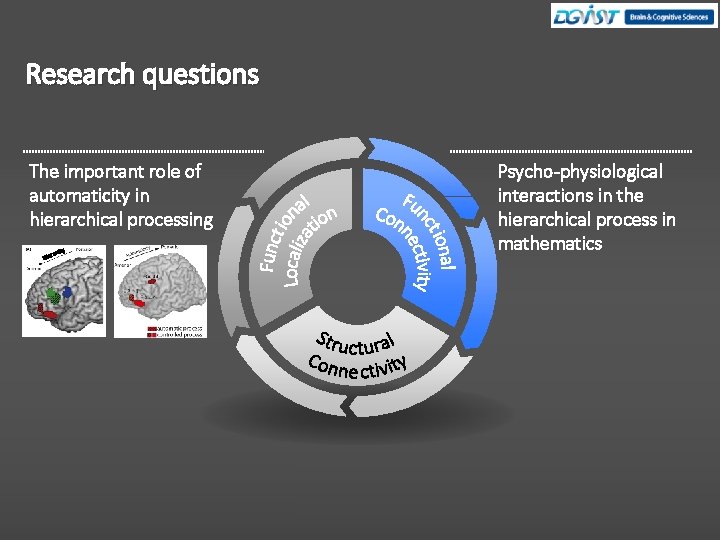
Research questions The important role of automaticity in hierarchical processing hy rarc Hie Psycho-physiological interactions in the hierarchical process in mathematics
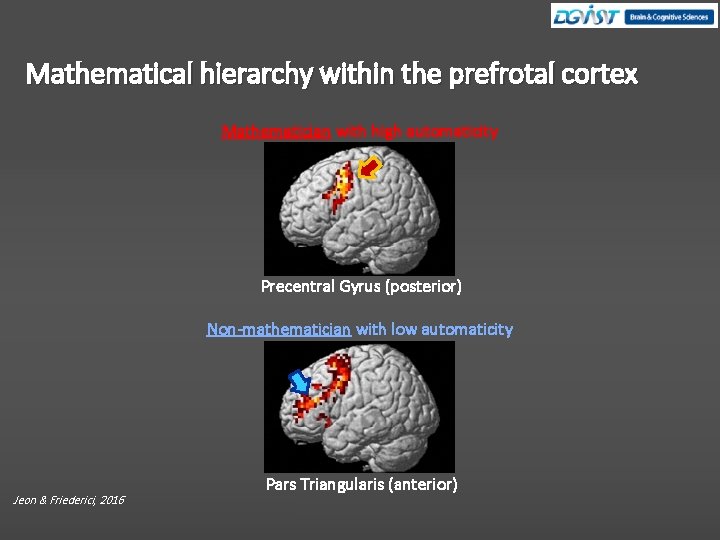
Mathematical hierarchy within the prefrotal cortex Mathematician with high automaticity Precentral Gyrus (posterior) Non-mathematician with low automaticity Jeon & Friederici, 2016 Pars Triangularis (anterior)
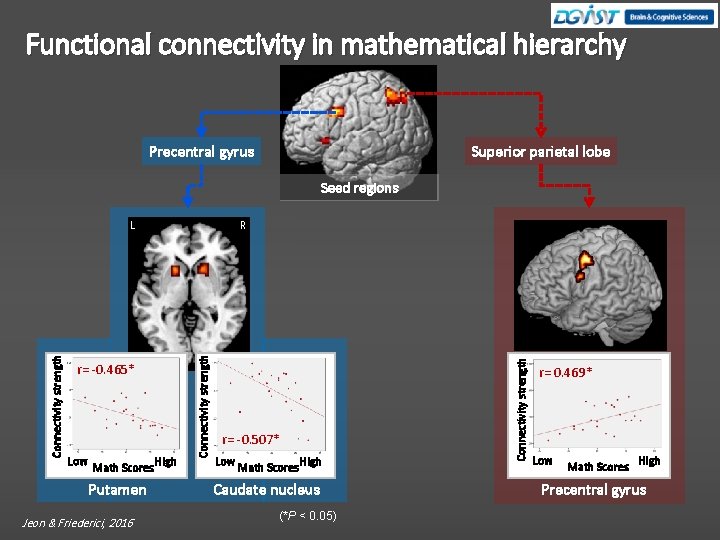
Functional connectivity in mathematical hierarchy Precentral gyrus Superior parietal lobe Seed regions r= -0. 465* Low Math Scores Putamen Jeon & Friederici, 2016 High r= -0. 507* Low Math Scores High Caudate nucleus (*P < 0. 05) Connectivity strength R Connectivity strength L r= 0. 469* Low Math Scores High Precentral gyrus
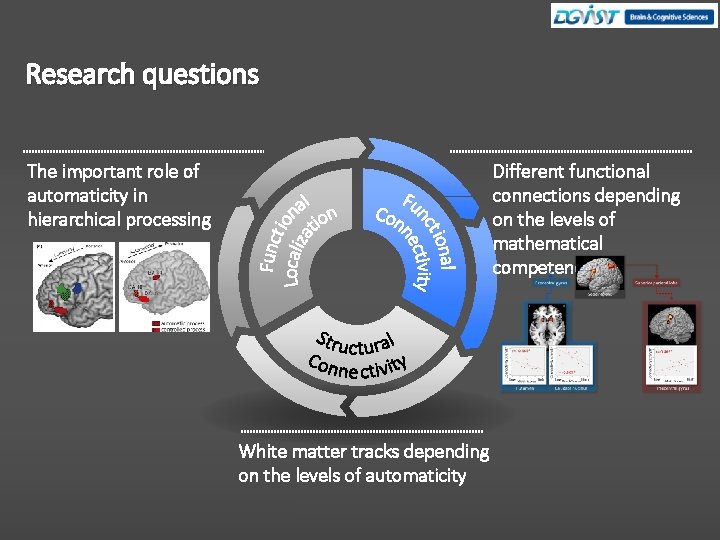
Research questions The important role of automaticity in hierarchical processing Different functional connections depending on the levels of mathematical competence White matter tracks depending on the levels of automaticity
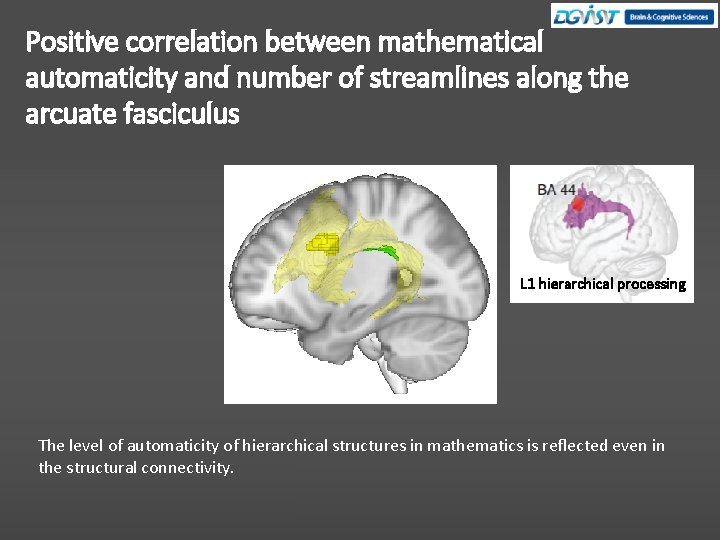
Positive correlation between mathematical automaticity and number of streamlines along the arcuate fasciculus L 1 hierarchical processing The level of automaticity of hierarchical structures in mathematics is reflected even in the structural connectivity.
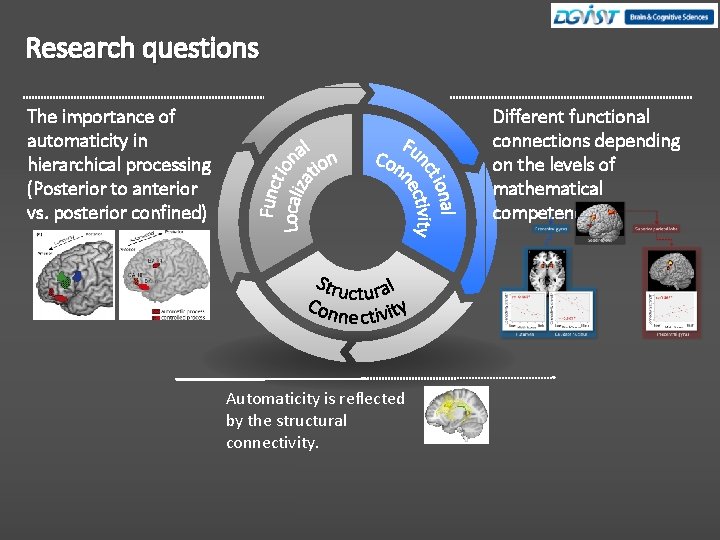
Research questions Different functional connections depending on the levels of mathematical competence The importance of automaticity in hierarchical processing (Posterior to anterior vs. posterior confined) Automaticity is reflected by the structural connectivity.
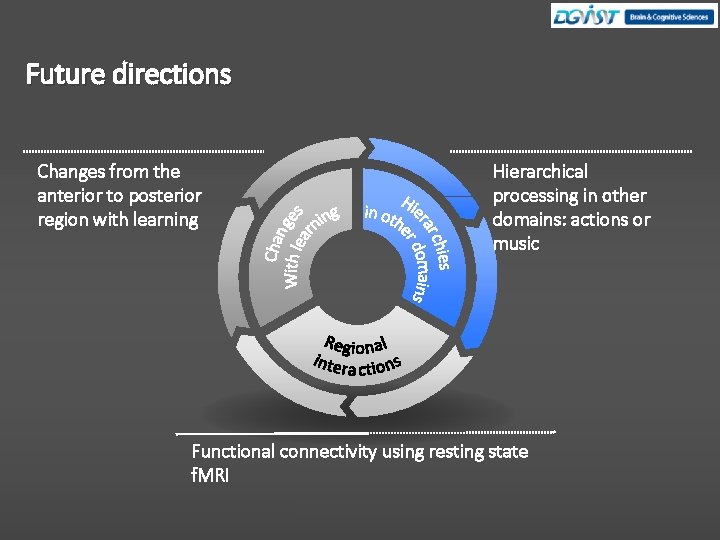
Future directions Changes from the anterior to posterior region with learning Hierarchical processing in other domains: actions or music Functional connectivity using resting state f. MRI

Thank you. jeonha@dgist. ac. kr cogneuro. dgist. ac. kr
- Slides: 17