
Hierarchical Classification vs Systematics Nomenclature is the science

- Slides: 21
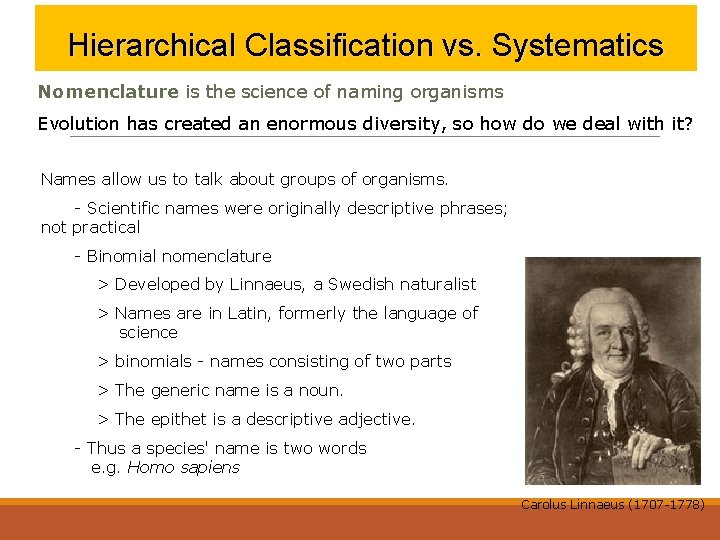
Hierarchical Classification vs. Systematics Nomenclature is the science of naming organisms Evolution has created an enormous diversity, so how do we deal with it? Names allow us to talk about groups of organisms. - Scientific names were originally descriptive phrases; not practical - Binomial nomenclature > Developed by Linnaeus, a Swedish naturalist > Names are in Latin, formerly the language of science > binomials - names consisting of two parts > The generic name is a noun. > The epithet is a descriptive adjective. - Thus a species' name is two words e. g. Homo sapiens Carolus Linnaeus (1707 -1778)
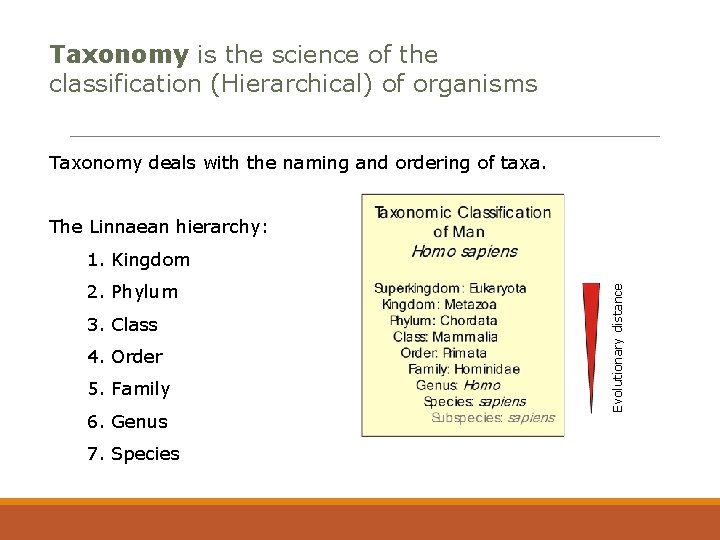
Taxonomy is the science of the classification (Hierarchical) of organisms Taxonomy deals with the naming and ordering of taxa. The Linnaean hierarchy: 2. Phylum 3. Class 4. Order 5. Family 6. Genus 7. Species Evolutionary distance 1. Kingdom
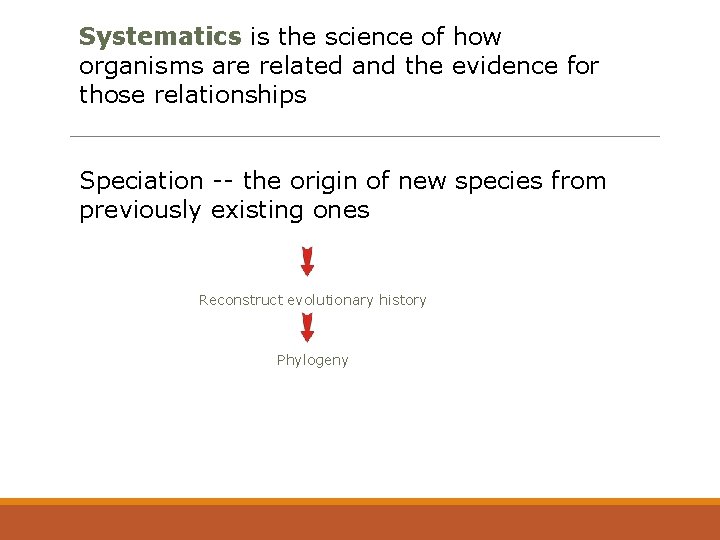
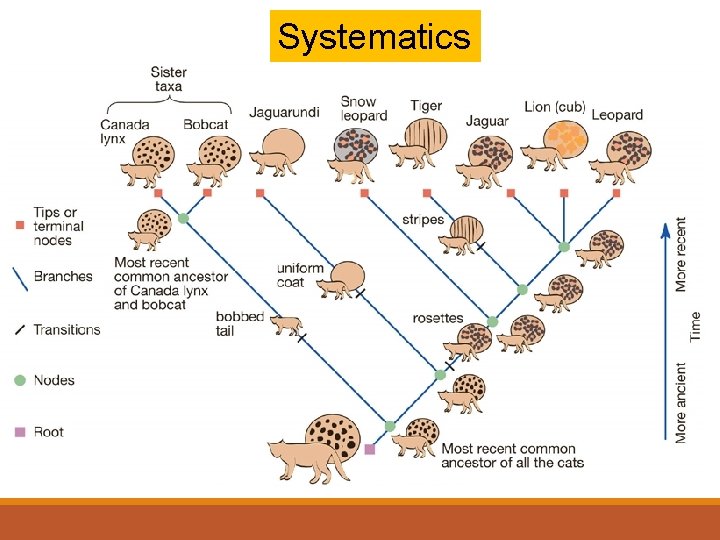
Systematics is the science of how organisms are related and the evidence for those relationships Speciation -- the origin of new species from previously existing ones Reconstruct evolutionary history Phylogeny
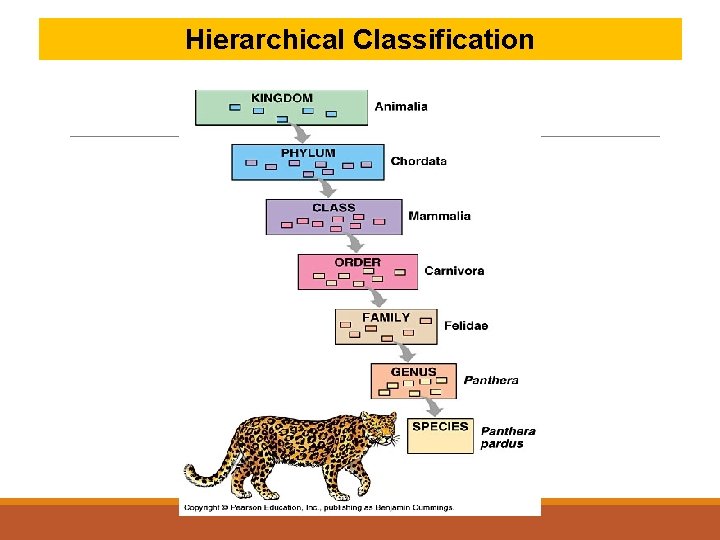
Hierarchical Classification
Systematics
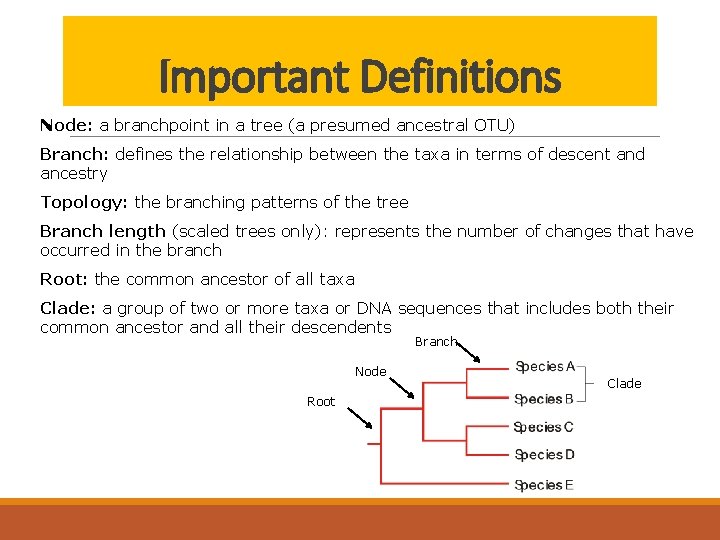
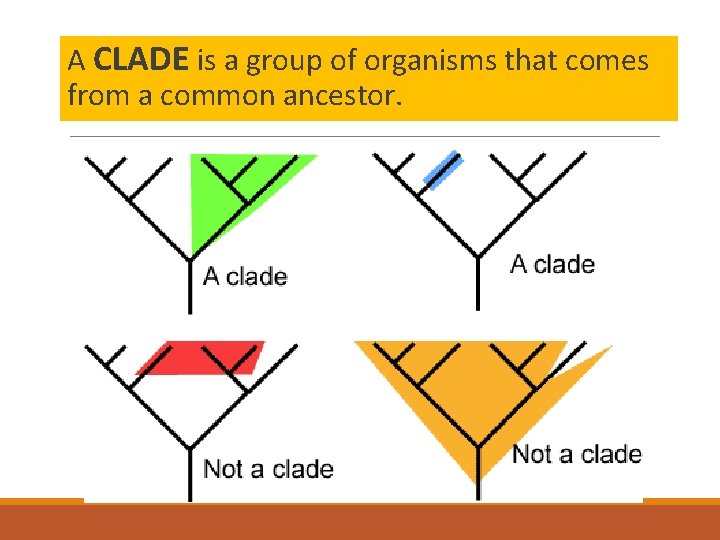
Important Definitions Node: a branchpoint in a tree (a presumed ancestral OTU) Branch: defines the relationship between the taxa in terms of descent and ancestry Topology: the branching patterns of the tree Branch length (scaled trees only): represents the number of changes that have occurred in the branch Root: the common ancestor of all taxa Clade: a group of two or more taxa or DNA sequences that includes both their common ancestor and all their descendents Branch Node Root Clade
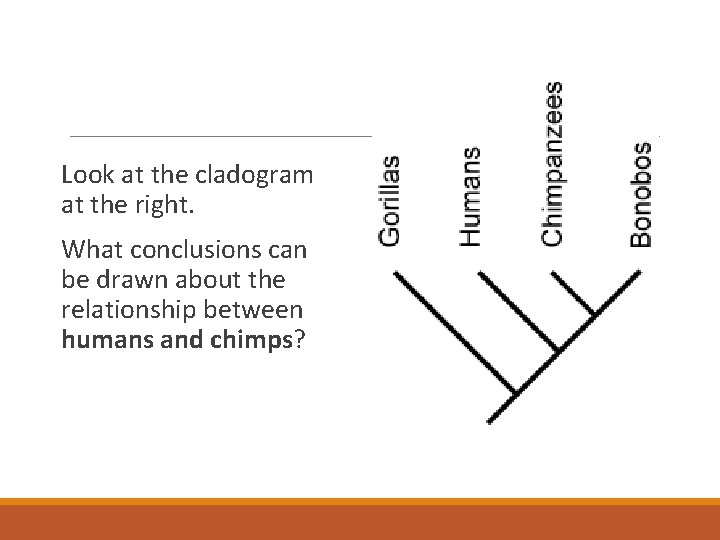
Look at the cladogram at the right. What conclusions can be drawn about the relationship between humans and chimps?
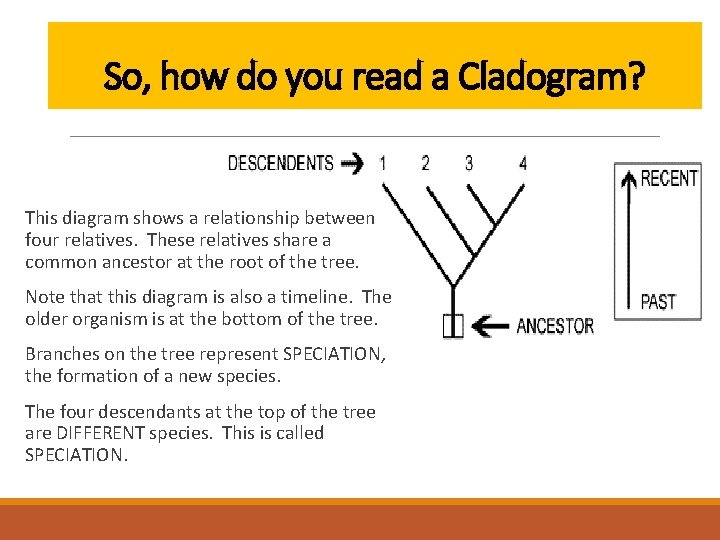
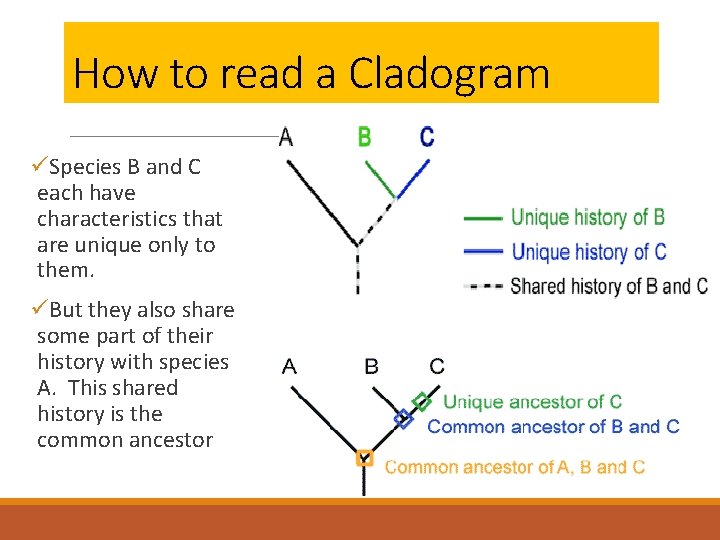
So, how do you read a Cladogram? This diagram shows a relationship between four relatives. These relatives share a common ancestor at the root of the tree. Note that this diagram is also a timeline. The older organism is at the bottom of the tree. Branches on the tree represent SPECIATION, the formation of a new species. The four descendants at the top of the tree are DIFFERENT species. This is called SPECIATION.
How to read a Cladogram üSpecies B and C each have characteristics that are unique only to them. üBut they also share some part of their history with species A. This shared history is the common ancestor
A CLADE is a group of organisms that comes from a common ancestor.
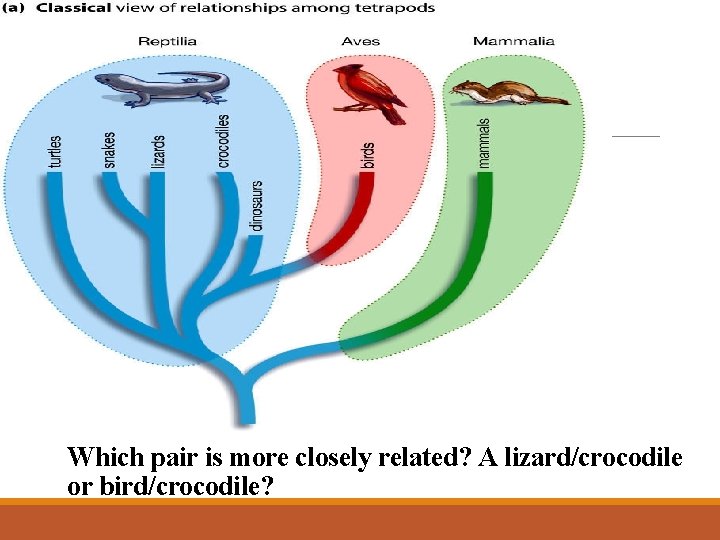
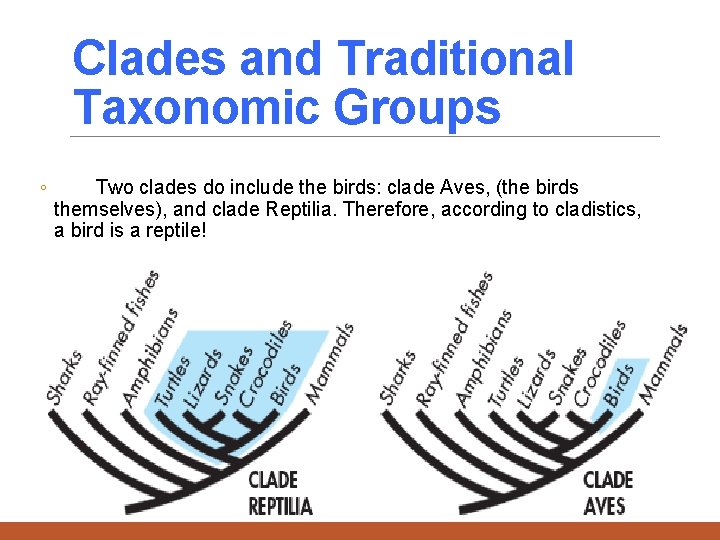
Which pair is more closely related? A lizard/crocodile or bird/crocodile?
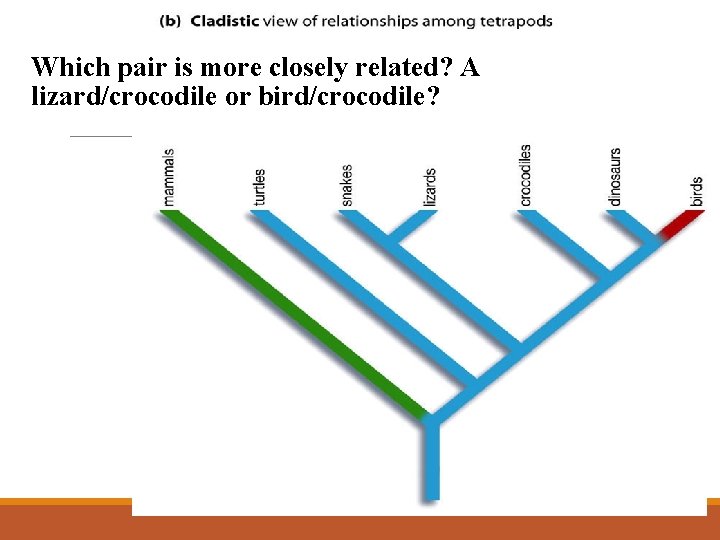
Which pair is more closely related? A lizard/crocodile or bird/crocodile?
Clades and Traditional Taxonomic Groups ◦ Two clades do include the birds: clade Aves, (the birds themselves), and clade Reptilia. Therefore, according to cladistics, a bird is a reptile!
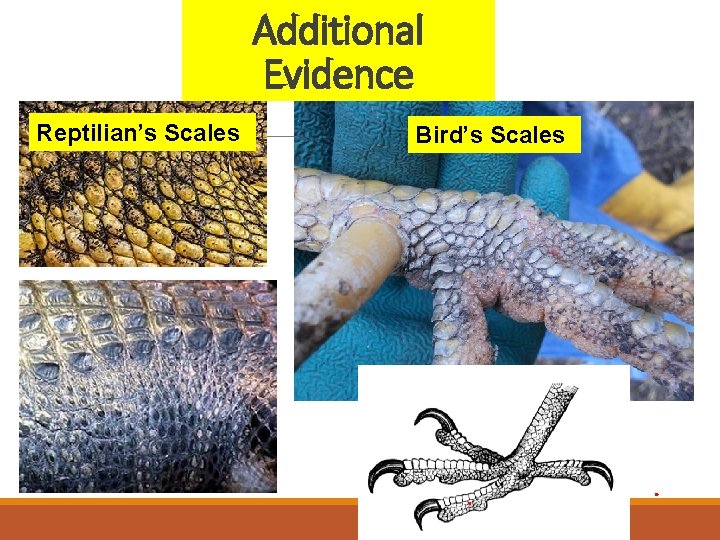
Additional Evidence Reptilian’s Scales Bird’s Scales
DNA in Classification ◦ ◦ How are DNA sequences used in classification? In general, the more derived genetic characters two species share, the more recently they shared a common ancestor and the more closely they are related in evolutionary terms.
Genes as Derived Characters ◦ All organisms carry genetic information in their DNA passed on from earlier generations. ◦ A wide range of organisms share a number of genes and show important homologies that can be used to determine evolutionary relationships.
Genes as Derived Characters ◦ All eukaryotic cells, for example, have mitochondria, and all mitochondria have their own genes. ◦ Because all genes mutate over time, shared genes contain differences that can be treated as derived characters in cladistic analysis. ◦ For that reason, similarities and differences in DNA can be used to develop hypotheses about evolutionary relationships. ◦ This suggests that American vultures are more closely related to storks than to other vultures.
New Techniques Suggest New Trees ◦ The use of DNA characters in cladistic analysis has helped to make evolutionary trees more accurate. ◦ For example, traditionally African vultures and American vultures were classified together in the falcon family. ◦ Molecular analysis, however, showed that DNA from American vultures is more similar to the DNA of storks than it is to the DNA of African vultures.
New Techniques Suggest New Trees ◦ Often, scientists use DNA evidence when anatomical traits alone can’t provide clear answers. ◦ For example, giant pandas and red pandas share many characteristics with both bears and raccoons.
New Techniques Suggest New Trees ◦ DNA analysis revealed that the giant panda shares a more recent common ancestor with bears than with raccoons. Therefore, the giant panda has been placed in a clade with bears. ◦ Red pandas, however, are in a clade with raccoons and other animals like weasels and seals.
YOU DO 1. Take out a sheet of paper and title it: “Building a Cladogram” 2. Obtain a “Buckle Down” booklet from the bookcase. Open it on page 161. Read and complete the activity: Explore it Yourself 3. Begin by defining the following words: q Cladogram q Primitive traits q Derive traits