
Hideaki Iida Tokyo Institute of Technology Collaborators M
Hideaki Iida Tokyo Institute of Technology Collaborators: M. Oka, H. Suganuma The XXI International Symposium on Lattice Field Theory Tsukuba International Congress Center (EPOCHAL TSUKUBA) July 15 - 19, 2003 [Contents] ・Introduction ・Estimation of the full quark-gluon vertex ・Extension of calculation to finite temperature system ・Results and prospects
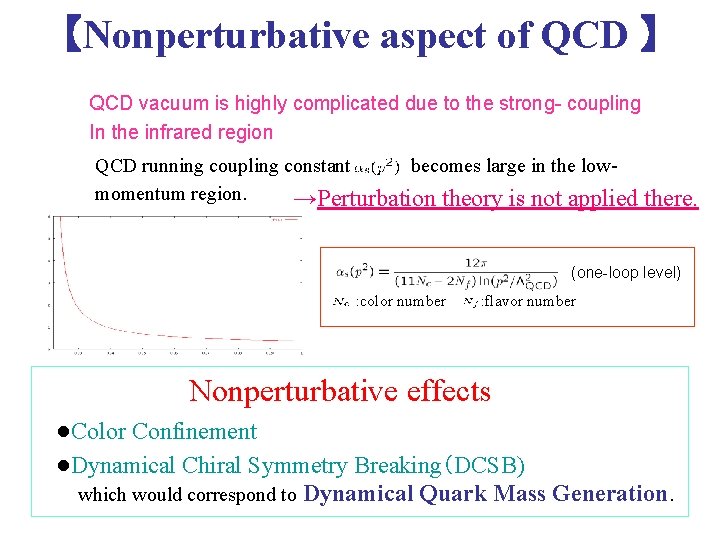
【Nonperturbative aspect of QCD 】 QCD vacuum is highly complicated due to the strong- coupling In the infrared region QCD running coupling constant becomes large in the lowmomentum region. →Perturbation theory is not applied there. (one-loop level) : color number : flavor number Nonperturbative effects ●Color Confinement ●Dynamical Chiral Symmetry Breaking(DCSB) which would correspond to Dynamical Quark Mass Generation.
Approaches to Nonperturbative QCD The aim of our study is to combine Lattice QCD simulation and the Schwinger-Dyson (SD) formalism for understanding nonperturbative QCD. There are two types of approaches: ・Effective model ex) NJL model、σ model、Instanton model、etc… …The picture of physics is clear in this approach. But this is not exactly based on QCD. ・Lattice QCD simulation …We can calculate physical quantities from first principle. But this is not analytic calculation. So, it is rather hard to extract the essense of the physics behind the phenomena. …We aim systematical understanding of QCD by unifying both methods. SD equation (model) + Lattice QCD
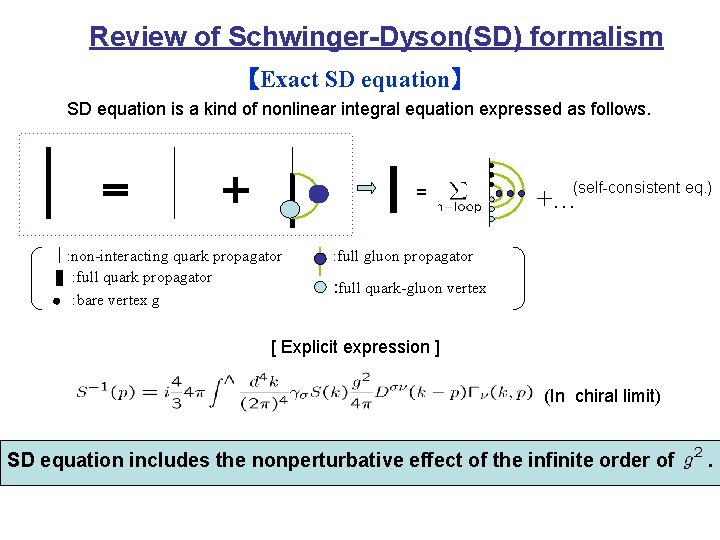
Review of Schwinger-Dyson(SD) formalism 【Exact SD equation】 SD equation is a kind of nonlinear integral equation expressed as follows. = + = : non-interacting quark propagator : full quark propagator : bare vertex g (self-consistent eq. ) +… : full gluon propagator : full quark-gluon vertex [ Explicit expression ] (In chiral limit) SD equation includes the nonperturbative effect of the infinite order of .
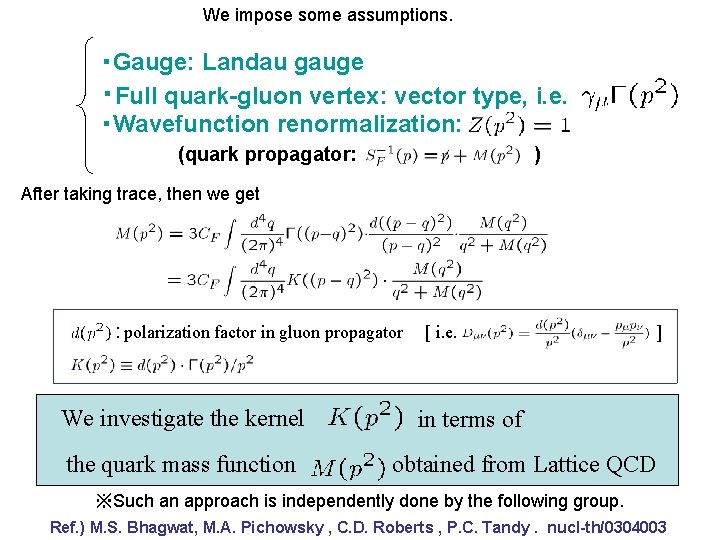
We impose some assumptions. ・Gauge: Landau gauge ・Full quark-gluon vertex: vector type, i. e. ・Wavefunction renormalization: (quark propagator: ) After taking trace, then we get :polarization factor in gluon propagator We investigate the kernel the quark mass function [ i. e. ] in terms of obtained from Lattice QCD ※Such an approach is independently done by the following group. Ref. ) M. S. Bhagwat, M. A. Pichowsky , C. D. Roberts , P. C. Tandy. nucl-th/0304003
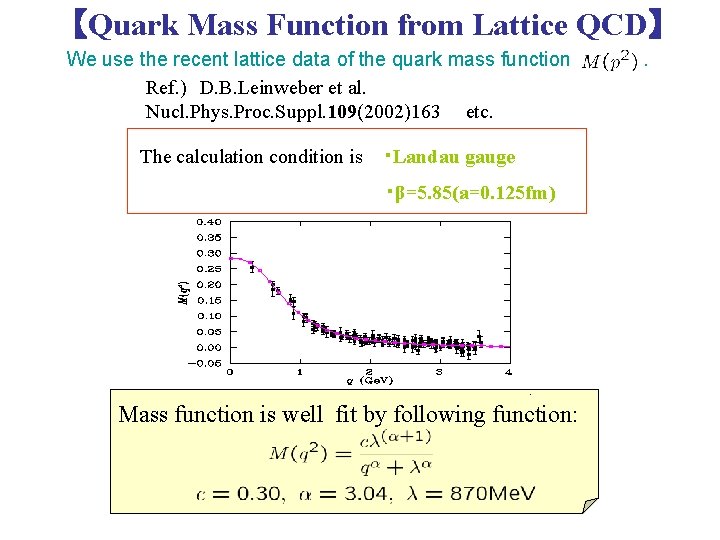
【Quark Mass Function from Lattice QCD】 We use the recent lattice data of the quark mass function Ref. ) D. B. Leinweber et al. Nucl. Phys. Proc. Suppl. 109(2002)163 etc. The calculation condition is ・Landau gauge ・β=5. 85(a=0. 125 fm) Mass function is well fit by following function: .

Extraction of the SD kernel The SD equation takes the convolution form. : So in coordinate space: Tilde means the Fourier transformation of a function. e. g. In fact, the kernel is expressed by According to this procedure, we can determine SD kernel.
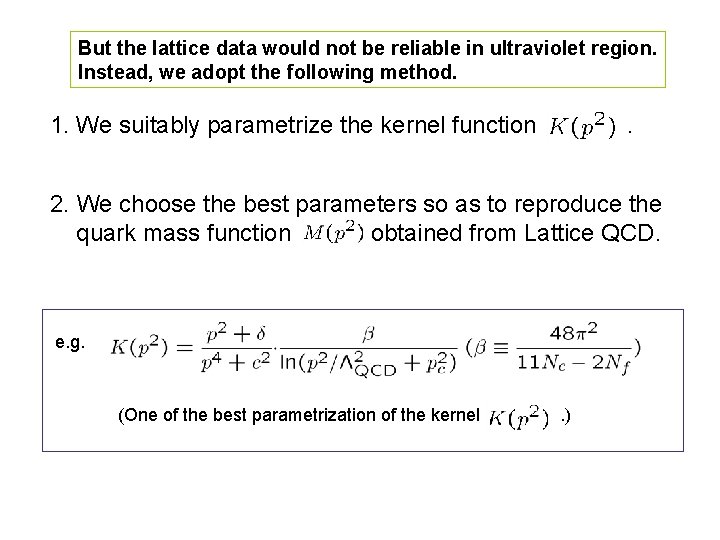
But the lattice data would not be reliable in ultraviolet region. Instead, we adopt the following method. 1. We suitably parametrize the kernel function . 2. We choose the best parameters so as to reproduce the quark mass function obtained from Lattice QCD. e. g. (One of the best parametrization of the kernel . )
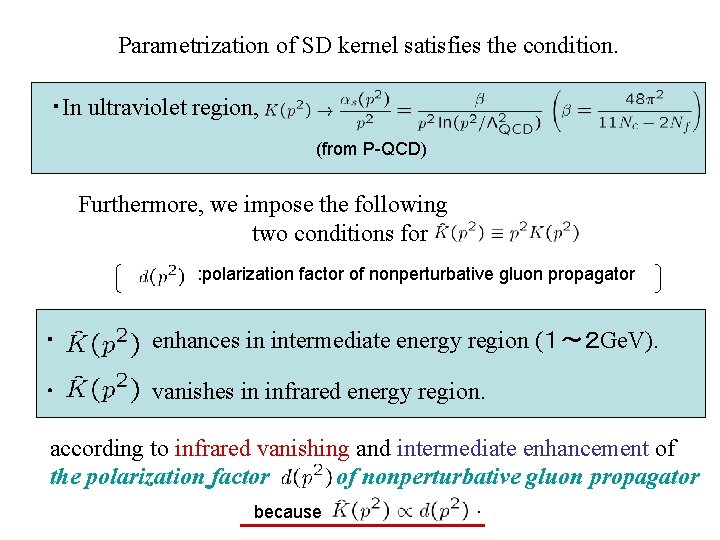
Parametrization of SD kernel satisfies the condition. ・In ultraviolet region, (from P-QCD) Furthermore, we impose the following two conditions for : polarization factor of nonperturbative gluon propagator ・ enhances in intermediate energy region (1~2 Ge. V). ・ vanishes in infrared energy region. according to infrared vanishing and intermediate enhancement of the polarization factor of nonperturbative gluon propagator. because
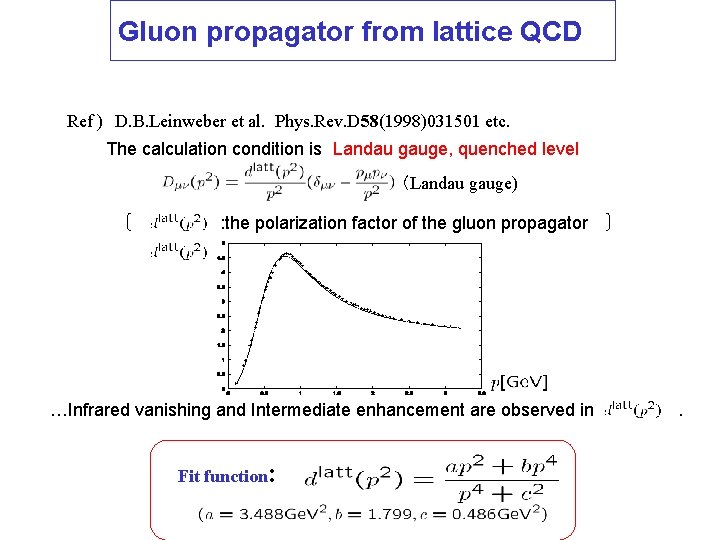
Gluon propagator from lattice QCD Ref ) D. B. Leinweber et al. Phys. Rev. D 58(1998)031501 etc. The calculation condition is Landau gauge, quenched level (Landau gauge) : the polarization factor of the gluon propagator …Infrared vanishing and Intermediate enhancement are observed in Fit function: .
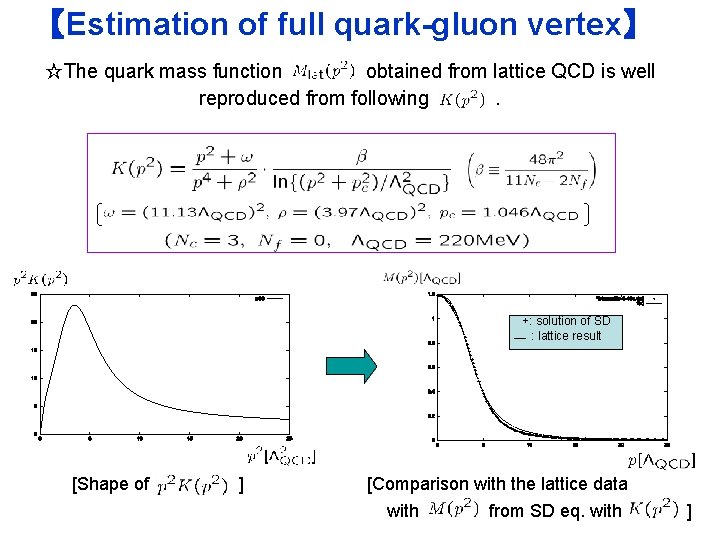
【Estimation of full quark-gluon vertex】 ☆The quark mass function obtained from lattice QCD is well reproduced from following. +: solution of SD : lattice result [Shape of ] [Comparison with the lattice data with from SD eq. with ]
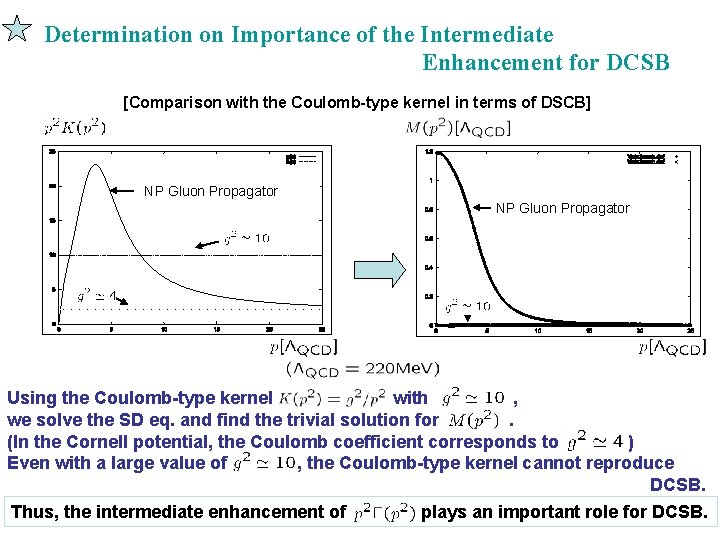
Determination on Importance of the Intermediate Enhancement for DCSB [Comparison with the Coulomb-type kernel in terms of DSCB] NP Gluon Propagator Using the Coulomb-type kernel with , we solve the SD eq. and find the trivial solution for. (In the Cornell potential, the Coulomb coefficient corresponds to ) Even with a large value of , the Coulomb-type kernel cannot reproduce DCSB. Thus, the intermediate enhancement of plays an important role for DCSB.
![Important quantities for DCSB There are several quantities related to DCSB [Pion decay constant]](http://slidetodoc.com/presentation_image_h2/121915c150bdab52998afccb453d9c12/image-13.jpg "Important quantities for DCSB There are several quantities related to DCSB [Pion decay constant]")
Important quantities for DCSB There are several quantities related to DCSB [Pion decay constant] With the Pagels-Stokar approximation, is derived from quark mass function. [quark condensate] ( is ultraviolet cutoff ) (RGI means renormalization group invariant quantity. )
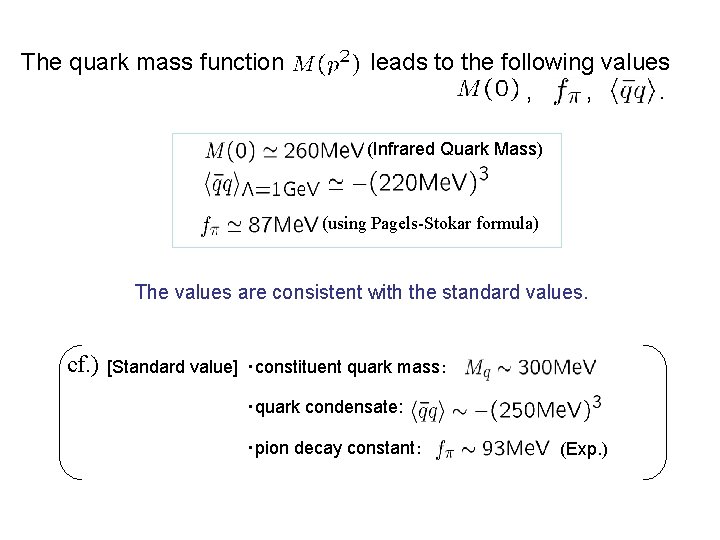
The quark mass function leads to the following values , , . (Infrared Quark Mass) (using Pagels-Stokar formula) The values are consistent with the standard values. cf. ) [Standard value] ・constituent quark mass: ・quark condensate: ・pion decay constant: (Exp. )
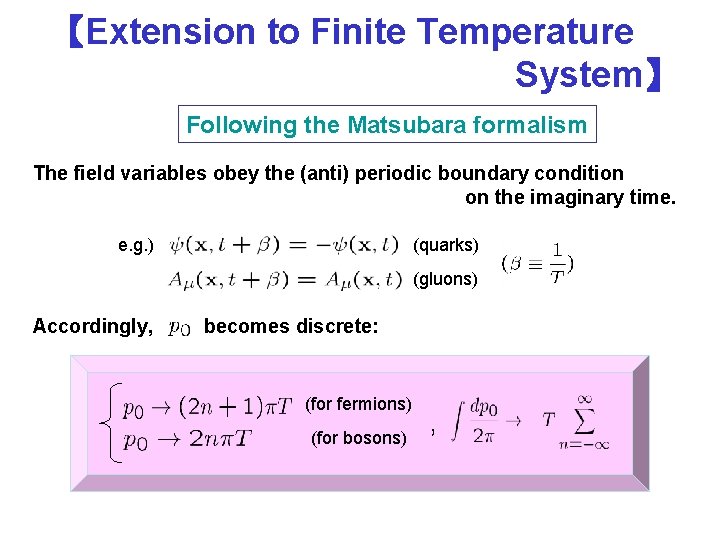
【Extension to Finite Temperature System】 Following the Matsubara formalism The field variables obey the (anti) periodic boundary condition on the imaginary time. e. g. ) (quarks) (gluons) Accordingly, becomes discrete: (for fermions) (for bosons) ,
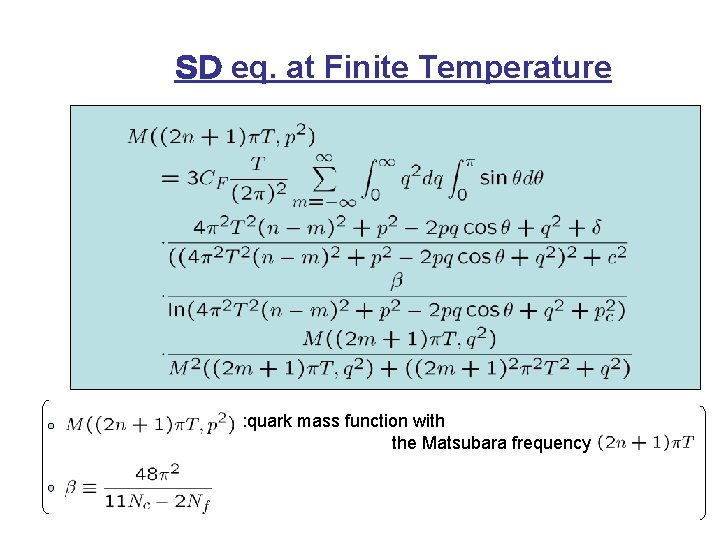
SD eq. at Finite Temperature : quark mass function with the Matsubara frequency
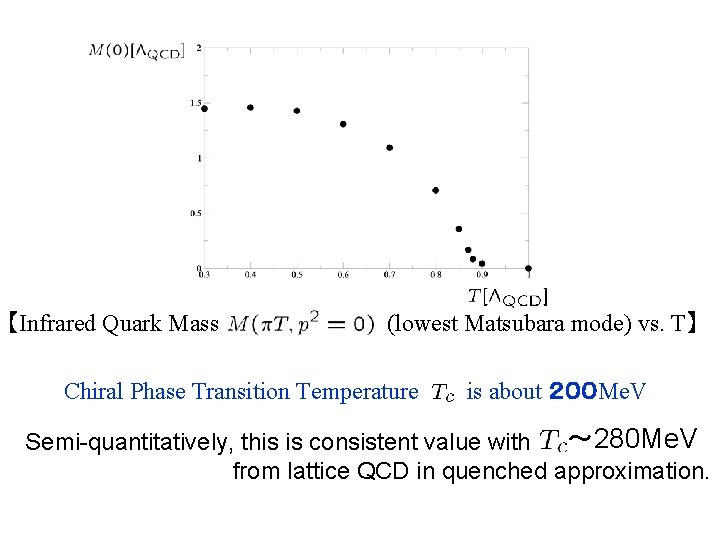
【Infrared Quark Mass (lowest Matsubara mode) vs. T】 Chiral Phase Transition Temperature is about 200 Me. V Semi-quantitatively, this is consistent value with ~ 280 Me. V from lattice QCD in quenched approximation.
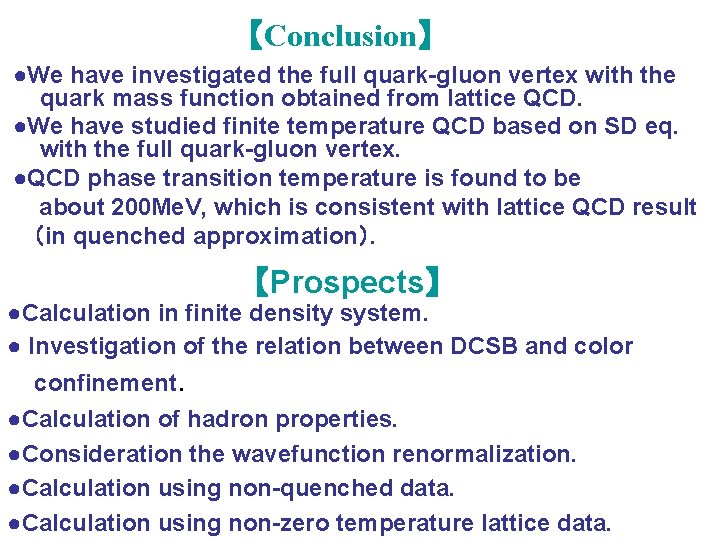
【Conclusion】 ●We have investigated the full quark-gluon vertex with the quark mass function obtained from lattice QCD. ●We have studied finite temperature QCD based on SD eq. with the full quark-gluon vertex. ●QCD phase transition temperature is found to be about 200 Me. V, which is consistent with lattice QCD result (in quenched approximation). 【Prospects】 ●Calculation in finite density system. ● Investigation of the relation between DCSB and color confinement. ●Calculation of hadron properties. ●Consideration the wavefunction renormalization. ●Calculation using non-quenched data. ●Calculation using non-zero temperature lattice data.
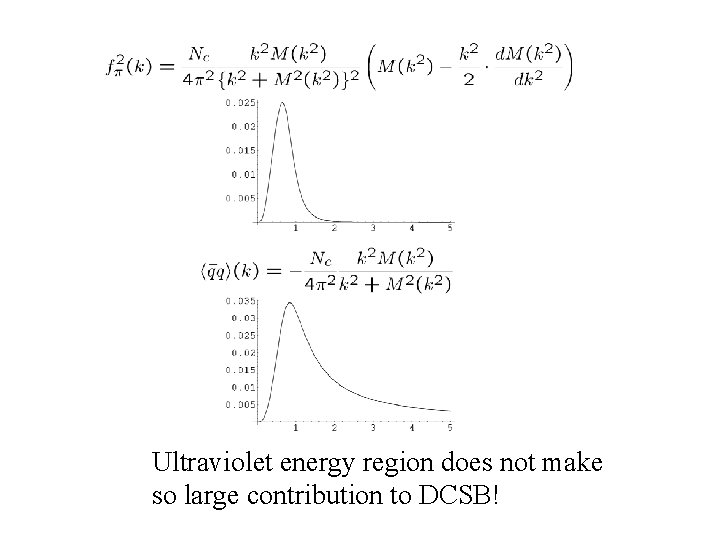
Ultraviolet energy region does not make so large contribution to DCSB!
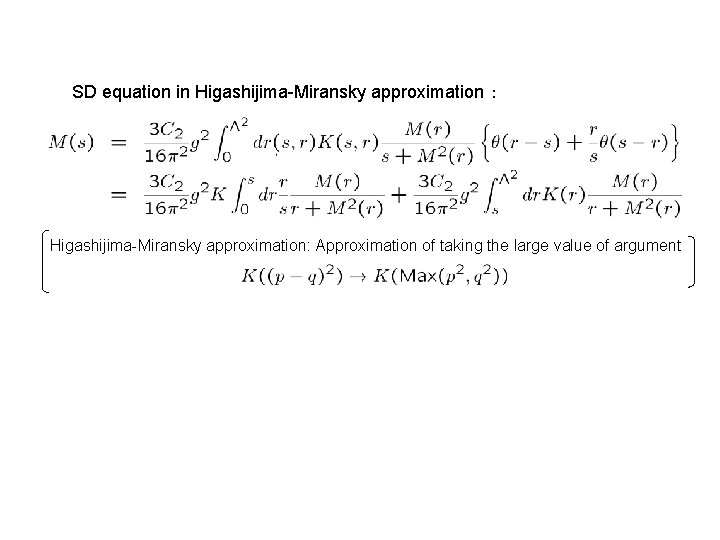
SD equation in Higashijima-Miransky approximation : Higashijima-Miransky approximation: Approximation of taking the large value of argument
- Slides: 20