
Hidden Markov Models Decoding Training Natural Language Processing
![Acoustic Model • 3 -state phone model for [m] – Use Hidden Markov Model](https://slidetodoc.com/presentation_image_h2/3f2cb5d57e648a904a98253f35d16ca4/image-5.jpg "Acoustic Model • 3 -state phone model for [m] – Use Hidden Markov Model")
- Slides: 21
Hidden Markov Models: Decoding & Training Natural Language Processing CMSC 35100 April 24, 2003
Agenda • Speech Recognition – Hidden Markov Models • Uncertain observations • Recognition: Viterbi, Stack/A* • Training the model: Baum-Welch
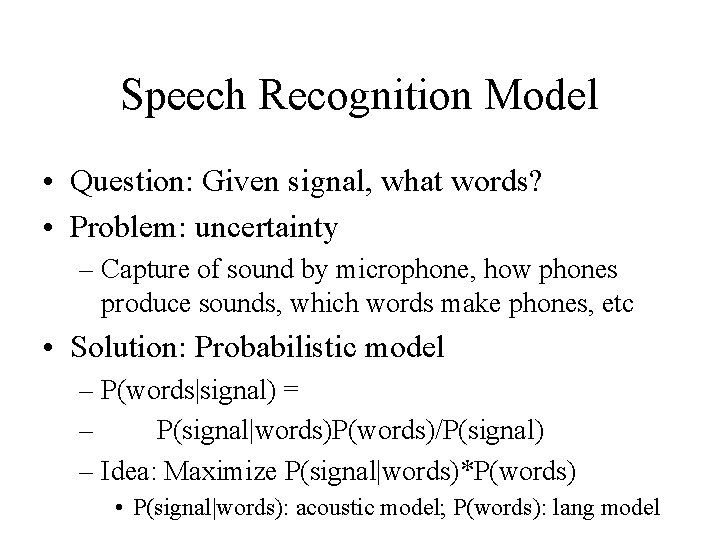
Speech Recognition Model • Question: Given signal, what words? • Problem: uncertainty – Capture of sound by microphone, how phones produce sounds, which words make phones, etc • Solution: Probabilistic model – P(words|signal) = – P(signal|words)P(words)/P(signal) – Idea: Maximize P(signal|words)*P(words) • P(signal|words): acoustic model; P(words): lang model
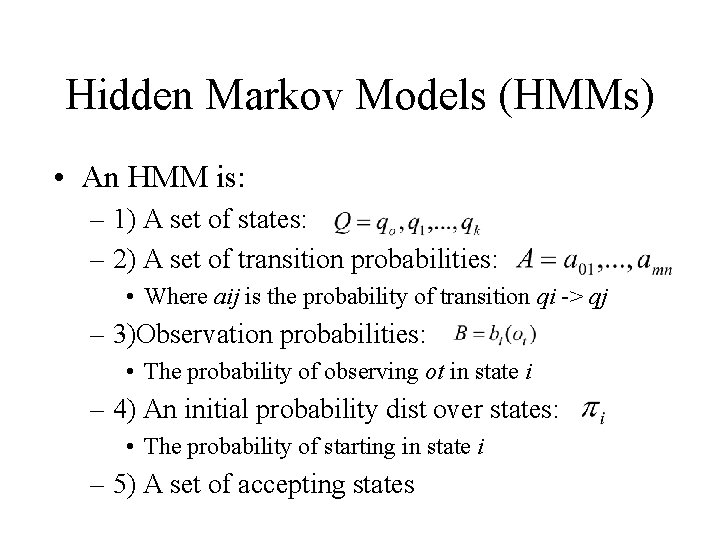
Hidden Markov Models (HMMs) • An HMM is: – 1) A set of states: – 2) A set of transition probabilities: • Where aij is the probability of transition qi -> qj – 3)Observation probabilities: • The probability of observing ot in state i – 4) An initial probability dist over states: • The probability of starting in state i – 5) A set of accepting states
Acoustic Model • 3 -state phone model for [m] – Use Hidden Markov Model (HMM) 0. 3 0. 9 0. 4 Transition probabilities Onset 0. 7 Mid 0. 1 End 0. 6 Final C 3: C 1: C 2: 0. 3 0. 5 0. 2 C 5: C 3: C 4: 0. 1 0. 2 0. 7 C 6: C 4: C 6: 0. 4 0. 1 0. 5 Observation probabilities – Probability of sequence: sum of prob of paths
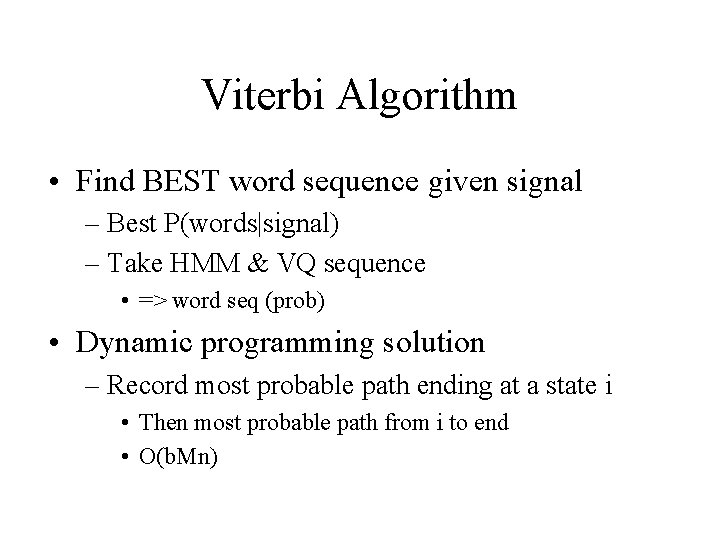
Viterbi Algorithm • Find BEST word sequence given signal – Best P(words|signal) – Take HMM & VQ sequence • => word seq (prob) • Dynamic programming solution – Record most probable path ending at a state i • Then most probable path from i to end • O(b. Mn)
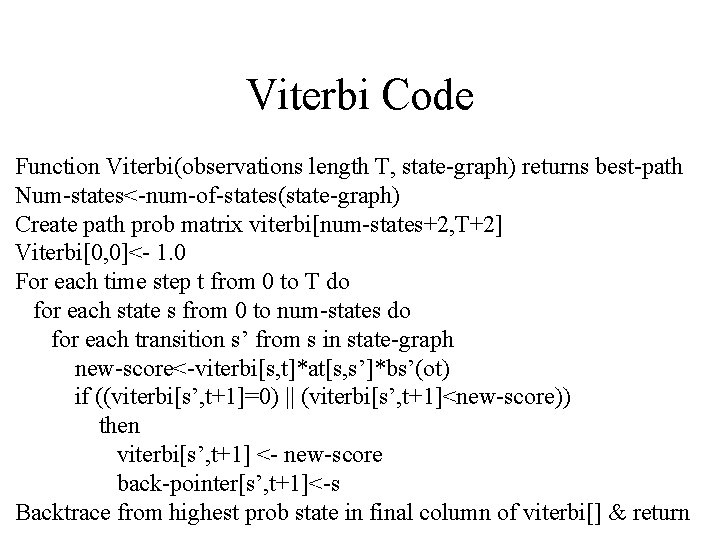
Viterbi Code Function Viterbi(observations length T, state-graph) returns best-path Num-states<-num-of-states(state-graph) Create path prob matrix viterbi[num-states+2, T+2] Viterbi[0, 0]<- 1. 0 For each time step t from 0 to T do for each state s from 0 to num-states do for each transition s’ from s in state-graph new-score<-viterbi[s, t]*at[s, s’]*bs’(ot) if ((viterbi[s’, t+1]=0) || (viterbi[s’, t+1]<new-score)) then viterbi[s’, t+1] <- new-score back-pointer[s’, t+1]<-s Backtrace from highest prob state in final column of viterbi[] & return
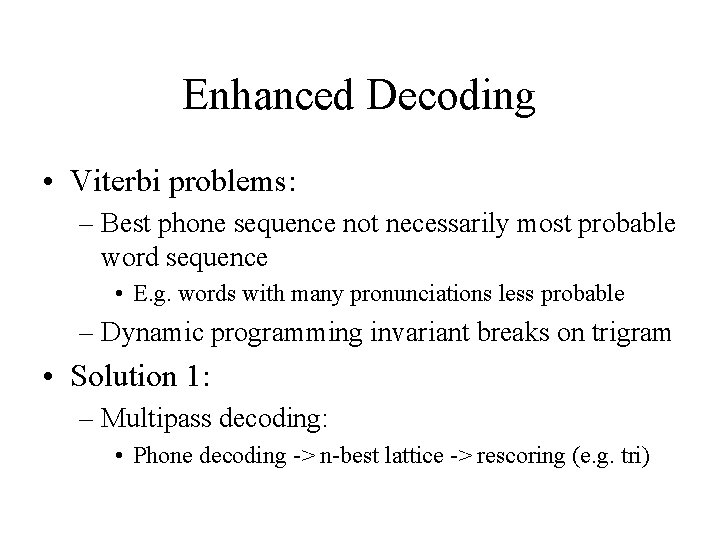
Enhanced Decoding • Viterbi problems: – Best phone sequence not necessarily most probable word sequence • E. g. words with many pronunciations less probable – Dynamic programming invariant breaks on trigram • Solution 1: – Multipass decoding: • Phone decoding -> n-best lattice -> rescoring (e. g. tri)
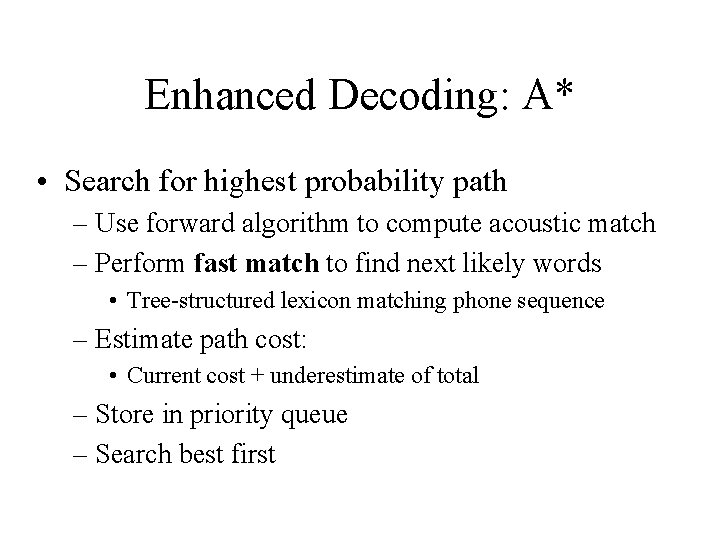
Enhanced Decoding: A* • Search for highest probability path – Use forward algorithm to compute acoustic match – Perform fast match to find next likely words • Tree-structured lexicon matching phone sequence – Estimate path cost: • Current cost + underestimate of total – Store in priority queue – Search best first
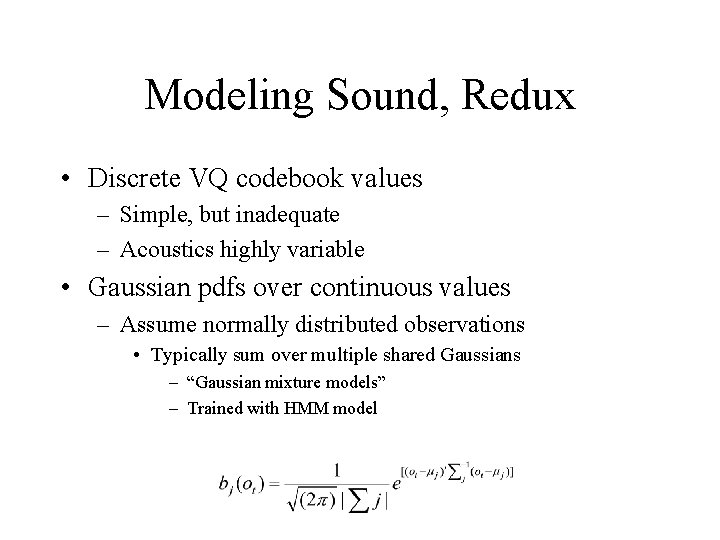
Modeling Sound, Redux • Discrete VQ codebook values – Simple, but inadequate – Acoustics highly variable • Gaussian pdfs over continuous values – Assume normally distributed observations • Typically sum over multiple shared Gaussians – “Gaussian mixture models” – Trained with HMM model
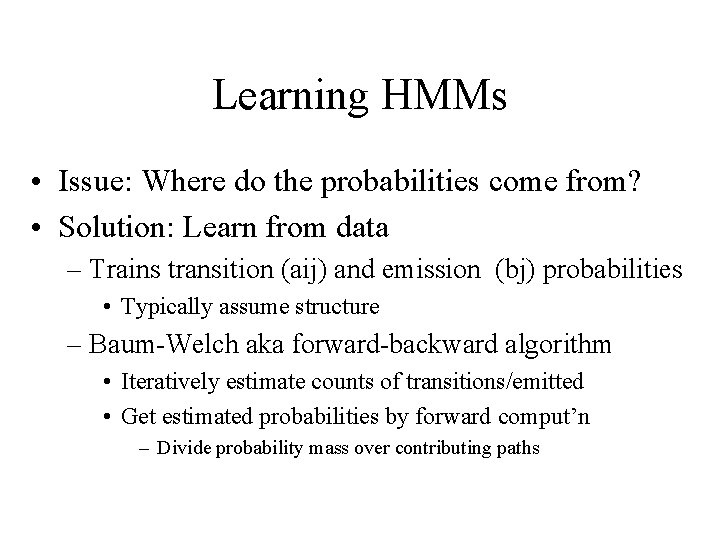
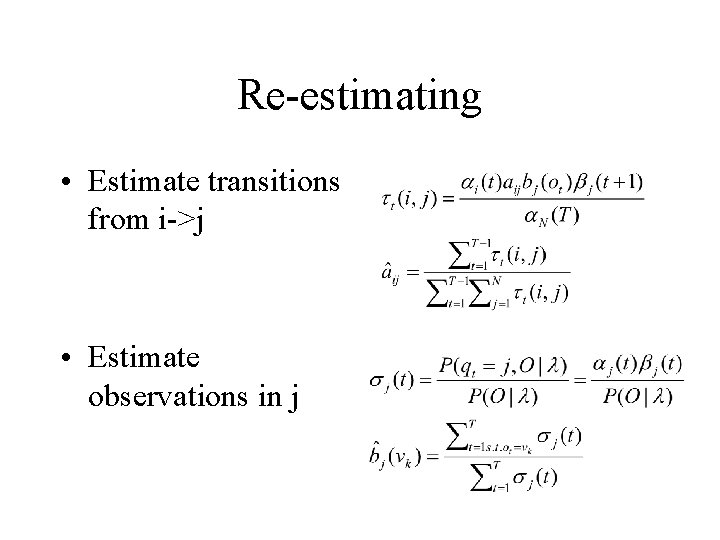
Learning HMMs • Issue: Where do the probabilities come from? • Solution: Learn from data – Trains transition (aij) and emission (bj) probabilities • Typically assume structure – Baum-Welch aka forward-backward algorithm • Iteratively estimate counts of transitions/emitted • Get estimated probabilities by forward comput’n – Divide probability mass over contributing paths
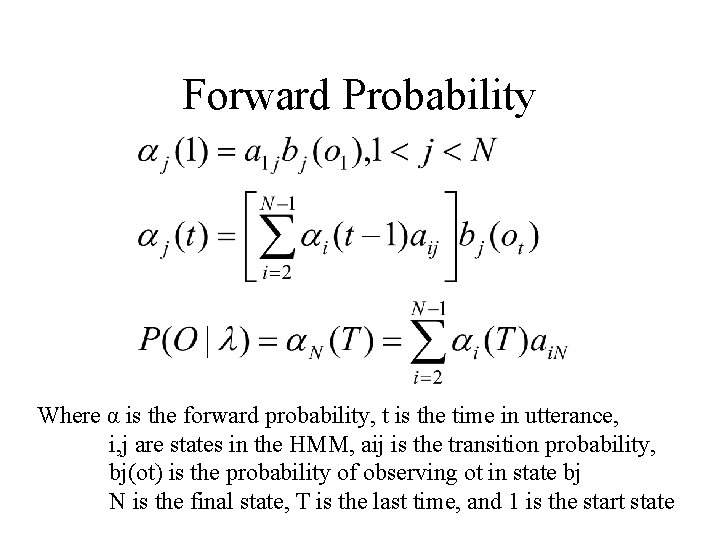
Forward Probability Where α is the forward probability, t is the time in utterance, i, j are states in the HMM, aij is the transition probability, bj(ot) is the probability of observing ot in state bj N is the final state, T is the last time, and 1 is the start state
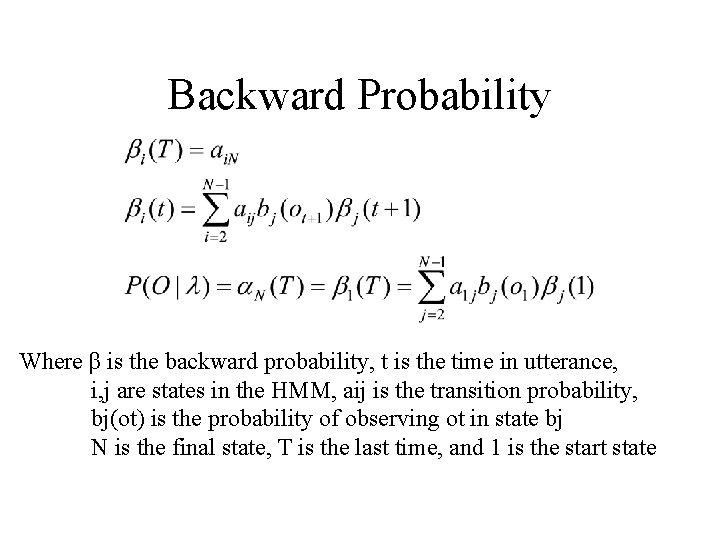
Backward Probability Where β is the backward probability, t is the time in utterance, i, j are states in the HMM, aij is the transition probability, bj(ot) is the probability of observing ot in state bj N is the final state, T is the last time, and 1 is the start state
Re-estimating • Estimate transitions from i->j • Estimate observations in j
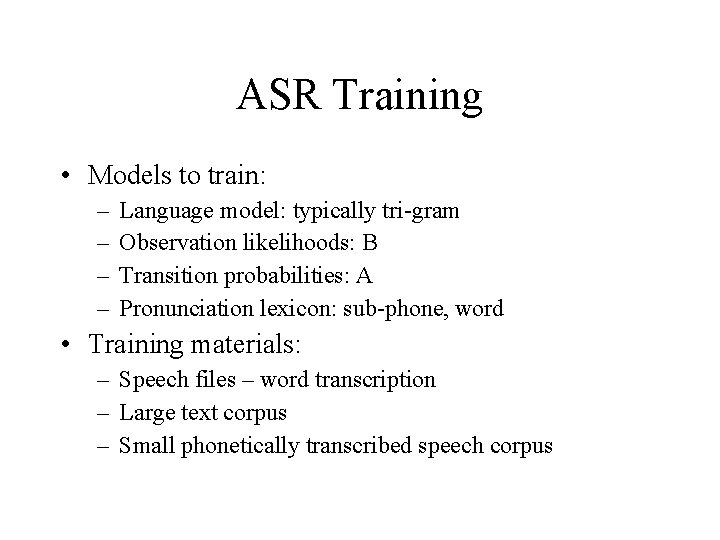
ASR Training • Models to train: – – Language model: typically tri-gram Observation likelihoods: B Transition probabilities: A Pronunciation lexicon: sub-phone, word • Training materials: – Speech files – word transcription – Large text corpus – Small phonetically transcribed speech corpus
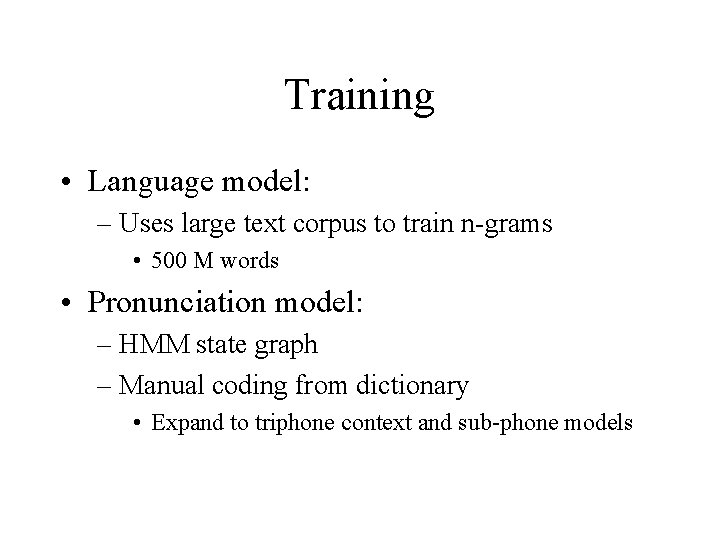
Training • Language model: – Uses large text corpus to train n-grams • 500 M words • Pronunciation model: – HMM state graph – Manual coding from dictionary • Expand to triphone context and sub-phone models
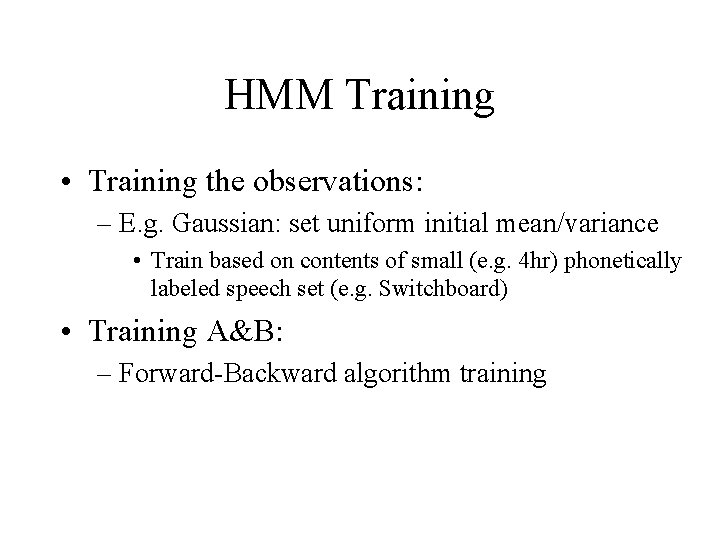
HMM Training • Training the observations: – E. g. Gaussian: set uniform initial mean/variance • Train based on contents of small (e. g. 4 hr) phonetically labeled speech set (e. g. Switchboard) • Training A&B: – Forward-Backward algorithm training
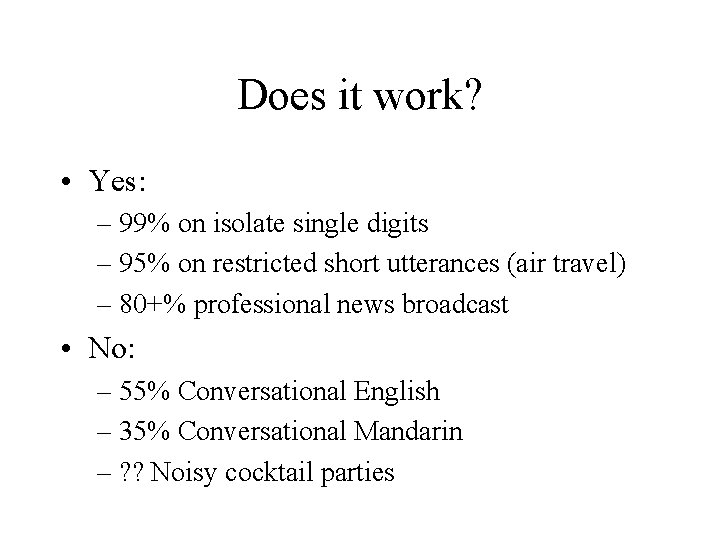
Does it work? • Yes: – 99% on isolate single digits – 95% on restricted short utterances (air travel) – 80+% professional news broadcast • No: – 55% Conversational English – 35% Conversational Mandarin – ? ? Noisy cocktail parties
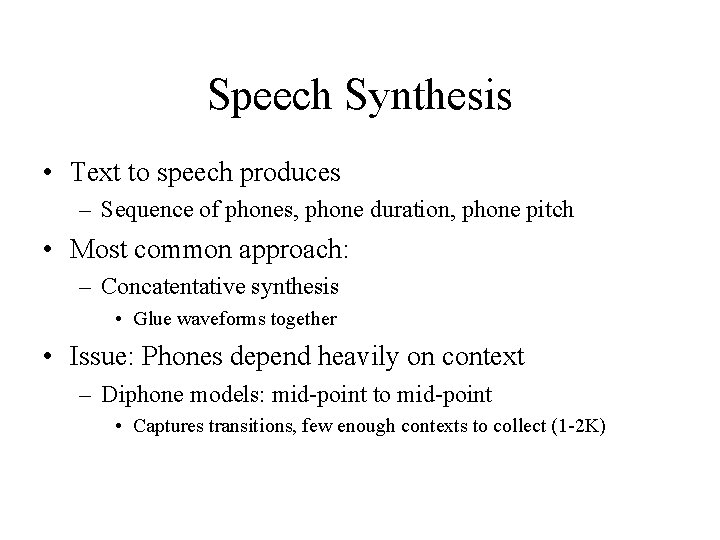
Speech Synthesis • Text to speech produces – Sequence of phones, phone duration, phone pitch • Most common approach: – Concatentative synthesis • Glue waveforms together • Issue: Phones depend heavily on context – Diphone models: mid-point to mid-point • Captures transitions, few enough contexts to collect (1 -2 K)
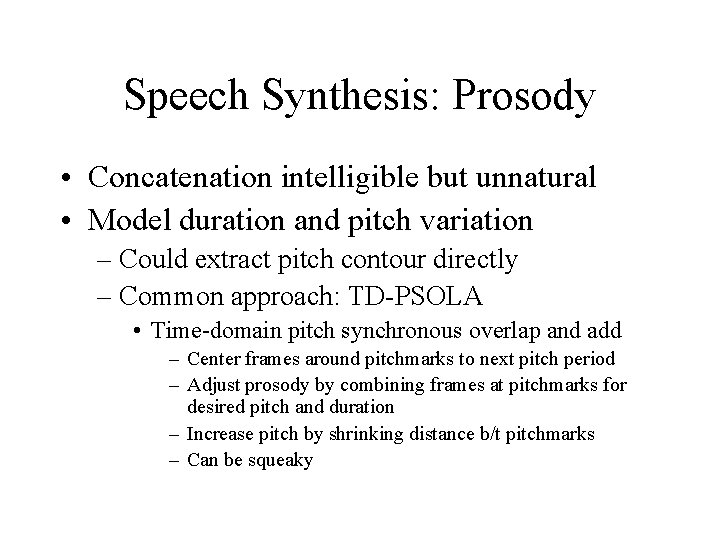
Speech Synthesis: Prosody • Concatenation intelligible but unnatural • Model duration and pitch variation – Could extract pitch contour directly – Common approach: TD-PSOLA • Time-domain pitch synchronous overlap and add – Center frames around pitchmarks to next pitch period – Adjust prosody by combining frames at pitchmarks for desired pitch and duration – Increase pitch by shrinking distance b/t pitchmarks – Can be squeaky
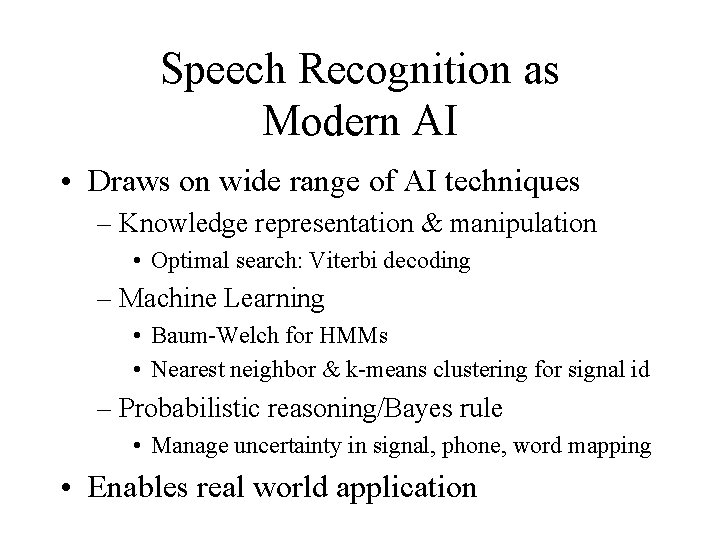
Speech Recognition as Modern AI • Draws on wide range of AI techniques – Knowledge representation & manipulation • Optimal search: Viterbi decoding – Machine Learning • Baum-Welch for HMMs • Nearest neighbor & k-means clustering for signal id – Probabilistic reasoning/Bayes rule • Manage uncertainty in signal, phone, word mapping • Enables real world application